Rural Development Class 12 Notes Sandeep Garg PDF are prepared for CBSE Class 12 Economics students. These notes include important questions, MCQs and revision material.
rural development sandeep garg pdf
rural development class 12 notes sandeep garg
rural development class 12 pdf
rural development class 12 pdf sandeep garg
sandeep garg indian economics class 12 pdf free download
MEANING OF RURAL DEVELOPMENT
Rural Development refers to the continuous and comprehensive socio-economic process that attempts to improve all aspects of rural life. In India, agriculture is the major source of livelihood in the rural sector, with more than two-third of Indian’s population depending on it. So, development in agriculture will contribute to the betterment of rural areas and rural people. The term rural development includes not only agricultural development, but it involves all those aspects, which improve quality of life of people. It aims at improving the economic and social conditions of people living in villages.
PROCESS OF RURAL DEVELOPMENT
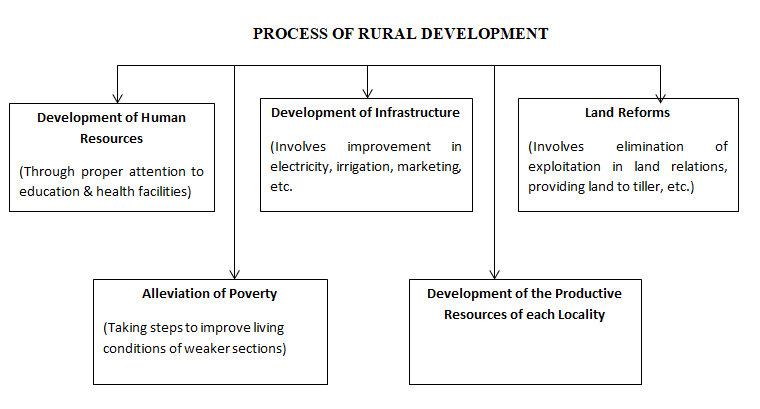
- Development of Human Resources – The quality of the human resource needs to be improved through the following measures:
Proper attention to literacy (specifically on female literacy), education and skill development.
2. Development of Infrastructure – It involves:
- Improvement in electricity, irrigation, credit, marketing and transport facilities.
- Better facilities for agriculture research and extension and information dissemination.
3. Land Reforms – It includes the following objectives:
- Elimination of exploitation in land relations;
- Actualization of the goal of ‘land to the tiller’;
- Increasing agricultural productivity and production. Agricultural productivity refer to output per hectare of land.
4. Alleviation of Poverty – As stated earlier, around 22% of the total population is still below the poverty line. So, there is a serious need to take serious steps to alleviate poverty and significantly improve the living conditions of weaker sections.
5. Development of the productive resources – Of Each locality to enhance opportunities for employment (particularly other than farming).
RURAL CREDIT
Growth of rural economy depends on timely infusion of capital, to realize higher productivity in agriculture and non-agriculture sectors. In agriculture, farmers are in strong need of credit due to the long time gap between crop sowing and realization of income. Farmers borrow from various sources to meet initial investment on seeds, fertilizers, implements and other family expenses such as marriage, death, religious ceremonies, etc. So, credit is one of the important factors contributing to agricultural production.
SOURCES OF RURAL CREDIT
SOURCES OF RURAL CREDIT
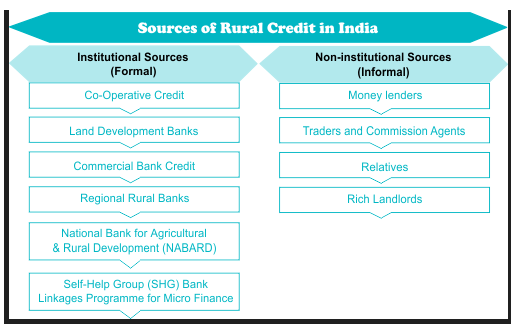
There are two sources, from which the farmers can raise loans:
- Non-Institutional Sources
- Institutional Sources
Non-Institutional Sources or Informal Sources
Non-institutional sources have been the traditional source of agricultural credit in India. They were the major source of credit at the time of independence. The major non-institutional sources are
- Moneylenders – From the very beginning, money lenders have been advancing a major share of farm credit. The peasants are exploited through exorbitant (very high) rates of interest. Quite frequently, their accounts are manipulated without their knowledge.
- Relatives – Cultivator borrow funds from their own relatives in times of crisis. These loan are a king of informal loans and carry no interest and are normally return after harvest.
- Traders and commission agents – They provide credit to the peasants for the mortgage of crops at high rates of interest, on a condition, that the crops will be sold to them at low prices.
- Rich Landlord – Small as well as marginal farmers and tenants, take loans from landlords, to meet their financial requirements. Landlords also charge high rates of interest on such loans and exploit the peasants, particularly small farmers and tenants.
Institutional Sources or Formal Sources
The various non-institutional sources are used to exploit small and marginal farmers by lending them credit at high interest rates and by manipulating the account to keep them in a debt-trap.
Some of the important institutional sources of agricultural credit and are
- Co-operative Credit – The primary objective of co-operatives is to liberate the Indian peasantry from the clutches of moneylenders and provide them with credit at low rates of interest.
- Land Development Bank – They provide credit to the farmers against the mortgage of their lands. Loans are provided for the permanent improvement of land, purchasing agricultural implements and repaying old debts.
- Commercial Bank Credit – Initially, commercial banks played a marginal role in advancing rural credit.
- Regional Rural Banks – They are opened up in those areas where there are no banking facilities.
- The Government – The loans provided by the government are known as taccavi loans and are lent during emergencies or distress, like famines, flood, etc. The rate of interest charged against such loans is as low as 6%.
- National Bank for Agriculture and Rural Development (NABARD) – It is the Apex Bank which coordinates the functioning of different financial institutions, working for expansion of rural credit.
- Self- Help Group (SHG) Bank Linkage Programme for Micro Finance – SHG has emerged as the major micro finance programme in the country in recent years.
- Their focus is largely on those rural poor, with no sustainable access to the formal banking system.
- So, their target groups comprise small and marginal farmers, agricultural and non-agricultural laborers, artisans, etc.
CRITICAL APPRAISAL OF RURAL BANKING
Rapid expansion of the banking system had a positive effect on rural farm and non-farm output, income and employment. After the green revolution, credit facilities helped farmers to obtain a variety of loans to meet their production needs.
Benefits of Organized Agricultural Credit System
Rural Banking System has come up with much support for the farmers and has led to rural development, directly or indirectly. An organized or well-structured agricultural credit system is very essential for the rural development as it ensures:
- Availability of adequate credit to the farmers.
- Loans to rural population for productive needs at cheaper rates of interest from formal credit sources.
- Increase in the rural farm and non-farm output, income and employment in rural areas.
Problems Faced in Rural Banking
Some of the problems faced in rural banking are:
- Insufficiency – The growth of rural economy depends primarily on the infusion of capital. Farmers need funds due to their long gestation period.
- Dependence on Informal Credit System – Due to the absence of collateral, many small and marginal farmers and other rural poor do not have access to a formal banking system.
- Inadequate Coverage of Institutional Sources – The institutional credit arrangement continues to be inadequate, as it has failed to cover the entire rural farmers of the country.
- Inadequate Amount of Sanction – The amount of loan sanctioned to the farmers is also inadequate. As a result, farmers often divert such loans for unproductive purposes, diluting the very purpose of such loans.
- Less Attention to poor or Marginal Farmers – Less attention has been given to the credit requirements of needy (small and marginal) farmers. Due to a lack of collateral (i.e. something to be pledged as security for repayment of a loan), such needy farmers are generally rejected for credit from Banks and other Institutional Sources.
rural development class 12 notes sandeep garg
AGRICULTURAL MARKET SYSTEM
Rural people not only face problems with regard to finance, but also encounter difficulties in marketing their goods. Thus, issue of ‘Agricultural Marketing’ needs urgent attention in the scheme of securing rapid rural development.
Meaning of Agricultural Marketing
Agricultural marketing is a process that involves assembling, storage, processing, transportation, packaging, grading and distribution of different agricultural commodities across the country.
Problem Faced by Farmers
- Manipulations by Big Traders – Prior to independence, farmers suffered from faulty weighing and manipulation of accounts while selling their produce to traders.
- Lack of Market Information – Farmers were often forced to sell at low prices due to lack of required information on prices prevailing in markets.
- Lack of Storage Facilities – they also did not have proper storage facilities to store their produce for later sale at a better price. Even today, more than 10% of goods produced in farms are wasted due to a lack of storage.
Benefits of Organized Agricultural Marketing System
An organized or well-structured agricultural marketing system helps the farmers to increase their income because of following reasons:
- It gives more focus on those rural poor, who have no sustainable access to the formal banking system.
- Orderly and transparent marketing conditions facilitate sale of farmers’ produce.
- Provision of better infrastructural facilities like roads, railways, warehouses, godowns, cold storages and processing units, etc., prevent distress sales.
Measures to Improve Agricultural Marketing
After Independence, the Government of India adopted the following measures to improve the system of agricultural marketing:
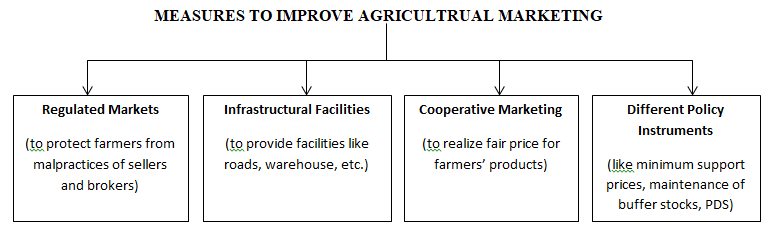
- Regulated Markets – The first measure was regulation of markets, to create orderly and transparent marketing conditions. Regulated markets have been organized with a view to protect the farmers from the malpractices of sellers and brokers. This policy benefited farmers as well as consumers.
- Infrastructural Facilities – The Government aims to provide physical infrastructure facilities like roads, railways, warehouses, go downs, cold storages and processing units. The current infrastructure facilities are quite inadequate to meet the growing demand and need improvement.
- Cooperative Marketing – The aim of cooperative marketing is to realize fair prices for farmers’ products. Cooperative Marketing is a system in which the farmers pool their marketable surplus of crops and distribute the sale proceeds on the basis of each individual share.
- Different Policy Instruments – In order to protect the farmers, the government has initiated the following policies:
- Minimum Support Price (MSP)
- Maintenance of Buffer Stocks
- Public Distribution System (PDS)
Emerging Alternate Marketing Channels
- Origin of Farmers Market – Farmers can increase their incomes, if they directly sell their produce to consumers. As a result, the concept of “Farmers Market” was started to give a boost to the small farmers by providing them direct access to the consumers and eliminating the middlemen. Some examples of these channels are:
- Apni mandi in Punjab, Haryana and Rajasthan;
- Hadaspar Mandi in Pune;
- Rythu Bazars in Andhra Pradesh and Telangana; and
- Uzhavar Sandies (farmers market in Tamil Nadu).
2. Alliance with National and Multinational Companies – Several national and multinational fast food chains are increasingly entering into contracts/alliances with farmers.
- They encourage the farmers to cultivate farm products (vegetables, fruits, etc.) of the desired quality.
- The provide them with not only seeds and other inputs, but also assure procurement of the produce at pre-decided Prices;
DIVERSIFICATION OF AGRICULTURAL ACTIVITIES
- Meaning1 of Agricultural Diversification Agricultural diversification relates to changes in copping into of work from from agriculture to other allied activities.
Reason for Diversification
Agriculture plays a very important role in the economic development. However, the vast majority of rural people work on land and there is greater risk in depending only on agriculture.
Benefits of Diversification
Agricultural Diversification helps in increasing farmers’ income as:
- There is a greater risk in depending exclusively on farming for livelihood. Diversification reduces the risk from the agriculture sector. It also provides sustainable livelihood options to the rural people.
- Expansion into other sectors provides supplementary gainful employment during the off-season period.
Types of Diversification
Diversification includes two aspects:
- Diversification of Crop Production
- Diversification of Production Activities
Diversification of Crop Production
It involves a shift from single-cropping system to multi-cropping system.
- Diversification involves a shift in cropping pattern from food grains cash crops. Basically, the main aim is to promote shift from subsistence farming to commercial farming.
- In India, agriculture is still dominated by subsistence farming and farmers give prime importance to cereals like wheat, rice, maize, etc., in the cropping system.
Diversification of Productive Activities
As agriculture is already overcrowded, a major proportion of the increasing labour force must find alternate employment opportunities in other non-farm sectors.
- It would provide alternative avenues of sustainable livelihood and would raise the level of income.
- Non-farm Activities have several segments. Some segments of non-farm activities possess dynamic linkages that permit healthy growth, while others are in subsistence, low productivity propositions.
NON-FARM AREAS OF EMPLOYMENTS
- Animal Husbandry – Animal Husbandry (or livestock farming) is that branch of agriculture, which is concerned with the breeding, rearing and caring of farm animals.
- Livestock is defined as domesticated animals raised (generally in an agricultural set-up) to produce labour and commodities such as cattle, goats, etc.
- Under livestock farming, cattle, goats and fowls (duck, goose, etc.) are the widely held species.
- India owns one of the largest livestock populations in the world.
- Silver Revolution: The Silver Revolution is related to the immense growth of egg production in India by using advanced methods and technologies to enhance efficient growth in poultry farming.
2. Dairying – Dairying is that branch of agriculture which involves breeding, raising and utilization of dairy animals for the production of milk and the various dairy products processed from it.
- Dairying is the business of producing, storing and distributing milk and its products.
- Operation Flood (or White Revolution) was started by National Dairy development Board (NDDB) in 1970 under the expect guidance of then chairman, Dr. Varghese Kurien. The objective of this programme was to create a nationwide mild grid. The movement for a massive rise in milk production in India is termed as White Revolution.
3. Fisheries – Fisheries refer to the occupation devoted to the catching, processing or selling of fish and other aquatic animals. Fisheries sector plays an important role in the socio-economic development of the country.
Important points About Fishing
- Fishing community regards water body as ‘Mother’ – The water bodies (sea, oceans, rivers, lakes, natural aquatic ponds, streams) are considered as ‘mother’ or ‘provider’ as they provide a life-giving source to the fishing community.
- Volume of Fish Production – Presently, fish production from inland sources contributes about 65% to the total fish production and the balance 35% comes from the marine sector (sea and oceans).
- Share of Fishing in GDP – The total fish production accounts for 0.9% of the total GDP. In India, West Bengal, Andhra Pradesh, Kerala, Gujarat, Maharashtra and Tamil Nadu are major fish producing states.
- Women Participation in Fishing – Although women are not involved in active fishing, still, 60% of the workforce in export marketing and 40% in internal marketing are women.
- Problems faced in Fishing – A large share of fish worker families are poor. Some of the major problems faced by these communities include:
- Widespread Underemployment;
- Low per capita earnings;
Blue Revolution – Blue Revolution also called as Neel Kranti Mission, was launched in India in 1985-1995 during the 7th Five Year Plan.
4. Horticulture – Horticulture refers to the science or art of cultivating fruits, vegetables, tuber crops, flowers, medicinal and aromatic plants, spices and plantation crops. Horticulture plays a vital role in providing food and nutrition to the rural population.
- India has adopted horticulture as it is blessed with varying climates and soil conditions.
- It is important sector for potential diversification and value addition in agriculture.
Important Points About Horticulture
- Contribution – Horticulture sector contributes nearly one-third of the value of agriculture output and 6% of Gross Domestic Product of India.
- Share in World’s Production – India has emerged as a world leader in producing a variety of fruits, like mangoes, bananas, coconuts, cashew nuts and a number of spices. Presently, India is the second largest producer of both fruits and vegetables in the world.
- Improvement in Economic Condition – Horticulture has improved economic condition of many farmers and has become a means of improving livelihood for many unprivileged classed too.
- Golden Revolution – Golden Revolution refers to the period in which there was a tremendous rise in the production of horticultural products like fruits, vegetables, etc.
- Great Scope for Women Employment – Flower harvesting, nursery maintenance, hybrid seed production and tissue culture, propagation of fruits and flowers and food processing are highly remunerative employment options for women in rural areas.
5. Information Technology – Information Technology (IT) refers to that branch of engineering that deals with the use of computers and telecommunications to retrieve and store and transmit information.
Important points about information technology
- Through appropriate information and software tools, government has been able to predict areas of food insecurity and vulnerability, to prevent or reduce the likelihood of an emergency.
- It also has a positive impact on the agriculture sector as it circulates information regarding emerging technologies and their applications, prices, weather and soil conditions for growing different crops, etc.
SUSTAINABLE DEVELOPMENT AND ORGANIC FARMING
Meaning
Organic farming is a form of agriculture that relies on techniques such as crop rotation, green manure, compost and biological pest control.
- Organic farming is the process of producing safe and healthy food, without leaving any adverse impact on the environment.
- In short, organic agriculture is a whole system of farming that restores, maintains and enhances the ecological balance.
- There is and increasing demand for organically grown food, to enhance food safety throughout the world.
Benefits of Organic Farming
Organic Farming is beneficial because of following reasons:
- Economical farming – Organic Farming offers a means to substitute costlier agricultural inputs (such as HYV seeds, chemical fertilizers, pesticides, etc.) with locally produced cheaper organic inputs.
- Generates Income through Exports – It generates income international exports as demand for organically grown crops is on a rise.
- Provides Healthy Food – Provides healthy food as organically grown food has mere nutritional value than food grown through chemical farming
- Source of Employment – Organic farming generates more employment opportunities as it requires more labour input than conventional farming. Due to this reason, India has comparative advantage in organic farming because of abundance of labour.
- Safety of Environment – The produce of organic farming is pesticide-free and is produced in an environmentally sustainable way.
Challenges before Organic Farming
Organic Farming suffers from following drawbacks:
- Less Popular – Organic farming needs to be popularized by creating awareness and willingness on the part of farmers to adopt new technology. There is a serious need for an appropriate agriculture policy to promote organic farming.
- Lack of Infrastructure and Marketing Facilities – Organic farming faces problems of inadequate infrastructure and marketing facilities.
- Low Yield – Organic farming has a lesser yield in the initial years as compared to modern agricultural farming. As a result, small and marginal farmers find it difficult to adapt to large-scale production.
- Shorter Food Life – Organic produce has a shorter shelf life as compared to sprayed produce.
- Limited Choice of Crops – The choice in production of off-season crops is quite limited in organic farming.
EVALUATOIN OF RURAL DEVELOPMENT
The rural sector will continue to remain backward until and unless some spectacular changes occur. Some of the changes which need to be taken for the development of the rural sector are outlined below:
- Stress on Diversification – There is a need to make rural areas more vibrant through diversification into dairying, poultry, fisheries, vegetables and fruits.
- Rural and Urban Linkage – Efforts should be made to link up the rural production centers with the urban and foreign (export) markets to realise higher on investment for the products.
- Better facilities – Proper efforts should be made to develop:
- Infrastructure elements like credit and marketing;
- State agricultural departments;
- Farmer-friendly agricultural policies;
- Constant appraisal and dialogue between farmers groups.
4. More emphasis on Sustainable Development – There is a need to invent or procure alternate sets of eco-friendly technologies that lead to sustainable development in different circumstances.
Short Answer Type Questions
- Explain any two objectives behind providing more and more institutional credit to farmers.
Answer:
The main objectives of institutional credit are:
- To provide farmers with timely and affordable loans.
- To protect farmers from the exploitation of moneylenders charging high rates of interest.
2. Discuss the non-institutional sources of rural credit.
Answer:
Non-institutional sources of rural credit include:
- Moneylenders
- Traders and Commission Agents
- Landlords
- Relatives and Friends
3. Discuss the role of National Bank for Agricultural and Rural Development (NABARD) in rural credit.
Answer:
NABARD is the apex institution for agricultural and rural finance. It:
- Provides refinance to cooperative banks and regional rural banks.
- Promotes agricultural and rural development.
- Supports Self-Help Groups (SHGs) and rural development programmes.
4. What is agricultural marketing? What are the problems faced by farmers in marketing of their agricultural produce?
Answer:
Agricultural marketing is the process of moving agricultural products from farmers to consumers.
Problems faced by farmers:
- Lack of storage facilities
- Poor transport
- Exploitation by middlemen
- Low prices for produce
- Lack of market information
5. Discuss the various policy instruments initiated by the government to protect the farmers in marketing of their agricultural produce.
Answer:
The government protects farmers through:
- Minimum Support Price (MSP)
- Procurement by the Food Corporation of India (FCI)
- Regulated markets (Mandis)
- Warehousing and cold storage facilities
- e-NAM (National Agricultural Market)
6. What is meant by diversification of crop production?
Answer:
Diversification of crop production means shifting from the cultivation of a single crop to the cultivation of a variety of crops. It helps farmers increase their income, reduce the risk of crop failure and make better use of available resources.
7. India ranks first in the world in milk production due to the successful implementation of Operation Flood. Defend or refute.
Answer:
The statement is correct. Operation Flood played a significant role in increasing milk production by developing dairy cooperatives, improving milk collection and providing better marketing facilities. As a result, India became the largest producer of milk in the world.
8. Make a critical evaluation of livestock farming.
Answer:
Livestock farming provides regular income and employment to rural households. It also supplies milk, eggs, meat and raw materials to industries. However, low productivity, poor breed quality and inadequate veterinary services remain major challenges.
9. “Over the past few year, India has witnessed a shift from traditional convenstional farming to natural/organic farming.” Discuss briefly any two reasons behind this shift towards organic produce.
Answer:
The shift towards organic farming has taken place because excessive use of chemical fertilizers and pesticides has damaged soil fertility and the environment. At the same time, growing awareness about health and the increasing demand for chemical-free food have encouraged farmers to adopt organic farming.
10. State any three challenges facing rural development in India.
Answer:
Rural development in India faces several challenges such as unemployment, inadequate infrastructure and lack of institutional credit. These problems reduce agricultural productivity and slow down the overall development of rural areas.
11. Discuss any two problems being faced in the process of rural banking in India.
Answer:
Rural banking in India faces problems such as a high level of loan defaults and limited banking facilities in remote villages. These difficulties reduce the effectiveness of institutional credit and affect rural development.
12. Critically evaluate the role of rural banking system in the process of rural development in India.
Answer:
Rural banking system plays an important role in rural development by providing institutional credit to farmers and rural people.
Role:
- It provides cheap and easy credit to farmers.
- It reduces the dependence on moneylenders.
- It promotes agricultural production by financing inputs and technology.
- It encourages rural employment through loans for non-farm activities.
Limitations:
- Lack of adequate credit supply in some areas.
- Complex procedures and delay in loan approval.
13. “Organic Farming is the need of the hour to promote sustainable development but, has its own limitation.” Elaborate any two advantages and limitations each of organic farming in the light of the above statement.
Answer:
Organic farming is a method of farming that uses natural inputs instead of chemical fertilisers and pesticides.
Advantages:
- It improves soil fertility and protects the environment.
- It provides chemical-free and healthy food products.
Limitations:
- Initial production is generally lower than conventional farming.
- It requires more labour and has higher certification costs.
14. “Recently the Government of India has taken numerous steps towards increasing the farmer’s income through agricultural diversification.” In light of the above statement, explain any two advantages of diversification in agriculture.
Answer:
Agricultural diversification means shifting from only crop production to other activities like dairy, fisheries and horticulture.
Advantages:
- It increases farmers’ income by providing multiple sources of earnings.
- It reduces risk caused by crop failure and creates employment opportunities.
15. Elaborate how a well-structural ‘Agricultural Marketing System’ helps the farmers to increase their income.
Answer:
An efficient agricultural marketing system helps farmers to get better returns from their produce.
Benefits:
- It provides fair prices through regulated markets and MSP.
- It reduces exploitation by middlemen.
- Storage and transport facilities prevent distress sale.
- Market information helps farmers to sell at the right time.
16. Discuss briefly, why agricultural diversification is essential for sustainable livelihoods.
Answer:
Agricultural diversification is essential because it provides alternative sources of income and employment.
Importance:
- It reduces dependence on a single crop.
- It provides regular income throughout the year.
- It reduces risks related to climate and crop failure.
- It promotes sustainable use of resources.
17. “Self-Help Groups provide stimulus for instituonalised lending, employment generation and women empowerment in the rural areas.” Justify the given statement with valid explanation.
Answer:
Self-Help Groups (SHGs) are small voluntary groups that encourage savings and provide credit facilities to rural people.
Role of SHGs:
- SHGs promote institutional lending by connecting rural people with banks.
- They generate employment through small businesses and self-employment activities.
- They empower women by increasing their income and participation in decision-making.
18. How did horticulture encourage rural development in India?
Answer:
Horticulture includes the cultivation of fruits, vegetables, flowers and medicinal plants.
Contribution to rural development:
- It provides employment opportunities throughout the year.
- It increases farmers’ income through high-value crops.
- It promotes exports and improves the standard of living of rural people.
19. Explain the role of non-farm employment in promoting rural diversification.
Answer:
Non-farm employment refers to activities other than agriculture, such as handicrafts, small industries, transport and services.
Role:
- It provides additional sources of income to rural households.
- It reduces dependence on agriculture.
- It creates employment opportunities and reduces rural unemployment.
20. “Recently, the Government of India launched Jan-Dhan Yojana.” In the light of the given statement, discuss briefly the objectives of this scheme.
Answer:
Pradhan Mantri Jan-Dhan Yojana (PMJDY) was launched to provide banking facilities to all sections of society.
Objectives:
- To provide a bank account to every household.
- To promote financial inclusion in rural and poor areas.
- To provide access to insurance, pension and direct transfer of government benefits.
21. ‘India can transform itself knowledge-based economy by using information technology.’ Justify the given statement.
Answer:
Information Technology (IT) plays an important role in developing a knowledge-based economy.
Reasons:
- IT improves access to information and education.
- It creates employment opportunities in the service sector.
- It increases productivity and promotes innovation.
- It helps in the growth of industries like software and digital services.
Long Answer Type Questions
- Briefly discuss the process of rural development.
Answer:
The process of rural development includes:
- Development of agriculture: Improvement in agricultural productivity through better technology, irrigation facilities, quality seeds and credit availability.
- Provision of rural credit: Institutional sources of credit help farmers and rural people to meet their financial requirements.
- Development of infrastructure: Roads, electricity, education, healthcare and communication facilities are necessary for rural progress.
- Generation of employment: Promotion of non-farm activities like handicrafts, small industries and services creates employment opportunities.
- Improvement in education and health: Better education and healthcare facilities improve the quality of life of rural people.
2. Discuss the various institutional sources of rural credit.
Answer:
Institutional sources provide organised and reliable credit facilities to rural people. The major sources are:
- Commercial Banks: They provide loans to farmers for agricultural and allied activities.
- Co-operative Credit Societies: These societies provide short-term and medium-term loans to farmers at reasonable interest rates.
- Regional Rural Banks (RRBs): RRBs were established to provide credit facilities to small and marginal farmers and rural workers.
- NABARD: NABARD provides financial support and guidance to rural financial institutions.
- Self-Help Groups (SHGs): SHGs provide small loans to members and promote savings and financial inclusion.
3. Discuss the “Self-Help Group Bank Linkages Programme.”
Answer:
The Self-Help Group Bank Linkage Programme was introduced to connect rural Self-Help Groups with formal banking institutions.
Main features:
- SHGs encourage regular savings among members.
- Banks provide loans to SHGs without requiring heavy collateral security.
- It promotes financial inclusion among poor rural households.
- It helps in generating employment through small economic activities.
- It has played an important role in empowering rural women.
4. Discuss the various problems being faced in the process of rural banking.
Answer:
Although rural banking has expanded significantly, it faces several problems:
- Limited availability of credit: Many small farmers still do not get adequate institutional credit.
- Regional imbalance: Banking facilities are not equally available in all rural areas.
- Complex procedures: Loan documentation and formalities often discourage poor farmers.
- Low repayment capacity: Small farmers may face difficulties in repaying loans due to uncertain agricultural income.
- Dependence on non-institutional sources: Many farmers still depend on moneylenders due to easy availability of credit.
5. Why is agricultural diversification required? State the benefits of diversification. What are the two types of diversification?
Answer:
Agricultural diversification means shifting from traditional crop production to other agricultural and non-agricultural activities.
Need for agricultural diversification:
- It reduces the risk of dependence on a single crop.
- It provides additional sources of income to farmers.
- It generates employment opportunities in rural areas.
- It promotes sustainable livelihoods.
Benefits of diversification:
- Increase in farmers’ income.
- Better utilisation of resources.
- Reduction in rural unemployment.
- Improvement in standard of living.
Types of diversification:
- Diversification of crop production:
Growing different types of crops instead of depending on a single crop. - Diversification of productive activities:
Adoption of allied activities like dairy, fisheries, poultry and horticulture.
6. Briefly discuss the various measured adopted by the Government of India to improve the system of agricultural marketing.
Answer: Agricultural marketing refers to the process through which farm products reach from producers to consumers. The Government of India has taken various measures to improve agricultural marketing.
- Regulated Markets: The government established regulated markets to protect farmers from exploitation by middlemen and ensure fair prices.
- Cooperative Marketing: Cooperative marketing societies help farmers in selling their produce collectively and getting better prices.
- Provision of Storage Facilities: Warehouses and cold storage facilities help farmers store their produce and avoid distress sale.
- Minimum Support Price (MSP): The government announces MSP for major crops to protect farmers from a fall in market prices.
- Agricultural Produce Market Committees (APMCs): APMCs provide organised markets where farmers can sell their produce.
- e-NAM (National Agriculture Market): It provides an online platform for farmers to access wider markets and better prices.
7. Briefly discuss the “Animal Husbandry” and “Dairyign”.
Answer:
Animal Husbandry refers to the scientific management and breeding of livestock such as cattle, sheep, goats and poultry.
Importance of Animal Husbandry:
- It provides employment and additional income to rural households.
- It supplies milk, meat, eggs and other useful products.
- It supports small and marginal farmers.
Dairying refers to the production and marketing of milk and milk products.
Importance of Dairying:
- It provides regular income throughout the year.
- It generates employment opportunities, especially for women.
- It improves the nutritional status of rural people.
8. Fisheries have become an important non-farm area of employment.” Comment.
Answer:
Fisheries include the production of fish through marine and inland sources. It has emerged as an important non-farm activity in rural areas.
Importance of Fisheries:
- It provides employment to fishermen and rural workers.
- It increases income opportunities for rural households.
- It contributes to food security by providing a rich source of protein.
- It promotes exports and earns foreign exchange.
- It supports diversification of rural economic activities.
9. “Horticulture is an important sector for potential diversification and value addition in agriculture.” Comment.
Answer:
Horticulture refers to the cultivation of fruits, vegetables, flowers and medicinal plants. It plays an important role in agricultural diversification.
Importance of Horticulture:
- It provides higher income compared to traditional crops.
- It generates employment opportunities in rural areas.
- It promotes value addition through food processing industries.
- It increases export opportunities for agricultural products.
- It helps in better utilisation of land resources.
10. Information Technology (IT) is playing and important role in acting as a source of sustainable living in rural areas. Elucidate.
Answer:
Information Technology has become an important tool for improving the quality of life and income opportunities in rural areas.
Role of IT in rural development:
- It provides information about weather, market prices and modern farming techniques.
- It helps farmers make better production and marketing decisions.
- It promotes online banking and financial inclusion.
- It creates employment opportunities through IT-based services.
- It improves access to education and healthcare facilities.
11. What is meant by organic farming? Discuss its benefits.
Answer:
Organic farming is a system of farming that uses natural inputs like organic manure, compost and bio-fertilisers instead of chemical fertilisers and pesticides.
Benefits of Organic Farming:
- Environmental Protection: It reduces soil and water pollution and maintains ecological balance.
- Improves Soil Fertility: Organic methods help in maintaining the quality of soil.
- Healthy Food Production: It produces chemical-free and safe food products.
- Sustainable Development: It helps in conserving natural resources for future generations.
- Export Potential: Organic products have increasing demand in domestic and international markets.
12. Discuss the various challenges before organic farming.
Answer: Organic farming is an environment-friendly method of farming that uses natural inputs instead of chemical fertilisers and pesticides. Although it has many benefits, it faces certain challenges.
- Lower Productivity: The production from organic farming is generally lower in the initial years as compared to conventional farming.
- High Cost of Production: Organic inputs like organic manure and bio-fertilisers are costly and require more labour.
- Lack of Awareness: Many farmers are not fully aware of organic farming techniques and their benefits.
- Marketing Problems: Farmers face difficulties in getting proper markets and fair prices for organic products.
- Certification Issues: The process of organic certification is expensive and time-consuming for small farmers.
13. Make a critical evaluation of rural development.
Answer:
Rural development refers to the overall improvement in the economic and social conditions of rural people. It aims at increasing income, employment opportunities and improving the quality of life.
Achievements of Rural Development:
- Increase in Agricultural Growth: Improvement in technology, irrigation and credit facilities has increased agricultural production.
- Development of Rural Infrastructure: Expansion of roads, electricity, education and healthcare facilities has improved rural life.
- Employment Generation: Programmes like MGNREGA have provided employment opportunities in rural areas.
- Financial Inclusion: Banking facilities, SHGs and rural credit institutions have improved access to finance.
Limitations/Challenges:
- Rural poverty and unemployment still exist.
- Regional inequalities continue in rural areas.
- Many small farmers still lack adequate credit and market facilities.
14. “Rural Economic development is essential for India Economic development.” Do you agree with the given statement? Support your answer with valid reasons.
Answer:
Yes, rural economic development is essential for India’s overall economic development because a large part of India’s population lives in rural areas.
Reasons:
- Large Population Dependence: A significant portion of India’s population depends on rural economic activities.
- Agricultural Growth: Development of agriculture increases production, income and employment opportunities.
- Employment Generation: Rural development creates jobs through agriculture, industries and service activities.
- Reduction in Poverty: Improvement in rural income helps in reducing poverty and inequality.
- Balanced Development: Development of rural areas reduces the gap between rural and urban regions.