BASIC CONCEPTS
Let us first understand few basic concepts relating to employment, such as worker, labour force and work force.
- Meaning of Worker – A worker is an individual, who is involved in some economic activity, to earn a living.
- A worker contributes to the process of gross domestic product (GDP) by rendering his productive activities.
- Some examples of workers are: farmers, managers, laborers, doctors barbers, professors, etc.
Nature of Employment in India is Multifaceted
- Some get employment throughout the year, while others get employed for only a few months in a year, like seasonal workers.
- Many workers do not get fair wages for their work.
- While estimating the number of workers, all those who are engaged in economic activities are included as employed.
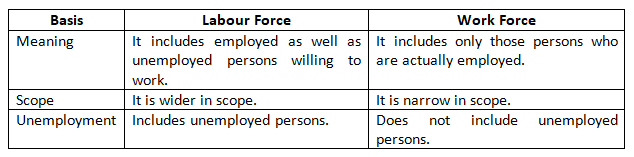
2. Labour force – Labour Force refers to all those people who are actually working (i.e. who have a job) and all those who are not working though seeking a job and are available for work (i.e. who are willing to work, but not getting work).
Labour Force = Persons working + Persons seeking and /or available for work.
In other words, Labour Force is the total of employed and unemployed persons.
How to calculate labour force?
To get the labour force, subtract the following from the total population:
- Unfit People like old or handicapped persons;
- People who are not willing to work;
- People who are not available for work.
3. Work Force – The number of persons, who are actually employed at a particular time are known as Work Force. It includes all those persons who are actually engaged in
productive activities. Work Force does not include unemployed people, i.e. all those people who are willing to work but do not get work are excluded.
Work Force = Labour Force – Unemployed People
Calculation of Number of Unemployed People
With the help of labour force and work force, we can calculate the number of unemployed people. If we subtract work force from labour force, we get number of unemployed people.
Number Unemployed People, i.e. Unemployed people = Labour Force – work Force
Rate of Unemployment = Number of Unemployed People / Size of Labour Force × 100
PARTICIPATION OF PEOPLE IN EMPLOYMENT
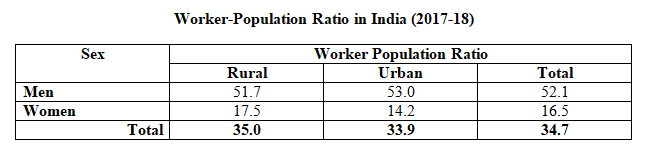
“Worker-Population ratio” is and indicator which is used to analyses the employment situation in the country. Worker-Population ratio refers to the ratio of a total number of workers to the total population. It is generally expressed in percentage.
Worker population ratio (or participation rate) = Total number of workers (or total work force) / Total Population × 100
Important Points about Worker-Population Ratio
a. Worker-Population ratio is very useful in determining the proportion of population that actively contributes to the production of goods and services in a country.
- A higher ratio indicates that a high proportion of its population is involved in economic activities.
- A medium or lower ratio indicates that fewer people are involved in economic activities.
b. The worker-population ratio indicates the status of workers in the society and their working conditions.
- By knowing the status with which a worker is placed in an enterprise, it may be possible to determine the quality of employment in a county.
- It also enables us to know the attachment, which a worker has with his job and the authority possessed by him over the enterprise and over other co-workers.
MEANING OF EMPLOYMENT
Employment is an activity which enables a person to earn means of living. It refers to an arrangement, by which a person earns income or means of livelihood. Employment may be either in the form of self-employment or wage employment.
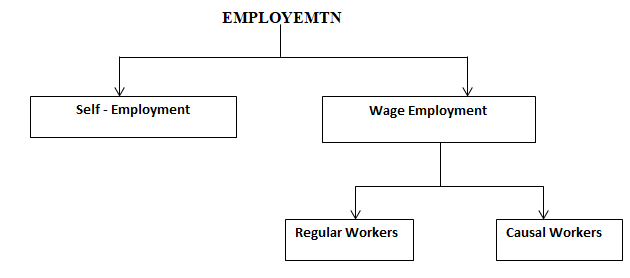
- Self-Employment – An arrangement in which a worker uses his own resources to make a living, is known as self-employment.
Self-employment is a major source of livelihood for both men and women. In case of self-employment, a person makes uses of his own land, labour, capital and entrepreneurship, to make a living. For example – shopkeepers, traders, businessmen, etc.
2. Wage Employment – An arrangement in which a worker sells his labour and earns wages in return is known as wage employment.
- Workers do not have any other resources (land, capital and entrepreneurship), except their own labour.
- They offer their labour services to others and, in return, get wages.
- For example – a doctor running his own clinic is an example of self-employment. However, if the doctor is employed by a hospital, then it will be wage employment.
- Wage employment is of two types:
- Regular Workers;
- Causal workers.
- Regular Workers (Regular Salaried Employees)
When a worker is engaged by someone or by an enterprise and is paid wages on a regular basis, then such worker is known as a regular salaried employee.
2. Causal Workers
Workers who are casually engaged in other’s from or non-farm enterprises and, in return, receive remuneration for the work done are termed as causal workers.
DISTRIBUTION OF EMPLOYMENT
- Distribution of Employment by Gender
The given figure shows the distribution of employment by gender:
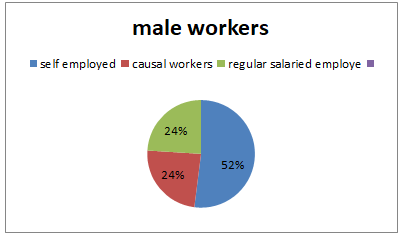
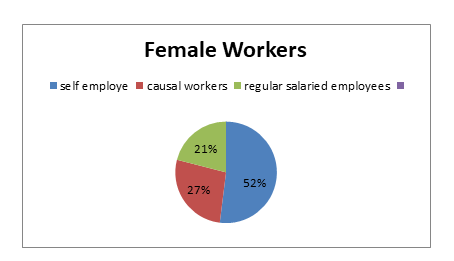
From the Pie diagrams, the following point are noticed :
- Self-employment is a major source of livelihood for both men (52%) and women (52%).
- Causal workers account for the second major source for both men (24%) and women (27%).
- In the case of regular salaried employment, men are found to have a greater proportion (25%), whereas women form only (21%).
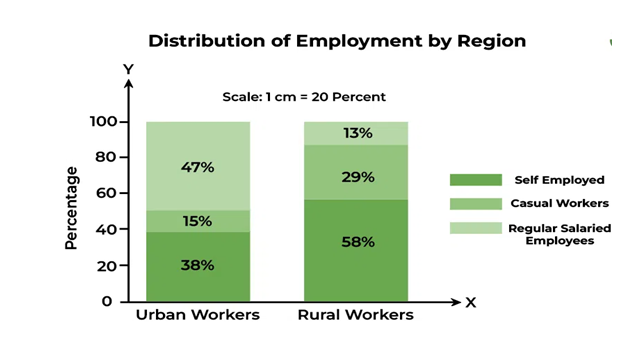
2. Distribution of Employment Region
Distribution of employed workers by region enables us to know the quality of employment and the attachment of workers to their jobs.
- Self-Employment
- Causal Workers
- Regular Salaried Employees
3. Distribution of Employment in different Sectors
In the course of economic development of a country, labour flows from agriculture and other related activities to industry and services. In this process, workers migrate from rural to urban areas. We divide all economic activities into following 8 different industrial divisions:
- Agriculture
- Mining and Quarrying
- Manufacturing
- Electricity, Gas and Water Supply
- Construction
- Trade
- Transport and Storage
- Services
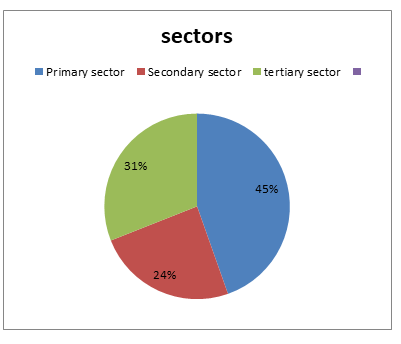
For simplicity, all the working persons engaged in these divisions can be clubbed into three major sectors:
- Primary Sector – In includes Agriculture and Mining and Quarrying ,
- Secondary Sector – It includes Manufacturing, Electricity, Gas and Water Supply and Construction
- Tertiary Sector – It includes Trade, Transport and storage, and Services.
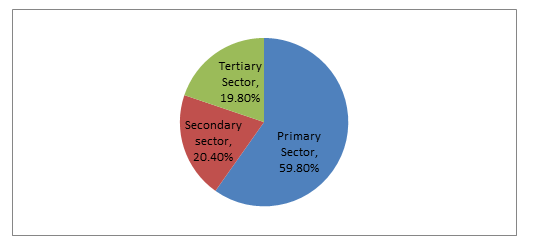
4. Distribution of Rural – Urban Employment in different sectors
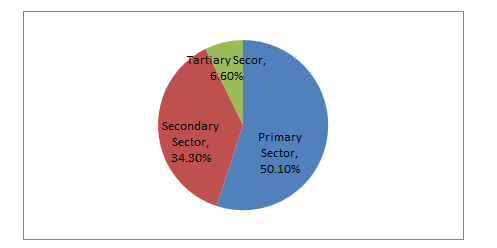
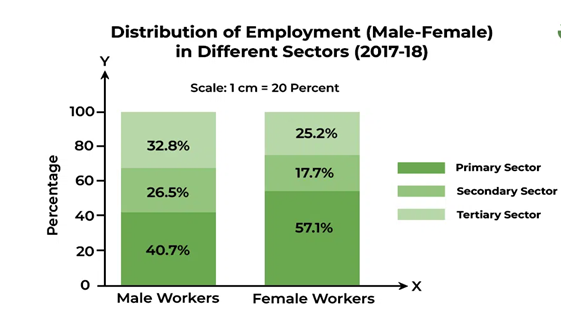
5. Distribution of Employment (Male-Female) in different sectors
GROWTH AND CHANGING STUCTURE OF EMPLOYMENT
- Growth of Employment and Gross Domestic Product (GDP)
Fifty years of planned development have always aimed at the expansions of the economy through an increase product and employment.
- During 1950-2010, the GDP of India grew positive & was higher than the employment growth.
- There was always fluctuation in the growth of GDP, but employment grew at the rate of not more than 2%.’
- However, in the late 1990s, employment growth started declining and reached the level of growth that India had in the early stages of planning.
2. Changing Structure of Employment
India is an agrarian nation. A major section of our population lives in rural areas and depends on agriculture as their main livelihood. The developmental strategies in many countries, including India, have always aimed at reducing the proportion of people depending on agriculture.
3. Casualization of workforce
The process of moving from self-employment and regular salaried employment to casual wage work is known as casualization of the workforce.
Reason for Increasing Casualization
Casualization of workforce has become a perennial (or everlasting) problem for India because of the following reasons:
- Slow growth of employment in the organised sector is also a reason for workers taking up casual jobs.
- Increase in the demand for casual labour in expanding construction, trade and service activities in rural areas, also led to casualization of workforce.
- Self-employed small and marginal farmers are becoming casual workers due to the low scope of earnings in agricultural activities.
INFORMALISATION OF INDIAN WORKFORCE
The employment structure in India can be studies with respect to two kinds of sectors:
- Formal of Organisation Sector
- Informal or Unorganised Sector.
In formalisation of workforce refers to a situation whereby the proportion of workforce in the informal sector to total workforce increases.
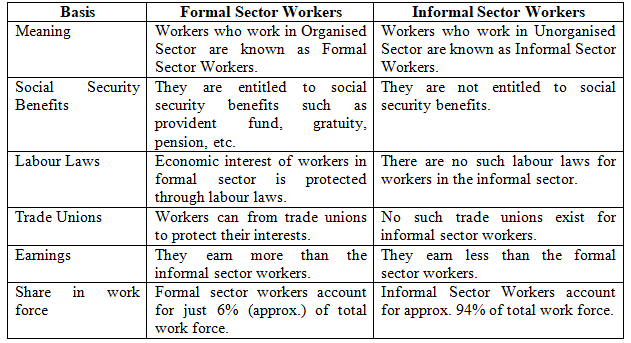
a. Formal or Organised Sector – All public enterprises and private establishments that employ 10 or more hired workers are called formal sector establishments.
- Workers who work in such establishments are known as formal sector workers.
- Formal workers enjoy social security benefits and earn more than those in the informal sector as they have better bargaining power for higher wages.
b. Informal or Unorganised Sector – Informal sector includes all those private enterprises which hire less than 10 workers.
- Workers who work in such enterprise are known as informal sector workers. For example, farmers, agricultural labours, owners of small enterprises, etc.
- It also includes all non-farm casual wage labourers who work for more than one employer, such as construction workers and head load workers.
Formal sector workers Vs Informal Sector Workers
Distribution of Workforce in Formal and Informal Sectors
As the economy grows, more and more workers should become formal sector workers and the proportion of workers engaged in the informal sector should decrease. However, the situation in India is very discouraging
Distribution of Workforce in Formal and Informal Sector, 2011-12

MEANING OF UNEMPLOYMENT
Unemployment refers to a situation in which people are willing and able to work at the existing wage rate, but do not get work. Unemployment is confined not only to unskilled workers, rather a sizable number of skilled workers fail to get jobs for long periods.
There are a variety of ways by which an unemployed person is identified. According to some economists, “Unemployed Person is the one who is not able to get employment of even one hour in half a day”.
TYPES OF UNEMPLOYMENT IN INDIA
- Disguised Unemployment (Hidden Unemployment) – Disguised Unemployment is a situation in which the number of workers engaged in a work is more than actually optimally required. It is also known as Hidden Unemployment. For example – If two workers are needed on a piece of land and five workers are engaged in the same job, then three workers are disguised unemployed.
Causes of Disguised Unemployment:
- Non-availability of alternative job opportunities outside agriculture compels people to work on family farms, which leads to disguised unemployment.
- Small Land Holdings with an increase in the size of the families further increase the possible of disguised unemployment.
- In case of Joint Family, people continue to work on their family land, which further leads to disguised unemployment.
2. Seasonal Unemployment – Unemployment that occurs during certain seasons of the year is known as seasonal unemployment.
- In India, seasonal unemployment is predominantly associated with agriculture.
- In agriculture, work is seasonal and there are no employment opportunities in the village for all months in the year. So, when there is no work to do on farms, men go to urban areas and look for jobs.
3. Open Unemployment – Open Unemployment refers to that economic phenomenon in which people are able and willing to work at the prevailing wage rate, but fail to get work. It is called open unemployment because such unemployment can be seen and counted in terms of the number of unemployed people.
CAUSES OF UNEMPLOYMENT
The reason for existence of widespread unemployed in India is not due to any single factor. It is the cumulative result of many causes. The important causes of the unemployment problem in India are:
- Slow Rate of Economic Growth – The actual growth rate always lies far below the rate targeted in the five decades of planning. Employment opportunities created under the plans could not keep pace with the additions to the labour force.
- Underdeveloped Agriculture – Heavy pressure of the population on land and the primitive methods of agricultural operations are responsible for massive rural unemployment and underemployment in the country.
- Defective Educational System – The prevailing education system in India is full of defects. A large number of engineering, management and other educational institutes provide numerous engineers, MBAs, etc. But due to lack of technical and vocational training, such educated people are unable to meet the requirement s of the firm and remain unemployed.
- Slow Growth of Industry – Due to a shortage of capital and a lack of modern and advanced technology, the industrial sector could not gain its momentum and could not generate sufficient employment opportunities in the country.
- Low Capital Formation – Low rate of capital formation has hampered the growth potential in the agricultural and industrial sectors. Consequently, job-creation capabilities of both the sectors have been affected adversely.
REMEDIAL MEASURES FOR UNEMPLOYMENT
The unemployment problem in India can be solved with the help of following measures:
- Accelerating growth rate of GDP – the aggregate employment problem can be solved through the process of accelerated growth. Growth rate of GDP between 8% and 9% are needed over the next ten year, to achieve a significant improvement in the employment situation.
- Encouragement to small-scale enterprises – The small-scale sector needs to encouraged through multiple initiatives like liberal finance, technical training , supply of raw materials, infrastructural facilities and marketing of their products.
- Special Employment programs – Special employment programs, which aim at providing wage employment or self-employment opportunities, should be implemented.
- Improvement of Employment Exchanges – The employment exchanges spread all over the country are of great assistance in directing the job seekers to the possible areas of employment. The functioning of such employment exchanges should be improved.
- Creation of self-employment opportunities – Government should provide various facilities like financial assistance, training of skills, supply of inputs, marketing of products, etc.to generate more self-employment opportunities.
GOVERNMENT POLICIES AND EMPLOYMENT GENERATION
Government has taken many initiatives to generate acceptable employment, ensuring at least minimal safety and job satisfaction. For example, Mahatma Gandhi National Rural Employment Guarantee Act (MGNREGA), 2005. MGNEREGA aims at enhancing t livelihood security of people in rural areas by guaranteeing 100 days of wage employment in a financial year to a rural household whose adult members volunteer to do unskilled manual work. Their efforts can be broadly categorised into two aspects:
- Government provides ‘Direct Employment’ by employing people in various departments for administrative purposes.
- With increase in output of goods and services of government enterprises, private enterprises providing raw material to government enterprises will also raise their output.
Short Answer Type Questions
- What is the difference between labour force and work force?
Ans.
2. Discuss the two main forms of wage employment.
Ans. The two main forms of wage employment are:
(i) Regular Salaried Employment: A person works regularly under an employer and receives a fixed salary.
(ii) Casual Wage Employment: A person works temporarily and gets wages according to the number of days worked.
3. Discuss the distribution of employment on the basis of gender.
Ans. Employment distribution in India is unequal between males and females. Male workers have a higher share in employment, while females are mainly engaged in agriculture and informal activities.
4. State any four causes of unemployment in India.
Ans. The main causes of unemployment in India are:
- Rapid growth of population.
- Slow economic growth.
- Heavy dependence on agriculture.
- Lack of required skills and training.
5. Discuss in brief, the distribution of employment in different sectors of economy on the basis of gender.
Ans. Women workers are mainly employed in the primary sector, especially agriculture. Men have a higher share in secondary and tertiary sectors like industries and services.
6. Write a note on changing structure of employment.
Ans. The structure of employment in India has changed over time. The share of employment in the primary sector has declined, while employment in secondary and tertiary sectors has increased. However, agriculture still employs a large number of people.
7. Mention four measures to solve the problem of unemployment in India.
Ans. The following measures can help in reducing unemployment:
- Promoting rapid economic growth.
- Encouraging small-scale and cottage industries.
- Improving education and skill development.
- Increasing employment opportunities in rural areas.
8. Write short note on problems faced by the workers of informal sector.
Ans. Workers in the informal sector face many problems such as:
- Low wages and irregular employment.
- Lack of job security.
- No social security benefits like pension and medical facilities.
- Poor working conditions.
9. “The efforts of the government in generating employment can be broadly categorised into two aspects.” Comment.
Ans. Government efforts for employment generation can be divided into two aspects:
- Direct employment generation: Government provides employment through various public programmes.
- Indirect employment generation: Government promotes economic activities that create more job opportunities.
10. Discuss the different sources of unemployment data.
Ans. The major sources of unemployment data in India are:
- Census of India – Conducted every ten years to collect employment information.
- National Sample Survey Organisation (NSSO) – Provides detailed data on employment and unemployment.
- Directorate General of Employment and Training (DGET) – Collects information through employment exchanges.
11. Defend or refute the following statement with valid explanation: ‘Disguised unemployment is a common form of unemployment in rural India.’
Ans. The statement is correct. Disguised unemployment is commonly found in rural areas where more people are engaged in agriculture than required. Some workers have zero or very low contribution to production, and removing them does not affect total output.
12. Discuss briefly the concept of ‘Informalisation of workforce’ in India.
Ans. Informalisation of workforce refers to the increasing proportion of workers engaged in the informal sector. These workers generally do not get job security, fixed wages or social security benefits.
13. Define worker-population ratio. What does it signifies?
Ans. Worker-population ratio refers to the percentage of working population in the total population. It shows the employment status and the proportion of people engaged in economic activities in a country.
14. Name the indicator that is generally used for analysing the employment situation in a county. Also discuss its importance.
Ans. The worker-population ratio is generally used to analyse the employment situation of a country. It helps to understand the proportion of people engaged in economic activities and indicates the employment opportunities available in the economy.
15. “It is necessary to generate employment in the formal sector rather than in the informal sector.” Justify the given statement with valid arguments.
Ans. Employment should be generated in the formal sector because:
- Workers get job security and regular wages.
- They receive social security benefits like pension and medical facilities.
- Working conditions are better compared to the informal sector.
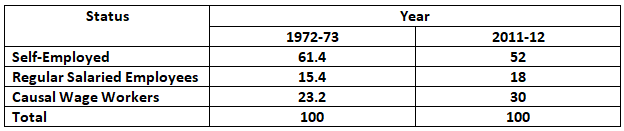
16. From the data given below, compare and analyse the status-wise distribution of workforce in India:
Trends in Employment Pattern (Status-wise) (in %)
1972-73 and 2011-12
Ans.

17. Compare and analyse the sector-wise trends in employment, based on following information:
Trends in Employment (Sector-wise)

Ans.

18. “In India, the self-employed constitute around 60% employees. The possible incidence of under employment is the highest among the self-employed.” As an economist, suggest and elaborate any two measures that may be taken to ensure more productive employment for the self-employed.
Answer:
Two measures to ensure productive employment for self-employed are:
- Provision of easy credit facilities: Cheap and adequate loans should be provided to expand their business activities.
- Skill development programmes: Proper training should be given to improve their skills, productivity and income.
19. ‘Kavya works on her family farm and is neither paid in cash nor in the form of grains.’ Can she be categorized as a worker? Give valid reasons in support of your answer.
Answer: Yes, Kavya can be categorized as a worker.
She contributes to the production process on her family farm. Receiving wages is not necessary to be considered a worker.
20. “In the late 1990’s India experienced a widening gap between between the growth of GDP and employment generation.” Discuss.
Answer: During the late 1990s, GDP growth increased rapidly but employment growth remained slow. This situation was known as jobless growth.
The main reason was the growth of capital-intensive industries and less employment opportunities.
21. “Casual workers often work in very poor working conditions.” Justify the given statement.
Answer:
Casual workers face poor working conditions because:
- They do not have job security.
- They receive low wages and no social security benefits.
- They often work in unsafe conditions.
22. ‘Mr. Rishi, after completing his education, has joined his family business but his marginal productivity is zero’. Comment upon the employment status of Mr.Rishi. Give valid reasons in support of your answer.
Answer:
Mr. Rishi is a disguised unemployed person.
Although he is working in the family business, his contribution to production is zero. His removal will not affect the total output.
23. “Amita is a regular worker in private firm that employs twelve hired workers.” Is she working in the formal/informal sector? Give valid reasons in support of your answer.
Answer:
Amita is working in the informal sector.
Reasons:
- A private firm employing only twelve hired workers comes under the small-scale sector.
- Workers in such firms generally do not get social security benefits like pension, paid leave and medical facilities.
- Hence, her employment is considered informal employment.
24. “The participation rate of people in economic activities in rural areas is more than that in urban areas.” Justify the given statement.
Answer:
The participation rate is higher in rural areas because:
- Rural people have limited opportunities for education and other non-economic activities.
- A large number of people are engaged in agriculture and related activities.
- Urban areas have more students and non-working population due to better educational opportunities.
25. Define disguised unemployment. State its implications on output and employment in a cournty.
Answer:
Disguised unemployment refers to a situation where more people are engaged in an activity than actually required, and some workers have zero marginal productivity.
Implications:
- Removal of some workers does not reduce total output.
- It indicates underutilisation of labour resources.
- It reduces the overall productivity of the economy.
26. “In a nation like India, self employment provides an important avenue for employment generation.” Defend or refute the given statement with valid arguments.
Answer:
The statement is true.
Arguments:
- Self-employment provides livelihood to a large section of the Indian population.
- It creates employment opportunities for people who cannot find regular jobs.
- Agriculture, small businesses and trade provide major sources of self-employment in India.
27. “As an economy grows, the number of employed persons in an economy also increases; however, since 1991 India has come up as an exception to this.” Do you agree with the given statement? Give valid arguments in support of your answer.
Answer:
Yes, India has been an exception after 1991. This situation is known as jobless growth.
Arguments:
- GDP growth increased significantly after economic reforms, but employment growth remained slow.
- Growth was mainly concentrated in capital-intensive sectors that created fewer jobs.
- The use of advanced technology reduced the demand for labour in some sectors.
Long Answer Type Questions
- What do you mean by employment? Discuss the two main forms of employment.
Answer: Employment refers to the engagement of a person in any economic activity to earn a livelihood. A person who contributes to the production of goods and services is considered employed.
The two main forms of employment are:
- Self-Employment: In self-employment, a person works independently and owns the means of production. For example, farmers, shopkeepers and professionals are self-employed.
- Hired Employment: In hired employment, a person works for an employer and receives wages or salary in return. It may be regular salaried employment or casual wage employment.
2. Briefly discuss the various causes of unemployment in India.
Answer:
The main causes of unemployment in India are:
- Rapid growth of population: The increase in population has resulted in a large supply of labour.
- Dependence on agriculture: Agriculture provides seasonal employment and leads to disguised unemployment.
- Slow growth of industries: The industrial sector has not expanded enough to provide employment to all.
- Lack of skill development: Many people lack the skills required for available jobs.
- Defective education system: The education system does not provide sufficient vocational training.
3. Discuss the male – female distribution of workforce on the basis of region (Rural-Urban) in India.
Answer:
The distribution of workforce between males and females differs in rural and urban areas.
Rural Areas:
- Female participation in the workforce is higher due to their involvement in agriculture and household enterprises.
- Many women work as unpaid family workers.
Urban Areas:
- Male participation is higher compared to females.
- Women’s participation is lower due to education, household responsibilities and social factors.
4. Briefly discuss the distribution of employment in different sector of economy.
Answer:
Employment in India is divided into three sectors:
- Primary Sector: It includes agriculture, forestry and fishing. It employs the largest number of workers but suffers from disguised unemployment.
- Secondary Sector: It includes manufacturing and construction. Its share in employment has increased due to industrial development.
- Tertiary Sector: It includes services like banking, education and transport. It is the fastest-growing sector providing new employment opportunities.
5. Discuss the various remedial measures, which are needed to solve the problem of unemployment in India.
Answer:
The following measures can help in reducing unemployment in India:
- Promotion of economic growth: A higher growth rate can create more employment opportunities.
- Development of labour-intensive industries: Industries using more labour should be encouraged.
- Promotion of self-employment: Easy credit and training facilities should be provided to encourage small businesses.
- Skill development: Vocational education and training should be promoted.
- Rural development: Investment in agriculture and rural industries can generate more employment.
6. What do you mean by formal & informal sectors? Discuss the conditions of workers in each of these sectors.
Answer:
Formal Sector:
The formal sector includes those enterprises which are registered with the government and follow government rules.
Conditions of workers:
- Workers get regular salary and job security.
- They receive benefits like pension, paid leave and medical facilities.
- Working conditions are generally better.
Informal Sector:
The informal sector includes small and unregistered enterprises which are not controlled by government rules.
Conditions of workers:
- Workers do not have job security.
- They receive low wages and no social security benefits.
- Working conditions are generally poor.
7. What do you mean by casualization of workforce? Discuss the concept with relevant facts.
Answer:
Casualization of workforce refers to the increase in the number of casual wage workers in the total workforce.
- Casual workers are employed on a temporary basis and are paid according to the work done.
- They do not enjoy job security and social security benefits.
- In India, the share of casual workers has increased over time, showing a rise in insecure employment.
8. Discuss the distribution of workforce in formal and informal sectors.
Answer:
The majority of India’s workforce is employed in the informal sector.
- Around 90% of workers are engaged in the informal sector.
- Only a small proportion of workers work in the formal sector.
Formal sector workers enjoy job security and social benefits, whereas informal sector workers generally lack these facilities.
9. Discuss the steps taken by the government to solve the problem of unemployment.
Answer:
The government has taken the following steps to reduce unemployment:
- Promoting economic growth to create more employment opportunities.
- Encouraging self-employment by providing loans and training facilities.
- Generating employment through government schemes in rural and urban areas.
- Skill development programmes to improve the employability of workers.
- Promoting rural development to create jobs in rural areas.
10. Discuss following types of unemployment; (i) Disguised Unemployment; (ii) Seasonal Unemployment; (iii) Open Unemployment.
Ans.
(i) Disguised Unemployment
It is a situation where more people are engaged in an activity than actually required.
- It is mainly found in agriculture.
- Some workers have zero marginal productivity.
(ii) Seasonal Unemployment
It occurs when people get employment only during a particular season.
- It is mainly found in agricultural activities.
- Workers remain unemployed during the off-season.
(iii) Open Unemployment
It refers to a situation where people are willing and able to work but do not get employment.
- It is common among educated youth.
- It occurs due to a lack of sufficient job opportunities.