human capital formation class 12 notes
notes of human capital formation class 12 pdf download
class 12th human capital formation notes
INTRODUCTION
The development of human resources means increasing the quality of human beings, which helps in the process of growth and development of the economy.
PHYSICAL CAPITAL AND HUMAN CAPITAL
The economic development of a country is possible only when there is optimum utilization of physical and human resources.
- Physical Capital – It includes all those inputs which are required for further production, like plant and machinery, factory, buildings, raw materials, etc.
- The physical capital is needed to make use of physical resources.
- Its accumulation is quite important for economic growth of a country.
- Decision regarding investment in physical capital is taken on the basis of one’s knowledge in this regard.
2. Human Capital – It refers to the skills that a person acquires through education, training and/or experience, adding to his/her value to the production process.
- It is the stock of skill, ability, expertise, education & knowledge embodied in the people.
- Human Capital is needed to make effective use of physical capital.
- There is a need for investment in human capital to produce more human capital out of human resources.
MEANING OF HUMAN CAPITAL FORMATION (HCF)
Human Capital formation refers to the process of addition made to the stock of skilled and capable people in a country over a period of time. In other words, HCF refers to development of abilities and skills among the population of the country.
- It is the process of acquiring and increasing the number of person, who have the skills, education and experience. For example – if in beginning of a year, human capital stock of a nation consists of 30 lakh skilled skilled workers and at the end of the year, it increases to 34 lakh skilled workers, then is human capital formation to the extent of 4 lakh skilled workers in a year.
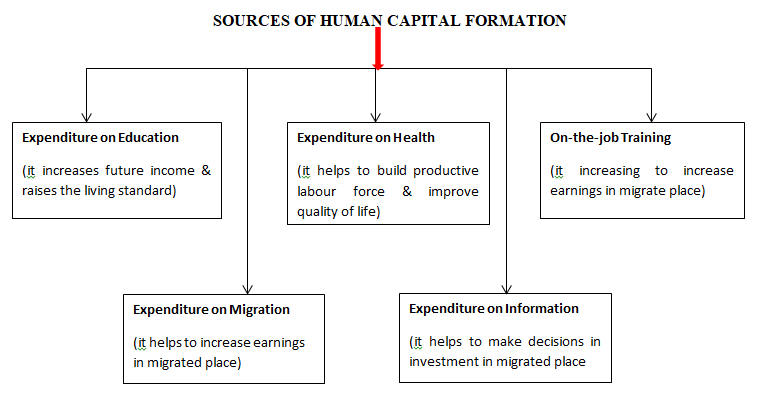
SOURCES OF HUMAN CAPITAL FORMATION
There are a number of ways by which human capital can be which human capital can be increased. The different sources of human capital formation are:
- Expenditure on Education: Proper utility of manpower depends on the system of education and training of people.
- Labour skill of an educated person is more than that of and uneducated person, which enables him to generate more income than the uneducated person.
- Spending on education by individuals is similar to spending on capital goods by companies. Individuals invest in education to increase their future income and raise their living standard.
2. Expenditure on Health: Health expenditure is a source of human capital formation as it directly increases the supply of healthy human force.
- Poor health and undernourishment adversely affect the quality of manpower. A sick labour, without access to medical facilities, is compelled to abstain from work, which leads to a loss o productivity
- Therefore expenditure on healthy is important to build and maintain a productive labour force and to improve the quality of life of people in society.
3. On-the-Job Training: As stated earlier, productivity of physical capital is substantially enhance with the improvement in human capital. Due to this reason, many firms provide on-the-job training to their workers.
- Such training has the advantage that it can be provided fast and without much cost.
- It increases the skill and efficiency of the workers and leads to an increases in production of goods and productivity of labour.
4. Expenditure on Migration: People migrate from one place to another in search of jobs that fetch them higher salaries.
- Unemployed people from rural areas migrate to urban areas in search of jobs.
- Technically qualified persons (like engineers, doctors, etc.) migrate to other countries because of higher salaries that they may get in such countries.
5. Expenditure on Information: Expenditure is incurred to acquire information relating to labour market and other markets.
- It involves amount spent on seeking information about educational institutions, their educational standards and cost of education.
- For example- people want to know the level of salaries associated with various types of jobs, whether educational institutions provide the right type of employable skills and at what cost.
HUMAN CAPITAL AND ECONOMIC GROWTH
Economic growth means the increase in real national income of a country.
- The contribution of an educated person to the economic growth is more than that of an illiterate person.
- Similarly, a healthy person also contributes to economic growth by providing an uninterrupted labour supply for a longer period of time.
HCF promotes inventions, innovations and technological improvements
The human capital formation (HCF) not only increases the productivity of human resources but also stimulates innovations and creates the ability to absorb new technologies.
- Education provides knowledge to understand changes in society and scientific advancements, thus facilitating inventions and innovations.
- Similarly, the availability of educated labour force facilitates adaptation to new technologies.
Difficult to prove Cause and Effect relation between Human capital and Economic Growth
Due to measurement problems, it is difficult to prove that increase in human capital causes economic growth.
- For example – education measured in terms of years of schooling, teacher-pupil ratio and enrolment rates may not reflect the quality of education.
IMPORTANCE OR ROLE OF HUMAN CAPITAL FORMATION
The importance / role of human capital formation will be clear from the following points:
- Effective use of Physical Capital – The growth and productivity of physical capital depends extensively on the human capital formation.
The physical capital can be created only by means of hard and intelligent work of human beings in the economy.
2. Higher productivity and production – Human capital formation raises the productivity and production as know ledgeable and skilled workers make better use of resources.
Increase in productivity and quality production depends on technical skill of the people, which can be acquired only by means of education, training and maintaining the health of the people.
3. Inventions, innovations and technological improvement – The human capital formation stimulates innovations and creates ability to absorb new technologies.
Education helps to understand the scientific advancements and changes taking place in the society, which facilitates inventions and innovations.
4. Modernization of attitudes – The knowledgeable, skilled and physically fit people are powerful instruments of change in the society.
Economic development of a country depends on the minds of the people and their changing attitudes towards creating a ‘will’ for development.
5. Increases life expectancy – Formation of human capital raises life expectancy of the people. Health facilities and availability of nutritive food enable people to live a healthy and long life. This in turn, adds to the quality of life.
6. Improves Quality of Life – The quality of population depends upon the level of educations, health of a person and skill formation acquired by the people.
- Human capital formation not only makes people productive and creative, but also transforms the lives of the people.
- People start living and enjoying higher incomes and more satisfying life.
7. Control of population growth – The has been observed that educated persons have smaller families as compared to illiterate families. So, the spread of education is necessary to control the population growth rate.
notes of human capital formation class 12 pdf handwritten
human capital formation class 12 important questions
PROBLEMS OF HUMAN CAPITAL FORMATION
The various problems of human capital formation are:
- Insufficient resources – The resources allocated to forming human capital have been much less than the resources required. Due to this reason, the facilities for the formation of human capital have remained grossly inadequate.
- Serious inefficiencies – There is a lot of wastage of society’s resources as capabilities of educated people are either not made use of (in case of unemployment) or are underutilized (in case of underemployment).
- Brain Drain – People migrate from one place to another in search of better job opportunities and handsome salaries.
- High Growth of Population – The continuous rise in population has adversely affected the quality of human capital.
- Several imbalances – A greater proportion of resources have been diverted towards higher education, which is meant for few people as compared to primary and secondary education.
HUMAN CAPITAL FORMATION IN INDIA: GREAT PROSPECTS
We have already learnt that human capital formation is the outcome of investments in education, health, on-the-job training, migration and information. Out of all these elements, education and health are very important sources of human capital formation.
- We know that ours is a federal country with a union government, state governments and local governments (Municipal Corporations, Municipalities and Village Panchayats). The Constitution of India mentions the functions to be carried out by each level of government.
Need for Government Intervention
- The expenditures on education and health make substantial long-term impacts and they cannot be easily reversed. For example – if a child is admitted to a school or health care center and required services are not provided in such instituted, then substantial amount of damage would have been done before the decision is taken to shift the child to another institution.
- Individual consumers of these services do not have complete information about the quality of services and their costs.
- The providers of education and health services may acquire monopoly power and may get involved in exploitation.
EDUCATIONAL SECTOR IN INDIA
Growth in Government Expenditure on Education
The expenditure by the government on education is expressed in two ways:
- As a percentage of total government expenditure – It indicates the importance of education in the scheme of things before the government. During 1952-2014, it increased from 7.92 to 15.7.
- As a percentage of Gross Domestic Product (GDP) – It expresses the proportion of income spent on development of education in the country. During 1952-2014, it increased from 0.64 to 4.13.
Important Points about Government Expenditure
- Government spends more on Elementary Education – Elementary Education (primary school education) takes a major share of total education expenditures.
- Expenditure on Tertiary Education is important – On an average, government spends less on tertiary education. However, ‘expenditure per student’ in tertiary education is higher than that of elementary education.
- Difference in Educational Opportunities across States – In 2014-15, the per capita education expenditure differed considerably across states from as high as Rs.34,651 in Himachal Pradesh to as low as Rs.4,088 in Bihar.
EDUCATIONAL ACHIEVEMENTS IN INDIA
- Adult Literacy Rate – Adult literacy rate refers to the ratio of literate adult population to the total adult population in a country.
- In case of males, the adult literacy rate increased from 61.9% in 1990 to 82% in 2017-18.
- In case of females, the adult literacy rate was just 37.9% in 1990, which increased to 66% in 2017-18, which is still far below the satisfaction level.
2. Primary Completion Rate – This is the percentage of students who complete the last year of primary school.
- In case of males, the primary completion rate increased from 78% in 1990 to 93% in 2017-18.
- In case of females, the rate increased form 61% in 1990 to 96% in 2017-18.
3. Youth Literacy Rate – It is the percentage of people aged 15-24 who can, with understanding, read and write a short, simple statement on their everyday life.
- In case of males, there was marginal increase in youth literacy rate from 76.6% in 1990 to 93% in 2017-18.
- In case of females, the youth literacy rate increased from 54.2% in 1990 to 90% in 2017-18.
Short Answer Type Questions
- Briefly discuss the meaning of human capital.
Answer: Human capital refers to the stock of knowledge, skills, education and health possessed by people. It increases their efficiency and productivity and helps in the economic development of a country.
2. “Expenditure on On-the-job training is an important means of human capital formation in an economy.” Give valid reasons to justify the given statement.
Answer: Expenditure on on-the-job training is an important means of human capital formation because it improves the skills and efficiency of workers. It enables them to perform their work better and increases their productivity.
3. “Human Capital Formation gives birth to innovation, invention and technological improvements.” Do you agree with the given statement? Support your answer with valid arguments.
Answer: Human capital formation leads to innovation, invention and technological improvements because educated and skilled people are more capable of developing new ideas and using modern technology efficiently.
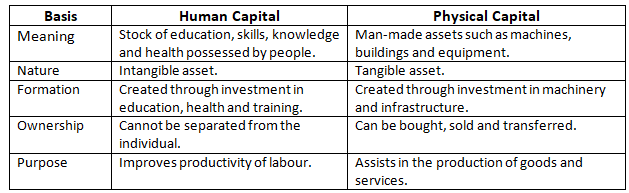
4. Distinguish between human capital and physical capital.
Ans.
5. “Higher productivity and production is the result of investment in human resources.” Do you agree with this statement?
Answer: Investment in human resources leads to higher productivity and production because education, training and better health improve the efficiency and skills of workers. As a result, the output of goods and services increases.
6. How does education contribute to economic growth?
Answer: Education contributes to economic growth by improving the knowledge and skills of people. It increases their productivity, helps in the use of modern technology and raises the income and output of the economy.
7. “There are many factors which contribute to human capital formation of a country.” Do you agree with the statement? Justify your answer.
Answer: Yes, I agree with the statement. Human capital formation depends on investment in education, health, on-the-job training, migration and information. These factors improve the quality and efficiency of human resources.
8. Why government expenditure on tertiary education is important?
Answer: Government expenditure on tertiary education is important because it develops skilled professionals, scientists, engineers and researchers. These people promote innovation and contribute to the economic development of the country.
9. How does human capital create both private and social benefits?
Answer: Human capital creates private and social benefits by increasing the income of individuals and improving their standard of living. At the same time, it raises productivity, creates employment and promotes the overall development of society.
10. Explain how ‘expenditure on information’ and ‘expenditure on migration’ acts as a source of human capital formation.
Answer: Expenditure on information and migration helps people find better education, training and employment opportunities. This improves their skills and productivity and contributes to human capital formation.
11. Explain, how does ‘Investment in Human Capital’ contributes to growth of an economy.
Answer: Investment in human capital contributes to the growth of an economy by improving the education, skills and health of people. It increases productivity, raises income and promotes economic development.
12. Discuss the need for promoting women’s education in India.
Answer: Women’s education is necessary because it improves the health and living standard of families. It increases employment opportunities for women and contributes to the social and economic development of the country.
13. State and discuss any one recommendation of the Education Commission (1964 – 66).
Answer: One recommendation of the Education Commission (1964–66) was to increase public expenditure on education to 6% of the Gross Domestic Product (GDP). This would help improve the quality and expansion of education in India.
14. “Active Government intervention is essential in education and health sectors in India.” Do you agree with the given statement? Give reasons in support of your answer.
Answer: Yes, I agree with the statement. Government intervention is necessary because education and health are basic services. It ensures that even poor people can access these services and helps in the development of human capital.
15. “Expenditure on different levels of education in India is in the same proportion.” Defend or refute the given statement by giving valid reasons.
Answer: The statement is not correct. Expenditure on different levels of education is not in the same proportion. In India, a larger share of public expenditure is generally spent on higher education than on primary education.
16. Discuss any two benefits accruing from human capital formation.
Answer: Human capital formation provides many benefits such as increasing the productivity and efficiency of people. It also improves the income level of individuals and helps in the economic development of the country.
17. Explain the role of affordable healthcare facilities in promoting human capital in a country.
Answer: Affordable healthcare facilities help in promoting human capital by keeping people healthy and improving their working efficiency. Healthy people can work better and contribute more to economic growth.
18. Explain the role of affordable healthcare facilities in promoting human capital in a country.
Answer: Affordable healthcare facilities contribute to human capital formation by reducing illness and increasing the productivity of workers. It improves the quality of human resources in the country.
19. Explain the role of quality education in human capital formation in a country.
Answer: Quality education plays an important role in human capital formation by developing knowledge, skills and abilities among people. It increases their efficiency and helps in the growth of the economy.
20. ‘It would be unclear to say that the growth of human capital lays the ground for economic growth of a nation.’ Do you agree with the given statement? Support your answer with the valid illustrations.
Answer: Yes, I agree with the statement. Human capital promotes economic growth by increasing the productivity and skills of people. Educated and trained individuals use resources efficiently and contribute to higher production and development.
Long Answer Type Questions
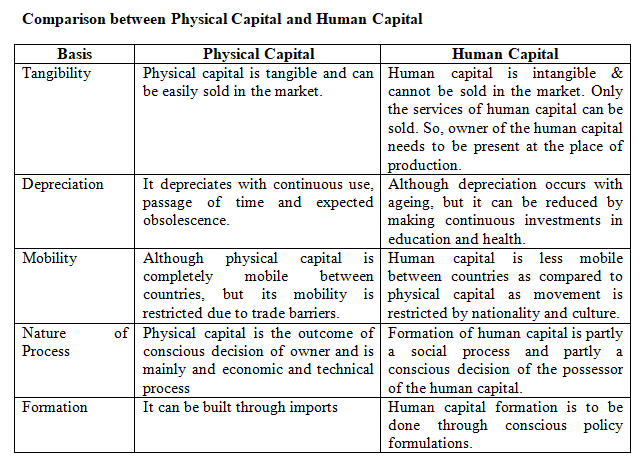
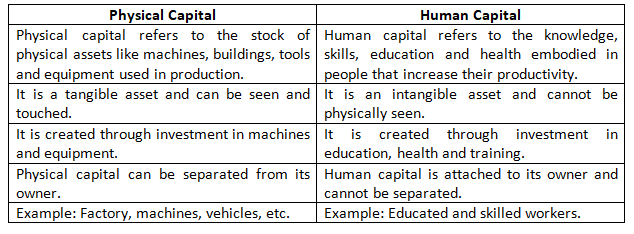
- Distinguish between physical capital and human capital.
Ans.
2. How does the following act as a source of human capital formation: (i) Expenditure on Health; (ii) Expenditure on Education.
Ans. (i) Expenditure on Health – Expenditure on health is an important source of human capital formation because a healthy person can work more efficiently and productively. Investment in healthcare facilities, medicines, nutrition and sanitation improves the physical and mental abilities of people. A healthy workforce contributes more effectively to economic development.
(ii) Expenditure on Education – Education helps in developing knowledge, skills and abilities among people. It increases the efficiency and productivity of individuals and enables them to adopt new technologies. Expenditure on education creates skilled human resources, which contribute to higher income and economic growth.
3. Discuss the educational achievements in India.
Ans. India has made considerable progress in the field of education since independence. The literacy rate has increased significantly and more people have gained access to schools and colleges.
The major educational achievements are:
- Increase in Literacy Rate: The literacy rate has increased from about 18% in 1951 to more than 70% in recent years.
- Expansion of Educational Institutions: There has been a rapid growth in the number of schools, colleges and universities.
- Growth of Higher Education: India has developed a large network of higher educational institutions providing education in various fields.
- Increase in Female Education: The participation of women in education has improved significantly.
- Development of Technical Education: Institutions providing technical and professional education have expanded, producing skilled manpower.
4. Briefly discuss the various problems of human capital formations.
Ans. The major problems of human capital formation in India are:
- Insufficient Investment: The amount spent on education and health is still inadequate compared to developed countries.
- Rapid Population Growth: A large population puts pressure on available educational and health facilities.
- Brain Drain: Many skilled and educated people migrate to other countries for better opportunities.
- Unequal Distribution: Access to education and healthcare facilities is unequal among different regions and sections of society.
- Poor Quality of Education: Many educational institutions lack proper infrastructure and qualified teachers.
- Unemployment: Lack of employment opportunities leads to wastage of human resources.
5. How does expenditure on “On-the-Job Training” and “Information” act as a source of human capital formation?
Ans. On-the-Job Training – On-the-job training improves the skills and efficiency of workers while they are working. Employers spend money on training programmes to enhance the productivity of employees. Skilled workers contribute more to production and earn higher incomes.
Information – Information regarding education, employment opportunities, health facilities and market conditions helps individuals make better decisions. Access to information increases the efficiency of human resources and improves productivity.
6. Why it is difficult to prove cause and effect relation between human capital and economic growth?
Ans. It is difficult to establish a direct cause and effect relationship between human capital and economic growth because both influence each other.
- Human capital increases productivity and promotes economic growth.
- Economic growth increases income, which allows more investment in education and health.
Thus, economic growth leads to human capital formation, and human capital formation leads to economic growth. Due to this two-way relationship, it becomes difficult to determine which one causes the other.
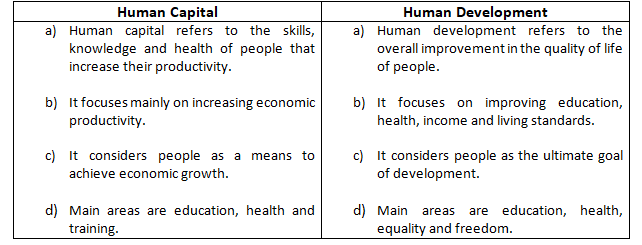
7. Distinguish between human capital and human development.
Ans.