government budget and the economy class 12 notes
government budget class 12 notes pdf download
government budget class 12 sandeep garg pdf
sandeep garg macroeconomics class 12 latest edition
macroeconomics class 12 sandeep garg 2026-27
macroeconomics class 12 sandeep garg 2026 27 pdf
government budget class 12 sandeep garg pdf
INTRODUCTON
In the modern world, every government aims at maximising the welfare of its country. It requires a number of infrastructural, economic and welfare activities. All these activities require huge expenditure to be incurred. This requires appropriate planning and policy of the government. The solution to all these problems is ‘Budget’. A budget is a document containing detailed programmes and policies of action for the given fiscal year.
MEANING OF GOVERNMENT BUDGET
Government budget is an annual statement, showing item wise estimates of receipts and expenditures during a Fiscal year.
Important Points of Government Budget
- Budget is prepared by Government at all levels, i.e. Central Government, State Government and Local Government, which prepares its respective annual budget. However, we will restrict our studies to Budget of Central Government, known as ‘Union Budget’.
- Estimated expenditures and receipts are planned as per the objectives of the government.
- In India, Budget is presented in the parliament on such a day, as the President may direct. By convention, Finance Minister presents the annual budget of the government on the first day of February each year.
- The Finance Minister reads out the ‘Budget Speech’ in the Lok Sabha. A copy of the Union Budget is laid in the Rajya Sabha soon after its presentation in the Lok Sabha.
- The Budget must be approved by the parliament, before it can come into effect on 1st April, the start on India’s Financial Year.
OBJECTIVES OF GOVERNMENT BUDGET
- Reallocation of Resources (or Allocation Function) – Through the budgetary policy, Government aims to reallocate resources in accordance with the economic (profit maximisation) and social (public welfare) priorities of the country. Government can influence allocation of resources through:
- Tax concessions or subsidies: To encourage investment, government can give tax concessions, subsidies etc., to the producers. For example, Government discourages the production of harmful consumption goods (like liquor, cigarettes etc.) through heavy taxes and encourages the use of ‘Khadi products’ by providing subsidies.
- Directly producing goods and services: There are many non-profitable economic activities which are not undertaken by the private sector, like water supply, sanitation, law and order, national defence, etc. These are called ‘Public Goods’.
2. Reducing inequalities in income and wealth: Economic inequality is an inherent part of every economic system. Government aims to reduce such inequalities of income and wealth, through its budgetary policy. Government aims to influence distribution of income by imposing taxes on the rice and spending more on the welfare of the poor.
3. Economic Stability: Economic Stability means the absence of large-scale fluctuation in prices. Such fluctuations create uncertainties in the economy. Government can exercise control over these fluctuations through taxes and expenditure. In short, policies of surplus budget during inflation and deficit budget during deflation helps to maintain stability of prices in the economy.
4. Management of Public Enterprises: There are large number of public sector industries (especially natural monopolies), which are established and managed for social welfare of the public. Budged is prepared with the objective of making various provisions for managing such enterprises and providing them financial help.
5. Economic Growth: Economic Growth implies a sustainable increase in the real GDP of an economy, i.e. an increase in volume of goods and services produced in an economy. Budget can be effective tool to ensure the economic growth in a country.
- If the government provided tax rebates and other incentives for productive ventures and projects, it can stimulate savings and investments in an economy.
- Spending on infrastructure of an economy enhances the production activity in different sectors of an economy.
6. Reducing regional disparities: The government budget aims to reduce regional disparities through its taxation and expenditure policy, which encourages the setting up of production units in economically backward regions. For example, establishment of Special Economic Zones (SEZs) in the backward regions for promoting their economic development.
7. Employment Generation: Government Budget is used as an effective tool in the process of employment generation in various ways. Investment in infrastructural projects like construction of flyovers, bridges, expansion of roads, etc., creates jobs for different sections of the workforce. In rural/urban areas, government aims to provide jobs through various employment generation schemes like MGNREGA, SJSRY, PMRY, etc.
COMPONENTS OF BUDGET
Components of budget refer to structure of the budget. Two main components of budget are:
- Revenue Budget: It deals with the revenue aspect of the government budget. It explains how revenue is generated or collected by the government and how it is allocated among various expenditure heads. Revenue budget has two parts: (i) Revenue Receipts; (ii) Revenue Expenditures. In short, Revenue Budget is the statement of estimated revenue receipts and estimated revenue expenditure during a fiscal year.
- Capital Budget: It deals with the capital aspect of the government budget and it consists of: (i) Capital Receipts; (ii) Capital Expenditures. In other words, Capital Budget is the statement of estimated capital receipts and estimated capital expenditure during a fiscal year.
BUDGET RECEIPTS
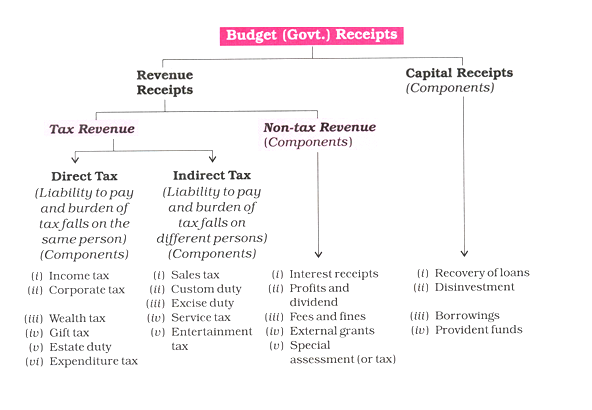
Budget receipt refer to the estimated money receipts of the government from all source during a given fiscal year. Budget receipt may be further classified as: (i) Revenue receipts; (ii) Capital receipts.
REVENUE RECEIPTS
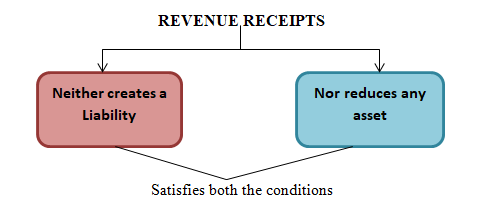
Revenue receipts refer to those receipts which neither create any liability nor cause any reduction in the assets of the government. A receipt is a revenue receipt, if it satisfies the following two essential conditions:
- The receipt must not create a liability for the government. For example, taxes levied by the government are revenue receipts as they do not create any liability. However, any amount borrowed by the government, is not a revenue receipt as it causes an increase in the liability in terms of repayment of borrowings.
- The receipt must not cause decrease in the assets. For example, receipts from the sale of shares of a public enterprise is not a revenue receipt as it leads to a reduction in assets of the government.
Two Sources of Revenue Receipts
Revenue receipts of the government are generally classified under two heads:
- Tax Revenue
- Non-Tax Revenue
TAX REVENUE
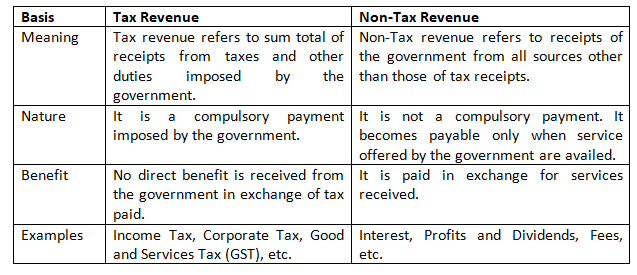
Tax revenue refers to the sum total of receipts from taxes and other duties imposed by the government. Tax is a unilateral (or one-sides) compulsory payment made by people and companies to the government without reference to any direct benefit in return. It means, there are two aspects of taxes:
- Tax is a compulsory payment, i.e., no one can refuse to pay it;
- Tax receipts are spent by the government for common benefit of people in the country. A taxpayer cannot expect that the tax amount will be used for his direct benefit.
Tax Revenue can be further classified as:
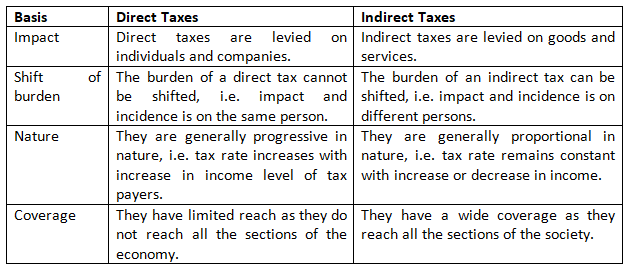
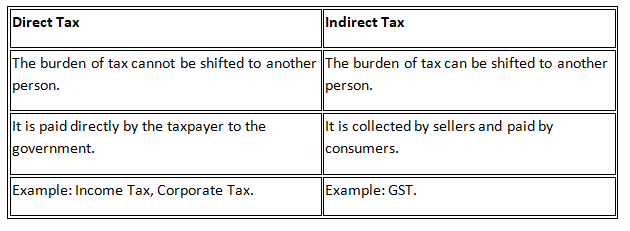
- Direct Taxes – Direct taxes refer to taxes that are imposed on property and income of individuals and companies and their burden cannot be shifted to the other person / entity.
- They are imposed on individuals and companies and their monetary burden is borne by those on whom they are levied.
- The ‘liability to pay’ the tax (i.e. impact) and ‘actual burden’ of the tax (i.e. incidence) lie on the same person, i.e. its burden cannot be shifted to others.
- They directly affect the income level and purchasing power of people and help to change the level of aggregate demand in the economy.
- Examples: Income Tax, Corporate Tax, Interest Tax, Property Tax, Wealth Tax, Death Duty, Capital Gains Tax, etc.
(ii) Indirect Taxes – Indirect taxes are those taxes which can be shifted to another person / entity. Their monetary burden is ultimately borne by final users of goods and services, rather than the person on whom the tax is levied.
They are imposed on goods and services.
The ‘liability to pay’ the tax (i.e. impact) and’ actual burden’ of the tax (i.e. incidence) lie on different persons, i.e. its burden can be shifted to others.
Comparison between Direct Taxes and Indirect Taxes
Items categorised as Direct and Indirect Taxes
- Corporation Tax – It is a direct tax as its impact and incidence lie on the same person. (Alternately, it is a direct tax as its liability to pay the tax (i.e. impact) and actual burden of the tax (i.e. incidence) lie on the same person.)
- Goods and Services Tax – It is an indirect tax as its impact and incidence lie on different person. (Alternately, it is an indirect tax as its liability to pay the tax (i.e. impact) and actual burden of the tax (i.e. incidence) lie on two different persons, i.e. its burden can be shifted.
- Income Tax – It is direct tax as its impact and incidence lie on the same person.
- Capital Gains Tax – It is a direct tax as its impact and incidence lie on the same person.
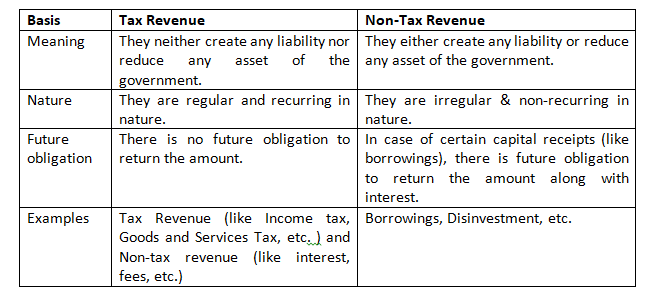
Non-Tax Revenue – Non-Tax revenue refers to receipts of the government from all sources other than those of tax receipts. The main sources of non-tax revenue are:
- Interest – Government receives interest on loans given to state governments, union territories, private enterprises and general public. Interest receipts from these loans are an important source of non-tax revenue.
- Profits and Dividends – Government earns profit through public sector undertakings like Indian railways, LIC, BHEL, etc. It earns profit from the sale proceeds of the products of such public enterprises. Government also gets dividends from its investments in other companies.
- Fees – Fees refer to charges imposed by the government to cover of recurring services services it provides. Such services are generally in public interest and fees are paid by those, who receive such services. It is also a compulsory contributions like tax. Court fees, registration fees, import fees, etc., are some examples of fees.
- License Fee – It is a payment charged by the government to grant permission for something. For example, a license fee is paid for permission to keep a gun or to obtain a National Permit for commercial vehicles.
- Fines and penalties – They refer to those payments which are imposed on law breakers. For example, fine for jumping red light or penalty for non-payment of tax. Fines are different from taxes as the former is levied to maintain law and order, whereas, the latter is imposed to generate revenue.
Comparison between Tax Revenue and Non-Tax Revenue
CAPITAL RECEIPTS
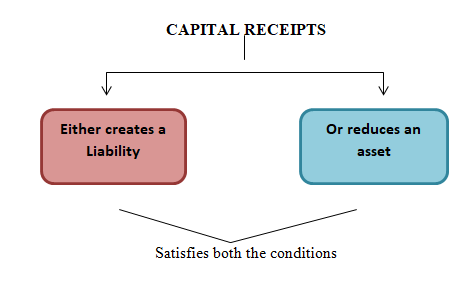
Capital receipts refer to those receipts which either create a liability or cause a reduction in the assets of the government. They are non-recurring and non-routine in nature. A receipt is a capital receipt if it satisfies any one of the two conditions:
- The receipts must create a liability for the government. For example – Borrowings are capital receipt as they lead to an increase in the liability of the government. However, tax received is not a capital as it does not result in creation of any liability.
- The receipts must cause a decrease in the assets. For example – receipts from sale of shares of public enterprise is a capital receipt as it leads to reduction in assets of the government.
Sources of Capital Receipts
Capital receipts are broadly classified into three groups:
- Borrowings – Borrowings are the funds raised by government to meet excess expenditure. Government borrow funds from: (i) Open Market (Public); (ii) Reserve Bank of India (RBI); (iii) Foreign governments (like loans from USA, England etc.); (iv) International institutions (like World Bank, International Monetary Fund). Borrowings are capital receipts as they create a liability for the government.
- Recovery of Loans – Government grants various loans to state government or union territories. Recovery of such loans is a capital receipt as it reduces the assets of the government.
- Other Receipts – These include:
- Disinvestment: Disinvestment refers to the act of selling a part or the whole of shares of selected public sector undertakings (PSU) held by the government. They are termed as capital receipts as they reduce the assets of the government.
- Small Savings: Small savings refer to funds raised from the public in the form of Post Office deposits, National Saving Certificates, Kisan Vikas Patras etc.
Debt Creating Vs Non-Debt Creating Capital Receipts
Capital Receipts can be classified as:
- Debt Creating Capital Receipts: These are the capital receipts which create debts for the government. Net Borrowings by the Government (from any source) is and example of Debt Creating Capital Receipt.
- Non-Debt Creating Capital Receipts: These are the capital receipts which do not create any debt or liability for the government. For example, Recovery of loans, disinvestments, etc.
Comparison between Revenue Receipts and Capital Receipts
Budget Expenditure – Budget Expenditure refers to the estimated expenditure of the government during a given fiscal year. The budget expenditure can be broadly categorised as:
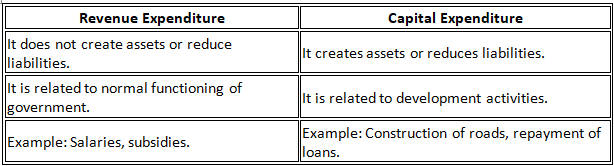
- Revenue Expenditure
- Capital Expenditure.
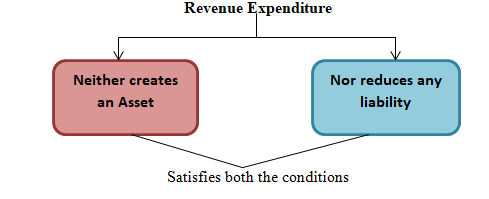
(i) Revenue and Capital Expenditure– Revenue expenditure refers to the expenditure which neither creates any asset nor causes reduction in any liability of the government. It is recurring in nature.
- It is incurred on normal functioning of the government & the provisions for various services.
- Example : Payment of salaries, pensions, interests, expenditure on administrative services, defence services, health services, grants to state, etc.
As expenditure is a revenue expenditure, if it satisfies the following two essential conditions:
- The expenditure must not create an asset of the government. For example, payment of salaries or pensions is revenue expenditure as it does not create any asset.
- The expenditure must not cause decrease in any liability. For example – repayment of borrowing is not a revenue expenditure as it leads to reduction in liability of the government.
(ii) Capital Expenditure – Capital expenditure refers to the expenditure which either creates an asset or causes a reduction in the liabilities of the government. It is non-recurring in natures.
- It adds to capital stock of the economy and increase its productivity through expenditure on long-term development programmes, like Metro of Flyover.
- Example : Loans to States and Union Territories, expenditures on building roads, flyovers, factories, purchases of machinery, repayment of borrowing, etc.
An expenditure is a capital expenditure, if it satisfies any one of the following two conditions:
- The expenditure must create an asset for the government. For example, Construction of creation of an asset.
- The expenditure must cause a decrease in the liabilities. For example, repayment of borrowings is a capital expenditure as it leads to a reduction in the liabilities of the government.
BALANCE, SURPLUS AND DEFICIT BUDGET
- Balance Budget – Government budget is said to be balance if estimated government receipts are equal to the estimated government expenditure.
i.e. Balance Budget: Estimated Government Receipts = Estimated Government Expenditure
- Balance Budget shows financial financial stability in the country. It is an ideal situation but not practical at times of inflation or deflation.
- It indicates that government is not indulging in wasteful expenditure.
2. Surplus Budget – It estimated government receipts are more than the estimated government expenditure, then the budget is termed as ‘Surplus Budget’.
i.e., Surplus Budget: Estimated Government Receipt > Estimated Government Expenditure
- In case of surplus budget, more money is being taken away by the Government than being injected in the economy. It helps to reduce the level of aggregate demand in the economy, which is required during excess demand to control inflation.
- However, during deflation, surplus budget further reduces the level of aggregate demand, which deflation, surplus budget further reduces the level of aggregate demand, which worsens the situation.
3. Deficit Budget – If estimated government receipts are less than the estimated government expenditure, then the budget is termed as ‘Deficit Budget’.
i.e. Deficit Balance : Estimated Government Receipts < Estimated Government Expenditure
- Developing countries generally have deficit budget because they need to incur more expenditure than the amount of resources the economy can mobilize.
- It helps to increase the level of aggregate demand in the economy, which is required during deficient demand to control deflation.
MEASURES OF GOVERNMENT DEFICIT
Budgetary deficit is defined as the excess of total estimated expenditure over total estimated revenue. When the government spends more than it collects, then it incurs a budgetary deficit.
Budgetary Deficit = Total Expenditure – Total Receipts
With reference to the budget of Indian government, budgetary deficit can be of 3 types:
- Revenue Deficit
- Fiscal Deficit
- Primary Deficit
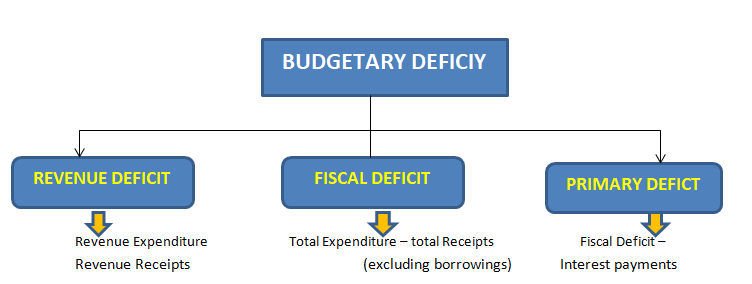
Revenue Deficit – Revenue deficit is concerned with the revenue expenditures & revenue receipts of the government. It refers to excess of revenue expenditure over revenue receipts during the given fiscal year.
Revenue Deficit = Revenue Expenditure – Revenue Receipts
Revenue deficit signifies that government’s own revenue is insufficient to meet the expenditures on normal functioning of government departments and provisions for various services.
Implications of Revenue Deficit
- It indicates the inability of the government to meet its regular and recurring expenditure in the proposed budget.
- It implies that government is dissaving, i.e. government is using up savings of other sectors of the economy to finance its consumption expenditure.
- It also implies that the government has to make up this deficit from capital receipts, i.e. through borrowings or disinvestments. It means, revenue deficit either leads to an increase in liability in the form of borrowings or reduces, reduces the assets through disinvestment.
Measure to Reduce Revenue Deficit
- Reduce Expenditure – Government should take serious steps to reduce its expenditure and avoid unproductive or unnecessary expenditure.
- Increase Revenue – Government should increase it receipts from various sources of tax and non-tax revenue.
Fiscal Deficit – Fiscal deficit presents a more comprehensive view of budgetary imbalances. It is widely used as a budgetary tool for explaining and understanding the budgetary developments in India.
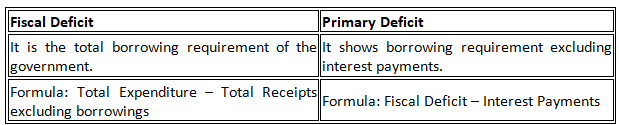
Fiscal deficit refers to the excess of total expenditure over total receipts (excluding borrowings) during the given fiscal year.
Fiscal Deficit = Total Expenditure – Total Receipts excluding borrowings
Implications of Fiscal Deficit
The implications of fiscal deficit are as follows:
- Debt Trap – Fiscal deficit indicates the total borrowing requirements of the government. Borrowings not only involve repayment of principal amount, but also require payment of interest. Interest payments increase the revenue expenditure, which leads to revenue deficit.
- Inflation – Government mainly borrows from Reserve Bank of India (RBI) to meet its fiscal deficit. RBI prints new currency to meet the deficit requirements. It increases the money supply in the economy, which leads to increase in general price level and creates inflationary pressure.
- Hampers the future growth – Borrowings increase the financial burden for future generations. It adversely affects the future growth and development prospects of the country.
Sources of Financing Fiscal Deficit
Government has to look out for different option to finance the fiscal deficit. The main two sources are:
- Borrowings: Fiscal deficit can be met by borrowings from the internal sources (public, commercial banks etc.) or the external sources (foreign government, international organisation etc.).
- Deficit Financing (Printing of new currency): Government may borrow from RBI against it securities to meet the fiscal deficit. RBI issues new currency for this purpose. This process is known as deficit financing.
Primary Deficit
Primary deficit refers to difference between fiscal deficit of the current year and interest payments on the previous borrowings.
Primary Deficit = Fiscal Deficit – Interest Payments
Implication of Primary Deficit
It indicates, how much of the government borrowings are going to meet expenses other than the interest payment. The difference between fiscal deficit and primary deficit shows the amount of interest payments on the borrowings made in the past. So, a law or zero primary deficit indicates that interest commitments (on earlier loans) have forced the government to borrow.
Short Answer Type Questions
- State three objectives of a government budget.
Answer:
The three main objectives of a Government Budget are:
- Allocation of Resources: To ensure proper allocation of resources for balanced economic development.
- Reduction of Inequalities: To reduce inequalities in income and wealth through taxation and public expenditure.
- Economic Stability: To maintain price stability and promote economic growth by controlling inflation and deflation.
2. Explain objective of stability of price of government budget.
Answer: The objective of price stability is to maintain a stable general price level in the economy by controlling inflation and deflation.
- During inflation, the government reduces excess demand by increasing taxes, reducing public expenditure or borrowing from the public.
- During deflation, the government increases public expenditure and reduces taxes to raise demand and employment.
3. How can a government budget help in reducing inequalities of income? Explain.
Answer: The Government Budget reduces inequalities in income and wealth through the following measures:
- The government imposes higher taxes on high-income groups and provides tax relief to low-income groups.
- It spends more on education, healthcare, housing, employment schemes and social welfare programmes for the poor.
- It provides subsidies and financial assistance to weaker sections of society.
4. Explain ‘allocation or resources’ objective of Government budget.
Answer: The objective of allocation of resources means ensuring that the country’s resources are used efficiently and for the welfare of society.
The government achieves this by:
- Providing funds for public goods such as defence, education, health and infrastructure.
- Encouraging the production of socially desirable goods and discouraging harmful goods through taxation and subsidies.
- Promoting balanced regional and economic development.
5. What is a government budget? Name two sources each of non-tax revenue receipts and capital and capital receipts.
Answer: A Government Budget is an annual statement of the estimated receipts and estimated expenditure of the government for a financial year.
Two sources of Non-Tax Revenue Receipts:
- Interest receipts
- Fees and fines
Two sources of Capital Receipts:
- Borrowings by the government
- Recovery of loans granted by the government
6. What is a government budget? Given the meaning of: (a) Revenue deficit; (b) Fiscal deficit.
Answer: A Government Budget is an annual statement showing the estimated receipts and estimated expenditure of the government for a financial year.
(a) Revenue Deficit: Revenue Deficit arises when Revenue Expenditure exceeds Revenue Receipts during a financial year.
Revenue Deficit = Revenue Expenditure – Revenue Receipts
(b) Fiscal Deficit: Fiscal Deficit is the excess of Total Expenditure over Total Receipts (excluding borrowings). It indicates the borrowing requirement of the government.Fiscal Deficit = Total Expenditure – (Revenue Receipts + Non-Debt Capital Receipts)
7. What are the two broad division of receipts of the government budget? Name two sources of each kind or receipt.
Answer: Government receipts are broadly divided into:
1. Revenue Receipts
- Tax Revenue
- Non-Tax Revenue
2. Capital Receipts
- Borrowings by the Government
- Recovery of Loans
8. “Tax revenue collection of the government may be categorized under two heads.” State and explain the two heads of tax revenue.
Answer: Tax Revenue is classified into two categories:
1. Direct Taxes: These are taxes whose burden cannot be shifted to another person. They are paid directly by the person on whom they are imposed.
Example: Income Tax.
2. Indirect Taxes: These are taxes whose burden can be shifted to others. They are collected by the seller and ultimately paid by the consumer.
Example: Goods and Services Tax (GST).
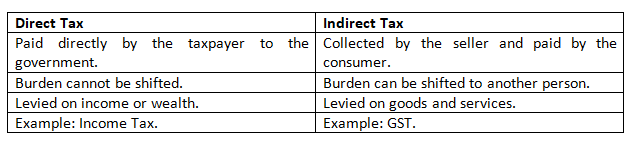
9. Distinguish between Direct Tax and Indirect Tax.
Answer –
10. Explain with the help of suitable examples the basis of classifying taxes into direct and indirect taxes.
Answer:
Taxes are classified on the basis of whether the burden of tax can be shifted or not.
- Direct Taxes: The burden cannot be shifted to another person. They are paid directly by the person on whom they are imposed.
Example: Income Tax. - Indirect Taxes: The burden can be shifted to the final consumer through higher prices of goods and services.
Example: GST.
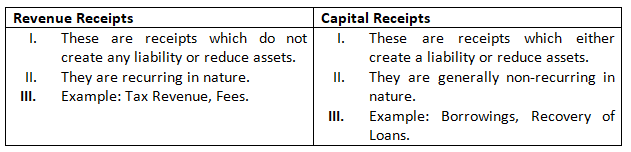
11. Distinguish between revenue receipts and capital receipts.
Answer-
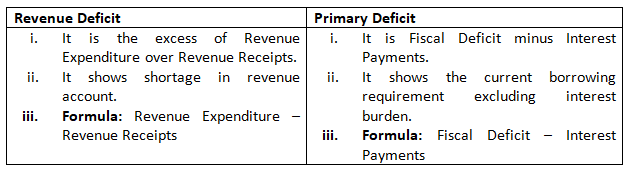
12. Distinguish between ‘Revenue Deficit’ and ‘Primary Deficit’.
13. State the basis of classification of government receipts into revenue receipts and capital receipts. Give an example of each.
Answer: Government receipts are classified on the basis of whether they create a liability or reduce assets.
- Revenue Receipts: Do not create any liability or reduce assets.
Example: Income Tax. - Capital Receipts: Create a liability or reduce assets.
Example: Borrowings by the Government.
14. Giving reasons, categorise the following into revenue receipts and capital receipts: (i) Recovery of loans; (ii) Corporation tax; (iii) Dividends on investments made by government; (iv) Sale of a public sector undertaking.
Answer –
(i) Recovery of Loans – Capital Receipt (It reduces government assets.)
(ii) Corporation Tax – Revenue Receipt (It is a tax received by the government.)
(iii) Dividends on Investments made by Government – Revenue Receipt (It is income earned by the government.)
(iv) Sale of a Public Sector Undertaking – Capital Receipt (It reduces government assets.)
15. Giving reasons, categorise the following into revenue expenditure and capital expenditure: (i) Subsidies; (ii) Grants given to State Government; (iii) Repayment of loans: (iv) construction of school buildings.
Answer –
(i) Subsidies – Revenue Expenditure (They do not create assets.)
(ii) Grants given to State Government – Revenue Expenditure (They are for day-to-day welfare purposes.)
(iii) Repayment of Loans – Capital Expenditure (It reduces government liabilities.)
(iv) Construction of School Buildings – Capital Expenditure (It creates durable assets.)
16. Giving reasons classify the following into direct & indirect tax: (i) Corporate tax; (ii) Goods and Services Tax.
Answer –
(i) Corporate Tax – Direct Tax (Its burden cannot be shifted to another person.)
(ii) Goods and Services Tax (GST) – Indirect Tax (Its burden is shifted to the final consumer.)
17. State the basis of classifiying government expenditure into revenue and capital expenditure. Give an example of each.
Answer: Government expenditure is classified on the basis of whether it creates assets or reduces liabilities.
- Revenue Expenditure: Does not create assets or reduce liabilities.
Example: Salaries of government employees. - Capital Expenditure: Creates assets or reduces liabilities.
Example: Construction of roads or school buildings.
18. Define the following: (1) Revenue deficit; and (2) primary deficit.
Answer:
(1) Revenue Deficit: Revenue Deficit occurs when Revenue Expenditure is more than Revenue Receipts of the government.
Revenue Deficit = Revenue Expenditure – Revenue Receipts
(2) Primary Deficit: Primary Deficit is the difference between Fiscal Deficit and Interest Payments.
Primary Deficit = Fiscal Deficit – Interest Payments
19. What are the implications of a large revenue deficit? Give two measures to reduce this deficit.
Answer: A large Revenue Deficit indicates that the government is unable to meet its regular expenses from its revenue receipts.
Measures to reduce it:
- Increase government revenue through higher tax collection.
- Reduce unnecessary government expenditure.
20. Explain the concept of ‘fiscal deficit’ in a government budget. What does it indicate?
Answer: Fiscal Deficit refers to the excess of Total Government Expenditure over Total Receipts excluding borrowings.
Fiscal Deficit = Total Expenditure – (Revenue Receipts + Non-Debt Capital Receipts)
It indicates the borrowing requirement of the government.
21. Explain the concept of ‘primary deficit’ in a government budget. What does it indicate?
Answer: Primary Deficit is the difference between Fiscal Deficit and Interest Payments.
Primary Deficit = Fiscal Deficit – Interest Payments
It indicates the current borrowing requirement of the government excluding interest burden on past loans.
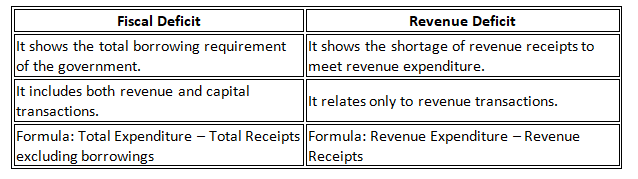
22. Distinguish between fiscal deficit and revenue deficit in a Government Budget.
23. Discuss the two sources to finance fiscal deficit.
Answer: The two main sources of financing Fiscal Deficit are:
- Borrowings: Government borrows from domestic and foreign sources.
- Deficit Financing: Government borrows from the central bank by issuing new currency.
24. Elaborate ‘economic growth’ as objective of government budget.
Answer: Government Budget promotes economic growth by:
- Increasing investment in infrastructure and productive activities.
- Providing funds for education, health and other development programmes.
- Encouraging production and employment opportunities.
25. Distinguish between Revenue Expenditure and Capital Expenditure in a government budget. Give examples.
26. Explain ‘revenue deficit’ in a government budget? What does it indicate?
Answer: Revenue Deficit is the excess of Revenue Expenditure over Revenue Receipts. It indicates that the government’s regular income is insufficient to meet its regular expenses.
27. Reduction in income inequalities raise welfare of the people. How can government help through government budget, in this regard? Explain.
Answer: Government reduces income inequalities through:
- Imposing higher taxes on high-income groups.
- Providing subsidies and welfare schemes for poor sections.
- Increasing expenditure on education, health and employment programmes.
28. “In the recent times, the Government of India has incurred a lot of expenditure on acquisition of indigenous defence items under’ Make-in-India’ programme.” Identify and discuss the two types of budget expenditures which may be undertaken by the Government as suggested in the above statement.
Answer: The two types of budget expenditures undertaken by the Government are:
1. Capital Expenditure: Expenditure on acquisition of defence items is a Capital Expenditure as it leads to the creation of assets for the government.
2. Revenue Expenditure: Expenditure on maintenance, repair and salaries related to defence services is a Revenue Expenditure as it does not create any asset.
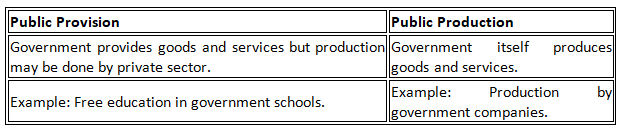
29. Differentiate between public public provision and public production.
30. Explain the distinction between fiscal deficit and primary deficit.
31. What is the basis of classify government expenditure into ‘Revenue Expenditure’ and ‘Capital Expenditure’? which of these types of expenditure is payment of salaries to government employees and why?
Answer: Government expenditure is classified on the basis of creation of assets or reduction of liabilities. Payment of salaries to government employees is Revenue Expenditure because it does not create any asset or reduce liability.
32. Explain the basis of classifying government receipts into revenue receipts and capital receipts. Which type of these receipts are borrowings by government and why?
Answer: Government receipts are classified on the basis of whether they create liabilities or reduce assets. Borrowings are Capital Receipts because they create liability for the government.
33. Is the following revenue expenditure or capital expenditure in the context of government budget? Give reason.
- Expenditure on collection of taxes.
- Expenditure on purchasing computers.
Answer –
(i) Expenditure on collection of taxes: Revenue Expenditure because it does not create any asset.
(ii) Expenditure on purchasing computers: Capital Expenditure because it creates an asset for the government.
34. (a) How are tax receipts different from no-tax receipts? Discuss briefly.
(b) State any two items of revenue expenditure in a government budget.
Answer:
a) Tax Receipts:
Receipts collected by the government through compulsory payments imposed on individuals and firms.
Example: Income Tax.
Non-Tax Receipts:
Receipts earned by the government from sources other than taxes.
Example: Fees, interest receipts.
b) Two items of Revenue Expenditure:
- Salaries of government employees.
- Subsidies.
35. Do ‘disinvestment’ and ‘loan proceeds from abroad’ constitute revenue receipts of the government? Give reasons.
Answer: No, both are Capital Receipts.
- Disinvestment: Reduces government assets.
- Loan proceeds from abroad: Create liability for the government.
36. Distinguish between Tax Revenue and Non-Tax Revenue.

37. Discuss briefly how the Government budget can be used as an effective tool in the process of employment generation.
Answer: Government Budget helps in employment generation by:
- Increasing expenditure on infrastructure projects.
- Promoting industries and production activities.
- Launching employment generation schemes.
38. “A budget can be deficit, surplus or balanced.” Do you agree with the given statement? Give valid reasons in support of your answer.
Answer: Yes, a budget can be:
- Deficit Budget: When expenditure is more than receipts.
- Surplus Budget: When receipts are more than expenditure.
- Balanced Budget: When receipts are equal to expenditure.
39. “Tax revenues, an important component of revenue receipts, can be further classified into two categories.” Imagine yourself as a member of Department of Revenue of the Government of India. Help your friend to identify and different between the two categories of taxes.
Answer: Tax Revenue is classified into:
1. Direct Taxes: The burden cannot be shifted to another person.
Example: Income Tax, Corporate Tax.
2. Indirect Taxes: The burden can be shifted to another person.
Example: GST.
Long Answer Type Questions
- Define Government budget. Explain the various objectives of government budget.
Answer: A Government Budget is an annual statement showing the estimated receipts and estimated expenditure of the government for a financial year.
The main objectives of Government Budget are:
- Allocation of Resources: The government uses the budget to allocate resources according to social and economic priorities. It provides funds for public goods like education, health, defence and infrastructure.
- Reduction of Inequalities of Income and Wealth: The government reduces income inequalities through progressive taxation and welfare schemes. Higher taxes are imposed on higher income groups and benefits are provided to weaker sections.
- Economic Stability: The government uses budgetary policies to control inflation and deflation. It maintains stability in the economy by adjusting taxes and public expenditure.
- Economic Growth: Government promotes economic growth by increasing investment in productive sectors, infrastructure and development activities.
- Management of Public Enterprises: The budget helps the government to manage and finance public sector enterprises for social welfare.
2. What is meant by non-tax revenue? Explain the different sources of non-tax revenue.
Answer: Non-Tax Revenue refers to the receipts of the government from sources other than taxes.
The main sources of Non-Tax Revenue are:
- Interest Receipts: Government earns interest on loans given to states, union territories and public sector enterprises.
- Fees: Fees are charges imposed by the government for providing specific services, such as registration fees.
- Fines and Penalties: The government receives income through fines and penalties imposed for violation of laws.
- Profits and Dividends: Government receives profits from public sector enterprises and dividends from its investments.
- License Fees: Government earns revenue by issuing licenses and permits.
3. What is meant by budget expenditure? Distinguish between revenue expenditure and capital expenditure
Answer: Budget Expenditure refers to the estimated expenditure to be incurred by the government during a financial year.
It is divided into two types:
- It is the expenditure which does not create any asset or reduce any liability of the government.
- It is related to the normal functioning of the government.
- Examples: Salaries, subsidies, pensions, interest payments.
2. Capital Expenditure
- It is the expenditure which creates assets or reduces liabilities of the government.
- It helps in increasing the productive capacity of the economy.
- Examples: Construction of roads, buildings and repayment of loans.
4. What is the meaning of revenue receipts? What are the two main sources of revenue receipts?
Answer: Revenue Receipts are those receipts of the government which neither create any liability nor reduce any asset of the government.
The two main sources of Revenue Receipts are:
- Tax Revenue: It includes receipts from taxes imposed by the government.
Examples: Income Tax, GST, Corporate Tax. - Non-Tax Revenue: It includes receipts from sources other than taxes.
Examples: Fees, interest receipts, dividends and profits.
5. Discuss the meaning of following deficits: (i) Revenue Deficit; (ii) Fiscal Deficit; and (iii) Primary Deficit.
Answer:
(i) Revenue Deficit – Revenue Deficit occurs when Revenue Expenditure exceeds Revenue Receipts.
(ii) Fiscal Deficit – Fiscal Deficit is the excess of total government expenditure over total receipts excluding borrowings.
(iii) Primary Deficit – Primary Deficit is the difference between Fiscal Deficit and Interest Payments.
Primary Deficit = Fiscal Deficit – Interest Payments
6. Distinguish between; (a) Direct tax and Indirect tax (b) Primary deficit and Revenue deficit.
Answer – (a) Direct tax and Indirect tax
(b) Primary deficit and Revenue deficit.
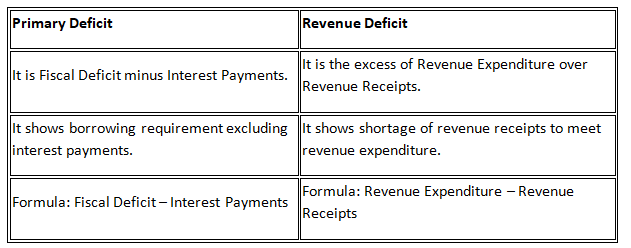
7. Distinguish between the following: (a) Revenue receipts and Capital receipts; (b) Revenue deficit and Fiscal deficit.
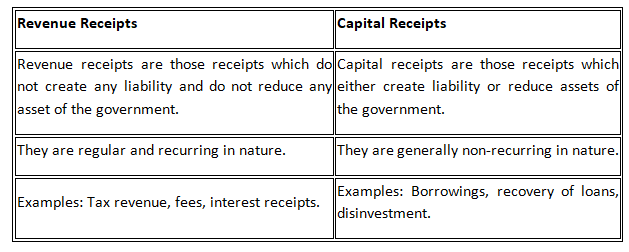
(b) Revenue Deficit and Fiscal Deficit
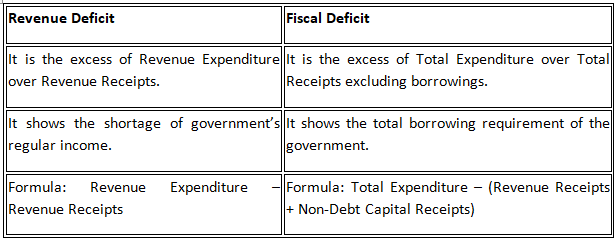
8. Explain the objectives of resources of resource allocation and income distribution in a government budget.
Answer –
Resource Allocation: The government uses the budget to allocate resources according to economic and social priorities.
- It provides funds for public goods like education, health, defence and infrastructure.
- It encourages production of socially desirable goods through subsidies.
- It discourages harmful goods through taxation.
Income Distribution: The government aims to reduce inequalities of income and wealth.
- Higher taxes are imposed on high-income groups.
- Government provides subsidies and welfare schemes for weaker sections.
- Public expenditure on education, health and employment helps in improving living standards.
9. Explain the role the government can play through the budget in influencing allocation of resources.
Answer: Government influences allocation of resources through:
- Tax Policy: The government imposes higher taxes on goods that are socially harmful and provides tax benefits to encourage useful activities.
- Subsidies: Subsidies are provided to encourage production of essential and socially desirable goods.
- Public Expenditure: Government spends on infrastructure, education, health and defence to ensure proper utilisation of resources.
10. Explain how the government can use the budgets policy in reducing inequalities in incomes.
Answer: The government reduces income inequalities through the following measures:
- Progressive Taxation: Higher taxes are imposed on higher income groups.
- Public Welfare Programmes: Government spends on education, health, housing and employment schemes for poor people.
- Subsidies: Subsidies are provided on essential goods to help low-income groups.
11. Explain the role of government budget in fighting inflationary and deflationary tendencies.
Answer: Government Budget helps in maintaining economic stability.
During Inflation:
- Government increases taxes to reduce purchasing power.
- It reduces unnecessary public expenditure.
- These measures help to control excess demand.
During Deflation:
- Government increases public expenditure.
- It reduces taxes to increase purchasing power.
- These measures increase demand and employment.
12. What is government budget? Explain how taxes and subsidies can be used to influence allocation of resources.
Answer: A Government Budget is an annual statement showing estimated receipts and expenditure of the government for a financial year.
Taxes and subsidies influence allocation of resources in the following ways:
Taxes:
- Higher taxes are imposed on harmful goods to reduce their production.
- Tax benefits are provided to encourage certain industries.
Subsidies:
- Subsidies encourage production of essential and socially desirable goods.
- They help producers by reducing their cost of production.
13. What is the difference between direct tax and indirect tax? Explain the role of government budget in influencing allocation of resources.
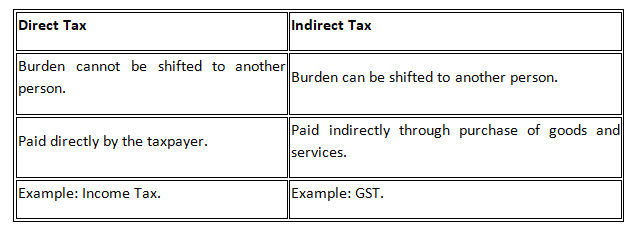
Role of Budget in Allocation of Resources:
- Government uses taxes and subsidies to encourage or discourage production.
- Public expenditure is used for development of infrastructure and public services.
- Resources are directed towards socially desirable sectors.
14. Explain the budgetary measures for achieving following objectives: (i) Setting up of production units in backward regions: (ii) Reducing inequalities of income and wealth.
Answer –
(i) Setting up of production units in backward regions
Government can encourage industries in backward regions by:
- Providing tax concessions and subsidies.
- Developing infrastructure facilities.
- Providing financial assistance to industries.
(ii) Reducing inequalities of income and wealth
Government can reduce inequalities by:
- Imposing higher taxes on rich sections.
- Providing subsidies and welfare schemes to poor sections.
- Increasing expenditure on education, health and employment programmes.
15. Define revenue receipts in a government budget. Explain how government budget can be used to bring in price stability in the economy.
Answer –
Revenue Receipts – Revenue Receipts are those receipts of the government which do not create any liability and do not reduce the assets of the government. They are received in the normal course of government activities.
Examples:
- Tax Revenue (Income Tax, GST, Corporation Tax)
- Non-Tax Revenue (Fees, Fines, Interest, Dividends)
Government Budget and Price Stability
The government uses the budget to control inflation and deflation.
During Inflation (Excess Demand):
- Increase taxes to reduce purchasing power.
- Reduce government expenditure to decrease aggregate demand.
During Deflation (Deficient Demand):
- Reduce taxes to increase disposable income.
- Increase government expenditure to raise aggregate demand and employment.
16. Explain the basis of classifying taxes into direct and indirect tax. Give two examples of each.
Answer – Basis of Classification – Taxes are classified on the basis of whether the burden of tax can be shifted to another person or not.
Direct Taxes – Direct taxes are those whose burden cannot be shifted to another person. The person who pays the tax also bears its burden.
Examples:
- Income Tax
- Corporation Tax
Indirect Taxes – Indirect taxes are those whose burden can be shifted to another person. They are collected from producers or sellers but ultimately paid by consumers.
Examples:
- Goods and Services Tax (GST)
- Customs Duty
17. What is the difference between revenue expenditure and capital expenditure? Explain how taxes and government expenditure can be used to influence distribution of income in the society.
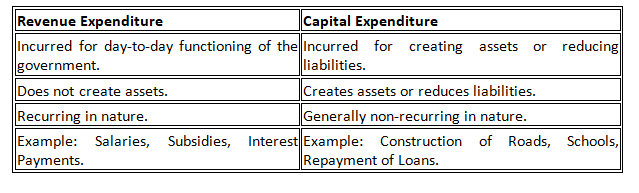
Distribution of Income
The government reduces income inequalities through:
1. Taxes
- Imposes higher direct taxes on high-income groups.
- Provides tax relief to low-income groups.
2. Government Expenditure
- Increases expenditure on education, health, employment programmes and social welfare.
- Provides subsidies and financial assistance to weaker sections.
18. What is government budget? Explain its major components.
Government Budget – A Government Budget is an annual financial statement showing the estimated receipts and estimated expenditure of the government for one financial year.
Major Components
1. Budget Receipts – Money received by the government.
Types:
- Revenue Receipts
- Capital Receipts
2. Budget Expenditure – Money spent by the government.
Types:
- Revenue Expenditure
- Capital Expenditure
19. Explain: (a) Allocation of Resources; and (b) Economic Stability as objective of Government Budget.
Answer –
(a) Allocation of Resources – The government allocates resources according to national priorities.
It does so by:
- Promoting priority sectors like education, health and defence.
- Discouraging harmful goods through higher taxes.
- Encouraging desirable industries by giving subsidies.
(b) Economic Stability – The government maintains stability by controlling inflation and deflation.
It does so by:
- Increasing taxes and reducing expenditure during inflation.
- Reducing taxes and increasing expenditure during recession or deflation.
20. Explain the distinction between Revenue Receipts and Capital Receipts in a government budget. Give their components.
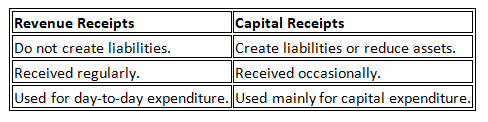
Components of Revenue Receipts
- Tax Revenue
- Non-Tax Revenue
Components of Capital Receipts
- Borrowings
- Recovery of Loans
- Disinvestment (Sale of Government Shares)
21. Discuss the concepts of: (i) Balanced Budget; (ii) Surplus Budget: (iii) Deficit Budget.
Answer –
(i) Balanced Budget – A budget in which Estimated Receipts = Estimated Expenditure.
Receipts = Expenditure
(ii) Surplus Budget – A budget in which Estimated Receipts > Estimated Expenditure.
Receipts > Expenditure
It is generally used to control inflation.
(iii) Deficit Budget – A budget in which Estimated Expenditure > Estimated Receipts.
Expenditure > Receipts
Unsolved Practical’s
- In a government boudget, revenue deficit is Rs.40 crores. If revenue receipts are Rs.90 crores and capital receipts Rs.60 crores, then how much is the revenue expenditure?
Ans. Revenue Deficit = Revenue Expenditure – Revenue Receipts
40 crores = Revenue Expenditure – 90 crores
Revenue Expenditure = 40 + 90 crores
= 130 crores
2. In a government budget, primary deficit is Rs.5,000 crores and interest payment is Rs.4,000 crores. How much is the fiscal deficit?
Ans. Primary Deficit = Fiscal Deficit – Interest payment
5000 crores = Fiscal Deficit – 4,000
Fiscal Deficit = 5,000 + 4,000
= 9,000 crores
3. As per the government budget, the interest payments are estimated at 1,60,000 crores. If total borrowing requirements of the government are 2,40,000 crores, then how much is primary deficit?
Solution – Interest payment = 1,60,000 crores
Borrowing = 2,40,000 crores
Primary Deficit = Fiscal Deficit – Interest payment
= 2,40,000 – 1,60,000
= Rs.80,000 crores
4. The interest payments as per the government budget during a year are Rs.13,500 crores, which is 30% of primary deficit. Calculate fiscal deficit.
Solution –
Interest = 13,500
Primary Deficit = 13,500 / 30 x 100
= Rs.45,000
FD = PD + Interest payment
= 45,000 + 13,500
= 58,500 crores
5. From the following data about a government budget, find (a) Revenue Deficit, (b) Fiscal Deficit and (c) Primary Deficit:
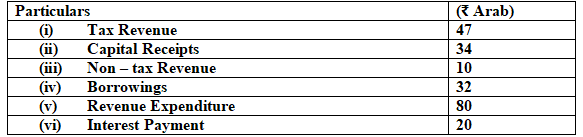
Solution –
- RD = RE – RR
= 80 – 57
= 23 Arab
- FD = 32 Arab
- PD = FD – Interest payment
= 32 – 20
= 12 Arab.
6. Calculate: (a) Revenue Deficit, (b) Fiscal Deficit and (c) Primary Deficit from the following data:

Solution –
- RD = RE – RR
= 45,000 – 35,000
= 10,000 crores
b. FD = 12,000 crores
c. PD = FD – Interest payment
= 12,000 – 3000
= 9,000 crores
7. From the given information, calculate: (a) Revenue Receipts (b) fiscal Deficit and (c) Primary Deficit:

8. From the following information, determine: (a) Capital Expenditure and (b) Interest Payments:

9. From the given information, calculate: (a) Revenue Deficit and (b) Fiscal Deficit:
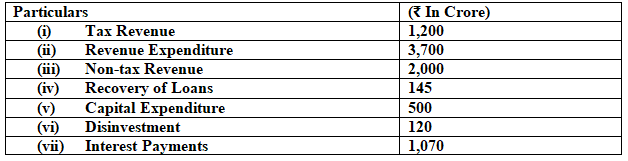
10. On the basis of the given information, calculation the values of the following: (i) Fiscal Deficit; (ii) Primary Deficit.

NCERT