excess demand and deficient demand class 12 notes
problem of deficient demand and excess demand class 12 notes pdf
excess demand and deficient demand class 12 important questions
excess demand and deficient demand class 12 pdf
excess demand and deficient demand class 12th notes
INTRODUCTION
According to Keynes, the equilibrium level of employment may or may not be the full employment level. It means, equilibrium level may exceed or fall short of full employment level.
It equilibrium level exceeds the full employment level, then there is excess demand in the economy. However, if equilibrium level falls short of full employment level, then it is a situation of deficient demand.
EXCESS DEMAND
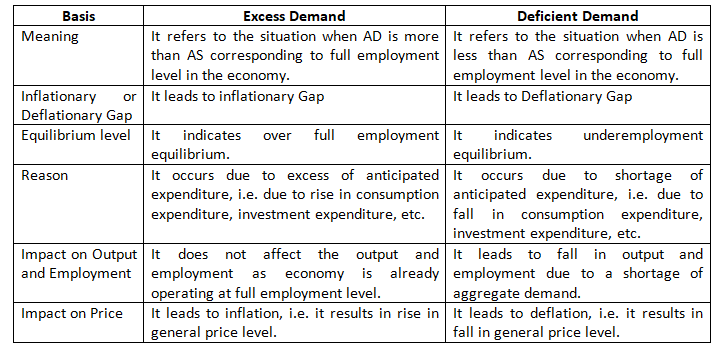
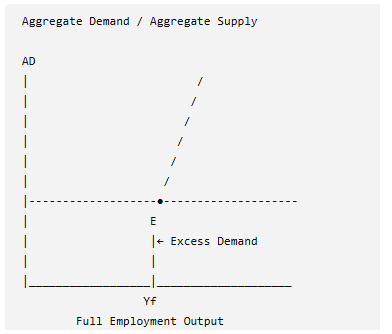
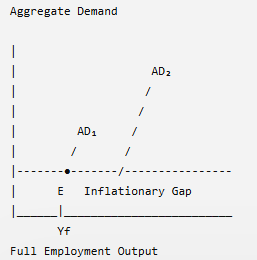
Excess demand refers to the situation when aggregate demand (AD) is more than the aggregate supply (AS) corresponding to the full employment level of output in the economy. It is the excess of anticipated expenditure over the value of full employment output. Excess demand gives rise to an inflationary gap. Inflationary gap refers to the gap by which actual aggregate demand exceeds the aggregate demand required to establish full employment equilibrium.
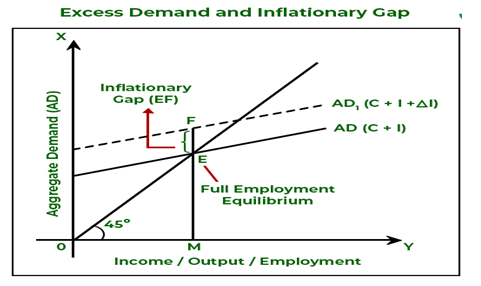
Reasons for Excess Demand
Excess demand may arise due to several factors. Important, among them are mentioned below:
- Rise in the Propensity to consume: Excess demand may arise because of an increase in consumption expenditure due to a rise in the propensity to consume or fall in the propensity to save.
- Reduction in taxes: It may also occur due to increase in disposable income and consumption demand because of decrease in taxes.
- Increase in Government Expenditure: Rise in government demand for goods and services due to increase in public expenditure will also result in excess demand.
- Increase in Investment: Excess demand can also arise when there is increase in investment due to decrease in rate of interest or increase in expected returns.
- Fall in Imports: Excess demand may also arise when demand for exports increases due to comparatively lower prices of domestic goods or due to decease in the exchange rate for domestic currency.
- Deficit Financing: Excess demand may be caused due to increase in the money supply caused by deficit financing.
Impact of Excess Demand
Excess demand is not a desired situation because it does not lead to any increase in level of aggregate supply as the economy is already at full employment level. Excess demand has the following effect on output, employment and general price level:
- Effect on Output: Excess demand does not affect the level of output because economy is already at full employment level and there is not idle capacity in the economy.
- Effect on Employment: There will be no change in the level of employment as the economy is already operating at full employment equilibrium and there is no involuntary unemployment.
- Effect on General Price Level: Excess demand leads to a rise in the general price level (known as inflation) as aggregate demand is more than aggregate supply.
DEFICIENT DEMAND
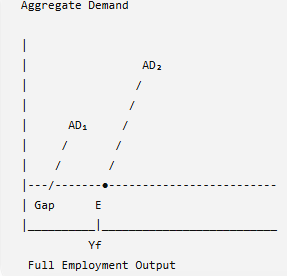
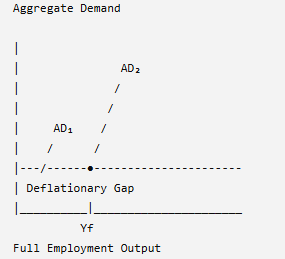
Deficient demand refers to the situation when aggregate demand (AD) is less than the aggregate supply (AS) corresponding to full employment level of output in the economy. The situation of deficient demand arises when planned aggregate expenditure falls short of aggregate supply at the full employment level. It gives rise to deflationary gap. Deflationary gap is the gap by which actual aggregate demand falls short of aggregate demand required to establish full employment equilibrium.
Reason for Deficient Demand
The reasons for occurrence of deficient demand are almost opposite to the reasons for excess demand. The main causes for deficient demand are:
- Decrease in Propensity to consume: A decrease in consumption expenditure, due to fall in the propensity to consume, leads to deficient demand in the economy.
- Increase in taxes: AD may also fall due to imposition of higher taxes. It leads to decrease in disposable income and, as a result, the economy suffers from deficient demand.
- Decrease in Government Expenditure: Increase in the rate of interest or fall in the expected returns lead to decrease in the investment expenditure. It reduces the AD and gives rise to deficient demand.
- Rise in Imports: When international prices are comparatively less than the domestic prices, then it may lead to a rise in imports, implying a cut in the aggregate demand.
- Fall in Exports: Exports may fall due to comparatively higher prices of domestic goods or due to increase in the exchange rate for domestic currency. This will lead to deficient demand.
IMPACT OF DEFICEINT DEMAND
Deficient demand creates many difficulties in the economy due to its deflationary nature. Generally, deficient demand adversely affects the level of output, employment and price level in the economy.
- Effect on Output: Due to lack of sufficient aggregate demand, there will be an increase in the inventory stock. It will force the firms to plan for lesser production for the subsequent period. As a result, planned output will fall.
- Effect on Employment: Deficient demand causes involuntary unemployment in the economy due to fall in the planned output.
- Effect on General Price Level: Deficient demand causes the general prices to fall due to lack of demand for goods and services in the economy.
EXCESS DEMAND VS DEFICIENT DEMAND
MEASURES TO CONTROL EXCESS AND DEFICIENT DEMAND
The problems of excess demand and deficient demand occur when the current aggregate demand is more or less than the aggregate demand required for full employment equilibrium. These problems can be solved by bringing a change in the level of aggregate demand in the economy. There are number of measures to control excess and deficient demand. However, the scope of the syllabus restricts the study of following measures:
- Change in Government Spending – Government spending is an important component of aggregate demand. This measure is a part of Fiscal Policy and is termed as ‘Expenditure Policy’ of the Government.
- Change in Taxes – Taxes’ is the main source of revenue for the government. This measure is part of Fiscal Policy and is termed as ‘Revenue Policy’ of the Government. Government imposes different kinds of direct and indirect taxes on the public.
- Change in Money Supply or Availability of Credit – The Reserve Bank of India (RBI) is empowered to regulate the money supply in the economy through its ‘Monetary Policy’.
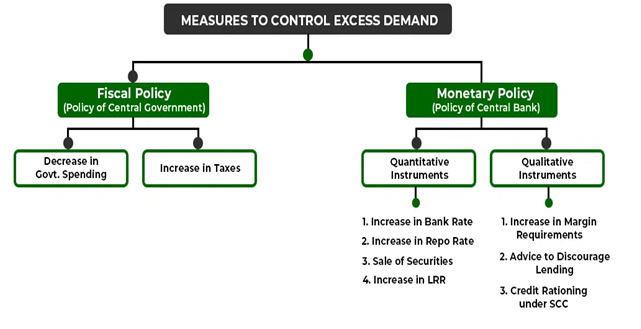
MEASURES TO CORRECT EXCESS DEMAND
During excess demand, the current aggregate demand in the economy is more than the full employment level of output. It happens because of rise in money supply and availability of credit at easy terms. In order to correct Excess Demand, the following measures may be adopted:
Decrease in Government Spending
It is a part of Fiscal Policy. The government spends a huge amount on infrastructure and administrative activities. To control the situation of excess demand, Government should reduce it expenditure to the maximum possible extent.
Increase in Taxes – During excess demand, government increases the rates of taxes and even imposes some new taxes. It leads to decrease in the level of aggregate expenditure in the economy and help to control the situation of excess demand.
Decrease in Money Supply or Availability of Credit
The Central Bank (RBI) aims to reduce availability of credit in the economy through its ‘Monetary Policy’. Two major instruments of Monetary Policy used to decrease money supply are:
- Increase in Bank Rate – Bank rate is the rate at which the central bank lends money to commercial banks to meet their long-term needs. During excess demand, central bank increases the bank rate, which raises the cost of borrowings from the central bank.
- Increase in Repo Rate – Repo rate is the rate at which the central bank lends money to commercial banks to meet their short-term needs. During excess demand, central bank increase the repo rate, which increase the cost of borrowings from the central bank.
- Increase in Reverse Repo Rate – Reverse Repo Rate is the rate of interest at which commercial banks can deposit their surplus funds with the Central Bank, for a relatively shorter period fo time. To deal with the situation of excess demand, Reverse Repo Rate may be increased by the Central Bank.
- Open Market Operations (Sale of securities) – Open Market operations refer to sale and purchase of securities in the open market by the central bank. It directly influences the level of money supply in the economy.
- Increase in Legal Reserve Requirements (LRR) – Commercial banks are obliged to maintain legal reserves. An increase in such reserves is a direct method to reduce the availability of credit. There are two components of legal reserves:
- Cash Reserve Ratio (CRR)
- Statutory Liquidity Ratio (SLR)
2. Qualitative Instruments
- Increase in Margin Requirements – Margin requirement refers to difference between the market value of security offered and the value of amount lent. When the economy is suffering from excess demand, central bank increase the margin, which restricts the credit creating power of banks.
- Moral Suasion (Advise to Discourage Lending) – This is a combination of persuasion and pressure that Central Bank applies on other banks in order to get them act, in a manner, in line with its policy.
- Selective Credit Controls (Introduce Credit Rationing) – It refers to a method in which the central bank gives direction to other banks to give or not to given credit for certain purposes to particular sectors.
MEASURES TO CORRECT DEFICINT DEMAND
During a situation of deficient demand, the level of aggregate demand in the economy is less then the full employment level of output. It happens due to decrease in money supply and availability of credit. The measures adopted to control deficient are just the opposite of the measures used in excess demand.
Increase in Government Spending – It is a part of fiscal policy. Government incurs expenditure on infrastructural and administrative activities. During deficient, the government should increase expenditure on public works like construction of roads, flyovers, building, etc. with a view to provide additional income to people.
Decrease in Taxes – During deficient demand, government reduces the rates of taxes and even abolishes some of the taxes. It raises the purchasing power of people. Due to increase in disposable income, people are able to spend more on consumption and investment. It raises the level of aggregate demand and helps to control the situation of deficient demand.
Increase in Money Supply or Availability of Credit – During deflationary situation, the central bank aims to ensure easy availability of credit and reducing cost of borrowing money through its ‘Monetary Policy’.
- Quantitative Instruments
- Decrease in Bank Rate – Bank rate is the rate at which the central bank lends money to commercial banks to meet their long-term needs. During deficient demand, the central bank reduces the bank rate in order to expand credit.
- Decrease in Repo Rate – Repo rate is the rate at which the central bank lends money to commercial banks to meet their short-term needs. During deficient demand, the central bank decrease the repo rate to expand credit.
- Decrease in Reverse Repo Rate – Reverse Repo Rate is the rate of interest at which commercial bank can deposited their surplus funds with the Central bank for a relatively shorter period of time.
- Open Market Operations (Purchase of securities) – Open market operating refer to sale and purchase of securities in the open market by the central bank. It derectly influences the level of money supply in the economy. During deficient demand, the central bank starts purchasing securities from the open market.
- Decrease In Legal Reserve Requirements (LRR) – Commercial banks are obliged to maintain legal reserves. Decrease in such reserve helps to raise the availability of credit. There are two components of legal reserves:
- Cash Reserve Ratio (CRR) – It is the minimum percentage of net demand and time liabilities to be kept by commercial banks with the central bank.
- Statutory Liquidity Ratio (SLR) – It refers to a minimum percentage of net demand and time liabilities, which commercial bank are required to maintain with themselves.
2. Qualitative Instruments
- Decrease in Margin Requirements – Margin requirement refers to difference between the market value of security offered and the value of amount lent. During deficient demand, central bank reduces the margin, which enhances the credit creating power of banks.
- Moral Suasion (Advise to Encourage Lending) – This is a combination of persuasion and pressure that Central Bank applies on other banks in order to get them act, in manner, in line with its policy. During deficient demand, the central bank advises, requests or persuades the commercial banks to encourage credit.
- Selective Credit Control (Withdraw Credit Rationing) – It refers to a method in which the central bank gives direction to other banks to give or not to give credit for certain purpose to particular sectors. During deficient demand, the central bank withdraws rationing of credit and make efforts to encourage credit.
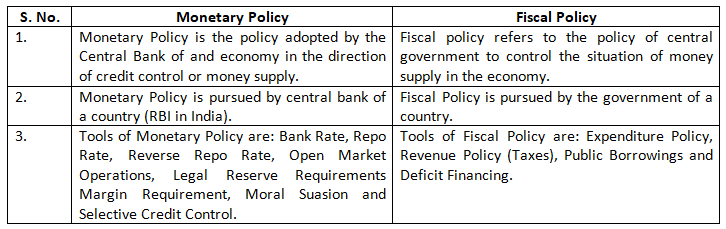
Monetary Policy Vs Fiscal Policy
EXCESS AND DEFICIENT DEMAND IN THREE-SECTOR ECONOMY
In a three-sector economy, with households, firms and government, AD is the sum total of consumption (C), investment (I) and government expenditure (G). With introduction of government sector, the new AD1 curve (C + I + G) lies above the old AD curve (C + I).
Short Answer Type Questions
- Does the situation of excess demand arise? How do you measure it? Show it with the help of a diagram.
Answer – Meaning of Excess Demand – Excess Demand is a situation in which Aggregate Demand (AD) is greater than Aggregate Supply (AS) at the full employment level of output.
AD > AS
In such a situation, the economy does not have enough goods and services to satisfy the existing demand. As a result, the general price level rises and creates inflationary pressure.
Measurement of Excess Demand
Excess Demand is measured as the difference between Aggregate Demand and Aggregate Supply at the full employment level of income.
Formula
Excess Demand = Aggregate Demand – Aggregate Supply
or
Excess Demand = Planned Expenditure – Full Employment Output
2. Suppose an imaginary economy is facing a situation of deficient demand in the short run time period. Discuss briefly the probable impacts of the same on the economy.
Answer – Deficient Demand refers to a situation in which Aggregate Demand is less than Aggregate Supply at the full employment level of output.
AD < AS
Effects of Deficient Demand
- Fall in Production
- Producers reduce output because goods remain unsold.
- Increase in Unemployment
- Firms reduce employment due to lower production.
- Decline in Income
- National income and people’s earnings decrease.
- Fall in Investment
- Businessmen reduce investment because of low demand.
- Price Level Falls
- Continuous fall in demand leads to downward pressure on prices.
- Economic Slowdown
- The economy enters a recessionary phase.
- Explain the meaning of inflationary gap with the help of a diagram.
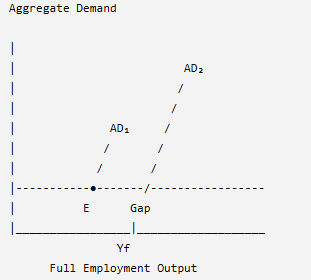
3. Explain the meaning of inflationary gap with the help of a diagram.
Answer – Inflationary Gap is the excess of Aggregate Demand over Aggregate Supply at the full employment level of output.
It represents the amount by which planned expenditure exceeds the value of goods and services available at full employment.
It represents the amount by which planned expenditure exceeds the value of goods and services available at full employment.
Formula
Inflationary Gap = Aggregate Demand – Aggregate Supply (at Full Employment)
4. Discuss the concept of deflationary gap with the help of a diagram.
Answer – A Deflationary Gap is the amount by which Aggregate Demand falls short of Aggregate Supply at the full employment level of output.
It indicates a shortage of demand in the economy.
Deflationary Gap = Aggregate Supply – Aggregate Demand (at Full Employment)
5. Define Inflationary Gap. State, how the Central Bank of an economy can control the situation of inflationary gap, using any monetary policy measure.
Answer
Inflationary Gap – Inflationary Gap refers to the excess of Aggregate Demand over Aggregate Supply at the full employment level of output.
It creates inflation because demand exceeds the economy’s productive capacity.
Monetary Policy Measure (Increase in Bank Rate)
The Central Bank can control the inflationary gap by increasing the Bank Rate (Repo Rate).
Working
- The Central Bank raises the Bank Rate.
- Commercial banks borrow funds at a higher cost.
- Banks increase lending interest rates.
- Loans become expensive.
- Borrowing by consumers and firms declines.
- Consumption and investment expenditure decrease.
- Aggregate Demand falls.
- Inflationary Gap is reduced.
6. Read the following news published on September 26, 2022. “The central bank has increased the benchmark lending rate by 140 basis points.” Identify the likely cause and consequence behind this action taken by the Reserve Bank of India.
Answer
The increase in the benchmark lending rate (Repo Rate) by the Reserve Bank of India indicates that the economy was facing excess demand and rising inflation.
Cause
- Aggregate Demand was higher than Aggregate Supply.
- Inflationary pressure was increasing in the economy.
- RBI adopted a contractionary monetary policy to control inflation.
Consequences
- Commercial banks borrow funds from RBI at a higher rate.
- Banks increase lending rates to customers.
- Loans become costly.
- Consumption and investment expenditure decline.
- Aggregate Demand falls.
- Inflationary pressure is reduced and price stability is restored.
7. How can a central bank control excess demand in an economy by making changes in the legal reserve requirements?
Answer
The Central Bank can control excess demand by increasing the Cash Reserve Ratio (CRR) and the Statutory Liquidity Ratio (SLR).
Explanation
- When CRR and SLR are increased, commercial banks are required to keep a larger proportion of their deposits with the RBI or in liquid assets.
- As a result, banks have less money available for lending.
- Credit creation decreases.
- Money supply in the economy falls.
- Consumption and investment expenditure decline.
- Aggregate Demand decreases.
- Excess demand is controlled.
8. Explain any two measures to remedy the problem of excess demand in an economy.
Answer
Excess demand can be controlled through the following measures:
(i) Increase in Bank Rate (Repo Rate)
- The Central Bank increases the Bank Rate.
- Borrowing becomes expensive.
- Loans decline.
- Consumption and investment expenditure decrease.
- Aggregate Demand falls.
(ii) Increase in Taxes
- The Government increases direct or indirect taxes.
- Disposable income of people decreases.
- Consumption expenditure falls.
- Aggregate Demand is reduced.
- Inflationary pressure is controlled.
9. “Decrease in the money supply helps in controlling the situation of excess demand in an economy”. Comment.
Ans.
The given statement is correct.
When the money supply is reduced, the availability of credit in the economy declines. Commercial banks lend less, and borrowing becomes difficult. As a result, consumption and investment expenditure decrease, leading to a fall in Aggregate Demand. Since excess demand is the main cause of inflation, a reduction in money supply helps control rising prices and restores economic stability.
10. Would you advocate expansion or contraction of money supply during excess demand?
Ans. During a situation of excess demand, the Central Bank should adopt a contractionary monetary policy. Under this policy, the money supply is reduced by increasing the Bank Rate, increasing CRR and SLR, and selling government securities through Open Market Operations. A reduction in money supply decreases credit availability, reduces consumption and investment expenditure, lowers Aggregate Demand, and helps control inflation.
11. Explain how government spending can be helpful in removing deficient demand.
Ans.
Deficient Demand is a situation where Aggregate Demand (AD) is less than Aggregate Supply (AS) at the full employment level. The Government can remove deficient demand by increasing its expenditure on public works, infrastructure, education and health services. Higher government spending increases the income of people, which raises consumption and investment expenditure. As a result, Aggregate Demand increases and the economy moves towards the full employment level.
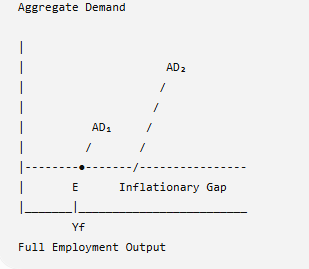
12. Discuss the role of government in correcting excess demand with the help of a diagram.
Answer
The Government can correct excess demand by adopting a contractionary fiscal policy.
It may:
- Increase taxes.
- Reduce government expenditure.
These measures reduce the disposable income of people, leading to a fall in consumption and investment. Consequently, Aggregate Demand decreases, helping to control inflation.
13. Explain the role of margin requirements in dealing with the problem of excess demand.
Answer – Margin Requirement is the difference between the market value of a security and the amount of loan granted against it. To control excess demand, the Central Bank increases the margin requirement. As a result, borrowers receive a smaller loan against the same security. This reduces credit availability, decreases consumption and investment expenditure, and lowers Aggregate Demand.
14. What role dose government expenditure play to control deficient demand in a three-sector economy? Use diagram.
Answer – In a three-sector economy, the Government controls deficient demand by increasing government expenditure. Higher expenditure on roads, schools, hospitals and public welfare generates employment and raises people’s income. This increases consumption expenditure and Aggregate Demand, helping the economy reach the full employment level.
15. Explain the role of “open market operation” in controlling the inflationary gap.
Answer – Open Market Operations (OMO) refer to the buying and selling of government securities by the Central Bank. To control an inflationary gap, the Central Bank sells government securities to the public. People purchase these securities by paying money to banks. This reduces the money supply, decreases credit creation, lowers Aggregate Demand, and helps control inflation.
16. Explain the role of taxation in reducing excess demand.
Answer – Taxation is an important fiscal policy measure to control excess demand. The Government increases direct taxes (such as income tax) or indirect taxes (such as GST). Higher taxes reduce the disposable income of consumers, leading to a fall in consumption expenditure. As a result, Aggregate Demand decreases, helping to control inflation.
17. “With the objective to correct deflation, Reserve Bank of India may decrease Repo-rate.” Discuss the behind the step taken by the Reserve Bank of India (RBI).
Answer – Deflation occurs when Aggregate Demand (AD) is less than Aggregate Supply (AS). To remove deflation, the RBI decreases the Repo Rate. As a result, commercial banks can borrow funds from the RBI at a lower cost. Banks reduce their lending rates, making loans cheaper. This encourages borrowing for consumption and investment. Consequently, Aggregate Demand increases, helping to remove deflationary conditions.
18. “With the objective to correct deflation, Reserve Bank of India may decrease the Bank rate.” Discuss the rationale behind the step taken by the Reserve Bank of India (RBI).
Answer – The Bank Rate is the rate at which the RBI lends money to commercial banks for the long term.
To correct deflation, the RBI reduces the Bank Rate. This lowers the cost of borrowing for commercial banks. Banks, in turn, reduce the interest rates charged to customers. Cheaper credit encourages borrowing, increases consumption and investment expenditure, and raises Aggregate Demand.
19. What is meant by Margin Requirement? How does the Central Bank use this measure to control deflationary conditions in an economy?
Answer – Margin Requirement is the difference between the market value of a security and the amount of loan granted against it. During deflation, the Central Bank reduces the margin requirement. This enables borrowers to obtain a larger loan against the same security. As credit availability increases, consumption and investment expenditure rise, leading to an increase in Aggregate Demand.
20. Show inflationary gap using a well labelled diagram. Suggest any two fiscal measures to correct the situation of inflationary gap.
Answer
Inflationary Gap is the excess of Aggregate Demand over Aggregate Supply at the full employment level of output.
Fiscal Measures
- Increase Taxes – Higher taxes reduce disposable income and consumption expenditure.
- Reduce Government Expenditure – Lower government spending reduces Aggregate Demand.
21. In the given figure, what does the gap ‘KT’ represent? State any two fiscal measures to correct the situation.
Answer – The gap ‘KT’ represents the Inflationary Gap. It shows that Aggregate Demand is greater than Aggregate Supply at the full employment level.
Fiscal Measures
- Increase Taxes to reduce disposable income and consumption.
- Reduce Government Expenditure to decrease Aggregate Demand.
22. State the impact of “Excess Demand” under the Keynesian theory on employment in an economy.
Ans.
According to Keynesian theory, excess demand occurs when Aggregate Demand is greater than Aggregate Supply at full employment level.
In the short run, excess demand does not increase employment because the economy is already at full employment level. It only leads to a rise in the general price level and causes inflation.
23. Explain how the ‘Reserve Repo Rate’ helps in correcting Excess Demand in an economy.
Answer
To control excess demand, the RBI increases the Reverse Repo Rate.
- A higher Reverse Repo Rate encourages commercial banks to deposit more funds with RBI.
- Money supply with banks decreases.
- Credit creation reduces.
- Aggregate Demand falls.
- Inflationary pressure is controlled.
24. ‘India’s GDP contracted 23.9% in the April-June quarter of 2020-21 as compared to same period of 2019 – 20, suggesting that the lockdown has hit the economy hard’.
Answer
The fall in GDP indicates a situation of deficient demand caused by the lockdown.
Due to restrictions:
- Production activities declined.
- Consumption and investment expenditure decreased.
- Employment and income levels fell.
- Aggregate Demand reduced.
25. State the meaning of ‘Deficient Demand’. Suggest any two monetary policy tools used to reduce deficient demand.
Answer
Deficient Demand refers to a situation when Aggregate Demand is less than Aggregate Supply at full employment level.
Two monetary policy tools to correct deficient demand are:
- Decrease in Bank Rate – It makes borrowing cheaper and increases credit availability.
- Decrease in Repo Rate – It reduces the cost of borrowing for commercial banks and increases money supply.
26. Discuss briefly, how the government can control the situation of deflation using the following: (a) Taxation Policy; and (b) Government Expenditure Policy.
Ans.
(a) Taxation Policy – The Government can reduce taxes to increase disposable income of people. Higher income increases consumption expenditure and Aggregate Demand.
(b) Government Expenditure Policy – The Government can increase public expenditure on infrastructure and welfare activities. It creates employment and increases income, which raises Aggregate Demand.
27. If in an economy, Bank rate is increased, how will it affect the demand for credit? Explain.
Answer
An increase in Bank Rate makes borrowing from the RBI expensive for commercial banks. Banks increase their lending rates.
As a result:
- Loans become costly.
- Demand for credit decreases.
- Consumption and investment expenditure fall.
28. “The Government has raised the exemption limit for the payment of Income tax from Rs.2 lakh to Rs.2.5 lakh.” If the situation of deficient demand is prevailing in the economy, what will be the impact of this action taken by the Government?
Answer
In a situation of deficient demand, an increase in the income tax exemption limit will increase the disposable income of people.
As a result:
- Consumption expenditure increases.
- Aggregate Demand rises.
- Deficient demand is reduced.
- Economic activity improves.
29. Demonstrate your understanding of how the Reserve Bank of India can apply monetary policy tools to tackle scenario of Deficient Demand in the economy. Identify and discuss four specific measures that the RBI can employ to effectively correct the situation.
Answer
To correct deficient demand, RBI adopts an expansionary monetary policy.
Four measures are:
- Decrease in Repo Rate – Reduces borrowing cost and increases credit.
- Decrease in Bank Rate – Encourages commercial banks to borrow more from RBI.
- Decrease in CRR – Increases lending capacity of banks.
- Purchase of Government Securities (Open Market Operations) – Increases money supply in the economy.
30. “With an objective to reduce inflation, government may reduce public Expenditure.” Discuss the rationale behind such a step which may be taken by the Government.
Answer
Inflation is generally caused by excess demand in the economy.
When the Government reduces public expenditure:
- Government demand decreases.
- Income generation reduces.
- Consumption expenditure falls.
- Aggregate Demand decreases.
- Inflationary pressure is controlled.
Long Answer Type Questions
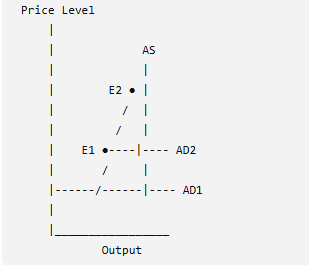
- Explain the concept of inflationary gap with the help of a diagram. What is its impact on output, employment and price level in the economy?
Answer –
Inflationary Gap refers to the situation when Aggregate Demand (AD) is greater than Aggregate Supply (AS) at full employment level. It occurs when demand in the economy increases beyond the production capacity.
Inflationary Gap = Actual AD – AD at Full Employment
Effects:
- Output: Initially, output may increase, but after full employment level, output cannot increase further due to limited resources.
- Employment: Employment increases up to full employment level. Beyond this, employment cannot rise.
- Price Level: Since demand exceeds supply, prices start rising, resulting in inflation.
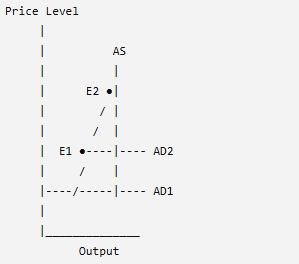
2. Explain the problem of ‘excess demand’ in an economy with the help of a diagram. Explain the role of bank rate in correcting it.
Answer –
Excess Demand refers to a situation when Aggregate Demand exceeds Aggregate Supply at full employment level.
It creates inflationary pressure in the economy.
Role of Bank Rate:
- Central bank increases the bank rate.
- Commercial banks increase their lending rates.
- Loans become expensive.
- Borrowing and investment decrease.
- Money supply decreases.
- Aggregate demand falls.
- Excess demand is controlled.
3. Explain the concept of ‘excess demand’ in macroeconomics. Also, explain the role of’ open market operations’ in correcting it.
Answer:
Excess Demand is a situation where Aggregate Demand is more than Aggregate Supply at full employment level.
It leads to a rise in prices and creates inflation in the economy.
Role of Open Market Operations:
- Open market operations refer to the buying and selling of government securities by the central bank.
- To control excess demand, the central bank sells government securities.
- Money flows out of the economy.
- Credit creation capacity of banks decreases.
- Investment and consumption reduce.
- Aggregate demand decreases.
- Excess demand is corrected.
4. Discuss, in brief, the meaning of deficient demand and deflationary gap with the help of a diagram. Also, discuss the effect of deficient demand on output, employment and price level.
Answer –
Deficient Demand refers to a situation when Aggregate Demand is less than Aggregate Supply at full employment level.
The gap between required demand and actual demand is called Deflationary Gap.
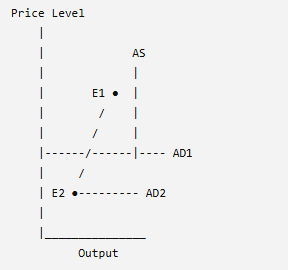
Effects:
- Output: Low demand reduces production, causing a fall in output.
- Employment: Lower production reduces employment opportunities and increases unemployment.
- Price Level: Due to low demand, prices fall and the economy may face deflation.
5. Explain the role of the following in correcting ‘deficient’ in an economy: (i) Open market operation. (ii) Bank rate.
Answer –
(i) Open market operation
- Central bank purchases government securities from the market.
- Money supply in the economy increases.
- Banks provide more loans.
- Investment and consumption increase.
- Aggregate demand rises.
- Deficient demand is corrected.
(ii) Bank rate
- Central bank reduces the bank rate.
- Commercial banks reduce their lending rates.
- Loans become cheaper.
- Investment and consumption increase.
- Aggregate demand increases.
- Deficient demand is corrected.
6. Explain the concept of excess demand and inflationary gap with the help of a diagram. How can the government correct it?
Answer –
Excess Demand refers to a situation when Aggregate Demand (AD) is greater than Aggregate Supply (AS) at full employment level.
The excess of actual Aggregate Demand over Aggregate Demand required at full employment is called Inflationary Gap.
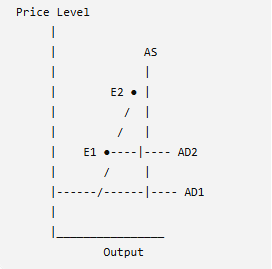
Measures to Correct Excess Demand:
The government can correct excess demand through:
- Increase in Taxes: Higher taxes reduce the disposable income of people, which decreases consumption demand.
- Reduction in Government Expenditure: Lower government spending reduces aggregate demand.
- Increase in Public Borrowing: It reduces the purchasing power in the economy and controls inflation.
7. How does money supply help in controlling the situation of deficient demand?
Answer:
Deficient Demand occurs when Aggregate Demand is less than Aggregate Supply at full employment level.
To correct deficient demand, the government increases the money supply in the economy.
- Central bank increases the supply of money through expansionary monetary policy.
- More money becomes available with commercial banks.
- Banks provide more loans at lower interest rates.
- Investment and consumption increase.
- Aggregate Demand rises.
- Production and employment increase.
8. Explain the role of the following in correcting ‘excess demand’ in an economy: (i) Bank rate. (ii) Open market operations.
Answer-
To correct excess demand:
- Central bank increases the bank rate.
- Commercial banks increase their lending rates.
- Borrowing becomes expensive.
- Investment and consumption decrease.
- Money supply reduces.
- Aggregate demand falls.
(ii) Open market operations – Open Market Operations refer to the buying and selling of government securities by the central bank.
To correct excess demand:
- Central bank sells government securities in the market.
- Money flows out of the economy.
- Liquidity with banks decreases.
- Credit creation reduces.
- Aggregate demand decreases.
9. Explain the concept of ‘deflationary gap’. Also, explain the role of ‘margin requirements’ in reducing it.
Answer: Deflationary Gap refers to the gap between Aggregate Demand required at full employment level and actual Aggregate Demand in the economy.It occurs due to deficient demand and results in unemployment and fall in output.
Role of Margin Requirements:
Margin requirement is the difference between the value of security offered and the amount of loan granted.
To correct deflationary gap:
- Central bank reduces margin requirements.
- Borrowers can get more loans against securities.
- Credit availability increases.
- Investment increases.
- Aggregate Demand rises.
- Deflationary gap is reduced.
10. Explain the concept of ‘deficient demand’ in macroeconomics. Also, explain the role of Bank Rate in correcting it.
Answer:
Deficient Demand refers to a situation when Aggregate Demand is less than Aggregate Supply at full employment level. It leads to a fall in production, income and employment.
Role of Bank Rate:
To correct deficient demand:
- Central bank reduces the bank rate.
- Commercial banks reduce their lending rates.
- Loans become cheaper.
- Investment and consumption increase.
- Aggregate Demand increases.
- Deficient demand is corrected.
11. Explain the concept of ‘inflationary gap’. Also explain the role of ‘legal reserve’ in reducing it.
Answer: Inflationary Gap refers to the excess of Aggregate Demand over Aggregate Supply at full employment level. It arises when demand increases beyond the productive capacity of the economy.
Role of Legal Reserve: Legal reserve refers to the minimum percentage of deposits that commercial banks are required to keep with the central bank.
To reduce inflationary gap:
- Central bank increases the legal reserve ratio.
- Banks have to keep more money as reserves.
- Lending capacity of banks decreases.
- Credit creation reduces.
- Money supply falls in the economy.
- Aggregate Demand decreases.
12. Explain the meaning of underemployment equilibrium. Explain two measures by which full employment equilibrium can be reached.
Answer: Underemployment Equilibrium refers to a situation when an economy is in equilibrium but the level of employment is less than full employment level.According to Keynes, an economy can achieve equilibrium even with unemployment because Aggregate Demand may not be sufficient to employ all resources.
Measures to Reach Full Employment Equilibrium:
1. Increase in Government Expenditure:
- Government can increase expenditure on public projects.
- It increases income and employment.
- Aggregate Demand increases.
2. Reduction in Taxes:
- Lower taxes increase disposable income of people.
- Consumption and investment increase.
- Demand and employment rise.
13. Distinguish between inflationary gap and deflationary gap. State two measures by which full employment equilibrium can be reached.
Answer –

Measures to Reach Full Employment:
- Increase in Government Expenditure: It increases demand, production and employment.
- Increase in Money Supply: It encourages investment and increases Aggregate Demand.
14. Explain the meaning of inflationary gap and deflationary gap with the help of diagrams.
Answer:
Inflationary Gap: Inflationary gap is the excess of Aggregate Demand over Aggregate Demand required at full employment level. It creates inflationary pressure in the economy.
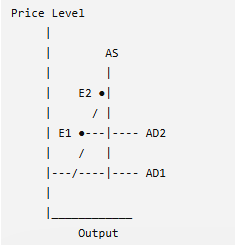
Deflationary Gap:
Deflationary gap is the difference between Aggregate Demand required at full employment level and actual Aggregate Demand. It leads to unemployment and fall in output.
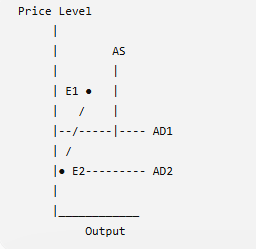
15. ‘Monetary measures offer a valid solution to the problem of Inflationary gap in an economy’. State and discuss any two monetary measures to justify the given statement.
Answer: Monetary measures are used by the central bank to control excess money supply and reduce inflationary gap.
Two monetary measures are:
1. Increase in Bank Rate:
- Central bank increases the bank rate.
- Commercial banks increase their lending rates.
- Loans become expensive.
- Investment and consumption decrease.
- Aggregate Demand falls.
- Inflationary gap is reduced.
2.Open Market Operations:
- Central bank sells government securities in the open market.
- Money flows out of the economy.
- Credit availability decreases.
- Spending reduces.
- Aggregate Demand decreases.
16. Explain the concept of Inflation Gap. Explain the role of Repo Rate in reducing this gap.
Answer:
Inflation Gap refers to the excess of Aggregate Demand over Aggregate Supply at full employment level. It creates inflationary pressure in the economy.
Role of Repo Rate:
Repo rate is the rate at which the central bank lends money to commercial banks.
To reduce inflation gap:
- Central bank increases the repo rate.
- Borrowing cost of commercial banks increases.
- Banks increase lending rates.
- Loans become expensive.
- Investment and consumption decrease.
- Aggregate Demand falls.
- Inflation gap is reduced.
17. What is ‘excess demand? Explain the role of ‘Reverse Repo Rate’ in removing it.
Answer:
Excess Demand refers to a situation when Aggregate Demand is greater than Aggregate Supply at full employment level.
It leads to a rise in prices and inflation in the economy.
Role of Reverse Repo Rate:
Reverse repo rate is the rate at which the central bank borrows money from commercial banks.
- Central bank increases the reverse repo rate.
- Banks deposit more money with the central bank.
- Liquidity in the economy decreases.
- Credit creation reduces.
- Aggregate Demand decreases.
- Excess demand is controlled.
18. What is inflation gap? Explain the role of Cash Reserve Ratio in removing this gap.
Answer:
Inflation Gap is the excess of Aggregate Demand over Aggregate Supply at full employment level.
Role of Cash Reserve Ratio (CRR):
CRR is the percentage of deposits that commercial banks are required to keep with the central bank.
To reduce inflation gap:
- Central bank increases CRR.
- Banks have to keep more reserves.
- Lending capacity of banks decreases.
- Money supply falls.
- Aggregate Demand decreases.
- Inflation gap is reduced.
19. How does a change in taxes help to control the situation of excess and deficient demand?
Answer:
Taxes are an important fiscal policy measure used to control demand.
In case of Excess Demand:
- Government increases taxes.
- Disposable income of people decreases.
- Consumption expenditure falls.
- Aggregate Demand decreases.
- Excess demand is controlled.
In case of Deficient Demand:
- Government reduces taxes.
- Disposable income increases.
- Consumption and investment increase.
- Aggregate Demand rises.
- Deficient demand is corrected.
20. Explain the situation of deficient demand in an economy. Also, explain the role of Repo Rate in correcting this.
Answer:
Deficient Demand refers to a situation when Aggregate Demand is less than Aggregate Supply at full employment level.
It results in fall in production, income and employment.
Role of Repo Rate:
- Central bank reduces the repo rate.
- Commercial banks get loans at lower rates.
- Lending rates decrease.
- Investment and consumption increase.
- Aggregate Demand rises.
- Deficient demand is corrected.
21. ‘An economy is operation at underemployment level of income’. What is meant by the given statement?
Answer: Underemployment equilibrium refers to a situation where an economy is in equilibrium but the level of employment is less than full employment level. It means that available resources are not fully utilised due to insufficient Aggregate Demand. According to Keynes, an economy can remain in equilibrium even with unemployment.
22. ‘India has been dealing with the problem of Deficient Demand since the imposition of Covid lockdown in March 2020’. State and discuss any two monetary policy measures to combat the situation of Deficient Demand in India.
Answer: During Covid lockdown, economic activities declined, resulting in lower demand and production. Monetary measures were adopted to increase demand.
1. Reduction in Repo Rate:
- Central bank reduced repo rate.
- Banks got funds at lower cost.
- Lending rates decreased.
- Borrowing and investment increased.
- Aggregate Demand increased.
2. Reduction in Cash Reserve Ratio (CRR):
- Central bank reduced CRR.
- Banks had more funds available for lending.
- Credit supply increased.
- Consumption and investment increased.
- Deficient demand was corrected.
23. Explain any two fiscal measures to correct the situation of deficient demand.
Answer:
Fiscal measures are government policies related to taxation and expenditure.
1. Increase in Government Expenditure:
- Government increases spending on infrastructure and public projects.
- It creates employment and increases income.
- Aggregate Demand increases.
2. Reduction in Taxes:
- Lower taxes increase disposable income.
- Consumption expenditure increases.
- Aggregate Demand rises.
- Deficient demand is corrected.
NCERT