Meaning of Foreign Exchange Rate
All countries have their own currencies, which are readily acceptable within their respective territories. For example, Indian Rupee in India, US Dollar ($) in America, Pound (£) in England, etc. However, currency of one country is generally not accepted in another country. Is generally not accepted in another country. In case of an international payment, currency of one country has to be converted into the currency of another country has to be converted into the currency of another country because every country wants the payment in its own currency.
For Example – if an American firm exports goods to India, it would like to receive the payment in Dollars. As a result, Indian importers will have to convert Indian Rupees into American Dollars to make the payment. It creates the problem of converting one currency into another and fixing the rate at which the two currencies are to be exchanged. In fact, it is the problem of determination of foreign exchange rate. Foreign Exchange Rate refers to the rate at which one currency is exchanged for the other. It represents the price of one currency in terms of another currecy.
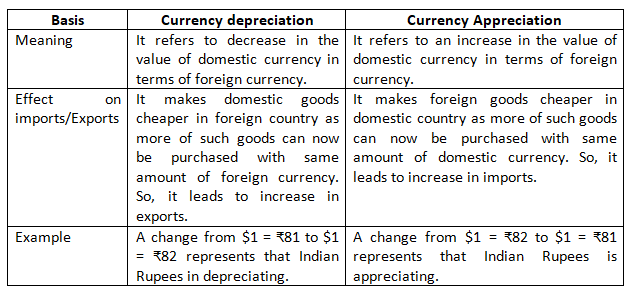
Currency Depreciation Vs Currency Appreciation
Currency Depreciation
Currency Depreciation refers to decrease in the value of domestic currency in terms of foreign currency. In makes the domestic currency less valuable and more of it is required to buy the foreign currency.
For Example:
- Rupee is said to be depreciating if price of $ 1 rises from Rs.81 to Rs.82.
- A change from $ 5 = £ 4 to $ 4.5 = £4 represents that UK pound is depreciating.
Effect of Depreciation of Domestic Currency
- Increase in ‘Exports’ – Depreciation of domestic currency means a fall in the price of domestic currency (say, rupee) it terms of a foreign currency (say, US$). It means, with same amount of dollars, more goods can be purchased from India, i.e. exports to USA will increase as they will become relatively cheaper.
- Decrease in ‘Imports’ – Depreciation will lead to decrease in imports as Indians will have to pay more domestic currency to import foreign goods. It leads to fall in imports as foreign goods will become relatively costly.
- Increase in ‘National Income’ – As exports will increase and imports will fall due to depreciation of domestic currency, Net Exports (=Exports – Imports) will increase. It will increase the National Income, assuming no change in other things (i.e. ceteris paribus).
Currency Appreciation
Currency Appreciation refers to an increase in the value of domestic currency in terms of foreign currency. As the domestic currency becomes more valuable, less of it is required to buy the foreign currency.
For example:
- Indian rupee appreciation when the price of $1 falls from ₹82 to ₹81.
- A change from $4.5 = £4 to $5 = £4 represents that the UK pound is appreciating.
Effect of Appreciation of Domestic Currency
- Increase in ‘IMPORT’ – Appreciation of domestic currency means a rise in the price of domestic currency (say, rupee) in terms of a foreign currency (say, US$). Now, one rupee can be exchanged for more $, i.e. with same amount of money, more goods can be purchased from the USA. This leads to an increase in imports from the USA as American goods will become relatively cheaper.
- Decrease in ‘Exports’ – appreciation will lead to a decrease in export as one unit of foreign currency will now buy less domestic goods. This will lead to a fall in exports as domestic goods will become relatively costly for foreign national .
- Decrease in ‘NATIONAL INCOME’ – as export will fall and import will rise due to appreciation of domestic currency net export will decrease. It will reduce the national income assuming
Currency Depreciation Vs Currency Appreciation
TYPES OF FOREIGN EXCHANGE RATE SYSTEM
Three main types of foreign exchange rate system
- Fixed Exchange Rate System (or Pegged Exchange Rate System)
- Flexible Exchange Rate System (or Floating Exchange Rate System)
- Managed Floating Rate System)
Fixed Exchange Rate System
Fixed exchange rate system refers to a system in which exchange rate for a currency is fixed by the government.
- The basic purpose of adopting this system is to ensure stability in foreign trade & capital movements.
- To achieve stability, the government undertakes to buy foreign currency when there is excess supply of foreign exchange and sells it when there is excess demand for foreign exchange.
- Under this system, each country keeps value of its currency fixed in terms of some ‘External Standard’.
- When value of a currency is fixed in terms of some other currency or in terms of gold, it is known as ‘Parity value’ of currency.
Merits of Fixed Exchange Rate System
- Stability in the Exchange Rate – It provides stability to the foreign exchange market. There is no uncertainty, with respect to exchange rate, which promotes the foreign trade.
- Promotes International Investment – It creates conditions for smooth flow of foreign capital between nation. Both, lender and borrower will not be prepared to lend or borrow in order to make long-term investments, if they are not sure about the rate of exchange. A stable exchange rate promotes international investments.
- Promotes International Trade – It creates confidence among the people that the existing rate will continue in future. As a result, foreign trade of a country flows more quickly and smoothly.
- Prevent Speculative Activities – As exchange rate is fixed by the government, it eliminates the possibility of speculative transactions in foreign exchange.
Demerits of Fixed Exchange Rate System
- Huge Foreign Exchange reserve required – Government has to maintain large reserve of foreign currencies to maintain the exchange rate at the level fixed by it. It restricts the movement of capital in different parts of the world and hampers the international growth.
- Difficulty in Fixing the Exchange Rate – It is very difficult to determine the level at which the exchange rate should be fixed. There may be undervaluation or overvaluation of currency. If the exchange rate is fixed at a level which is lower than the market level, it will result in deficit in balance of payments. If it is higher than the market level, then it may create inflationary pressure because of surplus in the balance of payments.
- Exchange Rates are not fixed – Pegged (fixed) exchange rates are not permanently fixed. Often, fluctuations in the international commodity prices and problems in the balance of payments compel countries to bring changes in the exchange rates. This makes it difficult to keep the exchange rates fixed.
Devaluation and Revaluation
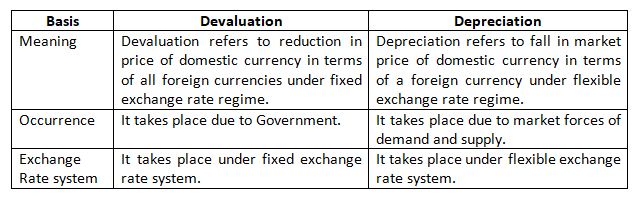
Devaluation refers to reduction in the value of domestic currency by the government. Devaluation is said to occur when the exchange rate is increase by the government under Fixed Exchange Rate System. On the other hand, Revaluation refers to increase in the value of domestic currency by the government.
Devaluation Vs Depreciation
Flexible Exchange Rate System
Flexible exchange rate system refers to a system in which exchange rate is determined by forces of demand and supply of different currencies in the foreign exchange market.
- The value of a currency is allowed to fluctuate freely according to changes in the demand and supply of foreign exchange.
- There is no official (Government) intervention in the foreign exchange market.
- Flexible exchange rate is also known as ‘Floating Exchange Rate’ or ‘Free Exchange Rate’.
Merits of Flexible Exchange Rate System
- Maintains Equilibrium Level – Flexible exchange rate is self-adjusting and automatically removes the disequilibrium in the Balance of Payment (BOP). It eliminates the problems of overvaluation and undervaluation of currencies.
- No need for Huge foreign Exchange reserves – There is no need for the government to hold large foreign exchange reserve. It enhances the movement of capital across different parts of the world and promotes international growth.
- Optimum Utilisation of Resources – It provides the opportunity for optimum utilisation of resources raises the level of efficiency in the economy.
Demerits of Flexible Exchange Rate System
- Instability in the Exchange Rate – The external value of domestic currency keeps on changing as per demand and supply of foreign exchange. It creates uncertainty about the amount of receipt and payments in foreign exchange transactions. Such instabilities hamper foreign trade.
- Speculative Activities – Speculators manipulate the market and make the exchange rates too low high. This makes the foreign exchange market unstable and discourages foreign trade and foreign investments.
- Creates Inflationary Situation – It generates inflationary trends in the economy, when there is an increase in the prices of imports due to depreciation of the currency.
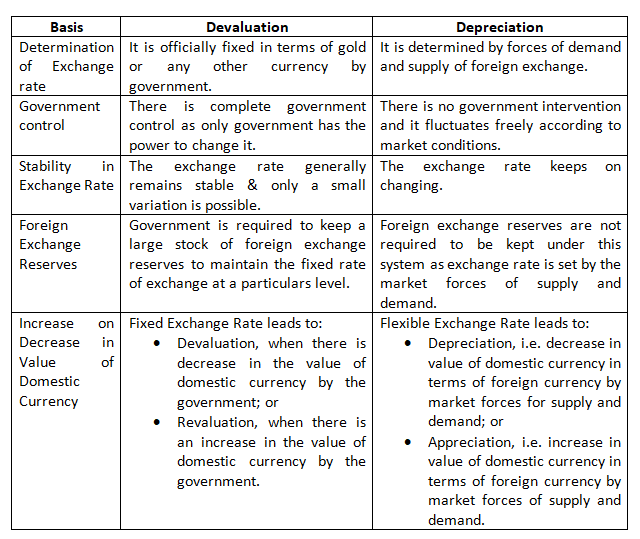
Fixed Exchange Rate Vs Flexible Exchange Rate
Managed Floating Rate System
Traditionally, International monetary economists have focused their attention on the framework of either Fixed or Flexible Exchange Rate System. With the end of Bretton Woods system, many countries have adopted the method of Managed Floating Exchange Rates.
It refers to a system in which foreign exchange rate is determined by market forces and central bank influences the exchange rate through intervention in the foreign exchange market.
- It is a hybrid (or mixture) of fixed exchange rate and a flexible exchange rate system.
- Like Flexible Exchange Rate System, exchange rate is primarily determined by forces of demand and supply; and
- Like fixed Exchange Rate System, exchange rate is managed by way of intervention by RBI.
It is also known as ‘Dirty Floating ‘. Dirty Float is a system in which value of a country’s currency is allowed to change in relation to others, but is controlled or manipulated by Central Bank (RBI in case of India) to keep it within a particular range. It can be contrasted with a Clean Float, where the Central Bank does not intervene.
DEMAND FOR FOREIGN EXCHANGE
The demand (or outflow) of foreign exchange comes from those people who need it to make payment in foreign currency. It is demanded by the domestic residents for the following reasons:
- Imports of Goods and Services – Foreign Exchange is demanded to make the payment for imports of goods and services.
- Tourism – Foreign exchange is needed to meet expenditure incurred in foreign tours.
- Unilateral Transfers sent abroad – Foreign exchange in required for making unilateral transfers like sending gifts to other countries.
- Purchase of Assets in Foreign Countries – It is demanded to make payment for purchase of assets, like land, shares, bonds, etc. in the foreign countries.
- Speculation – Demand for foreign exchange arises when people want to make gains from appreciation of currency.
For example – It people expect that the price of US dollar in terms of money will increase in future, they will buy more US dollars today. They will do so to make gains from appreciation of currency, i.e. in the expectation of making profit when dollar becomes expensive.
Demand Curve of Foreign Exchange
Demand curve of foreign exchange slope downwards due to inverse relationship between demand for foreign exchange and foreign exchange rate.
SUPPLY OF FOREIGN EXCHANGE
Supply of foreign exchange increase from any transaction that involves receipts of foreign currency. The supply (inflow) of foreign exchange comes from those people who receive it due to following reason:
- Exports of Goods and Services – Supply of foreign exchange comes through exports of goods and services.
- Foreign Investment. The amount, which foreigners invest in the home country, increase the supply of foreign exchange.
- Remittances (Unilateral transfers) from abroad – Supply of foreign exchange increase in the form of gifts and other remittances from abroad.
- Speculation – Supply of foreign exchange comes from those who want to speculate on the value of foreign exchange.
- Loans from Rest of the world – Borrowings from rest of the world contributes to supply of foreign Exchange to India.
Supply Curve of foreign Exchange
Supply curve of foreign exchange slopes upwards due to positive relationship between supply for foreign exchange and foreign exchange rate.
DETERMINATHION OF EXCHANGE RATE
Like the price of a commodity, flexible exchange rate is determined by the interaction of the forces of demand and supply. The equilibrium exchange rate is determined at a level where demand for foreign exchange is equal to the supply of foreign exchange.
CHANGES IN EXCHANGE RATE
The equilibrium exchange rate will be disturbed if some changes occur in the demand of supply of foreign exchange.
Change in Demand
- Increase in Demand – An increase in demand for foreign exchange will shift the demand curve towards right from DD to D1D1.
- Decrease in Demand – A decrease in demand will shift the demand curve towards left from DD to D2D2. It leads to deficit demand of QQ4 at the original exchange rate of OR. As a result, exchange rate will fall till it reaches OR2. Now, per unit price of US Dollar (in terms of rupees) has decreased, i.e. domestic currency, has appreciated.
Change in Supply
Change in supply may be either an ‘Increase in Supply’ or ‘Decrease in Supply’.
- Increase in Supply – If supply of foreign exchange increases, it will lead to a rightward shift in supply curve from SS to S1S1.
- Decrease in Supply – A decrease in supply will shift the supply curve towards left from SS to S2S2.It leads to deficit supply of QQ4 at the original exchange rate of OR. This will increase the exchange rate till it reaches OR2. So, per unit price of US Dollar (in terms of rupees) has increased and, thus, the domestic currency has depreciated.
FOREIGN EXCHANGE MARKET
Foreign exchange market is the market in which foreign currencies are bought and sold. The buyers and sellers include individuals, firms, foreign exchange brokers, commercial banks and the central bank.
Functions of Foreign Exchange Market
Foreign exchange market performs the following three functions:
- Transfer Function – It transfer purchasing power between the countries involved in the transactions. This function is performed through credit instruments like bills of foreign exchange, bank drafts and telephonic transfers.
- Credit Function – It provides credit for foreign trade. Bills of exchange, with maturity period of three months, are generally used for international payments. Credit is required for this period in order to enable the importer to take possession of goods, sell them and obtain money to pay off the bill.
- Hedging Function – When exporters and importers enter into an agreement to sell and buy goods on some future date at the current prices and exchange rate, it is called hedging. The purpose of hedging is to avoid losses that might be caused due to exchange rate variations in the future.
Kinds of Foreign Exchange Markets
Foreign exchange markets are classified on the basis of whether the foreign exchange transactions are spot or forward. Accordingly, there are two kinds of foreign exchange markets: (i) Spot Market; (ii) Forward Market.
Short Answer Type Questions
- Give the meaning of: (i) Foreign Exchange; (ii) Foreign Exchange Rate; (iii) Foreign Exchange Market.
Answer –
(i) Foreign Exchange – Foreign exchange means the currency of a foreign country or any claim payable in a foreign currency. It is used to make payments for international transactions.
(ii) Foreign Exchange Rate – Foreign exchange rate is the price of one country’s currency expressed in terms of another country’s currency.
Example: If 1 US Dollar = ₹85, then ₹85 is the exchange rate of one US Dollar.
(iii) Foreign Exchange Market – Foreign exchange market is the market where different countries’ currencies are bought and sold.
2. What is mean by foreign exchange rate? Give three reasons why people desire to have foreign exchange.
Answer – Foreign exchange rate is the rate at which one country’s currency is exchanged for another country’s currency.
Reasons for demand for foreign exchange:
- To import goods and services from other countries.
- To travel abroad for tourism, education or medical treatment.
- To make investments or send money abroad, such as purchasing foreign assets or remitting money.
3. Give two reasons for rise in demand for a foreign currency when its price falls.
Answer – When the price (exchange rate) of a foreign currency falls:
- Imports become cheaper, so people buy more foreign goods and services.
- Foreign education, travel and investment become less expensive, increasing the demand for foreign currency.
4. Give three sources each of demand and supply of foreign exchange.
Answer- Sources of Demand for Foreign Exchange
- Import of goods and services.
- Foreign travel, education and medical treatment.
- Investment and gifts/remittances sent abroad.
Sources of Supply of Foreign Exchange
- Export of goods and services.
- Foreign tourists spending money in India.
- Foreign investment and remittances received from abroad.
5. Why does the demand curve of foreign exchange slope downwards?
Answer – The demand curve for foreign exchange slopes downward because there is an inverse relationship between the exchange rate and the quantity of foreign exchange demanded.
- When the exchange rate falls (foreign currency becomes cheaper), imports, foreign travel and foreign investment become cheaper. Therefore, the demand for foreign exchange increases.
- When the exchange rate rises (foreign currency becomes costlier), these activities become expensive. Therefore, the demand for foreign exchange decreases.
6. Giving two examples explain the relation between the rise in price of a currency and its demand.
Answer – There is an inverse relationship between the price of a foreign currency and its demand.
Examples:
- If the price of US Dollar rises from ₹85 to ₹88, imports from the USA become costlier, so the demand for US Dollars falls.
- If the price of Euro rises, travelling or studying in Europe becomes more expensive, reducing the demand for Euros.
7. “There exists a positive relation between foreign exchange rate and supply of foreign exchange.” Do you agree with the given statement? Justify your answer with valid arguments.
Answer – Yes, I agree.
There is a positive relationship between the foreign exchange rate and the supply of foreign exchange.
- When the exchange rate rises, exporters receive more domestic currency for each unit of foreign currency. Therefore, they supply more foreign exchange.
- Similarly, higher exchange rates encourage foreign tourists and foreign investors to bring more foreign currency into the country.
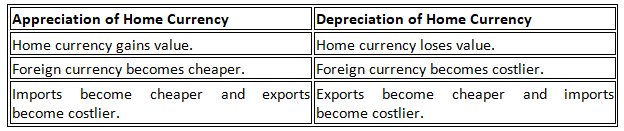
8. Distinguish between appreciation of home currency and depreciation of home currency.
Answer –
9. Explain the impact of home currency depreciation on the exports of a nation.
Answer – When the home currency depreciates:
- Exports become cheaper for foreign buyers.
- Foreign demand for exports increases.
- As a result, the country’s export earnings increase.
10. Explain the effect of appreciation of domestic currency on imports.
Answer – When the domestic currency appreciates:
- Foreign goods become cheaper in the domestic market.
- Imports increase because consumers can buy more foreign goods at lower prices.
- Thus, the demand for imports rises.
11. Distinguish between devaluation and depreciation of domestic currency.
Answer –
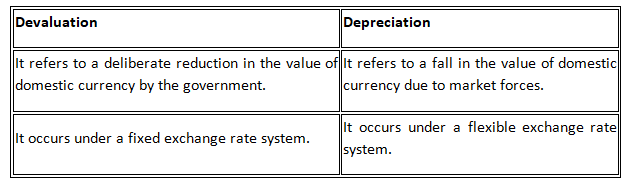
12. What is mean by fixed exchange rate system and flexible exchange rate system?
Answer –
Fixed Exchange Rate System: It is a system in which the exchange rate is fixed by the government or monetary authority.
Flexible Exchange Rate System: It is a system in which the exchange rate is determined by the forces of demand and supply of foreign exchange.
13. Write short notes on: (i) spot market; (ii) Forward market.
Answer –
(i) Spot Market: Spot market is a market where foreign exchange transactions are settled immediately or within a short period (usually two working days).
(ii) Forward Market: Forward market is a market where foreign exchange transactions are made for future delivery at a pre-decided exchange rate.
14. Distinguish between fixed exchange rate system and flexible exchange rate system.
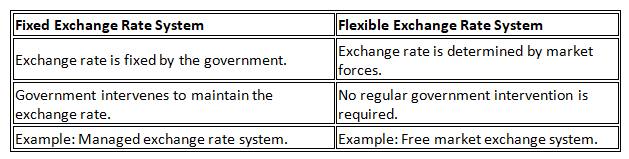
15. When price of foreign currency rises, its supply also rises. Explain why.
Answer – When the price of foreign currency rises, exporters and foreign investors receive more domestic currency in exchange for foreign currency. Therefore, they are encouraged to supply more foreign currency, causing its supply to increase.
16. Explain why there is a rise in demand for foreign exchange when its price falls.
Answer –
When the price of foreign currency falls:
- Imports become cheaper.
- Foreign travel and education become less expensive.
17. Give the meaning of foreign exchange rate. How is it determined under flexible exchange rate regime?
Answer – Foreign exchange rate is the price of one country’s currency expressed in terms of another country’s currency. Under a flexible exchange rate system, it is determined by the interaction of demand and supply of foreign exchange in the market.
18. Explain the effect of a fall in the price of foreign currency on exports.
Answer – When the price of foreign currency falls:
- Domestic goods become expensive for foreign buyers.
- Exports become less competitive.
- Demand for exports decreases.
19. Explain, how exchange rate is determined under a free market exchange rate system.
Answer – Under a free market exchange rate system, exchange rate is determined by the equilibrium between demand and supply of foreign exchange.
- Demand for foreign exchange creates pressure for a rise in exchange rate.
- Supply of foreign exchange creates pressure for a fall in exchange rate.
20. In India, exchange rate of U.S. Dollar has been rises considerably. What is its likely impact on Indian exports and why?
Answer – Rise in the price of U.S. Dollar means depreciation of Indian Rupee.
Its impact on exports:
- Indian exports become cheaper for foreign buyers.
- Demand for Indian exports increases.
- Export earnings of India may rise.
21. Explain two sources of supply of foreign exchange.
Answer – Two important sources of supply of foreign exchange are:
- Exports: When a country exports goods and services, it receives foreign currency from other countries.
- Foreign Investment: Foreign investors bring foreign currency into the country for investment purposes.
22. When foreign exchange rate in a country is on the rise, what impact is it likely to have on imports and how?
Answer – When foreign exchange rate rises, foreign currency becomes expensive.
- Imports become costlier because more domestic currency is required to buy foreign goods.
- Therefore, demand for imports decreases.
23. Explain the effect of appreciation of domestic currency on exports.
Answer – When domestic currency appreciates:
- Domestic goods become expensive for foreign buyers.
- Exports become less competitive in international markets.
- Therefore, exports decrease.
24. What is depreciation of Rupee? What is its likely impact on India imports and how?
Answer – Depreciation of Rupee means a fall in the value of Indian Rupee in terms of foreign currency.
Impact on imports:
- Imports become expensive because more rupees are required to buy foreign goods.
- Therefore, imports may decrease.
25. What is the role of a Central Bank in the following exchange rate: (a) Fixed exchange; (b) Floating exchange; and (c) Managed floating.
Answer – (a) Fixed Exchange Rate: Central Bank actively intervenes to maintain the fixed exchange rate by buying or selling foreign currency.
(b) Floating Exchange Rate: Central Bank generally does not intervene and exchange rate is determined by market forces.
(c) Managed Floating: Central Bank intervenes occasionally to reduce excessive fluctuations in exchange rate.
26. Discuss briefly the concept of managed floating system of foreign exchange rate determination.
Answer – Managed floating system is a system in which exchange rate is mainly determined by market forces of demand and supply, but the Central Bank intervenes whenever necessary to control excessive changes in exchange rate.
27. Discuss any two factors which directly affect the demand for foreign exchange of a nation.
Answer – Two factors affecting demand for foreign exchange are:
- Imports: Higher imports increase the demand for foreign currency.
- Foreign Investment: Investment in foreign countries increases the demand for foreign exchange.
28. ‘Appreciation and Revaluation of currency are one and the same thing.’ Do you agree? Comment.
Answer – No, both are different.
- Appreciation is a rise in the value of currency due to market forces under a flexible exchange rate system.
- Revaluation is an official increase in the value of currency by the government under a fixed exchange rate system.
29. Discuss briefly the determination of exchange rate under the flexible exchange rate system.
Answer – Under a flexible exchange rate system, exchange rate is determined by the interaction of demand and supply of foreign exchange.
- When demand is greater than supply, exchange rate rises.
- When supply is greater than demand, exchange rate falls.
30. In recent times the India Rupee (₹) depreciation to an all time low against the US dollar. ($). Discuss its impact on India’s Imports.
Answer – Depreciation of Rupee makes foreign currency expensive.
Impact on imports:
- Imports become costly as more rupees are required to purchase goods from abroad.
- Cost of imported goods like petroleum and machinery increases.
- Demand for imports may decrease.
31. Define the following:
- Foreign Exchange rate.
- Foreign Currency.
- Devaluation of Currency.
Answer –
(i) Foreign Exchange Rate: Foreign exchange rate is the price of one country’s currency expressed in terms of another country’s currency.
(ii) Foreign Currency: Foreign currency means the currency of a country other than the domestic country.
(iii) Devaluation of Currency: Devaluation refers to an official reduction in the value of domestic currency by the government under a fixed exchange rate system.
32. Explain the relationship between fall in price of a US Dollar ($) and its demand.
Answer – There is an inverse relationship between the price of US Dollar and its demand.
When the price of US Dollar falls:
- Imports from the USA become cheaper.
- Foreign travel and investment become less costly.
33. Discuss two merits each of Fixed Exchange Rate System and Flexible Exchange Rate System.
Answer – Merits of Fixed Exchange Rate System:
- It provides stability in international trade and investment.
- It reduces uncertainty and risk in foreign transactions.
Merits of Flexible Exchange Rate System:
- Exchange rate is automatically adjusted according to demand and supply.
- It does not require frequent intervention by the Central Bank.
34. Discuss one demerit or fixed exchange Rate System and two demerits of Flexible Exchange Rate System.
Answer – Demerit of Fixed Exchange Rate System:
- It requires continuous intervention by the Central Bank to maintain the fixed rate.
Demerits of Flexible Exchange Rate System:
- It creates uncertainty in international trade and investment.
- Exchange rate fluctuations may increase inflation and economic instability.
35. “Under the flexible exchange rate system, the Central Bank does not intervene in the foreign exchange market.” Justify the statement, giving valid arguments.
Answer – The statement is correct because:
- Under a flexible exchange rate system, exchange rate is determined by the forces of demand and supply of foreign exchange.
- The Central Bank does not regularly buy or sell foreign currency to influence the exchange rate.
36. “the central bank needs to intervene under the managed floating system.” Do you agree with the given statement? Support your answer with valid reasons.
Answer – Yes, the statement is correct.
- Under managed floating system, exchange rate is mainly determined by market forces.
- The Central Bank intervenes occasionally to control excessive fluctuations in exchange rate and maintain stability in the foreign exchange market.
Long Answer type Questions
- Explain the determination of equilibrium exchange rate in foreign exchange market.
Answer: – Foreign exchange rate refers to the price of one currency expressed in terms of another currency. The equilibrium exchange rate is determined by the interaction of demand and supply of foreign exchange in the foreign exchange market. The exchange rate is determined at a point where demand for foreign exchange is equal to the supply of foreign exchange. This point is known as the equilibrium exchange rate.
Determination through Demand and Supply:
- Demand for Foreign Exchange: The demand curve for foreign exchange is downward sloping because when the exchange rate falls, foreign currency becomes cheaper and its demand increases. People demand foreign exchange for imports, foreign travel, education abroad, investment, etc.
- Supply of Foreign Exchange: The supply curve of foreign exchange is upward sloping because when the exchange rate rises, exporters and foreign investors supply more foreign currency in exchange for domestic currency.
- Equilibrium Point: The equilibrium exchange rate is determined at the point where the demand curve and supply curve intersect each other.
Demand for Foreign Exchange = Supply of Foreign Exchange
2. Briefly discuss the major reasons for demand and supply of foreign exchange.
Answer: Foreign exchange is demanded and supplied due to various international transactions. The major reasons are as follows:
Reasons for Demand of Foreign Exchange:
- Imports of Goods and Services: Domestic residents require foreign currency to purchase goods and services from other countries.
- Foreign Travel: People need foreign exchange for travelling abroad for tourism, business, or education purposes.
- Investment Abroad: Foreign exchange is demanded when individuals and firms invest in foreign countries.
- Payments to Foreign Countries: Payments such as interest, dividends, and gifts to foreign countries create demand for foreign exchange.
Reasons for Supply of Foreign Exchange:
- Exports of Goods and Services: Foreign buyers provide foreign currency for purchasing goods and services exported from the domestic country.
- Foreign Investment: Investment made by foreigners in the domestic economy increases the supply of foreign exchange.
- Remittances from Abroad: Money sent by people working abroad increases the supply of foreign currency.
- Borrowings from Foreign Countries: Loans received from foreign countries increase the availability of foreign exchange.
3. What is a foreign exchange market? Discuss the major functions performed by a foreign exchange market.
Answer: – A foreign exchange market is a market where currencies of different countries are bought and sold. It provides a platform for exchange of one currency into another currency.
For example, Indian Rupees can be exchanged for US Dollars in the foreign exchange market.
Functions of Foreign Exchange Market:
a. Transfer Function: The foreign exchange market helps in transferring purchasing power from one country to another. It facilitates international payments for imports and exports.
b. Credit Function: Foreign exchange market provides credit facilities for international trade. Exporters and importers can obtain credit for completing foreign transactions.
c. Hedging Function: The foreign exchange market helps to protect traders from the risk of changes in exchange rates. It provides facilities to reduce uncertainty related to future payments.
d. Determination of Exchange Rate: The foreign exchange market determines the value of one currency in terms of another through demand and supply forces.
e. Facilitates International Trade: It promotes international trade by making payments between countries easier and more convenient.
4. Discuss briefly the meanings of: (i) Fixed Exchange Rate. (ii) Flexible Exchange Rate. (iii) Managed Floating Exchange Rate.
Answer –
(i) Fixed Exchange Rate – A fixed exchange rate is a system in which the exchange rate of a country’s currency is fixed by the government or central bank. Under this system, the government maintains the exchange rate at a predetermined level by buying or selling foreign currency in the foreign exchange market.
Example: Before 1971, many countries followed the fixed exchange rate system under the Bretton Woods System.
(ii) Flexible Exchange Rate – Flexible exchange rate refers to a system where the exchange rate is determined freely by the forces of demand and supply of foreign exchange in the market. There is no government intervention in determining the exchange rate. It is also known as a floating exchange rate system.
(iii) Managed Floating Exchange Rate – Managed floating exchange rate is a system in which the exchange rate is mainly determined by market forces of demand and supply, but the central bank intervenes whenever required to control excessive fluctuations. It is a combination of both fixed and flexible exchange rate systems. India follows a managed floating exchange rate system.
5. Given the meaning of ‘foreign exchange’ and ‘foreign exchange rate.’ Given reason, explain the relation between foreign exchange rate and demand for foreign exchange.
Answer:
Foreign Exchange: Foreign exchange refers to the currency of another country. For example, US Dollar, Euro, and Japanese Yen are foreign currencies for India.
Foreign Exchange Rate: Foreign exchange rate refers to the price of one country’s currency expressed in terms of another country’s currency.
For example, if 1 US Dollar = ₹85, then ₹85 is the foreign exchange rate.
Relation between Foreign Exchange Rate and Demand for Foreign Exchange:
There is an inverse relationship between foreign exchange rate and demand for foreign exchange.
- When the foreign exchange rate increases, foreign currency becomes expensive. As a result, people reduce their demand for foreign goods and services, leading to a fall in demand for foreign exchange.
- When the foreign exchange rate decreases, foreign currency becomes cheaper. Therefore, people increase imports, foreign travel, and investment abroad, causing an increase in demand for foreign exchange.
6. Explain three sources of demand for foreign exchange and three sources of supply of foreign exchange.
Answer: Foreign exchange is required for making payments to other countries. The demand and supply of foreign exchange arise due to various international transactions.
Sources of Demand for Foreign Exchange:
1. Import of Goods and Services: Domestic residents require foreign currency to purchase goods and services from other countries. For example, India needs US Dollars to import crude oil from foreign countries.
2. Foreign Travel and Education: People demand foreign exchange when they travel abroad for tourism, business, or education purposes.
3. Investment Abroad: Individuals and firms require foreign currency to purchase assets or make investments in other countries.
Sources of Supply of Foreign Exchange:
1. Export of Goods and Services: When domestic goods and services are exported, foreign buyers make payments in foreign currency, increasing the supply of foreign exchange.
2. Foreign Investment: Investment made by foreigners in the domestic economy brings foreign currency into the country.
3. Remittances from Abroad: Money sent by people working in foreign countries increases the supply of foreign exchange.
7. Explain the distinction between the flexible exchange rate and the managed floating exchange rate.
Answer: The distinction between flexible exchange rate and managed floating exchange rate is as follows:
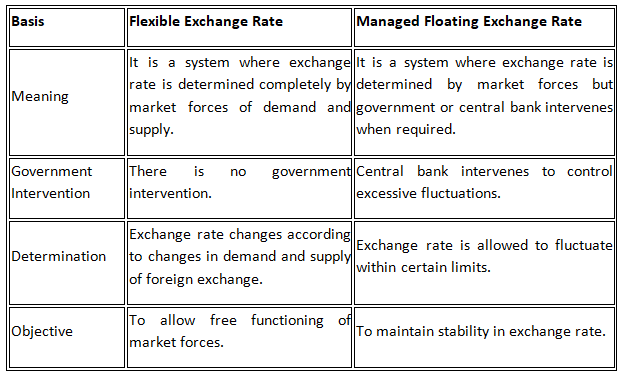
8. Explain by giving example, the distinction between depreciation and devaluation of domestic currency.
Answer: Both depreciation and devaluation refer to a fall in the value of domestic currency, but they differ on the basis of the exchange rate system.
Depreciation of Currency: Depreciation refers to a fall in the value of domestic currency due to market forces of demand and supply under a flexible exchange rate system.
Example: If the value of Indian Rupee falls from:
$1 = ₹80 to $1 = ₹85
then the Rupee has depreciated.
Devaluation of Currency: Devaluation refers to an official reduction in the value of domestic currency by the government or central bank under a fixed exchange rate system.
Example: If the government reduces the value of ₹ from:
$1 = ₹70 to $1 = ₹80
it is called devaluation of Rupee.
Main Difference:
- Depreciation occurs due to market forces.
- Devaluation occurs due to government decision.
9. Distinguish between the fixed exchange rate and the floating exchange rate. If exchange rate falls, explain its effects on exports and imports.
Answer:
Difference between Fixed and Floating Exchange Rate:
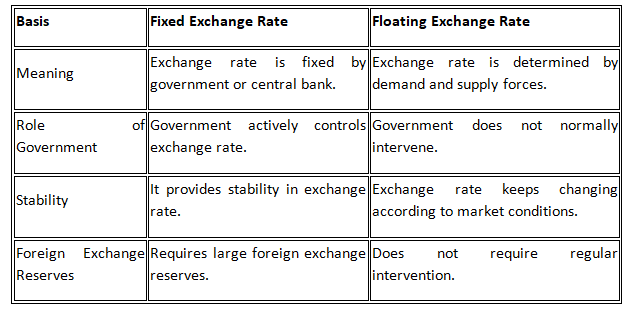
10. Define fixed exchange rate. How is the exchange rate determined in a flexible exchange rate system?
Answer:
Fixed Exchange Rate: Fixed exchange rate is a system in which the exchange rate of a currency is fixed by the government or central bank at a particular level. The government maintains this rate by buying or selling foreign currency whenever required.
Determination of Exchange Rate under Flexible Exchange Rate System:
In a flexible exchange rate system, exchange rate is determined by the forces of demand and supply of foreign exchange.
- When demand for foreign exchange is greater than supply, the exchange rate rises.
- When supply of foreign exchange is greater than demand, the exchange rate falls.
Demand for Foreign Exchange = Supply of Foreign Exchange
11. Discuss the merits and demerits of Fixed Exchange Rate System.
Answer: Fixed exchange rate system refers to a system where the exchange rate is fixed by the government or central bank.
Merits of Fixed Exchange Rate System:
1. Stability in Exchange Rate: It provides stability in international transactions as the exchange rate remains fixed.
2. Encourages International Trade: Stable exchange rates reduce uncertainty and encourage foreign trade and investment.
3. Prevents Speculation: Fixed exchange rates reduce the possibility of speculative activities in foreign exchange markets.
Demerits of Fixed Exchange Rate System:
1. Requirement of Large Foreign Exchange Reserves: The central bank needs to maintain large reserves to maintain the fixed exchange rate.
2. Loss of Monetary Independence: The government cannot freely use monetary policy because it has to maintain the fixed exchange rate.
3. Possibility of Currency Crisis: Maintaining an unrealistic exchange rate may lead to a shortage of foreign exchange reserves.
12. Discuss three merits and two demerits of Flexible Exchange Rate System.
Answer –
Merits of Flexible Exchange Rate System:
1. No Need for Foreign Exchange Reserves: The central bank does not need to maintain large foreign exchange reserves to control exchange rates.
2. Automatic Adjustment: Changes in exchange rate automatically correct disequilibrium in the balance of payments.
3. Freedom in Monetary Policy: The government can use monetary policy according to domestic economic conditions without worrying about exchange rate stability.
Demerits of Flexible Exchange Rate System:
1. Exchange Rate Fluctuations: Frequent changes in exchange rates create uncertainty in international trade and investment.
2. Encourages Speculation: Continuous fluctuations may encourage speculative activities in the foreign exchange market.