MEANING OF BALANCE OF PAYMENT
Every government keeps a record of the transactions that take place between the country and the rest of the world during a given period of time. This record is termed as the country’s Balance of Payments (BOP). Balance of Payment is an accounting statement that provides a systematic record of all the economic transactions, between Residents of a country and the rest of the world, in a given period of time.
Who are included in Residents?
Residents of a country include individuals, firms and government agencies. However, residents do not include Diplomatic staff, foreign military personal, tourists, migratory workers and branches of foreign companies, even though the work and operate within the domestic territory of the country.
Economic Transactions
Economic transactions refer to those transactions which involve the transfer of the title or ownership of goods, services, money and assets. They are broadly categorized as under:
- Visible Items – These include all types of physical goods which are exported and imported. These are called ‘visible items’ as they are tangible, i.e. they are made of some matter or material and can be seen, touched and measured.
- Invisible Items – Invisible items of trade refer to all types of services like shipping, banking, insurance, etc., which are given and received. These are called invisible items as they cannot be seen, felt, touched or measured.
- Unilateral Transfers – Unilateral transfers include gifts, personal remittances and other ‘one-way transactions’. Since these transactions do not involve any claim for repayment, they are also known as unrequited transfers.
- Capital Transfers – Capital transfers relate to capital receipts (through borrowings or sale of assets) and capital payments (though capital repayments or purchase of assets).
Structure of Balance of Payments
Balance of payments accounting uses the ‘Double Entry System’ for recording transactions with the rest of the world. Like a typical business account, BOP account also has two sides:
- Credit side – All inflow or sources of foreign exchange are recorded on the credit side.
- Debit side – All outflow or uses of foreign exchange are recorded on the debit side.
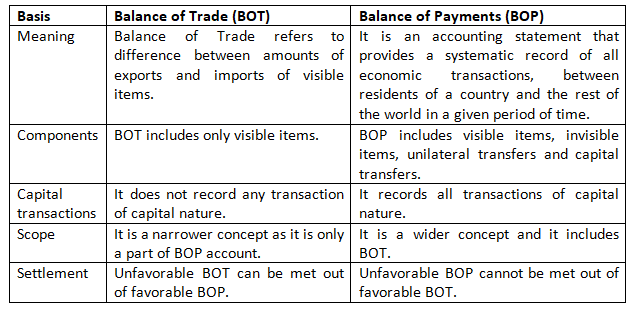
MEANING OF BALANCE OF TRADE
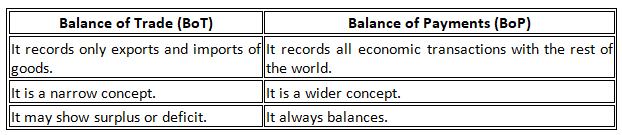
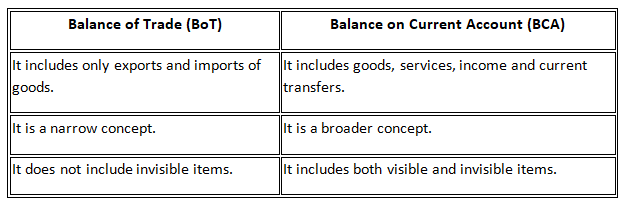
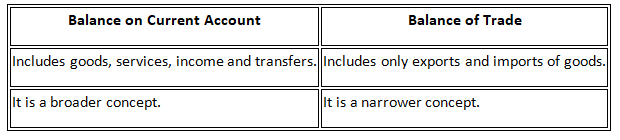
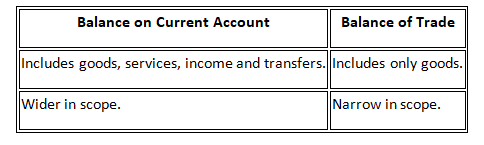
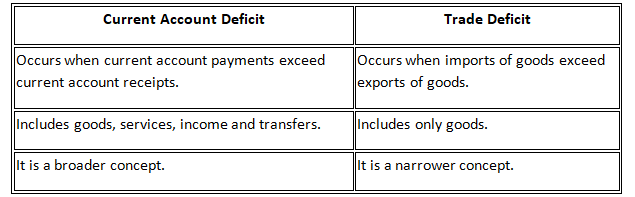
Balance of trade (BOT)j refers to difference between the amounts of exports and imports of visible items (goods).
Balance of Trade = Exports of goods – Imports of goods
Exports are entered as credit (positive) items in the BOP account, while imports are entered as debit (negative) items. BOT is just a part of BOP account and plays a crucial role in deciding the overall situation of BOP of a country. BOT is also known as ‘Balance of Visible Trade’ or Trade Balance’.
Balance on Balance of Trade
The balance of trade need not balance itself, i.e., it is not necessary that exports of goods are always equal to imports of goods. Balance on BOT can also be surplus (positive) or deficit (negative).
- Surplus BOT: If a country exports more goods than what it imports, then the balance of trade is said to be in surplus, i.e., balance of trade is ‘favorable’ for the country.
- Deficit BOT: If the import of goods exceeds the export of goods, then the country is said to have a deficit BOT, i.e., balance of trade is ‘unfavorable’ for the country.
Difference between Balance of Trade and Balance of Payments
COMPONENTS OF BALANCE OF PAYMENTS
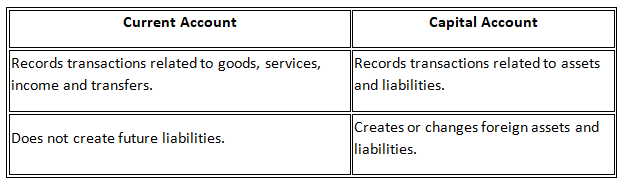
Current Account – Current Account refers to an account which records all the transactions relating to export and import of goods and services and unilateral transfers during a given period of time. Current Account contains the receipts and payments relating to all the transactions of visible items, invisible items and unilateral transfers.
Components of Current Account
The main components of Current Account are:
- Export and Import of Goods (Merchandise Transactions or Visible Trade) – A major part of transactions in foreign trade is in the form of export and import of goods (visible items). Payment for import of goods is written on the negative side (debit items) and receipt from exports is shown on the positive side (credit items). Balance of these visible exports and imports is known as Balance of Trade
- Export and Import of Services (Invisible Trade) – It includes a large variety of services sold and purchased by the residents of a country, to and from the rest of the world. Payments are either received or made to other countries for use of these services. Payments for these services are recorded on the negative side and receipts on the positive side. Services are generally classified as:
Factor Services – The monetary transactions related to factor incomes include Compensation of Employees and Investment Income. The investment income consists of income in the form of interest, rent and profits. Factor income receipts from abroad are recorded on the positive side of Balance of Payment Account, while payments to abroad are recorded on the negative side.
3. Unilateral or Unrequited Transfers to and from abroad (One-sided Transactions) – Unilateral transfers include gifts, grants, personal remittance and other ‘one-way’ transactions. These refer to those receipts and payments, which take place without any service in return. Receipts of unilateral transfers from the rest of the world are shown on the credit side and unilateral transfers to the rest of the world on the debit side.
‘INVISIBLES’ in BOP Account: In the Invisible Account, there are three broad categories:
- Non-Factor Services such as travel, transportation, insurance and miscellaneous services;
- Factor income, which includes Compensation of Employees and Investment Income; and
- Unilateral Transfers, which do not involve any value in exchange.
Difference between Balance of Trade and Current Account

Balance on Current Account
In the current account, receipts from export of goods, services and unilateral receipts are entered as credit or positive items and payments for import of goods, services and unilateral payments are entered as debit or negative items. The net value of credit and debit balance is the balance on current account.
- Current Account Surplus (CAS)
- Current Account Deficit (CAD)
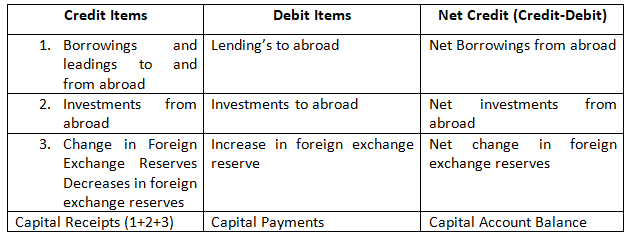
Capital Account – Capital account of BOP records all those transactions, between the residents of a country and the rest of the world, which cause a change in the assets or liabilities of the residents of the country or its government. It is related to claim and liabilities of financial nature. Capital Account is used to: (i) Finance deficit in current account; (ii) Absorb surplus of current account.
- Borrowings and lending’s to and from abroad – It includes:
All transactions relating to borrowings from abroad by private sector, government, etc. Receipts of such loans and repayment of loans by foreigners are recorded on the positive (credit) side.
2. Investments to and from abroad – It includes:
Investments by the rest of the world in shares of Indian companies, rent estate in India, etc. Such investments from abroad are recorded on the positive (credit) side as they bring in foreign exchange.
3. Change in Foreign Exchange Reserves – Foreign exchange reserves are the financial assets of the government held by the central bank. A change in reserves serves as the financing item in India’s BOP. So, any withdrawal from the reserve is recorded on the positive (credit) side and any addition to the reserve is recorded on the negative (debit) side.
Balance on Capital Account
The transactions, which lead to inflow of foreign exchange (like receipt of loan from abroad, sale of assets or share in foreign countries, etc.) are recorded on the credit or positive side of capital account. Similarly, transactions, which lead to outflow of foreign exchange (like repayment of loans, purchase of assets or shares in foreign countries, etc.) are recorded on the debit or negative side. The net value of credit and debit balances is the balance on capital account.
- Surplus in capital account arises when credit items are more than debit items. It indicates net inflow of capital.
- Deficit in capital account arises when debit items are more than credit items. It indicates net outflow of capital.
Components of Capital Account
Balance on Current Account Vs Balance on Capital Account
Balance on current account and balance on capital account are interrelated. In accounting sense, Current Account + Capital Account = 0.
- If an economy is facing the situation of Current Account Deficit (CAD), the same must be financed through surplus in Capital Account. CAD may be set-off through net capital inflows, like selling of assets or borrowing from abroad.
- Similarly, if the economy is facing the situation of Current Account Surplus (CAS), the same must be matched by a deficit on the Capital Account. CAS may be set-off through net capital outflows, like purchase of assets or repayment of loans.
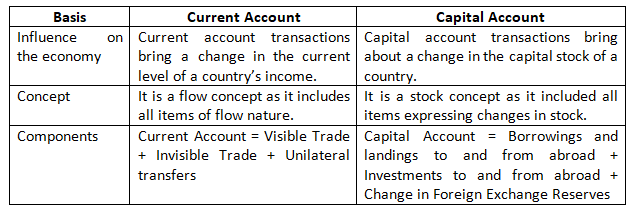
Difference between Current Account and Capital Account
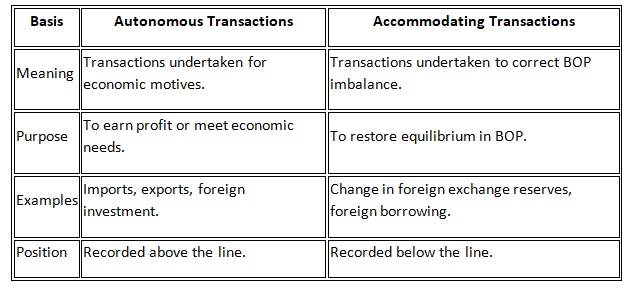
AUTONOMOUS AND ACCOMMADATING ITEMS
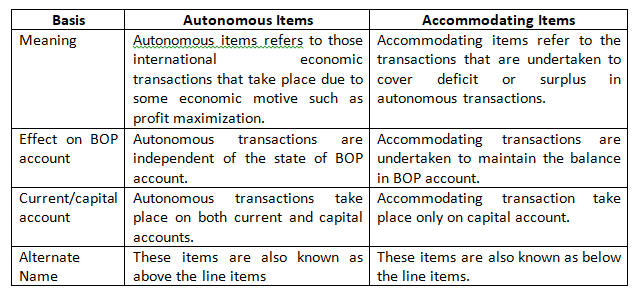
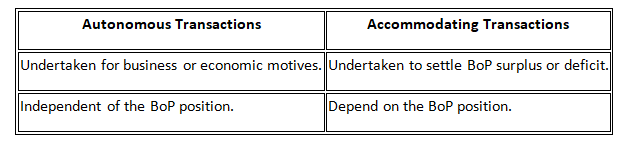
Autonomous Items – Autonomous items refer to those international economic transactions that take place due to some economic motive such as profit maximization. These items are also knows as ‘above the line items’.
Autonomous transactions are independent of the state of BOP account. For example, if a foreign company is making investments in India with the aim of earing profit, then such a transaction is independent of the country’s BOP situation. Autonomous transactions take place on both current and capital accounts.
Accommodating Items – Accommodating items refer to the transactions that are undertaken to cover the gap in the balance of payments, i.e. such transaction are undertaken to cover deficit or surplus in autonomous transactions. For example – if there is a current account deficit in the BOP, then this deficit is settled by capital inflow from abroad. The sources used to meet a deficit in BOP, are: (i) Foreign exchange reserves; (ii) Borrowings from IMF or foreign monetary authorities.
Autonomous Items Vs Accommodating Items
DEFICIT OR SURPLUS IN THE BALANCE OF PAYEMNTS
There is little possibility for the balance of payments to be in equilibrium during a given period of time. Disequilibrium in BOP of a country many be either in the form of deficit or as a surplus. A Surplus in BOP does not pose mist of a problem. However, a deficit often created difficult problems for the economy.
- Deficit in Balance of Payments Account arises when total inflows on account of autonomous transaction are less than total outflows on account of such transactions.
- On the other hand, Surplus in Balance of Payments Account arises when total inflows on account of autonomous transactions exceed total outflows on account of such transactions.
Short Answer type questions
- What is meant by economic transactions? How can they be categorized?
Answer: Economic transactions are transactions involving the exchange of goods, services, income or financial assets between the residents of a country and the rest of the world.
They are classified into:
- Current Account Transactions
- Capital Account Transactions
- Why is it said that the balance of payments is always balanced?
Answer: The Balance of Payments (BoP) is always balanced because every international transaction is recorded twice—once as a credit and once as a debit entry. Therefore, total receipts always equal total payments under the double-entry accounting system.
3. Distinguish between balance of trade and balance of payments.
4. What is meant by visible items and invisible items in the balance of payment account? Give two examples of invisible items.
Answer:
- Visible items are exports and imports of goods (merchandise).
- Invisible items are transactions related to services, income and transfers, which do not involve the movement of goods.
Examples of invisible items:
- Tourism services
- Interest and dividend
5. What does balance of payments account show? Name the two parts of the balance of payments account.
Answer: The Balance of Payments (BoP) account shows all economic transactions between the residents of a country and the rest of the world during a given year.
It has two parts:
- Current Account
- Capital Account
6. Distinguish between balance on trade account and balance on current account.
7. Which transactions determine balance of trade? When is balance of trade in surplus?
Answer: Balance of Trade is determined by the export and import of goods (visible items). Balance of Trade is in surplus when the value of exports of goods exceeds the value of imports of goods during a given period.
8. Explain meaning of deficit in a Balance of Payment account.
Answer: A deficit in the Balance of Payments means that the payments to the rest of the world exceed the receipts from the rest of the world. Such a deficit is generally financed through capital inflows or by using foreign exchange reserves.
9. State the nature of transactions that are recorded in current account of the Balance of Payment account.
Answer: The Current Account records transactions relating to:
- Export and import of goods.
- Export and import of services.
- Income receipts and payments (interest, profit, dividend, etc.).
- Current transfers such as gifts, donations and remittances.
10. State the components of current account of the Balance of Payment account.
Answer: The Current Account consists of four components:
- Export and Import of Goods (Visible Items)
- Export and Import of Services (Invisible Items)
- Income Receipts and Payments
- Current Transfers
11. State the components of capital account of balance of payments.
Answer: The Capital Account mainly includes:
- Foreign Direct Investment (FDI)
- Foreign Portfolio Investment (FPI)
- External Borrowings and Loans
- Banking Capital and Other Capital Transfers
- Changes in Foreign Exchange Reserves
12. ‘Trade Deficit must exist if a country is facing a situation of Current Account Deficit’. Defend or refute the statement, with valid argument.
Answer:
The statement is correct.
A Current Account Deficit occurs when the total payments on the current account exceed total receipts. Since the Balance of Trade is a major component of the Current Account, a country facing a Current Account Deficit must have a Trade Deficit. Although invisible items may reduce the deficit, they cannot completely offset it if the Current Account is in deficit.
13. Distinguish between current account and capital account of balance of payment account. Is import of machinery recorded in current account of capital account?
14. What is meant by ‘Surplus’ in Balance of Payments?
Answer: A surplus in the Balance of Payments means that the total receipts from the rest of the world exceed the total payments to the rest of the world during a given period.
15. Distinguish between autonomous and accommodating transactions in balance of payment account.
16. List the items included as invisibles in the balance of payments account.
Answer: Invisible items include:
- Services (tourism, banking, insurance, shipping, etc.)
- Income (interest, profit, dividend, wages)
- Current Transfers (gifts, donations, remittances)
17. What does the Balance of Payments Account record? Distinguish between the “Balance on current account” and the “Balance of trade” in this account.
Answer: The Balance of Payments (BoP) records all economic transactions between the residents of a country and the rest of the world during a year.
18. What is meant by “Balance of payment” Account? Distinguish between the “Balance on current account” and “ balance of trade” account. In which account would remittances from family members from abroad be accounted?
Answer: The Balance of Payments is a systematic record of all economic transactions between the residents of a country and the rest of the world during a year.
19. Give the meanings of ‘autonomous’ transactions and ‘accommodating’ transactions in the Balance of Payments Accounts.
Answer:
Autonomous Transactions: These are transactions undertaken independently for business, trade or investment purposes, without considering the Balance of Payments position.
Accommodating Transactions: These are transactions undertaken to finance or adjust the surplus or deficit in the Balance of Payments.
20. Foreign portfolio investment (FPI) witnessed a sharp turnaraound during 2023-24 with net FPI inflows of US$ 32.4 billion.’ In which sub-account and on which side of the balance of Payments accounts account the above transaction will be recorded? Give reasons in support of your answer.
Answer: The transaction will be recorded in the Capital Account under Foreign Portfolio Investment (FPI) on the Credit (Receipts) side of the Balance of Payments.
Reason: FPI inflows bring foreign capital into the country, resulting in a receipt of foreign exchange. Therefore, they are entered on the credit side of the Capital Account.
21. What is meant by ‘official reserve transactions’? Discuss their importance in Balance of Payments.
Answer: Official reserve transactions refer to changes in a country’s foreign exchange reserves maintained by the Central Bank (Reserve Bank of India).
Importance:
- They help in financing the Balance of Payments deficit.
- They maintain stability in the exchange rate.
- They ensure smooth settlement of international payments.
22. Define Balance of Payments. Discuss briefly the components of current account.
Answer: Balance of Payments (BoP) is a systematic record of all economic transactions between the residents of a country and the rest of the world during a given year.
The Current Account has four components:
- Export and Import of Goods
- Export and Import of Services
- Income Receipts and Payments
- Current Transfers
23. Distinguish between ‘Current Account Deficit’ and a ‘Trade Deficit’.
24. Distinguish between ‘Current Account Deficit’ and ‘Current Account Surplus.’
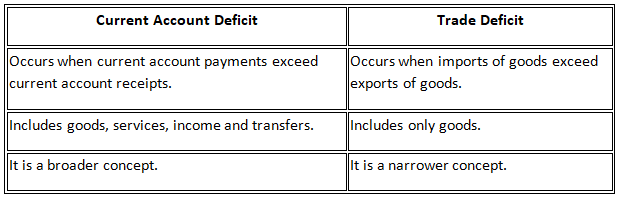
25. ‘Current account deficit in an economy must be financed by a corresponding capital account surplus’. Do you agree with the given statement? Give valid reason (s) in support of your answer.
Answer:
Yes, I agree.
A Current Account Deficit means that foreign exchange payments exceed receipts. This deficit is financed through Capital Account Surplus, such as foreign investment, foreign loans or other capital inflows. Hence, a capital account surplus is required to maintain equilibrium in the Balance of Payments.
26. “Accommodating transactions are undertaken are undertaken to maintain stability in the Balance of Payment Account.” Justify the given statement with valid explanation.
Answer:
The statement is correct.
Accommodating transactions are undertaken to finance or adjust the surplus or deficitin the Balance of Payments. They include foreign borrowing, foreign investment and changes in official reserves. These transactions help maintain stability and balance in the Balance of Payments.
27. Outline the meaning and reasons behind narrowing down of Current Account Deficit.
Answer: Narrowing of Current Account Deficit means a reduction in the gap between current account payments and current account receipts.
Reasons:
- Increase in exports of goods and services.
- Decline in imports, especially oil and gold.
- Higher remittances from abroad.
- Increase in earnings from services such as IT and tourism.
Long Answer type Questions
- What is the meaning of Balance of Payments? What are its main components? Explain them briefly.
Answer – Balance of Payments (BOP): Balance of Payments refers to a systematic record of all economic transactions between the residents of one country and the rest of the world during a given period of time, usually one year. It records all receipts and payments arising from transactions such as exports, imports, foreign investments, loans, and transfers. It is prepared on the basis of double-entry bookkeeping system, so every transaction is recorded as a credit or debit entry.
Main Components of Balance of Payments:
I. Current Account: The current account records transactions related to the export and import of goods and services, income, and transfers.
- Export and import of goods (Visible items)
- Export and import of services (Invisible items)
- Income receipts and payments
- Transfer payments such as gifts and remittances
II. Capital Account: The capital account records all transactions related to changes in foreign assets and liabilities of a country.
- Foreign investment
- Loans and borrowings
- Banking capital
- Changes in foreign exchange reserves
2. What is meant by current account? Explain its various components.
Answer – Current Account: Current Account of Balance of Payments records transactions related to the export and import of goods and services, income, and unilateral transfers during a particular period. These transactions do not create any future liability for the country.
Components of Current Account:
I. Export and Import of Goods: It includes transactions related to physical goods such as machinery, agricultural products, and manufactured goods.
- Export of goods creates a receipt.
- Import of goods creates a payment.
II. Export and Import of Services: Services include banking, insurance, transportation, tourism, and professional services.
- Export of services brings foreign exchange into the country.
- Import of services leads to payment of foreign exchange.
III. Income: It includes income received from and paid to foreign countries.
Examples:
- Interest
- Profit
- Dividend
- Compensation of employees
IV. Transfer Payments: These are one-sided transactions where no goods or services are exchanged in return.
Examples:
- Gifts
- Donations
- Remittances sent by Indians working abroad
3. What do you mean by capital account? Briefly discuss its components.
Answer – Capital Account: Capital Account of Balance of Payments records all transactions that affect the assets and liabilities of a country with the rest of the world. These transactions are related to capital flows and create future obligations or claims.
Components of Capital Account:
- Foreign Investment: Foreign investment refers to investment made by foreigners in domestic companies and assets.
It is of two types:
- Foreign Direct Investment (FDI): Investment made by foreign companies to establish or control business operations in another country.
- Portfolio Investment: Investment made in foreign financial assets such as shares and bonds.
2. Loans and Borrowings: It includes loans taken from foreign governments, international organizations, and commercial banks.
Examples:
- Loans from World Bank
- Foreign government loans
3. Banking Capital: It includes changes in foreign assets and liabilities of commercial banks and financial institutions.
4. Changes in Foreign Exchange Reserves: Changes in foreign exchange reserves held by the central bank are also recorded in the capital account.
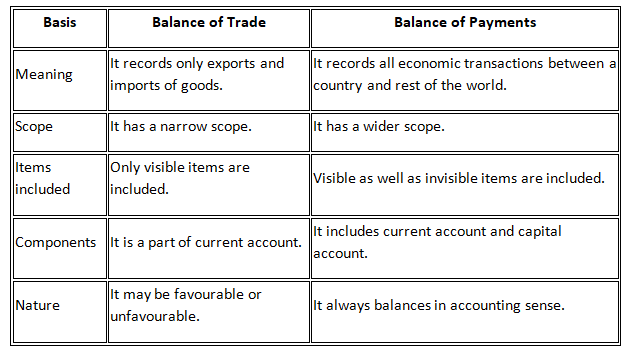
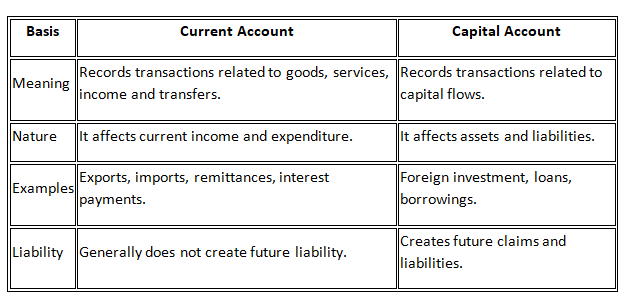
4. Distinguish between: (i) Balance of Trade and Balance of Payment; (ii) Current Account and Capital Account.
Answer – (i) Balance of Trade and Balance of Payment;
(ii) Current Account and Capital Account.
5. Explain the distinction between autonomous and accommodating transactions in balance of payments. Also explain the concept of balance of payments ‘deficit’ in this context.
Answer –
Autonomous Transactions: Autonomous transactions are those transactions which are undertaken independently of the condition of Balance of Payments. These transactions are motivated by economic factors such as profit, investment, and trade.
Examples:
- Export and import of goods and services
- Foreign investment
- Foreign loans
Accommodating Transactions: Accommodating transactions are undertaken to correct imbalance in Balance of Payments. They are generally made by the government or central bank.
Examples:
- Change in foreign exchange reserves
- Borrowing from international organisations
Balance of Payments Deficit: Balance of Payments deficit occurs when autonomous payments are greater than autonomous receipts. In other words,
Autonomous Payments > Autonomous Receipts = BOP Deficit
To correct this deficit, accommodating transactions are used, such as borrowing from abroad or using foreign exchange reserves.
6. Distinguish (a) between current account and capital account, and (b) Between autonomous transactions and accommodating transactions of balance of payments account.
Answer –
(a) between current account and capital account
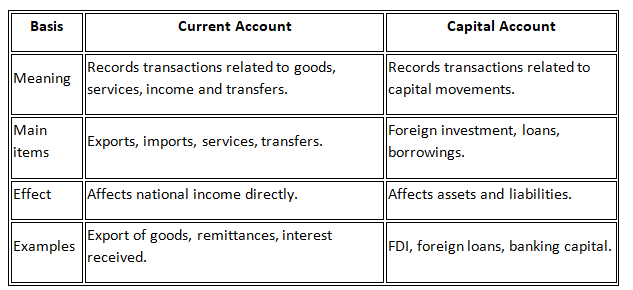
(b) Between autonomous transactions and accommodating transactions