basic concepts of macroeconomics class 12 notes
chapter 2 basic concepts of macroeconomics class 12 notes pdf
DOMESTIC TERRITORY (ECONOMIC TERRITORY)
Domestic Territory refers to the geographical territory administered by a government within which persons, goods and capital circulate freely.
In Addition to political frontiers, it also includes:
- Ships and Aircraft owned and operated by normal residents between two or more countries – For example – planes operated by Air India between Russia and Japan are part of the domestic territory of India.
- Fishing vessel, oil and natural gas rigs and floating platforms operated by the residents of a country in the international waters where they have exclusive rights of operation – For example – Fishing boasts operated by Indian fishermen in international waters of Indian Ocean will be considered a part of domestic territory of India.
- Embassies, consulates and military establishments of a country located abroad – For example – Indian Embassy in Russia is a part of the domestic territory of India.
Domestic Territory does not include:
- Embassies, consulates and military establishments of a foreign country. For example – Japanese Embassy in India is a part of domestic territory of Japan.
- International organization like UNO, WHO, etc. located within the geographical boundaries of a country.
NORMAL RESIDENTS
Normal resident of a country refers to an individual or an institution who ordinarily resides in the country and whose center of economic interest also lies in that country. Normal residents include both, individuals and institutions.
Centre of Economic Interest Implies two things:
- The resident lives or is located within the Domestic Territory; and
- The resident carries out basic economic activities earning, spending and accumulation from that location.
Following are not included under the category of Normal residents:
- Foreign tourists and visitors who visit a country for recreation, holidays, medical treatment, study, sports, conferences, etc.
- Foreign staff of Embassies, officials, diplomats and members of the armed forces of a foreign country, located in the given country.
- International organization like UNO, WHO, etc. are not considered as normal residents of the country in which they operate. They are treated as the normal residents of international area.
- Employees of international organizations are considered as residents of the countries to which they belong and not of the international area. For example, an American working in UNO office located in India will be treated as normal resident of America.
Citizenship and Resident ship are two different terms.
- CITIZENSHIP – It is basically a legal concept based on the place of birth of the person or some legal provisions allowing a person to become a citizen. It means, India citizenship can arise in two ways
- When a person is born in India he acquires automatic citizenship of India.
- A person born outside India applies for citizenship and India law allows him to become India citizen.
- RESIDENTSHIP –
- It is an economic concept based on the basic economic activity performed by a person.
- An individual is a normal resident of a country if he ordinarily resides in the country for a period more than one year and his center of economic interest also lies in that country.
EXAMPLE: A Chinese living in India for more than one year is a normal resident of India. However he is not a citizenship of India as he does not hold citizenship of India similarly a Non-Resident India is a citizenship of India but a resident of the country in which he lives. It means a person can be a citizenship of one country and at the same a resident of another country.
FACTOR INCOME AND TRANSFER INCOME
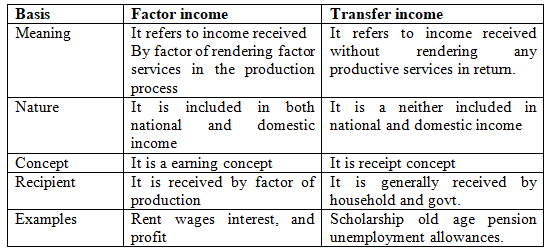
Factor income – Factor income refer to income received by factor of production for rendering factor services in the production process.
- It is received for providing factor services of land, labour, capital, and enterprise .As factor income is earned for contributing to production process it is a bilateral income.
- Factor income of normal resident of a country is included in the National Income.
- Examples- rent, wages, interest, and profit.
- It should be noted that factor payment and factor income are the two sides of the same coin. it is a factor income from the viewpoint of the producer of the goods and services
Transfer income – Transfer income refers to income received without rendering any production services in return
- It is a unilateral concept
- It is not included in national income as it does not reflect any production of good and services
- It can be received either within the domestic territory of a country or from abroad.
- EXAMPLES- old age pension, scholarship, unemployment, allowance, pocket money, etc.
FINAL GOODS AND INTERMEDIATE GOODS
All things that satisfy human want are called goods on the basis of end use of goods they can be mainly classified into two heads
- Final goods
- Intermediate goods
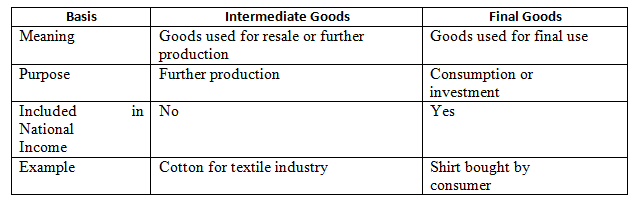
Final goods refers to those goods which are used either for consumption or for investment
- Goods purchased by consumer household as they are meant for final consumption
- Goods purchased by firms for capital formation or investment
Expenditure on final goods purchased by household is called consumption expenditure and expenditure on final goods purchased by the producer is called investment expenditure. So expenditure on final goods =consumption + investment
Intermediate goods
Intermediate goods refer to those goods which are used either for resale or further production in the same year.
- Goods purchased for resale
- Goods are used for production
How to Classify Goods as: Intermediate Goods and final Goods
The distinction between intermediate goods and final goods is made on the basis of the use of product and not on the basis of product itself. A commodity can be an intermediate goods as well as a final good, depending upon its nature of use.
For example:
- Sugar is an intermediate good when it is used by sweet shop for making sweets. However, if it is used by the consumers, then it becomes a final good.
- Similarly, milk is an intermediate good when it is used in dairy shops for resale. However, it becomes a final good when it is used by the households.
National Income includes only Final goods
Only final goods are included in national income. The intermediate goods are not included in the national income as they are already included in the final goods. If their value is added again, it will lead to double counting.
For Example – Out of wheat and flour, only flour (final good) is included in National Income as value of flour already includes the value of wheat (intermediate good).
CONSUMPTION GOODS AND CAPITAL GOODS
Final goods can be classified into two groups: Consumption Goods and Capital Goods
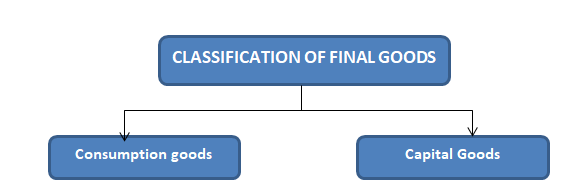
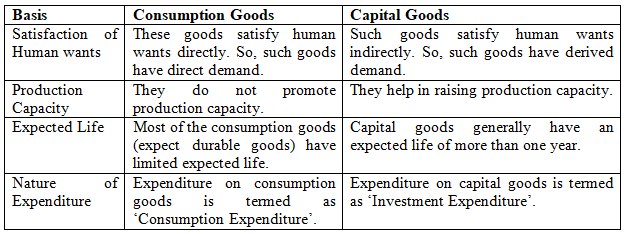
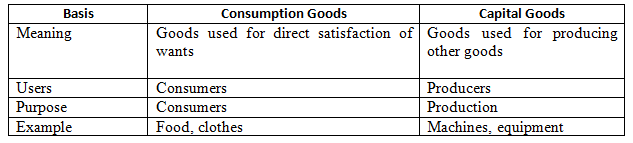
Consumption Goods – Consumption goods refer to those goods which satisfy the wants of the consumers directly.
For Example – Bread, butter, shirts, pens, television, furniture, etc.
Consumption goods can further be sub-divided into following categories:
- Durable Goods – It refers to those goods which can be used again and again over a considerable period of time. For example – television, refrigerators, etc.
- Semi-durable goods – Goods which can be used for a limited period of time are termed as semi-durable goods. These goods have a life span of around one year. For example – clothes, crockery, shoes, etc.
- Non-durable goods – Goods which are used up in a single act of consumption are known as non-durable goods. These goods cannot be used more than once, i.e. they lose their identity in single act of consumption. For example – mike, bread, food grains, paper, etc.
- Services – Services refer to non-material goods which directly satisfy the human wants. They are intangible activities, i.e. they can neither be seen nor touched. For example – services of teachers, doctors, banks, etc.
Capital Goods – Capital Goods are those final goods which help in production of other goods and services. For example – plant and machinery, equipment’s, etc.
Some Points about Capital Goods
- They are used in future for productive purpose and have expected life time of several years.
- They do not lose their identify in the production process, i.e. they do not get merged in the process of production.
- They need repairs or replacement over times as they depreciate over a period of time.
- They have derived demand as their demand is derived from the demand for other goods, which they help to produce.
Consumption Goods Vs Capital Goods
GROSS INVESTMETN, NET INVESTMETN AND DEPRECIATION
Investment or capital formation refers to addition to the capital stock of an economy. For example – construction of building, purchase of machinery, addition to inventories of goods, etc. Investment can be looked up in two forms:
- Gross Investment
- Net Investment
I. Gross Investment – Gross Investment is addition to the stock of capital before making allowance for depreciation. Capital stock consists of fixed assets unsold stock. So, gross investment is the expenditure on purchase of fixed assets and unsold stock during the accounting year.
Net Investment – The actual addition made to the capital stock of economy in a given period is termed as Net Investment.
Net Investment = Gross Investment – Depreciation
Increase in net investment (or net capital formation) leads to increase in productive capacity of the economy as there is greater availability of capital per unit of labour.
Depreciation (Consumption of Fixed Capital)
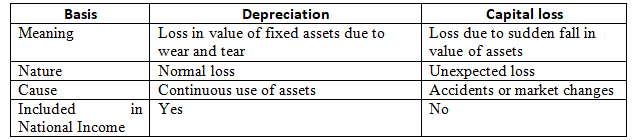
Depreciation refers to a fall in the value of fixed assets due to normal wear and tear, passage of time or expected obsolescence (change in technology). The concept of depreciation is very important to differentiate between Gross value and the Net value. ‘Gross’ is inclusive of depreciation, whereas, ‘net’ excludes it.
Gross Value = Net Value + Depreciation
Depreciation of assets in mainly due to 3 reasons:
- Normal wear and tear – Continuous use of fixed assets in production process decreases their productive capacity and value.
- Passage of time – Value of fixed assets also decreases with the passage of time, even if they are not being put to use in the business. Natural factors like rain, winds, weather, etc. contribute to fall in their value.
- Expected obsolescence – Value of fixed assets also decrease due to expected obsolescence (i.e. loss in value due to change in technology or change in demand for goods and services).
class 12 economics chapter 2 basic concepts of macroeconomics important questions
NET INDIRECT TAXES (NIT)
Net indirect taxes refer to the difference between indirect taxes and subsidies.
Net Indirect Taxes = Indirect Taxes – Subsidies
Let us discuss the two components of NIT:
I. Indirect Taxes – Indirect taxes refer to those taxes which are imposed by the government on production and sale of goods and services. For example – Goods and services, tax (GST), Basic Custom Duty, Central Excise and VAT on Petroleum Products, Excise on Liquor, Electricity Durities, Stamp Duty, Securities Transaction Tax, Entry Taxes and Toll, etc.
II. Subsidies – Subsidies are the ‘financial assistance’ provides by the government to producers of fulfill it social welfare objectives. In India, LPG cylinder is sold at subsidized rates.
- They are often granted to promote exports or to encourage firms for setting up the industries in the backward areas.
- Subsidies are opposite to indirect taxes as they reduce the market price of the commodity. In the example of speaker, if the Government grants a subsidy of Rs.10, then price of speakers will fall to Rs.540 due to subsidies.
- Subsidies may also be referred as ‘Economic Assistance’ or ‘Financial Assistance.’
Factor Cost Vs Market Price
- Factor Cost (FC) – It refers to amount paid to factors of production for their contribution in the production process. In the given example, Rs.500 is the ‘Factor Cost’.
- Market Price (MP) – It refers to the price at which product is actually sold in the market. In the given example, Rs.540 is the ‘Market Price’. It includes the indirect taxed and excludes the subsidies.
- Market Price = Factor Cost + (Indirect Taxes – Subsidies)
- Market Price = Factor Cost + Net Indirect Taxes
Calculate Net Indirect Taxed (NIT) in the following cases:
Case 1 – (i) Indirect Taxes = 0; (ii) Subsidies = Rs.100
Ans. NIT = 0 – Rs.100 = – Rs.100
NET FACTOR INCOEM FROM ABROAD (NFIA)
It refers to the difference between factor income received from the rest of the world and factor income paid to the rest of the world.
NFIA = Factor income earned from abroad – Factor income paid abroad
Significance of NFIA – NFIA is significant to differentiate between ‘Domestic Income’ and ‘National Income’. In practical estimates, domestic income is estimated first and then, National Income is derived from Domestic Income in the following manner:
National Income
= Domestic Income + Factor income from abroad (due to contribution of normal residents to production outside the economic territory) – Factor income to abroad (due to contribution of non-residents to production inside the economic territory)
The difference of Factor income from abroad and Factor income to abroad is termed as “Net factor income from abroad” or popularly abbreviated as NFIA.
So, National Income = domestic Income + NFIA
NFIA can be Positive, Negative or Zero
- NFIA is Positive when income earned from abroad is more than income paid to abroad.
- NFIA is Negative when income earned from abroad is less than income paid to abroad.
- NFIA is Zero when income earned from abroad is equal to income paid to abroad.
Components of NFIA
There are three main components of NFIA:
- Net Compensation to Employees – It refers to difference between income form work received by resident workers living or employed abroad for less than one year and similar payments made to non-resident workers staying or employed within the domestic territory of the country for less than one year.
- Net Income from property and entrepreneurship – It refers to difference between income from property and entrepreneurship (in the form of rent, interest and dividend) received by residents of the country and similar payments made to the non-residents.
- Net Retained Earnings – It refers to difference between retained earnings of resident companies located abroad and retained earnings of non-resident companies located within the domestic territory of the country.
IMPORTANT FORMULAE AT A GLANCE
Net Investment = Gross Investment – Depreciation
Net Indirect Taxes = Indirect Taxes – Subsidies
OR
= Market Price – Factor Cost
Net Factor Income from Abroad (NFIA) = National Income – Domestic Income
OR
= Factor income earned from abroad – Factor income paid abroad
OR
= Net Compensation of Employees (Net COE) + Net Income from Property and Entrepreneurship + Net Retained Earnings
Short Answer Type Questions
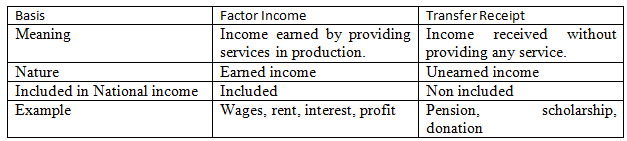
- Difference between Factor Income and Transfer Receipt
Ans.
2. Difference between Intermediate products and Final products. Give examples.
Or – Explain the basis of classifying goods into intermediate and final goods. Give suitable examples.
Ans.
3. “Machine’ purchased is always a final good.” Do you agree?
Ans. No, a machine is not always a final good. When a machine is purchased by a producer for production purposes, it is treated as a final good because it is used as a capital asset. But if a machine is purchased for resale, then it becomes an intermediate good. Hence, the classification depends upon the use of the machine.
4. Which of the following expenditures incurred are on intermediate products and which are on final products?
- Purchase of ticket for train journey by an individual.
- Purchase of eatables by a firm.
- Purchase of a car by an employer for office use by his employees.
- Purchase of wheat in the wholesale market.
Ans. Identify Intermediate Goods and Final Goods
(i) Ticket for train journey by an individual — Final Good
(ii) Eatables purchased by a firm — Intermediate Good
(iii) Car purchased for office use — Final Good
(iv) Wheat purchased in wholesale market — Intermediate Good
5. Difference between Consumption Goods and Capital Goods
Ans.
6. Difference between Consumer Goods and Capital Goods. Which of these are final goods?
Ans.

Both consumer goods and capital goods are treated as final goods because they are not purchased for resale.
7. State & discuss briefly 3 Main Components of Net Factor Income from Abroad (NFIA)
Ans. The three main components of NFIA are:
1. Net compensation of employees
2. Net income from property and entrepreneurship
3. Net retained earnings of resident companies abroad
NFIA shows the difference between factor income received from abroad and factor income paid abroad.
8. Define Intermediate Goods and Final Goods. Can milk be an intermediate good?
Ans. Intermediate Goods – Goods purchased for resale or further production are known as intermediate goods.
Final Goods – Goods purchased for final consumption or investment are called final goods.
Yes, milk can be an intermediate good if it is purchased by a sweet shop or dairy for making
other products.
9. Difference between Depreciation and Capital Loss.
Ans.
10. Different between Factor Cost and market Price
Ans.

Formula:
Market Price = Factor Cost + Indirect Taxes – Subsidies
11. “National Income includes income earned by factors of production, within domestic territory only.” Defend or refute the given statement with valid reasons.
Ans. The statement is incorrect. National income includes income earned by normal residents of a country, whether earned within the domestic territory or abroad. Domestic income includes income generated only within domestic territory. Therefore, national income is based on residency and not only on domestic territory.
12. Increase in national income always implies increase in domestic income. Elucidate.
Ans. The statement is not always correct.
National Income = Domestic Income + Net Factor Income from Abroad (NFIA)
National income may increase because of an increase in income received from abroad even if
domestic income does not increase. Therefore, increase in national income does not always mean increase in domestic income.
13. Classification of final goods into consumption and capital goods depends on the economic nature of its use. Defend or refute the statement, with the help of a suitable example.
Ans. The statement is correct. If a good is used for direct satisfaction of wants, it is called a
consumption good. If the same good is used for further production, it becomes a capital good.
For example, a computer purchased by a family is a consumption good, while the same computer purchased by an office is a capital good.
Long Answer Type Questions
1. Explain the concept of normal residents.
Ans. Normal residents are those persons or institutions whose centre of economic interest lies in a particular country and who normally live there for a long period of time. In national income accounting, the concept of normal residence is more important than nationality. A person may be a citizen of one country but can be treated as a normal resident of another country if he or she normally lives and works there for more than one year. Normal residents include individuals, households, firms, and government institutions that carry out economic activities within the country. Indian embassies situated abroad, as well as ships and aircraft operated by Indian residents, are also considered a part of India’s domestic territory. On the other hand, foreign tourists, foreign diplomats, and people visiting another country for medical treatment, education, or tourism for a short period are not treated as normal residents. The concept of normal residents is important because national income includes income earned by normal residents both within the country and abroad.
2.Briefly discuss the meaning of domestic territory.
Ans. Domestic territory refers to the geographical area under the political and economic control of a country where goods, services, labour, and capital can move freely. It is the area within which domestic income is generated. Domestic territory includes not only the political boundaries of the country but also territorial waters, airspace, and ships and aircraft operated by residents between two countries. Apart from this, embassies and consulates of a country situated abroad are also included in its domestic territory because they represent the government of that country. Similarly, military establishments of the country located abroad are also included. However, foreign embassies and international organisations located within the country are excluded from domestic territory because they are considered a part of foreign countries. The concept of domestic territory is very important in national income accounting because domestic income is calculated on the basis of production activities taking place within this territory, irrespective of whether the producers are residents or non-residents.
3. Discuss the concept of factor income and transfer income with the help of examples.
Ans. Factor income refers to the income earned by factors of production in return for providing productive services in the production process. The four factors of production are land, labour, capital, and entrepreneurship. Income earned by these factors is called factor income and is included in national income because it contributes to current production. Examples of factor income include wages and salaries paid to workers, rent received for land, interest earned on capital, and profit earned by entrepreneurs. Transfer income, on the other hand, refers to income received without rendering any productive service. Such income does not arise from current production activities and therefore is not included in national income. Transfer payments are one-sided payments made out of love, respect, social welfare, or charity. Examples include pension, scholarship, unemployment allowance, gifts, and donations. Thus, factor income is productive in nature and forms a part of national income, whereas transfer income is unearned income and is excluded from national income calculations.
4. Distinguish between Intermediate Product and Final Product, giving suitable examples in support of your answer.
Ans.
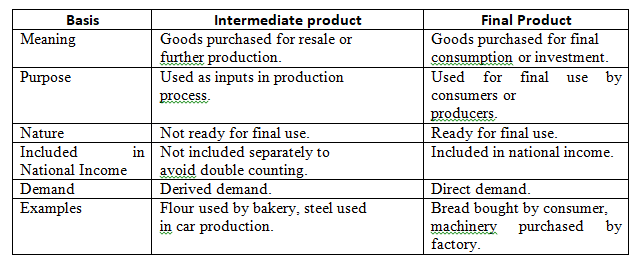
Intermediate goods are used for producing other goods and services during the same accounting year. Their value is already included in the value of final goods, so they are not counted separately. Final goods, on the other hand, are goods that are either consumed by households or used for investment purposes. The classification mainly depends upon the purpose for which the goods are used.
basic concepts of macroeconomics class 12 handwritten notes