circular flow of income class 12 notes pdf
circular flow of income class 12 notes
MEANING OF MACROECONOMICS
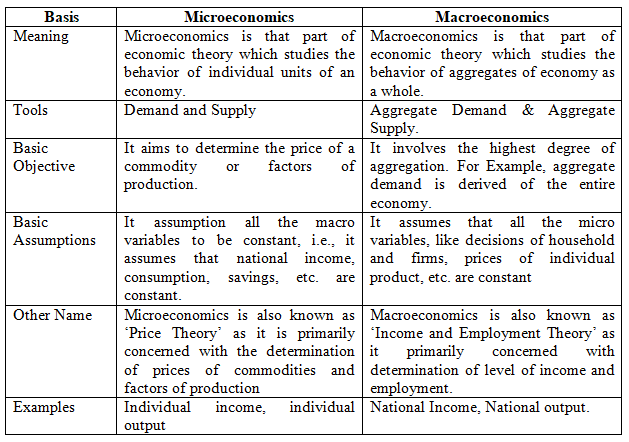
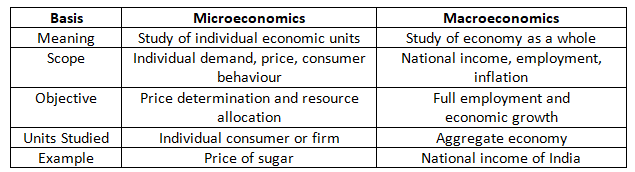
Macroeconomics is that part of economics theory which studies the behavior of aggregates of the economy as a whole. For example – National income, aggregate output, aggregate consumption, etc. Its main tools are Aggregate Demand and Aggregate Supply.
Difference between Microeconomic and Macroeconomics
MEANING OF CIRCULAR FLOW OF INCOME
It refers to the cycle of generation of income in the production process, its distribution among the factors of production and finally, its circulation from households to firms in the form of consumption expenditure on goods and services produced by them.
Phase of Circular Flow of Income
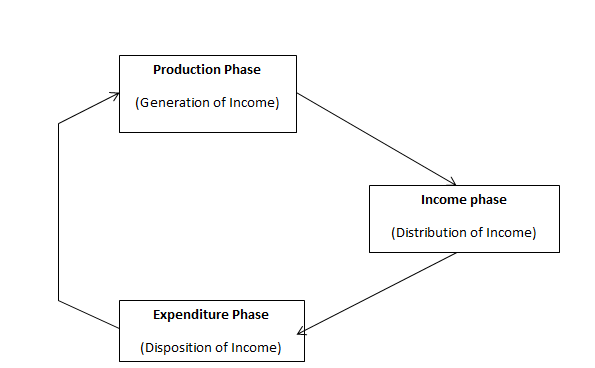
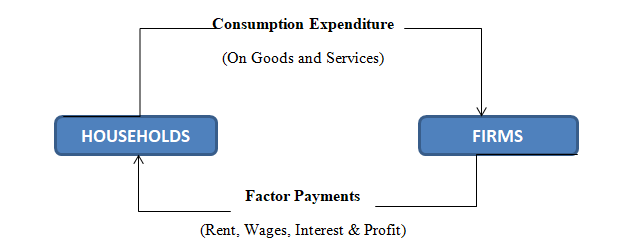
There are 3 different phases (generation, distribution and disposition) in circular flow of income, as shown in the given diagram:
- Generation Phase – In this phase, firms produce goods and services with the help of factor services.
- Distribution Phase – This phase involves the flow of factor income (rent, wages, interest and profit) from firms to the households.
- Disposition Phase – In this phase, the income received by factors of production, is spent on the goods and services produced by firms.
STOCK AND FLOW
The concepts of stock and flow are used frequently in macroeconomics. Some of the macro variables relate to stock, while others relate to flow.
Therefore, it is important to understand their meaning so that variables can be categorised as stock of flow.
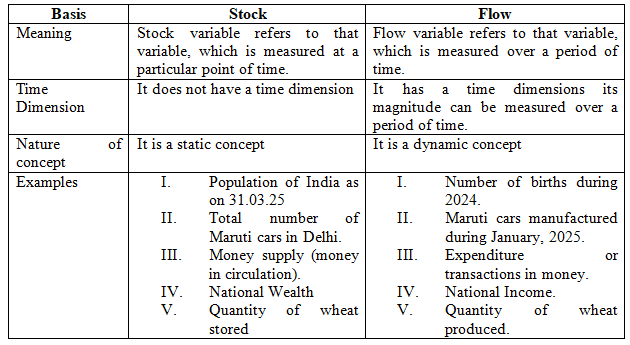
Stock – Stock variable refers to that variable, which is measured at a particular point of time. For example – the stock of goods in the go down as on 31st January, 2025. It means, stock variables are not time dimensional.
Some more examples of stock variables are national wealth, national capital, money supply etc.
Flow – Flow variable refers to that variable, which is measured over a period of time. For example – the production of goods during the month of January 2025, the birth rate in the year 2024, National Income in the year 2024 are flow variables. The ‘period of time’ could be a day, a week, a year, etc.
Examples for Better Clarity
The total number of houses as on 31st December, 2024 is the stock concept, while the number of houses constructed during 2024 is a flow variable.
Difference between Stock and Flow
TYPES OF CIRCULAR FLOW
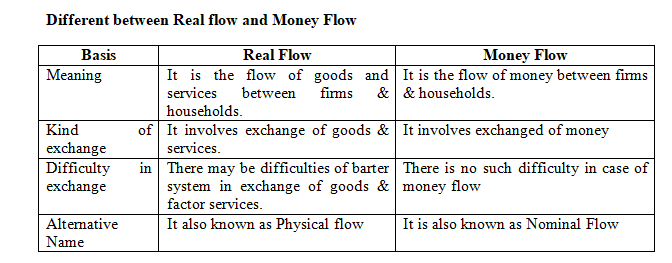
I. Real Flow – Real flow refers to the flow of factor services from households to firms and the corresponding flow of goods and services from firms to households.
- It is also known as ‘Physical flow’.
- There is only exchange of goods and services between the two sectors without involvement of any money.
- Real flow determines the magnitude of the growth process in an economy. For Example – when more factor services are offered to firms, then volume of production will be more and it speeds up the process of economic growth.
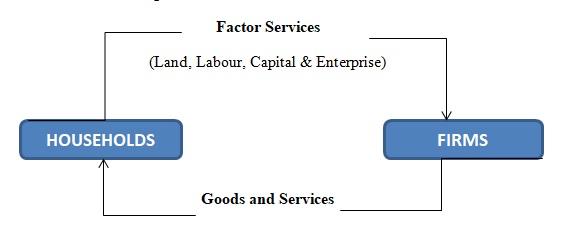
II. Money Flow – Money Flow refers to flow of factor payments from firms to households for their factor services and corresponding flow of consumption expenditure from households to firms for purchase of goods and services produced by the firms.
- It is also known as ‘Normal flow’.
- It involves an exchange of money between the two sectors.
Four Sectors of the Economy
The four major sector in an economy according to the macroeconomic point of view are:
- Household Sector – It includes consumers of goods and services and the owners of factors of production. They supply factors like land, labour, capital and entrepreneur and receive income in return in the form of rent, wages, interest and profit respectively.
ii. Producing Sector (Firms) – It includes all producing firms in the economy. To produce goods are services, the firm hires factors of production from the household. Households consume goods and services to satisfy their wants and firms produce goods and services to make a profit.
- Government Sector – It acts in two capacities:
- As a welfare agency, it is involved in maintaining law and order, defence and other services of public welfare.
- As a producer, it produces goods and services in public sector enterprises.
iii. Foreign Sector (or External Sector or Rest of the World Sector) – This sector includes transactions with the rest of the world. It is involved in the export and import of goods and the flow of capital between the domestic economy and other countries of the world.
CIRCULAR FLOW IN A SIMAPLE ECONOMY (TWO-SECTOR ECONOMY)
A simple economy assumes the existence of only two sectors, i.e., household sector & firm sector.
Closed Economy and Open Economy
- Closed Economy – is an economy which has no economic relations with the rest of the world. However, in the current scenario, there is hardly any country which does not have any economic relations with other nations. However A closed economy has 3 sectors: Household sector, producing sector and government sector, i.e., it does not have any foreign sector.
- Open Economy – is an economy which has economic relations with the rest of the world. In the current scenario, all the nations have economic relations with other nations. An open economy has 4 sectors: Household Sector, Producing Sector, Government Sector and Foreign Sector.
In order to make our analysis simple, we take some assumptions:
- There are only 2 sectors in the economy: Households and Firms. It means, there is no government and foreign sector.
- Household sector supplies factor services only to firms and the firms hire factor services only from households.
- Firms produce goods and services and sell their entire output to the households.
- Households receive factor income for their services and spend the entire amount on consumption of goods and services.
- There are no savings in the economy, i.e. neither the households save from their incomes, nor the firms save from their profits.
Conclusions of Circular Flow in a Simple Economy
In a Two-Sector Economy, the following Conclusions can be drawn:
- Total Production of goods and services by Firms = Total Consumption of goods and services by Households.
- Factor Payments by firms = Factor Incomes of households.
- Consumption Expenditure by households = Factor Income of households.
- Real Flow in the form of factor services and final goods and services = Money Flow between firms and households.
Short Answer Type Questions
- Explain the circular flow of income.
Ans. Circular flow of income refers to the continuous flow of production, income, and
expenditure in an economy. In a two-sector economy, households provide factor services
to firms and firms provide goods and services to households. Thus, income keeps
circulating between households and firms.
2. Briefly explain the different phases of circular flow of income.
Ans. The circular flow of income has two phases:
1. Real Flow – Flow of factor services and goods & services.
2. Money Flow – Flow of factor payments and consumption expenditure.
Both flows occur simultaneously in opposite directions.
3. What is meant by circular flow of income? Distinguish between Real Flow and Money Flow.
Ans. Circular flow of income means the continuous movement of goods, services, and money income between different sectors of an economy.

4. “Households and Firms depend on each other in the circular flow of income.” Justify.
Ans. Households supply factors of production to firms. Firms pay factor income such as wages, rent, interest, and profit to households. Households spend this income on goods and services produced by firms. Therefore, households and firms are interdependent.
5. Distinguish between stocks and flows. Give an example of each.
Ans.

6. Discuss briefly the circular flow of income in a two-sector economy with the help of a suitable diagram.
Ans. In a two-sector economy, there are only households and firms. Households provide factor services to firms and receive factor income. Firms produce goods and services which are purchased by households. Thus, there is a continuous circular movement of income and expenditure.
7. “Circular Flow of Income principle is based on the assumption — one’s expenditure
is other’s income.” Justify the given statement.
Ans. When households spend money on goods and services, it becomes income for firms.
Similarly, when firms make factor payments, it becomes income for households. Hence,
expenditure of one sector creates income for another sector.
8. Discuss the meaning of Macroeconomics. Give suitable examples.
Ans. Macroeconomics is the branch of economics that studies aggregate economic variables
such as national income, employment, general price level, and economic growth. It studies
the economy as a whole. Examples include inflation, unemployment, and national income
determination.
Long Answer Type Questions
1. Briefly explain the money flow and the real flow of income.
Ans. Circular flow of income includes two types of flows — real flow and money flow. Real flow refers to the flow of factor services from households to firms and the flow of goods and services from firms to households. Households supply land, labour, capital, and entrepreneurship to firms. In return, firms produce goods and services for consumption by households. This flow is known as real flow because it involves real resources and commodities. Money flow refers to the flow of money between households and firms. Firms pay wages, rent, interest, and profit to households for providing factor services. These payments constitute factor income for households. Households, in turn, spend their income on purchasing goods and services produced by firms. This expenditure becomes income for firms. Real flow and money flow move in opposite directions but are equal in value. Both flows are interdependent and together maintain the circular flow of income in the economy.
2. Describe the circular flow of income in a two-sector economy.
Ans. A two-sector economy consists of two sectors — households and firms. Households are
the owners of factors of production, while firms are producers of goods and services. The circular flow of income explains the continuous movement of income and expenditure between these two sectors. Households provide factor services such as land, labour, capital, and entrepreneurship to firms. In return, firms make factor payments in the form of wages, rent, interest, and profit. These payments generate income for households. Households use this income to purchase goods and services produced by firms. This spending is known as consumption expenditure. Thus, money flows back to firms. Simultaneously, goods and services flow from firms to households. Therefore, there are two flows in the economy — real flow and money flow. Real flow includes factor services and goods, while money flow includes factor payments and consumption expenditure. Both flows move continuously in opposite directions and together form the circular flow of income in a two-sector economy.
3. Differentiate between Microeconomics and Macroeconomics.
Ans.
NCERT website