national income and related aggregates class 12 notes
national income and related aggregates class 12 pdf
BASIC AGGREGATES OF NATINAL INCOME
- Gross domestic product at Market Price (GDPMP) – It refers to gross market value of all final goods and services produced within the domestic territory of a country during a period of one year.
- Gross – Gross in GDPMP signifies that on provision has been made for depreciation, i.e. it includes depreciation.
- Domestic – In GDPMP signifies that it includes goods and services produced by all units located within the domestic territory (irrespective of fact whether produced by residents or non-residents).
- Market Price – In GDPMP signifies that it includes amount of indirect taxes paid & excludes amount of subsidy received, i.e. it shows that net indirect taxes (NIT) have been included.
- Product – In GDPMP signifies that only final goods and services have to be included.
2. Gross Domestic Product at Factor Cost (GDPFC) – It refers to gross money value of all the final goods and services product within the domestic territory of a country during a period of one year.
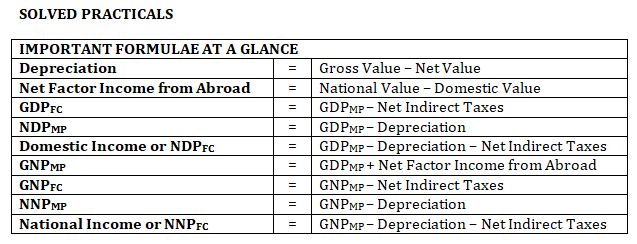
GDPFC = GDPMP –Net Indirect Taxes
3. Net Domestic Product at Market Price (NDPMP) – It refers to net market value of all the final goods and services produced within the domestic territory of a country during a period of one year.
NDPMP = GDPMP – Depreciation
4. Net Domestic Product at Factor Cost (NDPFC) – It refers to net money value of all the final goods and services product within the domestic territory of a country during a period of one year.
NDPFC = GDPMP – Net Indirect Taxes – Depreciation
5. Gross National Product at Market Price (GNPMP) – It refers to gross market value of all the final goods and services product by the normal residents of country during a period of one year.
GNPMP = GDPMP + Net factor income from abroad
6. Gross National Product at Factor Cost (GNPFC) – It refers to gross money value of all the final goods and services produced by the normal residents of a country during a period of one year.
GNPFC = GNPMP – Net Indirect Taxes
7. Net National Product at Market Price (NNPMP) – It refers to net market value of all the final goods and services produced by the normal residents of a country during a period of one year.
NNPMP = GNPMP – Depreciation
8. Net National Product at Factor Cost (NNPFC) – It refers to net money value of all the final goods and services produced by the normal residents of a country during a period of one year.
NNPFC = GNPMP – Net Indirect Taxes – Depreciation
Short Answer Type Questions
1. Define the following terms: (i) GDP at MP (ii) NDP at FC (iii) NNP at MP
Ans. (i) GDP at MP – Gross Domestic Product at Market Price refers to the money value of all final goods and services produced within the domestic territory of a country during an accounting year, including net indirect taxes.
(ii) NDP at FC – Net Domestic Product at Factor Cost refers to the net value of all final goods and services produced within the domestic territory of a country during an accounting year at factor cost.
NDP at FC = GDP at MP – Depreciation – Net Indirect Taxes.
(iii) NNP at MP – Net National Product at Market Price refers to the market value of all final goods and services produced by normal residents of a country during an accounting year after deducting depreciation.
2. When can domestic product be more than national product?
Ans. Domestic Product can be more than National Product when Net Factor Income from Abroad (NFIA) is negative, i.e., factor income paid abroad is greater than factor income received from abroad.
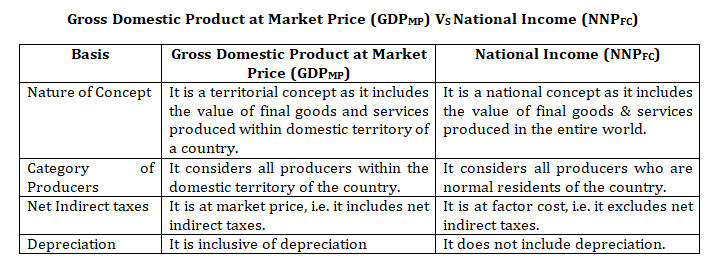
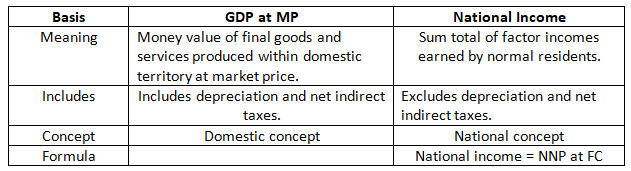
3. Distinguish between Gross Domestic Product at Market Price and National Income.
Ans.
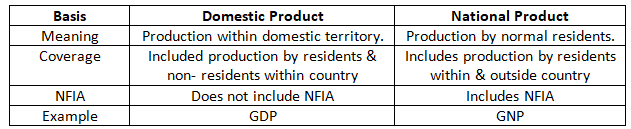
4. Distinguish between Domestic Product and National Product.
5. “National Income is always greater than Domestic Income.” Do you agree with the give statement? Support your answer with a valid reason.
Ans. No, I do not agree. National Income is not always greater than Domestic Income because it depends upon Net Factor Income from Abroad (NFIA). If NFIA is negative, National Income can be less than Domestic Income.
6. Distinguish between GDP at MP and NDP at MP.
Ans.

Formula – NDP at MP = GDP at MP – Depreciation
national income and related aggregates class 12 handwritten notes
class 12 economics handwritten notes pdf macroeconomics
Long Answer Type Questions
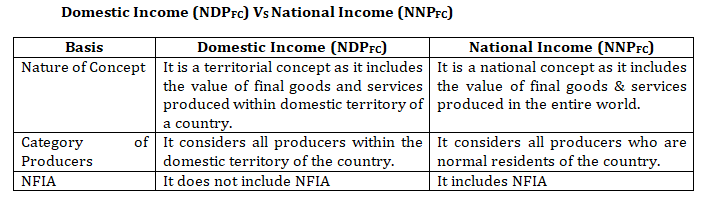
1. Distinguish between Domestic Product and National Product by giving suitable examples.
Ans. Domestic Product refers to the value of all final goods and services produced within the domestic territory of a country during an accounting year. It includes income generated by both residents and non-residents within the domestic territory. It does not include Net Factor Income from Abroad (NFIA). National Product refers to the value of all final goods and services produced by the normal residents of a country during an accounting year, whether within the domestic territory or abroad. It includes NFIA. Thus, the main difference between the two concepts is that Domestic Product is based on place of production, whereas National Product is based on ownership or residency.
Example: Income earned by a foreign company in India is included in Domestic Product but not in National Product. On the other hand, income earned by an Indian company in a foreign country is included in National Product but not in Domestic Product.
Relation between the two:
National Product = Domestic Product + Net Factor Income from Abroad (NFIA)
2. Discuss the concepts of: (i) NDP at MP; (ii) GNP at FC and (iii) GDP at MP.
(i) NDP at MP – Net Domestic Product at Market Price refers to the market value of all final goods and services produced within the domestic territory of a country during an accounting year after deducting depreciation. It is obtained by deducting consumption of fixed capital from GDP at MP.
Formula:
NDP at MP = GDP at MP – Depreciation
It is a domestic concept and includes net indirect taxes.
(ii) GNP at FC – Gross National Product at Factor Cost refers to the gross money value of all final goods and services produced by the normal residents of a country during an accounting year at factor cost. It includes Net Factor Income from Abroad and excludes net indirect taxes.
Formula:
GNP at FC = GDP at MP + NFIA – Net Indirect Taxes
It is a national concept because it relates to normal residents of the country.
(iii) GDP at MP – Gross Domestic Product at Market Price refers to the money value of all final goods and services produced within the domestic territory of a country during an accounting year at market prices. It includes depreciation and net indirect taxes. GDP at MP is an important indicator of the level of economic activity in a country.
Formula:
GDP at MP = NDP at MP + Depreciation
UNSOLVED PRACTICALS
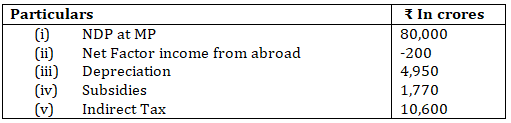
- Calculate GNP at FC.
Solution –
GNPFC = NDPMP + Depreciation + NFIA – NIT
= 80,000 + 4,950 + (-200) – (10,600 – 1770)
= 84,950 – 200 – 8,830
= 84,950 – 9,030
= Rs.75,920 Crores
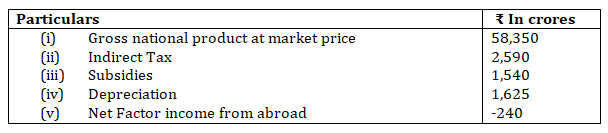
2. Calculate the Domestic Income.
Solution –
Domestic Income (NDPFC) = GNPMP – Depreciation – NFIA – NIT
= 58,350 – 1,625 – (-240) – (2,590 – 1,540)
= 56,725 + 240 – 1,050
= 56,725 – 810
= Rs.55915 crores
3. Calculate National Income or NNP at FC.

Solution –
National Income (NDPFC) = GNPMP – Consumption of fixed capital + NFIA – NIT
= 4,800 – 200 + 80 – (300 – 60)
= 4,680 – 240
= Rs.4,440 crores
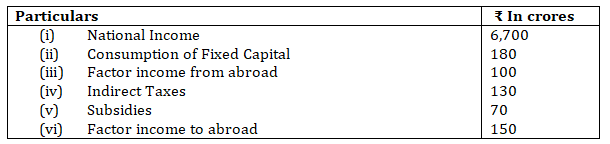
4. Calculate GDP at MP.
Solution –
GNPMP = NDPFC + Consumption of fixed capital – NFIA + NIT
= 6,700 + 180 – (100 – 150) + (130 – 70)
= 6,880 – (-50) + 60
= 6,880 + 50 + 60
= Rs.6,990 crores
5. Calculate Domestic Income.
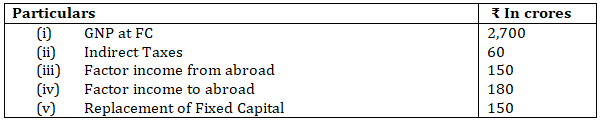
Solution –
= GNPFC – Replacement of fixed capital – NFIA
= 2,700 – 150 – (150 – 180)
= 2,550 – (-30)
= Rs.2,580 crores
6. Calculate (a) Domestic Income; (b) National Income.
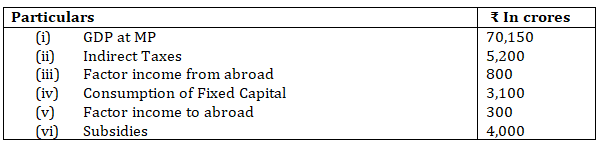
Solution –
- Domestic income (NDPFC) = GDPMP – consumption of fixed capital – NIT
= 70,150 – 3,100 – (5,200 – 4,000)
= 67,050 – 1,200
= Rs.65,850 crores
- National Income (NNPFC) = NDPFC + NFIA
= 65,850 + (800 – 300)
= 65,850 + 500
= Rs.66,350 crores
7. Calculate Indirect Taxes from the following data:
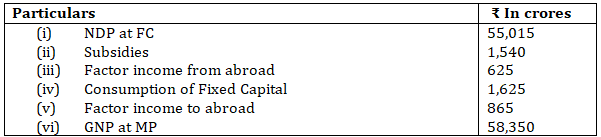
Solution –
NIT = GNPMP – (NDPFC + Consumption of fixed capital + NFIA)
= 58,350 – (55,915 + 1,625 + (625 – 865)]
= 58,350 – [57,540 + (-240)]
= 58,350 – (57,300)
= Rs.1,050 crores
NIT = Indirect taxes – Subsidies
1,050 = indirect taxes – 1,540
1050 + 1,540 = indirect taxes
indirect taxes = Rs.2590 crores
8. Calculate Factor Income to abroad:
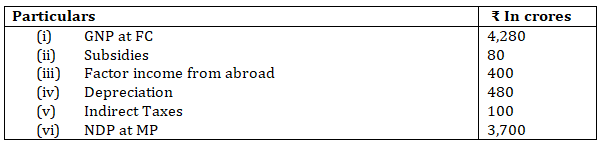
Solution –
NFIA = GNPFC – (NDPMP + Depreciation – NIT)
= 4,280 – (3,700 + 480 – (100 – 80)]
= 4,280 – (4180 – 20)
= Rs.120 crores
Now,
NFIA = Factor income from abroad – Factor income to abroad
120 = 400 – Factor income to abroad
Factor income to abroad = 400 – 120
= Rs.280 crores
9. Calculate Depreciation:
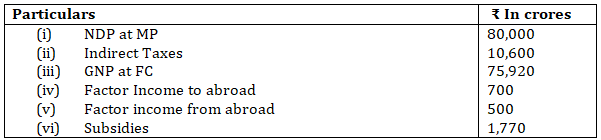
Solution –
Depreciation = GNPFC = (NDPMP + NFIA – NIT)
= 75,920 – (80,000 + (500 – 700) – (10,600 – 1,770)]
= 75,920 – (80,000 – 200 – 8,830)
= 75,920 – 70,970
= Rs.4,950 crores
10. Calculate Subsidies:
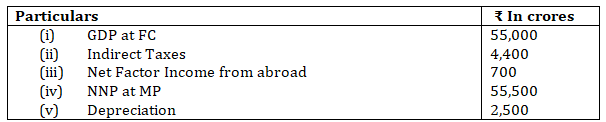
Solution –
NIT = NNPMP – (GDPFC – Depreciation + NFIA)
= 55,500 – [55,000 – 2,500 + (1,300 – 600)]
= 55,500 – (52,500 + 700)
= 55,500 – 53,200
= Rs.2,300 crores
Now,
NIT = Indirect taxes – Subsidies
2,300 = 4,400 – Subsidies
Subsidies = 4,400 – 2,300
= Rs.2,100 crores
11. Gross National Product at market prices of an economy is Rs.65,000 crores. The capital stock of the economy is valued at Rs.1,20,000 crores, which depreciation at the rate of 10% per annum. Indirect taxes amount to Rs.6,000 crores and subsidies amount to Rs.1,000 crores. Estimate National of the economy.
Solution –
Given –
GNPMP = Rs.65,000 crores
Capital stock = Rs.1,20,000 crores @ 10% depreciation
Depreciation = Rs.12,000 crores
Indirect taxes = Rs.6,000 crores
Subsidies = Rs.1,000 crores
Now,
NNPFC = GNPMP – Depreciation – NIT
= 65,000 – 12,000 – (6,000 – 1000)
= 53,000 – 5000
= Rs.48,000 crores
12. Suppose, in an imaginary economy, Gross Domestic Product (GDP) at market price in 2019-20 was Rs.5,000 crore, National Income was Rs.3,500 crore, Net Factor Income paid by the economy to rest of the world was Rs.450 crore and the Net Indirect Taxes was Rs.400 crore. Estimate the value of consumption of fixed capital for the economy from the information given above.
13. From the following data, estimate the value of Net Indirect Taxes:

NCERT