central problems of an economy class 11 notes
class 11 economics central problems of an economy notes
central problems of an economy – class 11 notes pdf download
CENTRAL PROBLEMS OF AN ECONOMY
Production, exchange and consumption of goods and services are among the basic economic activities of life. In the course of these basic economic activities, every society has to face scarcity of resources and it is the scarcity of resources that gives rise to the problem of choice. Every society has to decide on how to use its scarce resources. The problems of an economy are very often summarized as follows:
- What is produced and in what quantities? – Every society must decide on how much of each of the many possible goods and services it will produce. Whether to produce more of food, clothing, housing or to have more of luxury goods. Whether to have more agricultural goods or to have industrial products and services.
- How are these goods produced? – Every society has to decide on how much of which of the resources to use in the production of each of the different goods and services. Whether to use more labor or more machines. Which of the available technologies to adopt in the production of each of the goods?
- For whom are these goods produced? – Who gets how much of the goods that are produced in the economy? How should the produce of the economy be distributed among the individuals in the economy? Who gets more and who gets less? Whether or not to ensure a minimum amount of consumption for everyone in the economy.
Microeconomics Definition
In microeconomics, we study the behaviour of individual economic agents in the markets for different goods and services and try to figure out how prices and quantities of goods and services are determined through the interaction of individuals in these markets. In macroeconomics, Here, we are interested in finding out how the levels of these aggregate measures are determined and how the levels of these aggregate measures change over time.
Production Possibility Frontier –
- The resources of an economy as a whole are always limited in comparison to what the people in the economy collectively want to have. The scarce resources have alternative usages and every society has to decide on how much of each of the resources to use in the production of different goods and services.
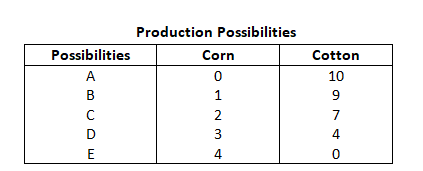
- In other words, every society has to determine how to allocate it scarce resources to different goods and services. The collection of all possible combinations of the goods and services that can be produced from a given amount of resource and given stock of technological knowledge is called the production possibility set of the economy.
Example – The figure illustrates the production possibilities of the economy. Any point on or below the curve represents a combination of corn and cotton that can be produced with the economy’s resources. The curve gives the maximum amount of corn that can be produced in the economy for any given amount of cotton and vice-versa. This curve is called the production possibility frontier.
If more of the scarce resources are used in the production of corn, less resources are available for the production of cotton and vice versa. Therefore, if we want to have more of one of the goods, we will have less of the other goods. Thus, there is always a cost of having a little more of one goods in terms of the amount of the other good that has to be forgone. This known as the opportunity cost of an additional unit of the goods. Every economy has to choose one of the many possibilities that it has. In other words, one of the central problems of the economy is to choose from one of the many production possibilities.
The centrally Planned Economy – In a centrally planned economy, the government or the central authority plans all the important activities in the economy. All important decisions regarding production, exchange and consumption of goods and services are made by the government. The central authority may try to achieve a particular allocation of resources and a consequent distribution of the final combination of goods and services which is thought to be desirable for society as a whole.
The Market Economy –
- Centrally planned economy, in a market economy, all economy activities are organised through the market. A market, as studied in economics, is an institution which organises the free interaction of individuals pursing their respective economic activities.
- In other words, a market is a set of arrangements where economic agents can freely exchange their endowments or products with each other. For buying and selling commodities, individuals may or may not meet each other in an actual physical location.
- Interaction between buyers and sellers can take place in a variety of situations such as a village-chowk or a super bazaar in a city. For the smooth functioning of any system, it is imperative that there is coordination in the activities of the different constituent parts of the system.
Difference between Positive and Normative Economics
- Distinction is made between positive economic analysis and normative economic analysis depending on whether we are trying to figure out how a particular mechanism functions or we are trying to evaluate it.
- In positive economic analysis, we study how the different mechanisms function, and
- In normative economics, we try to understand whether these mechanisms are desirable or not.
- However, this distinction between positive and normative economic analysis is not a very sharp one.
- The positive and the normative issues involved in the study of the central economic problems are very closely related to each other and a proper understanding of one is not possible in isolation to the other.