dissolution of partnership firm class 12 ncert pdf
class 12 accounts dissolution of partnership firm ncert solutions
Dissolution of Partnership – As stated earlier dissolution of partnership changes the existing relationship between partners but the firm may continue its business as before. The dissolution of partnership may take place in any of the following ways:
- Change in existing profit sharing ratio among partners:
- Admission of a new partner;
- Retirement of a partner;
- Death of a partner;
- Insolvency of a partner;
- Completion of the venture, if partnership is formed for that; and
- Expiry of the period of partnership, if partnership is for a specific period of time;
Dissolution of a firm – Dissolution of a partnership firm may take place without the intervention of court or by the order of a court, in any of the ways specified later in this section. It may be noted that dissolution of the firm necessarily brings in dissolution of the partnership.
Dissolution of a firm takes place in any of the following ways:
- Dissolution by Agreement
- Compulsory Dissolution
- On the happening of certain contingencies
- Dissolution by Notice
- Dissolution by Court
Settlement of Accounts – In case of dissolution of a firm, the firm ceases to conduct business and has to settle its accounts. For this purpose, it disposes off all its assets for satisfying all the claims against it. In this context it should be noted that, subject to agreement among the partners, the following rules as provided in Section 48 of the Partnership Act 1932 shall apply.
I. Treatment of Losses – Losses, including deficiencies of capital, shall be paid:
- First out of profits,
- Next out of capital of partners, and
- Lastly, if necessary, by the partners individually in their profits sharing ratio.
II. Application of Assets – The assets of the firm, including any sum contributed by the partners to make up deficiencies of capital, shall be applied in the following manner and order:
- In paying the debts of the firm to the third parties;
- In paying each partner proportionately what is due to him/her from the firm for advances as distinguished from capital (i.e. partner’ loan);
- In paying to each partner proportionately what is due to him on account of capital; and
- The residue, if any, shall be divided among the partners in their profit sharing ratio.
Accounting treatment – When the firm is dissolved, its books of account are to be closed and the profit or loss arising on realisation of its assets and discharge of liabilities is to be computed. For this purpose, a Realisation Account is prepared to ascertain the net effect (profit or loss) of realisation of assets and payment of liabilities which may be is transferred to partner’s capital accounts in their profit sharing ratio.
Short Answer Questions
1. State the difference between dissolution of partnership and dissolution of partnership firm.
Ans. Dissolution of Partnership: Dissolution of partnership means change in the existing relation of the partners due to admission, retirement, death or insolvency of a partner. The firm may continue its business.
Dissolution of Partnership Firm: Dissolution of partnership firm means dissolution of partnership among all the partners of the firm. The business of the firm is closed and the firm ceases to exist.
2. State the accounting treatment for: (i) Unrecorded Assets (i) Unrecorded Liability
Ans. (i) Unrecorded Assets – An unrecorded asset, if realised, is credited to Realisation Account. If it is taken over by a partner, the concerned partner’s Capital Account is debited and Realisation Account is credited.
(i) Unrecorded Liability – An unrecorded liability, if paid, is debited to Realisation Account and credited to Cash/Bank Account. If it is taken over by a partner, Realisation Account is debited and the concerned partner’s Capital Account is credited.
3. On dissolution, how will you deal with partner’s loan if it appears on:
Ans. (a) Assets side of the Balance Sheet – It represents a loan given by the firm to a partner. It is transferred to the debit side of the Realisation Account as an asset.
(b) Liabilities side of the Balance Sheet – It represents a loan given by a partner to the firm. It is paid after payment of outside liabilities and before payment of partners’ capital accounts.
4. Distinguish between firm’s debts and partner’s private debts.
Ans. Firm’s Debts
1. These are liabilities payable by the firm.
2. They have first claim against the assets of the firm.
3. They are paid out of the firm’s assets.
Partner’s Private Debts
1. These are liabilities payable by an individual partner.
2. They have first claim against the private assets of the partner.
3. They are paid out of the partner’s private assets.
5. State the order of settlement of accounts on dissolution.
Ans. According to Section 48 of the Indian Partnership Act, 1932, the assets of the firm, including any sum contributed by the partners to make up deficiencies of capital, shall be applied in the following order:
1. In paying the debts of the firm to third parties.
2. In paying to each partner rateably what is due to him from the firm for advances as distinguished from capital.
3. In paying to each partner rateably what is due to him on account of capital.
4. The residue, if any, shall be divided among the partners in their profit-sharing ratio.
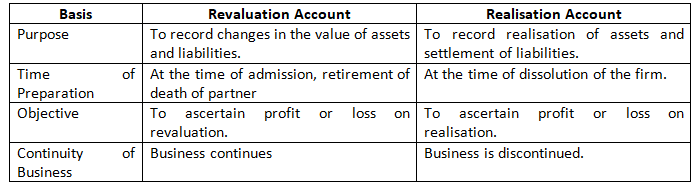
6. On what account does Realisation Account differ from Revaluation Account?
Ans.
Long Answer Questions
1. Explain the process of dissolution of partnership firm.
Ans. Dissolution of a partnership firm means that the business of the firm is wound up and the accounts are settled. The process involves the following steps:
1. Transfer all assets (except cash/bank and fictitious assets) to Realisation Account.
2. Transfer all external liabilities to Realisation Account.
3. Realise assets and record the amount realised.
4. Pay liabilities and realisation expenses.
5. Transfer profit or loss on realisation to partners’ capital accounts in their profit- sharing ratio.
6. Settle partners’ loan accounts.
7. Settle partners’ capital accounts.
8. Close the Cash/Bank Account.
2. What is a Realisation Account?
Ans. A Realisation Account is a nominal account opened at the time of dissolution of a partnership firm. It is prepared to ascertain the profit or loss on the realisation of assets and payment of liabilities. All assets (except cash/bank) and external liabilities are transferred to this account. The profit or loss on realisation is transferred to the partners’ capital accounts in their profit- sharing ratio.
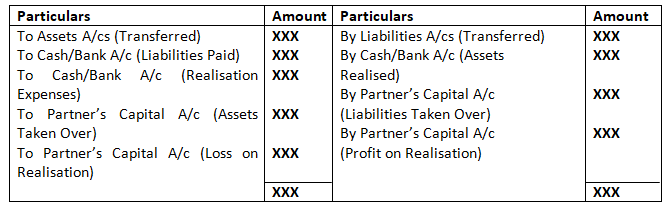
3. Reproduce the format of Realisation Account.
Ans. Realisation Account
4. How deficiency of creditors is paid off?
Ans. If the assets of the firm are insufficient to pay the creditors, the partners are required to contribute cash in their profit-sharing ratio to meet the deficiency. The amount so contributed is utilised for payment of the creditors. If any partner is insolvent, the deficiency is dealt with according to the provisions applicable to insolvency of a partner.
Numerical Questions
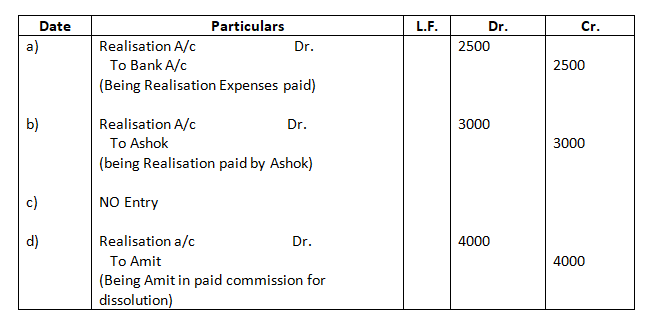
- Journalise the following transactions regarding realisation expenses:
- Realisation expenses amounted to Rs.2,500.
- Realisation expenses amounting to Rs.3,000 were paid by Ashok, one of the partners.
- Realisation expenses Rs.2,300 borne by Tarun, personally.
- Amit, a partner was appointed to realise to realise the assets, at a cost of Rs.4,000.
The actual amount of realisation expenses amounted to Rs.3,000.
Solution:-
Journal
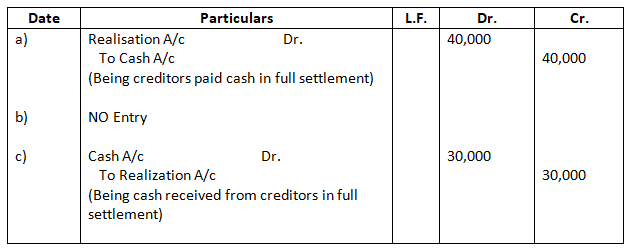
2. Record necessary journal entries in the following cases:
- Creditors worth Rs.85,000 accepted Rs.40,000 as cash and Investment worth Rs.43,000, in full settlement of their claim.
- Creditors were Rs.16,000. They accepted Machinery valued at Rs.18,000 in settlement of their claim.
- Creditors were Rs.90,000. They accepted Buildings valued Rs.1,20,000 and paid cash to the firm Rs.30,000.
Solution:-
Journal
3. There was an old computer which was written-off in the books of accounts in the previous year. The same has been taken over by a partner Nitin for Rs.3,000. Journalise the transaction when the firm has been dissolved.
Solution:-
Journal

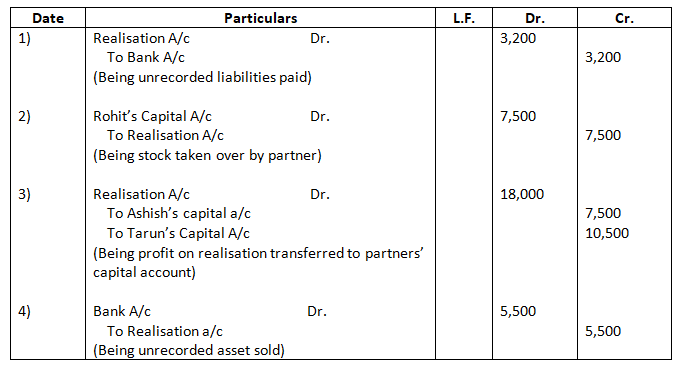
4. What journal entries will be recorded for the following transactions on the dissolution of a firm:
- Payment of unrecorded liabilities of Rs.3,200.
- Stock worth Rs.7,500 is taken over by a partner Rohit.
- Profit on Realisation amounting to Rs.18,000 is to be distributed between the partners Ashish and Tarun in the ratio of 5:7.
- An unrecorded asset realised Rs.5,500.
Solution:-
Journal Entires
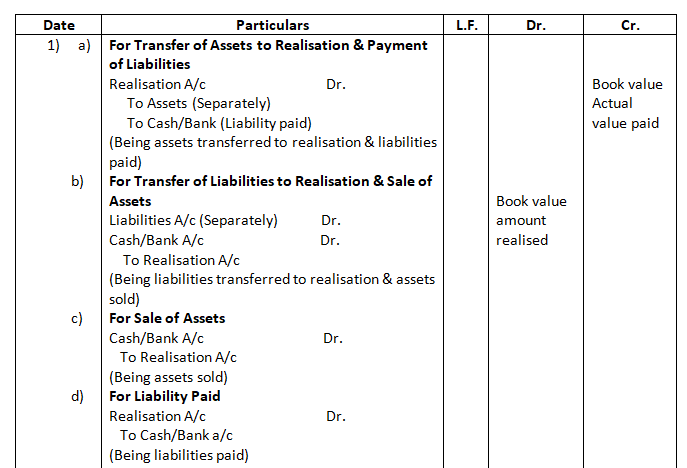
5. Give journal entries for the following transactions:
- To record the realisation of various assets and liabilities.
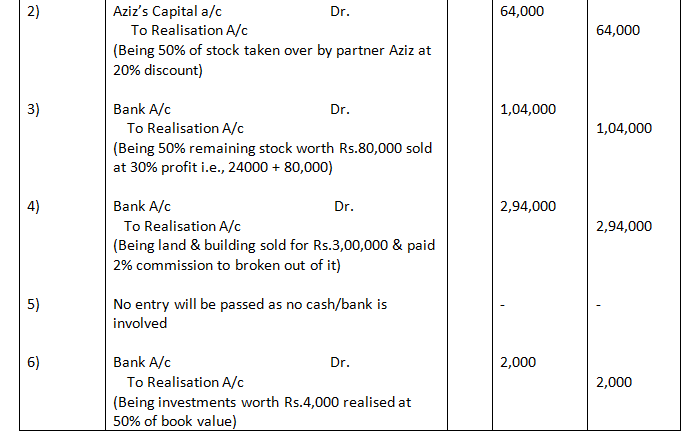
- A firm has a Stock of Rs.1,60,000. Aziz, a partner took over 50% of the Stock at a discount of 20%.
- Remaining Stock was sold at a profit of 30% on cost,
- Land and Building (book value Rs.1,60,000) sold for Rs.3,00,000 through a broker who charged 2%, commission on the deal,
- Plant and Machinery (book value Rs.60,000) was handed over to a creditor at an agreed valuation of 10% less than the book value.
- Investment whose face value was Rs.4,000 was realised at 5%.
Solution:-
Journal Entries
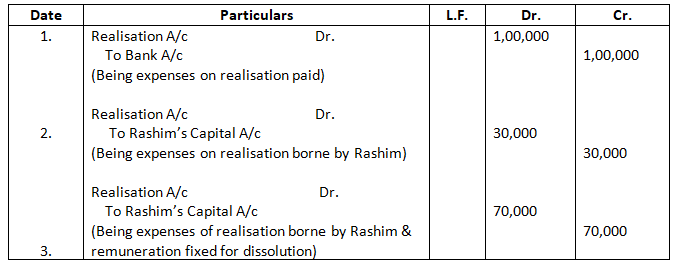
6. How will you deal with the realization expenses of the firm of Rashim and Bindiya in the following cases:
- Realisation expenses amount to Rs.1,00,000,
- Realisation expenses amounting to Rs.30,000 are paid by Rashim, a partner.
- Realisation expenses are to be borne by Rashim and he will be paid Rs.70,000 as remuneration for completing the dissolution process. The actual expenses incurred by Rashim were Rs.1,20,000.
Solution:-
Journal Entries
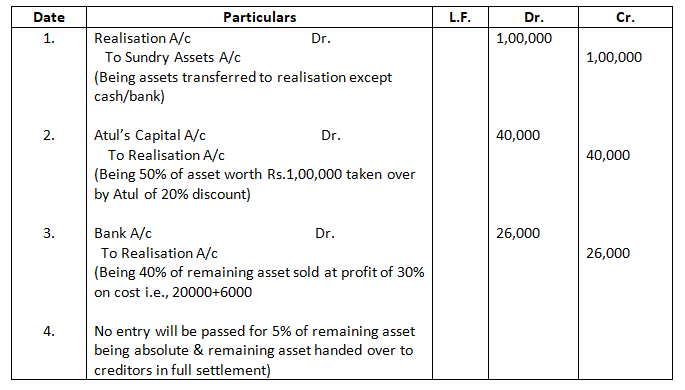
7. The book value of assets (other than cash and bank) transferred to Realisation Account is Rs.1,00,000. 50% of the assets are taken over by a partner Atul, at a discount of 20%; 40% of the remaining assets are sold at a profit of 30% on cost; 5% of the balance being obsolete, realised nothing and remaining assets are handed over to a Creditor, in full settlement of his claim.
You are required to record the journal entries for realisation of assets.
Solution:-
Journal Entries
8. Record necessary journal entries to realise the following unrecorded assets and liabilities in the books of Paras and Priya:
- There was an old furniture in the firm which had been written-off completely in the books. This was sold for Rs.3,000.
- Ashish, an old customer whose account for Rs.1,000 was written-off as bad in the previous year, paid 60% , of the amount.
- Paras agreed to takeover the firm’s goodwill (not recorded in the books of the firm), at a valuations of Rs.30,000.
- There was an old typewriter which had been written-off completely form the books. It was estimated to realise Rs.400. It was taken away by Priya at an estimated price less 25%.
- There were 100 share of Rs.10 each in Star Limited acquired at a cost of Rs.2,000 which had been written-off completely form the books. These shares are valued @ Rs.6 each and divided among the partners in their profit sharing ratio.
Solution:-
Journal Entries
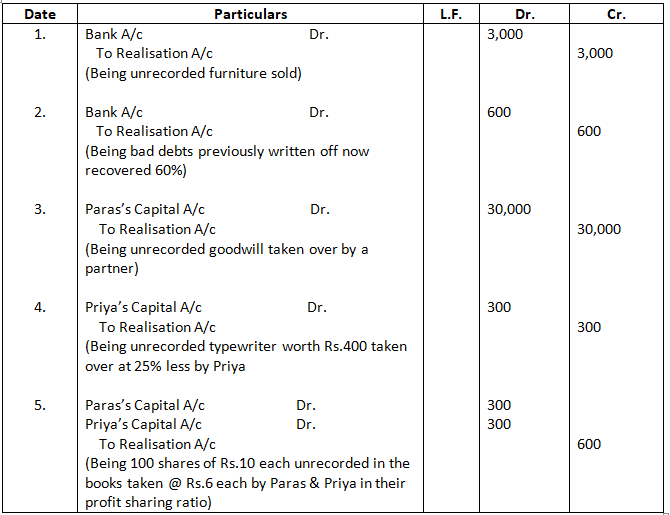
Note: As no information is given, hence profit sharing ratio for 5th entry is taken as equal.
9. All partners wish to dissolve the firm. Yastin, a partner wants that her loan of Rs.2,00,000 must be paid off before the payment of capitals to the partners, But, Amart, another partner wants that the capital must be paid before the payment of Yastin’s loan. You are required to settle the conflict giving reasons.
Answer:- According to Section 48 of Partnership Act 1932, there is a sequence of preferences given which tells the priority of payment at time of dissolution. In the above condition, the loans advances of partner’s i.e., Rs.2,00,000 will be paid before and payment of capital is always done at last.
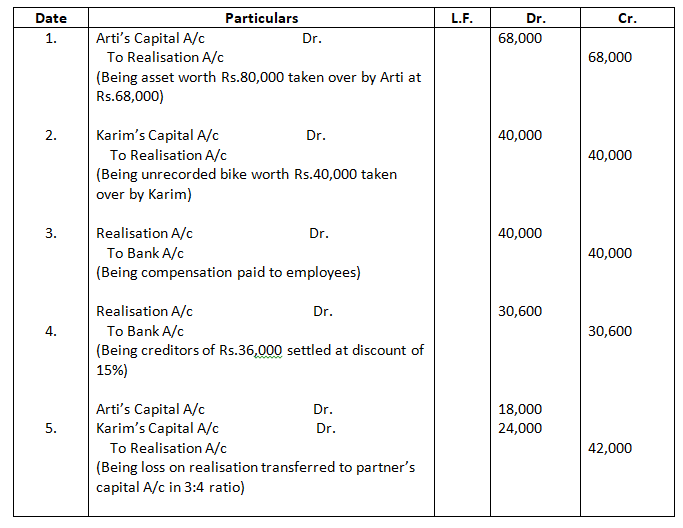
10. What journal entries would be recorded for the following transactions on the dissolution of a firm of Arti and Karim after various assets (other than cash) on the third party liabilities have been transferred to Realisation account.
- Arti took over the Stock worth Rs.80,000 at Rs.68,000.
- There was unrecorded Bike of Rs.40,000 which was taken over by Mr. Karim,
- The firm paid Rs.40,000 as compensation to employees.
- Sundry creditors amounting to Rs.36,000 were settled at a discount of 15%.
- Loss on realisation Rs.42,000 was to be distributed between Arti and Karim in the ratio of 3:4.
Solution:-
Journal Entries
11. Rose and Lily shared profits in the ratio of 2:3. Their Balance Sheet on March 31, 2017 was as follows:
Balance Sheet of Rose and Lily as on March 31, 2017
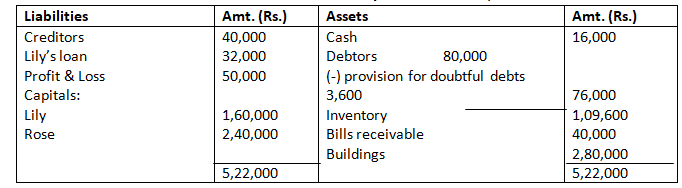
Rose and Lily decided the firm on the above date. Assets (except bills receivables) realised Rs.4,84,000. Creditors agreed to take Rs.38,000. Cost of realisation was Rs.2,400. There was a Motor Cycle in the firm which was bought out of the firm’s money, was not shown in the books of the firm. It was now sold for Rs.10,000. There was a contingent liability in respect of outstanding electric bill of Rs.5,000 which was paid Bill Receivable taken over by Rose at Rs.33,000.
Show Realisation Account, Partners Capital Account, Loan Account and Cash Account.
Solution:-
Dr. Realisation A/c Cr.
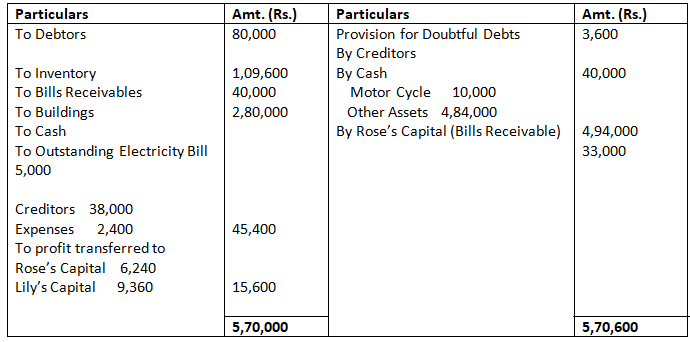
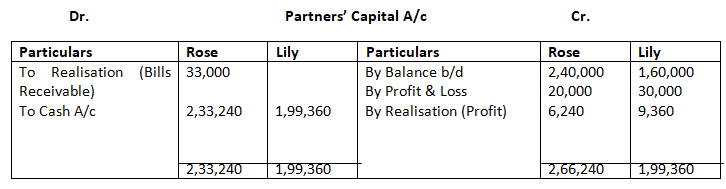

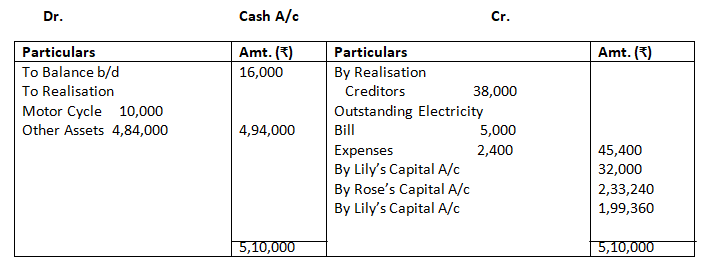
Note: The question has given bill receivable to partner Rose at Rs.30,000 and again at Rs.33,000 By mistake. In this solution, bills receivable have been considered at Rs.33,000.
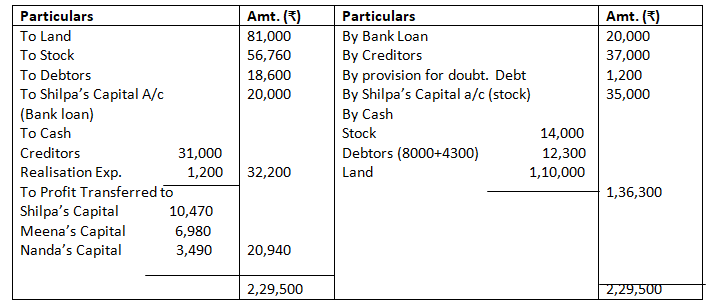
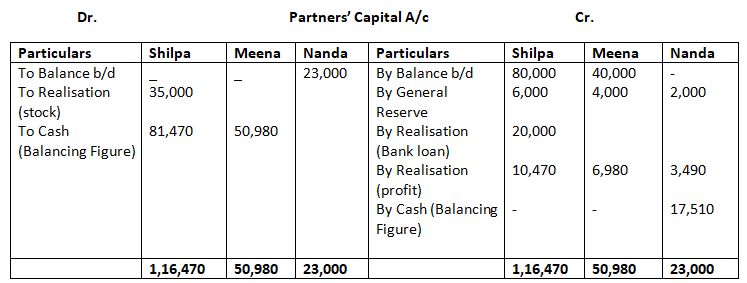
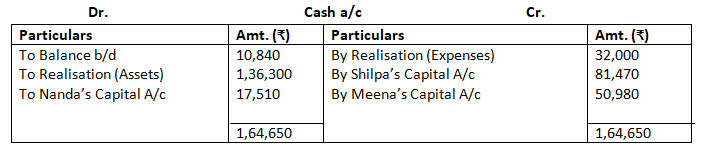
12. Shilpa, Meena and Nanda decided to dissolve their partnership on March 31, 2017. Their profit sharing ratio was 3:2:1 and their Balance Sheet was as under:
Balance Sheet for Shilpa, Meena & Nanda as on March 31, 2017
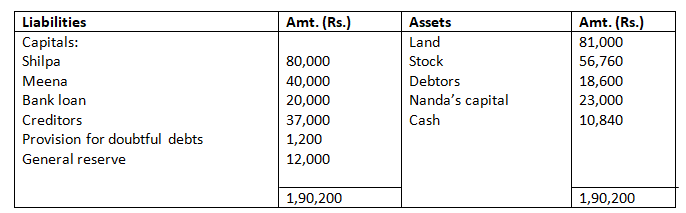
The stock of value of Rs.41,660 are taken over by Shilpa for Rs.35,000 and she agreed to discharge bank loan. The remaining stock was sold at Rs.14,000 and debtors amounting to Rs.10,000 realised Rs.8,000. Land is sold for Rs.1,10,000. The remaining debtors realised 50% at their book value. Cost of realisation amounted to Rs.1,200. There was a typewriter not recorded in the books worth Rs.6,000 which were taken over by one of the Creditors at this value. Prepare Realisation Account.
Solution:-
Dr. Realisation A/c Cr.
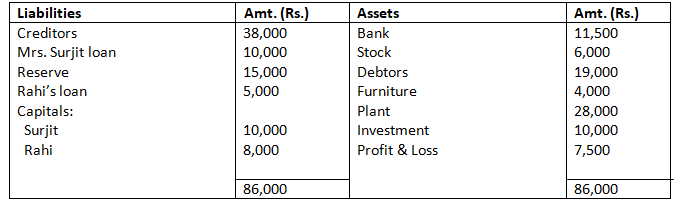
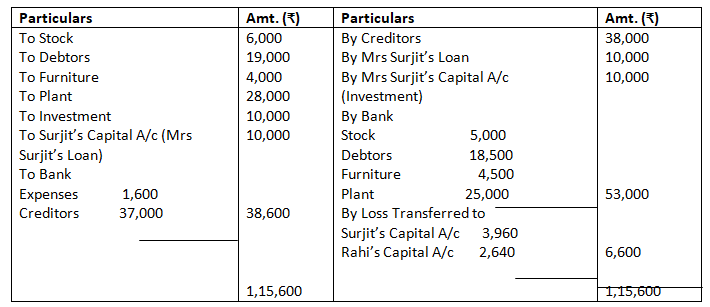
13. Surjit and Rahi were sharing profits (losses) in the ratio of 3:2, their Balance Sheet as on March 31, 2017 is as follows:
Balance Sheet of Surjit and Rahi as on March 31, 2017
The firm was dissolved on March 31, 2017 on the following terms:
- Surjit agreed to take the investments at Rs.8,000 and to pay Mrs. Surjit’s loan
- Other assets were realised as follows:
Stock Rs.5,000
Debtors Rs.18,500
Furniture Rs.4,500
Plant Rs.25,000
3. Expenses on realisation amounted to Rs.1,600.
4. Creditors agreed to accept Rs.37,000 as a final settlement.
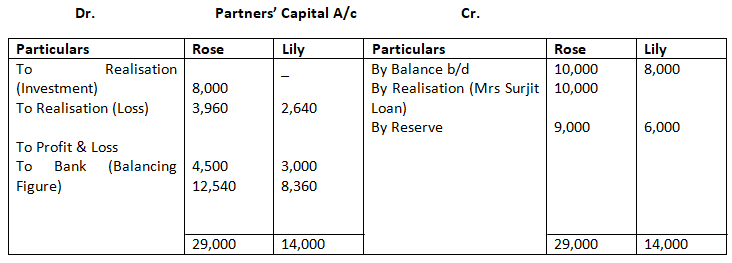
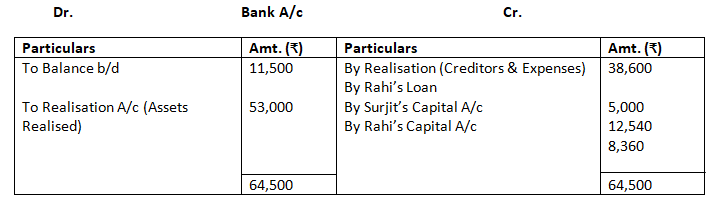
You are required to prepare Realisation account, Partner’s Capital account and bank account.
Solution:-
Dr. Realisation A/c Cr.

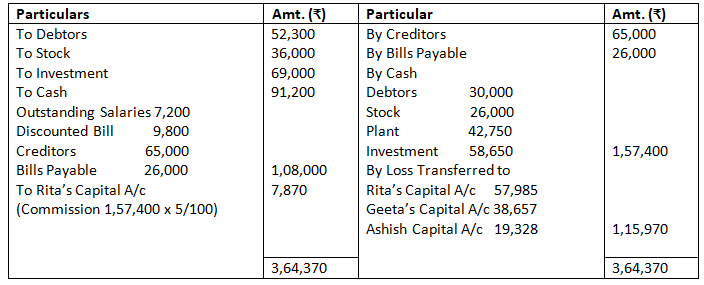
14. Rita, Geeta and Ashish were partners in a firm sharing profits/losses in the ratio of 3:2:1. On March 31, 2017 their balance sheet was as follows:
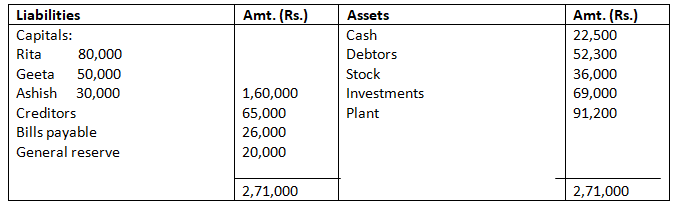
On the date of above mentioned date the firm was dissolved:
- Rita was appointed to realise the assets. Rita was to receive 5% commission on the sale of assets (except cash) and was to bear all expenses of realisation,
- Assets were realised as follows:
Debtors Rs.30,000
Stock Rs.26,000
Plant Rs.42,750
- Investment were realised at 85% of the book value,
- Expenses of realisation amounted to Rs.4,100.
- Firm had to pay Rs.7,200 for outstanding salary not provided for earlier,
- Contingent liability in respect of bills discounted with the bank was also materialised and paid off Rs.9,800.
Prepare Realisation account, Capital Accounts of Partner’s and Cash Account.
Solution:-
Dr. Realisation A/c Cr.
Dr. Partners’ Capital A/c Cr.
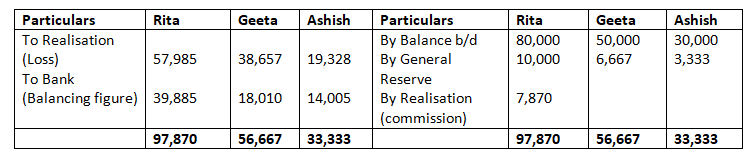
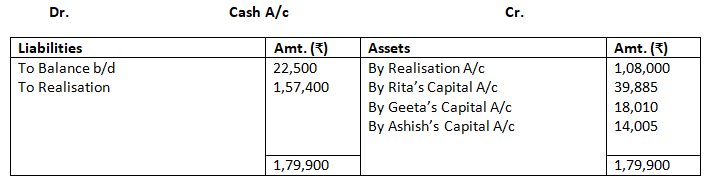
Note:- No treatment will be done for expenses on realisation Rs.4,100 as the firm has already paid 5% assets realised as commission for dissolution to Rita, Rs.4,100 actual expense will be paid by Rita personally.
15. Anup and Sumit are equal partners in a firm. They decided the partnership on March 31, 2017. When the balance sheet is as under:
Balance Sheet of Anup and Sumit as on March 31, 2017
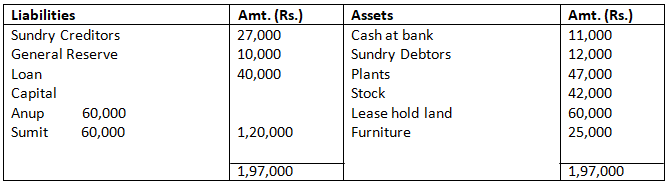
The Assets were realised as follows:
Lease hold land Rs.72,000
Furniture Rs.22,500
Stock Rs.40,000
Plant Rs.48,000
Sundry Debtors Rs.10,500
The Creditors were paid rs.25,500 in full settlement. Expenses of realisation amount to Rs.2,500.
Prepare Realisation Account, Bank Account, Partners Capital Accounts to close the books of the firm.
Solution:-
Dr. Realisation A/c Cr.
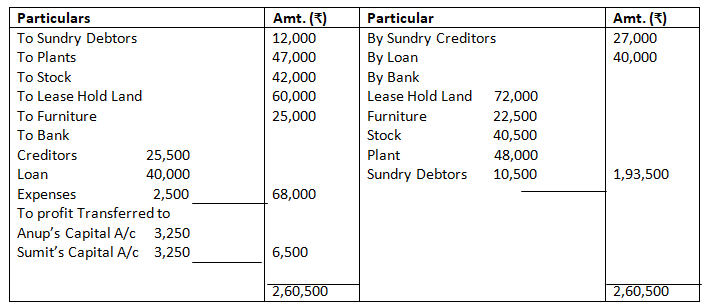
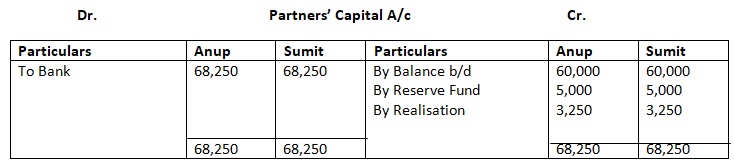
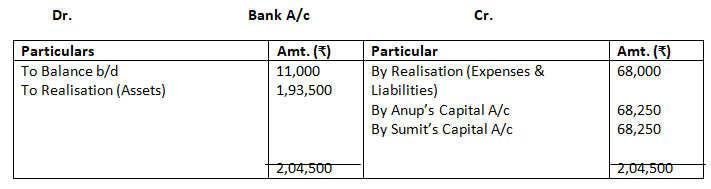
Note:- Loan Rs.40,000 can be paid directly through loan account without transferring to realisation account.
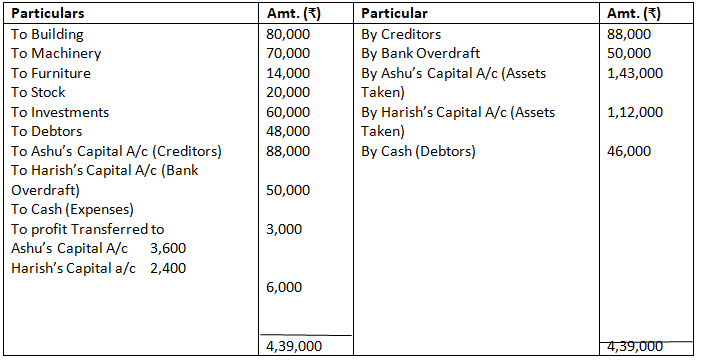
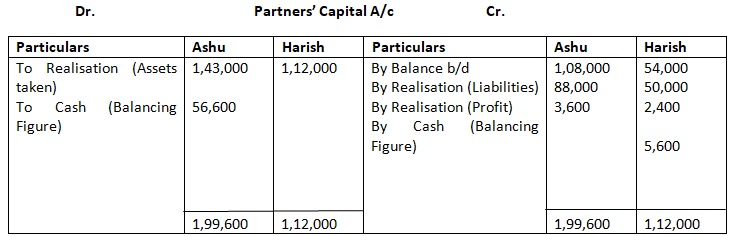
16. Ashu and Harish are partners sharing profit and losses as 3:2. They decided to dissolve the firm on March 31, 2017. Their balance sheet on the above date was:
Balance Sheet of Ashu and Harish as on March 31, 2017
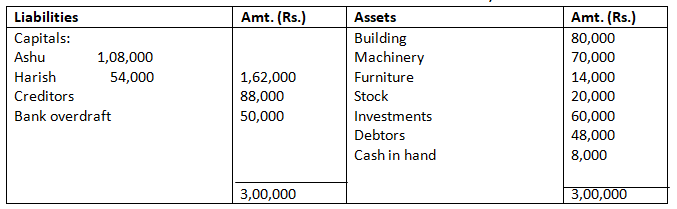
Ashu is to take over the building at Rs.95,000 and Machinery and Furniture is take over by Harish at value of Rs.80,000 Ashu agreed to pay Creditor and Harish agreed to meet Bank overdraft. Stock and Investments are taken by both partner in profit sharing ratio. Debtors realised for Rs.46,000, expenses of realisation amounted to Rs.3,000. Prepare necessary ledger account.
Solution:-
Dr. Realisation A/c Cr.
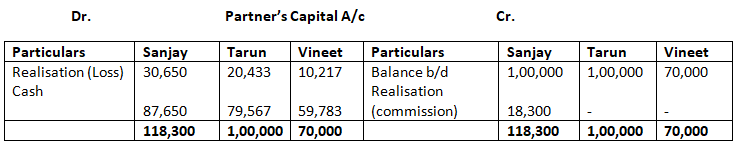
17. Sanjay, Tarun and Vineet shared profit in the ratio of 3:2:1. On March 31, 2017 their balance sheet was as follows:
Balance Sheet of Sanjay, Tarun and Vineet
As on March 31, 2017
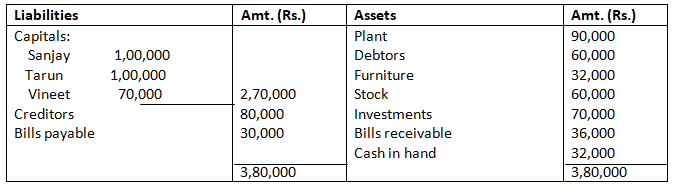
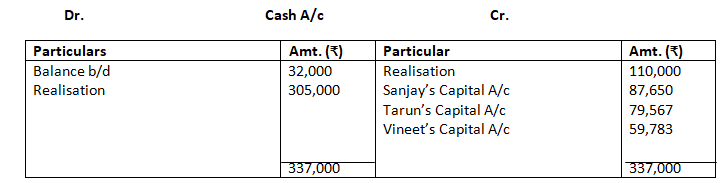
On this date the firm was dissolved. Sanjay was appointed to realise the assets. Sanjay was to receive 6% commission on the sale of assets (except cash) and was to bear all expenses of realisation.
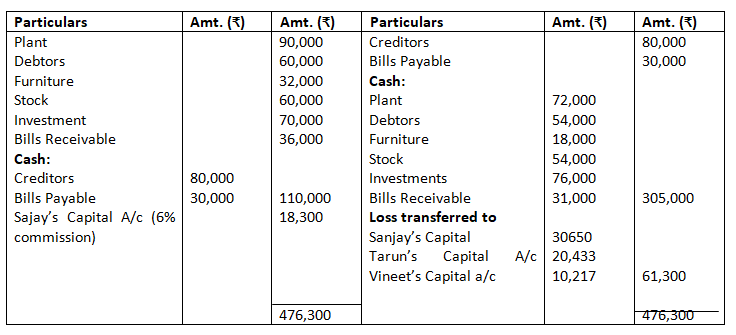
Sanjay realised the assets as follows : Plant Rs.72,000, Debtors Rs.54,000, Furniture Rs.18,000, Stock 90% of the book value, Investments Rs.76,000 and Bills receivable Rs.31,000. Expenses of realisation amounted to Rs.4,500. Prepare Realisation Account, Capital Accounts and Cash Account.
Solution:-
Books of Sanjay, Tarun and Vineet
Dr. Realisation A/c Cr.
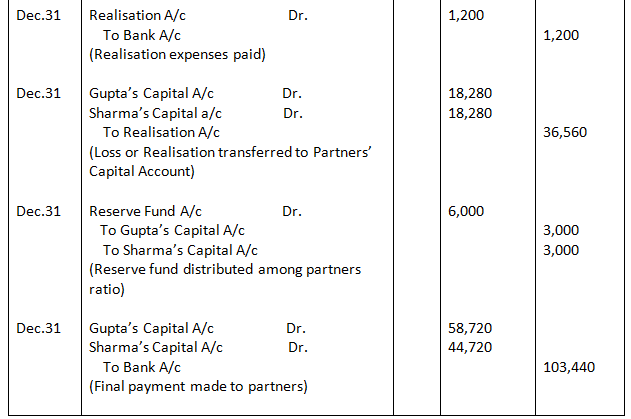
18. The following is the Balance Sheet of Gupta and Sharma as on March 31, 2017:
Balance Sheet of Gupta and Sharma as on March 31, 2017
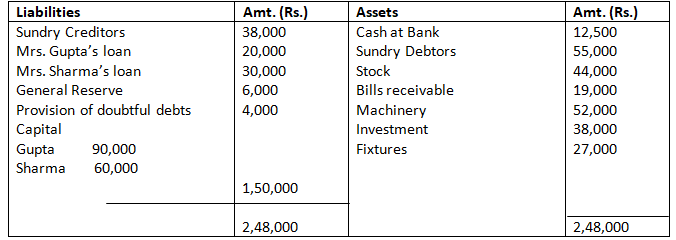
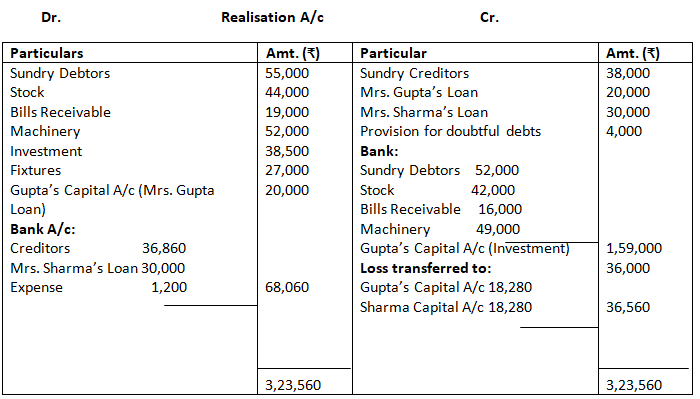
The firm was dissolved on December 31, 2017 and asset realised and settlements of liabilities as follows:
- The realisation of the assets were as follows:
Sundry Rs.52,000
Stock Rs.42,000
Bills receivable Rs.16,000
Machinery Rs.49,000
Fixture Rs.20,000
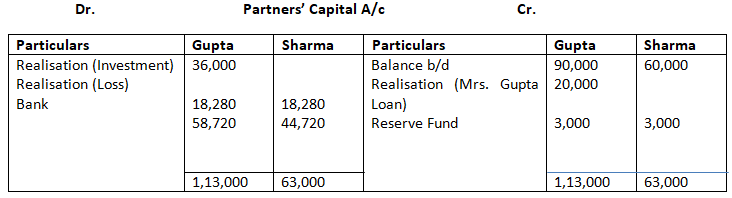
- Investment was taken over by Gupta at agreed value of Rs.36,000 and agreed to pay of Mrs. Gupta’s loan.
- The Sundry Creditors were paid off less 3% discount.
- The realisation expenses incurred amounted to Rs.1,200.
Journalise the entries to be made on the dissolution and prepare Realisation Account, Bank Account and Partners Capital Accounts.
Solution:-
Books of Gupta and Sharma
Journal Entries
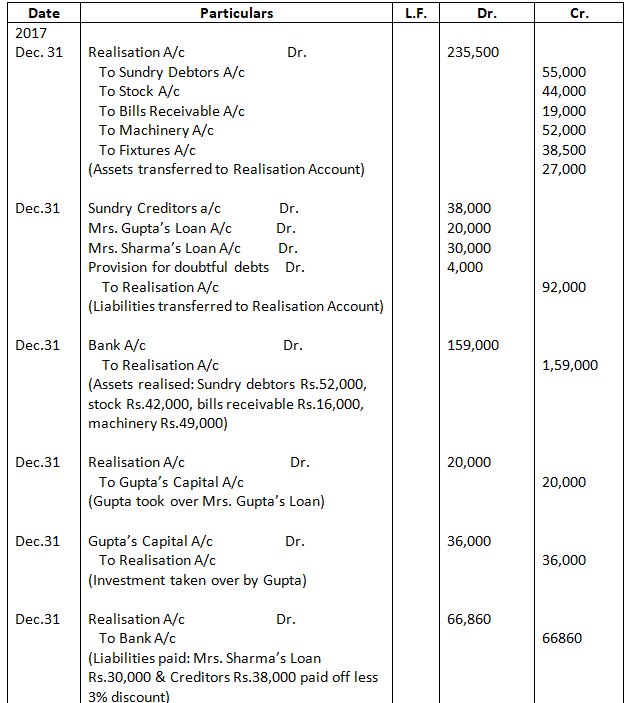
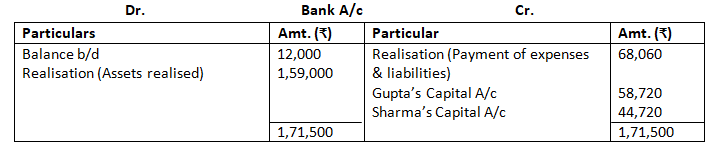
Note: As per the solution, the total of Bank Account is Rs.1,71,500. However, the answers for the same has not been mentioned in the book.
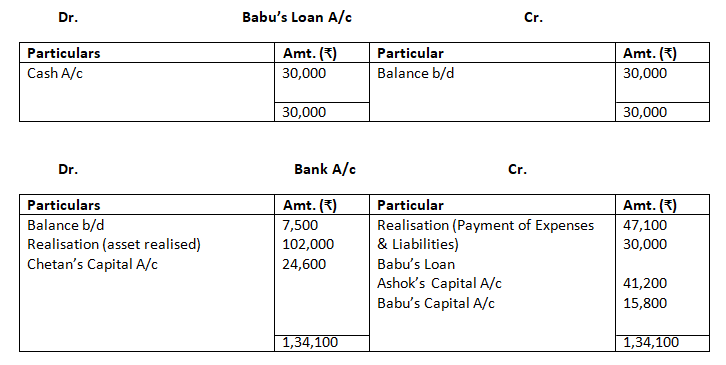
19. Ashok, Babu and Chetan are in partnership sharing profit in the proportion of ½, 1/3 , 1/6 respectively. They dissolve the partnership of the December 31, 2017, when the balance sheet of the firm as under:
Balance Sheet of Ashok, Babu and Chetan
As on December 31, 2017
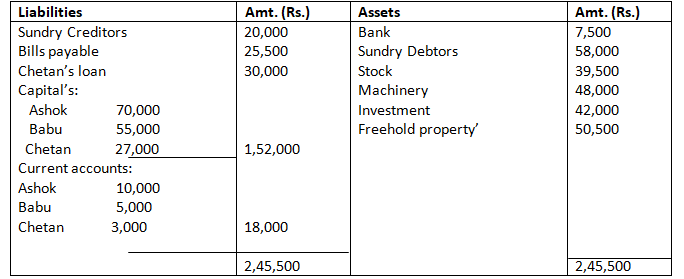
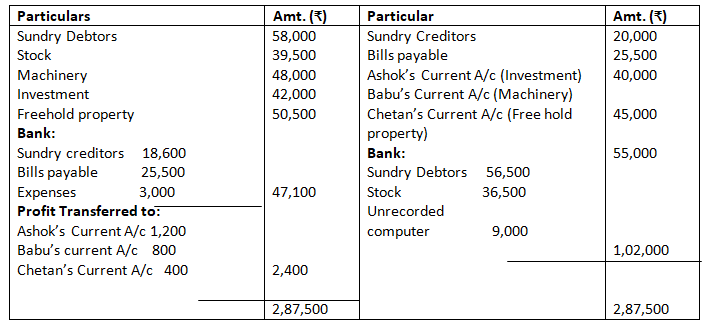
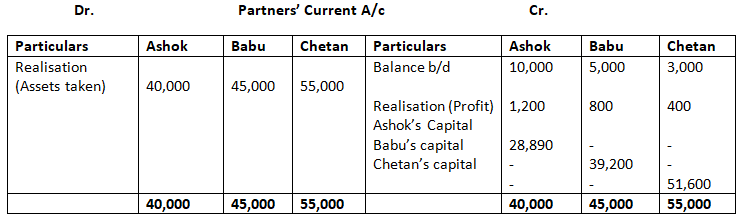
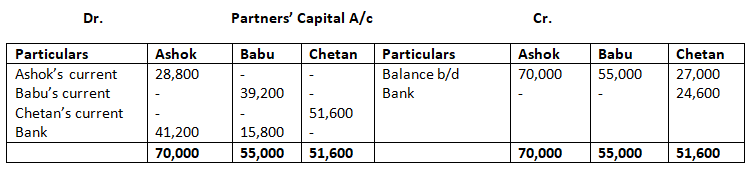
The machinery was taken over by Babu for Rs.45,000, Ashok took over the Investment for Rs.40,000 and Freehold property took over by Chetan at Rs.55,000. The remaining Assets realised as follows: Sundry Debtors Rs.56,500 and Stock Rs.36,500. Sundry Creditors were settled at discount of 7%. A Office computer, not shown in the books of accounts realised Rs.9,000. Realisation expenses amounted to Rs.3,000.
Prepare Realisation Account, Partners Capital Account, Bank Account.
Solution:-
Dr. Realisation Cr.
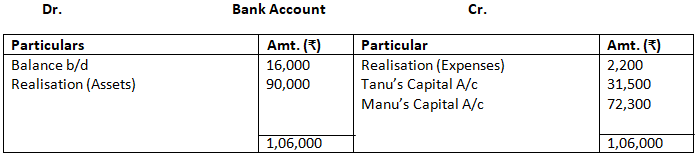
20. The following is the Balance Sheet of Tanu and Manu, who share profit and losses in the ratio of 5:3, On March 31, 2017:
Balance Sheet of Tanu and Manu as on March 31, 2017
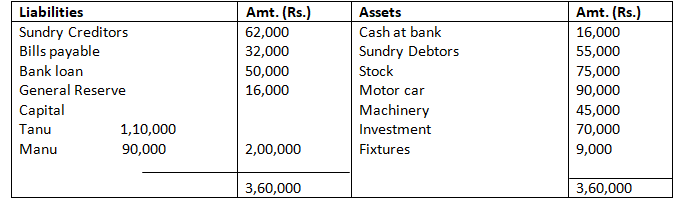
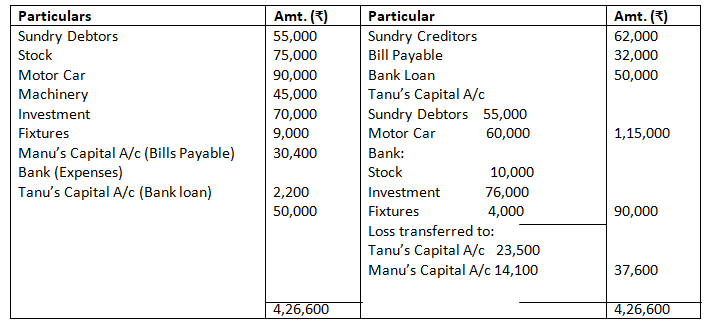
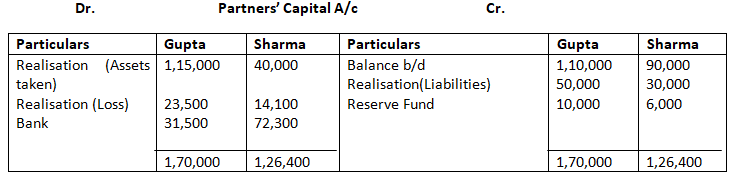
On the above date the firm is dissolved and the following agreement was made: Tanu agree to pay the bank loan and took away the sundry debtors. Sundry creditors accepts stock and paid Rs.10,000 to the firm. Machinery is taken over by Manu for Rs.40,000 and agreed to pay of bills payable at a discount of 5%. Motor car was taken over by Tanu for Rs.60,000. Investment realised Rs.76,000 and fixtures Rs.4,000. The expenses of dissolution amounted to Rs.2,000.
Solution:-
Books of Tanu and Manu
Dr. Realisation A/c Cr.
dissolution of partnership firm class 12 ncert pdf