Features of a Company – A company may be viewed as an association of person who contribute money or money’s worth to a common stock and use in for a common purpose. It is an artificial person having or corporate legal entity distinct from its members (shareholder) and has a common seal used for its signature. Thus, it has certain special feature which distinguish it from the other forms of organization. These are as follows:
- Voluntary Association
- Separate Legal Entitiy
- Limited Liability
- Perpetual Succession
- Common Seal
- Transferability
- Transferability
- May Sue or be Sued
Kinds of a Company – Companies can be classified either on the basis of the liability of its members or on the basis of the number of members. On the basis of liability of its members the companies can be classified into the following three categories:
- Companies Limited by Shares: In this case, the liability of its members is member has paid the full amount of the shares, there is no liability on his part whatsoever may be the debts of the company.
- Companies Limited by Guarantee – In this case, the liability of its members is limited to the amount they undertake to contribute in the event of the company being wound up.
- Unlimited Companies – When there no limit on the liability of its members, the company is called an unlimited company. When the company’s property is not sufficient to pay off its debts, the private property of its members can be used for the purpose.
On the basis of the number of members, a company can be divided into two categories as follows:
- Public Company – A public company means a company which (a) is not a private company, (b) has minimum capital of Rs.5 lakh on such higher paid-up capital may be prescribed, and (c) is a private company which is a subsidiary of which is not a private company.
- Private Company – A private company is one which has a minimum paid up capital of Rs.1 Lakh or such higher paid-up capital as may be prescribed by its Articles:
Share Capital of a Company – A company, being an artificial person, cannot generate its own capital which has necessarily to be collected from several persons. These persons are known as shareholders and the amount contributed by them is called share capital.
Categories of Share Capital
- Authorized Capital – Authorized capital is the amount of share capital which a company is authorized to issue by its Memorandum of Association.
- Issued Capital – It is that part of the authorized capital which is actually issued to the public for subscription including the shares allotted to vendors and the signatories to the company’s memorandum.
- Subscribed Capital – It is that part of the issued capital which has been actually subscribed by the public. When the shares offered for public subscription are subscribed fully by the public the issued capital and subscribed capital would be the same.
- Called-up Capital – It is that part of the subscribed capital which has been called up on the shares. The company may decide to call the entire amount or part of the face value of the share.
- Paid-up Capital – It is that portion of the called up capital which has been actually received from the shareholders. When the share holders have paid all the call amount, the called-up capital is the same to the paid-up capital.
- Uncalled Capital – That portion of the subscribed capital which has not yet been called-up. As stated earlier, the company may collect this amount any time when it needs further funds.
- Reserve Capital – A company may reserve a portion of its uncalled capital to be called only in the event of winding up of the company.
Classes of Shares – As per Section 86 of the companies Act, a company can issue two types of shares (1) Preference shares, and (2) equity shares (also called ordinary shares).
Preference Shares – According to Section 85 of The Companies Act, 1956, a preference share is one, which fulfills the following conditions:
- That it carries a preferential right to dividend to be paid either as a fixed amount payable to preference shareholders or an amount calculated by a fixed rate of the nominal value of each share before any dividend is paid to the equity shareholders.
- That with respect to capital it carries or will carry, on the winding-up of the company, the preferential right to the repayment of capital before anything is paid to equity shareholders.
Equity Shares – The equity shareholders are entitled to share the distributable profits of the company after satisfying the dividend rights of the preference share profits of the company after satisfying the dividend rights of the preference share holders. The dividend on equity shares is not fixed and it may vary from year to year depending upon the amount of profits available for distribution. The equity share capital may be (i) with voting rights; or (ii) with differential rights as to voting.
Issue of Shares – A salient characteristic of the capital of a company is that the amount on its shares can be gradually collected in easy instalments spread over a period of time depending upon its growing financial requirement. The first installment is collected along with application and is thus, known as application money, the second on allotment (termed as allotment money), and the remaining instalment (termed as allotment money), and the remaining instalement are termed as first call, second call and so on.
The important steps in the procedure of share issue are:
- Issue of Prospectus – The company first issues the prospectus to the public. Prospectus is an invitation to the public that a new company has come into existence and it needs funds for doing business.
- Receipt to Applications – When prospectus is issued to the public, prospective investors intending to subscribe the share capital of the company would make an application along with the application money and deposit the same with a scheduled bank as specified in the prospectus. The company has get minimum subscription (Refer Box 1) within 120 days from the date of the issue of the prospectus.
- Allotment of Shares – If minimum subscription has been received, the company may proceed for the allotment of shares after fulfilling certain other legal formalities. Letters of allotment are sent to those whom the shares have been allotted, and letters of regret to those to whom no allotment has been more.
Accounting Treatment –
On application –
Bank A/c Dr.
To Share Application A/c
(Amount received on application for – shares @ Rs. ___ per share).
On Allotment –
The journal entries with regard to allotment of shares are as follows:
- For Transfer of Application Money
Share Application A/c Dr.
To Share Capital A/c
(Application money on ____ Shares allotted/transferred to Share Capital)
2. For Money refunded on rejected application
Share Application A/c Dr.
To Share Capital A/c
(Application money returned on rejected application for – shares).
3. For Amount Due on Allotment
Share Allotment A/c Dr.
To Share Capital A/c
4. For Adjustment of Excess Application Money
Share Application A/c Dr.
To Share Allotment A/c
(Application Amount on – Share @ Rs. Per shares adjusted to the amount due on allotment).
5. For Receipt of Allotment Amount
Bank A/c Dr.
To Share Allotment A/c
(Allotment money received on – share @ Rs. __ per share combined account)
On Calls –
- For call amount due
Share call A/c Dr.
To Share capital A/c
(Call money due on – Shares @ Rs. ____ per share)
2. For Receipt of Call Amount
Bank A/c Dr.
To Share call A/c
(Call money received)
Call in Arrears – It often happens that shareholders do not pay the call amount when it becomes due. When any shareholder fails to pay the amount due on allotment or on any of the calls, such amount is known as ‘Calls-in Arrears’/’Unpaid Calls’.
Calls in Arrears A/c Dr.
To Share I Call Account A/c
To Share II and Final Call Account A/c
When the shareholder makes the payment of calls-in-arrears together with interest, the entry will be as follows:
Bank A/c Dr.
To Calls-in-Arrears A/c
To Interest A/c
If nothing is specified, there is no need to take the interest on calls-in-arrears account and record the above entry
Calls in Advance – Sometimes some shareholders pay a part or the whole of the amount of the calls not yet made. The amount so received from the shareholders is known as “Calls in Advance”. The amount received in advance is a liability of the company and should be credited to ‘Call-in-Advance Account.”
Bank A/c Dr.
To Calls-in-Advance A/c
(Amount received on call-in-advance)
When calls become actually due requiring adjustment of ‘Call-in-Advance’ Account, the journal entry will be:
Calls-in-Advance A/c Dr.
To particular Call A/c
(Calls-in-advance adjusted with the call money due)
Over Subscription – There are instances when applications for more shares of a company are received than the number offered to the public for subscription. This usually happens in respect of share issues of well-managed and financially strong companies and is said to be a case of ‘Over Subscription’.
In such a condition, three alternatives are available to the directors to deal with the situation: (1) they can accept some applications in full and totally reject the others; (2) they can make a pro-rata allotment to all; and (3) they can adopt a combination of the above two alternatives which happens to be the most common course adopted in practice.
- Bank A/c Dr.
To Share Application A/c
(Money received on application for 25,000 shares @ Rs. – per share)
2. Share Application A/c Dr.
To Share capital A/c
To Bank A/c
(Transfer of money on application 20,000 for shares allotted and money refunded on application for __ shares rejected)
3. Share Allotment A/c Dr.
To Share capital A/c
(Amount due on the allotment of ___ shares @ Rs.__ per share)
4. Bank A/c Dr.
To Share Allotment A/c
(Allotment money received)
Under subscription – Under subscription is a situation where number of shares applied for is less than the number for which applications have been invited for subscription. For example, a company offered 2 lakh shares for subscription to the public but the applications were received for 1,90,000 share, only. In such a situation, the allotment will be confirmed to 1,90,000 share and entires shall be made accordingly.
Issue of Shares at a Premium – It is quite common for the shares of financially strong and well-managed companies to be issued at a premium, i.e. at an amount more than the nominal or par value of shares. Thus, when a share of the nominal of 5 per cent.
- For Premium Amount called with application money
a. Bank A/c Dr.
To Share Application A/c
(Money received on application for —– share @ Rs. ___ per share including premium
Share Application A/c Dr.
To Share capital A/c
To Securities Premium A/c
(Transfer of application money to share capital and securities premium accounts)
2. Premium Amount called with Allotment Money
a. Share Allotment A/c Dr.
To Share Capital A/c
To Securities Premium A/c
(Amount due on allotment of shares @ Rs ___ per share including premium)
b. Bank A/c Dr.
To Share Allotment A/c
(Allotment money received including premium)
Issue of Share at a Discount – There are instances when the shares of a company are issued at a discount, i.e. at an amount less than the nominal or par value of shares, the difference between the nominal value and issue price representing discount on the issue of shares. For example, when a share of the nominal value of Rs.100 is issued at Rs.98,
Share Allotment A/c Dr.
Discount on the Issue of Shares A/c Dr.
Share Capital A/c
(Amount due on allotment of __ shares @ Rs ___ per share and discount on issue brought into account)
Issue of Shares for consideration other than cash – There are instances where a company enters into an arrangement with the vendors from whom it has purchased assets, whereby the latter agrees to accept, the payment in the form of fully paid shares of the company issued to them.
No. of shares to be issued = Amount Payable/Issue Price
Forfeiture of Shares – it may happen that some shareholders fail to pay one or more instalments, viz.. allotment money and/or call money. In such circumstances, the company can forfeit their shares, i.e. cancel their allotment and treat the amount already received thereon as forfeited to the company within the framework of the provisions in its articles. There provisions are usually based on Regulation 29 to 35 of the Table A which authorize, the directors to forefeit the shares for non-payment of calls made. For this purpose, they have to strictly follow the procedure laid down in this regard.
Share capital A/c Dr.
To share forfeiture A/c
To Share Allotment A/c
To Share Calls A/c (individually)
(…. Shares forfeited for non-payment of allotment money and calls made)
Forfeiture of Shares issued at a Premium – The important point to be noted in this context is that the share premium account is not to be debited at the time of forfeiture if the premium has been received in respect of the forefeited share. In case, however, if the premium amount has not been received, either wholly or partially, in respect of the shares forfeited, the shares premium account will also be debited with the amount of premium not received along-with the share capital account at the time forfeiture.
Share capital A/c Dr.
Securities Premium A/c Dr.
To Share forfeiture A/c
To Share Allotment A/c
And/or
To share calls A/c (individually)
(….. shares forfeited for non-payment of allotment money and calls made)
Forfeiture of Shares Issued at a Discount – Where shares forfeited were originally issued at a discount, the discount applicable to such share must be cancelled or written back. Hence the Discount on Issue of Shares Account should be credited at the time of forfeitures. So, that the balance on ‘Discount on Issue of Shares Account’ relates only to the remaining shares forming part of share capital Account. Thus, the journal entry to record the forfeiture will be:
Share capital A/c Dr.
To share forfeiture A/c
To Discount on Issue of shares
To Share Allotment A/c
To share calls A/c
Or
To calls-in-Arrears A/c
(forfeiture of …… shares for non-payment of allotment money and the calls made).
Re-issue of Forfeited Shares – The directors can either cancel or re-issue the forefeited shares. In most cases, however, they reissue special shares which may be at par, at premium or at a discount. Normally, the forfeited shares are reissued as fully paid and at a discount. For example, when a company forfeits 200 shares of Rs.10 each on which Rs.600 had been received, it can allow a maximum discount of Rs.600 on their reissue. Assuming that the company reissues these shares for Rs.1,800 as fully paid, the necessary journal entry will be:
Bank A/c Dr. 1,800
Share Forfeiture A/c Dr. 200
To share capital A/c 2,000
(Reissue of 200 forfeited shares at Rs.9 per share as fully paid)
This shall leave a balance of Rs.400 in share forfeited account which should be transferred to Capital Reserve Account by recording the following journal entry:
Forfeited Share A/c Dr. 400
To Capital Reserve 400
(Profit on reissue of forfeited shares transferred)
Short Answer Questions
1. What is a Public Company?
Ans. A public company is a company which is not a private company. It has a minimum paid- up capital as prescribed and invites the public to subscribe to its shares and debentures. The minimum number of members in a public company is seven and there is no limit on the maximum number of members.
2. What is a Private Limited Company?
Ans. A private company is a company which by its Articles:
* Restricts the right of members to transfer its shares;
* Limits the number of its members to 200, excluding present and former employee-
members; and
* Prohibits any invitation to the public to subscribe for its shares or debentures.
The minimum number of members is two.
3. Define Government Company.
Ans. A Government Company is a company in which not less than 51% of the paid-up share capital is held by the Central Government, State Government(s), or jointly by the Central Government and one or more State Governments.
4. What do you mean by a Listed Company?
Ans. A listed company is a company which has any of its securities listed on a recognized stock exchange.
5. What are the uses of Securities Premium?
Ans. According to Section 52 of the Companies Act, the amount of Securities Premium can be used for:
- Issuing fully paid bonus shares to members;
- Writing off preliminary expenses of the company;
- Writing off the expenses, commission or discount on issue of shares or debentures;
- Providing for premium payable on redemption of preference shares or debentures; and
- Purchase of its own shares or other securities under buy-back provisions.
6. What is Buy-back of Shares?
Ans. Buy-back of shares means the purchase by a company of its own shares. It is a method of reducing the share capital of the company and is subject to the provisions of the Companies Act.
7. Write a brief note on Minimum Subscription.
Ans. Minimum Subscription means the minimum amount that, in the opinion of the Board of Directors, must be raised by the issue of shares to meet the needs of the business operations relating to:
- Purchase of property,
- Preliminary expenses,
- Repayment of money borrowed,
- Working capital, and
- Any other expenditure required for the business.
As per SEBI guidelines, a company must receive applications for at least **90% of the issued amount before making any allotment. If the minimum subscription is not received, all application money must be refunded
Long Answer Questions
1. What is meant by the word ‘Company’? Describe its characteristics.
Ans. A company is an association of persons formed for carrying on a business and registered under the Companies Act. It is an artificial person created by law having a separate legal entity, perpetual succession and a common seal.
Characteristics of a Company
- Artificial Person: – A company is an artificial person created by law. It exists only in the eyes of law.
- Separate Legal Entity: A company has a separate legal existence distinct from its members.
- Perpetual Succession: A company continues to exist irrespective of changes in its membership.
- Common Seal: The common seal is the official signature of the company.
- Limited Liability: The liability of members is limited to the amount unpaid on the shares held by them.
- Transferability of Shares: Shares of a public company are freely transferable.
2. Explain in brief the main categories in which the share capital of a company is divided.
Ans. The share capital of a company is divided into the following categories:
- Authorized Capital – It is the amount of capital which a company is authorized to issue by its Memorandum ofAssociation.
- Issued Capital – It is that part of the authorized capital which is offered to the public for subscription.
- Subscribed Capital – It is that part of the issued capital which has been subscribed by the public.
- Called-up Capital – It is the amount of subscribed capital which has been called up on the shares by thecompany.
- Paid-up Capital – It is the amount of called-up capital actually paid by the shareholders.
- Reserve Capital – It is that part of the uncalled capital which a company decides not to call except in theevent of winding up.
3. What do you mean by the term ‘Share’? Discuss the types of shares which can be issued under the Companies Act.
Ans. A share represents a unit into which the share capital of a company is divided. It is the interest of a shareholder in the company measured by a sum of money.
Types of Shares
According to the Companies Act, a company limited by shares can issue:
1. Equity Shares – Equity shares are those shares which are not preference shares.
They may be:
- Equity shares with voting rights; or
- Equity shares with differential rights as to dividend, voting or otherwise.
2. Preference Shares – Preference shares are those shares which carry:
- A preferential right as to payment of dividend; and
- A preferential right as to repayment of capital at the time of winding up.
4. Discuss the process for the allotment of shares of a company in case of over- subscription.
Ans. Over-subscription occurs when applications for shares exceed the number of shares offered for issue.
In such a case, the company may adopt any of the following methods:
1. Rejection of Applications – Some applications may be rejected and application money refunded.
2. Pro-rata Allotment – Shares are allotted in a fixed proportion to the number of shares applied for.
3. Combination of the Above – Some applications may be rejected, some accepted in full and the remaining applicantsallotted shares on a pro-rata basis.The excess application money received may be adjusted towards allotment money orrefunded.
5. What is a Preference Share? Describe the different types of preference shares.
Ans. A preference share is one which carries:
- A preferential right as to dividend; and
- A preferential right as to repayment of capital on winding up.
Types of Preference Shares
- Cumulative Preference Shares – The dividend not paid in any year accumulates and is payable in future years.
- Non-cumulative Preference Shares – The right to arrears of dividend does not exist.
- Participating Preference Shares – These shares participate in surplus profits in addition to fixed dividend.
- Non-participating Preference Shares – These shares do not participate in surplus profits.
- Convertible Preference Shares – These shares can be converted into equity shares.
- Non-convertible Preference Shares – These shares cannot be converted into equity shares.
- Redeemable Preference Shares – These shares are repayable after a specified period.
6. Describe the provisions of law relating to Calls-in-Arrears and Calls-in-Advance.
Ans. Calls-in-Arrears – Calls-in-Arrears refer to the amount called up but not paid by a shareholder on the due date.
- Interest may be charged on calls-in-arrears.
- The rate of interest is generally specified in the Articles of Association.
- Table F provides interest at 10% per annum unless otherwise specified.
Calls-in-Advance – Calls-in-Advance refer to the amount received by a company from shareholders before it has been called up.
- It does not form part of share capital.
- Interest may be paid on calls-in-advance.
- Table F provides interest at a rate not exceeding 12% per annum.
7. Explain the terms ‘Over-subscription’ and ‘Under-subscription’. How are they dealt with in accounting records?
Ans. Over-subscription – When the number of shares applied for exceeds the number of shares offered for issue,it is called over-subscription.
Accounting Treatment:
- Excess application money may be refunded; or
- Adjusted towards allotment and subsequent calls.
Under-subscription – When the number of shares applied for is less than the number of shares offered forissue, it is called under-subscription.
Accounting Treatment:
- Shares are allotted to all applicants.
- The entries are passed for the actual number of shares subscribed.
8. Describe the purposes for which a company can use Securities Premium Account.
Ans. The Securities Premium Account can be utilised for:
- Issuing fully paid bonus shares to members.
- Writing off preliminary expenses of the company.
- Writing off commission, discount or expenses on issue of shares or debentures.
- Providing premium payable on redemption of preference shares or debentures.
- Buy-back of shares or other securities.
9. State clearly the conditions under which a company can issue shares at a discount.
Ans. Shares at a discount can be issued only when the following conditions are fulfilled:
- The shares to be issued are of a class already issued.
- The issue is authorised by an ordinary resolution passed in the general meeting and sanctioned by the Central Government.
- The resolution specifies the maximum rate of discount.
- The discount should not exceed 10% unless a higher rate is permitted.
- At least one year must have elapsed since the company became entitled to commence business.
- The shares must be issued within two months after obtaining approval.
10. Explain the term ‘Forfeiture of Shares’ and give the accounting treatment on forfeiture.
Ans. Forfeiture of Shares – Forfeiture of shares means the cancellation of shares by a company due to non-payment of allotment money or call money by the shareholders.The shareholder loses all rights on the forfeited shares.
Accounting Treatment
When shares are forfeited:
Journal Entry
Share Capital A/c Dr.
To Share Allotment A/c
To Share Call A/c
To Forfeited Shares A/c
* Share Capital Account is debited by the amount called up.
* Unpaid allotment/call accounts are credited.
* Amount already received is credited to Forfeited Shares Account.
Numerical Questions
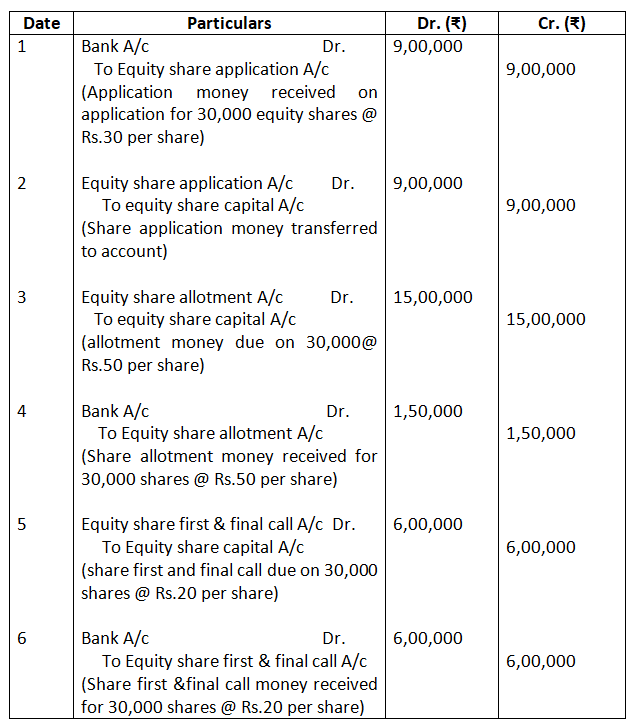
- Anish Limited issued 30,000 equity shares of Rs.100 each payable at Rs.30 on application, Rs.50 on allotment and Rs.20 on 1st and final call. All money was duly received. Record these transactions in the journal of the company.
Solution:-
Books of Ashis Limited
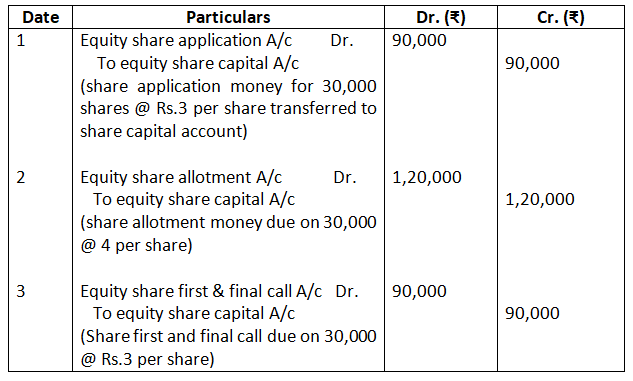
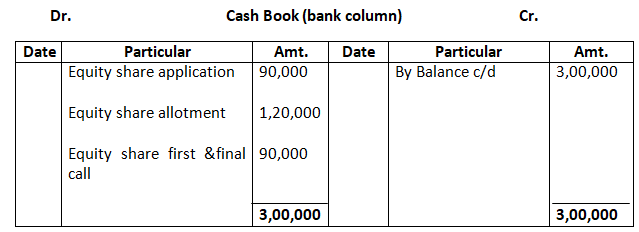
2. The Adarsh control Device Ltd. Was registered with the authorized capital of Rs.3,00,000 divided into 30,000 shares of Rs.10 each, which offered to the public. Amount payable as Rs.3 per share on application, Rs.4 per share on allotment and Rs.3 per share on first and final call. These share were fully subscribed and all money was dully received. Prepare journal and Cash Book.
Solution:-
Books of Adarsh Control Device Ltd.
Journal
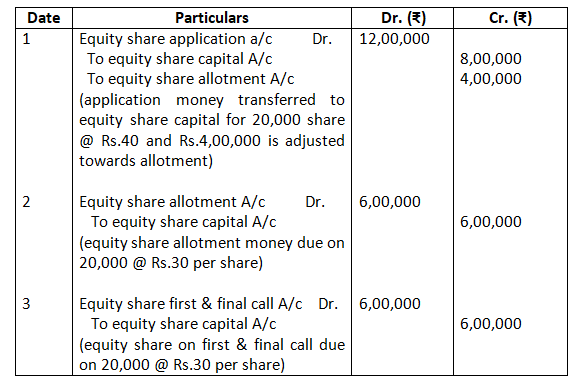
3. Software solution India Ltd. Inviting application for 20,000 equity share of Rs.100 each, payable Rs.40 on application, Rs.30 on allotment and Rs.30 on call. The company received applications for 32,000 shares. Application for 2,000 shares were rejected and money returned to Applicants. Applications for 10,000 shares were accepted in full and applicants for 20,000 share allotted half of the number of shared applied and excess application money adjusted into allotment. All money received due on allotment and call. Prepare journal and cash book.
Solution:-
Books of Software solution India Ltd.
Journal
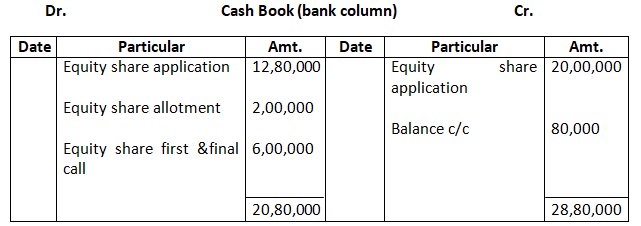
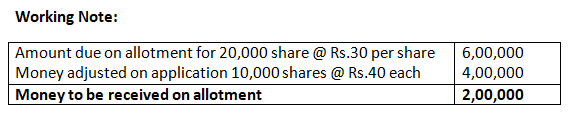
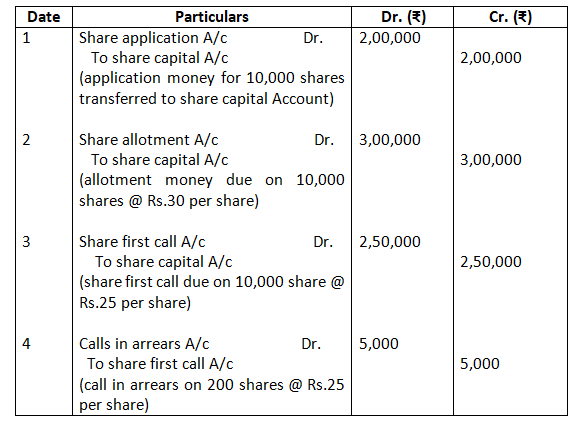
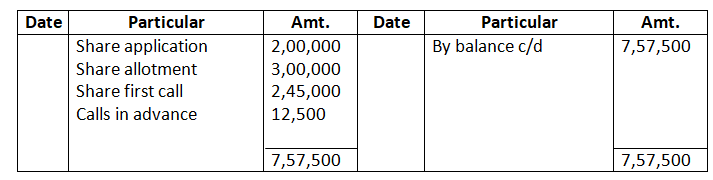
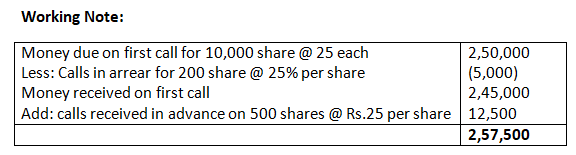
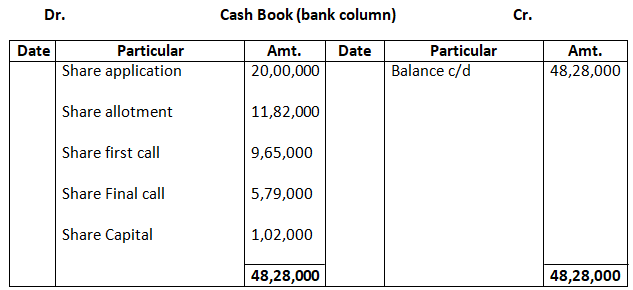
4. Rupak Ltd. Issued 10,000 shares of Rs.100 each payable Rs.20 per share on application, Rs.30 per share on allotment and balance in two calls of Rs.25 per share. The application and allotment money were duly received. On first call all member pays their dues except one member holding 200 shares, while another member holding 500 shares paid for the balance due in full. Final call was not made. Give journal entries and prepare cash book.
Solution:-
Books of Rupak Ltd.
Journal
Dr. Cash Book (bank column) Cr.
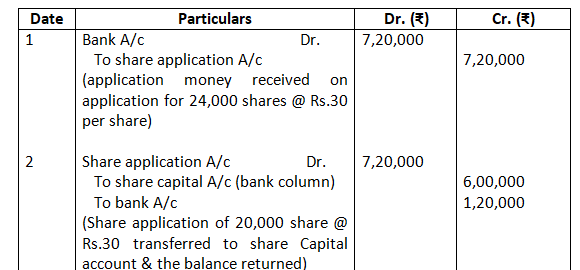
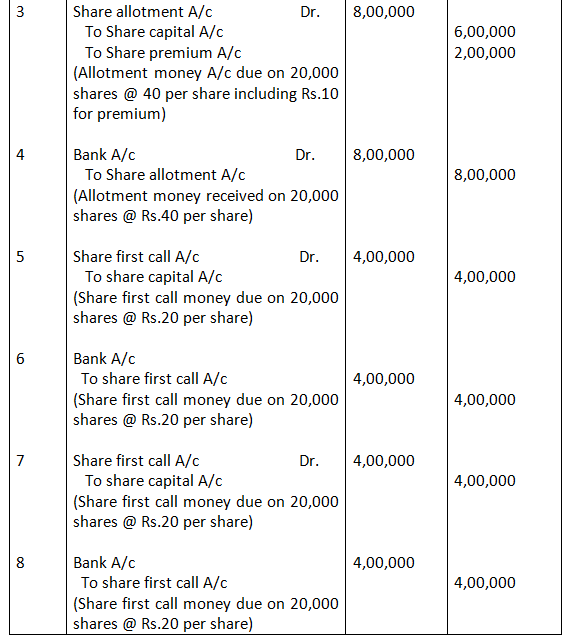
5. Mohit Glass Ltd. Issued 20,000 shares of Rs.100 each at Rs.110 per share, payable Rs.30 on application, Rs.40 on allotment (including Premium), Rs.20 on first call and Rs.20 on final call. The applications were received for Rs.24,000 shares and allotted 20,000 shares and reject 4,000 shares and amount returned thereon. The money was duly received. Give journal entries.
Solution:-
Books of Mohit Glass Ltd.
Journal
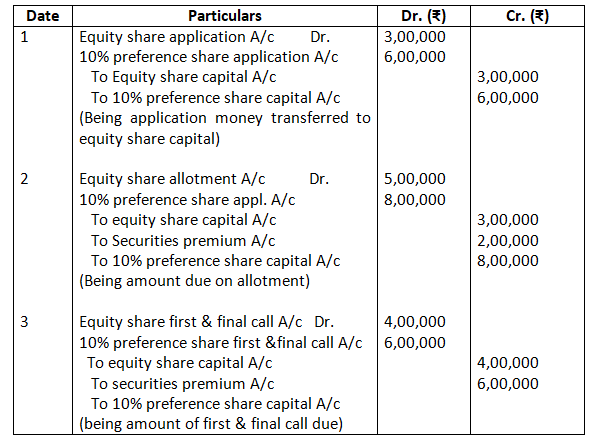
6. A limited company offered for subscription of 1,00,000 equity shares of Rs.10 each at a premium of Rs.2 per share 2,00,000. 10% Preference shares of Rs.10 each at par.
The amount on share was payable as under:
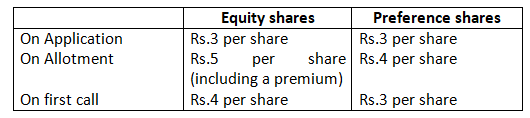
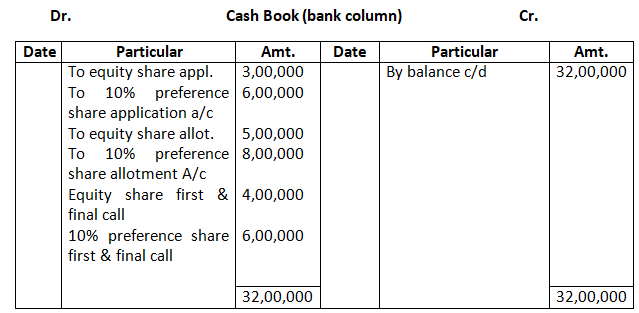
All the share were fully subscribed, called-up and paid. Record these transactions in the journal and cash book of the company.
Solution:-
Books of A Limited
Journal
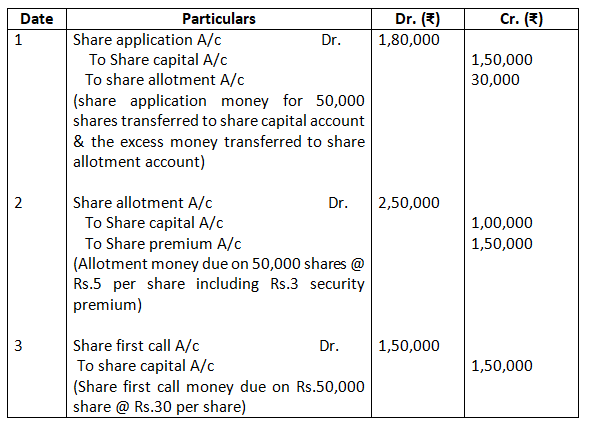
7. Eastern company Limited, having and authorized capital of Rs.10,00,000 in share of Rs.10 each, issued 50,000 shares at a premium of Rs.3 per share payable as follows:
On Application Rs.3 per share
On Allotment (including premium) Rs.5 per share
On first call (due three months after allotment) Rs.3 per share and the balance as and when required.
Applications were received for 60,000 shares and the directors allotted the shares as follows:
- Applicants for 40,000 shares received shares, in full.
- Applicants for 15,000 shares received and allotment of 8,000 shares.
- Applicants for 500 shares received 200 shares on allotment, excess money being returned.
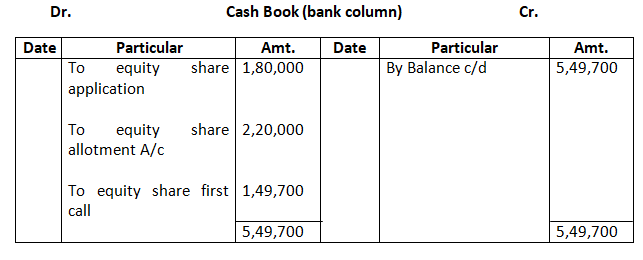
All amounts due on allotment were received.
The first call was duly made and the money was received with the exception of the call due on 100 shares.
Give journal and cash book entires to record these transacitons of the company. Also prepare the Balance Sheet of the company.
Solution:-
Books of Eastern Company Ltd.
Journal
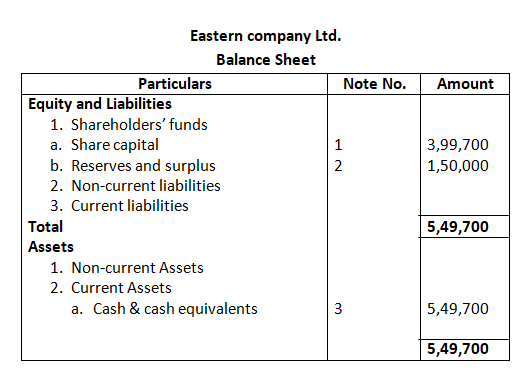
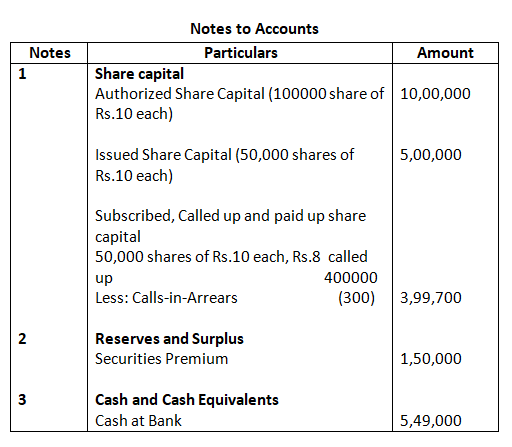
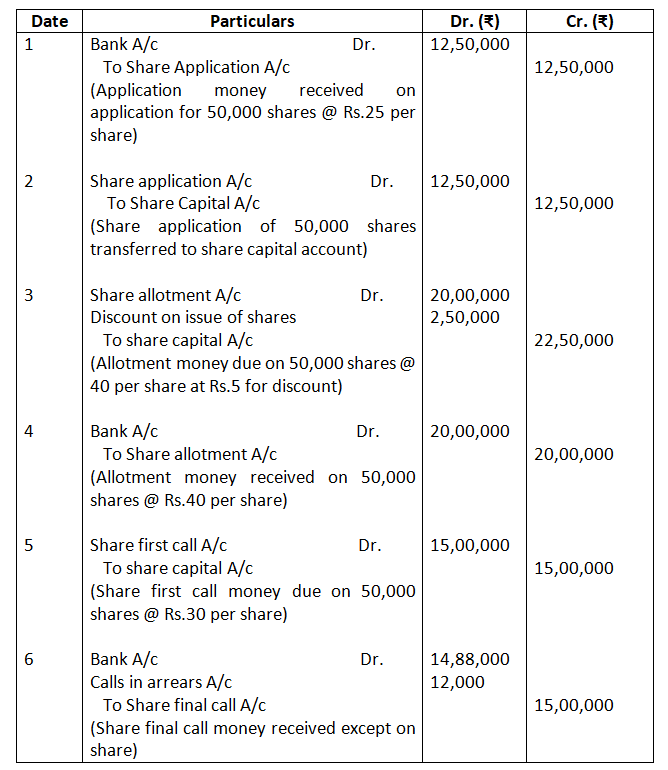
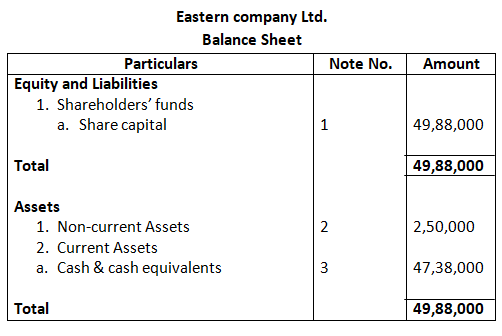
8. Sumit Machine Ltd issued 50,000 shares of Rs.100 each at discount of 5%. The shares were payable Rs.25 on application. Rs.40 on allotment and Rs.30 on first and final call. The issue were fully subscribed and money were duly received except the final call on 400 shares. The discount was adjusted on allotment.
Give journal entires and prepare balance sheet.
Solution:-
Books of Sumit Machine Ltd.
Journal
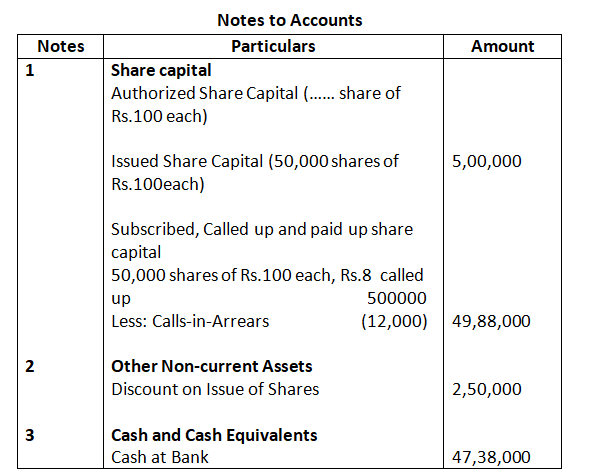
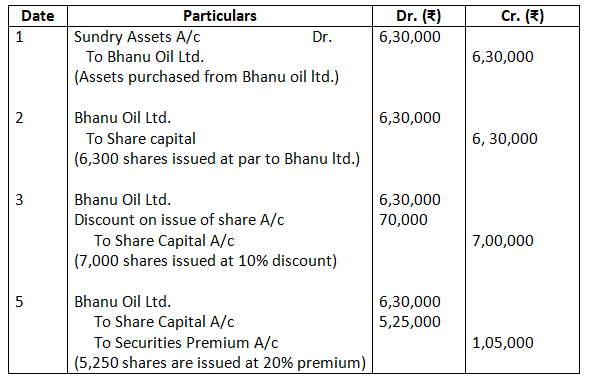
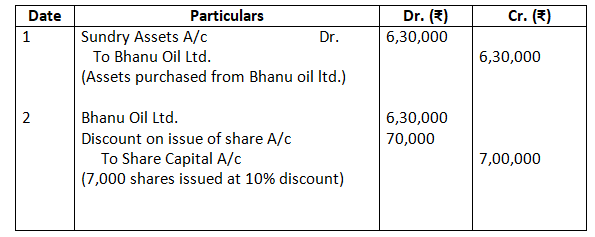
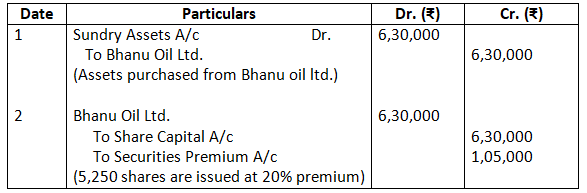
9. Kumar Ltd. Purchases assets of Rs.6,30,000 from Bhanu Oil Ltd. Kumar Ltd. Issued equity share of Rs.100 each fully paid in consideration. What journal entires will be made, if the share are issued, a) at par, b) at discount of 10% and c) at premium of 20%.
Solution:-
Case a) Books of Kumar Ltd.
Journal
Case b)
Journal
Case c)
Journal
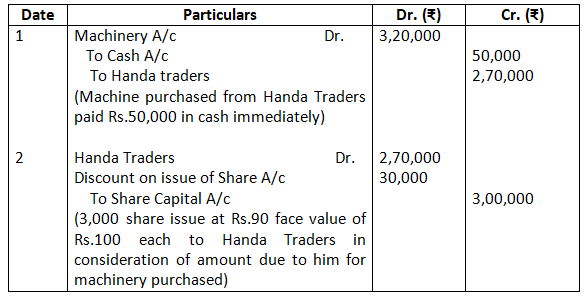
10. Bansal Heavy machine Ltd purchased machine worth Rs.3,20,000 from Handa Trader. Payment was made as Rs.50,000 cash and remaining amount by issue of equity share of the face value of Rs.100 each fully paid at an issue price of Rs.90 each. Give journal entires to record the above transaction.
Solution:-
Books of Bansal Heavy Machine Ltd.Journal
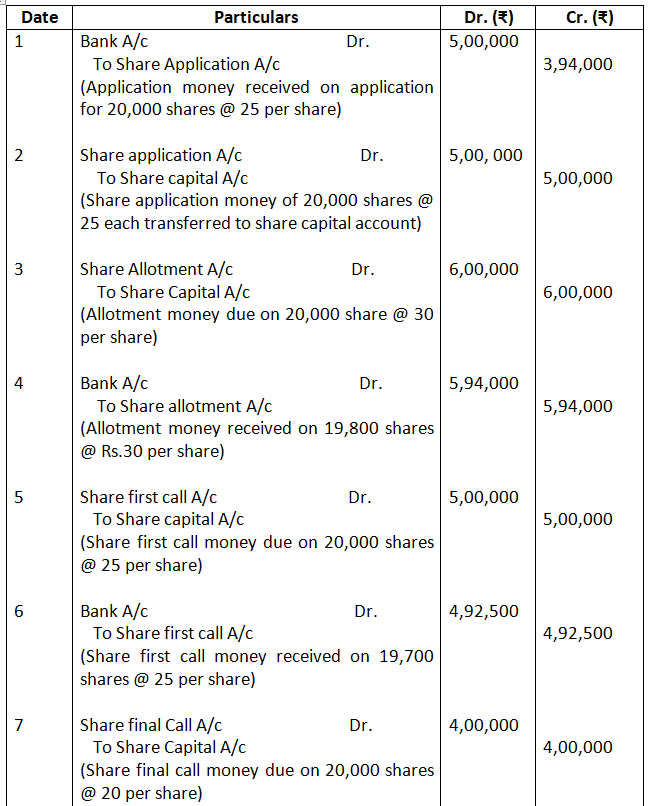
11. Naman Ltd issued 20,000 shares of Rs.100 each, payable Rs.25 on application, Rs.30 on allotment, Rs.25 on first call and The balance on final call. All money duly received except Anubha, who holding 200 shares did not pay allotment and calls money and Kumkum, who holding 100 shares did not pay both the calls. The directors forfeited shares of Anubha and kumkum. Give journal entires.
Solution:-
Books of Naman Glass Ltd.
Journal
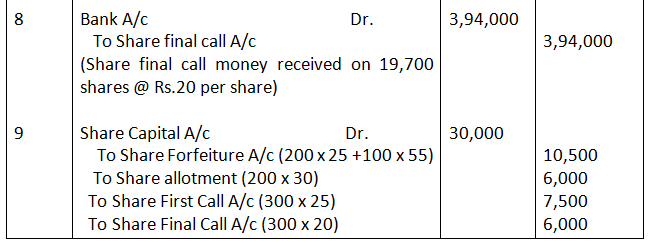
Working Note:
Forfeited Amount
Amount on application (300 Shares @ 25 each) = 7500
Amount on allotment (100 Shares @ 30 each = 3,000
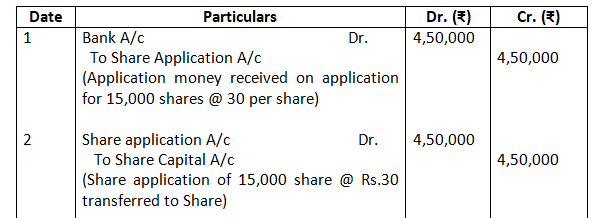
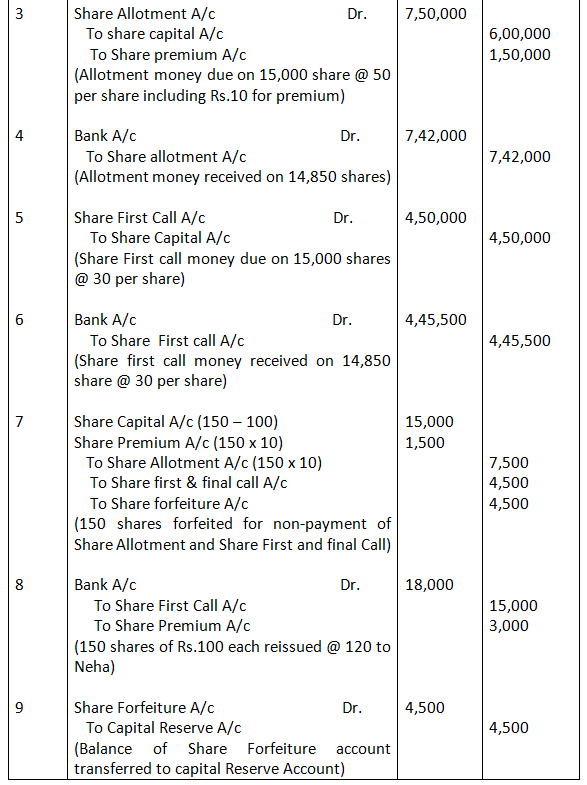
12. Kishna Ltd issued 15,000 shares of Rs.100 each at a premium of Rs.10 per share, payable as follows:
On application Rs.30
On allotment Rs.50 (including premium)
On first and final call Rs.30
All the shares subscribed and the company received all the money due, With the exception of the allotment and call money on 150 shares. These shares were forfeited and reissued to Neha as fully paid share of Rs.12 each. Give journal entires in the books of the company.
Solution:-
Books of Krishna Ltd.
Journal
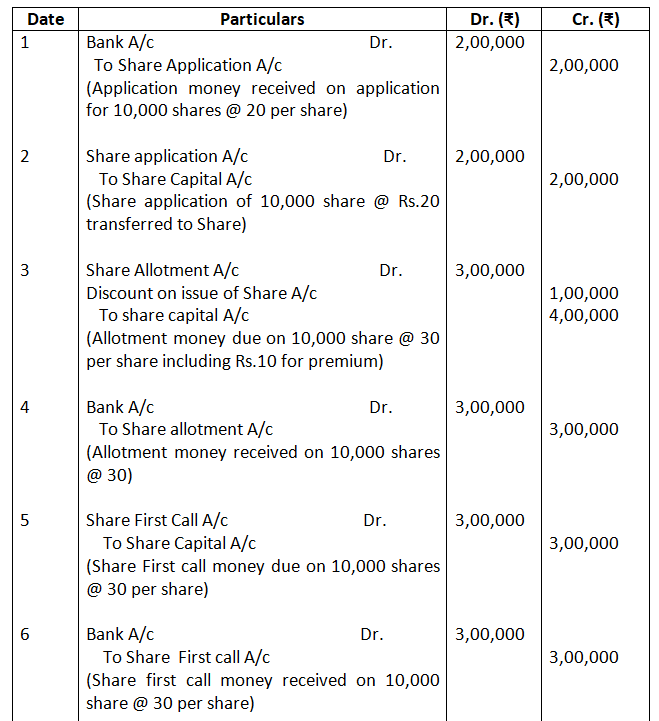
13. Arushi Computers Ltd issued 10,000 equity shares of Rs.100 each at 10% discount. The net amount payable as follows:
On application Rs.20
On allotment Rs.30 (Rs.40 – discount Rs.10)
On first call Rs.30
On final call Rs.10
A shareholder holding 200 shares did not pay final call. His shares Were forfeited. Out of these 150 shares were reissued to Ms. Sonia at Rs.75 per shares. Give journal entires in the books of the company.
Solution:-
Books of Krishna Ltd.Journal
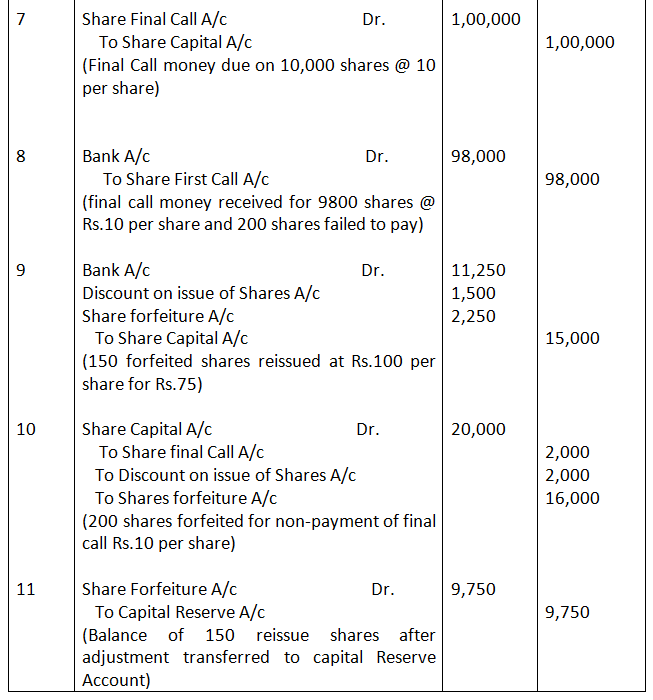
Working Notes:
Amount Transferred to Capital Reserve A/c
Amount Credited share forfeiture Rs.80 per share
Less: Amount debited to Share forfeiture Rs.(15) per share
Balance after adjustment Rs.65 per share
Amount transferred to Capital Reserve Account = Balance per share after adjustment x Number of Shares reissued Rs.9,750 = Rs.65 x Rs.150 per share
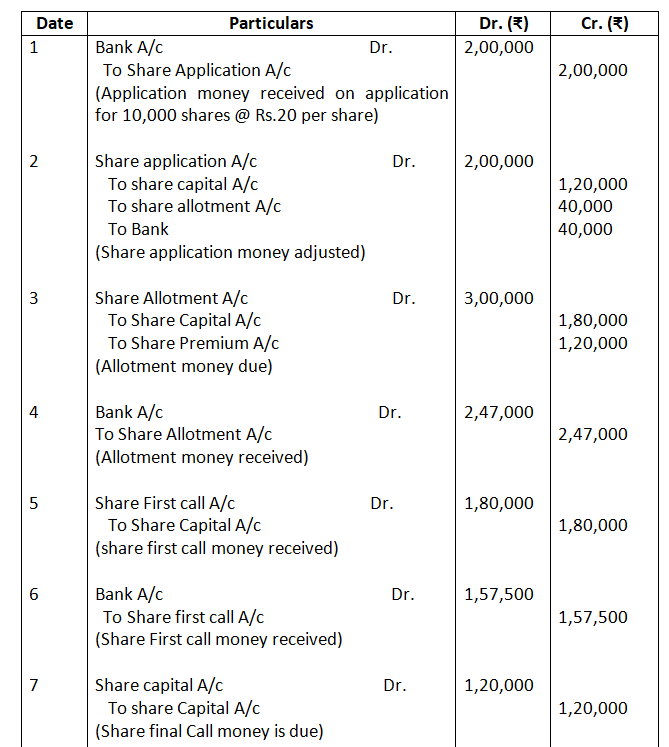
14. Raunak Cotton Ltd. Issued a prospectus inviting applications for 6,000 equity shares of Rs.100 each at a premium of Rs.20 per shares, payable as follows:
On application Rs.20
On allotment Rs.50 (including premium)
On first call Rs.30
On final call Rs.20
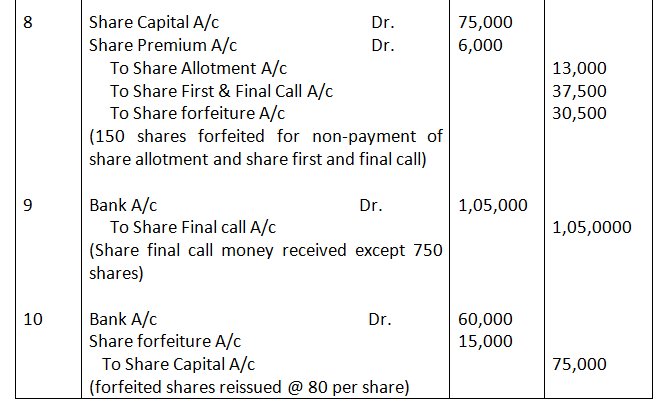
Application were received for 10,000 shares and allotment was made Pro-rata to the applicants of 8,000 shares, the remaining applications Being refused. Money received in excess on the application was adjusted toward the amount due on allotment. Rohit, to whom 300 shares were allotted failed to pay allotment and calls money, his shares were forfeited. Itika, who applied for 600 shares, failed to pay the two calls and her share were also forfeited. All these shares were sold to Kartika as fully paid for Rs.80 per shares. Give journal entires in the books of the company.
Solution:-
Books of Krishna Ltd.
Journal
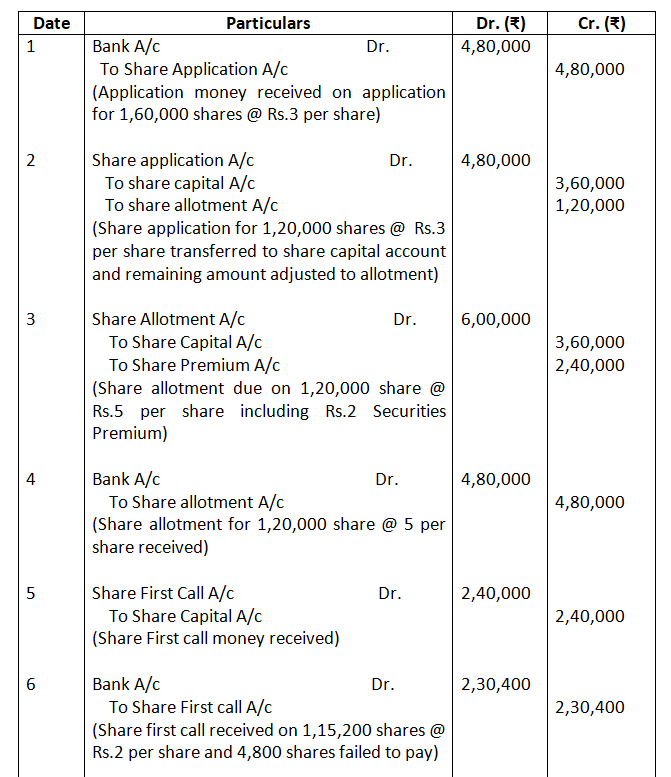
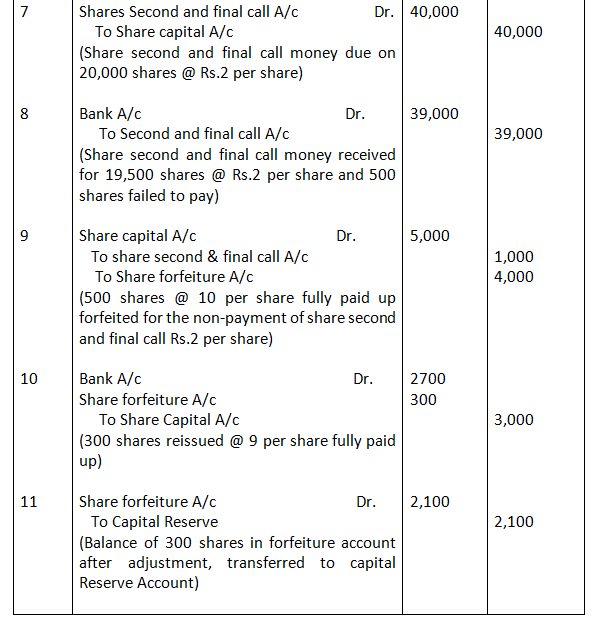
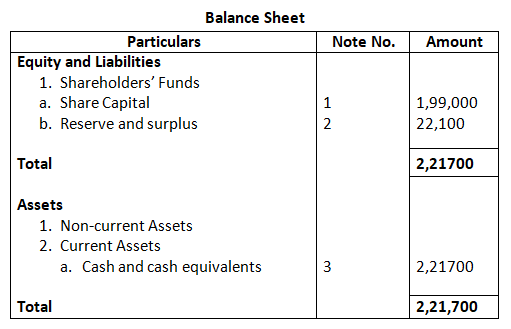
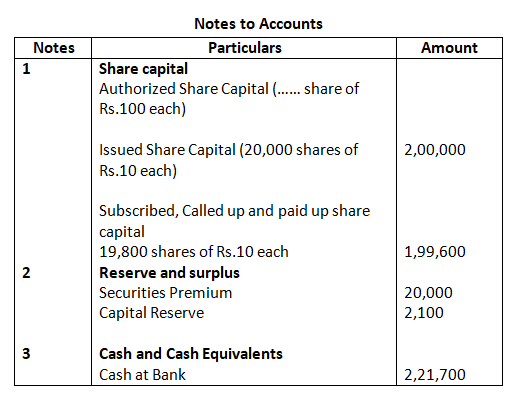
15. Himalaya Company Limited issued for public subscription of 1,20,000 equity shares of Rs.10 each at a premium of Rs.2 per share payable as under:
With Application Rs.3 per share
On allotment (including premium) Rs.5 per share
On first call Rs.2 per share
On Second and Final call Rs.2 per share
Application were received for 1,60,000 shares. Allotment was made on pro-rata basis. Excess money on application was adjusted against the amount due on allotment.
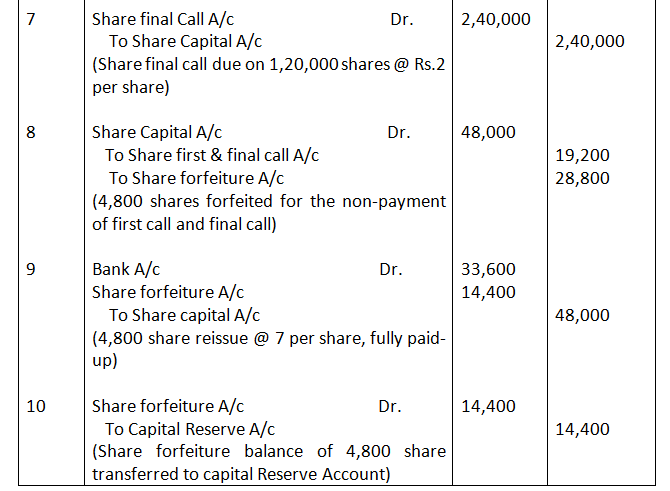
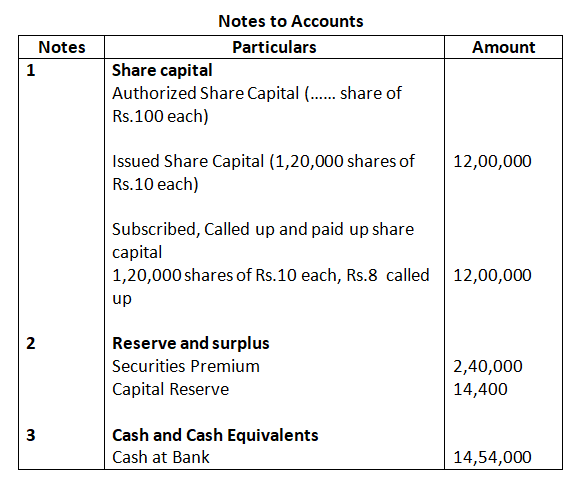
Rohan, whom 4,800 shares were allotted, failed to pay for the two calls. These shares were subsequently forfeited after the second call was made. All the shares forfeited were reissued to Teena as fully paid at Rs.7 per share.
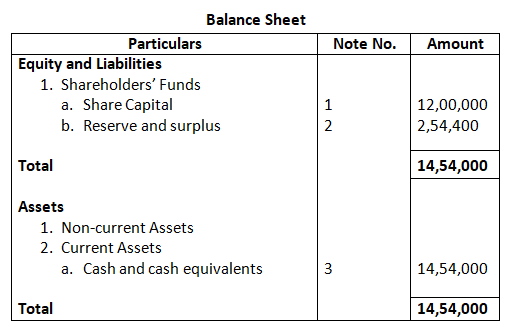
Record journal entries in the books of the company to record these transactions relating to share capital. Also show the company’s balance sheet.
Solution:-
Books of Himalya Company Ltd.
Journal
16. Prince Limited issued a prospectus inviting applications for 2,00,000 equity shares of Rs.10 each at a premium of Rs.3 per share payable as follows:
With Application Rs.2
On allotment (including premium) Rs.5
On first call Rs.3
On second call Rs.3
Applications were received for 30,000 shares and allotment was made on pro-rata basis. Money overpaid on application was adjusted to the amount due on allotment.
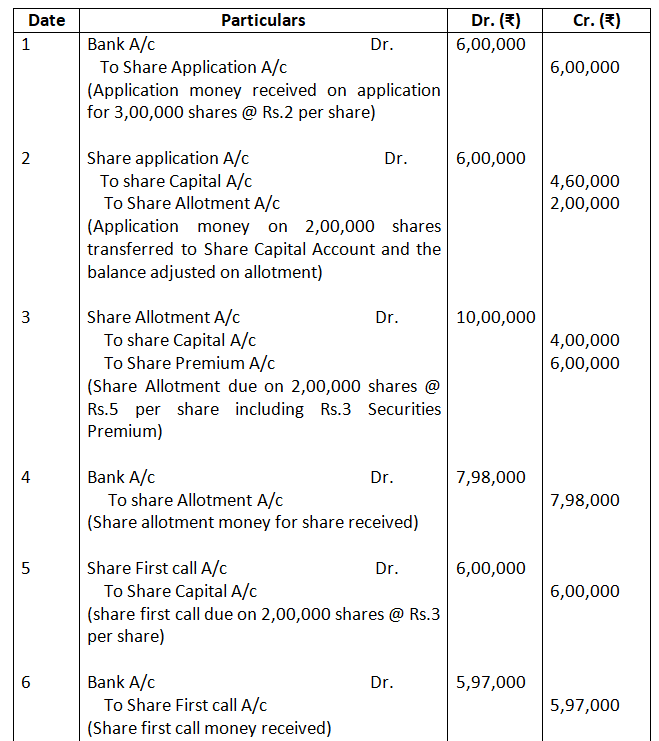
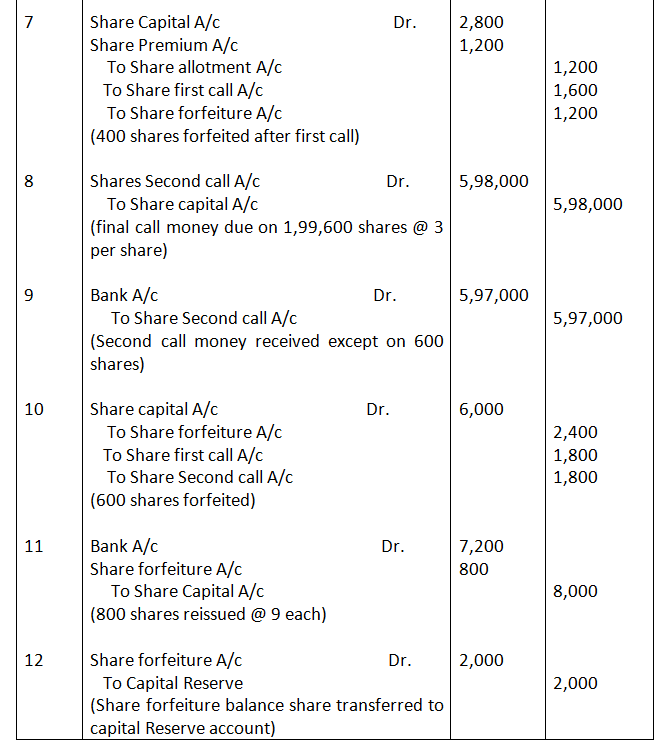
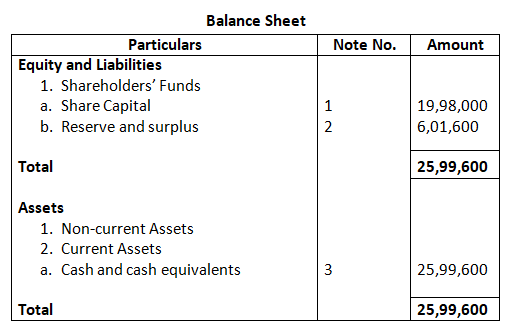
Mr. ‘Mohit’ whom 400 shares were allotted, failed to pay the allotment money and the first call, and her share were forfeited after the first call. Mr. ‘Joly’, whom 600 shares were allotted, failed to pay for the two calls and hence, his shares were forfeited. Of the shares forfeited, 800 shares were reissued to Supriya as fully paid for Rs.9 per share, the whole of Mr. Mohit’s shares being included. Record journal entries in the books of the Company and prepare the Balance Sheet.
Solution:-
Books of Prince Ltd.
Journal
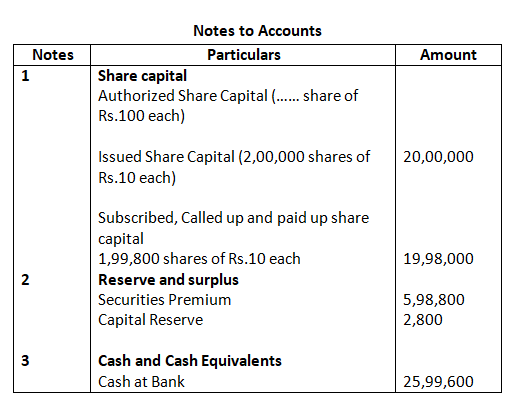
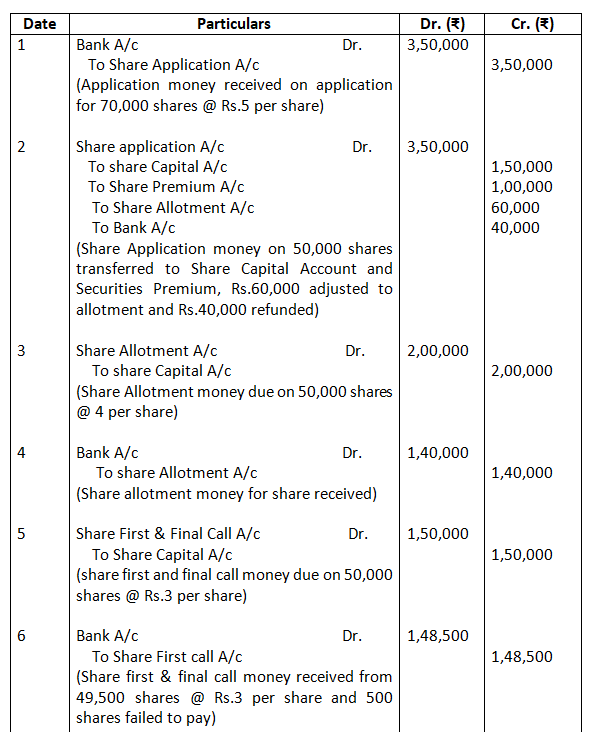
17. Life machine tools Limited, issued 50,000 equity shares of Rs.10 each at Rs.12 per share, payable at to Rs.5 on application (including premium), Rs.4 on allotment and the balance on the first and final call. Applications for 70,000 shares had been received. Of the cash received. Rs.40,000 was returned and Rs.60,000 was applied to the amount due on allotment, the balance of which was paid. All shareholders paid the call due, with the exception of one share holder of 500 shares. These shares were forfeited and reissued as fully paid at Rs.8 per share. Journalese the transactions.
Solution:-
Books of Prince Ltd.
Journal
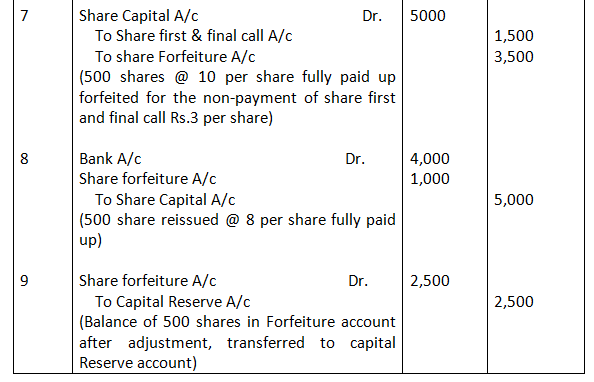
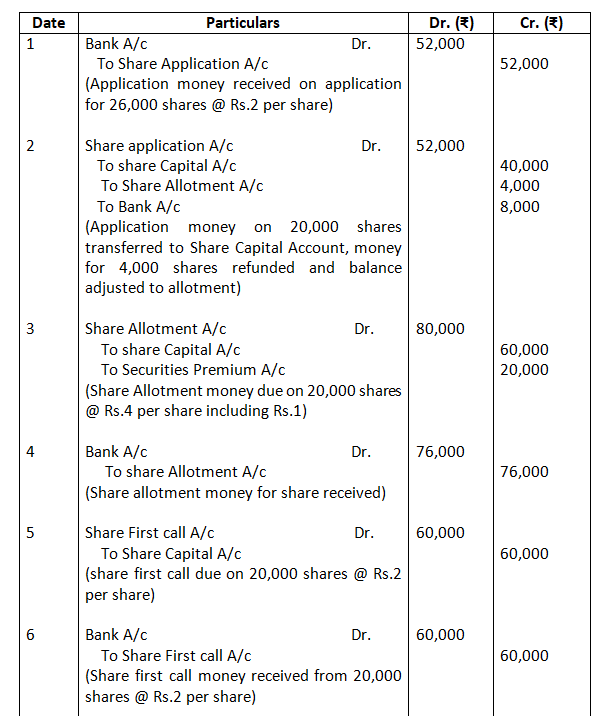
18. The Orient Company Limited offered for public subscription 20,000 equity shares of Rs.10 each at premium of 10% payable at Rs.2 on application; Ra.4 on allotment including premium; Rs.3 on first call and Rs.2 on Second and final call. Applications for 26,000 shares were received. Applications for 4,000 shares were rejected. Pro-rata allotment was made to the remaining applicants. Both the calls were made and all the money were received except the final call on 500 shares which were forfeited. 300 of the forfeited shares were later on issued as fully paid at Rs.9 per share. Give journal entires and prepare the balance sheet.
Solution:-
Books of Orient Company Ltd.
Journal
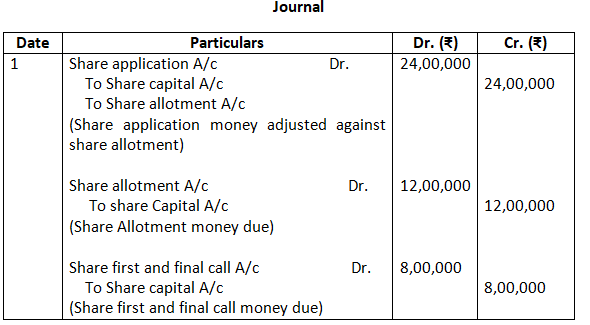
19. Alfa Limited invited applications for 4,00,000 of its equity shares of Rs.10 each on the following terms:
Payable on application Rs.5 per share
Payable on allotment Rs.3 per share
Payable on first and final call Rs.2 per share
Application for 5,00,000 shares were received. It was decided:
- To refuse allotment to the applicants for 20,000 shares;
- To allot in full to applicants for 80,000 shares;
- To allot the balance of the available shares’ pro-rata among the other applicants; and
- To utilize excess application money in part as payment of allotment money.
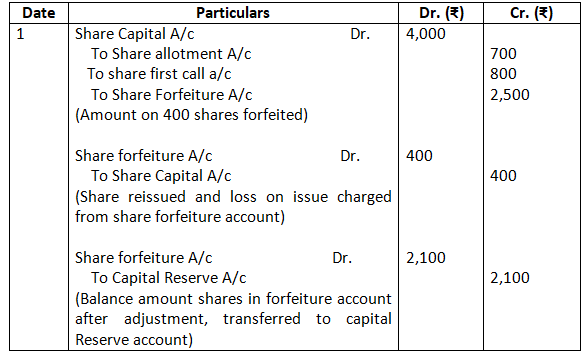
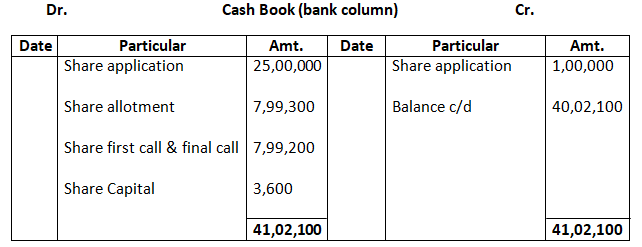
One applicant, whom shares had been allotted on pro-rata basis, did not pay the amount due on allotment and on the call, and his 400 shares were forfeited. The shares were reissued @ Rs.9 per shares. Show the journal and prepare Cash book to record the above.
Solution:-
Journal
Working Notes:
Call in arrears by application on allotment :
Money received on application = Rs.2,500
Less: Amount adjusted on Application = Rs.2,000
Amount adjusted on allotment = Rs.500
Money due on allotment = Rs.1,200
Less: Amount adjusted = Rs.700
Balance due on allotment = Rs.500
Journal
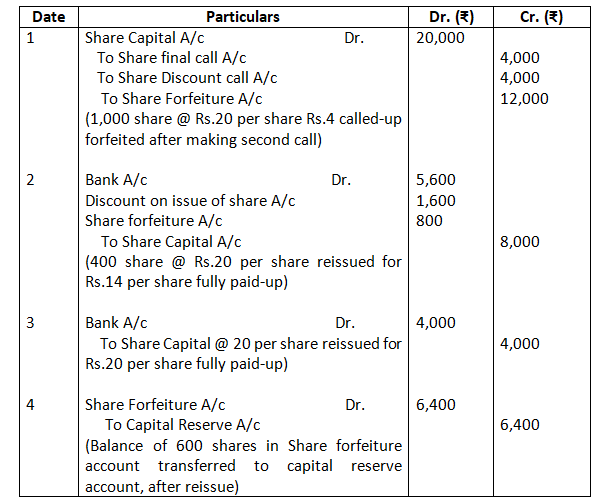
20. Ashoka Limited Company which had issued equity shares of Rs.20 each at a discount of Rs.4 per share, forfeited 1,000 shares for non-payment of final call of Rs.4 per share. 400 of the forfeited shares are reissued at Rs.14 per share out of the remaining shares of 200 shares reissued at Rs.20 per share. Give journal entires for the forfeiture and reissue of shares and show the amount transferred to capital reserve and the balance in Share Forfeiture Account.
Solution:-
Journal
Working Notes:
Balance in Share Forfeiture Account (12,000 – 800 – 6,400) = Rs.4,800
Share forfeiture Account credited = Rs.12 per share
Less: Share forfeiture Account debited = Rs.(2) per share
Amount transferred to Capital Reserve Account = Rs.10 per share
Amount of 400 shares transferred to Capital Reserve Account, after reissue = 400 shares @ Rs.10 per share = Rs.4000
For 200 share
Share forfeiture Account credited = Rs.12 per share
Less: Share forfeiture Account debited = Rs.(0) per share
Amount transferred to Capital Reserve Account = Rs.12 per share
Amount of 200 shares transferred to Capital Reserve Account, after reissue = 200 share @ Rs.12 per share = 2,400
Total amount transferred to capital reserve account for 600 shares = 4,000 + 2,400 = 6,400
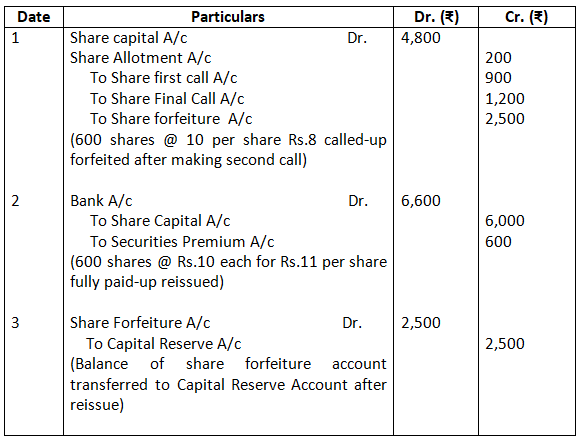
21. Amit holds 100 shares of Rs.10 each on which he had paid Rs.1 per shares as application money. Bimal holds 200 shares of Rs.10 each on which he has paid Rs.1 and Rs.2 per shares as application and allotment money, respectively. Chetan holds 300 shares of Rs.10 each and has paid Rs.1 on application, Rs.2 on allotment and Rs.3 for the first call. They all fail to pay their arrears and the second call of Rs.2 per share and the directors, therefore, forfeited their shares. The shares are reissued subsequently for Rs.11 per share as fully paid. Journalise the transactions.
Solution:-
Journal
Working Notes:
Share Forfeiture Account credited
Amit (100 x 1) = 100
Bimal (200 x 3) = 600
Chetan (300 x 6) = 1800
2,500
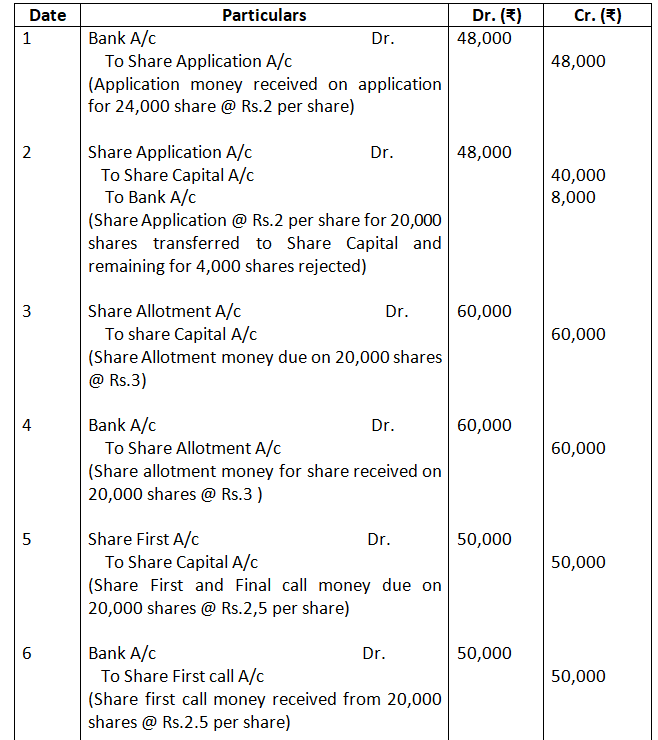
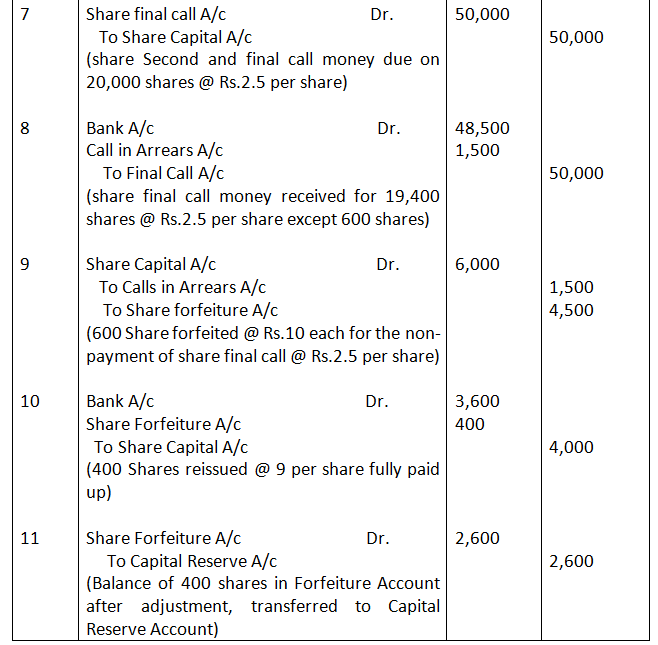
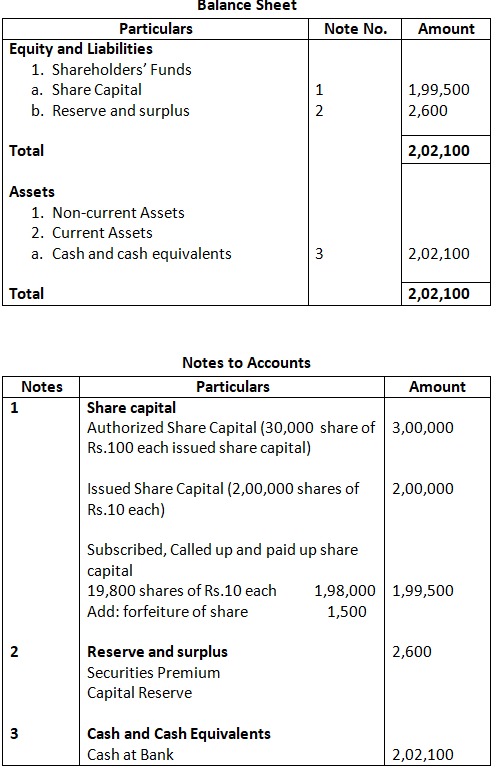
22. Ajanta company limted having a normal capital of Rs.3,00,000 divided into shares of Rs.10 each offered for public subscription of 20,000 shares payable at Rs.2 on application; Rs.3 on allotment and the balance in two calls of Rs.2.50 each. Application were received by the company for 24,000 shares. Applications for 20,000 shares were accepted in full and the shares allotted. Applications for the remaining shares were rejected and the application money was refunded. All moneys due were received with the exception of the final call on 600 shares which were forfeited after legal formalities were fulfilled. 400 shares of the forfeited shares were reissue at Rs.9 per share.
Record necessary journal entires and prepare the balance sheet showing the amount transferred to capital reserve and the balance in share forfeiture account.
Solution:-
Journal
23. Journalize the following transaction in the books Bhushan Oil Ltd:
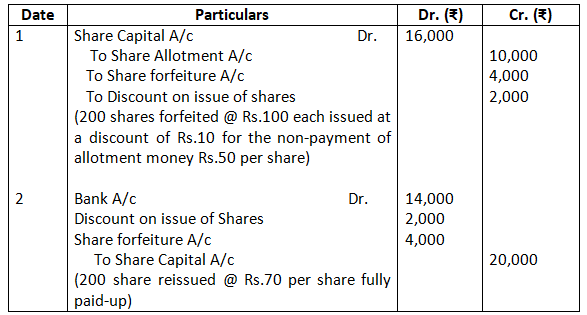
- 200 shares of Rs.100 each issued at a discount of Rs.10 were forfeited for the non-payment of allotment money of Rs.50 per share. The first and final call of Rs.20 per share on these share were not made. The forfeited share were reissued at Rs.70 per share as fully paid-up.
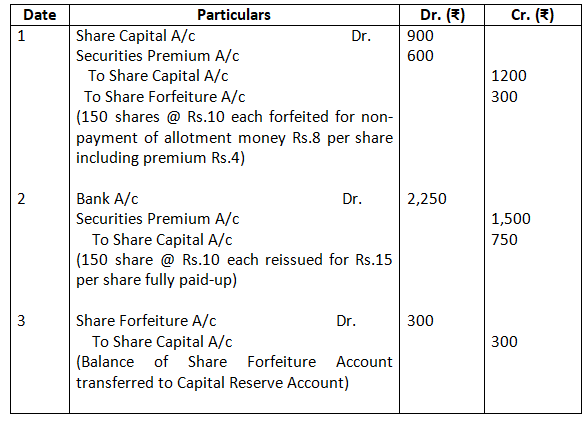
- 150 shares of Rs.10 each issued at a premium of Rs.4 per share payable with allotment were forfeited for non-payment of allotment money of Rs.8 per share including premium. The first and final call of Rs.4 per share were not made. The forfeited share were reissued at Rs.15 per share fully paid-up.
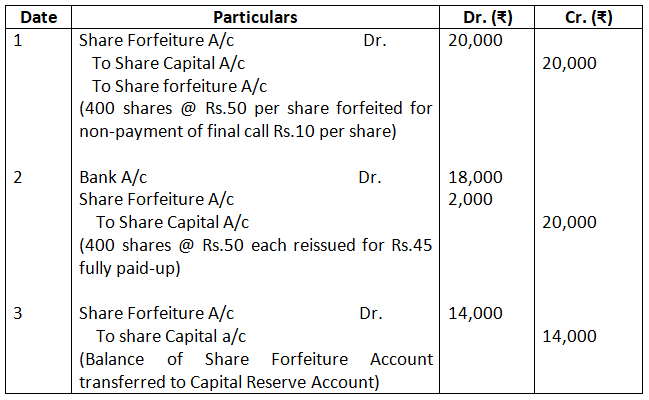
- 400 share of Rs.50 each issued at per were forfeited for non-payment of final call of Rs.10 per share. These share were reissued at Rs.45 per share fully paid-up.
Solution:-
Case (a)
Journal
Case (b)
Journal
Case (c)
Journal
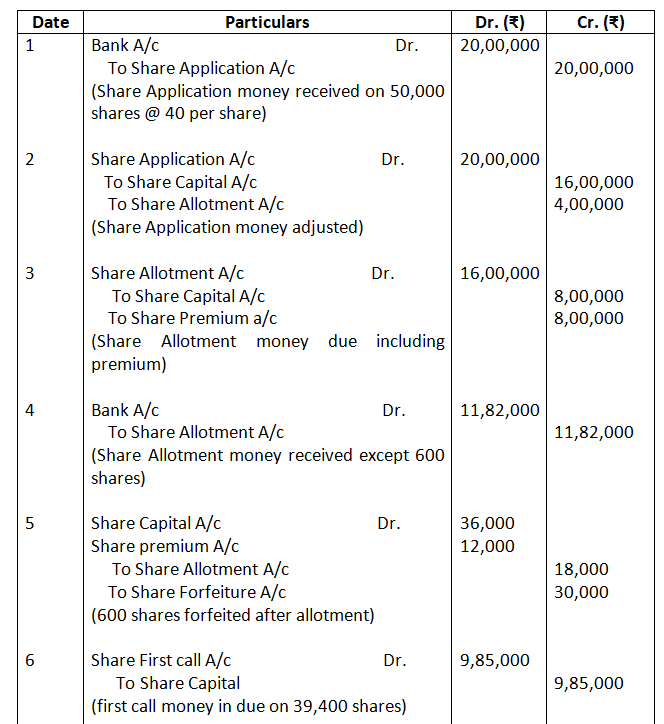
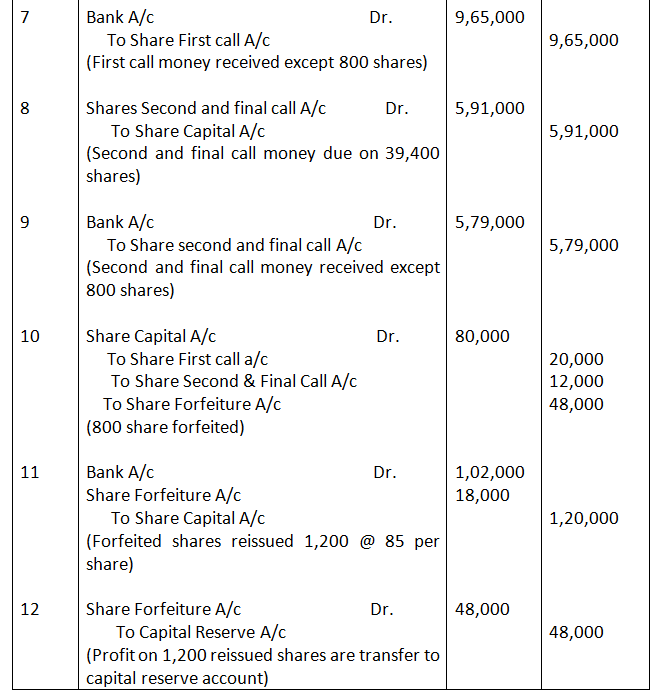
24. Amisha Ltd inviting application for 40,000 shares of Rs.100 each at a premium of Rs.20 per share payable; on application Rs.40; on allotment Rs.40 (including premium): on first call Rs.25 and Second and final call Rs.15. Application were received for 50,000 shares and allotment was made on pro-rata basis. Excess money on application was adjusted on sums due on allotment.
Rohit to whom 600 shares were allotted failed to pay the allotment money and his shares were forfeited after allotment. Ashmita, who applied for 1000 shares failed to pay the two calls and his share were forfeited after the second call. Of the shares forfeited, 1200 shares were sold to Kapil for Rs.85 per share as fully paid, the whole of Rohit’s shares being included. Record necessary journal entries.
Solution:-
Journal
Working Notes:
- Number of shares applied by Rohit = Total number of applied shares /Total number of allotment shares x number of allotted shares
= 50000 / 40000 * 600
= 750 shares
2. Call in arrears by Rohit on allotment
Money received on application (750 * 40) = 30,000
Less: Amount adjusted on application (600 * 40) = 24,000
Amount adjusted on Allotment = 6,000
3. Money due on Allotment (600 * 40) = 24,000
Less: Money adjusted = 6,000
Balance due on allotment = 18,000
4. Number of shares Ashmita = Total number of allotted shares / total number of shares applied x number of shares applied
= 40,000 /50,000 * 1,000 = 800shares
5. Profit on the forfeiture of 600 share of Rohit = Rs.30,000
Profit on the forfeiture of 600 share of Ashmita = Rs.36,000
6. Profit on forfeiture of 1200 share (30,000 + 36,000) = 66,000
Less: Loss on reissue of shares = 18,000
Transfer to Capital Reserve = 48,000
7. Balance in Share Forfeiture Account (48,000 – 36,000) = Rs.12,000