consumer’s equilibrium class 11 notes
consumer equilibrium class 11 notes pdf download handwritten
consumer equilibrium class 11 sandeep garg pdf
INTRODUCTION
A consumer is the main decision-maker of consumption pattern. A consumer is one who buys goods and services for satisfaction of wants. The consumer makes decision with regard to the kind of goods to be purchased in order to satisfy their wants. The main objective to get maximum satisfaction from spending the income on various goods and services.
A consumer has to follow some principles or laws in order to attain the highest satisfaction level. The two main approaches to study consumer’s behavior and consumer’s equilibrium are:
- Cardinal Utility Approach (or Marshall’s Utility Analysis or Marginal Utility Analysis)
- Ordinal Utility Approach (or Indifference Curve Analysis or Hicksian Analysis)
Cardinal Utility Approach – People consume different goods and services in order to maximize their satisfaction level. However, to do this, it is necessary to determine the quantum of satisfaction obtained from a particular commodity. Under the Cardinal Utility Approach, the concept of “Utility” is used to attain the Consumers’ Equilibrium.
Concept of Utility – Although the concepts of ‘taste’ and ‘satisfaction’ are familiar to all of us, it is much more difficult to express these concept in concrete terms. For example – Suppose you have just eaten an ice cream and a piece of chocolate. Can you tell how much you are satisfied from each of these items? You can probably tell which item you like more. But, it is very difficult to express measure of satisfaction. Due to this reason, economists developed the concept of utility.
Meaning of Utility – Utility refers to want satisfying power of a commodity. It is the satisfaction, actual or expected, derived from the consumption of a commodity. Utility differs from person-to-person, place-to-place and time-to-time. In the words of Prof. Hobson, “Utility is the ability of a good to satisfy a want”.
How to Measure Utility? – After understanding the meaning of utility, the next big question is: How to measure utility? According to classical economical, utility can be measured, in the same way, as weight or height is measured. For this, economists assumed that utility can be measured in cardinal (numerical) terms.
Example – Measurement of satisfaction in utils – Suppose you have just eaten an ice cream and a chocolate. You agree to assign 20 units as utility derived from the ice cream. Now the question is: how many utils be assigned to the chocolate? If you liked the chocolate less, then you may assign utils less than 20. However, if you liked it more, you would give it a number greater than 20. Suppose, you assign 10 utils to the chocolate, then it can be concluded that you liked the ice cream twice as much as you liked the chocolate.
Total Utility (TU) – Total utility refers to the total satisfaction obtained from the consumption of all possible units of a commodity. It measures the total satisfaction obtained from the consumption of all the units of that good.
For example – if the 1st ice cream gives you a satisfaction of 20 utils and 2nd one gives 16 utils, then TU from 2 ice cream is 20 + 16 = 36 utils. If the 3rd ice cream generates satisfaction of 10 units, then TU from 3 ice cream will be 20 + 16 + 10 = 46 utiles.
TU can be calculate as:
TUn = U1 + U2 + U3 + ………………. + Un
Where:
TUn = total utility from n units of a given commodity
U1 , U2 , U3 , ………………. Un = Utility from the 1st , 2nd , 3rd ………….., nth unit
N = Number of units consumed
Marginal Utility (MU) – Marginal utility is the additional derived from the consumption of one more unit of the given commodity. It is the utility derived from the last unit of a commodity purchased. As per the given example, when 3rd ice cream is consumed, TU increases from 36 utils to 46 utils. The additional 10 utils from the 3rd ice cream is the MU. In the words of Chapman, “Marginal utility is an addition made to the utility by consuming one more unit of a commodity”.
MU can be calculated as: MUn = YUn = TUn-1
One More way to calculate MU – MU is the change in TU when one more unit is consumed. However, when a change in units consumed is more than one, then MU can also be calculate as:
MU = Change in Total Utility / Change in number of Units
= ΔTU / ΔQ
Relationship between TU and MU
- TU increase with an increase in consumption of a commodity as long as MU is positive, i.e. till the 4th ice cream. In this phase, TU increases, but a diminishing rate as MU from each successive unit tends to diminish.
- When TU reaches its maximum, MU becomes zero, i.e. when the 5th ice cream is consumed. This is known as point of satiety. TU curve stops rising at the stage.
- When consumption is increased beyond the point of satiety, TU starts fallings as MU becomes negative.
Law of Diminishing Marginal Utility
Law of diminishing marginal utility (DMU) states that as we consume more and more units of a commodity, the utility derived from each successive unit goes on decreasing. In making choices, most people spread their incomes over different kinds of goods. People prefer a variety of goods because consuming more and more of any one good reduces the marginal satisfaction derived from further consumption of the same good. This law expresses an important relationship between utility and the quantity consumed of a commodity. Let us understand this law with the help of an example:
Assumptions of Law of Diminishing Marginal Utility
The law of DMU operates under certain specific conditions. Economists call them the ‘assumptions’ of this law. These are as follows:
- Cardinal measurement of utility – It is assumed that utility can be measured and consumer can express his satisfaction in quantitative terms such as 1,2,3 etc.
- Monetary measurement of utility – It is assumed that utility is measurable in monetary terms.
- Consumption of reasonable quantity – it is assumed that a reasonable quantity of the commodity is consumed. For example – we should compare the MU of a glassful of water and not of a spoonful of water. If a thirsty person is given water in a spoon, then every additional spoon will yield him more utility. So, to hold the law true, a suitable and proper quantity of the commodity should be consumed.
- Continuous consumption – It is assumed that consumption is a continuous process For example – if one ice cream is consumed in the morning and another in the evening, then the second ice cream may provide equal or higher satisfaction as compared to the first one.
- No change in Quality – Quality of the commodity consumed is assumed to be uniform. A second cup of ice cream with nuts and toppings may give more satisfaction than the first one, if the first ice cream was without nuts or toppings.
- Rational consumer – the consumer is assumed to be rational who measures, calculates and compares the utilities of different commodities and to maximize total satisfaction.
Consumer’s Equilibrium – The term ‘equilibrium’ is frequently used in economic analysis. Equilibrium means a state of rest or a position of no change. It refers to a position of rest, which provides the maximum benefit or gain under a given situation. A consumer is said to be in equilibrium, when he does not intend to change his level of consumption, i.e., when he derives maximum satisfaction.
Consumer’s Equilibrium refers to the situation when a consumer is having maximum satisfaction with limited income and has no tendency to change his way of existing expenditure.
Consumer’s equilibrium can be discussed under two different situations:
- Consumer spends his entire income on a Single Commodity
- Consumer spends his entire income on Two Commodities
Consumer’s Equilibrium in case of Single Commodity – The law of DMU can be used to explain consumer’s equilibrium in the case of a single commodity. Therefore, all the assumptions of the Law of DMU are taken as assumptions of consumer’s equilibrium in the case of a single commodity. A consumer purchasing a single commodity will be at equilibrium, when he is buying such a quantity of that commodity, which gives him maximum satisfaction. The number of units to be consumed of the given commodity by a consumer depends on 2 factors:
- Price of the given commodity;
- Expected utility (Marginal Utility) from each successive unit.
Marginal Utility in terms of Money = Marginal Utility in utils / Marginal Utility of one rupee (MUM)
Equilibrium Condition – Consumer in consumption of single commodity (say, x) will be at equilibrium when:
Marginal Utility (MUx) is equal to Price (Px) paid for the commodity; i.e. MUx = Px
Consumer’s Equilibrium in case of Two Commodities – The Law of DMU applies in case of either once commodity or one use of a commodity However, in real life, a consumer normally consume more than one commodity. In such a situation, ‘Law of Equi-Marginal Utility’ helps in optimum allocation of his income.
As the law of Equi-marginal utility is based on law of DMU, all assumption of the latter also apply to the former. Let us now discuss equilibrium of consumer by taking tow goods; ‘x’ and ‘Y’. The same analysis can be extended for any number of goods. In the case of consumer equilibrium under a single commodity, we assumed that the entire income was spent on a single commodity. Now, the consumer wants to allocate his money income between the two goods to attain the equilibrium position.
According to the low of Equi-marginal utility, a consumer gets maximum satisfaction, when the ration of MU of two commodities and their respective prices are equal and MU falls as consumption increases. It means, there are two necessary condition to attain Consumer’s Equilibrium in case of Two Commodities:
- The ratio of Marginal Utility to Price is same in case of both the goods.
- We know, a consumer in consumption of single commodity (say, x) is at equilibrium
When = MUx / Px
= MUm
- Similarly, consumer consuming another commodity (say, y) will be at equilibrium when = MUy / Py
= MUm
Equating 1 and 2, we get: MUx / Px = MUy / Py = Mum
As marginal utility of money (MUm) is assumed to be constant, the above equilibrium condition can be restated as:
MUx / Px = MUy / Py Or MUx / MUy = Px / Py
When Px = Py then the equilibrium condition can be restated as: MUx = MUy.
2. MU falls as consumption increases : The second condition needed to attain consumer’s equilibrium is that MU of a commodity must fall as more of it is consumed. If MU does not fall as consumption increases, the consumer will end up buying only one good which is unrealistic and consumer will never reach the equilibrium position.
Ordinal Utility Approach (Indifference Curve Or Hicksian Analysis)
Modern economists disregarded the concept of ‘cardinal measure of utility’. They were of the opinion that utility is a psychological phenomenon and that it is next to impossible to measure utility in absolute terms. According to them, a consumer can rank various combinations of goods and services in order of his preference. For example – if a consumer consumes two goods, apples and Bananas, then he can indicate:
- Whether he prefers apple over banana; or
- Whether he prefers banana over apple; or
- Whether he is indifferent between apples and bananas, i.e. both are equally preferable and both of them give him same level of satisfaction.
Meaning of Indifference Curve – When a consumer consumes various goods and services, then the there are some combinations, which give him exactly the same total satisfaction. The graphical representation of such combination is termed as indifference curve. Indifference curve refers to the graphical representation of various alternative combinations of bundles of two goods among which the consumer is indifferent. Alternately, indifference curve is a lacus of points that shows such combinations of two commodities which give the consumer same satisfaction. An indifference curve is also known as ‘equal satisfaction curve’ or ‘Iso-utility curve’.
Indifference Map – Indifference Map refers to the family of indifference curves that represent consumer preferences over all the bundles of the two goods.
An indifference curve represents all the combinations, which provide same level of satisfaction. However, every higher or lower level of satisfaction can be shown on different indifference curves. It means, infinite number of indifference curves can be drawn. IC1 represents the lowest satisfaction, IC2 shows satisfaction more than that of IC1 and the highest level of satisfaction is depicted by indifferent curve IC3. However, each indifference curve shows the same level of satisfaction individually.
Marginal Rate of Substitution (MRS)
MRS refers to the rate at which the commodities can be substituted with each other, so that total satisfaction of the consumer remains the same. For example, in the example of apples (A) and bananas (B), MRS of ‘A’ for ‘B’, will be number of units of ‘B’, that the consumer is willing to sacrifice for an additional unit of ‘A’, so as to maintain the same level of satisfaction.
MRSAB = Units of Bananas (B) willing to Sacrifice / Units of Apples (A) willing to gain
MRSAB = ΔB / ΔA
MRSAB is the rate at which a consumer is willing to give up Bananas for one more unit of Apple. It means, MRS measures the slope of indifference curve.
Assumptions of Indifference Curve
consumer equilibrium class 11 sandeep garg notes
The various assumption of indifference curve are:
- Two commodities – It is assumed that the consumer has a fixed amount of money, the whole of which is to be spent on the two goods, given the constant prices of both goods.
- Non Satiety – It is assumed that the consumer has not reached the point of saturation. A consumer always prefers more of both commodities, i.e. he always tries to move to a higher indifference curve to get higher and higher satisfaction. The consumer’s choice is presumed to be monotonic, i.e. a consumer always prefers a bundle with more goods as it offers him a higher level of satisfaction.
- Ordinal Utility – A consumer can rank his preferences on the basis of the satisfaction from each bundle or goods.
- Diminishing marginal rate of substitution – Indifference curve analysis assumes diminishing marginal rate of substitution. Due to this assumption, an indifference curve is convex to the origin.
- Rational Consumer – The consumer is assumed to behave in a rational manner, i.e. he aims to maximize his total satisfaction.
Properties of Indifference Curve –
- Indifference curves are always convex to the origin – An indifference curve is convex to the origin because of diminishing MRS. MRS declines continuously because of the law of diminishing marginal utility. When the consumer consumers more and more apples, his marginal utility from apples keeps on declining and he is willing to give up less and less of bananas for each apple. Therefor, indifference curve are convex to the origin. It must be noted that MRS indicates the slope of indifference curve.
- Indifference curve slope down wards – It implies that as a consumer consumes more of one good, he must consume less of the other good. This happens because if the consumer decides to have more units of one good (say apples), he will have to reduce the number of units of another good (say bananas), so that total satisfaction remains the same.
- Higher Indifference curves represent higher levels of satisfaction – A higher indifference curve represents a large bundle of goods, which means more utility because of monotonic preference. Consider point ‘A’ on IC1. At ‘A’ consumer gets the combination (OR, OP) of the two commodities x and y. At ‘B’, consumer gets the combination (OS, OP). As OS > OR, the consumer gets more satisfaction at IC2.
- Indifference curves can never intersect each other – As two indifference curves cannot represent the same level of satisfaction, they cannot intersect each other. It means, only one indifference curve will pass through a given point on an indifference map.
Budget Line
So far, we have discussed different combinations of two goods that provide same level of satisfaction. But, which combination a consumer actually purchases depends upon his income (‘consumer budget) and prices of the two commodities. Consumer Budget states the real income or purchase power of the consumer from which he can purchase certain quantitative bundles of two goods as a given price. It means, a consumer can purchase only those combination (bundles) of goods, which cost less than or equal to his income.
Budget line is a graphical representation of all possible combinations of two goods which can be purchased with given income and prices, such that the cost of each of these combinations is equal to the monetary income of the consumer. Alternately, Budget Line is the locus of different combinations of the two goods which the consumer consumes and which cost exactly his income. Budget Line is also known as: (A) Price Line; (b) Price Opportunity Line; (c) Price-Income Line; or (d) Budget Constraint Line.
Budget Set – Budget set is the set of all possible combination of the two goods which a consumer can afford given his income and prices in the market. In addition to the three options, there are some more options available to the consumer his income, even if entire income is not spent. Budget set includes all the bundles with a total income of Rs.20, i.e. possible bundles or consumer’s bundles are: (0, 0); (0, 1); (0, 2); (1, 0); (2, 0); (1, 1). Consumer’s Bundle is a quantitative combination of two goods which can be purchased by a consumer from his given income.
Diagrammatic Explanation of Budget Line – Suppose, a consumer has a budget of Rs.20 to be spent on two commodities: apples (A) and bananas (B). If apple is priced at Rs.4 each and banana at Rs.2 each, then the consumer can determine the various combination (bundles), which form the budget line. The possible option for spending income of Rs.20.
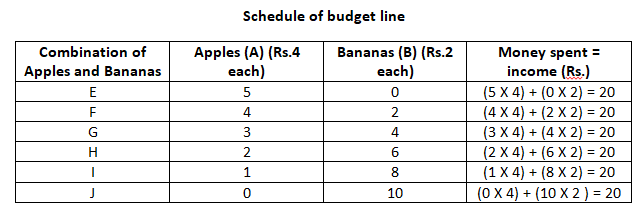
Algebraic Expression of Budget Line
The budget line can be expressed as an equation:
M = (PA X QA) + (PB X QB)
Where:
M = Money income;
QA= Quantity of apples (A);
QB = Quantity of bananas (B);
PA = Price of each Apple;
PB = Price of each bananas.
All points on the budget line ‘AB’ indicate those bundles, which cost exactly equal to ‘M’.
Slope of the Budget Line – We know that the slope of a curve is calculated as a change in variable on the vertical Y-axis divided by a change in variable on the horizontal or X-axis. In the example of apples and bananas, slope of the budget line will be number of units of bananas, that the consumer is willing to sacrifice for an additional unit of apple.

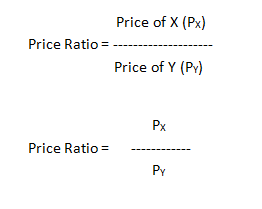
Price Ratio – Price Ratio is the price of the good on the horizontal or X-axis divided by the price of the good on the vertical or Y-axis. For instance, if good X is plotted on the horizontal axis and good Y on the vertical axis, then:
Properties of Budget Line
The two main properties of Budget line are:
- Budget Line is Downward Sloping – Budget line has a negative slope, i.e. it slopes downwards as more of one good can be bought by decreasing some units of the other good.
- Budget Line is a straight line – The slope of Budget line is represented by the Price Ratio. As Price Ratio is constant throughout, the budget line is a straight line.
Shift in Budget line
Budget line is drawn with the assumptions of constant income of consumer and constant prices of the commodities. A new budget line would have to be drawn if either (a) Income of the consumer changes, or (b) Price of the commodity changes.
- Effect of a Change in the Income of Consumer – If there is any change in the income, assuming no change in the price of a apples and bananas, then the budget line will shift. When income increases, the consumer will be able to buy more bundles of goods, which was previously not possible.
- Effect of change in Price (Apple and Bananas) – If there is any change in price of two commodities, assuming no change in money income of consumer, then budget line will change.
- Change in Price of both commodities
- Change in the Price of commodities on X-axis (Apples)
- Change in the Price of commodity on Y-axis (Bananas)
Consumer’s Equilibrium by Indifference curve Analysis
Consumer equilibrium refers to a situation, in which a consumer derives maximum satisfaction, with no intention to change it and subject to given prices and his given income. The point of maximum satisfaction is achieved by studying the indifference map and budget line together.
Conditions of Consumer’s Equilibrium – The consumer’s equilibrium under the indifference curve theory must meet the following two conditions:
- MRSXY = Ratio of Prices or Px/PY = Market Rate of Exchange (MRE)
- MRS continuously falls – The second condition for consumer’s equilibrium is that MRS must be diminishing at the point of equilibrium, i.e. the indifference curve must be convex to the origin at the point of equilibrium. Unless MRS continuously falls, the equilibrium cannot be established.
Cardinal Utility Vs Ordinal Utility
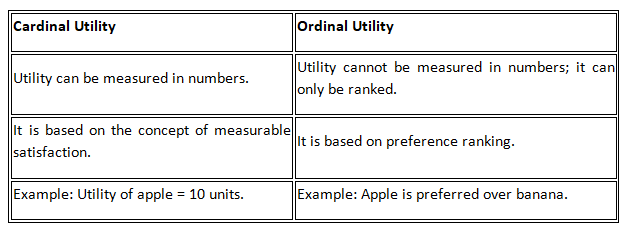
- Under Cardinal Utility Approach, it is assumed that utility can be measured in cardinal terms, such as 1,2,3, etc. However, according to the Ordinal Utility Approach, Utility is a subjective concept, which cannot be measured and we can just rank the scale of preferences.
- Under the Cardinal Approach, the term “util” was developed as a unit to measure utility, whereas, no such unit of measurement was developed under Ordinal Approach.
- Example – Suppose a person consumes apple and banana.
- According to Cardinal Approach, the consumer can assign utils to both commodities, say, 20 utils to apple and 15 utils to banana. This signifies that apple offers 5 more utils than banana.
- According to Ordinal Approach, the consumer cannot express the satisfaction in exact terms. It means, if the consumer likes apple more than banana, then the he will give 1st rank to apple and 2nd rank to banana.
Short Answer Type Questions
- Define the following terms: (i) Total Utility; (ii) Initial Utility.
Answer –
(i) Total Utility (TU) – Total Utility is the total satisfaction obtained by a consumer from consuming all units of a commodity.
(ii) Initial Utility – Initial Utility is the utility derived from the consumption of the first unit of a commodity. It is generally the highest because the want is most intense at the beginning.
2. Define marginal utility. State the law of diminishing marginal utility.
Answer: Marginal Utility (MU) – is the additional satisfaction obtained from consuming one more unit of a commodity.
Law of Diminishing Marginal Utility: According to this law, as a consumer consumes more and more units of a commodity, the marginal utility derived from each additional unit gradually decreases, assuming other things remain the same.
3. Explain the various points of relationship between marginal utility and total utility with the help of schedule and diagram.
Answer:
Relationship between TU and MU:
- When MU is positive, TU increases.
- When MU decreases but remains positive, TU increases at a diminishing rate.
- When MU becomes zero, TU is maximum.
- When MU becomes negative, TU starts decreasing.
4. How does a consumer reach equilibrium position when he is buying only one commodity? Explain with the help of utility schedule.
Answer: A consumer is in equilibrium when the Marginal Utility (MU) of the commodity is equal to its price (P).
Condition:
MU = Price (MU = P)
At this point, the consumer gets maximum satisfaction and has no incentive to buy more or less of the commodity.
5. A consumer only two goods X and Y. State and explain the conditions of consumer’s equilibrium with the help of utility analysis.
Answer: A consumer attains equilibrium when the following conditions are satisfied:
- MUx / Px = MUy / Py
(Marginal utility per rupee spent on both goods should be equal.) - Marginal Utility should be diminishing.
6. Define the following terms: (i) Indifference curve; (ii) Indifference map; (iii) Marginal rate of substitution.
Answer –
- Indifference Curve: An indifference curve shows different combinations of two goods which provide the same level of satisfaction to a consumer.
- Indifference Map: An indifference map is a group of indifference curves showing different levels of satisfaction.
- Marginal Rate of Substitution (MRS): MRS is the rate at which a consumer is willing to sacrifice one good to get more units of another good while keeping satisfaction unchanged.
7. Explain the law of diminishing marginal utility with the help of a utility schedule.
Answer: The law states that as more and more units of a commodity are consumed, the marginal utility from each additional unit goes on decreasing.
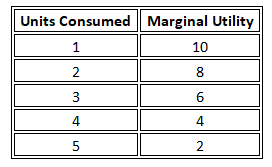
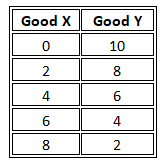
8. Discuss the meaning of budget line, with a hypothetical schedule and diagram.
Answer: A budget line shows all possible combinations of two goods which a consumer can buy with his given income and prices of goods.
Schedule:
9. Explain the relation between total utility and marginal utility.
Answer:
- When MU is positive, TU increases.
- When MU becomes zero, TU is maximum.
- When MU becomes negative, TU starts falling.
10. Define an indifference curve. Explain why an indifference curve is downward sloping from left to right.
Answer: An indifference curve shows different combinations of two goods giving equal satisfaction. It slopes downward because when consumption of one good increases, the consumer has to reduce the quantity of another good to maintain the same satisfaction.
11. What are monotonic preferences? Explain why an indifferences curve to the right shows higher utility.
Answer: Monotonic preferences mean that a consumer always prefers more quantity of a good rather than less quantity. An indifference curve towards the right shows higher utility because it represents more quantity of goods.
12. Define an indifference map. Explain why an indifference curve to the right shows higher utility level.
Answer: An indifference map is a collection of indifference curves showing different satisfaction levels. A curve towards the right represents a higher utility level because it contains better combinations of goods.
13. A consumer only two goods X and Y and is in equilibrium. Price of X rises. Explain the reaction of the consumer with the help of utility analysis.
Answer: When the price of X rises, marginal utility per rupee spent on X falls. The consumer reduces the consumption of X and increases the consumption of Y until:
MUx/Px = MUy/Py
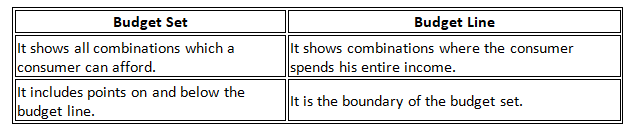
14. Explain the distinction between budget set and budget line.
15. Define Marginal Rate of Substitution. Explain why is an indifference curve convex.
Answer –
Marginal Rate of Substitution (MRS) is the rate at which a consumer is willing to sacrifice one good to get an additional unit of another good without changing the level of satisfaction. An indifference curve is convex to the origin because of diminishing MRS. As the consumer gets more of one good, he is willing to sacrifice less quantity of the other good.
16. Explain the difference between cardinal utility and ordinal utility. Give example.
Answer –
17. What is budget line? Why is it downward sloping?
Answer – A Budget Line shows all possible combinations of two goods that a consumer can buy with his given income and prices. It is downward sloping because to buy more of one good, the consumer has to reduce the quantity of the other good.
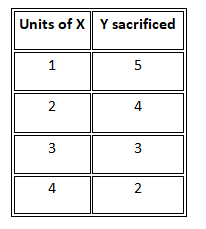
18. Explain the meaning of diminishing marginal rate of substitution with the help of a numerical example.
Answer: Diminishing MRS means that as a consumer consumes more units of one good, he is willing to sacrifice fewer units of another good.
Example:
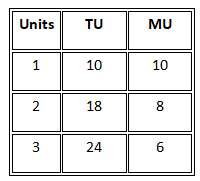
19. Explain the correct of ‘marginal utility’ with the help of numerical example.
Answer – Marginal Utility is the additional satisfaction obtained from consuming one more unit of a commodity.
Formula:
MU = Change in TU / Change in Quantity
Example:
20. Explain why an indifference curve is convex to the origin.
Answer – An indifference curve is convex to the origin because of the law of diminishing marginal rate of substitution. The consumer sacrifices fewer units of one good to gain additional units of another good.
21. A consumer only two goods A and B is in equilibrium. Show that when price of good B falls, demand for B rises. Answer this question with the help of utility analysis.
Answer: When the price of B falls, MUb/Pb increases. The consumer buys more of B until the equilibrium condition is restored:
MUa/Pa = MUb/Pb
22. A consumer consumes two goods X and Y. What will happen if Mux/Px is greater than MUy/Py?
Answer: If MUx/Px > MUy/Py, the consumer will buy more of good X and less of good Y because X provides more utility per rupee spent.
The consumer will continue this process until:
MUx/Px = MUy/Py
23. A consumer consumes only two goods X and Y. Marginal utilities of X and Y are 5 and 4 respectively. The prices of X and Y are Rs.4 per unit and Rs.5 per unit respectively. Is the consumer in equilibrium? What will be the further reaction of the consumer? Explain.
Answer –
Consumer equilibrium condition:
Mux/Px = Muy/Py
5/4 = 1.25
4/5 = 0.80
Since MUx/Px > MUy/Py, the consumer is not in equilibrium.
The consumer will buy more units of X and less units of Y until:
Mux/Px = MUy/Py
24. A consumer consumes only two goods X and Y. The marginal rate of Substitution is 1. Price of X and Y are Rs.3 and Rs.4 per unit respectively. Is the consumer equilibrium? What will be further reaction of the consumer? Give reason.
Answer – Equilibrium condition under indifference curve approach:
MRSxy = Px/Py
Given:
MRS =1
Px/Py = 3/4
= 0.75
Since MRS ≠ Px/Py, the consumer is not in equilibrium.
25. ‘Higher indifference curve represents higher of satisfaction to the consumer’. Explain the statement. Also state the underlying assumption related to this property of indifference curve.
Answer – A higher indifference curve represents a higher level of satisfaction because it contains combinations of goods with more quantity of one or both goods.
Assumption: Consumer preferences are monotonic, i.e., more quantity of goods is preferred to less.
26. Explain the reaction of the consumer when Price Ratio (or Market Rate of Exchange) is higher than Marginal Rate of Substitution.
Answer –
When:
Px/Py ˃ MRS
the consumer finds good Y relatively cheaper.
Therefore, the consumer increases consumption of Y and decreases consumption of X until equilibrium is reached.
27. Explain conditions of consumer’s equilibrium under indifference curve approach.
Answer:
The two conditions of consumer equilibrium are:
- MRSxy = Px/Py
(Slope of IC = Slope of Budget Line) - Indifference curve must be convex to the origin due to diminishing MRS.
28. Explain the meaning of ‘Budget set’ and ‘Budget line’.
Answer –
- Budget Set: It shows all possible combinations of two goods which a consumer can buy with given income and prices.
- Budget Line: It shows those combinations where the consumer spends his entire income.
29. Explain the meaning of marginal rate of substitution. Why does it diminish as one good it diminish as one good is substituted for the other? Explain.
Answer – MRS is the rate at which a consumer is willing to sacrifice one good to get more units of another good without changing satisfaction. MRS diminishes because as the quantity of one good increases, its importance decreases compared to the other good.
30. Explain the meaning of budget line. What can cause a change in it? Explain.
Answer: Budget line shows all possible combinations of two goods that a consumer can purchase with given income and prices. A change in income or prices of goods causes a change in budget line.
31. Why is budget line a straight line? Explain.
Answer: Budget line is a straight line because the prices of goods remain constant and the rate of exchange between two goods remains unchanged.
32. Explain the law of equi-marginal utility.
Answer: The law states that a consumer distributes his income among different goods in such a way that the marginal utility per rupee spent on each good is equal.
Condition:
Mux/Px = MUy/Py
33. A rational consumer is consuming only two goods, Good X and Good Y with Rs.4 and Rs.5 as their respective prices. Her total money income is Rs.40. Answer the following question, based on the given information:
- State the consumer’s budget line equation.
- What would be the slope of the budget line?
Answer –
(a) State the consumer’s budget line equation.
Answer:
Budget line equation:
PxX + PyY = M
4X + 5Y = 40
(b) What would be the slope of the budget line?
Answer:
Slope of budget line:
- Px / Py
= -4/5
Therefore, the slope of the budget line is -4/5.
Long Answer Type Questions
- Explain consumer’s equilibrium, in case of a single commodity, with the help of a utility schedule.
Answer – Consumer’s equilibrium refers to a situation when a consumer gets maximum satisfaction from his limited income and has no desire to change his consumption.
In case of a single commodity, consumer’s equilibrium is determined by comparing Marginal Utility (MU) of the commodity with its price.
The condition of equilibrium is:
MU = Price (P)
If:
- MU > Price: Consumer will buy more units because satisfaction from additional unit is more than the price paid.
- MU < Price: Consumer will reduce consumption because satisfaction from additional unit is less than the price paid.
- MU = Price: Consumer is in equilibrium.
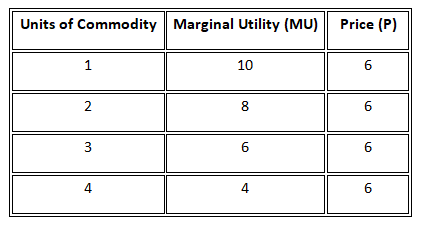
From the above schedule, the consumer will consume 3 units because at this level:
MU = Price = 6
2. A consumer consumes only two goods. Explain equilibrium with the help of utility approach.
Answer – When a consumer consumes two goods, equilibrium is achieved when he allocates his income between the two goods in such a way that he gets maximum satisfaction.
The condition of consumer equilibrium under utility approach is:
Mux/Px = MUy/Py
Where,
- MUx = Marginal Utility of Good X
- MUy = Marginal Utility of Good Y
- Px = Price of Good X
- Py = Price of Good Y
A consumer will continue to shift his expenditure from one good to another until the marginal utility per rupee spent on both goods becomes equal.
If:
Mux/Px ˃ MUy/Py
The consumer will buy more of Good X and less of Good Y.
If:
Mux/Px ˂ MUy/Py
The consumer will buy more of Good Y.
Therefore, equilibrium is achieved when:
Mux/Px = MUy/Py
3. Explain the conditions of consumer’s equilibrium in case of (i) single commodity and (ii) two commodities. Use utility approach.
(i) Single Commodity Case – In case of a single commodity, consumer equilibrium is achieved when:
1. Marginal Utility is equal to Price
MU = P
2. Marginal Utility should be decreasing – The marginal utility of the commodity must fall as more units are consumed.
(ii) Two Commodities Case
In case of two commodities, consumer equilibrium is achieved when:
a) Equality of Marginal Utility per Rupee
Mux/Px = MUy/Py
b) Consumer spends entire income
The consumer should spend his complete income on the two commodities. When these conditions are fulfilled, the consumer gets maximum satisfaction from his income.
4. A consumer consumes only two goods X and Y, both priced at Rs.2 per unit. If the consumer chooses a combination of the two goods with Marginal Rate of Substitution equal to 2, is the consumer in equilibrium? Why or why not? What will a rational consumer do in this situation? Explain.
Answer –
Given:
Price of X = Rs.2
Price of Y = Rs.2
Therefore,
Px/Py = 2/2 = 1
For consumer equilibrium under indifference curve approach:
MRSxy =Px / Py
Here,
MRSxy = 2
But
Px/Py = 1
Since,
MRSxy ≠ Px / Py
The consumer will substitute Good X for Good Y because he is willing to give up 2 units of Y for 1 unit of X, while the market requires giving up only 1 unit of Y.
A rational consumer will increase the consumption of X and decrease the consumption of Y until:
MRSxy = Px / Py
- Using indifference curves approach, explain the conditions of consumer’s equilibrium.
Answer – According to the indifference curve approach, consumer equilibrium is the point where the consumer obtains maximum satisfaction from his given income and prices.
The following conditions must be satisfied:
1. Tangency Condition
At equilibrium, the budget line must be tangent to the indifference curve.
MRSxy = Px / Py
Where,
- MRSxy = Marginal Rate of Substitution
- Px/Py = Ratio of prices of goods
2. Indifference Curve must be Convex to the Origin – The indifference curve should be convex because of the diminishing marginal rate of substitution. At the equilibrium point, the consumer cannot move to a higher indifference curve because it is not affordable with his given income.
6. A consumer only two goods X and Y whose prices are Rs.2 and Rs.1 per unit respectively. If the consumer choose a combination of the two goods with marginal utility of X being 4 and that of Y also being 4, is the consumer in equilibrium? Give reasons. Explain what will a rational consumer do in this situation? Use Marginal Utility Analysis
Answer: Consumer equilibrium under utility approach is achieved when marginal utility per rupee spent on each good is equal.
Condition of equilibrium:
Mux / Px = MUy / Py
Given:
Price of X = Rs.2
Price of Y = Rs.1
MU of X = 4
MU of Y = 4
Now,
Mux / Px = 4 / 2 = 2
MUy / Py = 4 / 1 = 4
Here,
Mux / Px ≠ MUy / Py
7. a) What is a budget line? What does the point on it indicate in terms of prices?
b)A consumer consumes only two goods X and Y. Her money income is Rs.24 and the prices of Goods X and Y are Rs.4 and Rs.2 respectively. Answer the following questions:
(i) Can the consumer affoard a bundle 4X and 5Y? Explain.
(ii) What will be the MRSxy when consumer is in equilibrium? Explain.
Answer: a) A budget line is a line that shows all possible combinations of two goods which a consumer can buy with his given income and prices of goods. It represents the purchasing power of the consumer. The points on the budget line show different combinations of goods which the consumer can afford.
The slope of the budget line shows the price ratio of two goods:
Px / Py
It indicates the rate at which one good can be exchanged for another in the market.
(b) Income = Rs.24, Price of X = Rs.4, Price of Y = Rs.2
(i) Can consumer afford 4X and 5Y?
Cost of 4 units of X:
= 4 × 4 = Rs.16
Cost of 5 units of Y:
= 5 × 2 = Rs.10
Total expenditure:
= Rs.16 + Rs.10 = Rs.26
Consumer’s income = Rs.24
(ii) What will be MRSxy at equilibrium?
At consumer equilibrium:
MRSxy = Px / Py
= 4/2 = 2
8. Explain the following: (a) Why is an indifference curve convex to the origin? (b) why does a higher indifference curve represent a higher level of satisfaction?
(b) Why does a higher indifference curve represent higher satisfaction?
A higher indifference curve represents a larger combination of goods. Since more goods provide more satisfaction, a higher indifference curve shows a higher level of satisfaction.
9. State and explain the characteristics of indifference curve.
Answer: The main characteristics of an indifference curve are:
a. It slopes downward from left to right – An indifference curve slopes downward because an increase in one good must be compensated by a decrease in another good to maintain the same satisfaction.
b. It is convex to the origin – It is convex because of diminishing marginal rate of substitution.
c. Higher indifference curve gives higher satisfaction – A higher indifference curve shows a greater quantity of goods and therefore provides more satisfaction.
d. Two indifference curves cannot intersect each other – Two curves cannot intersect because it would give an impossible result regarding consumer preferences.
e. Indifference curves do not touch the axes – A consumer is assumed to consume both goods, therefore indifference curves do not touch the axes.
10. What are monotonic preferences? Explain why is an indifference curve: (i) Downward sloping from left to right and; (ii) convex.
Answer –
Monotonic Preferences – Monotonic preferences mean that a consumer always prefers more quantity of goods rather than less quantity.\
(i) Why is an indifference curve downward sloping?
An indifference curve slopes downward because when the quantity of one good increases, the quantity of another good must decrease to keep satisfaction unchanged.
(ii) Why is an indifference curve convex?
An indifference curve is convex due to diminishing marginal rate of substitution. When a consumer gets more of one good, the importance of that good decreases and he is willing to sacrifice fewer units of the other good.
11. Explain the concepts of (i) marginal rate of substitution and (ii) budget line equation with the help of numerical examples.
Answer –
(i) Marginal Rate of Substitution (MRS)
Marginal Rate of Substitution refers to the rate at which a consumer is willing to sacrifice one good to obtain an additional unit of another good, while keeping the level of satisfaction constant.
MRS = Loss of Y / Gain of X
Example:
Suppose a consumer has 10 units of good Y and 2 units of good X. To get one more unit of X, he is ready to give up 3 units of Y.
MRS = 3Y / 1X = 3
(ii) Budget Line Equation
A budget line shows all possible combinations of two goods that a consumer can buy with his given income and prices of goods.
Equation of Budget Line:
Px / X + Py / Y = M
Where,
Px = Price of good X
Py = Price of good Y
X and Y = Quantity of goods
M = Consumer’s income
Example:
If income = Rs.100, price of X = Rs.10 and price of Y = Rs.5,
10X + 5Y = 100
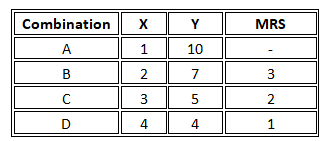
12. Explain the concept of Marginal Rate of Substitution and its behavior along the typical indifference curve. Give a numerical example. Also give reason for its behaviors.
Answer – Marginal Rate of Substitution (MRS) refers to the amount of one good that a consumer is willing to sacrifice for an additional unit of another good without changing his level of satisfaction.
Example:
13. A consumer consumes only two goods X and Y and is in equilibrium. Price of good X falls. Show that it will lead to rise in demand for good X.
Answer – When the price of good X falls, the consumer can buy more units of X with the same income.
Initially, the consumer is in equilibrium where:
MUX/PX = MUY/PY
MUX/PX > MUY/PY
The consumer will increase consumption of X because X gives more satisfaction per rupee. As more units of X are consumed, its marginal utility falls. The consumer will continue increasing consumption until:
MUX/PX = MUY/PY
14. A consumer consumes only two goods X and Y and is in equilibrium. Price of good Y rises. Show that it will lead fall in demand for good Y.
Answer – Initially, consumer equilibrium is:
MUX/PX = MUY/PY
When the price of Y rises, MUY/PY falls because PY increases.
Now:
MUX/PX > MUY/PY
The consumer will reduce consumption of Y and spend more income on X.
As consumption of Y falls, its marginal utility rises. The consumer will reach equilibrium when:
MUX/PX = MUY/PY
15. Explain the distinction between budget set and budget line. When can a budget line shift?
Answer –
Budget Set: Budget set refers to all possible combinations of two goods which a consumer can buy with his given income and prices.
Budget Line: Budget line shows only those combinations of goods where the consumer spends his entire income.
Difference:

Shift in Budget Line:
Budget line shifts when:
- Consumer’s income changes.
- Prices of goods change.
16. Show diagrammatically the conditions for consumer’s equilibrium in Hicksian analysis of demand.
Answer – According to Hicks, consumer equilibrium is achieved when the consumer reaches the highest possible indifference curve within his budget.
The conditions are:
1. MRS = Price Ratio
MRSxy = Px/Py
The rate at which the consumer substitutes one good for another must be equal to the market price ratio.
2. Indifference Curve must be Convex to Origin
The indifference curve should have diminishing MRS. At this point, the budget line touches the indifference curve. This point represents consumer equilibrium.
17. A consumer spends his entire income on two goods: X and Y. Currently his marginal rate of substitution (MRS) of X and Y is more than the price ratio of two goods. Discuss the changes that will take place so that consumer is able to reach the equilibrium position.
Answer –
18. Define budget line & indifference curve. Also explain why the two are downward sloping from left to right?
Answer –
Budget Line: A budget line shows all possible combinations of two goods which a consumer can purchase with his given income and prices.
Indifference Curve: An indifference curve shows different combinations of two goods that provide the same level of satisfaction to a consumer.
Reasons for Downward Slope:
- Budget Line: It is downward sloping because if a consumer buys more of one good, he must reduce the consumption of another good due to limited income.
- Indifference Curve: It is downward sloping because to increase consumption of one good, the consumer must sacrifice some quantity of another good to maintain the same satisfaction level.
19. A consumer, Mr. Aman is in state of equilibrium consuming two goods X and Y, with given prices Px and Py. Explain what will happen if: (a) Mux/Px is greater than MUy/Py; (b) Py falls.
(a) MUX/PX > MUY/PY
The consumer gets more satisfaction per rupee from good X.
Therefore, he will buy more X and reduce Y.
This process continues until:
MUX/PX = MUY/PY
Consumer reaches equilibrium.
(b) Py falls
When price of Y falls, MUY/PY increases.
Now Y provides more satisfaction per rupee.
20. Explain the Law of Equi-Marginal utility.
Answer – The Law of Equi-Marginal Utility states that a consumer gets maximum satisfaction when he spends his income on different goods in such a way that the marginal utility per rupee spent on each good is equal.
MUX/PX = MUY/PY
Example:
If a consumer buys goods X and Y, he will distribute his income until the satisfaction received from the last rupee spent on both goods becomes equal.
This law helps consumers achieve maximum satisfaction from limited income.
21. Suppose a consumer whose budget is Rs.500, wants to consume only two goods, Good X and Good Y. The goods are respectively priced at Rs.50 and Rs.25. Answer the following questions on the basis of the given information:
- State the budget equation of the consumer.
- What is the slope of the budget line?
- How many units can she purchase if she spends the entire Rs.500 on Good X?
- How many units can she purchase if she spends the entire Rs.500 on Good Y, given that the Price of good Y has doubled?
Answer –
a) Budget Equation – The budget equation shows all possible combinations of goods X and Y that a consumer can purchase with his given income.
Budget equation is:
PxX + PyY = M
50X + 25Y = 500
b) Slope of Budget Line – The slope of the budget line shows the rate at which one good can be substituted for another good.
Slope of budget line:
= -Px/Py
= -50/25
= -2
c) How many units can she purchase if she spends the entire Rs.500 on Good X?
When the consumer spends the whole income on Good X:
Number of units of X = Income / Price
- = 500 / 50
=10 units
d) How many units can she purchase if she spends the entire Rs.500 on Good Y, given that the price of Good Y has doubled?
Original price of Y = Rs.25
Price of Y after doubling:
25 × 2 = Rs.50
Number of units of Y = Income / New Price of Y
= 500/ 50
= 10 units
consumer equilibrium class 11 unsolved practical questions
consumer equilibrium class 11 numericals
UNSOLVED PRACTICAL
Practical’s on TU and MU
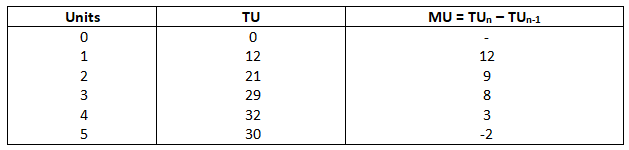
- A person’s total utility (TU) schedule is given below. Derive marginal utility (MU).

Solution –
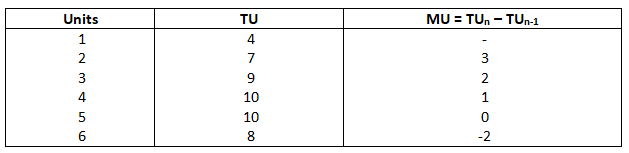
2. Derive MU from the total utility (TU) schedule given below:

Solution –
3. A person’s MU schedule is given below. Derive TU:
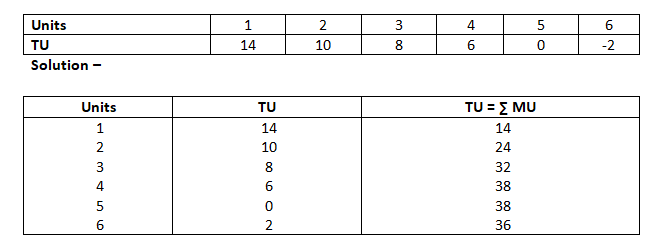
4. Calculate the missing figures.

Solution –
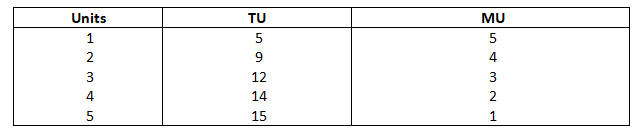
Practical’s on Consumer’s Equilibrium (Single Commodity)
5. Suppose price of a commodity ‘x’ is given as Rs.5 and the MU (in terms of money) for 4 units is given as:

How many units should a consumer purchase, so that his satisfaction is maximum?
Solution –

According to consumer’s equilibrium a consumer attains maximum satisfaction when MUx becomes equal to Px.
So, according to the question, a consumer attains maximum satisfaction when he consumer 3 units of good.
6. Following is the utility schedule of a consumer:

If the commodity is sold for Rs.5 and MU of one rupee is 2 utils. How many units will a consumer purchase to maximize his satisfaction?
Solution –
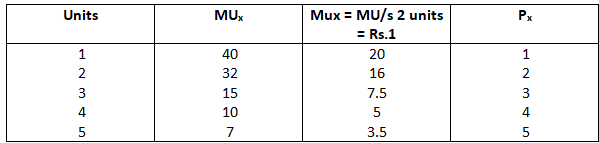
When a consumer is consuming 4 units of a product, he will get maximum satisfaction as at that point Mux is equal to Px.
Practicals on Consumer’s Equilibrium (Two Commodities)When a consumer is consuming 4 units of a product, he will get maximum satisfaction as at that point Mux is equal to Px.
Practicals on Consumer’s Equilibrium (Two Commodities)When a consumer is consuming 4 units of a product, he will get maximum satisfaction as at that point Mux is equal to Px.
Practicals on Consumer’s Equilibrium (Two Commodities)
7. The MU schedule for goods X and Y are given. Price of both the goods is Rs.1 each and the income of Ramesh (an individual) is assumed to be Rs.5. Determine, how many units of both the commodities should be purchased by Ramesh to maximize his total utility. What is the total amount of utility received by Ramesh at the point of equilibrium?
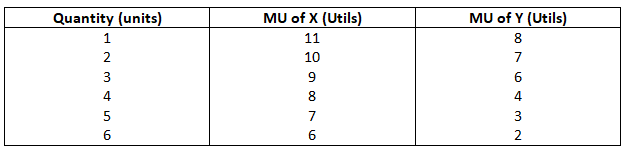
Solution – A consumer consuming two goods will be at equilibrium when.
Mux / Px = Muy / PY
MU falls as consumption increases
A consumer will get maximum satisfaction when he consumes: –
4 units of good X and 1 unit of, good Y.
- Total utility = 11 + 10 + 9 + 8 + 8
- = 46 utils.
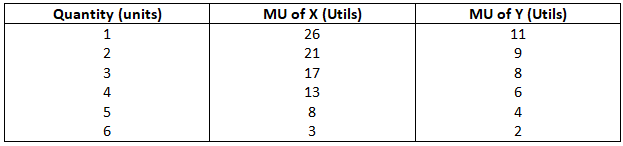
8. The marginal utility schedule for goods A and B are given. Price of both the goods is Rs.1 each and the income of Ms. Nidhi is assumed to be Rs.8. Determine, how many units of both the commodities should be purchased by Nidhi to maximize her total utility. Also, calculate the total utility at the point of equilibrium.
Solution –
Ms Nidhi will be at equilibrium when she is consuming –
5 units of good A and 3 units of good B
Total utility = 26 + 21 + 17 + 13 + 8 + 11 + 9 + 8 = 113 utils.
9. Suppose consumer can buy 5 units of good x and 4 units of good y, if he spends his entire income. The price of good x is Rs.10 and that of y is Rs.12. Calculate the income of the Consumer.
Solution –
To find : – Income of a consumer
He buys : –

So, income of a consumer = 50 + 48
= Rs.98
10. Amit wants to purchase two goods which are available in integer units only. If his income is Rs.40 and both the goods are priced at Rs.10 each, then write the bundles which cost exactly Rs.40.
Solution –
Let the 2 goods be A and B.
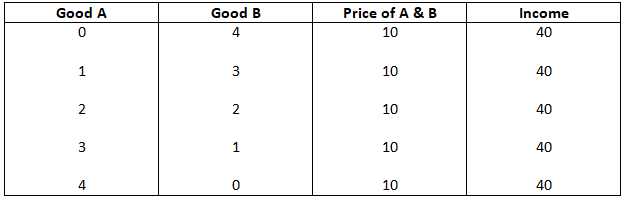
Bundles of (A, B) = (0, 4) (1, 3) (2, 2) (3, 1) (4, 0)
11. Suppose there are three bundles containing good 1 and good 2: Bundle (10, 10); Bundle (10, 9) and Bundle (7, 10). Which bundle will be preferred by the consumer, if he has monotonic preferences?
Solution –
Bundle (10,10) will be preferred by a consumer if he has Monotonic preference because this bundle contains more of both the Goods.
12. Manish is indifferent to the bundles (4, 7) and (4, 8). Indicat, whether Manish has monotonic preference or not?
Solution –
No, Manish did not have monotonic preference because if he had monotonic preference then he would have preferred bundle (4, 8) as it contains more of one good.
consumer equilibrium class 11 sandeep garg pdf