Meaning of Market –
Market refers to the whole region where buyers and sellers of a commodity are in contact with each other to effect the purchase and sale of the commodity.
Meaning and Basis for Classifying Market Structure
- Number of Buyers and Sellers – Number of buyers and sellers of a commodity in the market indicates the influence exercised by them on the price of the commodity.
- Nature of the Commodity – If the commodity is of homogeneous nature, i.e. identical in all respects, then it is sold at a uniform price. However, if the commodity is of differentiated nature (like different brands of toothpaste), then it may be sold at different prices.
- Freedom of Movement of firms – If there is freedom of entry and exit of firms, then the price will be stable in the market.
- Knowledge of Market Conditions – If buyers and sellers have perfect knowledge about the market conditions, then a uniform price prevails in the market. However, in case of imperfect knowledge, sellers are in a position to charge different prices.
- Mobility of Goods and Factors of Production – When the factors of production can move freely from one place to another, then a uniform price prevails in the market. However, in the case of immobility of goods and factors, different prices may prevail in the market.
Perfect Competition
Perfect competition refers to a market situation where there are very large number of buyers and sellers dealing in a homogeneous product at a price fixed by the market.
Example of Perfect Competition – In reality, perfect competition has never existed. The closest example we may have for such kind of market can be a market for agricultural goods (like wheat and rice). In the case of wheat, there are numbers buyers and sellers (farmers). As a result, no single buyer or seller can significantly affect the market price of wheat.
Features of Perfect Competition
- Very Large Number of Buyers and Sellers – In a perfectly competitive market, there are very large number of buyers and sellers. Implication of ‘Very large number of buyers & sellers’ is that the number of sellers is so large that the share of each seller is insignificant in the total supply. Hence, an individual seller cannot influence the market price.
- Homogeneous Product – The products offered for sale in the market are homogeneous, i.e., the product sold is identical in all respects like size, shape, quality, colour, etc. Implication of ‘Homogeneous product’ is that buyers treat the products as identical. Therefore, the buyers are willing to pay only the same price for the products of all the firms in the industry.
- Freedom of Entry and Exit – Every seller has the freedom to enter or exit the industry. There are no artificial or natural barriers to the entry of new firms and exit of existing firms. It ensures the absence of abnormal profits and abnormal losses in the long run.
- Perfect knowledge among buyers and sellers – Perfect knowledge means that both buyers and sellers are fully informed about the market price. Its implication is that no firm is in a position to charge a difference price and no buyer will pay higher price. As a result, uniform prices prevail in the market.
- Perfect Mobility of Factors of Production – The factors of production (land, labour, capital and entrepreneurship) are perfectly mobile. There is no geographical or occupational restriction on their movement. The factors are free to the industry in which they get the best price.
Perfect Competition and Pure competition
Perfect Competition is used in a wider sense as compared to Pure Competition. The competition is said to be ‘Pure Competition’ when the following 3 fundamental conditions exist:
- Very Large number of buyers and sellers;
- Homogeneous product;
- Freedom of entry and exit.
Perfect completion is a wider concept. For the market to be perfectly competitive, in addition to three fundamental conditions, four additional condition must be satisfied:
- Perfect Knowledge among buyers and sellers;
- Perfect mobility of factors of production;
- Absence of selling costs.
Firm is Price-taker – price taker means that an individual firm has no option but to sell at a price determined by the industry. Under perfect competition, an individual firm cannot influence the price on its own as its share in total market supply is negligible.
Demand curve under perfect competition
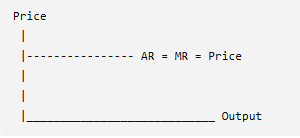
In the case of perfect competition, there are very large number of buyers and sellers selling a homogeneous product at a price fixed by the market. Therefore, each firm is a price-taker and faces a perfectly elastic demand curve.
MR = AR under perfect competition – In the perfectly competitive market, each firm is a price-taker. All the firms have to accept the same price as determined by market forces of demand and supply. As a result, uniform price prevails in the market. It means, that revenue from every additional unit (known as MR) us equal to the price (AR) of the product. So, MR = AR.
Introduction
The concepts of demand and supply help us to understand the motivations and actions of people in their roles as consumers and producers. However, these concepts are of limited use when they are taken separately. They become more useful when they are used together to explain the behavior of equilibrium in the market. So, a market consists of three elements:
- Demand, describing the behavior of consumers in the market.
- Supply, describing the behavior of firms in the market.
- Market Equilibrium, connecting demand and supply and describing how consumers and producers interact in the market.
Determination of Market Equilibrium Under Perfect Competition
As discussed before, perfect competition is a market structure where each firm is a price-taker and price is determined by the market forces of demand and supply. We know that equilibrium refers to a state of balance. It means, under perfect competition, market equilibrium is determined when market demand is equal to market supply.
Let us recall the concept of market demand and market supply:
- Market demand is the sum total of demand for a commodity by all the buyers in the market. Its curve slopes downwards due to the operation of the law of demand.
- Market supply is the sum total of supplies of a commodity by all the producers in the market. Its curve slopes upwards due to the operation of the law of supply.
Why any other price is not the Equilibrium Price?
- Any price above Rs.6 is not the equilibrium price as the resulting surplus, i.e. excess supply, would cause competition among sellers. In order to sell the excess stock, the price would come down to the equilibrium price of Rs.6.
- Any price below Rs.6 is also not the equilibrium price as due to excess demand, buyers would be ready to pay higher prices to meet demand. As a result, price would rise upto the equilibrium price of Rs.6.
Excess Demand – Excess demand refers to a situation when the quantity demanded is more than the quantity supplied at the prevailing market price. Under this situation, the market price is less than the equilibrium price. Excess demand occurs at prices market supply. Let us understand the concept of excess demand.
Excess Supply – Excess supply refers to a situation, where the quantity supplied is more than the quantity demanded at the prevailing market price. Under this situation, the market price is more than the equilibrium price. Excess supply occurs at prices of Rs.8 and Rs.10, when market supply is more than market demand. If market price is OP1 then market supply of OQ1 is more than market demand of OQ2. This situation is termed as excess supply.
Viable and Non-Viable Industry
Viable Industry – Viable industry refers to an industry for which supply curve and demand curve intersect each other in positive axes. In the viable industry, supply and demand curves must intersect at some positive point as shown in. As seen in the given diagram, both demand and supply curves intersect each other in the positive range of X-axis and Y-axis.
Non-viable Industry – Non-viable industry refers to an industry for which supply curve and demand curve never intersect each other in the positive axes. In a non-viable industry, the supply curve lies above the demand curve as price is too high for the consumers. It happens when the price, at which producers are ready to produce, is so high that consumers are not willing to buy even a single unit. As a result, the product is not produced.
Effects of Changes in Demand and Supply On Market Equilibrium in Short Run
As discussed, equilibrium price and equilibrium quantity are determined when the quantity demanded is equal to the quantity supplied. So, if there is any change which leads to a shift in either the demand curve or supply curve or both, then the equilibrium price and equilibrium quantity are bound to change. Demand and Supply, we studies the various reasons for the shift in the demand curve and supply curve. Let us first revise them before we proceed.
Change in Demand
Change in demand or shift in the demand curve occurs due to change in any of the factors that where assumed constant under the law of demand. The change may be either an ‘Increase in Demand’ or ‘Decrease in Demand’
- Increase in Demand – An increase in demand (assuming no change in supply) leads to a rightward shift in the demand curve from DD to D1D1.
- Decrease in Demand – In case of a decrease in demand (supply remaining unchanged), the demand curve shifts to the left from DD to D2D2. When demand decrease to D2D2, it creates an excess supply at the old equilibrium price of OP.
Change in Supply
Change in supply of shift in the supply curve occurs due to change in any of the factors that were assumed constant under the law of supply. The change may be either an ‘Increase in Supply’ or ‘Decrease in Supply’. Original Equilibrium is determined at point E when the demand curve DD and the original supply curve SS intersect each other.
- Increase in Supply – When there is an increase in supply, demand remaining unchanged, the supply curve shifts towards the right from SS to S1S1.
- Decrease in Supply – When the supply decreases, demand remaining unchanged and then the supply curve shifts to the left from SS to S2S2 as seen in. when supply decreases to S2S2, it creates as excess demand at the old equilibrium price of OP. This leads to competition among buyers, which raises the price. An increase in price leads to a rise in supply and a fall in demand. These changes continue till the new equilibrium is established at point E2. Equilibrium price rises form OP to OP2 and equilibrium quantity falls from OQ to OQ2.
Change in Bothe Demand and Supply
Demand and Supply model is very easy to use when there is a change in either demand or supply. However, in reality, there are a number of situation which lead to simultaneous changes in both demand and supply. To predict whether the equilibrium price and the equilibrium quantity rise or fall in such cases, we need to know the magnitude of changes in both demand and supply.
- Both Demand and Supply Decrease – original Equilibrium is determined at point E when the original demand curve DD and the original supply curve SS intersect each other. OQ is the equilibrium quantity and OP is the equilibrium price.
Case 1 – Decrease in Demand = Decrease in Supply
When a decrease in demand is proportionately equal to the decrease in supply, then the leftward shift in the demand curve from DD to D1D1 is proportionately equal to the leftward shift in the supply curve from SS to S1S1. The new equilibrium is determined at E1. As demand and supply decrease in the same proportion, the equilibrium price remains same at OP, but the equilibrium quantity falls from OQ to OQ1.
Case 2 – Decrease in Demand > Decrease in Supply
When a decrease in demand is proportionately more than the decrease in supply, then the leftward shift in the demand curve from DD to D1D1 is proportionately more than leftward shift in the supply curve from SS to S1S1. The new equilibrium is determined at E1, the equilibrium price falls from OP to OP1 and the equilibrium quantity falls from OQ to OQ1.
Case 3 – Decrease in Demand < Decrease in Supply
When a decrease in demand is proportionately less than the decrease in supply, then the leftward shift in the demand curve from DD to D1D1 is proportionately less than a leftward shift in the supply curve from SS to S1S1. The new equilibrium is determined at E1, the whereas, equilibrium quantity falls from OQ to OQ1.
(ii) Both Demand and Supply Increase – Original Equilibrium is determined at point E when the original demand curve DD and the original supply curve SS intersect each other. OQ is the equilibrium quantity and OP is the equilibrium price.
Case 1 – Increase in Demand = Increase in Supply
When an increase in demand is proportionately equal to the increase in supply, then a rightward shift in demand curve from DD to D1D1 is proportionately equal to a rightward shift in the supply curve from SS to S1S1. The new equilibrium is determined at E1. As both demand and supply increase in the same proportion, equilibrium price remains the same at OP, but equilibrium quantity rises from OQ to OQ1.
Case 2 – Increase in Demand > Increase in Supply
When an increase in demand is proportionately more than the increase in supply, then a rightward shift in demand curve from DD to D1D1 is proportionately more than a rightward shift in the supply curve from SS to S1S1. The new equilibrium is determined at E1, equilibrium price rises from OP to OP1 and equilibrium quantity rises from OQ to OQ1.
Case 3 – Increase in Demand < Increase in Supply
When increase in demand is proportionately less than increase in supply, then rightward shift in demand curve from DD to D1D1 is proportionately less than rightward shift in supply curve from SS to S1S1. The new equilibrium is determined at E1, equilibrium price falls from OP to OP1 whereas, equilibrium quantity rises from OQ to OQ1.
(iii) Demand Decrease and Supply Increase – The effect of a simultaneous decrease in demand and increase in supply on equilibrium price and equilibrium quantity is analysed in the in the following three cases:
Case 1 – Decrease in Demand = Increase in Supply
When a decrease in demand is proportionately equal to increase in supply, then the leftward shift in the demand curve from DD to D1D1 is proportionately equal to rightward shift in supply curve from SS to S1S1. The new equilibrium quantity remains the same at OQ, but equilibrium price falls from OP to OP1.
Case 2 – Decrease in Demand > Increase in Supply
When a decrease in demand is proportionately more than increase in supply, then the leftward shift in the demand curve from DD to D1D1 is proportionately more than the rightward shift in supply curve from SS to S1S1. The new equilibrium is determine at E1, equilibrium quantity fall from OQ to OQ1 and equilibrium price falls from OP to OP1.
Case 3 – Decrease in Demand < Increase in Supply
When a Decrease in demand is proportionately less than the increase in supply, then the leftward shift in the demand curve from DD to D1D1 is proportionately less than rightward shift in the supply curve from SS to S1S1. The new equilibrium is determined at E1, equilibrium quantity rises from OQ to OQ1 whereas, equilibrium price falls from OP to OP1.
(iv) Demand Increase and supply Decrease – The effect of an increase in demand and a decrease in supply on equilibrium price and equilibrium quantity is discussed in the following three cases:
Case 1 – Decrease in Demand = Increase in Supply
When an increase in demand is proportionately equal to a decrease in supply, then the rightward shift in the demand curve from DD to D1D1 is proportionately equal to the leftward shift in the supply curve from SS to S1S1. The new equilibrium is determined at E1. As the increase in demand is proportionately equal to the decrease in supply, equilibrium quantity remains the same at OQ, but equilibrium price rises from OP to OP1.
Case 2 – Increase in Demand > Decrease in Supply
When an increase in demand in proportionately more than the decrease in supply, then the rightward shift in the demand curve from DD to D1D1 is proportionately more than leftward shift in the supply curve from SS to S1S1. The new equilibrium is determined at E1. As the increase in demand is proportionately more than the decrease in supply, equilibrium quantity rises from OQ to OQ1 and equilibrium price rises from OP to OP1.
Case 3 – Decrease in Demand < Increase in Supply
When an increase in demand is proportionately less than decrease in supply, then the rightward shift in the demand curve from DD to D1D1 is proportionately less than a leftward shift in the supply curve from SS to S1S1. The new equilibrium is determined at E1. As the increase in demand is proportionately less than the decrease in supply, equilibrium quantity falls from OQ to OQ1 whereas, equilibrium price rise from OP to OP1.
Special Cases
(i) Change in Demand when supply is perfectly Elastic – When supply is perfectly elastic, then a change in demand does not affect the equilibrium price of the commodity. It only changes the equilibrium quantity. Original Equilibrium is determined at point E, when the original demand curve DD and the perfectly elastic supply curve SS intersect each other. OQ is the equilibrium quantity and OP is the equilibrium price.
- Increase in Demand – When demand increase, the demand curve shifts to the right from DD to D1D1. Supply curve SS is a horizontal straight curve SS is a horizontal straight line parallel to the X-axis. Due to the increase in demand for the product, the new equilibrium is established at E1. Equilibrium quantity rises from OQ to OQ1 but equilibrium price remains the same at OP as supply is perfectly elastic.
- Decrease in Demand – When demand decreases, the demand curve shifts to the left from DD to D2D2. Supply curve SS is a horizontal straight line parallel to the X-axis. Due to a decrease in demand, the new equilibrium is established at E2. Equilibrium quantity falls from OQ to OQ2 but equilibrium price remains the same at OP as supply is perfectly elastic.
(ii) Change in Supply when Demand is Perfectly Elastic – When demand is perfectly elastic, then a change in supply does not affect the equilibrium price of the commodity. It only changes the equilibrium quantity. Original Equilibrium is determined at point E when the perfectly elastic demand curve DD and the original supply curve SS interest each other. OQ is the equilibrium quantity and OP is the equilibrium price.
- Increase in Supply – When supply increases, the supply curve shifts to the right from SS to S1S1. Demand curve DD is a horizontal straight line parallel to the X-axis. Due to an increase in supply for the product, the new equilibrium is established at E1. Equilibrium quantity rises from OQ to OQ1 but equilibrium price remains the same at OP as demand is perfectly elastic.
- Decrease in Supply – When supply decreases, the supply curve shifts to the left from SS to S2S2. Demand curve DD is a horizontal straight line parallel to the X-axis. Due to a decrease in supply for the product, the new equilibrium is established at E2. Equilibrium quantity falls from OQ to OQ2 but equilibrium price remains the same at OP due to perfectly elastic demand.
(iii) Change in Demand when Supply is Perfectly Inelastic – when supply is perfectly inelastic, then a change in demand does not affect the equilibrium quantity. It only changes the equilibrium price. The change may be either an ‘Increase in Demand’ or ‘Decrease in Demand’.
- Increase in Demand – When demand increase, the demand curve shifts to the right from DD to D1D1. Supply curve SS is a vertical straight line parallel to the Y-axis. Due to the increase in demand for the product, the new equilibrium is established at E1. Equilibrium price rises from OP to OP1 but equilibrium quantity remains the same at OQ as supply is perfectly inelastic.
- Decrease in Demand – When demand decrease, the demand curve shifts to the left from DD to D2D2. Supply curve SS is a vertical straight line parallel to the Y-axis. Due to decrease in demand, the new equilibrium is established at E2. Equilibrium price falls from OP to OP2 but equilibrium quantity remains the same at OQ as the supply is perfectly inelastic.
(iv) Change in Supply when Demand is Perfectly Inelastic – When demand is perfectly inelastic, then a change in supply does not affect the equilibrium quantity. It only changes the equilibrium price. The change may be either an ‘Increase in Supply’ or ‘Decrease in Supply’.
- Increase in Supply – When supply increase, the supply curve shifts to the right from SS to S1S1. Demand curve DD is a vertical straight line parallel to the Y-axis. Due to the increase in supply for the product, the new equilibrium is established at point E1. Equilibrium price falls from OP to OP1 but equilibrium quantity remains the same at OQ as demand is perfectly inelastic.
- Decrease in Supply – When supply decrease, the supply curve shifty to the left from SS to S2S2. Demand curve DD is a vertical straight line parallel to the Y-axis. Due to a decrease in supply for the product, the new equilibrium is established at point E2. Equilibrium price rises from OP to OP2 but equilibrium quantity remains the same at OQ as demand is perfectly inelastic.
Simple application of Tools of Demand and Supply – Markets are rarely free from government interference. At times, the government has to intervene in the process of price determination when the equilibrium price so determined is either too high for the consumers or too low (i.e. unprofitable) for the producers of the commodity. Let us now discuss the two types of government interventions:
- Price Ceiling or Maximum Price Ceiling
- Price Floor or Minimum Support Price (MSP)
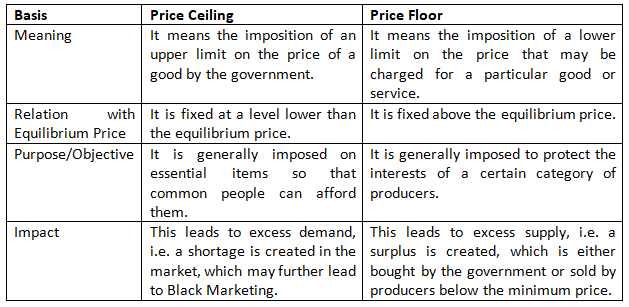
Price Ceiling Or Maximum Price ceiling – The government plays an important role in controlling the prices of essential commodities (wheat, sugar, kerosene, etc.) when the equilibrium price determined by free play of demand and supply in too high for the poor people. Price Ceiling refers to fixing the maximum price of a commodity at a level lower than the equilibrium price.
Need for Price Ceiling – It is generally imposed on essential items and is fixed below the equilibrium price or market determined price. The reason for the price ceiling is that the equilibrium price is too high for the common people to afford.
Consequences of Price Ceiling
- Black Marketing – Black Market is any market in which the commodities are sold at a price higher than the maximum price fixed by the government. Black marketing may be termed as direct consequence or implication of price ceiling as it implies a situation where the commodity under the government.
- Rationing System – To meet the excess demand, the government may also enforce the ‘Rationing System’.
- Rationing is a technique adopted by the government to sell a minimum quato of essential commodities at a price less than the equilibrium price to supply goods to the poor community at a cheaper price. Under the system, consumers are given ration cards / coupons to buy commodities at a cheaper price from ration shops.
- Difficulty in obtaining goods from ration shops – consumers have to stand in long to stand in long queues to buy goods from ration shops. Sometime, commodities are not available in the ration shops or goods are of inferior quality.
3. Dual Price Policy – Government may also allow a system of having two prices for the same product at the same time to avoid the situation of black marketing. Under this system, a fixed quantity of the product is supplied to consumers at a lower price through fair price shops and at the same time, the product is also made available in the open market at the market price determined by market forces of demand and supply.
Price Floor or Minimum Support Price (MSP)
The government also intervenes in the process of price determination through the Price Floor. Price Floor refers to the minimum price (above the equilibrium price), fixed by the government, which the producers must be paid for their produce. Price Floor or Minimum Price Ceiling refers to imposition of lower limit on the price that may be charged for a particular good or service.
Need for Price Floor – The need for price floor arises when the government finds that the equilibrium price is too low for the producers.
- Most well-known examples of imposition of Price Floor are agricultural price support programmes and minimum wage legislation.
- Indian Government maintains a variety of minimum support price programmes for various agricultural products like wheat, sugarcane, etc., and the floor is normally set at a level higher than the market determined price for these goods.
Difference between Price Ceiling and Price Floor
Short Answer Type Questions
- State any three characteristics of a perfectly competitive market.
Answer:
The three main characteristics of a perfectly competitive market are:
- Large number of buyers and sellers: There are a large number of firms and consumers in the market, so no single firm can influence the market price.
- Homogeneous product: All firms produce identical products. Therefore, buyers do not prefer the product of any particular firm.
- Free entry and exit of firms: Firms are free to enter or leave the market according to profit conditions.
2. “A firm under perfect competition is a price taker and the industry is a price maker”. Do you agree with the given statement? Support your answer with valid explanation.
Answer: Yes, the statement is correct. Under perfect competition, the industry is the price maker because the market forces of demand and supply determine the equilibrium price. A firm is a price taker because it has no control over the market price and has to accept the price determined by the industry. Each firm can sell any quantity at the given market price.
3. Explain the implications of ‘freedom of entry and exit of firms’ under perfect competition.
Answer: Freedom of entry and exit means that new firms can enter the market and existing firms can leave the market without any restriction.
Implications:
- In the long run, firms earn only normal profit.
- If firms earn abnormal profits, new firms enter the market, increasing supply and reducing price.
- If firms incur losses, some firms leave the market, reducing supply and increasing price.
4. Explain the implication of ‘homogeneous product’ feature of perfect competition.
Answer: Homogeneous product means that all firms produce identical products with the same quality, size and features.
Implications:
- Buyers do not differentiate between products of different firms.
- A single market price prevails in the market.
- No firm can charge a higher price than the market price.
5. Why is the average revenue curve of a firm under perfect competition parallel to X-axis?
Answer: Under perfect competition, a firm is a price taker and sells every unit of output at the same price. Since AR is constant, the AR curve is a horizontal straight line parallel to the X-axis.
AR = Price = Constant.
6. What is meant by a product being perfectly homogeneous? What is its implication for the price charged by producers in the market?
Answer: A perfectly homogeneous product means that the products of all firms are identical in terms of quality, size, colour and other features.
Implication:
All firms charge the same price because buyers cannot differentiate between the products of different firms.
7. Explain the implication of ‘perfect knowledge about market’ under perfect competition.
Answer: Perfect knowledge means that buyers and sellers have complete information about the market conditions, including price and quality of the product.
Implications:
- Buyers cannot be charged a higher price by any firm.
- A uniform price prevails in the market.
8. To what extent, can a firm influence the price under perfect competition?
Answer: A firm under perfect competition cannot influence the price. It is a price taker and has to accept the price determined by the industry through market demand and supply forces.
9. Explain the implication of large number of buyers in a perfectly competitive market.
Answer: Large number of buyers implies that each buyer purchases a very small quantity of the total market supply.
Implication:
No single buyer can influence the market price. Therefore, the price is determined by the forces of demand and supply.
10. Why can a firm not earn abnormal profits under perfect competition in the long run? Explain.
Answer: A firm cannot earn abnormal profits in the long run because of free entry and exit of firms.
- If firms earn abnormal profits, new firms enter the market, increasing supply and reducing price.
- This continues until firms earn only normal profit.
11. Identify the market form and explain the corresponding feature, as given in the following statement: “The commodity in this market has attributes which are identical for seller and buyers.”
Answer:
The market form is Perfect Competition.
The feature is homogeneous product. It means that the products of all firms are identical and buyers cannot differentiate between them.
12. There are no barriers in the way of firms leaving or joining industry in a perfectly competitive market. Explain the significance of this feature.
Answer:
This feature is known as freedom of entry and exit of firms.
Significance:
- It ensures that firms earn only normal profit in the long run.
- New firms enter when there are abnormal profits and firms leave when there are losses.
13. What difference does it make to the market when we say that there are large number of sellers in a perfectly competitive market? Explain.
Answer: Large number of sellers means that each firm supplies only a small part of the total market supply.
Implication:
- No individual seller can influence the market price.
- All firms are price takers and the price is determined by industry demand and supply.
Long Answer Type Questions
- Define perfect competition. Explain the various features of perfect competition.
Answer:
Perfect Competition: Perfect competition is a form of market structure where there are a large number of buyers and sellers, all firms sell homogeneous products, and no individual firm has control over the price of the product.
Features of Perfect Competition:
- Large number of buyers and sellers: There are a large number of buyers and sellers in the market. Each firm supplies only a small part of the total market supply. Therefore, no firm can influence the market price.
- Homogeneous product: All firms produce identical products in terms of quality, size, colour and other features. Buyers cannot differentiate between the products of different firms.
- Freedom of entry and exit: Firms are free to enter or leave the industry without any restriction. This ensures that firms earn only normal profit in the long run.
- Perfect knowledge: Buyers and sellers have complete knowledge about market conditions, price and quality of products. Therefore, a uniform price prevails in the market.
- Perfect mobility of factors of production: Factors of production like labour and capital can move freely from one firm to another.
- Uniform price: Due to homogeneous products and perfect knowledge, all firms charge the same price in the market.
2. Explain the implications of the following features of perfect competition: (a) large number of buyers and sellers; (b) freedom of entry and exit of firms.
Answer:
(a) Large number of buyers and sellers: Under perfect competition, there are a large number of buyers and sellers in the market.
Implications:
- Each firm supplies only a small portion of total market supply.
- No single firm can influence the market price.
- Each firm acts as a price taker.
- Market price is determined by the forces of demand and supply.
(b) Freedom of entry and exit of firms: Freedom of entry and exit means that firms can enter the industry when profits are high and leave the industry when they face losses.
Implications:
- If firms earn abnormal profits, new firms enter the market.
- Entry of new firms increases supply and reduces price.
- If firms incur losses, some firms leave the industry.
- Reduction in supply increases price and firms move towards normal profit.
3. Discuss the nature of the demand curve under perfect competition.
Answer:
Under perfect competition, a firm is a price taker and has to accept the price determined by the industry.
The demand curve of an individual firm is a horizontal straight line parallel to the X-axis.
Reasons:
- Uniform price: All firms sell the product at the same market price due to homogeneous products.
- No control over price: A single firm cannot increase or decrease the price because buyers can shift to other firms.
- Perfectly elastic demand: The firm can sell any quantity of output at the given market price.
4. Explain the outcome of the following features of a perfectly competitive market: (i) freedom for the firm to enter the industry; (ii) Freedom for the firm to leave the industry.
Answer –
(i) Freedom for the firm to enter the industry: When firms earn abnormal profits, new firms can freely enter the industry.
Outcome:
- Market supply increases.
- Price falls.
- Abnormal profits are reduced.
- In the long run, firms earn only normal profit.
(ii) Freedom for the firm to leave the industry: When firms face losses, they can freely leave the industry.
Outcome:
- Market supply decreases.
- Price increases.
- Losses are reduced.
- Remaining firms earn normal profit in the long run.
5. Explain the implications of the following in a perfectly competitive market; (a) perfect knowledge among buyers and sellers; (b) Homogeneous products.
Answer –
(a) Perfect knowledge among buyers and sellers: Perfect knowledge means that buyers and sellers have complete information about prices, quality and market conditions.
Implications:
- Buyers cannot be charged a higher price by any seller.
- Sellers cannot charge different prices for the same product.
- A uniform price exists in the market.
(b) Homogeneous products: Homogeneous products mean that products of all firms are identical in quality, size and features.
Implications:
- Buyers do not prefer the product of any particular firm.
- No firm can charge a price higher than the market price.
- All firms sell their products at the same price.