Meaning of Profit
Profit refers to the excess of receipts from the sale of goods over the expenditure incurred on producing them. The amount received from the sale of goods is known as ‘revenue’ and the expenditure on production of such goods is termed as ‘cost’. The difference between revenue and cost is known as ‘profit’. For example – if a firm sells goods for Rs.10 crores after incurring an expenditure of Rs.7 crores, then profit will be Rs.3 crores.
Producer’s Equilibrium
Producer’s Equilibrium refers to that price and output combination, which brings maximum profit to the producer and profit declines as more is produced.
There are two methods for determination of Producer’s Equilibrium:
- Total Revenue and Total Cost Approach (TR – TC Approach)
- Marginal Revenue and Marginal Cost Approach (MR – MC Approach).
Marginal Revenue – Marginal Cost Approach (MR – MC Approach)
According to MR-MC approach, producer’s equilibrium refers to stage of that output level at which:
- MC = MR – As long as MC is less than MR, it is profitable for the producer to go on producing more because it adds to its profits. The producer stops producing more only when MC becomes equal to MR.
- MC is greater than MR after MC = MR output level – When MC is greater than MR after equilibrium, it means producing more will lead to a decline in profits.
Producer’s Equilibrium (When Price remains Constant) – when price remains constant, firms can sell any quantity of output at the price fixed by the market. Price or AR remains the same at all levels of output. Also, the revenue from every additional unit (MR) is equal to AR. It means, AR curve is same as MR curve. Producer aims to produce that level of output at which MC is equal to AR. It means, AR curve is same as MR curve. Producer aims to produce that level of output at which MC is equal to MR and MC is greater than MR after MC = MR output level.
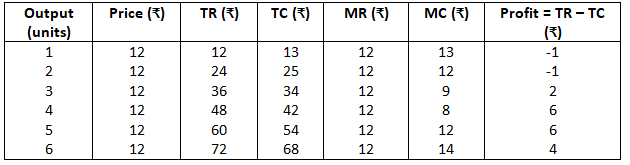
Relation between Price and MC at Equilibrium (When Price remains Constant) – When price remains same at all levels of output, then Price (or AR) = MR. As equilibrium is achieved when MC = MR, it means, price is equal to MC at the equilibrium level.
Producer’s Equilibrium (when Price falls with rise in output)
When there is no fixed price and price falls with a rise in output, MR curve slopes downwards. Producer aims to produce that level of output at which MC is equal to MR and MC curve cuts the MR curve from below.
Short Answer type Questions
- Explain producer’s equilibrium with the help of a diagram.
Answer – Producer’s equilibrium refers to the situation when a producer produces that level of output at which his profit is maximum.
According to the MR-MC approach, a producer is in equilibrium when:
- MR = MC
- MC curve cuts MR curve from below.
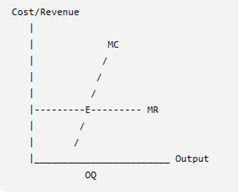
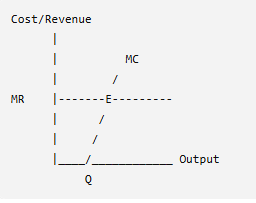
At point E, MC = MR and MC cuts MR from below. Therefore, output OQ is the equilibrium output.
2. “To achieve producer’s equilibrium, MC curve should cut the MR curve from below.” Defend or refute.
Answer – The statement is correct.
For producer’s equilibrium, equality between marginal revenue and marginal cost is necessary, but it is not sufficient. The MC curve must cut the MR curve from below.
The reason is that:
- Before equilibrium, MR > MC, so profit increases with increase in output.
- After equilibrium, MC > MR, so profit starts falling.
- At the point where MC = MR and MC cuts MR from below, profit is maximum.
3. “Producer is also not in equilibrium when marginal revenue is more than marginal cost”. Comment.
Answer – The statement is true.
When MR > MC, the producer can increase his profit by producing more units because the additional revenue is greater than the additional cost.
Therefore, the producer is not in equilibrium at this point.
Producer will continue increasing output until:
MR = MC and MC cuts MR from below.
Only then, maximum profit is achieved.
4. Explain the conditions of producer’s equilibrium with the help of numerical example.
Answer – The two conditions of producer’s equilibrium are:
- MR = MC
- MC curve should cut MR curve from below.
Numerical Example:
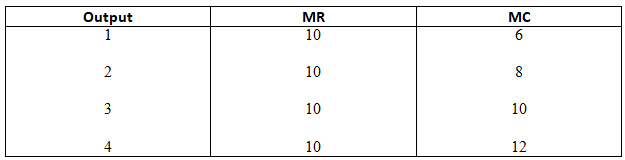
At output 3 units, MR = MC = 10.
Before 3 units, MR > MC and after 3 units, MC > MR. Therefore, output of 3 units is the equilibrium output.
Answer – Producer’s equilibrium is the situation in which a producer produces that level of output at which his profit is maximum. Merely producing output where MR = MC does not always ensure maximum profit. For maximum profit, the following condition must also be fulfilled: MC curve must cut MR curve from below. If MC cuts MR from above, profit will not be maximum because the producer can increase profit by changing output.
Long Answer Type Questions
- Explain the conditions of producer’s equilibrium with the help of a schedule, assuming that the producer can sell more at the same price.
Answer – Producer’s equilibrium refers to a situation when a producer gets maximum profit and has no tendency to change the level of output.
When a producer can sell more output at the same price, Price = MR = AR.
The producer is in equilibrium when:
- MR = MC
- MC curve cuts MR curve from below
Schedule:

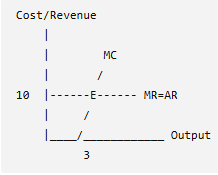
At 3 units of output, MR = MC = ₹10. After this level, MC becomes greater than MR, so profit starts falling. Therefore, the producer will produce 3 units.
2. What is producer’s equilibrium? Explain the conditions of producer’s equilibrium through the ‘marginal cost and marginal revenue’ approach. Use diagram.
Answer – Producer’s equilibrium is the point where a producer earns maximum profit and does not want to change his output.
According to MR and MC approach, the conditions of producer’s equilibrium are:
(i) MR = MC: A producer is in equilibrium when marginal revenue is equal to marginal cost.
(ii) MC should be rising after equilibrium: MC curve must cut MR curve from below, which means MC becomes greater than MR after equilibrium.
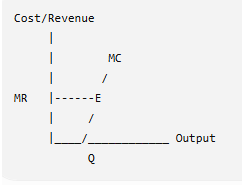
At output Q, MR = MC and MC is rising. Therefore, the producer earns maximum profit and is in equilibrium.
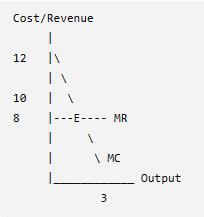
3. Explain the conditions of producer’s equilibrium with the help of a schedule, assuming that the producer can sell more only by lowering the price.
Answer – When a producer has to reduce the price to sell more units, MR falls with increase in output.
The producer’s equilibrium conditions are:
- MR = MC
- MC curve must cut MR curve from below
Schedule:

At 3 units, MR = MC = ₹8. After this point, MC becomes greater than MR, so profit decreases. Hence, the producer will produce 3 units.
4. Explain the conditions of producer’s equilibrium with the help of a numerical example. Use marginal cost and marginal revenue approach.
Answer – Producer’s equilibrium refers to a situation where a producer earns maximum profit and has no desire to change the level of output.
According to MC and MR approach, the conditions of producer’s equilibrium are:
- MR = MC
- MC curve must cut MR curve from below, which means MC should be rising after the equilibrium point.
Numerical Example:
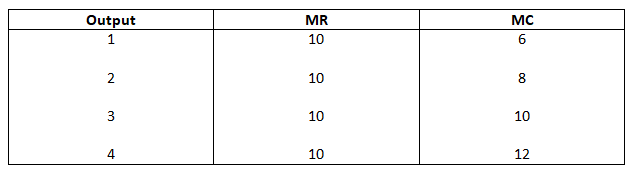
At 3 units of output, MR = MC = ₹10. After this level, MC becomes greater than MR. Therefore, production beyond 3 units will reduce profit.
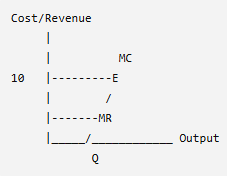
5. Explain the rationale behind the conditions of equilibrium of a producer.
Answer – The conditions of producer’s equilibrium are based on the following logic:
- MR = MC:
MR is greater than MC, producing an additional unit increases profit. Therefore, the producer will increase output.
MC is greater than MR, producing an additional unit reduces profit. Therefore, the producer will reduce output.
b. MC should cut MR from below: At the equilibrium point, MC should be increasing. If MC is falling, then producing more units can increase profit.
6. A producer is producing output at which MC = MR. However, if he produces more, then MC becomes less than MR. Is in equilibrium? Use diagram.
Answer – No, the producer is not in equilibrium.
The first condition of producer’s equilibrium is satisfied because:
MC = MR
But the second condition is not satisfied because after increasing output, MC becomes less than MR.
When MR > MC, the producer can increase profit by producing more units.
Unsolved Practicals
- From the following schedule, find out the level of output at which the producer is in equilibrium, using marginal cost and marginal revenue approach. Give reason for your answer.

Solution –

To attain equilibrium two conditions are required-
- MC = MR
- MC ˃ MR after MC = MR
According to given schedule producer is in equilibrium at 3 units of output as both the condition are fulfilled at this point.
2. The TR and TC values of a firm are given in the following schedule. Calculate MR and MC. Also determine the level of output, at which producer’s equilibrium is achieved?

Solution –
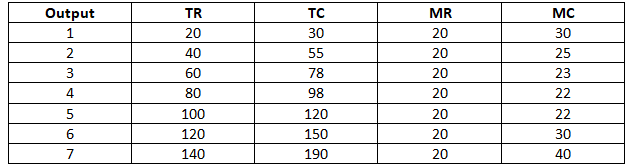
At output level of 4 units producer is equilibrium as at this place MR = MC and MC ˃ MR.
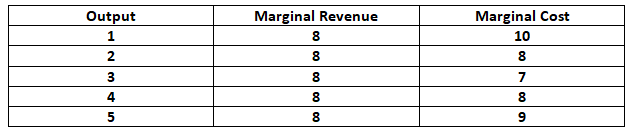
3. From the following table, find out the level of output at which the producer will be in equilibrium. Give reasons for your answer.
Solution –
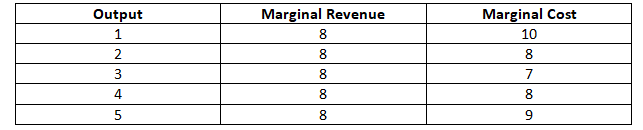
Producer is in equilibrium at 4 units of output as MC = MR and MC ˃ MR after MC = MR.
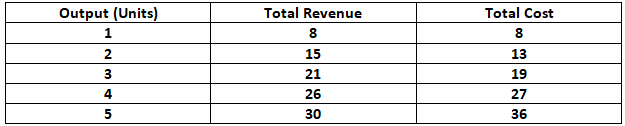
4. Give reason identify the equilibrium level of output and find and profit at this output using ‘Marginal cost and marginal Revenue’ approach from the following:
Solution –
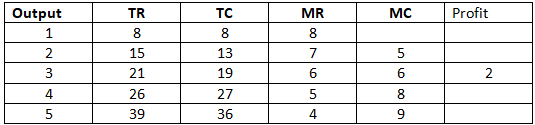
Producer is in equilibrium at 3 units of output as both the condition of equilibrium is fulfilled here.
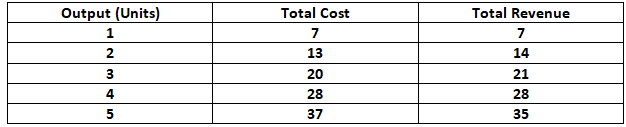
5. Giving reasons identify the equilibrium level of output and find profit at this output using ‘Marginal Cost and Marginal Revenue’ approach from the following:
Solution –
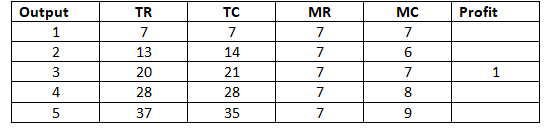
Producer is in equilibrium at 3 units of output as at this point ME = MR and MC ˃ MR after MC = MR.
6. From the following information about a firm, find the firm’s equilibrium output in terms of marginal cost and marginal revenue. Give reasons. Also find profit at this output.

Solution –
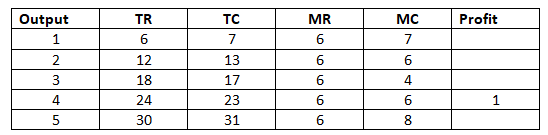
Producer is in equilibrium at 4 units of output as MC = MR and MC ˃ MR after becoming equal.
7. Giving reason find out the level of output at which producer will be in equilibrium. (Use marginal cost and marginal revenue approach).

Solution –

Producer is in equilibrium at 4 units of output as MC = MR and MC ˃ MR after this level output.
8. A producer can sell any quantity of a commodity a given price Rs.10 per unit. His cost schedule is given below:

How many units should he produce to get maximum profit? Explain.
Solution –
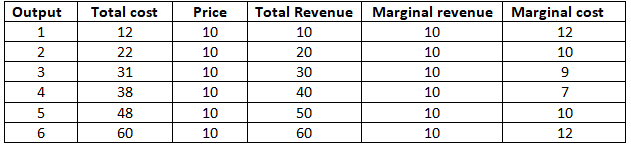
Producer is in equilibrium at 5 units of output as both the conditions of equilibrium are fulfilled here.
- MC = MR
- MC ˃ MR, after becoming equal to each other.
9. From the following information, determine the output level at which the producer will be in equilibrium

Solution –
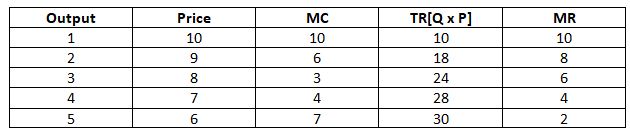
Producer is in equilibrium at 4 units of output as both the conditions of equilibrium are fulfilled here. i.e.,
- MC = MR and
- MC ˃ MR, after become equal to each other.
10. Give below is the cost schedule of a produced by a firm. The market price per unit of the product at all levels of output is Rs.12. Using marginal cost and marginal revenue approach, find out level of equilibrium output. Give reasons for your answer.

Solution –
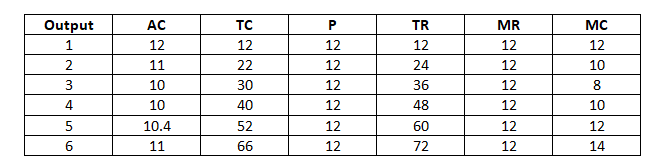
Producer is in equilibrium at 5 units of output as:
- MC = MR and
- MC ˃ MR after becoming equal to each other.
11. From the following total cost and total revenue schedule of a firm, find out the level of output, using marginal cost and marginal cost and marginal revenue approach, at which the firm would be in equilibrium. Give reasons for your answer.

Solution –
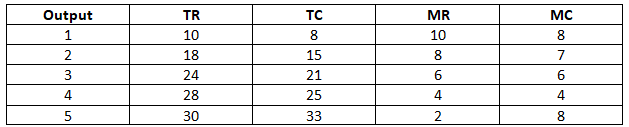
Producer is in equilibrium at 4 units of output as both the conditions to attain equilibrium is fulfilled there.
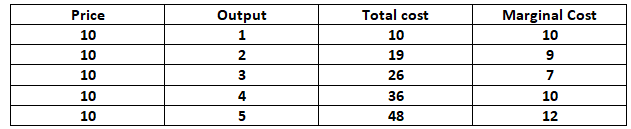
12. Identify the equilibrium level of output using “marginal cost and marginal revenue” approach. Give reasons
Solution –
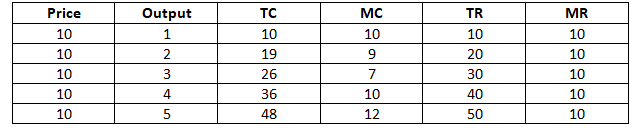
Producer is in equilibrium at 4 units of output as (i) MC = MR and (ii) MC ˃ MR after this point.
13. Given the following schedule, state at which level of output, will the firm be at equilibrium and why.

Solution –
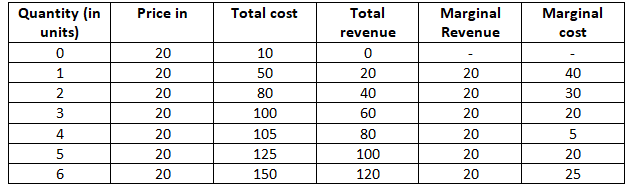
Firm will be at equilibrium at 5 units of output, as at this level :
- MC = MR
- MC ˃ MR, after MC becomes equal to MR.