MEANING OF ENVIRONMENT
Environment is defined as the total planetary inheritance and the totality of all resources.
- It includes all the biotic and abiotic factors that influence each other.
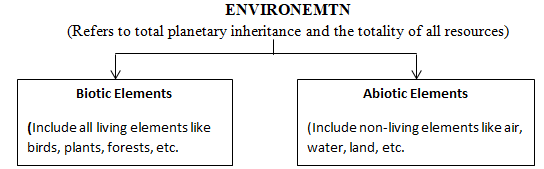
- Biotic Elements – Biotic elements include all living elements like birds, animals and plants, forests, fisheries, etc.
- Abiotic Elements – Abiotic elements include non-living elements like air, water, land, etc.
Functions of the Environment
The environment performs four vital functions:
- Provides resources for production – Environment supplies renewable and non-renewable resources.
- Renewable resources are those which can be used without the possibility of the resource becoming depleted or exhausted, like trees, fishes, etc.
- Non-renewable resources are those which get exhausted with extraction and use, like fossil fuel.
- The natural resources provided by the environment are used as inputs for production.
2. Environment assimilates waste – The process of production and consumption activities generates a lot of waste, which is absorbed by the environment.
3. Environment sustains life – Some basic necessities of life (sun, soil, water and air) are part of environment. So, environment sustains life by providing these essential elements.
4. It provides aesthetic services – Environment includes land, forests, water bodies, rainfall, air, atmosphere, etc. People enjoy the scenic beauty of these elements (like that of hill stations). Such elements help in improving the quality of life.
Reasons for Environmental Crisis
The various reasons for environmental crisis are summarized as under:
- The population explosion and advent of industrial revolution has increased the demand for environmental resources, but their supply is limited due to overuse and misuse.
- The intensive and extensive extraction of both renewable and non-renewable resources has exhausted some of the vital resources. Due to this, huge amount of money is spent on technology and research to explore new resources.
- Extinction of many resources and continuous rise in population have also resulted in an environmental crisis.
- Due to the affluent consumption and production standards of the developed world, the wastes generated are beyond the absorptive capacity of the environment.
- The development process has polluted the atmosphere and waters and there is a decline in air and water quality (70% of water in India is polluted).
Global Warming
Global warming is the observed and projected increase in the average temperature of earth’s atmosphere and oceans. During the past century, the atmospheric temperature has risen by 1.1F (0.6 C) and the sea level has risen several inches.
Causes of Global Warming
Among factors that may be contributing to global warming are:
- Burning of fossil fuels, like coal and petroleum products (sources of carbon dioxide, methane, nitrous oxide, ozone);
- Deforestation, which increases the amount of carbon dioxide in the atmosphere
- Methane gas released in animal waste; and
- Increased cattle production contributes to deforestation, methane production and the use of fossil fuels.
Main Harmful Effects of Global Warming
Global warming has adversely affected the earth:
- Melting of Ice – Ice is melting worldwide, especially at the earth’s poles. It has led to a steep rise in sea level and coastal flooding.
- Natural Disasters – Hurricanes and other tropical storms are likely to become stronger.
- Tropical Diseases – Global Warming has increased the incidence of tropical diseases, like malaria, cholera, dengue and chikungunya, etc.
- Effect on Animals – Thousands of species (like polar bears) are in danger of becoming extinct forever.
- Effect on Seasons – Global Warming has led to a led to a shift in thy cycle of seasons as summers are getting unusually longer than winters.
Ozone Depletion
Ozone depletion refers to the destruction of ozone in the ozone layer due to the presence of chlorine from manmade chlorofluorocarbons (CFCs) and other forces.
Cause of Ozone Depletion
The problem of ozone depletion is caused by high levels of chlorine and bromine compounds in the stratosphere. The origin of these compounds is:
- CFC, which is used as cooling substances in AC and refrigerators; or
- Aerosol propellants and Bromofluorocarbons (halons), which is used in fire extinguishers.
Montreal Protocol
As the ozone layer prevents most harmful wavelengths of ultraviolet light from passing through the earth’s atmosphere, its depletion has generated worldwide concern. It has led to adoption of the “Montreal Protocol”.
STATE OF INDIA’S ENVIRONMENT
India has abundant natural resources in terms of rich soil quality, hundreds of rivers and tributaries, lush green forests, plenty of mineral deposits, etc.
- The black soil of the Deccan Plateau is particularly suitable for cultivation of cotton, leading to concentration of textile industries in this region.
- The Indio-Genetic plains spread from the Arabian Sea to the Bay of Bengal are among the most fertile, intensively cultivated and densely populated regions in the world.
- India’s forests, though unevenly distributed, provide green cover for a majority of its population and natural cover for its wildlife.
- Large deposits of iron ore, coal and natural gas are found in the country. India alone accounts for nearly 20% of the world’s total iron ore reserves.
- Bauxite, copper, chromate, diamonds, gold, lead, lignite, manganese, zinc, uranium, etc. are also available in different parts of the country.
CHALLENGES TO INDIA’S ENVIRONMENT
- Land Degradation – Land degradation refers to a decline in the overall quality of soil, water or vegetation condition, commonly caused by human activities.
- It occurs through natural and man-made processes of wind erosion, water erosion and water logging.
- In India, land suffers from different types of degradation, mainly because of unstable use and inappropriate management practices.
Causes of Land Degradation –
Some of the factors responsible for land degradation are:
- Loss of vegetation due to deforestation.
- Overgrazing, i.e. grazing of natural pastures at stocking intensities above the livestock carrying capacity.
- Encroachment into forest lands and forest fire.
2. Degradation of Forests or Deforestation – Deforestation is defined as large scale cutting down of trees for executing developmental projects.
- Deforestation leads to loss of vegetation and biodiversity. Encroachment of forest land disturbs the natural habitat of various species of flora and fauna.
- Large-scale cutting down of trees leads to an increase in the amount of greenhouse gases such as carbon dioxide, methane, etc., in the atmosphere.
3. Soil Erosion – Soil erosion takes place when the surface soil is washed away through excessive rains and floods.
- Deforestation is one of the major reasons for soil erosions.
- As per the estimates, the soil is being eroded at a rate of 5>3 billion tonnes a year, which is in excess of the recharge capacity.
4. Biodiversity Loss – Biodiversity is a term used to describe the enormous variety of life on Earth, i.e., it refers to every living thing, including plants, bacteria, animals, and humans.
- Scientists have estimated that are around 8.7 million species of plants & animals in existence. However, only around 1.2 million species have been identified and described so far, most of which are insects. This means that millions of other organisation remain a complete mystery.
- Conservation and sustainable use of biodiversity is fundamental to ecologically sustainable development.
5. Water Pollution – When toxic substances enters, streams and other water bodies and dissolve or become suspended in water, it leads to water pollution. Water pollution degrades the quality of water and has led to the death of several animals and posed a serious threat to human life.
6. Air Pollution – Air pollution is the presence of pollutants like smoke, dust particles, etc., in air in such concentrations, which are harmful to man and the environment.
- In India, air pollution is widespread in urban areas where vehicles are the major contributors, and in a few other areas, which have a high concentration of industries and thermal power plants.
- Vehicular emissions are of particular concern as these are ground level sources and have the maximum impact on the general population.
Some ways to control air pollution
Air pollution causes health problems and also damage to the environment and property.
- Promotion of cleaner fuels in vehicles, like the use of CNG instead of petrol and diesel.
- Use of cleaner fuels such as LPG in households to reduce indoor air pollution.
Pollution Control Boards
In order to address water and air pollution in India, the government set up the Central Pollution control board (CPCB) in 1974. This was followed by states establishing their own state-level boards to address all the environmental concerns.
Main Functions of Pollution Control Boards
- They investigate, collect and disseminate information relation to water, air and land pollution, lay down standards for sewage/trade effluent and emissions.
- These boards provide technical assistance to government in promoting cleanliness of streams and wells by prevention, control and abatement of water and air pollution is the country.
- These boards also carry out and sponsor investigation and research, relating to problems of water and air pollution and for their prevention, control or abatement.
- They also organise, through mass media, a comprehensive mass awareness programme for the same.
SUSTAINABLE DEVELOPMENT
Sustainable Development refers to the development process that meets the needs of present generation without compromising on the ability of the future generations to meet their respective needs.
- The basic aim of sustainable development is to ensure that the present generation should leave a stock of ‘quality of life’ for the next generation, which is no less than what we have inherited.
- Environmentalists have used the term’ sustainability’ in an attempt to clarify the desired balance between economic growth on one hand & environmental preservation on the other.
- For economists, a development path is sustainable, if the stock of overall capital assets remains constant or rises over time.
Sustainable Development aims:
- Sustainable and equitable use of resources, to meet the needs of the present and future generations, without causing damage to environment;
- To prevent further damage to our life-support systems;
- To conserve and nurture biodiversity and other resources for long-term food security.
How to Achieve Sustainable Development?
Sustainable development can be achieved, if we strictly follow the five given rules:
- Restrict use of renewable resources.
- Substitute non-renewable with renewable resources.
- Become Input Efficient.
- Control Pollution.
- Control the growth of population.
Strategies for Sustainable Development
Sustainable development will not only save the present generation from the high opportunity cost of negative environmental impact, but will serve the interest of the future generation also.
The following strategies need to be adopted to achieve sustainable development:
- Use of Non-conventional sources of energy – India is hugely dependent on thermal and hydropower plants to meet its power needs. But, both these sources have adverse environmental impacts.
- Non-conventional sources like wind power and solar rays are cleaner and greener energy sources, but have not yet been explored on a large-scale due to a lack of technological devices.
- In areas with high wind speeds, windmills can provide electricity without any adverse impact on the environment.
2. Use of Cleaner Fuels –
- In Urban areas, the use of Compressed Natural Gas (CNG) is being promoted to be used as fuel. In Delhi, the use of CNG in public transport has significantly lowered air pollution.
- In Rural areas, households generally use wood, dung cake or other biomass as fuel. These fuels have several adverse implications like deforestation, reduction in green cover, wastage of cattle dung and air pollution.
3. Establishment of Mini-Hydel Plants – In mountainous regions, perpetual (or perennial) steams can be found almost everywhere.
- These streams can be used to generate electricity electricity (via turbines) through Mini-hydel plants.
- Such power plants are more or less environment-friendly and generate enough power to meet local demands.
4. Traditional Knowledge and Practices – Traditionally, Indian people have been close to their environment. All practices relating to the agriculture system, healthcare system, housing, transport, etc., used to be environment friendly.
- The shift from the traditional systems has caused large-scale damage to the environment and to our rural heritage.
- For example, India is well known for its Ayurveda, Yoga and Naturopathy, Unani, Siddha and Homeopathy (AYUSH) treatment with about 15,000 species of plants, which have medicinal properties.
5. Use of Bio-compost – The use of chemical fertilizers to increase agricultural production has not only adversely affected the large areas of productive land but also contaminated the water bodies. The use of chemical fertilizers has led to: (i) contamination of soil; (ii) Contamination of groundwater.
- Due to the use of chemical fertilizers, demand for irrigation has been going up year after year.
- With the rise in demand for organic food, farmers have again started using Bio-compost, i.e., compost made from organic wastes of different types. Bio-composting refers to the process of converting organic waste of various types into natural manure.
6. Control of Biopest – The advent of green revolution has increase the use of chemical pesticides, which not only contaminates the food products, but also pollutes the water bodies.
- To meet this challenge, better methods of pest control are promoted. The following traditional practices can help in controlling contamination without the use of chemical fertilizers:
- Mixed cropping and growing different crops in consecutive years on the same land have also helped farmers.
7. Change in unsustainable patterns of consumption and production – With increasing purchasing power, wasteful consumption, linked to market-driven consumerism, is stressing the resource base of developing countries further.
Short Answer Type Questions
- State the various causes of land degradation.
Ans. The main causes of land degradation are deforestation, overgrazing, mining, excessive use of chemical fertilisers and pesticides, and improper irrigation practices.
2. What do you mean by sustainable development? What does it aim to ensure?
Ans. Sustainable development means development that meets the needs of the present generation without harming the ability of future generations to meet their needs. It aims to ensure economic growth along with environmental protection and conservation of resources.
3. Briefly discuss the concept of air pollution.
Ans. Air pollution refers to the contamination of air due to harmful gases, smoke, dust and other pollutants released from industries, vehicles and other sources. It affects human health and the environment.
4. How does poverty lead to degradation of environment?
Ans. Poverty forces people to depend heavily on natural resources for their survival. Excessive use of forests, land and water resources leads to environmental degradation.
5. Enumerate some of the ways to control air pollution.
Ans. Air pollution can be controlled by using cleaner fuels, reducing industrial emissions, promoting public transport, planting more trees and following pollution control measures.
6. State the functions of pollution control boards.
Ans. Pollution control boards are responsible for controlling and preventing pollution. They set pollution standards, monitor pollution levels, and take measures to protect the environment.
7. State the strategies needed to achieve sustainable development.
Ans. The main strategies for sustainable development are conservation of natural resources, use of renewable resources, controlling pollution, and promoting eco-friendly technologies.
8. Discuss in brief, the meaning of ozone depletion.
Ans. Ozone depletion refers to the thinning of the ozone layer in the atmosphere due to harmful chemicals like CFCs. It increases the entry of harmful ultraviolet rays on the Earth.
9. What is deforestation? Mention its adverse effects.
Ans. Deforestation means the large-scale cutting of forests for various purposes. It causes soil erosion, loss of biodiversity, climate change, and disturbance in the ecological balance.
10. State and discuss any two environmental concerns faced by India in the present tiems.
Ans. Two major environmental concerns faced by India are:
(i) Air Pollution: It is caused by industries, vehicles and burning of fuels, affecting health and environment.
(ii) Water Pollution: It occurs due to discharge of waste into water bodies, making water unsafe for use.
11. State and discuss any two principle causes of environmental degradation.
Ans. The two main causes of environmental degradation are:
(i) Industrialisation: Industries release harmful pollutants and waste materials.
(ii) Deforestation: Cutting of forests leads to loss of biodiversity and ecological imbalance.
12. State and discuss any one strategy involved in attaining sustainable development in India.
Ans. One important strategy for sustainable development is the use of renewable resources like solar and wind energy. It helps in reducing pollution and conserving natural resources for future generations.
13. Comment upon the following statement: Traditional knowledge and practices are still applicable in ensuring sustainable development.
Ans. Traditional knowledge and practices help in sustainable development as they promote the efficient use and conservation of natural resources. Practices like organic farming, rainwater harvesting and use of natural resources help in maintaining ecological balance.
14. Explain how the Bio-composting can be helpful in achieving the objectives of sustainable development.
Ans. Bio-composting converts organic waste into useful manure. It reduces the use of chemical fertilisers, improves soil fertility and helps in maintaining environmental balance.
15. Explain how the opportunity costs of negative environment impacts are high.
Ans. The opportunity cost of environmental degradation is high because it reduces the availability of natural resources and affects future generations. The loss of biodiversity, health problems and depletion of resources involve high social and economic costs.
16. State any two harmful effects of Global Warming.
Ans. Two harmful effects of global warming are:
(i) Rise in sea level due to melting of glaciers.
(ii) Increase in extreme weather events like floods and droughts.
17. Explain briefly any two function of the environment.
Ans. Two important functions of the environment are:
(i) Supply of resources: Environment provides resources like land, water, minerals and forests.
(ii) Assimilation of waste: Environment absorbs and decomposes waste generated by human activities.
18. Explain absorptive capacity of environment with example.
Ans. Absorptive capacity refers to the ability of the environment to absorb and decompose waste without causing damage. For example, a limited amount of biodegradable waste can be naturally decomposed by the environment.
Long Answer Type Questions
- Discuss the various reasons for environment crisis.
Ans. Environment crisis is mainly caused by rapid population growth, industrialisation, urbanisation and excessive use of natural resources. Increasing pollution, deforestation and over-exploitation of resources have disturbed the ecological balance. The limited absorptive capacity of the environment has also contributed to this crisis.
2. What is meant by sustainable development? Discuss briefly any two strategies of sustainable development.
Ans. Sustainable development refers to development that satisfies the needs of the present generation without compromising the ability of future generations to meet their needs.
Two strategies of sustainable development are:
(i) Use of renewable resources: Resources like solar and wind energy should be used to reduce pressure on non-renewable resources.
(ii) Control of pollution: Adoption of cleaner technologies and proper waste management helps in protecting the environment.
3. What do you mean by global warming? Why does it occur? How can it adversely affect the earth?
Ans. Global warming refers to the increase in the average temperature of the Earth due to the excessive emission of greenhouse gases like carbon dioxide and methane. It occurs mainly due to burning of fossil fuels, deforestation and industrial activities. It adversely affects the Earth by causing melting of glaciers, rise in sea level, climate changes and extreme weather conditions.
4. Discuss the five rules, which should be followed to achieve sustainable development.
Ans. The five rules to achieve sustainable development are:
(i) Reduce the use of natural resources.
(ii) Use renewable resources efficiently.
(iii) Control pollution and waste generation.
(iv) Promote recycling and reuse of resources.
(v) Protect biodiversity and maintain ecological balance.
5. “India’s environmental problems are both poverty induced as well as the consequence of affluence”. Comment.
Ans. India’s environmental problems are caused by both poverty and affluence. Poverty leads to excessive dependence on natural resources, causing deforestation and land degradation. On the other hand, affluence results in increased consumption, industrialisation and pollution, which also harm the environment.
6. What is meant by environment? Briefly discuss its various functions.
Ans. Environment refers to the surroundings in which living organisms exist and interact. It includes natural resources, living organisms and physical conditions.
The main functions of environment are:
(i) Provides resources: It supplies resources like land, water, minerals and forests.
(ii) Assimilates waste: It absorbs and decomposes waste produced by human activities.
(iii) Supports life: It provides suitable conditions for survival of living organisms.
(iv) Provides aesthetic services: It offers natural beauty and recreational benefits.
7. Write short notes on: (i) Global Warming; (ii) Ozone Depletion.
Ans.
(i) Global Warming: Global warming refers to the rise in the average temperature of the Earth due to increased greenhouse gases. It results in climate change, melting of glaciers and rise in sea level.
(ii) Ozone Depletion: Ozone depletion refers to the reduction in the thickness of the ozone layer due to chemicals like CFCs. It allows harmful ultraviolet rays to reach the Earth and causes health and environmental problems.