liberalisation privatisation and globalisation an appraisal class 12 notes
liberalisation privatisation and globalisation an appraisal class 12
chapter 3 indian economy class 12 pdf
REASONS FOR ECONOMIC REFORMS
The economic condition of India in the year 1991 was very miserable. It was due to the cumulative effect of number of reasons. Let us discuss the various reasons, which aroused the need for making major economic reforms in the country:
- Poor Performance of Public Sector: In the 40 years period (1951-90), public sector was assigned and important role to work for the economic development of India. However, except for few public enterprises, the overall performance was very disappointing. Considering the huge losses incurred by a good number of public sector enterprise, the Government recognized the need for making necessary reforms.
- Deficit in Balance of Payments (BOP): Deficit in BOP arises when foreign payments for imports exceed foreign receipt from exports. Even after imposing heavy tariffs and fixing quotas, there was a sharp rise in imports.
- Inflationary Pressures: There was a consistent rise in the general price level in the economy due to increase in money supply and shortage of essential goods.
- Fall in Foreign Exchange Reserves: Foreign Exchange Reserve (also termed as Forex. Reserves or FX Reserves) are external assets (like convertible foreign currencies, Gold, Special Drawing Rights, etc.) held by the Central Bank for direct financing of external payments imbalances.
- Huge Burden of Debts: The expenditure of the government was much higher than revenue. As a result, government had to borrow money from banks, public and international financial institutions.
- Inefficient Management: The origin of the financial crisis can be traced from the inefficient management of the Indian economy.
liberalisation privatisation and globalisation an appraisal class 12 handwritten notes
liberalisation, privatisation and globalisation class 12 notes
THE NEW ECONOMIC POLICY
The New Economic Policy (NEP) was announced in July 1991. It consisted of wide range of economic reforms. The main aim of the policy was to create a more competitive environment in the economy and remove the barriers to entry and growth of firms.
The New Economic Policy can be broadly classified in two kinds of measures:
- Stabilization Measures: They refer to short-term measures which aim at:
- Correcting weaknesses of the balance of payments by maintaining sufficient foreign exchange reserves; and
- Controlling inflation by keeping rising prices under control.
2. Structural Reform Measures: They refer to long-term measures which aim at:
- Improving the efficiency of the economy; and
- Increasing international competitiveness by removing the rigidities in various segments of the Indian economy.
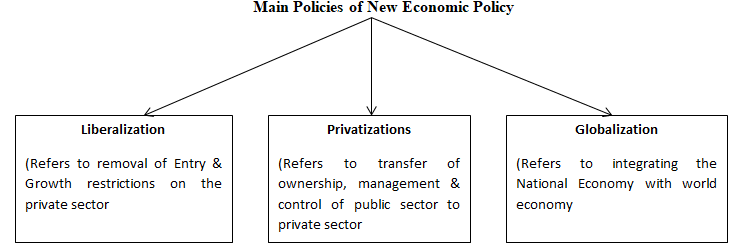
- LIBERALIZATION – In July 1991, a package of economic reforms was announced, which marked the beginning of process of ‘Liberalization’ in India. Liberalization means removal of entry and growth restrictions on the private sector.
The purpose of liberalization was:
- To unlock the economic potential of the country by encouraging private sector and multinational corporations to invest and expand; and
- To introduce much more competition into the economy and create incentives for increasing efficiency of operations.
The economic reforms taken by the Government under liberalization include the following
- Industrial Sector Reforms
- Foreign Exchange Reforms
- Financial Sector Reforms
- Trade and Investment Policy Reforms
- Tax Reforms
(i) Industrial Sector Reforms – The various measures under industrial policy reforms include.
a. Reduction in Industrial Licensing: The new policy abolished industrial licensing for all the projects, except for 18 industries. This number was further reduced to 5 industries.
They are:
- Distillation and brewing of alcoholic drinks;
- Cigars and cigarettes of tobacco and manufactured tobacco substitutes;
- Electronic Aerospace and defence equipment’s;
- Industrial explosives;
- Specified Hazardous chemicals.
b. Decrease in role of Public Sector: One of the striking features was the substantive reduction in the role of the public sector in the future industrial development of the country.
c. De-reservation under small-scale industries: Many goods produced by small scale industries were de-reserved. In many industries, the market was allowed to determine the prices through forces of the market (any not by directive policy of the government.
d. Monopolies and Restrictive Trade Practices ( MRTP) Act: With the introduction of liberalization and expansion schemes, the requirement for large companies, to seek prior approval expansion, establishment of new undertakings, merger, amalgamations, etc.
(ii) Financial Sector Reforms – Financial sector includes financial institutions like commercial banks, investment banks, stock exchange operations and foreign exchange market. The financial sector in India is controlled by the Central Bank – Reserve Bank of India (RBI).
The reforms introduced under financial sector are:
- Change in the Role of RBI: The role of RBI was reduced from regulator to facilitator of financial sector. As a result, financial sector was allowed to take decisions on many matters, without consulting the RBI.
- Origin of Private Banks: The reform policies led to the establishment of private sector banks, Indian as well as foreign. For example, Indian banks like ICICI and foreign banks like HSBC increased the competition and benefitted the consumers through lower interest rates and better services.
- Increase in limit of Foreign investment: The limit of foreign investment in banks was raised to around 74%. Foreign Institutional Investors (FII) such as merchant bankers, mutual funds and pension funds were now allowed to invest in financial markets.
- Ease in Expansion Process: Banks were given freedom to set up new branches (after fulfillment of certain conditions) without the approval of the RBI.
(iii) Tax Reforms – Tax reforms refer to reforms in governments’ taxation and public expenditure policies, which are collectively known as its ‘fiscal policy’.
Taxes are of two types:
- Direct Taxes: Consist of taxes on incomes of individuals as well as profits of business enterprises. For example – Income tax (taxes on individual incomes) and Corporate tax (taxes on profits of companies.
- Indirect Taxes: Refer to those taxes which affect the income and property of persons through their consumption expenditure. Indirect taxes are generally imposed on goods and services. For Example – Goods and Services tax (GST).
The major Tax Reforms made are:
- Rationalization of Direct Taxes: Since 1991, there has been a continuous reduction in income and corporate tax as high tax rates were an important reason for tax evasion.
- Reforms in Indirect Taxes: Considerable reforms have been made in indirect taxes to facilitate the establishment of a common national market for goods and commodities.
- Simplification of Process: In order to encourage better compliance on the part of taxpayers, many procedures have been simplified.
(iv) Foreign Exchange Reforms
The important reforms made in the foraging exchange market are:
- Devaluation of Rubin the value refers to deliberate reduction in the value of domestic currency vis – a- vis any foreign currency by the government of a country.
- Market Determination of Exchange Rate: The Government allowed rupee value to be free from its control. As a result, market forces of demand and supply determine the exchange value of the Indian rupee in terms of foreign currency.
(v) Trade and Investment Policy Reforms – Before 1991, a lot of restrictions (high tariffs and quotas) were imposed on imports to protect domestic industries. However, this protection reduced the efficiency and competitiveness of domestic industries and led to their slow growth.
The important trade and investment policy reforms include:
- Removal of Quantitative restrictions on imports and Exports: Under the New Economic Policy, quantitative restrictions on imports and exports were greatly reduced. For example- Quantitative restrictions on imports of manufactured consumer goods and agricultural products were fully removed from April 2001.
- Removal of Export Duties: Export duties were removed to increase the competitive position of Indian goods in the international markets.
- Reduction in import Duties: Import duties were considerably reduced, which improved the competitiveness of domestic industries by enabling them to import raw materials at better prices.
- Relaxation in Import Licensing System: The Import licensing was abolished, except in case of hazardous and environmentally sensitive industries.
2. PRIVATIZATION – Privatization refers to shedding of the ownership or management of a government owned enterprise. privatization implies greater role of the private sector in the economic activities of the country. Over the years, Indian Government has diluted its stake in several public enterprises, including IPCL, IBP, Maruti Udyog, etc.
Privatization can be done in two ways:
- Transfer of ownership and management of public sector companies from the government to the Private Sector;
- Disinvestment: privatizations of the public sector undertakings (PSU) by selling off part of the equity of PSUs to the public. This process is known as disinvestment.
3. GLOBALIZATION – Globalization means integrating the national economic with the world economy through removal of barriers on international trade and capitasl movements.
- Globalization generally means as integration of the economy of the country with the world economy.
- However, it is a complex phenomenon. It is an outcome of the set of various policies that aim to transform the world towards greater interdependence and integration. Globalization is indeed an outcome of the liberalization of an economy. Reduction of restrictions in the industrial sector, financial sector, trade and investment policy, etc. opened the doors of the Indian economy to the rest of the world.
Changes made by Globalization of the Indian Economy
- The New Economic Policy prepared a specified list of high technology and high investment priority industries, in which automatic permission will be available for foreign direct investment up to 51 per cent of foreign equity.
- In respect of foreign technology agreements, automatic permission is provided in high priority industries upto a sum of rupees 1 crore. No permission is now required for hiring foreign technician or for testing indigenously development technology abroad.
- In order to make international adjustment of Indian currency, rupee was devalued in July 1991 by nearly 20 per cent. It stimulated export, discouraged imports and raised the influx of foreign capital.
- To integrate Indian economy with world, the Union Budget 1992-93 made Indian rupee partially convertible and then the rupee was made fully convertible in 1993-94 budget.
Positive and Negative Traits of Globalization
The process of globalization through liberalization and privatization policies has produced positive as well as negative results, both for Indian and other countries.
In Favor of Globalization
Globalization resulted in:
- Greater access to global markets;
- Advanced technology;
- Better future prospects for large industries of developing countries to become important players in the international arena.
- Better prospects for skilled people across the globe to increase their earnings by utilizing their skills.
Against Globalization
Globalization has been criticized by some scholars because according to them:
- Benefits of globalization accrue more to developed countries as they are able to expand their markets in other countries.
- Globalization compromises the welfare and identity of people belonging to poor countries.
- Market-driven globalization increases the economic disparities among nations and people.
- As a result of globalization, MNCs have gained a strong position in developing countries, due to which domestic companies are forced to face stiff competition.
Outsourcing – Outsourcing refers to hiring business services from external sources, mostly from other countries, which were previously provided internally or from within the country. These services include legal advice, computer service advertisement, security, etc.
- Outsourcing is one of the important outcomes of the globalization process. Outsourcing is emerging as a major activity in industrial and service sectors.
- It has intensified in recent times because of the growth of fast modes of communication, particularly the growth of information Technology (IT).
India has become a favorable destination for outsourcing for most of the MNC’s because of:
- Availability of Skilled Manpower: Indian has vast skilled manpower which enhances the faith of MNCs for investment in India.
- Favorable Government Policies: MNCs get various types of lucrative offers from the Indian Government such as tax holidays, tax concessions, etc.
- Low Wages Rates and availability of cheap labour in Indian for Skilled work.
- Considerable growth of the Indian IT industry, which has proved its competitive strength in the world.
liberalisation, privatisation and globalisation class 12 question answer
World Trade Organization (WTO)
Origin of World Trade Organization (WTO) – Prior to WTO, General Agreement on Tariffs and Trade (GATT) was established as global trade organization, in 1948 with 23 countries. GATT was set up to administer all multilateral trade agreements by providing equal opportunities to all countries in the international market. WTO was founded in 1995 as the successor organization to the GATT. The WTO agreements cover trade in goods as well as services, to facilitate international trade. At present, there are 164 member countries of WTO and all members are required to abide by laws and policies framed under WTO rules. As an important member of WTO, India has been at the forefront of framing fair global rules, regulations and advocating the interests of the developing world. India has kept its commitments made to the WTO. India has taken reasonable steps to liberalize trade by removing quantitative restrictions on imports and reducing tariff rates.
Some Major Functions of WTO:
- To facilitate international trade (both bilateral and multilateral trade) through removal of tariff as well as non-tariff barriers;
- To establish a rule-based trading regime, in which nations cannot place arbitrary restrictions on trade;
- To enlarge production and trade of services;
- To ensure optimum utilization of world resources; and
- To protect the environment.
Should India be a member of WTO?
Some scholars are of the view that there is no use for a developing country like indian to be a member of the WTO. According to them:
- Major volume of international trade occurs among the developed nations; and
- Developing countries are being cheated as they are forced to open up their markets for developed countries and are not allowed access to markets of developed countries.
Arguments in Favour of Economic Reforms
The following are some of the important arguments advanced in favour of economic reforms:
- Increase in rate of Economic Growth: the growth in GDP was 5.6% during 1980-91 as compared to growth rate of 6.7% in 2017-18. During the reform period, the growth of agricultural has declined and industrial sector reported fluctuation, whereas, growth of services sector has gone up. This indicates that the growth is mainly driven by the growth in the serviced sector.
- Inflow of Foreign Investment: The opening up of the economy has led to a rapid increase in foreign direct investment (FDI).
- Rise in Foreign Exchange Reserves: There has been an increase in the foreign exchange reserve from about US $ 6 billion in 1990-91 to about US $ 413 billion in 2018-19.
- Rise in Exports: Since 1991, India has experienced a considerable increase in exports of auto parts, pharmaceutical goods, engineering goods, IT software and textiles.
- Control on inflation: Increase in production, tax reforms helped in controlling the inflation.
Criticism of Economic Reforms
- Growing Unemployment: Though the GDP growth rate has increased in the reform period, but such growth failed to generate sufficient employment opportunities in the country.
2. Neglect of Agriculture: The new economic policy has neglected the agricultural sector as compared to industry, trade and services sector.
- Reduction of public investment
- Removed of subsidy
- Liberalization and reduction in import duties
- Shift towards cash crops
3. Low level of Industrial Growth: Industrial growth recorded a slowdown do the following reasons:
- Cheaper Imported Goods
- Lack of infrastructure facilities
- Non-tariff barriers by Developed countries
4. Ineffective Disinvestment Policy: The government has always fixed a target for disinvestment of public sector enterprises (PSEs). The aim of the disinvestment was to boost financial discipline and modernization. However, according to some scholars, the disinvestment policy of government was not successful because:
- The assets of PSEs were undervalued and sold to the private sector, which resulted in significant losses to the government.
- Moreover, such proceeds from disinvestment were used to compensate shortage of government revenues rather than using it for the development of PSEs and building social infrastructure in the country.
5. Ineffective Tax Policy: The tax reduction in the reform period was done to generate larger revenue and to curb tax evasion. But, it did not result in increase in tax revenue for the government.
- Tariff reduction decreased the scope of revenue raising through customs duties.
- Tax incentives provided to foreign investors to attract foreign investment further reduced the scope for raising tax revenues.
liberalisation privatisation and globalisation class 12 sandeep garg
DEMONETISATION
On the 8th of November, 2016, the Government of India made an announcement with profound implications for Indian economy. It was decided to demonetize high value currency notes of denomination of Rs.500 and Rs.1,000 with immediate effect, ceasing to be legal tender, except for a few specified purposes. Demonetization is the act of removing a currency unite of its status as Legal Tender.
Features of Demonetization
- Demonetization is viewed as a ‘Tax Administration Measure’. Cash holdings arising from declared income were readily deposited in banks and exchanged for new notes.
- Demonetization is also interpreted as a shift on the part of government, indicating that Tax Evasion will no longer be tolerated or accepted.
- Demonetization also led to channelizing savings into the formal financial system’s Though, much of the cash deposited in the banking system is bound to be withdrawn.
GOODS AND SERVICES TAX (GST)
GST or “Goods and Services Tax” is a comprehensive Indirect Tax that tax has replaced many Indirect Taxes in India. The Goods and Services Tax Act was passed in the Parliament on 29th March, 2017. The Act came into effect on 1st July, 2017. It is a comprehensive, multi-stage, destination-based tax that is levied on every value addition. GST has been identified as one of the most important tax reforms post-independence.
Types of Taxes under GST
The types of taxes levied under GST are:
- Central Goods and Services Tax (CGST): It is the GST levied on the ‘Intra-State’ supply of goods or services by the Centre.
- State Goods and Services Tax (SGST): It is the GST levied on the ‘Intra-State’ supply of goods or services by the State (including Union Territories with legislature).
- Integrated Goods and Services Tax (IGST): It is the GST levied on the ‘Inter-State’ supply of goods or services and is collected by the Centre. IGST is equivalent to the sum total of CGST and SGST.
Some Facts about GST
- Single Tax Structure: GST aims to subsume multiple taxes into one single tax across the country and make goods uniformly priced across India.
- Effect on Prices: With the implementation of GST, luxury goods have become costlier, while items of mass consumption have become cheaper.
- Consumption Based Tax: GST is a ‘Consumption Based Tax’, i.e. the tax is received by the state in which the goods or services are consumed and not by the state in which such goods are manufactured.
- Invoice Matching: The Indian GST will have a mechanism for matching invoices. Input Tax Credit of purchased services and goods will be available only when the inward supply details filed in by buyer matches the outward supplies details filed in by supplier.
- Anti-Profiteering Measure: It is one of the key features of the recently implemented GST law.
- Registration under GST: A business whose aggregate turnover in a financial year exceeds Rs.20 lakhs has to compulsorily register under Goods and Services Tax. This limit is set at Rs.10 lakhs for North Eastern and hilly states flagged as special category states.
Key Features of GST
- Applicability of GST: The territorial spread of GST is the whole country.
- Applicable on Supply of Goods and Services: GST is applicable on the ‘supply’ of goods or services as opposed to the earlier concept of tax on the manufacture or sale of goods or on the provision of services.
- Consumption Based Tax: It is based on the principle of destination-based consumption tax against the earlier principle of origin-based taxation.
- GST on Imports: Import of goods and services is treated as inter-State supplies and would be subject to IGST in addition to the applicable customs duties.
- GST Rates: CGST, SGST and IGST are levied at rates mutually agreed upon by the Center and the States under the aegis of the GST Council. There are four tax slabs namely 5%, 12%, 18% and 28% for all goods or services. Exports and supplies to SEZ are zero-rated.
Short Answer Type Questions
- Mention any three causes, which were responsible for the economic reforms.
Ans. The main causes responsible for introducing economic reforms in 1991 were:
- Economic crisis – India faced a serious balance of payments crisis and shortage of foreign exchange.
- High fiscal deficit – Government expenditure was much higher than its income, creating financial problems.
- Low economic growth and inefficiency – The economy was suffering from slow growth, outdated technology, and inefficient industries.
2. Briefly discuss the two kinds of measures, in which new economic policy can be classified.
Ans. The New Economic Policy (1991) was classified into two types of measures:
- Stabilization measures – These were short-term measures aimed at controlling inflation, reducing the budget deficit, and improving the balance of payments situation.
- Structural reform measures – These were long-term measures aimed at improving the efficiency and competitiveness of the economy through liberalization, privatization, and globalization.
3. Name the three principle features of the New Economic Policy.
Ans. The three main features of the New Economic Policy were:
- Liberalization
- Privatization
- Globalization
4. What was the purpose of liberalization?
Ans. The purpose of liberalization was to remove unnecessary government restrictions and controls on economic activities and allow private enterprises to operate freely. It aimed to increase competition, efficiency, and economic growth.
5. State the economic reforms taken by the Government under liberalization.
Ans. The major reforms under liberalization were:
- Removal of industrial licensing (except for a few industries).
- Reduction of government control over private businesses.
- Freedom to import and export goods with fewer restrictions.
- Reduction in import duties and tariffs.
- Encouragement of foreign investment.
- Simplification of rules and regulations for businesses.
6. What are the important reforms introduced in the foreign exchange market?
Ans.
• Devaluation of Indian Rupee.
• Introduction of market-based exchange rate system.
• Making rupee convertible on current account.
• Replacement of FERA by FEMA.
7. State and discuss any two major ‘Tax Reforms’ taken under the New Economic Policy of 1991.
Ans.
1. Reduction in Tax Rates:
• Tax rates were reduced to encourage savings and investment.
2. Simplification of Tax Structure:
• Tax system was made simple and transparent.
8. The process of globalization has produced positive as well as negative results.” Comment.
Ans.
Positive Effects:
• Increase in foreign investment.
• Better technology and quality products.
Negative Effects:
• Small producers faced competition.
• Benefits were not equally distributed.
9. Discuss the concept of outsourcing. Name some of the services, which are being outsourced to India by the developed countries.
Ans.
• Outsourcing means getting services from another country to reduce cost and improve efficiency.
• India provides services like:
- Call centres
- Software services
- Data entry
- Accounting services
10. Mention the major functions of World Trade Organisation.
Ans.
• Promotes international trade.
• Removes trade barriers.
• Settles trade disputes.
• Implements trade agreements.
• Provides a platform for trade negotiations.
11. What is meant by privatization? What are the two ways in which privatization can be done?
Ans.
Privatization means transfer of ownership or management of public sector enterprises to the private sector.
Two ways:
- Disinvestment – Selling shares of public enterprises.
- Transfer of ownership – Complete sale of government enterprises.
12. State the impact of demonetization on interest rates, private wealth and real estate.
Ans.
• Interest Rates: Increased deposits led to a fall in interest rates.
• Private Wealth: Unaccounted money became useless.
• Real Estate: Demand and prices declined due to less cash transactions.
13. Write a short note on GST Council.
Ans.
• GST Council was formed under the GST Act.
• It is headed by the Union Finance Minister.
• It decides GST rates, rules and regulations.
• It includes representatives of Central and State governments.
14. State the feature of Demonetization.
Ans.
• Withdrawal of old currency notes from circulation.
• Introduction of new currency notes.
• Aim was to control black money and corruption.
• Promoted digital payments and formal banking.
15. Critically appraise the disinvestment policy initiated by the government during the reforms of 1991.
Ans.
Positive Effects:
• Increased government revenue.
• Improved efficiency of public enterprises.
Negative Effects:
• Loss of government control.
• Fear of unemployment among workers.
16. Discuss any two liberallisation measures pertaining to the financial sector, introduced by the Government of India during the economic reform process of 1991.
Ans.
- Banking Sector Reforms:
• Reduced government control over banks and improved efficiency. - Capital Market Reforms:
• SEBI was strengthened to regulate the stock market.
17. “Some economics believe that the economic reforms have adversely affected the agriculture sector in India.” Do you agree with the given statement? Justify your answer with valid reason.
Ans.
Yes, economic reforms affected agriculture negatively due to:
• Reduction in government investment in agriculture.
• Increase in cost of agricultural inputs.
• Increased competition due to imports.
• Slow growth of agricultural sector.
18. The policy of liberalization changed the role of Reserve Bank of India (RBI) from a regulator ‘to’ a facilitator’ in the financial sector. Defend or refute the given statement with valid arguments.
Ans.
• RBI reduced direct control over banks.
• Banks were given more freedom in decision-making.
• RBI focused on maintaining financial stability.
• It promoted competition and efficiency in the banking sector.
19. “India is often called as ‘Outsourcing Hub’ of the world.” State and discuss the prime reasons for this name given to India.
Ans.
India is called an outsourcing hub because of:
• Availability of skilled and educated labour.
• Low cost of services.
• Use of advanced technology.
• Large English-speaking population.
20. State and discuss any two reasons for the poor performance of industrial sector in the reforms period.
Ans.
• Slow growth of demand for industrial goods.
• Increased competition from foreign companies.
• Lack of infrastructure facilities.
• Decline in investment in some industries.
21. ‘Globalisation is an essential outcome of liberalization of an economy’. Justify the given statement with a valid explanation.
Ans.
• Liberalization removes restrictions on trade and investment.
• It allows foreign companies to enter domestic markets.
• It increases international trade and investment.
• Hence, globalization becomes possible.
22. “Trade and Investment Policy of India had undergone comprehensive changes in the post reforms period of 1991.” Do you agree with the given statement? Justify your answer with any two valid arguments.
Ans.
• Import restrictions were reduced.
• Foreign investment was encouraged.
• Trade barriers and tariffs were lowered.
• India became more connected with the global economy.
Long Answer Type Questions
- Discuss the various reasons for making economic reforms.
Answer: The Indian economy faced a serious economic crisis in 1991. The government introduced economic reforms to overcome these problems and improve the efficiency of the economy.
The major reasons for introducing economic reforms were:
- Balance of Payment Crisis: During 1991, India faced a severe balance of payment crisis. The foreign exchange reserves declined sharply and the country found it difficult to finance its imports.
- High Fiscal Deficit: Government expenditure increased continuously, while revenue was not sufficient. This resulted in a high fiscal deficit and increased financial burden on the economy.
- Poor Performance of Public Sector: Many public sector enterprises were running in losses and were unable to achieve the desired level of efficiency. Reforms were required to improve their performance.
- Low Rate of Economic Growth: The Indian economy was growing at a slow rate due to excessive government controls and restrictions. Reforms were introduced to promote faster economic growth.
- Need for Foreign Investment: India required foreign capital and advanced technology for industrial development. Therefore, policies were introduced to encourage foreign investment.
- Discuss the industrial sector reforms introduced under the new economic policy.
2. Discuss the industrial sector reforms introduced under the new economic policy.
Answer: The industrial sector reforms were introduced in 1991 under the New Economic Policy to increase industrial efficiency, promote competition and reduce unnecessary government control.
Major Industrial Sector Reforms:
- Abolition of Industrial Licensing: Most industries were freed from the requirement of obtaining industrial licenses. This reduced government interference and encouraged private investment.
- Reduction in Public Sector Role: The number of industries reserved exclusively for the public sector was reduced. Private sector participation was encouraged.
- Disinvestment Policy: The government started selling a part of its ownership in public sector enterprises to improve efficiency and financial performance.
- Freedom to Private Sector: Private companies were given more opportunities to establish and expand industries.
- Foreign Direct Investment (FDI): Foreign investment was encouraged to bring capital, modern technology and managerial skills.
- Removal of MRTP Restrictions: Restrictions on large industrial houses were reduced to promote expansion and competition.
3. Explain in brief, the liberalization reforms introduced in the financial sector.
Answer: Financial sector reforms were introduced to improve the efficiency of banks and financial institutions and to make the financial system more competitive.
Major Financial Sector Reforms:
- Change in Role of RBI: The role of the Reserve Bank of India changed from a regulator to a facilitator. It allowed financial institutions to take decisions independently.
- Banking Sector Reforms: Steps were taken to improve the performance and efficiency of commercial banks.
- Entry of Private Banks: Private sector banks were allowed to operate, which increased competition in the banking sector.
- Interest Rate Reforms: Interest rates were gradually deregulated and allowed to be determined by market forces.
- Capital Market Reforms: The capital market was improved by strengthening SEBI and increasing transparency.
4. What do you understand by the term ‘Globalisation’? Mention any 4 changes made by the globalization of the Indian economy.
Answer: Globalisation refers to the process of integration of the Indian economy with the world economy through trade, investment, technology and exchange of services.
Changes due to Globalisation:
- Increase in Foreign Investment: Foreign companies were encouraged to invest in India, which increased capital inflow.
- Entry of Multinational Companies (MNCs): Many international companies started their operations in India.
- Growth in Foreign Trade: Restrictions on imports and exports were reduced, increasing international trade.
- Transfer of Technology: Globalisation helped India to receive advanced technology and modern production methods.
5. Discuss the trade and investment policy reforms introduced under the new economic policy.
Answer: Trade and investment policy reforms were introduced in 1991 to increase international trade and attract foreign investment.
Major Trade and Investment Reforms:
- Removal of Trade Restrictions: Restrictions on imports and exports were reduced to promote free trade.
- Reduction in Import Duties: Import tariffs were lowered to encourage international competition.
- Promotion of Exports: Various measures were taken to increase exports and earn foreign exchange.
- Encouragement of Foreign Investment: Foreign Direct Investment (FDI) was allowed in many sectors to attract foreign capital.
- Integration with World Economy: India adopted policies to become a part of the global market.
6. Explain the arguments in favour of new economic policy.
Answer: The New Economic Policy (NEP) was introduced in India in 1991. It aimed at improving the efficiency of the economy through Liberalisation, Privatisation and Globalisation (LPG). The policy received support due to its positive effects on the Indian economy.
Arguments in favour of New Economic Policy:
- Increase in Economic Growth: Economic reforms helped in increasing the growth rate of the Indian economy by encouraging investment and improving productivity.
- Improvement in Efficiency: Liberalisation increased competition among firms, which encouraged industries to improve quality and reduce costs.
- Increase in Foreign Investment: The policy attracted Foreign Direct Investment (FDI), which brought capital, technology and managerial skills to India.
- Growth of Private Sector: Privatisation encouraged private sector participation and reduced the burden on the government.
- Development of Modern Technology: Globalisation helped India to access advanced technology and modern production techniques.
- Expansion of International Trade: Trade reforms increased exports and helped India become more connected with the global economy.
7. Explain in brief, the various points of criticism of economic reforms.
Answer: Although economic reforms brought many changes in the Indian economy, they were also criticised for certain negative effects.
Points of Criticism:
- Neglect of Agriculture Sector:
Critics argue that economic reforms focused more on industry and services, while agriculture did not receive adequate attention. - Increase in Unemployment: Some sectors faced job losses due to increased competition and restructuring of industries.
- Growth of Inequality: The benefits of reforms were not equally distributed among all sections of society, leading to increased income inequality.
- Dependence on Foreign Countries: Increased foreign investment and imports created concerns about dependence on the global economy.
- Pressure on Small Industries: Small-scale industries faced difficulties due to competition from large domestic and multinational companies.
Social Sector Neglect: Critics believe that areas like education, health and poverty reduction did not receive sufficient attention
8. State the features of Goods and Services Tax (GST).
Answer: Goods and Services Tax (GST) is an indirect tax introduced in India on 1 July 2017. It replaced many indirect taxes and created a common national market.
Features of GST:
- One Nation, One Tax: GST provides a uniform tax system throughout India.
- Indirect Tax: GST is a tax imposed on the supply of goods and services and is collected by the government.
- Destination Based Tax: GST is collected at the place where goods and services are consumed.
- Replacement of Multiple Taxes: GST replaced several indirect taxes like VAT, service tax, excise duty and other state taxes.
- Input Tax Credit Facility: Businesses can claim credit for taxes already paid on inputs, reducing the tax burden.
- Increase in Transparency: GST has made the taxation system simpler and more transparent.