income determination and multiplier class 12 notes
income determination and multiplier class 12 unsolved practical
income determination and multiplier class 12 notes pdf
DETERMINATHION OF EQUILIBRIUM LEVEL
According to the Keynesian Theory, equilibrium condition is generally stated equilibrium condition is generally stated in terms of aggregate demand (AD) and aggregate supply (AS). An economy is in equilibrium when aggregate demand for goods and services is equal to aggregate supply during a period of time.
So, equilibrium is achieved when:
AD = As ……………(1)
We know, AD is the sum total of Consumption (C) and Investment (I):
AD = C + I ……………(2)
Also, AS is the sum total of consumption (C) and saving (S):
AS = C + S ……………..(3)
Substituting (2) and (3) in (1), we get:
C + S = C + I
Or, S = 1
Two Approaches for Determination of Eqilibrium level
The two approaches to determine equilibrium level of income, output and employment in the economy are:
- Aggregate Demand-Aggregate Supply Approach (AD-AS Approach)
- Saving-Investment Approach (S-I Approach)
Assumptions- Before we proceed further, let us first state the various assumptions made in determination of equilibrium output:
- The determination of equilibrium output is to be studied in the context of two-sector model (households & firms). It means, it is assumed that there is no government & foreign sector.
- It is assumed that investment expenditure is autonomous, i.e. investment are not influenced by level of income.
- Price level is assumed to remain constant.
- Equilibrium output is to be determined in the context of the short-run.
Aggregate Demand-Aggregate Supply Approach (AD-AS Approach)
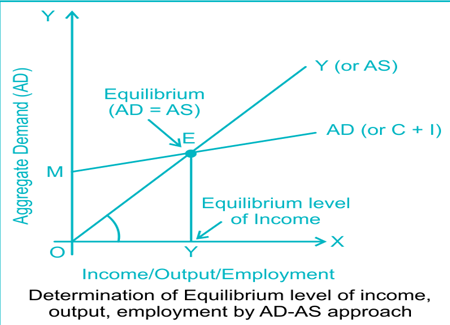
According to the Keynesian theory, the equilibrium level of income in an economy is determined when aggregate demand, represented by C + I curve is equal to the total output (Aggregate Supply or AS).
When AD is more than AS – When planned spending (AD) is more than planned output (AS), then (C + I) curve lies above the 45ᵒ line. It means that consumers and firms together would be buying more goods than firm are willing to produce. As a result, the planned inventory would fall below the desired level.
When AD is less than AS – When AD < AS, then (C + I) curve line below the 45ᵒ line. It means that consumers and firms together would be buying lesser goods than firms are willing to produce. As a result, the planned inventory would rise.
Saving-Investment Approach (S-I Approach)
According to this approach, the equilibrium level of income is determined at a level, when planned saving (S) is equal to planned investment (I).
When Saving is more than Investment – It planned saving is more than planned investment, i.e. after point ‘E’ in it means that households are not consuming as much as the firms expected them to. As a result, the inventory rises above the desired level.
When Saving is less than Investment – If planned saving is less than planned investment, i.e. before point ‘E’ in it means that household are consuming more and saving less than what the firms expected them to. As a result, planned inventory would fall below the desired level.
EQUILIBRIUM LEVEL
According to the classical economists, equilibrium level of income is attained always at full employment level, i.e. there is absence of involuntary unemployment. However, as per the Keynesian theory, equilibrium level can be achieved at:
- Full employment level; or
- Underemployment level, i.e. less than full employment level; or
- Over full employment level, i.e. more than full employment level.
Full Employment Equilibrium – It refers to a situation when the aggregate demand is equal to the aggregate supply at full employment level.
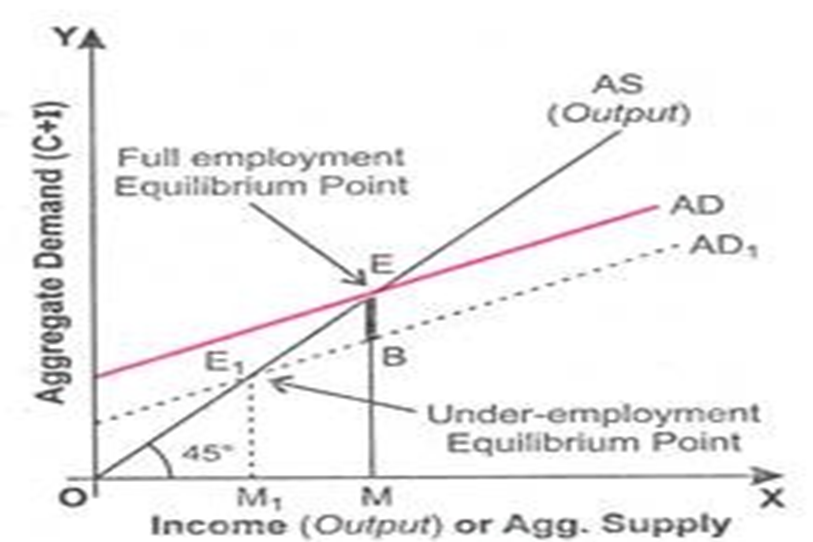
Underemployment Equilibrium – It refers to a situation when the aggregate demand is equal to the aggregate supply when the resources are not fully employed.
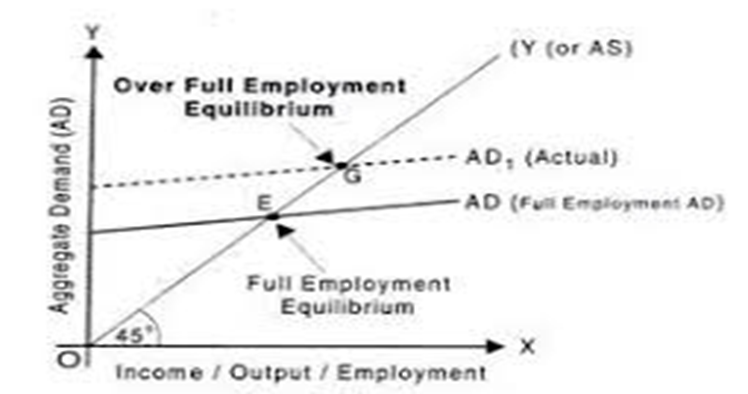
Over Full Employment Equilibrium – It refers to a situation when AD is equal to AS beyond the full employment level. It occurs after the full employment level.
Short-run Fixed Price Analysis of Product Market
In the short-run, prices take some time to respond to the forces of excess supply or demand as producers try to update their production plans in the meantime. For instance, in case of excess supply, firms plan to produce less in the next cycle in order to avoid accumulation of inventory. Also, an individual firm is very small in relation to entire market and is not in a position to influence the market price.
As a result, an individual firm has to accept the price that prevails in the market. Price level remains constant and it changes only when the economy is unable to eliminate the effect of excess demand or supply. So, it is assumed that prices remain constant in short-run and vary in the long-run.
income determination and multiplier class 12 formulas
CONCEPT OF INVESTMENT MULTIPLIER
The concept of ‘Investment Multiplier’ is an important contribution of Prof.J.M. Keynes. Keynes believed that an initial increment in investment increases the final income by many times. Multiplier expresses the relationship between an initial increment in investment and the resulting increase in aggregate income.
Multiplier (k) is the ratio of increase in national income (ΔY) due to an increase in investment (ΔI).
K = ΔY / ΔI
Multiplier and MPC – There exists a direct relationship between MPC and the value of multiplier. Higher the MPC, more will be the value of multiplier, and vice-versa.
The concept of multiplier is based on the fact that one person’s expenditure is another person’s income. When investment is increased, it also increases the income of the people. People spend a part of this increased income on consumption. However, the amount of increased income spent on consumption depends on the value of MPC.
- In case of higher MPC, people will spend a large proportion of their increased income on consumption. In such case, value of multiplier will be more.
- In case of low MPC, people will spend lesser proportion of their increased income on consumption. In such case, value of multiplier will be comparatively less.
Thus, the value of multiplier depends upon the MPC.
Algebraic Relationship between Multiplier and MPC
The algebraic relation between Multiplier and MPC can be derived in the following manner:
We know, at equilibrium, income (Y) is the sum total of consumption (C) and investment (I).
Y = C + I
Similarly, any change in income (ΔY) will also be equal to (ΔC + ΔI).
ΔY = ΔC + ΔI
Dividing both sides by ΔY, we get
ΔY/ ΔY = ΔC/ ΔY + ΔI/ ΔY
1 = MPC + 1/k [ ΔY/ΔY = 1; ΔC/ΔY = MPC; ΔI/ΔY = 1/K]
Or k = 1/ 1 – MPC
Multiplier (k) in terms of MPS
We know, k = 1/ (1 – MPC)
We also know, 1 – MPC = MPC
So, k = 1 / MPS
Short Answer Type Questions
- Can an economy be in equilibrium when there is unemployment in the economy? Explain.
Answer: Yes, an economy can be in equilibrium even when there is unemployment. This situation is called underemployment equilibrium. It occurs when Aggregate Demand (AD) is equal to Aggregate Supply (AS), but the equilibrium level of output is less than full employment output. As a result, some labour and other resources remain unemployed.
2. Discuss, in brief, the state of full employment equilibrium with the help of a diagram.
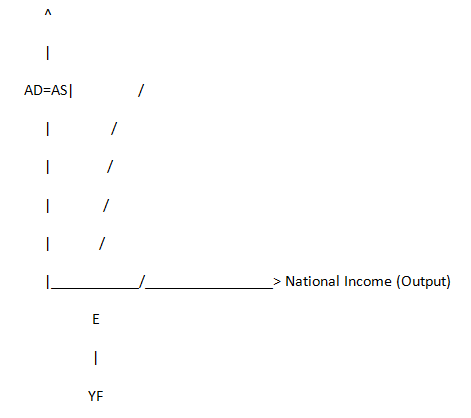
Answer: Full employment equilibrium is the situation where Aggregate Demand (AD) equals Aggregate Supply (AS) at the full employment level of output. At this point, all available resources are fully and efficiently utilised, and there is no involuntary unemployment.
Aggregate Demand / Aggregate Supply
3. Briefly discuss the concept of over full employment equilibrium. Use diagram.
Answer: Over full employment equilibrium exists when Aggregate Demand exceeds the economy’s full employment output. Since all resources are already fully employed, the increase in demand leads to inflationary pressure rather than an increase in real output.
Aggregate Demand / Aggregate Supply
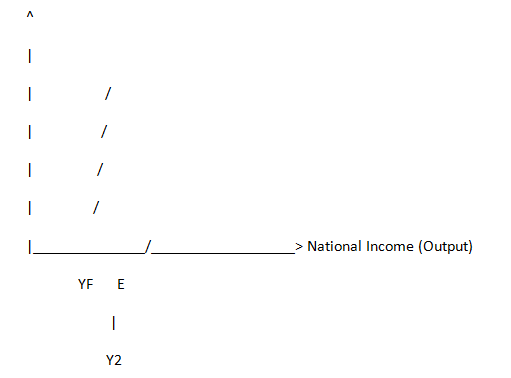
(Over Full Employment)
4. What happens to level of national income when aggregate demand falls short of aggregate supply?
Answer: When Aggregate Demand (AD) is less than Aggregate Supply (AS), producers are unable to sell their entire output. This leads to an unplanned increase in inventories, reduction in production, and fall in employment. As a result, national income decreases until AD becomes equal to AS.
5. Discuss the changes that will take place in the economy when planned saving is less than planned investment.
Answer: When planned saving is less than planned investment (S < I), aggregate demand becomes greater than aggregate supply. This causes unplanned reduction in inventories, encouraging firms to increase production and employment. Consequently, national income rises until planned saving becomes equal to planned investment (S = I).
6. Explain the meaning of investment multiplier. What can be its minimum value and why?
Answer: Investment Multiplier (K) refers to the ratio of the total increase in national income to the initial increase in investment.
Formula:
K=ΔY / ΔI
Where:
- ΔY = Change in National Income
- ΔI = Change in Investment
The multiplier shows how an increase in investment leads to a multiple increase in national income due to repeated rounds of consumption expenditure.
Minimum Value of Multiplier:
The minimum value of the multiplier is 1.
Reason:
When the Marginal Propensity to Consume (MPC) = 0, people do not spend any part of the additional income. They save the entire income. Therefore, the increase in national income is equal to the increase in investment only.
K = 1/ 1-MPC
= 1/1 – 0
= 1
7. Define investment multiplier. How is it related to marginal propensity to consume?
Answer: Investment Multiplier is the ratio of the increase in national income to the increase in investment.
K=ΔY / ΔI
The multiplier is directly related to the Marginal Propensity to Consume (MPC).
The relationship is:
K = 1 / 1−MPC
or
K = 1 / MPS
where MPS = 1 − MPC.
Relationship:
- Higher MPC → Higher Multiplier.
- Lower MPC → Lower Multiplier.
Example:
If MPC = 0.8,
K = 1 / 1−0.8
= 5
Thus, an increase of ₹100 in investment will increase national income by ₹500.
8. Discuss the concept of multiplier with the help of a diagram.
Answer: The Multiplieris the process by which an increase in investment causes a multiple increase in national income. The increase occurs because one person’s expenditure becomes another person’s income, creating repeated rounds of spending.
Formula:
K = 1/ 1−MPC
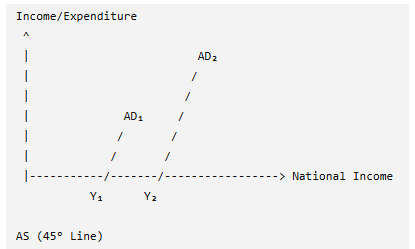
Explanation:
- Initially, equilibrium is at Y₁ where AD₁ intersects the 45° line.
- An increase in investment shifts Aggregate Demand from AD₁ to AD₂.
- National income rises from Y₁ to Y₂.
- The increase in income is greater than the initial increase in investment due to the multiplier effect.
9. Explain equilibrium level of national income using Savings and Investment approach. Draw a diagram in support of your explanation.
Answer: According to the Savings–Investment Approach, national income is in equilibrium when planned savings are equal to planned investment (S = I). At this point, there is neither a tendency for income to rise nor to fall.
Diagram:
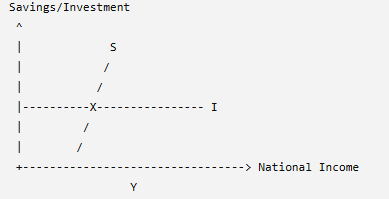
Explanation:
- The upward-sloping S curve shows that savings increase with income.
- The I curve is horizontal because planned investment is assumed to be autonomous.
- Equilibrium is achieved at point X, where S = I.
- If S > I, income falls because planned expenditure is less than output.
- If S < I, income rises because planned expenditure exceeds output.
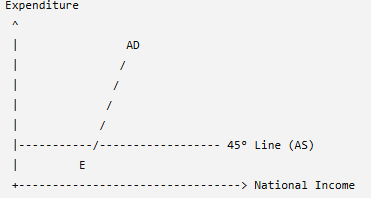
10. Explain how the level of effective demand is attained in an economy if Aggregate Demand is more than the Aggregate Supply.
Answer: When Aggregate Demand (AD) is greater than Aggregate Supply (AS), producers find that goods are selling faster than expected. As a result, they increase production and employ more labour and other resources.
This raises:
- Employment,
- Income, and
- Output.
As income increases, Aggregate Supply also increases. The process continues until Aggregate Demand becomes equal to Aggregate Supply (AD = AS).
At this point:
- Producers have no incentive to change production.
- The economy reaches the equilibrium level of national income, also known as the level of effective demand.
Diagram:
11. Using the ‘saving and investment’ approach explain how is the equilibrium level of national income determined? Also explain what will happen if the equilibrium condition is not fulfilled.
Answer: According to the Saving and Investment approach, equilibrium level of national income is determined when planned saving is equal to planned investment (S = I).
At this point, there is no tendency for national income to change.
- If S > I, then planned expenditure is less than output. Unsold stock increases, so producers reduce production and income falls.
- If S < I, then planned expenditure is more than output. Inventories decrease, so producers increase production and income rises.
12. In an economy, planned spending is less than planned output. Explain all the changes that will take place in the economy.
Answer: When planned spending is less than planned output (AD < AS), producers are unable to sell their entire output.
The following changes take place:
- Unsold stock or inventories increase.
- Producers reduce production.
- Employment and income decrease.
- Reduction in income leads to a fall in consumption expenditure.
13. Explain the meaning of underemployment equilibrium.
Answer: Underemployment equilibrium refers to a situation where an economy reaches equilibrium level of income at a level where resources are not fully employed.
In this situation:
- Aggregate Demand is equal to Aggregate Supply.
- But there is unemployment of labour and other resources.
14. Using a hypothetical example, elaborate the working of investment multiplier in an economy.
Answer: Investment multiplier shows the multiple increase in national income due to an increase in investment.
Example:
Suppose investment increases by ₹100 crore and MPC = 0.8.
K = 1 / 1 – MPC
K = 1 / 1 – 0.8
= 5
Increase in income:
ΔY = K × ΔI
= 5 x 100
= 500 crore
15. ‘Investment multiplier and Marginal Propensity to consume are directly related to each other.’ Explain with the help of numerical example.
Answer: Investment multiplier is directly related to Marginal Propensity to Consume (MPC) because a higher MPC leads to a higher multiplier.
Formula:
K = 1 / 1 – MPC
Example:
When MPC = 0.5
K = 1 / 1 – 0.5
= 2
When MPC = 0.8
K = 1 / 1 – 0.8
= 5
16. If planned savings fall short of planned investments in an economy, state its likely impact on output and income.
Answer:
When planned savings are less than planned investment (S < I), it means planned expenditure is greater than output.
- Demand for goods increases.
- Inventories fall below the desired level.
- Producers increase production.
- Employment and income rise.
17. Discuss briefly the relationship between marginal propensity to save and investment multiplier, using a hypothetical numerical example.
Answer: Investment multiplier is inversely related to Marginal Propensity to Save (MPS).
Formula:
K = 1 / MPS
Example:
If MPS = 0.25,
K = 1 / 0.25
= 4
If MPS increase to 0.5,
K = 1 / 0.5
= 2
18. “Ex-ante Savings and Ex-ante Investments are always equal.” Defend or refute the given statement with valid reasons.
Answer:
The statement is refuted.
Ex-ante savings and ex-ante investments are not always equal because they are planned by different individuals.
- Households plan savings.
- Firms plan investments.
19. “In and economy, ex-ante Aggregate Demand is more than ex-ante Aggregate Supply.” Explain its impact on the level of output, income and employment.
Answer:
When ex-ante Aggregate Demand is greater than ex-ante Aggregate Supply (AD > AS):
- Demand for goods increases.
- Inventories fall below the desired level.
- Producers increase output.
- Employment and income increase.
20. “If actual demand for final goods falls short of the actual output of final goods corresponding to full employment level, it may lead to an uninitended accumulation of investories.” Do you agree with the given statement? Give valid reasons in support of your answer.
Answer:
Yes, the statement is correct.
When actual demand is less than output at full employment level:
- Producers are unable to sell the entire output.
- Unsold goods accumulate as unintended inventories.
- Producers reduce production.
- Employment and income fall.
Long Answer Type Questions
- Explain determination of equilibrium level of income using ‘Consumption plus Investment’ approach. Use diagram.
Answer:
According to Consumption plus Investment (C + I) approach, equilibrium level of income is determined at a point where Aggregate Demand (AD) is equal to Aggregate Supply (AS).
In a two-sector economy:
AD = C + I
Where:
- C = Consumption expenditure
- I = Investment expenditure
Equilibrium occurs when:
Y = C + I
At this point, planned expenditure is equal to the total output produced in the economy.
Explanation:
- When AD > AS, it means planned expenditure is more than output. Inventories fall and producers increase production. As a result, income and employment rise.
- When AD < AS, unsold inventories increase. Producers reduce production, leading to a fall in income and employment.
- The adjustment process continues until AD = AS.
Diagram:
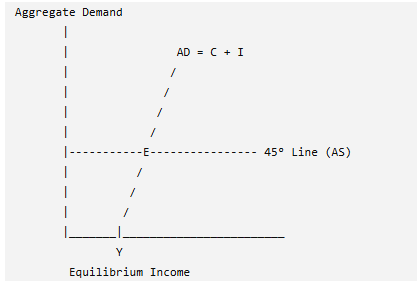
2. Why must aggregate demand be equal to aggregate supply at the equilibrium level of income and output? Explain with the help of a diagram.
Answer:
Equilibrium level of income is achieved when Aggregate Demand (AD) is equal to Aggregate Supply (AS).
At this point:
- Planned expenditure is equal to planned output.
- There is no change in inventories.
- Producers have no reason to increase or decrease production.
If AD > AS:
- Demand exceeds available output.
- Inventories decrease.
- Producers increase production.
- Income and employment rise.
If AD < AS:
- Output is more than demand.
- Unsold inventories increase.
- Producers reduce production.
- Income and employment fall.
Therefore, equilibrium is possible only when:
AD = AS
Diagram:
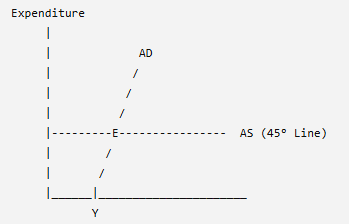
3. Explain the meaning of equilibrium level of income and output using saving and investment approach. Use a diagram.
Answer:
According to the Saving and Investment approach, equilibrium level of income is determined at a point where planned savings are equal to planned investment.
S = I
Where:
- S = Saving
- I = Investment
Explanation:
- At equilibrium, all planned savings are converted into planned investments.
- There is no unplanned change in inventories.
- Producers continue their existing level of production.
When equilibrium condition is not fulfilled:
(i) S > I:
Savings are more than investment. Demand falls, inventories increase and producers reduce output.
(ii) S < I:
Investment is more than savings. Demand increases, inventories fall and producers increase output.
Diagram:
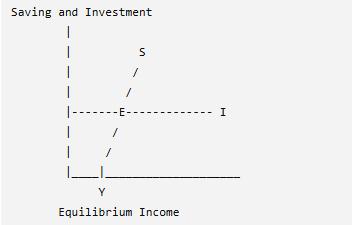
At point E, savings and investment are equal.
4. Discuss the working of the adjustment mechanism in the following situations:
a. If aggregate demand is greater than Aggregate supply.
b. If Ex-ante Investments are less than Ex-ante Savings.
Answer:
- When AD > AS, planned expenditure exceeds planned output.
The adjustment process is as follows:
- Consumers demand more goods than the available output.
- Inventories fall below the desired level.
- Producers increase production to meet the increased demand.
- Increase in production raises income and employment.
- The process continues until AD = AS.
b. When Ex-ante Investment is less than Ex-ante Saving (I < S):
- Total planned expenditure becomes less than total output.
- Goods remain unsold and inventories accumulate.
- Producers reduce production.
- Employment and income decrease.
- The economy moves towards equilibrium where:
S = I
5. What changes will take place to bring an economy in equilibrium if: (i) planned savings are greater than planned investment; (ii) planned savings are less than planned investment.
Answer:
(i) When planned savings are greater than planned investment (S > I):
- Aggregate demand becomes less than aggregate supply.
- Unsold inventories increase.
- Producers reduce production.
- Employment and income decrease.
- Income falls until savings become equal to investment.
(ii) When planned savings are less than planned investment (S < I):
- Aggregate demand becomes greater than aggregate supply.
- Inventories decrease.
- Producers increase production.
- Employment and income increase.
- Income rises until savings become equal to investment.
6. Explain determination of equilibrium level of national income using aggregate demand and aggregate supply approach. Use diagram. Also explain the effect when aggregate demand is less than aggregate supply.
Answer:
According to the Aggregate Demand and Aggregate Supply approach, equilibrium level of national income is determined at a point where Aggregate Demand (AD) is equal to Aggregate Supply (AS).
AD = AS
Where:
- AD represents total planned expenditure in the economy.
- AS represents total output produced in the economy.
At this point:
- Planned expenditure is equal to planned output.
- There is no change in inventories.
- Producers have no tendency to change the level of production.
Effect when AD < AS:
When Aggregate Demand is less than Aggregate Supply:
- Producers are unable to sell their entire output.
- Unsold goods accumulate as inventories.
- Producers reduce production.
- Employment and income decrease.
- The economy moves towards equilibrium.
Diagram:
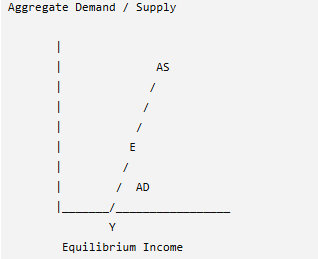
At point E, AD is equal to AS and equilibrium income is determined.
7. Discuss the meaning of investment multiplier. What can be its minimum and maximum value?
Answer: Investment Multiplier – refers to the ratio of the change in national income to the change in investment.
K = ΔY/ ΔI
Where:
- K = Multiplier
- ΔY = Change in income
- ΔI = Change in investment
The multiplier shows how an initial increase in investment leads to a multiple increase in income.
Minimum Value:
The minimum value of multiplier is 1.
When:
MPC = 0
Then,
K = 1/ 1−MPC
= 1
This happens when the entire additional income is saved.
Maximum Value:
Theoretically, the maximum value of multiplier can be infinite.
When:
MPC = 1
then:
K = 1 / 1−1
= ∞
It means the entire additional income is consumed and no part is saved.
8. Explain the working of investment multiplier with the help of a numerical example.
Answer: Investment multiplier explains the process through which an increase in investment leads to a multiple increase in national income.
Example:
Suppose:
- Increase in Investment = ₹100 crore
- MPC = 0.8
Multiplier:
K = 1 / 1 – MPC
K = 1 / 1 – 0.8
= 5
Increase in income:
ΔY = K × ΔI
= 5 × 100
= Rs.500 crore
Thus, an increase in investment of ₹100 crore increases national income by ₹500 crore.
9. “the size of multiplier varies directly with the size of the MPC.” Defend or refute.
Answer: The given statement is correct.
Investment multiplier and Marginal Propensity to Consume (MPC) are directly related.
The formula of multiplier is:
K = 1 / 1 – MPC
When MPC increases, the value of multiplier also increases.
Example:
When MPC = 0.5:
K = 1 / 1 – 0.5
= 2
When MPC = 0.8:
K = 1 / 1 – 0.8
= 5
It shows that a higher MPC results in a higher multiplier.
10. Explain national income equilibrium through aggregate demand and aggregate supply. Use diagram. Also explain the changes that take place in an economy when the economy is not in equilibrium.
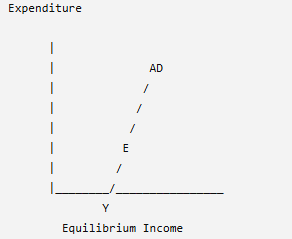
Answer: National income equilibrium is achieved when Aggregate Demand is equal to Aggregate Supply.
AD = AS
At this level:
- Planned expenditure equals planned output.
- There is no unintended change in inventories.
- The economy remains stable.
When economy is not in equilibrium:
1. When AD > AS:
- Demand exceeds production.
- Inventories fall.
- Producers increase output.
- Employment and income rise.
2. When AD < AS:
- Production exceeds demand.
- Inventories increase.
- Producers reduce output.
- Employment and income fall.
11. Explain the determination of equilibrium level of national income using ‘saving and investment’ approach. Use diagram. Also explain the effects if saving is greater than investment.
Answer: According to the Saving and Investment approach, equilibrium level of national income is determined at a point where planned savings are equal to planned investment.
S=IS = IS=I
Where:
- S = Planned Savings
- I = Planned Investment
At this point:
- Total savings generated in the economy are completely converted into investment.
- There is no unintended change in inventories.
- The level of output, income and employment remains constant.
Effect when Saving is greater than Investment (S > I):
When savings are greater than investment:
- Planned expenditure becomes less than output.
- Unsold stock of goods increases.
- Producers reduce production.
- Employment and income decrease.
- Income continues to fall until savings become equal to investment.
Diagram:
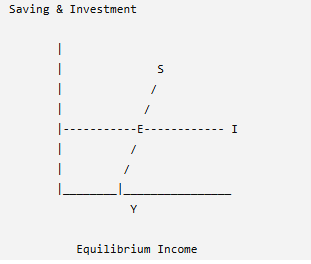
Point E shows the equilibrium level where S = I.
12. Explain the changes that take place when aggregate demand and aggregate supply are not equal.
Answer: Equilibrium in an economy is achieved when:
AD = AS
When Aggregate Demand and Aggregate Supply are not equal, the following changes take place:
(i) When AD > AS:
- Demand for goods is more than production.
- Inventories decrease.
- Producers increase output.
- Employment and income increase.
- The economy moves towards equilibrium.
(ii) When AD < AS:
- Production is more than demand.
- Unsold inventories increase.
- Producers reduce output.
- Employment and income decrease.
- The economy moves towards equilibrium.
13. Derive the two alternative conditions of expressive national income equilibrium. Show these equilibrium conditions on a single diagram.
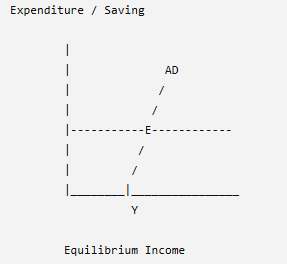
Answer: There are two approaches to determine equilibrium national income:
1. Aggregate Demand and Aggregate Supply Approach:
Equilibrium occurs when:
AD = AS
In a two-sector economy:
Y = C + I Y
2. Saving and Investment Approach:
Equilibrium occurs when:
S = I
Both conditions represent the same equilibrium level of income.
Diagram:
14. Discuss briefly the working process of investment multiplier (k), assuming that Change in Investment (ΔI) is Rs.4,000 crore and Marginal Propensity consume (MPC) is 0.5.
Answer: Investment multiplier shows the relationship between change in investment and the resulting change in national income.
Formula:
K = 1 / 1 – MPC
Given:
MPC = 0.5
K = 1 / 1 – 0.5
K = 2
Now,
ΔY = K × ΔI
= 2 × 4000
= Rs.8,000 crore
Therefore, an increase in investment of Rs. 4,000 crore will increase national income by Rs. 8,000 crore.
15. What is Effective Demand Principle? Discuss with the help of an imaginary numerical example.
Answer: The Effective Demand Principle states that the level of employment and national income in an economy is determined by the level of Aggregate Demand (AD).
Equilibrium is achieved when:
AD = AS
At this point, the demand for goods is equal to the output produced.
Numerical Example:
Suppose:
- Consumption expenditure = ₹800 crore
- Investment expenditure = ₹200 crore
Therefore,
AD = C + I
AD = 800 + 200
= 1000 crore
If the total output produced is also Rs.1,000 crore, then:
AD = AS
The economy will be at equilibrium level of income and employment.
Unsolved Practical’s
Practical on Investment Multiplier
- Calculate the value of multiplier, if MPC is: (i) 0.60; (ii) 0.50
Solution :
A. Multiplier (k) = 1/1-MPC
= 1/1 – 0.6
= 1/0.40
= 2.5
B. Multiplier (k) = 1/1-MPC
= 1 / 1-0.50
= 2
2. Calculate the value of multiplier, if the marginal propensity to save is 0.25.
Solution –
K = 1/MPS
= 1/0.25
= 4
3. How much additional income will be generated in an economy with an additional investment of Rs.100 crores and when half of increase in income is spent on consumption?
Solution –
ΔI = 100 crores
MPC = 0.5 (Half of income is spent on consumption)
K = 1/1-MPC
= 1/1 – 0/5
= 1/0.5
= 2
Also,
K = ΔY/ΔI
2 = ΔY/100
2 x 100 = ΔY
200 crores = ΔY
Additional income generated = Rs.200 crores.
4. What is the value of MPC, if an additional investment of Rs.40 crores leads to an increase of Rs.100 crores in the income?
Solution –
Given:
ΔI = Rs.40 crores
ΔY = Rs.100 crores
To find : MPC
We now,
K = ΔY/ΔI
= 100/40
= 2.5
Also,
K = 1 / 1 – MPC (1 – MPC = MPS)
- = 1/MPS
MPS = 1/2.5
= 0.4
Now,
MPC = 1 – MPS
= 1 – 0.4
= 0.6
5. Calculate the value of multiplier if the entire increase in income is saved.
Solution –
Given MPS = 1
So,
K = 1/MPS
= 1/1
= 1
6. In an economy, the increase in income is five times the increase in investment expenditure. Calculate the values of MPC.
Solution –
Let, increase in investment be x
So, increase in income will be 5x
K = ΔY / ΔI
= 5x / x
= 5
K = 5
Now,
K = 1 / 1 – MPC
1 – MPC = 1/5
1 – MPC = 0.2
MPC = 1 – 0.2
= 0.8
7. “In an economy, an increase in investment leads to doubling of the national income.” Calculate the Marginal Propensity to Consume (MPC) for the given economy.
Solution –
Change in investment be ΔI
Initial national income be Y
The change in nation income (ΔY)
There fore, ΔIY = Y.
Change in investment (ΔY = 2 x ΔI), the investment multiplier (K) is exactly 2.
K = ΔY/ ΔI = 2
K = 1/1-MPC
K = 2
2 = 1/1-MPC
2(1- MPC) = 1
2 – 2 (MPC) = 1
2 – 1 = 2(MPC)
1 = 2(MPC)
MPC = 1/2
= 0.5
8. An increase in investment by Rs.5,000 crores leads to increase in national income which is four times more than the increase in investment. Calculate marginal propensity to save.
Solution –
Given
ΔI = Rs.5,000 crores
ΔY = (4 x ΔI) + 5,000
= (4 x 5,000) + 5,000
= 25,000
Now,
K = ΔY/ ΔI
= 25,000/5,000
= 5
Also,
K = 1/MPS
5 = 1/MPS
MPS = ./5
= 0.20
9. Due to an increase in investment, the national income increased by Rs.10,000 crores. If 20% of additional income is saved, calculate the increase in investment.
Solution –
Given,
ΔY = Rs.10,000 crores
MPS = 0.20
K = 1/MPS
K = 1/0.20
= 5
Also,
K = ΔY/ΔI
5 = 10,000/ ΔI
ΔI = Rs.2,000 crores
10. Calculate MPC and Multiplier (k) from the following data:

Solution –

Multiplier (k) = 1/1 – MPC
= 1 / 1 – 0.80
= 1/0.20
= 5
Multiplier (k) = 1 / 1 – MPC
= 1 / 1 – 0.90
= 1 / 0.10
= 10
11. The consumption function of an economy is given as: C = 40 + 0.8 Y. Calculate the total increase in income and consumption if investment expenditure increase by Rs.500 crores.
Solution –
Given:
C = 40 + 0.8Y
i.e., MPC = 0.8
ΔI = Rs.500 crores
To find –
ΔY , ΔC
We know,
Multiplier (k) = ΔY/ΔI
= 1 / 1 – MPC
ΔY/500 = 1 / 1 – 0.8
ΔY = 500/ 0.2
= 2,5000
ΔY = Rs.2,500 crores
Now,
MPC = ΔC/ΔY
0.8 = ΔC / 2,500
0.8 x 2,500 = ΔC
2,000 crores = ΔC
12. In an economy, the investment expenditure is increased by Rs.2,000 crores. Calculate the total increase in income and consumption expenditure if ratio of marginal propensity to consume and marginal propensity to save is 4 : 1.
Solution –
Given –
ΔI = 2,000 crores
MPC/MPS = 4.1
i.e.,
MPC = 4 MPS
We know,
MPC + MPS = 1
4 MPS + MPS = 1
5 MPS = 1
MPS = 1/5
MPS = 0.2
Now,
Multiplier (k) = ΔY/ ΔI
= 1/MPS
ΔY / 2000 = 1/0.2
ΔY = 2,000 / 0.2
ΔY = Rs.10,000 crores
Increase in consumption expenditure: MPC = ΔC/ ΔY
0.8 = ΔC/10,000
0.8 x 10,000 = ΔC
Rs.8,000 crores = ΔC
13. In an economy, people always consume half of any additional income and save the other half. Determine the additional income generated if the government makes an additional expenditure of Rs.20,000 crores.
Solution –
Given:
MPC = MPS = 0.5
ΔI = Rs.20,000 crores
(Government expenditure is assumed to be investment)
To find ΔY
We know,
K = ΔY/ ΔI
= 1 / 1 – MPC
= ΔY / 20,000
= 1/0.5
ΔY = 20,000 / 0.5
ΔY = Rs.40,000 crores
14. For a hypothetical economy, assume the government increased an infrastructural investment by 30,000 crores. 80% of additional income is consumed in the economy. Estimate the increase in increase in income and the corresponding increase in consumption expenditure in the economy.
Solution –
Given –
ΔI = 30,000 crores
MPC = 80% = 0.8
K = 1/1 – MPC
K = 1/1 – 0.8
= 1/0.2
= 5
ΔY = K x ΔI
ΔY = 5 x 30,000
= 1,50,000 crores
ΔC = MPC x ΔY
ΔC = 0.8 x 1,50,000
= 1,20,000 crores
15. If consumption function for an economy is given as: C = 120 + 0.9Y, then what is the value of multiplier?
Solution –
Given –
C = 120 + 0.9Y
MPC = 0.9
K = 1 / 1 – MPC
= 1 / 1 – 0.9
K = 1/0.1
= 10
16. If consumption at zero level of income is Rs.40 crores and investment multiplier is 4, then determine the relevant consumption function.
Solution –
Given –
k = 4
C = 40 crores
To find : Consumption function
We know,
K = 1/ 1 – MPC
4 = 1 / 1 – MPC
1 – MPC = 1/4
1 – MPC = 0.25
1 – 0.25 = MPC
0.75 = MPC
Now,
C = C + by (b = MPC)
C = 40 = 0.75Y
17. For a hypothetical economy, the government incurs an additional investment expenditure of Rs.5,000 crore. Assuming that the Marginal Propensity to Save (MPS) becomes half from its present level of 20%, estimate the change in income due to this fall in Marginal Propensity to Save (MPS).
Solution –
Given –
ΔI = 5,000 crores
MPS1 = 20% = 0.20
MPS2 = 20%/2 = 10% = 0.10
K = 1/MPS
MPS1 = 0.20:
K1 = 1/0.20
= 5
ΔY1 = K1 x ΔI
ΔY1 = 5 x 5,000
ΔY1 = Rs.25,000 crores
MPS2 = 0.10:
K2 = 1/0.10
= 10
ΔY2 = K2 x ΔI
ΔY2 = 10 x 5,000
= 50,000 crores
Change in income (ΔY) = ΔY2 – ΔY1
ΔY= 50,000 – 25,000
= Rs.25,000 crore
Practical on Determination of Equilibrium Level
18. Calculate AD, AS for every level of income and the equilibrium level, from the following schedule: (assuming that the investment is fixed at Rs.40 crores)

Solution –
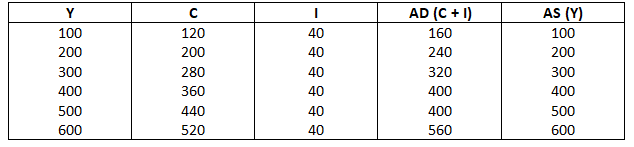
Equilibrium level : AD = AS = 400 crores
19. Calculate aggregate demand (AD), aggregate supply (AS) for all levels and the equilibrium level of income from the given schedule, if the investment is fixed at Rs.20 crores:

Solution –
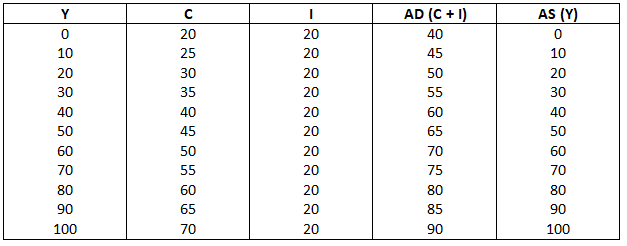
Equilibrium level : AD = AS = 80 crores
20. In a two-sector economy, the income and consumption functions are: Y = C + I and C = 50 + 0.80 Y. If the investments are Rs.50 crores, calculate: (a) Equilibrium level of income; (b) level of consumption at equilibrium; (c) Saving at equilibrium.
Solution –
Given :
Y = C + I
C = 50 + 0.8Y
I = Rs.50 crores
a. Y = C + I
C = Y – I ………. (1)
C = 50 + 0.8 Y ………. (2)
Substituting Eq. (1) in Eq. (2)
Y – I = 50 + 0.8Y (Given I = 50)
Y – 50 = 50 + 0.8Y
Y – 0.8Y = 50 + 08Y
Y – 0.8Y = 50 + 50
0.2Y = 100
Y = 100/0.2
= Rs.500 crores
b. C = 50 + 0.8Y
= 50 + 0.8 x 500
= 50 + 400
= Rs.450 crores
c. We know,
Y = C + S
500 = 450 + S
50 crores = S
21. The function of saving (S) is given to be: S = -40 + 0.25Y. If planned investments are Rs.100 crores, determine: (a) Equilibrium level of income; (b) Level of consumption at equilibrium; (c) Saving at equilibrium.
Solution –
Given:
S = -40 + 0.25Y
I = 100 crores
We know,
S = -C + (1 – b)Y
So,
-C = -40 i.e., C = 40
(1 –b) = 0.25
So, b = 0.75
Also,
C = C + by
i.e., C = 40 + 0.75Yl
(a) At equilibrium:-
AS = Ad
Y = C + I
Y = 40 + 0.75Y + 100
Y – 0.75Y = 140
0.25Y = 140
Y = 140/0.25
Y = Rs.560 crores
(b) C = 40 + 0.75Y
= 40 + 0.75 x 560
= 40 + 420
= Rs.460 crores
(C)At equilibrium level of income:
AD = AS
C + I = C + S
I = S
Rs.100 crores = S
22. The saving function of an economy is given as: S = -50 + 0.4Y. The economy is in equilibrium at the income level of Rs.1,500 crores. Calculate: (a) Investment at equilibrium income level; (b) Autonomous consumption; (c) Multiplier.
Solution –
Given:
S = -50 + 0.4Y
Y = Rs.1,500 crores
a. At equilibrium level of income –
I = S
So,
I = -50 + 0.4Y
= -50 + 0.4 x 1.500
= -50 + 600
I = 550 crores
b. Autonomous Consumption
C = 50 Crores
c. Multiplier (k) = 1 / MPS
= 1 / 0.4
= 2.5
23. In an economy, C = 300 + 0.8Y and I = 500 (where C = Consumption, Y = Income, I = Investment). Calculate the following: (a) Equilibrium level of income; (b) Consumption expenditure at equilibrium level of income.
Solution –
Given:
C = 300 + 0.8Y
I = Rs.500 crores
a. At equilibrium –
AS = AD
Y = C + I
Y = 300 + 0.8Y + 500
Y – 0.8Y = 800
0.2Y = 800
Y = 800 / 0.2
= 4000
Now,
b. Consumption expenditure at equilibrium level of income
C = 300 + 0.8Y
= 300 + 0.8 x 4000
= 300 + 3200
= 3500
24. An economy is in equilibrium. Its consumption function is C = 300 + 0.8Y where C is consumption expenditure and Y is income and investment is Rs.700. fine national income.
Solution –
C = 300 + 0.8Y
I = Rs.700 crores
National Income –
AS = AD
Y = C + I
Y = 300 + 0.8Y + 700
Y – 0.8Y = 1000
0.2Y = 1000
Y = 1000 / 0.2
= 5000
25. In an economy, the consumption function is C = 600 + 0.9Y, where C is consumption expenditure and Y is income. Calculate the equilibrium level of income and consumption expenditure, when investment expenditure is 500.
Solution –
Given:
C = 600 + 0.9Y
C = Rs.500 crores
At equilibrium –
AS = AD
Y = C + I
Y = 600 + 0.9Y + 500
Y – 0.9Y = 1100
0.1Y = 1100
Y = 1100 / 0.1
= 11000
Now,
C = 600 + 0.9Y
= 600 + 0.9 x 11000
= 600 + 9,900
= 10,500
26. In an economy S = -50 + 0.5Y is the saving function (where S = saving and Y = national income) and investment expenditure is Rs.7,000. Calculate; (i) Equilibrium level of national income. (ii) Consumption expenditure at equilibrium level of national income.
Solution –
Given : –
S = -50 + 0.5Y
I = 7,000
a. At equilibrium –
AS = AD
Y = C + I
Y = 50 + 0.5Y + 7,000
Y – 0.5Y = 50 + 7,000
0.5Y = 7,050
Y = 7050 / 0.5
= 14,100
b. C = 50 + 0.5Y
= 50 + 0.5 x 14,100
= 50 + 7,050
= Rs.7,100
27. Suppose, an economy is in equilibrium. From the following data, calculate investment expenditure in the economy:
- National income (Y) = 10,000 crore
- Marginal Propensity to Consume (MPC) = 0.8
- Autonomous Consumption (c) = Rs.100 crore
Solution –
Given –
Y = 10,000 crore
MPC = 0.8
C = 100 crore
C = C + (MPC + Y)
= 100 + (0.8 x 10,000)
= 100 + 8,000
= Rs.8,100 crore
Y = C + I
10,000 = 8,100 + I
I = 10,000 – 8,100
I = Rs.1900 crore
28. The consumption function is given as C = 75 + 0.75Y and autonomous investment is 100 crore. Derive the saving function and calculate the level of income at which saving is equal to investment.
Solution –
Given :
C = 75 + 0.75Y
I = Rs.100 crores
To find –
Saving function equilibrium income
We know,
C = C + by
i.e., C = 75 + 0.75Y
So,
C = 75
B = 0.75
Now,
S = -C + (1 – b) Y
i.e. S = -75 + (1 – 0.75) Y
S = -75 + 0.25Y
Equilibrium level of income:
AS = AD
Y = C + I
Y = 75 + 0.75 + 100
0.25Y = 175
Y = 175/0.25
Y = Rs.700 crores
29. From the following data about an economy, calculate:
- Equilibrium level of national income.
- Total consumption expenditure at equilibrium level of national income.
- C = 200 + 0.75 Y, where C = Consumption, Y = Income
- Investment Expenditure (I) = 4,000 crores
Solution –
Given:
C = 200 + 0.75Y
I = Rs.4000 crores
a. At equilibrium –
AS = AD
Y = C + I
Y = 200 + 0.75Y + 4000
Y – 0.75Y = 4200
0.25Y = 4200
Y = 4200 / 0.25
= 16800
Now,
b. Consumption expenditure at equilibrium level of income
C = 200 + 0.75Y
= 200 + 0.75 x 16800
= 200 + 12600
= 12800
Miscellaneous Questions
30. In an economy, the marginal propensity to save is 0.25. Investment is increased by Rs.200 crores. Calculate the total increase in income and consumption expenditure.
Solution –
Given:
ΔI = 200 crores
MPS = 0.25
To find:
ΔY
ΔC
We know:
K = 1/MPS
= ΔY/ ΔI
i.e.,
1/0.25 = ΔY/200
200/0.25 = ΔY
Rs.800 crores = ΔY
Also,
ΔY = ΔC + ΔI
800 = ΔC + 200
800 – 200 = ΔC
Rs.600 crores = ΔC
31. By increase in investment of Rs.100 crores, national income of a country increase by Rs.250 crores. Find out the marginal propensity to consume.
Solution –
ΔI = Rs.100 crores
ΔY = Rs.250 crores
To find : MPC
ΔY = ΔC + ΔI
250 = ΔC + 100
Rs.150 crore = ΔC
MPC = ΔC/ ΔY
= 150/250
MPC = 0.6
32. If increase in investment is Rs.125 cores and increase in national income is 500 crores, calculate marginal propensity to save.
Solution –
ΔI = Rs.125 crores
ΔY = Rs.500 crores
To find : MPS
We now,
ΔY = ΔC + ΔI
500 = ΔC + 125
RS.375 crores = ΔC
Also,
ΔY = ΔC + ΔS
500 = 375 + ΔS
ΔS = Rs.125 crores
Now,
MPS = ΔS/ ΔY
= 125/500
MPS = 0.25
33. An increase in investment in a country leads to increase in national income by Rs.200 crores. If marginal propensity to consume is 0.75, what is the increase in investment? Calculate.
Solution –
Given:
ΔY = Rs.200 crores
MPC = 0.75
To find: ΔI
We know,
K = 1/1-MPC
= ΔY/ ΔI
= 1/1-0.75
= 200/ ΔI
ΔI = 200 x 0.25
ΔI = 50 crores
34. In an economy, marginal propensity to save is 0.10. How much increase in investment is required so that national income rises by Rs.400 crores?
Solution –
Given:
MPS = 0.10
ΔY = Rs.400 crores
To find: ΔI
We now,
K = 1/MPS
= ΔY/ ΔI
= 1/0.10
= 400 / ΔI
ΔI = 400 x 0.10
ΔI = Rs.40 crores
35. Suppose in a hypothetical economy, the saving increase by Rs.20 crores when national income increases by Rs.100 crores. Compute the additional investment needed to attain an increase in national income by Rs.6,000 crores.
Solution –
Given –
ΔS = 20 crores
ΔY = 100 crores
To find –
ΔI when ΔY is Rs.6,000 crores
We know,
K = 1 / MPS
K = 1 / 0.2 [MPS = ΔY/ ΔI = 20/100 = 0.2]
K = 5
Also,
K = ΔY/ ΔI
5 = 6,000/ ΔI
ΔI = 6,000 / 5
ΔI = 1200 crores
36. In an economy, investment increase by Rs.1,000 crore and marginal propensity to save is 0.25.
Calculate:
- Investment multiplier (k)
- Total Increase in income (ΔY)
Solution –
Given –
ΔI = Rs.1000 crores
MPS = 0.25
To find – K
ΔY
We know,
K = 1/MPS
= 1/0.25
= 4
Also
K = ΔY/ ΔI
4 = ΔY/1000
ΔY = 1000 x 4
ΔY = 4000 crores
37. From the following data, calculate the (a) Consumption Expenditure and (b) Investment Expenditure for the economy.

Solution –
Given by:
MPC = 1 – MPS
Given that MPS = 0.4:
MPC = 1 – 0.4
= 0.6
- Consumption expenditure
C = C + (MPC x Y)
C = 500 + (0.6 x 5,000)
C = 500 + 3,000
C = 3,500 crores
b. Investment Expenditure
Y = C + I
I = Y – C
I = 5,000 – 3,500
I = 1,500 crores
38. Answer the following questions based on the data given below:
Planed Investments = 100 crores
C = 50 + 0.50 Y
- Determine the equilibrium level of income.
- Calculate the value of Savings at equilibrium level of National Income.
- Calculate the value of Investment Multiplier.
Solution –
- Equilibrium income
Y = C + I
Y = 50 + 0.50Y + 100
Y – 0.50Y = 150
0.50Y = 150
Y = 150/0.50
= 300 crores
b. Equilibrium savings
S = I
C = 50 + 0.50(300)
= 50 + 150
= 200 crores
S = Y – C
= 300 – 200
= 100 crores
c. Investment multiplier
K = 1 / 1 – MPC
K = 1 / 1 – 0.50
= 1/0.50
= 2
39. The saving function of an economy is given as: S = (-) 50 + 0.10Y. If the ex-ante Investments are Rs.450 crores, calculate the following:
- Equilibrium level of income in the economy.
- Additional investment which will be needed to gain an additional income level of Rs.3,000 crores.
Solution –
Given –
S = -50 + 0.10Y
I = Rs.450 crores
To find-
Equilibrium income ΔI needed to gain ΔY of 3,000 crores
At equilibrium –
S = I
-50 + 0.1Y = 450
0.1Y = 500
Y = 5,000 crores
Now, we know –
K = 1/MPS
= 1/0.1
K = 10
Also,
K = ΔY/ ΔI
10 = 3,000 / ΔI
ΔI 3,000 / 10
ΔI = Rs.300 crores
40. The saving function of an economy is given as: S = -256 + 0.25 Y. If the planned investment is 2,000 crores, calculate the following:
- Equilibrium level of income in the economy.
- Aggregate demand at income of 5,000 crores.
Solution –
Given –
S = -250 + 0.25Y
I = 2,000 crores
To find –
Equilibrium income
AD at income of 5,000 crores
AD = C + I
= C + by + I
C = 250
At equilibrium
S = I
-250 + 0.25Y = 2,000
0.25Y = 2,250
Y = 2,250/ 0.25
Y = 9,000 crores
B = (1 – 0.25) = 0.75
Y = 5,000
So,
AD = 250 + (0.75 x 5,000) + 2,000
= 250 + 3,750 + 2,000
= 6,000
41. If in an economy: (a) Consumption function is given by C = 100 + 0.75Y and (b) Autonomous Investment is Rs.150 crores. Estimate (i) Equilibrium level of Income and (ii) Consumption and Savings at the Equilibrium Level of Income.
Solution –
Given –
C = 100 + 0.75Y
I = 150 crores
To find –
Equilibrium income (Y)
C and S at equilibrium
At equilibrium –
Y = C + I
Y = 100 + 0.75Y + 150
0.25Y = 250
Y = 250/0.25
Y = Rs.1,000 crores
Consumption at equilibrium level:
C = 100 + 0.75 x 1,000
= 100 + 750
= 850 crores
Saving –
Y = C + S
1,000 = 850 + S
1000 – 850 = S
150 crores = S
42. An economy is in equilibrium. Its national is Rs.5,000 and autonomous consumption expenditure is Rs.500. What is the total consumption expenditure if marginal propensity to consumer is 0.7?
Solution –
Given:
Y = 5,000
C = 500
MPC (b) = 0.7
To find: Consumption expenditure (C)
We know,
C = C + by
= 500 + 0.7 x 5,000
= 500 + 3,500
= 4,000
43. Find ‘investment’ from the following: National Income = Rs.500; Autonomous consumption = Rs.100; Marginal propensity to consume = 0.75.
Solution –
Given:
Y = 500
C = 100
MPC (b) = 0.75
To find: Investment (I)
We know
Y = C + I
Y = (C + by) + I
500 = (100 + 0.75 x 500) + I
500 = 100 + 375 + I
500 – 475 = I
Rs.25 = I
44. Find consumption expenditure from the following: Autonomous consumption = Rs.100; Marginal propensity to consume = 0.70; National Income = 1,000.
Solution –
Given:
C = 100
MPC = 0.70
Y = 1,000
To find: Consumption expenditure (C)
We know,
C = C + by
= 100 + 0.75 x 1,000
= 100 + 700
= Rs.800
45. C = 100 + 0.4Y is the Consumption Function of an economy, where C is Consumption Expenditure and Y is National Income. Investment expenditure is 1,100. Calculate: (i) Equilibrium level of National Income; (ii) Consumption expenditure at equilibrium level of national income.
Solution –
Given:
C = 100 + 0.4Y
I = 1,100
(i) Equilibrium level of national income
We know,
As = AD
Y = C + I
Y = 100 + 0.4Y + 1,100
Y – 0.4Y = 1.200
Y = 1,200/0.6
Y = 2,000
(ii) Consumption expenditure
C = 100 + 0.4Y
= 100 + 0.4 x 2,000
= 100 + 800
= 900
46. S = -60 + 0.1 Y is the saving function, where S is Saving and Y is National Income and Investment Expenditure (I) is Rs.4,000 crore in an economy. Calculate the Equilibrium level of Income.
Solution –
Given:
S = -60 + 0.1Y
I = 4,000
To find – Y
At equilibrium –
S = I
-60 + 0.1Y = 4,000
0.1Y = 4060
Y = 4060 / 0.1
Y = 40600
47. From the date given below about an economy, calculate: (a) investment expenditure; and (b) consumption expenditure.
- Equilibrium level of income 5,000
- Autonomous consumption 500
- Marginal propensity to consume 0.4
Solution –
(i) Investment expenditure [C = C + by]
Y = C + I
5,000 = 500 + 0.4 x 5,000 + I
5,000 = 500 + 2,000 + I
5,000 – 2,000 = I
2,500 = I
(ii) Consumption expenditure
= C + by
= 500 + 0.4 x 5,000
= 500 + 2,000
= 2,500
48. If in an economy, C = 500 + 0.9 Y and I = Rs.1,000 crores, where C = Consumption Expenditure, Y = National Income, I = Investment. Calculate the following: (i) Equilibrium level of Income; (ii) Value of Investment Multiplier.
Solution –
Given –
C = 500 + 0.9Y
I = 1,000
To find –
Equilibrium income (Y) K
We know at equilibrium
AS = AD
Y = C + I
Y = 500 + 0.9Y + 1,000
Y – 0.9Y + 1,500
Y – 0.9Y = 1,500
0.1Y = 1,500
Y = 1,500/0.1
Y = 15,000
Now,
K = 1/1-MPC
= 1 / 1 – 0.9
= 1 / 0.1
= 10
49. An Economy is in equilibrium, calculate the Marginal Propensity to Save (MPS) from the following:
- National Income (Y) 4,400
- Autonomous Consumption 1,000
- Investment Expenditure (I) 70
Solution –
Given:
Y = 4,400
C = ?
I = 70
To find: MPC
At equilibrium –
Y = C + I
4,400 = C + 70
C = 4,400 – 70
C = 4,330
C = C + c(Y)
4,330 = 1,000 + c(4,400)
4,330 – 1,000 = 4,400c
3,330 = 4,400c
C = 3,330/4,400
MPC = 0.7568
MPC + MPS = 1
MPS = 1 – MPC
MPS = 1 – 0.7568
MPS = 0.2432
MPS = 0.24
50. Calculate ‘Investment’ from the following:
- Equilibrium income 500
- Consumption expenditure at zero income 50
- Marginal propensity to consume 0.7
Solution –
Y = C + I
500 = 50 + 0.7 x 500 + I
500 = 50 + 350 + I
500 – 400 = I
Rs.100 = I
51. For a hypothetical economy, assuming there is an increase in the Marginal Propensity to Consume (MPC) from 80% to 90% and change in investment to be Rs.1,000 crores. Using the concept of investment multiplier, calculate the increase in income due to change in Marginal Propensity to Consume.
Solution –
Given –
ΔI = 1,000
MPC1 = 80% = 0.8
MPC2 = 90% = 0.9
Find –
MPS
K1 = 1/1 – MPC1
K1 = 1/1 – 0.8
= 1/0.2
= 5
ΔY1 = K1 x ΔI
ΔY1 = 5 x 1,000
= 5,000 crores
K2 = 1/1 – MPC2
K1 = 1/1 – 0.9
= 1/0.1
= 10
ΔY2 = K2 x ΔI
ΔY2 = 10 x 1,000
= 10,000 crores
Additional increase in income = ΔY2 – ΔY1
= 10,000 – 5,000
= 5,000 crores
52. Calculate equilibrium level of income from the following:
- Consumption expenditure at zero income 40
- Marginal Propensity to Consume 0.8
- Investment 80
Solution –
Y = C + I
Y = 40 + 0.8Y + 80
Y – 0.8Y = 120
Y = 120 /0.8
Y = Rs.600
53. Calculate change income (ΔY) for a hypothetical economy, for which it is given that:
- Marginal Propensity to Consume (MPC) = 0.75, and
- Change in Investments (ΔI) = 20,000 crores.
Solution –
Given –
MPC = 0.75
ΔI = 20,000 crores
K = 1/1-MPC
K = 1/1 – 0.75
K = 1/0.25
K = 4
K = ΔY/ ΔI
ΔY = K x ΔI
ΔY = 4 x 20,000
ΔY = 80,000 crores
54. In an economy, C = 200 + 0.5 Y is the consumption function where C is the consumption expenditure and Y is the national income. Investment expenditure is Rs.400 crores. Is the economy in equilibrium at an income level Rs.1,500 crores? Justify your answer.
Solution –
Given –
C = 200 + 0.5Y
I = Rs.400 crores
At equilibrium
Y = C + I
Y = 200 + 0.5Y + 400
0.5Y = 600
Y = 600/0.5
Y = Rs.1200 crores
Equilibrium level of income is Rs.1200 crores so economy is not in equilibrium at an income level of 1500 crores.
55. If in economy:
Change in initial Investments (ΔI) = Rs.1,000 crores
Marginal Propensity to Save (MPS) = 0.2
Find the values of the following: (a) Investment Multiplier (k); (b) Change in Final Income (ΔY).
Solution –
Given –
ΔI = 1,000 crores
MPS = 0.2
K = 1/MPS
K = 1/0.2
K = 5
K = ΔY/ ΔI
ΔY = K x ΔI
ΔY = 5 x 1,000
ΔY = 5,000
56. Calculate autonomous consumption expenditure from the following date about an economy which is in equilibrium.
National income = 1,200
Marginal propensity to save = 0.20
Investment expenditure = 100
Solution –
Y = C + I
1,200 = C + 0.80 x 1,200 + 100
1,200 = C + 960 + 100
1,200 – 1,060 = C
140 = C
57. Calculate marginal propensity to consume of an economy which is in equilibrium.
National Income = 1,500
Autonomous Consumption Expenditure = 300
Investment Expenditure = 300
Solution –
Y = C + I
1,500 = 300 + 1,500b + 300
1,500 – 600 = 1,500b
900 = 1,500b
900/1,500 = b
0.6 = b
58. Suppose the following information is given about a hypothetical economy:
C = 200 + 0.75 Y (where, C = Consumption and Y = Income)
I0 = 300 (I0 = Autonomous Investment)
Calculate the following on the basis of the given information:
a. Equilibrium Level of Income
b. Aggregate Demand at Equilibrium Level of Income
c. Marginal Propensity to Save
Solution –
- Equilibrium Income
Y = C + I0
Y = (200 + 0.75Y) + 300
Y = 500 + 0.75Y
Y – 0.75Y = 500
0.25Y = 500
Y = 500/0.25
Y = 2000
b. Determine Aggregate demand
AD = 1700 + 300
AD = 2000
c. Propensity to Save
MPC = 0.75
MPC = 1 – MPC
MPC = 1 – 0.75
MPC = 0.25
59. From the following data about an economy, calculate its equilibrium level of income:
Marginal Propensity to Consume = 0.5
Autonomous Consumption Expenditure = 300
Investment Expenditure = 6,000
Solution –
Y = C + I
Y = 300 + 0.5Y + 6,000
Y – 0.5Y = 6,300
Y = 6,300/0.5
Y = 12,600
60. Assume the following for a hypothetical economy:
(i) Autonomous consumption Expenditure (C) = 25 crore
(ii) Marginal Propensity to Save (MPS) = 0.1
(iii) Level of Income (Y) = 2,000 crore
(iv) Autonomous Investment (I) = 25 crore
Is the economy in equilibrium situation? Justify your answer with valid calculations.
Solution –
MPC = 1 – MPS
MPC = 1 – 0.1
MPC = 0.9
C = C + (MPC x Y)
C = 25 + (0.9 x 2,000)
C = 25 + 1,800
C = 1,825 crores
AD = C + I
AD = 1,825 + 25
AD = 1,850 crores
Equilibrium condition
Y = 2,000 crores
AD = 1,850 crore
S = Y – C
S = 2,000 – 1,825
S = 175 crore
I = 25crores
S ˃ I
175 ˃ 25
61. In an economy the autonomous investment is 60 and the marginal propensity to consume is 0.8. If the equilibrium level of income is 400, then the autonomous consumption is 30. True of False? Justify your answer.
Solution –
Given:
I = 60
MPC = 0.8
Y = 400 (At equilibrium)
To find C would be 30 or not
We know,
Y = C + I
400 = C + 60
340 = C
Now,
C = C + by
340 = C + 0.8 x 400
340 – 320 = C
20 = C
Hence, C = 30 is false as the value of autonomous consumption will be 20
62. Given the following information, identify whether the economy is in equilibrium or not.

Solution –
Given –
A = 200 crores
C = 0.70
Y = 1,000 crores
Equilibrium formula
AD = Y
AD = A + cY
AD = 200 + 0.70 x 1,000
AD = 200 + 700
AD = 900 crores
63. Suppose consumption function for an economy is C = 80 + 0.75 Y (where C = consumption function and Y = national income) and the investment expenditure is Rs.200 crores.
Estimate the following:
- Equilibrium level of income
- Values of consumption and saving at equilibrium level of income.
Solution –
Given –
C = 80 + 0.75Y
I = 200 crores
- Equilibrium Level of Income (Y)
Y = (80 + 0.75Y) + 200
Y = 280 + 0.75Y
Y = Y – 0.75Y = 280
0.25Y = 280
Y = 280/0.25
Y = 1,120 crores
b. Values of consumption and saving at equilibrium level of income
i. Equilibrium consumption (C)
C = 80 + 0.75 (1,120)
C = 80 + 840
C = 920 crores
ii. Equilibrium saving (S)
S = Y – C
S = 1,120 – 920
S = 200 crores
64. Estimate the value of ex-ante AD, when autonomous investment and consumption expenditure (A) is 60 crores and MPC is 0.8 and level of income is 500 crores.
Solution –
Given –
A = 60 crores
MPC (b) = 0.8
Y = 500
AD = A + b(Y)
AD = 60 + 0.8 x 500
AD = 60 + 400
AD = 460 crores
65. In an economy, investment increase from 300 to 500. As a result of this, equilibrium level of income increase by 2,000. Calculate the marginal propensity to consume.
Solution –
Calculate change in investment
ΔI = 500 – 300
ΔI = 200
Determine investment multiplier
K = ΔY/ ΔI
K = 2,000/200
K = 10
Propensity to consume
K = 1/1-MPC
10 = 1/1 – MPC
1 – MPC = 1/10
1 – MPC = 0.1
MPC = 1 – 0.1
MPC = 0.9
66. In an economy, 20 percent of increased income is saved. How much will be the increase in income if investment increase by 10,000? Calculate.
Solution –
Given –
ΔI = 10,000
MPS = 20% = 0.20
K = 1/0.20
K = 5
ΔY = 5 x 10,000
ΔY = 50,000
67. Suppose marginal propensity to consume is 0.8. How much increase in investment is required to increase national income by Rs.2,000 crore? Calculate?
Solution –
Given:
MPC = 0.8
ΔY = 2,000 crores
To find: ΔI
We know,
K = 1 / 1-MPC
K = 1/1-0.8
= 1/0.2
= 5
Also,
K = ΔY / ΔI
5 = 2,000/ ΔI
ΔI = 2,000 /5
ΔI = 400 crores
68. Calculate equilibrium level of income for hypothetical economy, for which it is given that:
- Autonomous Investment (I0) = 2,500 crores, and
- Consumption Function; C = 1,000 + 0.8Y
Where C = Consumption and Y = Income.
Solution –
Given –
I0 = 2,500
C = 1,000 + 0.8Y
Consumption and Y = ?
Equilibrium
Y = C + I
Y = (1,000 + 0.8Y) + 2,500
Y = 3,500 + 0.8Y
Y – 0.8Y = 3,500
0.2Y = 3,500
Y = 3,500/0.2
Y = 17500 crores
69. Calculate consumption expenditure in the economy whose equilibrium level of income is 20,000, autonomous consumption is 500 and marginal propensity to save is 0.5.
Solution –
Given:
Y = 20,000
C = 500
MPS = 0.5
To find – C
We know,
C = C + by
= 500 + (1 – 0.5) x 20,000
= 500 + 0.5 x 20,000
= 500 + 10,000
= 10,500
70. In a hypothetical economy, when savings are zero, it is given that:
- Level of Income = Rs.100 crore, and
- Autonomous Consumption (C) = 40 crore.
Calculate the value of Marginal Propensity to Consume (MPS) in the economy.
Solution –
Given –
Y = 100 crores
C = 40 crores
S = 0
Y = C + S
Y = C
C = Rs.100 crores
C = C + c(Y)
100 = 40 + c(100)
100 – 40 = 100c
60 = 100c
C = 60/100
C = 0.6
MPC + MPS = 1
0.6 + MPS = 1
MPS = 1 – 0.6
MPS = 0.4
71. In an economy, investment increased by 1,000 and as a result of it, income increased by 5,500. Had the marginal propensity to save been 25 percent, what would have been the increase in income?
Solution –
Given –
ΔI = 1,000
ΔY = 5,500
MPS = 25% = 0.25
K = 1/MPS
MPS = 0.25
K = 1/0.25
K = 4
ΔY = K x ΔI
ΔY = 4 x 1,000
ΔY = 4,000
income determination and multiplier class 12 short notes
NCERT