Measurement of National Income
Measurement of National Income class 12
Measurement of National Income Sandeep Garg unsolved practical
National Income of a country can be measured by 3 different methods:
NATIONAL INCOME
National Income of a country can be measured by 3 different methods:
- Value Added Method
- Income Method
- Expenditure Method
- VALUE ADDED METHOD – This method is used to measure national income in different phases of production in the circular flow. It shows the contribution (value added) of each producing unit in the production process.
- Every individual enterprise adds a certain value to the products, which it purchases from some other firm as intermediate goods.
- When value added by each and every individual firm is summed up, we get the value of national income.
Value Added Method is also known as: (i) Product Method; (ii) Inventory Method; (iii) Net Output Method; (iv) Industrial Origin Method; and (v) Commodity Service Method.
Concept of Value Added – Value added refers to the addition of value of the raw material (intermediate goods) by a firm, by virtue of its productive activities. It is the contribution of an enterprise to the current flow of goods & services. It is calculated as the difference between value of output & value of intermediate consumption.
Value Added = Value of Output – Intermediate Consumption
Example of Concept of Value Added – Suppose a baker needs only flour to produce bread. He purchases flour as inputs worth Rs.500 from the miller and then by virtue of its productive activities, converts the flour into bread and sells the bread for Rs.700.
In the given example:
- Flour is an input (Intermediate goods) and its value of Rs.500 is termed as value of ‘Intermediate Consumption’.
- Bread is the Output and its value of Rs.700 is termed as ‘Value of Output’.
- Difference between the value of output and intermediate consumption is termed as ‘Value Added’. It means, that the baker has added a value of Rs.200 to the total flow of final goods and services in the economy.
Imports are not Separately Included – If the value of intermediate consumption is given, then imports are not included separately as imports are already included in the value of intermediate consumption.
Value of Output – Value of output refers to market value of all goods and service produced during a period of one year.
How to Measure the Value of Output?
- When the entire output is sold in an accounting year, then:
Value of Output = Sales + Production for Self-Consumption
- When the entire output is not sold in an accounting year, then the unsold stock is also added. Unsold stock is the excess of closing stock over opening stock and is termed as ‘Change in Stock’. It means,
Value of Output = Sales + Change in Stock + Production for Self-Consumption
Out More way to Calculate Value of Output
It can also be calculated as: Value of Output = (Quantity x Price) + Change in Stock
For example – It a firm manufactures 1,000 pairs of shoes annually and sells them @ Rs.500 per pair (assuming change in stock in nil), then:
Value Output = 1,000 x 500 = Rs.5,00,000
Export are not Separately Included – Like imports, exports are also not separately included in value of output if ‘Sales’ are given (and domestic sales are not specifically mentioned). In case of an open economy, sales include both domestic sales and exports.
Industrial Classification of Producing Enterprises
All the production units of the economic territory are grouped into three broad groups:
- Primary Sector – It includes production units exploiting natural resources like land, water, subsoil assets, etc. for example – farming, fishing, mining, animal husbandry, forestry, etc.
- Secondary Sector – It includes production units which are engaged in transforming one good into another good. Such an activity is called manufacturing activity.
- Tertiary Sector – It includes production units engaged in producing services. For example – transport, education, finance, government administration, etc. This sector finds third place because its growth primarily depends on primary and secondary sectors.
Precautions of Value Added Method
The various precautions to be taken in Value Added Method are:
- Intermediate Goods are not to be included in the national income – Since such goods are already included in the value of final goods. If they are included again, it will lead to double counting.
- Sale and Purchase of second-hand goods are not included – As they were included in the year in which they were produced and do not add to current flow of goods and services. However, any commission or brokerage on sale or purchase of such goods will be included in the national income as it is a production service.
- Production of Services for self-consumption (Domestic Services) are not included – Domestic services like services of a housewife, kitchen gardening, etc. are not included in the national income since it is difficult to measure their market value. These services are produced and consumed at home and never enter the market place and are termed as non-market transactions.
- Production of Goods for self-consumption will be included – In the national income as they contribute to the current output. Their value is to be estimated or imputed as they are not sold in the market.
- Imputed value of owner-occupied houses should be included – people, who live in their own houses, do not pay any rent. But , they enjoy housing services similar to those people who stay in rented houses.
Problem of Double Counting – In measuring the national income, the value of only final goods and services is to be included. Double counting refers to counting of an output more than once while passing through various stages of production. A commodity passes through various stages of production before reaching the final stage. When value of the commodity is taken at each stage, it is likely to include the cost of inputs more than once. This leads to double counting.
Let us understand this through the famous example of Farmer, Miller and Bader.
- Farmer – Suppose, farmer produces 50 kg of wheat and sells it for Rs.500 to miller (flour mill). For farmer, wheat of Rs.500 is a final product. (If intermediate cost for farmer to be zero, then his value added will be Rs.500).
- Miller – For miller, wheat is an intermediate good. Miller converts wheat into flour and sells it for Rs.700 to a baker. Now, flour of Rs.700 is a final product for the Miller. (Value added by miller = 700 – 500 = Rs.200)
- Baker – for baker, flour is an intermediate good. Baker manufactures bread from flour and sells the entire bread to final consumers for Rs.1000. Bread of Rs.1,000 is a final product for the baker. (Value added by baker = 1,000 – 700 = Rs.300)
How to Avoid Double Counting?
There are two alternative ways of avoiding double counting:
- Final Output Method – According to this method, value of only final goods should be added to determine the national income. In the given example, value of bread of Rs.1,000 sold to final consumers should be taken in the national income.
- Value Added Method – According to this method, sum total of the value added by farmer (Rs.500), miller (Rs.200) and baker (Rs.300), i.e. total of Rs.1,000 should be included in the National Income.
2. INCOME METHOD
According to this method, all the incomes that accrue to the factors of production by way of wages, profits, rent, interest, etc. are summed up to obtain the national income. Income method is also known as ‘Distributive Share Method’ or ‘Factor Payment Method’.
Components of Factor Income
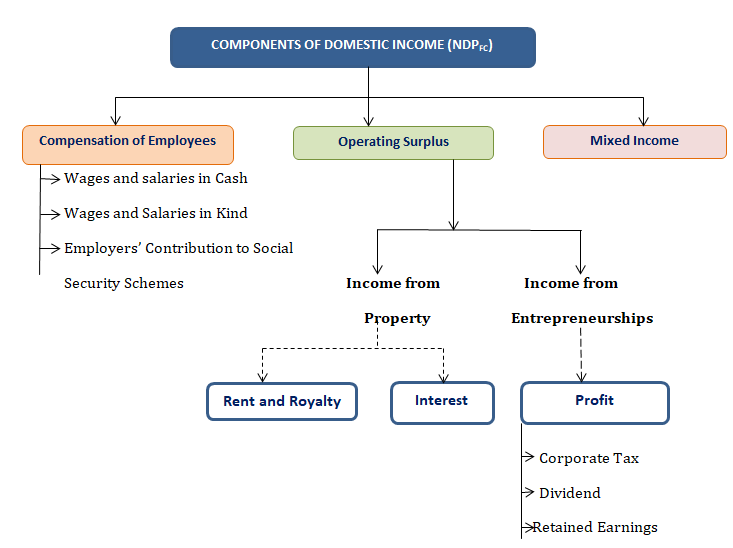
The sum total of all the factor incomes earned within the domestic territory of a country is known as ‘Domestic income (NDPFC)’. System of National Accounts (SNA) 1993 (joint publication of United Nations and World Bank) has elaborated the following components of Income Method:
I. Compensation of Employees (COE) – COE refers to the sum total of remuneration paid to employees by employers for rendering productive services in the form of cash / kind/social security contributions.
- Wages and salaries in cash – It includes all monetary benefits, like wages, salaries, bonus, dearness allowances, commission, etc.
- Wages and salaries in kind – It includes all non-monetary benefits, like rent free home, free car, free medical and educational facilities, etc.
- Employers’ contribution to social security schemes – It includes contribution made by employer for the social security of employees. For example – contribution to provident fund, gratuity, labour welfare funds, etc.
II. Rent and Royalty – Rent is factor income earned by the owners for lending their services such as land, buildings, etc. Royalty is the income earned by a person institution for lending intellectual property rights and right of subsoil assets. For example – owners of mineral deposits like coal, iron ore, natural gas, etc. can earn income by giving mining rights to the contractors.
III. Interest – Interest refers to amount received for lending funds to a production unit, For example – interest paid by a firm (private or government) to household or interest paid by bank to the individuals will be included in the interest income as it contributes to the production of goods and services.
IV. Profit – Profit is the reward to the entrepreneur for his contribution to the production of goods and services. It is the residual income, which an entrepreneur earns after paying all the other factors of production.
- Corporate tax
- Dividend
- Retained Earnings
rofit = Corporate Tax + Dividend + Retained Earnings
V. Mixed Income – it is the income generated by own-account workers (like farmers, barbers, etc.) and unincorporated enterprises (like retail trades, small shopkeepers, etc.) It is the income of people who won and operate a business enterprise using their own factor services. For example – The income of a doctor running a clinic at his residence.
Precautions of Income Method
Following precautions are to be considered while estimating national income by Income Method:
- Transfer Incomes – (like scholarships, donations, charity, old age penstions, etc.) are not included in the National income because such receipts are not connected with any productive activity and there is no value addition.
- Income from sale of second-hand goods will not be included – In National income as their original sale has already been counted. If they are included again, it would lead to double counting.
- Income from sale of share, bonds and debentures will not be included – As such transactions do not contribute to current flow of goods and services. These financial assets are mere paper claims and involve a change of title only.
- Windfall gains – (like income from lotteries, horse race, etc.) are not included as there is no productive activity connected with them.
- Imputed value of services provided by owners of production units will be included – Imputed value of owner-occupied houses, interest on own capital, production for self-consumption, etc. will be included as these are productive and add to the flow of goods and services.
3. EXPENDITURE METHOD
Factor income earned by factors of production is spent in the form of expenditure on purchase of goods and services produced by firms.
- This method measures national income as sum total of final expenditures incurred by households, business firms, government and foreigners.
- This total final expenditure is equal to gross domestic product at market price,
Final Expenditure = GDPMP
- This method is also known as ‘Income Disposal Method’ or ‘Consumption and Investment Method’.
Components of Final Expenditure
Expenditure is undertaken by all the sectors of an economy: Households, Government, Firms and the Foreign Sector.
- Private Final Consumption Expenditure (PFCE) – It refers to expenditure incurred by households and private non-profit institutions serving households on all types of consumer goods, i.e. durable (except houses), semi-durable, non-durable goods and services.
PFCE = Household Final Consumption Expenditure + Private Non-Profit Institutions Serving Households Final Consumption Expenditure.
2. Government Final Consumption Expenditure (GFCE) – It refers to the expenditure incurred by general government on various administrative services like defense, law and order, education etc. Government produces goods and services with the aim of social welfare without any intention of earning profits.
3. Gross Domestic Capital Formation (GDCF) or Gross Investment – It refers to the addition to capital stock of the economy. It represents the expenditure incurred on acquiring goods for investment by the production units located
within the domestic territory. There are two components of GDCF:
I. Gross Fixed Capital Formation – It refers to the expenditure incurred on purchase of fixed assets. This expenditure is generally divided into three sub-categories:
- Gross Business Fixed Investment
- Gross Residential Construction
- Gross Public Investment
II. Inventory Investment (Change in Stock or Change in Inventory) – It refers to the physical change in the stock of raw material, semi-finished goods and finished goods lying with the producers.
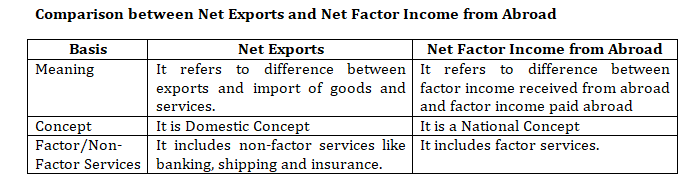
4. Net Exports (X – M) – It refers to the difference exports and imports of a country during a period of one year.
- Export (X) refer to expenditure by foreigners on purchase of domestic products. The exported goods have been produced within the country’s domestic territory. So, they are included in output of an economy.
- Imports (M) are the expenditure by residents on foreign products. Imports are deducted to obtain domestic product as they are not produced within the domestic territory.
Precaution of Expenditure Method
The various precautions to be taken while using the Expenditure Method are:
- Expenditure on Intermediate Goods will not be included in the national income – as it is already included in the value of final expenditure. If it is included again, it will lead to double counting of expenditures.
- Transfer Payments are not included – As such payments are not connected with any productive activity and there is no value addition.
- Purchase of second-hand goods will not be included – As such expenditure has already been included when they were originally purchased. Such goods do not affect the current flow of goods and services. However, any commission or brokerage on such goods is included as it is a payment made for productive service.
- Purchases of financial assets – (Shares, debentures, bonds etc.) will not be included as such transactions do not contribute to current flow of goods and services. These financial assets are mere paper claims and involve a change of title only. However, any commission or brokerage on such financial assets is included as it is a productive service.
- Expenditure on own account production – (like production for self-consumption, imputed value of owner occupied houses, free services from general government and private non-profit institution serving households) will be included in the national income since these are productive services.
NATIONAL INCOME AT CURRENT PRICE AND CONSTANT PRICE
National Income of Current Price
It is the money value of final goods and services produced by normal residents of a country in a year, measured at the prices of the current year. For example, measurement of India’s National Income of 2024-25 at the prices of 2024-25.
- It is also known as ‘Nominal National Income’.
- It does not show the true picture of economic growth of a country as any increase in nominal national income may be due to rise in price level without any change in physical output.
So, In order to eliminate the effect of price changes, national income is also estimated at a constant price.
National Income at Constant Price
It is the money value of final goods and services product by normal residents of a country in a year, measured at base year price. Base Year is a normal year which is free from price fluctuations. Presently, 2011-12 is taken as the base year in India.
If we measure India’s National Income of 2024-25 at the price of 2011-12, then it is termed as ‘National Income at constant price’.
- It is also known as ‘Real National Income’.
- It shows the true picture of economic growth of a county as any increase in real national income is due to increase in output only.
Conversion of National Income at Current Price into Constant Price
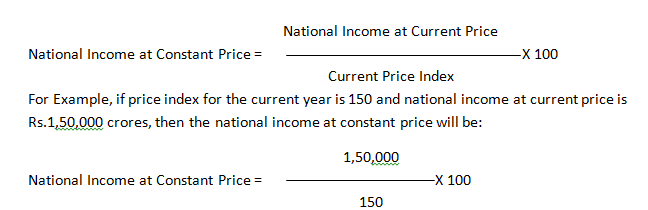
This can be done by eliminating the effects of price change on national income with the help of a suitable ‘Price Index’. Price Index number which shows the change in price level between two different time periods. It indicates whether a rise or a fall in the national income from one year to another is real or not.
It is done with the help of the following formula:
NOMINAL GDP AND REAL GDP
- Nominal GDP or GDP at Current Price: When GDP of a given year is estimated on the basis of price of the same year, it is called nominal GDP.
- Real GDP or GDP at Constant Price: When GDP of a given year is estimated on the basis of price of Base Year, it is called real GDP.
Which is better: Nominal GDP or Real GDP?
Real GDP is better as compared to Nominal GDP because of following reasons:
- Real GDP helps in determining the effect of increased production of goods and services as it is affected only by change in physical output. On the other hand, Nominal GDP can increase even without any increase in physical output as it is affected by change in prices also.
- Real GDP is a better measure to make periodic comparison in the physical output of goods and services over different years.
- Real GDP facilities international comparison of economic performance across the countries.
Determination of Nominal GDP and Real GDP
Nominal GDP and Real GDP can be determined in the following manner:
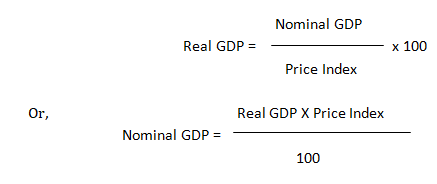
Example for Better Understanding: Estimate the value of Nominal Gross Domestic Product for hypothetical economy, the value of Real Gross Domestic Product and Price and Price Index are given as Rs.500 crores and 125 respectively.
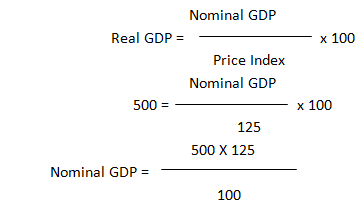
GDP Deflator (or Price Index)
As we have seen, Nominal GDP is affected by both changes in price and physical output. On the other hand, Real GDP is affected by change in physical output only. To eliminate the effect of price changes and to determine the real change in physical output, we can use ‘GDP Deflator’. GDP Deflator measures the average level of prices of all the goods and services that make up GDP. It is the ratio of Nominal GDP to Real GDP of current year.
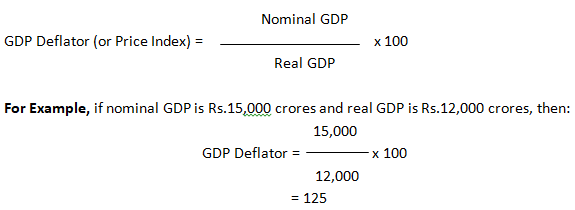
GDP and Walfare – GDP is often considered as an index of welfare of the people. Welfare means a sense of material well-being among the people. Welfare is generally measured in terms of availability of goods and services per person. An increase in the Real GDP means increase in the physical output in the economy, i.e. greater per head availability of goods and services, which means higher level of welfare of people. So, higher GDP is generally taken as greater welfare of people.
However, this generalization may not be correct due to following limitations or reasons:
- Distribution of GDP: It is possible that with rise in GDP, inequalities in the distribution of income may also increase, i.e. the gap between rich and poor increase (i.e. rich become more rich and poor become more poor). So, if with rise in GDP, inequality increases, then welfare of the people may not rise as much as the rise in GDP.
- Change in prices: If increase in GDP is due to rise in prices and not due to increase in physical output, then it will not be a reliable index of economic welfare.
- Non-monetary exchanges: Many activities in an economy are not evaluated in monetary terms. For example, non-market transactions like services of housewife, kitchen gardening, leisure time activities, etc. are not included in GDP, due to non-availability of data. However, such activities influence the economic welfare.
- Externalities: Externalities refer to benefits or harms of an activity caused by a firm or an individual, for which they are not paid or penalized. Activities which result in benefits to others are termed as positive externalities and activities which result in harm to others are termed as negative externalities.
- Rate of population growth: GDP does not consider the changes in the population of a country. If rate of population growth is higher than the rate of growth of GDP, then it will decrease the per capita availability of goods and services, which will adversely affect the economic welfare.
- Composition of GDP: Higher GDP will promote welfare only if increased output comprises of goods of mass consumption and essential goods. Increase in production of war goods does not lead to any direct increase in the welfare of people. So, composition of GDP also affects welfare.
Short Answer type
- Discuss briefly the meaning of Value Addition.
Ans. Value addition refers to the increase in the value of a product at each stage of production. It
is calculated as:
[\text{Value Added} = \text{Value of Output} – \text{Intermediate Consumption}]
2. What is meant by Problem of Double Counting? How this problem can be avoided?
OR – Define the problem of double counting in the computation of national income. State any two approaches to correct the problem of double counting.
Ans. Double counting means counting the value of the same good more than once while
estimating national income. It leads to overestimation of national income.
It can be avoided by:
a. Counting only final goods and services.
b. Using the value added method.
3. What Precautions (any four) should be taken while Estimating National Income by Production Method?
Ans.
- Value of only final goods should be included.
- Sale and purchase of second-hand goods should not be included.
- Production for self-consumption should be included.
- Transfer payments should not be included.
4. What is mean by of Compensation of Employees? Discuss three elements of compensation of employees.
Ans. Compensation of employees means payment made by employers to employees for
rendering services.
Its elements are:
- Wages and salaries in cash.
- Wages and salaries in kind.
- Employer’s contribution to social security schemes.
5. Define Operating Surplus. State its components.
Or – discuss briefly the three components of ‘Operating Surplus’.
Or – State the meaning of ‘Income from Property and Entrepreneurship’.
Ans. Operating surplus is the income earned by owners of enterprises after paying
compensation to employees and production taxes.
Components:
- Rent
- Interest
- Profit
6. Discuss briefly, the concept of ‘Mixed Income of Self-Employed’ under the Income method.
Ans. Mixed income refers to the income of self-employed persons where it is difficult to
separate wages, rent, interest and profit. Example: income of shopkeepers, farmers, etc.
7. What Precautions (any four) should be taken while Estimating National Income by Income Method?
Ans.
- Transfer incomes should not be included.
- Income from illegal activities should not be included.
- Windfall gains should not be included.
- Only factor incomes earned for productive services should be included.
8. What is meant by Gross Domestic Capital Formation? State Its Components.
Ans. Gross Domestic Capital Formation means addition to the stock of physical assets in an economy during a year.
Components:
- Gross fixed capital formation
- Change in stocks
- Net acquisition of valuables
9. Explain any two Precautions that should be taken into account, while Estimating National Income by Expenditure Method.
Ans.
- Expenditure on intermediate goods should not be included.
- Expenditure on second-hand goods should be excluded.
10. Give the Meaning of Nominal GDP and Real GDP. Which of these is the indicator of economic welfare?
Ans. Nominal GDP is measured at current year prices.
Real GDP is measured at constant prices.
Real GDP is considered a better indicator of economic welfare.
11. Explain how distribution of gross domestic product is its limitation as a measure of economic welfare.
Or – “Gross domestic product (GDP) as an indicator of welfare loses its significance if the distribution of income turns unequal.’ Justify the given statement with valid reason.
Ans. GDP may increase even when income is unevenly distributed. If the benefits of growth are enjoyed only by a few people, economic welfare of society may not improve.
12. Difference between Real GDP and Nominal GDP
Ans.

13. Given reason Identify Final or Intermediate Expenditure or intermediate expenditure.
Ans.
(i) Maintenance of office building – Intermediate expenditure.
(ii) Improvement of a machine in a factory – Final expenditure.
14. GDP and Economic Welfare
Ans. Yes, I agree. Many services like household work, voluntary services and non-monetary
exchanges increase welfare but are not included in GDP because they are not sold in the
market.
15. “In the past few decades, Indian economy has been fairly benefitted by positive Externalities created by rapid rise in Infrastructure.” Justify the given statement with valid arguments.
Ans. Rapid growth of infrastructure improves transport, communication and electricity facilities. It increases productivity, employment and economic growth, benefiting the economy as a whole.
16. GDP and Sum of GVA in an economy are always equal. Justify the given statement with valid arguments.
Ans. GDP and sum of GVA are equal because GDP is obtained by adding net indirect taxes to
GVA. Both represent the value of final goods and services produced in the economy.
17. Is GDP a True Index of Economic Welfare of the people? Give two reasons in support of your answer.
Or – “Gross Domestic Product does not give us a clear indication of economic welfare of a country.” Defend or refute the given statement with valid reason.
Ans. No, GDP is not a perfect measure of welfare because:
1. It ignores distribution of income.
2. Non-market activities are not included in GDP.
18. Suppose only one Good ‘X’ is produced in the country. Output of Good X during year 2018 and 2019 were 100 units and 110 units respecitvley. The market price of the product during the two years was Rs.50 and Rs.55 per unit respectively. Calcualte the Percentage Change in Real GDP in year 2019 using 2018 as the base year.
Asn. Real GDP in 2018 = (100 \times 50 = 5000)
Real GDP in 2019 at base year price = (110 \times 50 = 5500)
[\text{Percentage Change} = \frac{5500-5000}{5000}\times100]
\text{Percentage Change in Real GDP}=\frac{5500-5000}{5000}\times100=10%
Therefore, percentage change in Real GDP = **10%**.
19. State the various components of the Income Method that are used to calculate national income.
Ans. Components of Income Method
1. Compensation of employees
2. Operating surplus
3. Mixed income of self-employed persons
20. If the Nominal GDP is Rs.1,200 and Price Index (with base = 100) is 120, calculate
Real GDP.
Ans. Real GDP = (Nominal GDP × 100) / Price Index
\text{Real GDP} = \frac{1200 \times 100}{120} = 1000
∴ Real GDP = ₹1,000.
21. If the Real Gross Domestic Product is Rs.16,000 crores and Gross Domestic Product at current prices is Rs.20,000 crores, calculate the value of price index.
Ans. Price Index = (Nominal GDP / Real GDP) × 100
\text{Price Index} = \frac{20000}{16000} \times 100 = 125
∴ Price Index = 125.
22. In an economy, if the Real Gross Domestic Product (GDP) is Rs.300 crore and Price Index (With base = 100) is 110, calculate the Nominal Gross Domestic Product.
Ans. Nominal GDP = (Real GDP × Price Index) / 100
\text{Nominal GDP} = \frac{300 \times 110}{100} = 330
∴ Nominal GDP = ₹330 crore.
23. “In the estimation of Gross Domestic Product (GDP) using expenditure method, focus lies only on expenditure by the residents of the country.” Do you agree with the given statement? Give valid reasons for your answer.
Ans.
24. Government spends on child immunization programme. Analyse its impact on Gross Domestic Product and welfare of the people.
Ans. No, I do not agree with the statement. Under the Expenditure Method, expenditure by both residents and non-residents within the
domestic territory is included in GDP. Government expenditure on child immunization increases production of health services, so GDP increases. It improves health standards and welfare of the people.
25. If normal income is Rs.500 and price index is 125, calculate real income.
And. Real Income = (Nominal Income × 100) / Price Index
\text{Real Income} = \frac{500 \times 100}{125} = 400
∴ Real Income = ₹400.
26. Using the following information, calculate and analyse the value of Gross Domestic Product (GDP) Deflator:

Ans.
GDP Deflator = (Nominal GDP / Real GDP) × 100
2014–15
\text{GDP Deflator} = \frac{6.5}{6.5} \times 100 = 100
2016–17
\text{GDP Deflator} = \frac{9}{7.2} \times 100 = 125
Analysis:
GDP Deflator increased from 100 to 125, showing a rise in the general price level.
27. What is real GDP? State three limitations of GDP as an index of economic welfare.
Ans. Real GDP – Real GDP refers to GDP measured at constant (base year) prices.
Limitations of GDP as an index of welfare:
1. Ignores externalities.
2. Does not show income distribution.
3. excludes non-monetary activities.
28. “Gross Domestic Product (GDP) Deflator is represented by the ratio of Real GDP and Nominal GDP.” Do you agree with the given statement? Justify your answer with valid arguments and a hypothetical numerical example.
Ans. No, I do not agree with the statement.
GDP Deflator = (Nominal GDP / Real GDP) × 100, not Real GDP / Nominal GDP.
Example:
\text{GDP Deflator} = \frac{2000}{1600} \times 100 = 125
29. State the various components of the Expenditure Method that are used to calculate national income.
Ans. Components of Expenditure Method:
1. Private Final Consumption Expenditure (PFCE)
2. Government Final Consumption Expenditure (GFCE)
3. Gross Domestic Capital Formation (GDCF)
4. Net Exports (X – M)
30. Suppose a ban is imposed on consumption of liquor in the country. Examine its effected on (a) Gross Domestic Product and (b) Welfare.
Ans.
(a) Effect on GDP – Ban on liquor consumption will reduce production and expenditure, so GDP will fall.
(b) Effect on Welfare – Health and social welfare of people will improve, so welfare will increase.
31. Explain the concepts of Real GDP and Nominal GDP, using a suitable numerical example.
Or – Distinguish between Real Gross Domestic Product and Nominal Gross Domestic Product, using a suitable numerical example.
Ans. Nominal GDP – GDP measured at current year prices is called Nominal GDP.
Real GDP – GDP measured at base year prices is called Real GDP.
Example:
\text{Real GDP} = \frac{2400 \times 100}{120} = 2000
If Current Price GDP = ₹2400 and Price Index = 120, then Real GDP = ₹2000.
32. Distinguish between ‘Fixed Investment’ and ‘Inventory Investment’.
Ans.
Fixed Investment Inventory Investment
Expenditure on fixed assets Change in stock of unsold goods
Example: Machinery, building Example: Finished goods stock
33. “ The public investment on the construction of a multi-lane flyover may reduce traffic congestion.” On the basis of above statement, discuss its likely impact on Gross Domestic Product (GDP) and welfare in an economy.
Ans. Construction of a flyover increases production and employment, so GDP rises.
Reduction in traffic congestion saves time and fuel, increasing welfare.
34. Define net exports. How is it different from net factor income from abroad?
Ans. Net Exports:
Net Exports = Exports – Imports.
Difference:
Net exports relate to goods and services.
Net factor income from abroad relates to factor incomes.
35. Distinguish between ‘value of output’ and ‘value added’.
Ans. Value of Output: Total value of goods and services produced by a producer.
Value Added: Value Added = Value of Output – Intermediate Consumption.
36. Define the following: (i) Net Exports; (ii) Externalities; and (iii) Problem of Double Counting.
Ans.
(i) Net Exports: Net Exports = Exports – Imports.
(ii) Externalities: Effects of an economic activity on third parties are called externalities.
(iii) Problem of Double Counting: Counting the value of the same good more than once is called double counting.
37. “Externalities can be classified negative or positive, however it is not necessary that they will be directly correlated with the Gross Domestic Product.” Do you agree with the given statement? Give valid reasons in support of your answer.
Ans. Yes, I agree with the statement.
Externalities may be positive or negative, but they are not always directly related to GDP.
For example: Pollution is a negative externality even when GDP rises. Public parks create positive externalities though their full benefits may not be reflected in GDP.
38. ‘Compensation to the victims of a cyclone is an example of a welfare measure taken by the government.’ State with valid reason, should it be included it be included/not included in the estimation of national income of India.
Ans. Compensation given to cyclone victims will not be included in national income because it is a transfer payment and no current production takes place in return.
39. Distinguish between net exports and net factor income from abroad.
Ans. Net Exports Net Factor Income from Abroad
Exports – Imports Factor income from abroad – Factor income paid abroad
Related to goods and services Related to factor services
40. On the basis of the following hypothetical data:

Ans. Percentage Change in Real GDP:
\%\Delta \text{Real GDP} = \frac{4500-4000}{4000} \times 100 = 12.5\%
∴ Real GDP increased by 12.5%.
41. Define intermediate consumption and explain it with an example. How is it different from final consumption?
Ans. Intermediate Consumption: Goods and services used for further production are called intermediate consumption.
Example: Flour used in making bread.
Difference from Final Consumption: Intermediate goods are used for further production.
Final goods are purchased for final use.
42. Distinguish between Rent and Royalty.
Ans. Rent Royalty – Payment for use of land/building Payment for use of natural resources
Example: House rent
Example: Payment for mining minerals
43. “National income exceeds domestic income only when exports are agreater than imports.” Comment.
Ans. The statement is incorrect. National Income exceeds Domestic Income only when Net Factor Income from Abroad (NFIA) is positive, not when exports are greater than imports.
Long Answer Type Questions
- Explain the production method of estimating national income.
Ans. The Production Method, also known as the Value Added Method, measures national income by estimating the contribution of each producing enterprise within the domestic territory of a country.
Step 1: Identify and classify all producing units into three main sectors: Primary, Secondary, and Tertiary.
Step 2: Calculate Gross Value Added at Market Price (GVA at MP) for each sector. Value Added = Value of Output minus Intermediate Consumption.
Step 3: Summing up the GVA at MP of all sectors gives the Gross Domestic Product at Market Price (GDP at MP).
Step 4: To find the National Income (NNP at FC), we subtract Depreciation and Net Indirect Taxes (NIT) from GDP at MP, and finally add Net Factor Income from Abroad (NFIA).
Formula: NNP at FC = GDP at MP minus Depreciation minus NIT plus NFIA.
2. Discuss in brief the various precautions of value added method.
Answer: While using the Value Added Method, the following precautions must be observed:
1. Avoid Double Counting: Only the value of final goods should be included. Intermediate goods are excluded because their value is already included in the final product.
2. Second-hand Goods: The sale and purchase of second-hand goods are not included as they were part of the production of a previous year.
3. Self-consumption: The value of goods produced for self-consumption (like a farmer’s
crop) should be included at their estimated market value.
4. Imputed Rent: The imputed rent of owner-occupied houses should be included because all houses have a rental value.
5. Services for Self-consumption: Domestic services like those of a housewife are excluded as it is difficult to ascertain their market value.
3. Describe the steps involved in the estimation of national income by this method. State any two precautions that must be taken while estimating national income by this method.
Answer:
Steps:
- Classification of Factor Incomes: Identify and classify all factor payments into Compensation of Employees, Operating Surplus (Rent plus Royalty plus Interest plus Profit), and Mixed Income.
- Calculation of Domestic Income: Summing these three components gives Net Domestic Product at Factor Cost (NDP at FC).
- Calculation of National Income: Add Net Factor Income from Abroad (NFIA) to NDP at FC to arrive at NNP at FC. Precautions:
- Transfer Incomes: Unearned incomes like old-age pensions or scholarships should be excluded.
- Windfall Gains: Incomes from lotteries or horse racing are excluded as they do not reflect productive activity.
4. State any six precautions which must be taken while estimating factor income.
Answer:
1. Transfer Incomes: Exclude transfer payments like gifts or subsidies as no productive service is rendered.
2. Illegal Income: Income from illegal activities (smuggling, gambling) is excluded.
3. Sale of Second-hand Goods: Excluded, as these were counted in the year of original production.
4. Windfall Gains: Exclude sudden gains like lottery winnings.
5. Imputed Rent: Include the estimated rent of owner-occupied houses.
6. Death Duties/Wealth Tax: Exclude these as they are paid out of past savings or wealth, not current income.
5. Explain the precautions that are taken while estimating national income by value added method.
Answer:
1. Intermediate Goods: Exclude to avoid double counting.
2. Second-hand Goods: Exclude the sale value, though commission earned on them is included.
3. Self-consumption: Include the value of goods produced for self-use.
4. Imputed Rent: Include the rental value of owner-occupied property.
5. Own-account Production: Include the value of fixed assets produced by the enterprise for its own use.
6. Explain in brief the various components of expenditure method.
Answer:
The components are:
- Private Final Consumption Expenditure: Total spending by households and private non profit institutions on consumer goods and services.
- Government Final Consumption Expenditure: Expenditure by the government on various administrative services like defense and education.
- Gross Domestic Capital Formation: This refers to investment and includes Gross Fixed Capital Formation and Change in Stock.
- 4.Net Exports: The difference between the value of exports and imports.
7. Discuss the various steps of expenditure method for calculating national income
Answer:
- Identification: Identify all economic units incurring final expenditure within the domestic territory.
- Classification: Group the expenditures into Private Consumption, Government Consumption, Investment, and Net Exports.
- Summation: Add these components to get Gross Domestic Product at Market Price (GDP at MP).
- Adjustment: Subtract Depreciation to get NDP at MP. Subtract Net Indirect Taxes to get NDP at FC.
- Final Step: Add Net Factor Income from Abroad (NFIA) to NDP at FC to reach National Income (NNP at FC).
8. Explain the precautions that should be taken while estimating national income by expenditure
Answer:
- Intermediate Expenditure: Expenditure on intermediate goods should be excluded to prevent double counting.
- Transfer Payments: Government transfer payments are excluded.
- Second-hand Goods: Expenditure on second-hand goods is excluded.
- Financial Assets: Purchase of shares or bonds is excluded as these are just paper claims.
- Self-use Production: Expenditure on goods produced for own use (investment) should be included.
9. Why are exports included in the estimation of domestic product by the expenditure method? Can gross domestic product be greater than gross national product? Explain.
Answer:
Exports: Exports are included because they represent the value of goods and services produced within the domestic territory of a country, regardless of who buys them.
GDP vs GNP: Yes, GDP can be greater than GNP. This occurs when Net Factor Income from Abroad (NFIA) is negative. A negative NFIA means that the factor income paid to the rest of the world is greater than the factor income received from abroad.
Relationship: GNP = GDP plus NFIA. If NFIA is negative, GNP will be less than GDP.
10. Distinguish between real gross domestic product and nominal gross domestic product. Can gross domestic product be used as an index of welfare of the people? Give two reasons.
Answer:
Nominal GDP: It is the value of final goods and services produced in a year, measured at current year prices.
Real GDP: It is the value of final goods and services measured at constant (base year) prices.
GDP as Welfare Index: No, GDP is not a perfect index of welfare because:
- Distribution of Income: If the increase in GDP is concentrated in the hands of a few rich people, the welfare of the masses does not improve.
- Non-monetary Exchanges: GDP ignores many productive activities like services of housewives or barter trade, which contribute to welfare.
11. How will you treat the following while estimating national income of India? Give reasons for your answer.
- Salaries received by Indian residents working in Russian Embassy in India.
- Profits earned by an Indian bank from its branches abroad.
- Goods and Services Tax received by the government.
Answer:
(i) Salaries received by Indian residents in Russian Embassy: Included in National Income. Reason: It is factor income received by residents from the rest of the world (part of NFIA).
(ii) Profits earned by an Indian bank from its branches abroad: Included in National Income.
Reason: It is factor income from abroad earned by a resident.
(iii) Goods and Services Tax (GST) received by the government: Excluded from National Income.
Reason: National income is measured at factor cost, and GST is an indirect tax which is a transfer payment to the government.
12. Explain the problem of double counting in estimating national income, with the help of an example. Also explain two alternative ways of avoiding the problem.
Answer:
Problem: Double counting happens when the value of a good is counted more than once.
Example: Suppose a farmer sells wheat for 500 to a miller. The miller sells flour for 700 to a baker. The baker sells bread for 1000 to consumers. If we add 500 + 700 + 1000, we get 2200. This is wrong because the value of wheat is counted thrice.
Ways to avoid:
- Final Product Method: Only include the value of the final product (Bread = 1000).
- Value Added Method: Sum the value added at each stage (500 + 200 + 300 = 1000).
13. Explain the concept of “real income”. Explain why, due to the presence of externalities, real national income in itself cannot be treated as a true index of welfare.
Answer:
- Real Income: Real National Income is the national income measured at constant prices.
- Externalities: These are side effects of production for which no payment is made. Negative
- Externalities, like a factory polluting a river, reduce welfare. Since GDP does not subtract the cost of this pollution, it overestimates welfare. Positive Externalities, like a public garden, increase welfare but are not included in GDP, leading to an underestimation of welfare.
14. Distinguish between ‘nominal income’ and ‘real income’. Explain why due to the presence of non-monetary production, real national income on its own cannot be treated as a true index of welfare.
Answer:
- Nominal Income: Income measured at current market prices.
- Real Income: Income measured at base year prices.
- Non-monetary Production: Many activities (like household work) are not traded in the market. Since these are not included in GDP, the actual level of services available is higher than what GDP shows. Therefore, GDP is not a true index of welfare.
15. Explain any four limitations of using GDP as a measure/index of welfare of a country.
Answer:
- Distribution of GDP: An increase in GDP may not reach the poor if it is skewed towards the rich.
- Composition of GDP: If GDP grows because of more production of weapons, it does not mean people’s welfare has increased.
- Non-monetary Exchanges: Many welfare-enhancing activities stay out of GDP calculations.
- Externalities: Environmental degradation caused by industrial growth is ignored by GDP.
16. Explain ‘non’ monetary exchanges’ as a limitation of using gross domestic product as an index of welfare of a country.
Answer: In many economies, several productive activities do not involve money. Barter transactions or services provided by family members are not recorded in GDP due to lack of data. Since these activities contribute to the standard of living but are omitted from GDP, the GDP figures underestimate the actual welfare of the people.
17. How will you treat the following while estimating domestic product of a country? Give reasons for your answer:
- Profits earned by branches of country’s bank in other countries.
- Gifts given by an employer to his employees on Independence Day.
- Purchase of goods by foreign tourists.
Answer:
(a) Profits earned by branches of country’s bank in other countries: Excluded from Domestic Product. Reason: It is earned outside the domestic territory.
(b) Gifts given by an employer to his employees: Excluded from Domestic Product.
(c) Reason: It is a transfer payment, not a factor payment.
(d)Purchase of goods by foreign tourists:
(e)Included in Domestic Product. Reason: These goods are produced within the domestic territory and are considered exports.
18. Differentiate between National Income at Current Prices and National Income at Constant Prices. Which of the two presents a better view of the economic growth of economy and why?
Answer:
National Income at Current Prices: Measured at the prices prevailing in the year of production. National Income at Constant Prices: Measured at base year prices.
Better View: National Income at Constant Prices provides a better view because it eliminates the effect of inflation and shows the actual increase in production.
19. Explain the meaning of Real Gross Domestic Product and Nominal Gross Domestic product, using a numerical example
Answer:
Nominal GDP: Calculated as Current Quantity multiplied by Current Price.
Real GDP: Calculated as Current Quantity multiplied by Base Year Price.
Example: Suppose a country produces only Cloth.
Base Year: Price = 10, Quantity = 100 meters. GDP = 1000.
Current Year: Price = 20, Quantity = 120 meters.
Nominal GDP: 120 multiplied by 20 = 2400.
Real GDP: 120 multiplied by 10 = 1200.
The Nominal GDP rose by 1400, but the Real GDP shows that the actual production only increased from 1000 to 1200. Thus, Real GDP gives a clearer picture of growth.
class 12 economics Sandeep Garg Unsolved practical
UNSOLVED PRACTICAL
Practical on Value Added Method
- In an economy, following transactions took place. Calculate value of output and value added by Firm B:
- Firm A sold to firm B goods of Rs.80 crore; to firm C Rs.50 crore; to household Rs.30 crore and goods of value of Rs.10 crore remains unsold
- Firm B sold to firm C goods of Rs.70 crore; to firm D Rs.40 crore; goods of value Rs.30 crore were exported and goods of value Rs.5 crore was sold to government.
Solution –
Value of output = Sales + change in stock
= 70+30+40+5) + 0
= Rs.145 crore
Value Added by Firm B
(GDPMP) = Sales + Change in stock – IC
= Value added = I.C
= 145 – 80
= Rs.65 crore
2. Calculate Value added by firm A and firm B.
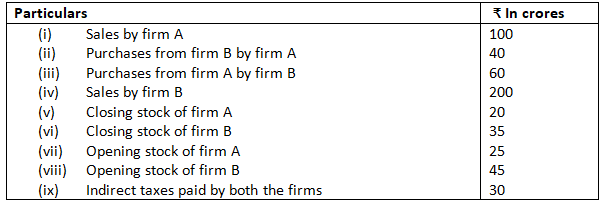
Solution –
Value added by firm A = Sales + Change in stock – I.C
= 100 + (20 – 25) – 40
= 100 – 5 – 40
= 100 – 45
= Rs.55 crore
Value added by firm B
= Value of output – Intermediate consumption
= (Sales + change in stock) – Intermediate consumption
= 200 + (35 – 45) – 60
= Rs.135 crores
3. Calculate net value added at factor cost from following data:
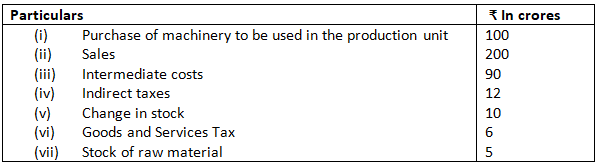
Solution –
GDPMP = Sales + change in stock – I.C
= 200 + 10 – 90
= 210 – 90
= Rs.120 crore
NVAFC = Value of output – Intermediate consumption – Depreciation – Net Indirect taxes
= (200 + 10) – 90 – 12
= 210 – 102
= Rs.1,08 crores
4. Calculate NDPFC.
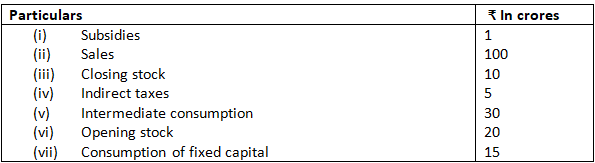
Solution –
NDPFC = Value of output – Intermediate consumption – Depreciation – Net indirect taxes
= [100 + (10 – 20) ] – 30 – 15 – [15 – 1]
= 90 – 45 – 4
= Rs.41 crores
5. Calculate ‘value of output’ from the following data:
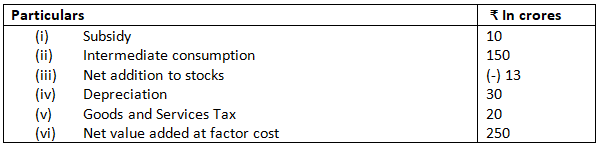
Solution –
NVAFC = Value of output – Intermediate consumption – Depreciation – Net Indirect taxes
250 = Value of output – 150 – 30 – (20 – 10)
250 + 150 + 30 + 10 = Value of output
Rs.440 lakhs = value of output
6. Calculate value of output and gross value added at market price.
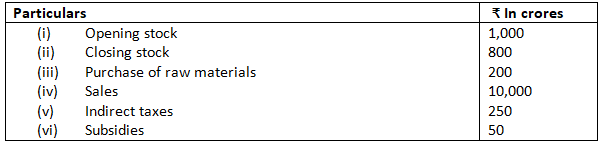
Solution –
Value of output = Sales + change in stock
= 10,000 + (800 – 1,000)
= 10,000 – 200
= Rs.9800 crores
GVAMP = value of output – Intermediate consumption
= 9,800 – 200
= Rs.9,600 crores
7. Calculate the value of ‘Sales’ from the following data:
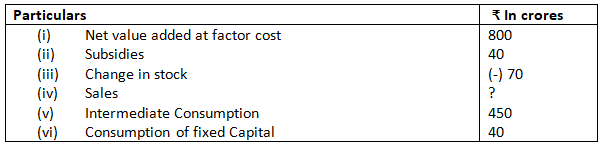
Solution –
NDPFC = 800
GDPMP = NDPFC + Dep. + NIT
= NDPFC + Dep. + (IT – Subsidies)
= 800 + 40 + (0 – 40)
= 800 crore
GDPMP = Sales + Change in stock – I.C
800 = Sales + (-70) – 450
800 = Sales – 70 – 450
800 + 70 + 450 = Sales
Rs.1320 = sales
Sales = Rs.1320 crores
7a. Calculate “Intermediate Consumption” from the following data:

Solution –
GDPMP = NDPFC + Dep. + NIT
= 100 + 30 + (IC – 5)
= 100 + 30 + (0 – 15)
= 130 – 15
= Rs.115 crore
GDPMP = Value of output – IC
115 = 300 _ IC
IC = 300 – 115
IC = Rs.185 crore
7b. Calculate Net Value Added at Factor Cost (NVAFC) from the following data:
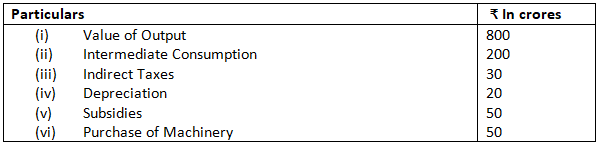
Solution –
GDPMP = Value of output – IC
= 800 -200
= 600
NDPFC = GDPMP – Dep. – NIT
= GDPMP – Dep. – (IT – Subscription)
= 600 – 20 – (30 – 50)
= 600 – 20 – (-20)
= 600 – 20 + 20
= Rs.600 crore
8. Calculate Net Value Added at Factor Cost:
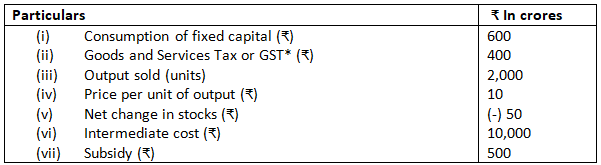
Solution –
NVAFC = Value of output – Intermediate consumption – Depreciation – net Indirect taxes
Value of output = (Quantity x Price) + change in stock
= 2,000 x 10 + (-50)
= 20,000 – 50
= Rs.19,950
NVAFC = 19,950 – 10,000 – 600 – (400 – 500)
= 9,350 + 100
= Rs.9,450
9. On the basis of the given data, estimate the value of Net Value Added at Factor Cost (NVAFC):
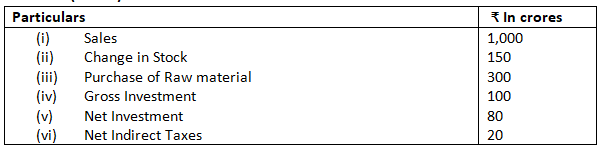
Solution –
GDPMP = Sales + Change in stock – IC
= 1000 + 150 – 300
= Rs.850 crore
NDPFC (NVAFC) = GDPMP – Dep. – NIT
= 850 – (Gross I – Net I) – 20
= 850 – (100 – 80) – 20
= 850 – 20 – 20
= Rs.810 crore
10. Calculate Net Value Added at Factor Cost (NVAFC) from the following data:
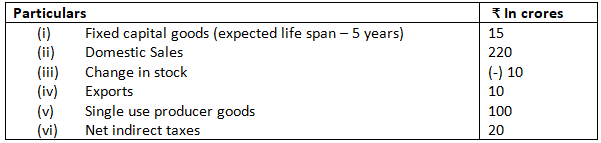
Solution –
GDPMP = Sales + Change in stock – IC
= (220 + 10) + (-10) – 100
= 230 – 10 – 100
= 230 – 110
= 120 lakh
NDPFC = GDPMP = – Dep. _ NIT
= 120 – 3 – 20
= Rs.97 lakh
Depreciation = Cost of F.A / Life of F.A
= 15 / 5
= Rs.3 lakh
11. Calculate ‘Sales’ from the following data:
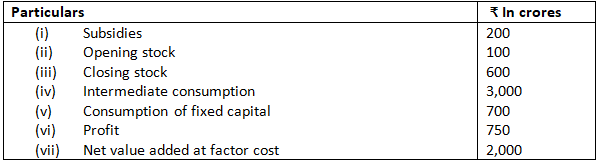
Solution –
NVAFC = Sales + change in stock – Intermediate consumption – Depreciation – Net Indirect taxes
2,000 = Sales + (600 – 100) – 3,000 – 700 + 200
2,000 – 500 + 3,000 + 700 – 200 = sales
5,700 – 700 = Sales
Rs.5,000 lakhs = sales
12. Suppose firm A sold timber produced in its forest to firm B for Rs.1,000 and firewood to consumers for fuel for Rs.500. Firm B converted logs into slippers and partly sold them to furniture making firm C for Rs.800 and the remaining to private consumers for Rs.700. Firm C sold furniture worth Rs.1,000 to private consumers and the remaining to a government office for Rs.500. Calculate: (i) Values added by firm A, firm B and firm C; (ii) Total value of output.
Solution –
Firm A:
Sold to firm B = Rs.1,000
Sold to consumers = Rs.500
Value added by firm A = Value of output – Intermediate consumption
= 1,000 + 500
= Rs.1,500
Firm B:
Sold to firm C = Rs.800
Sold to private consumers = Rs.700
Purchased from firm A (Intermediate consumption) = Rs.1,000
Value added by firm B = Value of output – Intermediate consumption
= 800 + 700 – 1,000
= Rs.500
Firm C:
Sold to private consumers = Rs.1,000
Sold to government = Rs.500
Purchased from firm B = Rs.800
Value added by firm C = Value of output – Intermediate consumption
= 1,000 + 500 – 800
= Rs.700
(iii)Total value of output
= value of output of firm A + value of output of firm B + value of output of firm C
= (1,000 + 500) + (800 + 700) + (1,000 + 500)
= 1,500 + 1,500 + 1,500
= Rs.4,500
13. You are given following information about four producers A, B, C and D in and economy. A sells Rs.300 worth of his output to B, Rs.200 worth of his output to C and Rs.500 worth of output to households. The sales of B to A, C and D are worth Rs.400, Rs.200 and Rs.300 respectively. C sells to A, B and D output worth Rs.100 each. Sales by C to households are worth Rs.900. D sells to households output worth Rs.700. His exports are worth Rs.300 while stock worth Rs.200 remains unsold with D. Estimate the value added by.
- A, B, C and D separately.
- All of them together.
Solution – (i)
Product A:
Sales to B = Rs.300
Sales to C = Rs.200
Sales to households = Rs.500
Purchaser from B = Rs.400
Purchase from C = Rs.100
Value added by producer A = Value of output – Intermediate consumption
= 300 + 200 + 500 – 100 – 400
= Rs.500
Product B:
Sales to A = Rs.400
Sales to C = Rs.200
Sales to D = Rs.300
Purchase from A = Rs.300
Purchase from C = Rs.100
Value added by producer B = Value of output – Intermediate consumption
= 400 + 200 +300 – 300 + 100
= Rs.500
Product C:
Sales to A = Rs.100
Sales to B = Rs.100
Sale to D = Rs.100
Sale to = Rs.300
Purchase from A = Rs.200
Purchase from B = Rs.200
Value added by producer C = Value of output – Intermediate consumption
= 100 + 100 + 100 + 900 – 200 – 200
= Rs.800
Value added by producer D = Value of output – Intermediate consumption
= 700 + 300 + 200 – 300 – 100
= Rs.800
(ii) Value added by all = value added by A + value added by B + value added by C + value added by D
= 500 + 500 + 800 + 800
= Rs.2,600
14. Suppose firm A sold raw material to firm B for Rs.1,000 and to firm C for Rs.600. Firm B sold its product partly to private consumers for Rs.800 and the remaining product was exported for Rs.600. Firm C part of its product to the government for Rs.500 for public consumption and the remaining product worth Rs.500 was unsold stock left with it. (Assume that firm A buys no raw material). (i) Find the value added by firm A, firm B and firm C. (ii) Total Consumption Expenditure.
Solution –
Firm A:
Sold to B = Rs.1,000
Sold to C = Rs.600
Value added = Value of output – Intermediate consumption
= Rs.1,000 + 600
= Rs.1600
Firm B:
Sold to private consumers = Rs.800
Export = Rs.600
Purchased from firm A = Rs.1,000
Value added = Value of output – Intermediate consumption
= (800 + 600) – 1,000
= 1,400 – 1,000
= Rs.400
Firm C:
Sold to government = Rs.500
Unsold stock (change in stock) = Rs.500
Purchased from firm A = Rs.600
Value added = Value of output – Intermediate consumption
= (500 + 500) – 600
= 1,000 – 600
= Rs.400
Total Expenditure = consumption of private consumption + consumption by government for public
= 800 + 500
= Rs.1,300
15. In an economy, the following transactions take place and the final sale is for private consumption. A, B, C and D are four industries. A sells to B for Rs.20,000. B whose value added is Rs.40,000, sells half of its output to C and another half to D. C sells all its output to D. D’s whose value added is Rs.30,000, sells all its output to final product for Rs.1,30,000. What is value added by C?
Solution –
A
Sells to B = Rs.20,000
B
Value added = Rs.40,000
Purchase from A = Rs.20,000
Value added = Value of output – Intermediate consumption
40,000 = value of output – 20,000
Value of output = 40,000 + 20,000
= Rs.60,000
Now
Sales to C = RS.30,000
Sales to D = Rs.30,000
D
Value added = RS.30,000
Sales = Rs.1,30,000
Value added = value of output – Intermediate consumption
30,000 = 1,30,000 – Intermediate consumption
Intermediate consumption = 1,30,000 – 30,000
= Rs.1,00,000
Intermediate consumption = Purchase from B + Purchase from C
1,00,000 = 30,000 + Purchase from C
Rs.70,000 = Purchase from C
C
Sales form D = Rs.70,000
Purchase from B = Rs.30,000
Value added = value of output – Intermediate consumption
= 70,000 – 30,000
= Rs.40,000
Practical on Income Method
16. Calculate National Income.
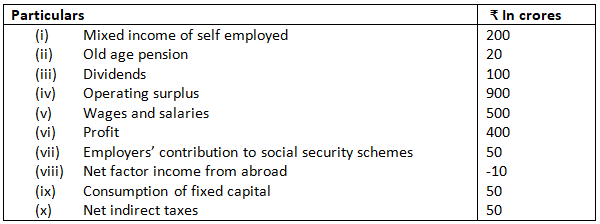
Solution –
NDPFC = COE + OS + MI
= (Wages/sales + ER to SSC) + OS + MI
= (500 + 50) + 900 + 200
= RS.1650 crore
NNPFC = NDPFC + NFIA
= 1650 + (-10)
= Rs.1650 crore
17. Calculate NNP at FC.
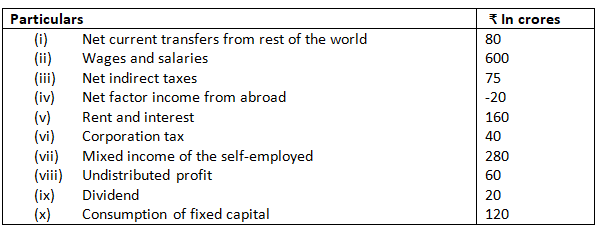
Solution –
NDPFC = COE + OS + MI
= (Wages/sales + FC to SSC) + Rest + Interest + Corporate tax + Undistributed Profit + Dividend + MI
= 600 + 160 + 40 + 20 + 60) + 280
= 600 + 280 + 280
= Rs.1160 crore
NNPFC = NDPFC + NFIA
= 1160 + (-20)
= 1160 – 20
= Rs.1140 crore
18. On the basis of the data given below, estimate the value of Gross National Product at Factor Cost (GNPFC):
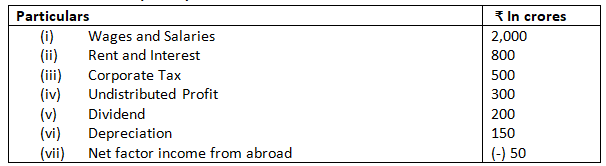
Solution –
NDPFC = COE + OS + MI
= (Sales/wages + ER to SSS) + R/Royalty to + I + P ) + MI
= 2000 + 800 + 500 + 300 + 20 + 0
= Rs.3800 crore
GNPFC = NDPFC – Dep. + NFIA
= 3800 + 150 + (-50)
= Rs.3900 crore
19. Calculate GNP at MP.
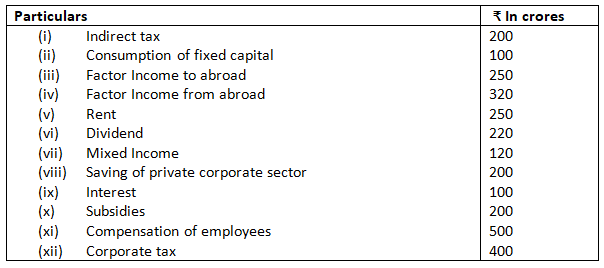
Solution –
NDPFC = COE + OS + MI
= (Sales/wages + ER to SSS) + (R/Royalty to + I + P ) + MI
= 500 ( 250 + 100 + 220 + 200 + 400) + 120
= 500 + 1170 + 120
= Rs.1790 crore
GNPFC = NDPFC + Dep. + NFIA + NIT
= 1790 + 100 + (320 – 200) – (200 – 200)
= 1790 + 100 + 70 – 0
= Rs.1960 crore
20. Calculate “Gross National Product at Market Price” from the following data:
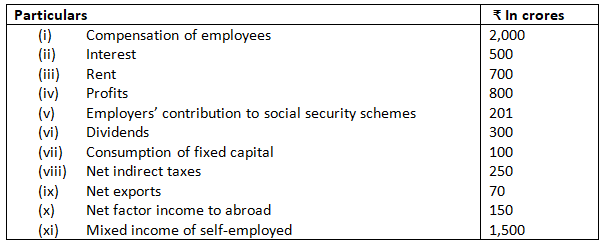
Solution –
NDPFC = Compensation of employees + OS + Mixed Income
= (Sales/wages + ER to SSS) + (R/Royalty to + I + P ) + MI
= 2000 + 500 + 700 + 800 + 1500
= Rs.5500 crore
GNPMP = NDPFC + Dep. + NFIA + NIT
= 5500 + 100 + (Net factor income to abroad + 250
= 5500 + 100 – 150 + 250
= 5600 – 150 + 200
= Rs.5700 crore
21. From the data given below, prove that ‘Net Value Added at Factor Cost’ is equal to ‘Income Generated’.
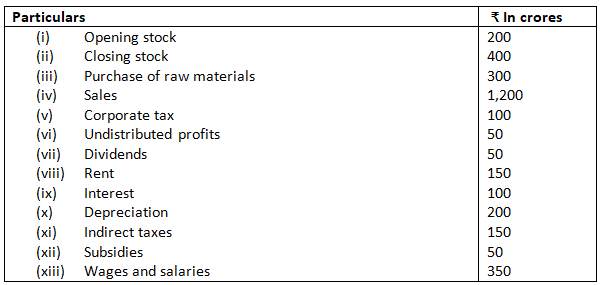
Solution –
NDPFC = Compensation of employees + OS + Mixed Income
= (Sales/wages + ER to SSS) + (R/Royalty to + I + P ) + MI
= 350 + (100 + 50 + 50 + 150 + 100) + 0
= Rs.800 crore
Value added
GNPMP = sales + change in stock – IC
= 1200 + (400 – 200) – 300
= 1200 + 200 – 300
= 1100
NDPFC = Compensation of employees + OS + Mixed Income
= (Sales/wages + ER to SSS) + (R/Royalty to + I + P ) + MI
= 720 + (90 + 540 + 180 + 120 ) + 0
= 720 + 930
= Rs.1650 crore
Value added inventory
GDPMP = Sales + Change in stock – IC
= (2160 + 240) + 240 – 840
= 2400 + 240 – 840
= 1800
NDPFC = GDPMP – Dep. – NIT
= 1800 – 90 – (60 to)
= 1800 – 90 – 60
= Rs.1650
OS = Rest/ Royalty + Interest + Profit
= 40 + 80 + 130 + 100
= Rs.350 crore
22. From the following data, show that Net Value Added at factor Cost (NVAFC) is equal to the sum of factor income:
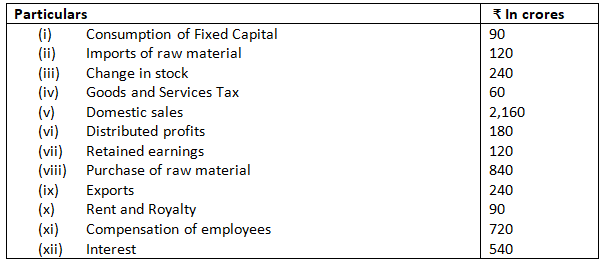
Solution –
NDPFC = Compensation of employees + OS + Mixed Income
= (Sales/wages + ER to SSS) + (R/Royalty to + I + P ) + MI
= 720 + (90 + 5540 + 180 + 120) + 0
= 720 + 930
= Rs.1650 crore
Value added method
GDPMP = Sales + Change in stock – IC
= (2160 + 240) + 240 – 840
= 2400 + 240 – 840
= 1800
NDPFC = GDPMP – Dep. – NIT
= 1800 – 90 – ( 60)
= 1800 – 90 – 60 = Rs.1650
Practical’s on Operating Surplus and Compensation of Employees
23. Calculate operating surplus.
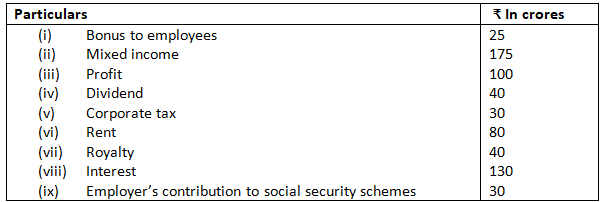
Solution –
OS = Rest/ Royalty + Interest + Profit
= 40 + 80 + 130 + 100
= Rs.350 crore
23a. From the following data, calculate the value of operating surplus:
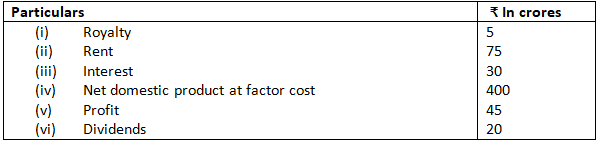
Solution –
Operating Surplus = Rent & Royalty + Interest + Profit
= 75 + 5 + 30 + 45
= 80 + 75
= Rs.155 crore
23b. From the following data, calculate the value of compensation of employees (COE):
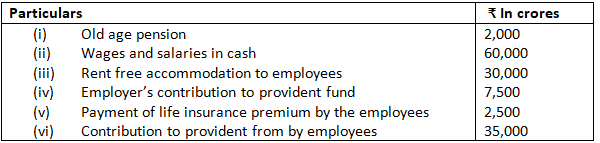
Solution –
Compaction of Employees (COE) = Wages & sales + ER contribution to PF + Rent free accommodation to employees
= 60000 + 7500 + 30000
= 97500 crore
24. Calculate the value of operating surplus.
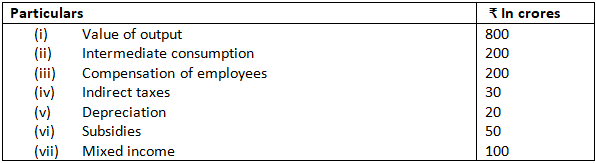
Solution –
GDPMP = value of output – IC
= 800 – 200
= Rs.600 crore
NDPFC = GDPMP – Dep. – NIT
= GDPMP – Dep. – (IT – Subsidiary)
= 600 – 20 – (30 – 50)
= 600 – 20 – (-20)
= 600 – 20 + 20
= Rs.600 crore
NDPFC = COE + OS + MI
600 = 200 + OS + 100
= 300 + OS
600 – 300 = OS
Operating Surplus = Rs.300 crore
25. Calculate the operating surplus from the following data:
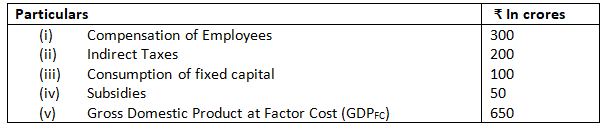
Solution –
NDPFC = GDPMP – Dep.
= 650 – 100
= Rs.550 crore
NDPFC = COE + OS + MI
550 = 300 + OS + 0
550 – 300 = OS
OS = Rs.250 crore
26. Calculate operating surplus and compensation of employees.
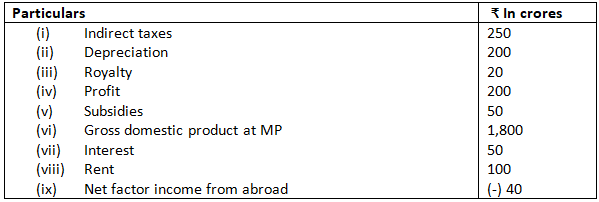
Solution –
Operating Surplus = Rent + Royalty + Interest + Profit
= 100 + 20 + 50 + 200
= Rs.370 crore
NDPFC = GDPMP – Dep. – NIT
= 1800 – 200 – (250 – 50)
= 1800 – 200 – 200
= Rs.1400 crore
NDPFC = COE + OS + MI
1400 = COE + 370 + 0
1400 – 370 = COE
1030 = COE
COE = Rs.1030 crore
Practical’s on Expenditure Method
27. Calculate GNP at MP.
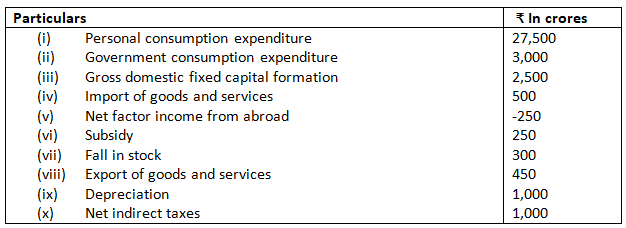
Solution –
GDPMP = PFCE + GFCE + GDCF + NE
= PFCE + GFCE + (GD fixed CF – Fall in stock) + NE
= 27500 + 3000 + (2500 – 300) + (450 – 500)
= 30500 + 2200 + ( -50)
= 30500 + 2200 – 50
= 32700 – 50
= Rs.32650 crore
GNPMP = GDPMP + NFIA
= 32650 + (-250)
= Rs.32400 crore
28. On the basis of given data, estimate the value of National Income:
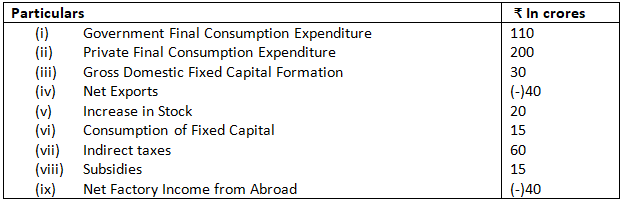
Solution –
GDPMP = PFCE + GFCE + GDCF + NE
= PFCE + GFCE + (GD fixed CF – increase in stock) + NE
= 200 + 110 + (30 + 20) + ( -40)
= 310 + 50 – 40
= Rs.320 crore
NNPFC = GNPMP – Dep. + NFIA – NIT
= 320 – 15 + (-40) – (60 – 15)
= 320 – 15 – 40 – 45
= 320 – 100
= Rs.220 crore
29. Calculation National Income.
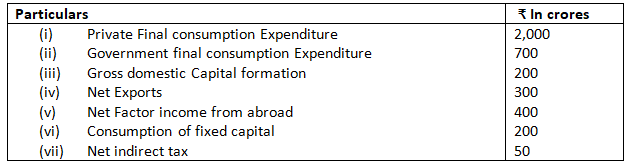
Solution –
GDPMP = PFCE + GFCE + GDCF + NE
= 2000 + 700 + 200 + 300
= Rs.3200 crore
NNPFC = GNPMP – Dep.– NIT+ NFIA
= 3200 – 200 – 50 + 400
= Rs.3350 crore
30. On the basis of data given below for an imaginary economy, estimate the value of Net Domestic Product at Factor Cost (NDPFC):
Solution –
GDPMP = PFCE + GFCE + GDCF + NE
= PFCE + GFCE + (GD fixed CF – change in stock) + NE
= 590 + 500 + (300 – 60) + (70 – 80)
= 990 + 240 – 10
= 990 + 230
= Rs.1220 crore
NNPFC = GDPMP – Dep.– NIT
= 1220 – 50 – 50
= Rs.1120 crore
Miscellaneous Practicals
31. Calculate National Income by Income and Expenditure method.
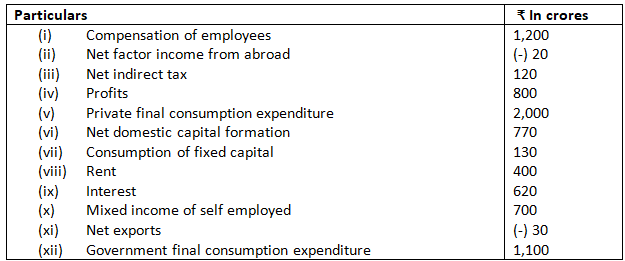
Solution –
Income method
NDPFC = COE + OS + MI
= COE + (R + P + I) + MI
= 1200 + (800 + 400 + 620) + 700
= Rs.3720 crore
NNPFC = NDPFC + NFIA
= 3720 + (-20)
= Rs.3700 crore
Expenditure Method
GDPMP = PFCE + GFCF + GDCF + NE
= 2000 + 1100 + (770 + 130) + (-30)
= 3100 + 900 – 30
= Rs.3970 crore
NNPFC = GDPMP – Dep. – NIT + NFIA
= 3970 – 130 – 120 + (-20)
= 3970 – 130 – 120 – 20
= 3970 – 270
= Rs.3700 crore
32. From the following data, calculation “National Income” by (a) income method and (b) expenditure method:
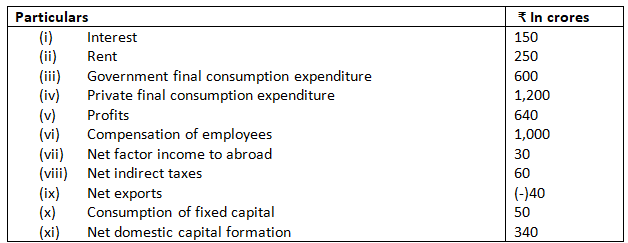
Solution –
- Income Method
NDPFC = COE + OS + MI
= (Wages/Salary + ER to SSS) + (R/R + I + P) + MI
= 1000 + 250 + 150 + 640 + 0
= 1000 + 1040
= Rs.2040 crore
NNPFC = NDPFC + NFIA
= NDPFC – Net factor income to profit
= 2040 – 30
= Rs.2010 crore
- Expenditure method
GDPMP = PFCE + GFCF + GDCF + Not Exp.
= 1200 + 600 + (NDCF + Dep.) + (-40)
= 1800 + (340 + 50) – 40
= Rs.2150 crore
NNPFC = GDPMP – Dep. – NIT + NFIA
= GDPMP – Dep. – ( IT- sub) – NFI to abroad
= 2150 – 50 – 60 + 30
= Rs.2010 crore
33. Calculate National Income by Income and Expenditure method.
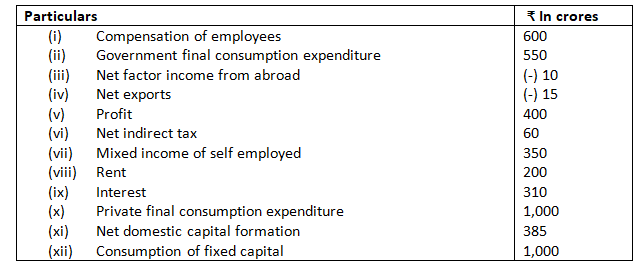
Solution –
- Income Method
NDPFC = COE + OS + MI
= (Wages/Salary + ER to SSS) + (R/R + I + P) + MI
= 600 + ( 200 + 310 + 400) + 350
= 600 + 910 + 350
= Rs.1860 crore
NNPFC = NDPFC + NFIA
=1860 + (-10)
= Rs.1850 crore
- Expenditure Method
GDPMP = PFCE + GFCF + GDCF + Not Exp.
= 1000 + 550 + (385 + 65) + (-15)
= 1550 + 450 – 15
= Rs.1985 crore
NNPFC = GDPMP – Dep. – NIT + NFIA
= 1985 – 65 – 60 + (– 10)
= 1985 – 65 – 60 – 10
= 1985 – 135
= Rs.1850 crore
34. Calculate National Income by Income method and expenditure method.
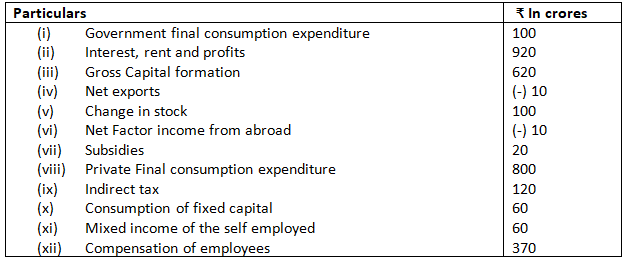
Solution –
- Income Method
NDPFC = COE + OS + MI
= 370 + 920 + 60
= 370 + 980
= Rs.1350
=
NNPFC = NDPFC + NFIA
= 1350 + (-10)
= Rs.1340 crore
- Expenditure Method
GDPMP = PFCE + GFCF + GDCF + Not Exp.
= 800 + 100 + 600 + (-10)
= Rs.1510 crore
NNPFC = GDPMP – Dep. – NIT + NFIA
= 1510 – 60 – (120 – 20) + (-10)
= 1510 – 60 – 100 – 10
= 1510 – 170
= Rs.1340 crore
35. Calculate National Income by Income and Expenditure method.
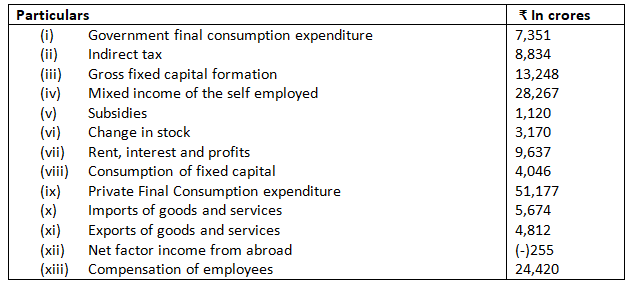
Solution –
- Income Method
NDPFC = COE + OS + MI
= 24420 + 9637 + 28267
= Rs.62324 crore
NNPFC = NDPFC + NFIA
= 62324 + (-255)
= Rs.62069 crore
- Expenditure Method
GDPMP = PFCE + GFCF + GDCF + Not Exp.
= 51177 + 7351 + (13248 + 3170) + (48812 – 5674)
= 74946 + (-862)
= Rs.74084 crore
NNPFC = GDPMP – Dep. – NIT + NFIA
= 74084 – 4046 – (8834 – 1120) + (-255)
= 74084 – 4046 – 7714 – 255
= Rs.62069 crore
36. Calculation National Income by Income and Expenditure method.
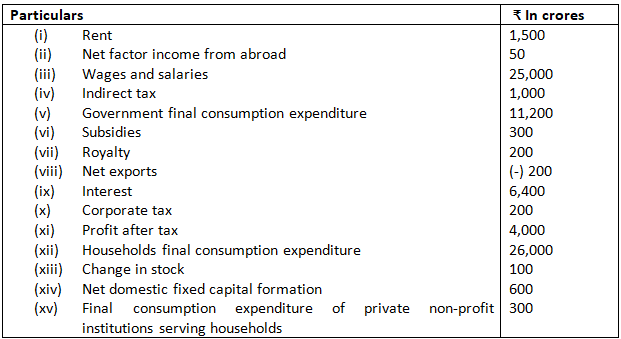
Solution –
- Income Method
NDPFC = COE + OS + MI
= (Wages/Salary + ER to SSS) + (R/R + I + P) + MI
= 25000 + (1500 + 200 + 6400 + 200 + 4000) + 0
= Rs.37300 crore
NNPFC = NDPFC + NFIA
= 37300 + 50
= Rs.37350 crore
- Expenditure Method
GDPMP = PFCE + GFCF + GDCF + Not Exp.
= (2600 + 300) + 11200 + (600 + 100) + (-200)
= 2800 + 11200 + 700 – 20
= Rs.14600 crore
NNPFC = GDPMP – Dep. – NIT + NFIA
= 38000 – 0 – (1000 – 300) + 50
= 38000 – 700 + 50
= Rs.37350 crore
37. Calculate National Income by Income and expenditure method.
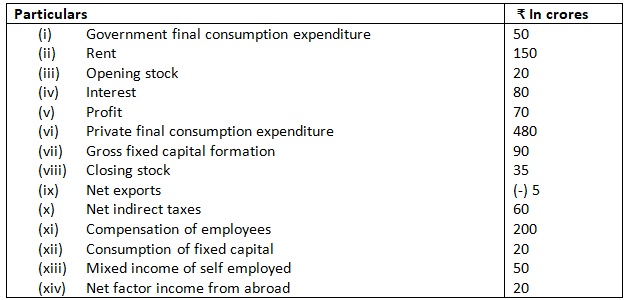
Solution –
- Income Method
NDPFC = COE + OS + MI
= 200 + 150 + 80 + 70 + 50
= Rs.550 crore
NNPFC = NDPFC + NFIA
= 550 + 20
= Rs.570 crore
- Expenditure Method
GDPMP = PFCE + GFCF + GDCF + Not Exp.
= 480 + 50 + (90 + (35-20)) + (-5)
= 530 + 90 + 15 – 5
= Rs.630 crore
NNPFC = GDPMP – Dep. – NIT + NFIA
= 630 – 20 – 60 + 20
= Rs.570 crore
38. Calculate national Income by Income and Expenditure method.
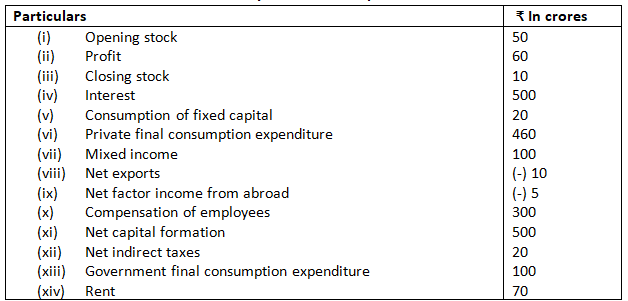
Solution –
- Income Method
NDPFC = COE + OS + MI
= 300 + (60 + 500 + 70) + 0
= Rs.1030 crore
NNPFC = NDPFC + NFIA
= 1030 + (-5)
= Rs.1025 crore
- Expenditure Method
GDPMP = PFCE + GFCF + GDCF + Not Exp.
= 460 + 100 + (500 + 20) + (-10)
= 460 + 100 + 520 – 10
= Rs.1070 crore
NNPFC = GDPMP – Dep. – NIT + NFIA
= 1070 – 20 – 20 + (-5)
= Rs.1025 crore
39. Calculate NNP at FC by Income and Expenditure method.
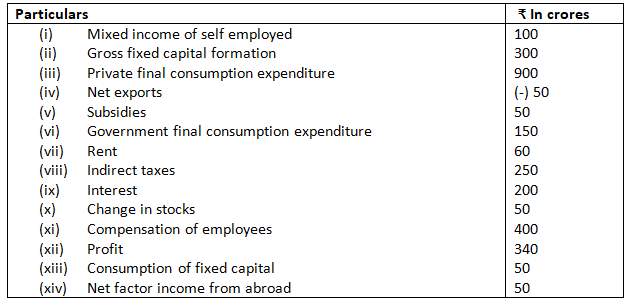
Solution –
- Income Method
NDPFC = COE + OS + MI
= 400 + ( 60 + 200 + 340) + 100
= Rs.1100 crore
NNPFC = NDPFC + NFIA
= 1100 + 50
= Rs.1150 crore
- Expenditure Method
GDPMP = PFCE + GFCF + GDCF + Not Exp.
= 900 + 150 + (300 + 50) + (-50)
= 1050 + 350 – 50
= Rs.1350 crore
NNPFC = GDPMP – Dep. – NIT + NFIA
= 1350 – 50 – (250 – 50) + 50
= 1300 – 200 + 50
= Rs.1150 crore
40. Calculate GNP at MP by Income and Expenditure method.
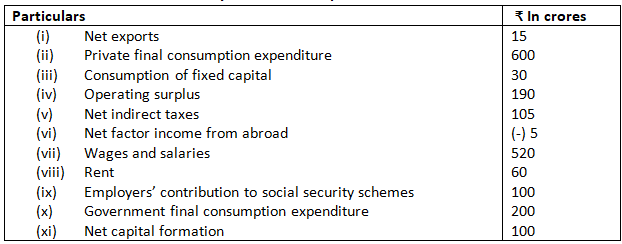
Solution –
- Income Method
NDPFC = COE + OS + MI
= (520 + 100) + 190 + 0
= Rs.810 crore
NNPFC = NDPFC + NFIA
= 810 + 30 + (-5) + 105
= 840 – 5 + 105
= Rs.940 crore
- Expenditure Method
GDPMP = PFCE + GFCF + GDCF + Not Exp.
= 600 + 200 + (100 + 30) + 15
= 600 + 200 + 130 + 15
= Rs.945 crore
NNPFC = GDPMP + NFIA
= 945 + (-5)
= Rs.940 crore
41. Calculate the value of Domestic Income from the following data:
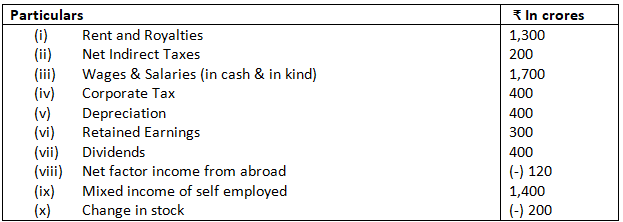
Solution –
NDPFC = COE + OS + MI
= (W/S + ER to SSS) + (R + R + I +P) + MI
= (1700 + 0) + (1300 + 0 + 400 + 400 + 300) + 1400
= 1700 + 2300 + 1400
= Rs.5500 crore
42. Calculate gross national product at factor cost from the following data by (a) income method and (b) expenditure method.
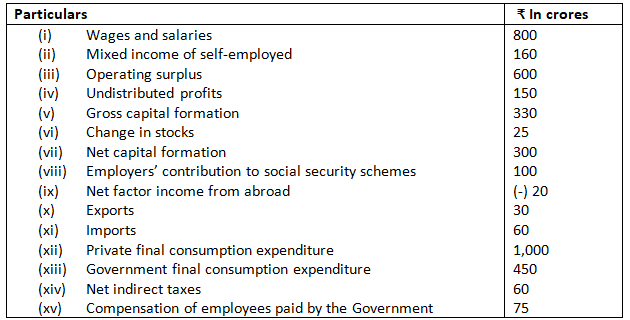
Solution –
- Income Method
NDPFC = COE + OS + MI
= (W/S + ER to SSS) + OS + MI
= (800 + 100) + 600 + 160
= Rs.1660 crore
NNPFC = NDPFC + Dep. + NFIA
= NDPFC + (Gross CF – Net Exp.) + NFIA
= 1660 + (330 – 300) + (-20)
= Rs.1670 crore
- Expenditure Method
GDPMP = PFCE + GFCF + GDCF + Not Exp.
= 1000 + 450 + 330 + (30 – 60)
= 1450 + 330 – 30
= Rs.1750
GNPFC = GDPMP + NFIA – NIT
= 1750 + (-20) – 60
= 1750 – 20 – 60
= Rs.1670 crore
43. Calculate GDPMP by income method and National income by expenditure method.
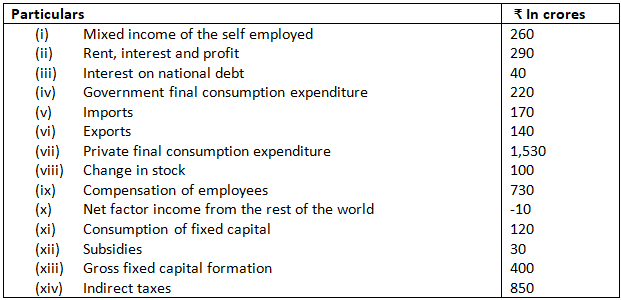
Solution –
- Income Method
NDPFC = COE + OS + MI
= COE + R, I , P + MI
= 730 + 290 + 260
= Rs.1280 crore
NNPFC = NDPFC + NFIA
= 1280 + 120 + (850 – 30)
= 1400 + 820
= Rs.2220 crore
- Expenditure Method
GDPMP = PFCE + GFCF + GDCF + Not Exp.
= PFCE + GFCF + (GD Fixed CF + change in stock) + (E – I)
= 1530 + 220 + (400 + 100) + ( 140 – 170)
= 1750 + 500 – 30
= Rs.2220 crore
NNPFC = GDPMP – Dep. – NIT + NFIA
= 2220 – 120 – ( 850 – 30) + (-10)
= 2220 – 120 – 820 – 10
= 2220 – 950
= Rs.1270 crore
44. Calculate GDP at MP by Income method and National income by Expenditure method.
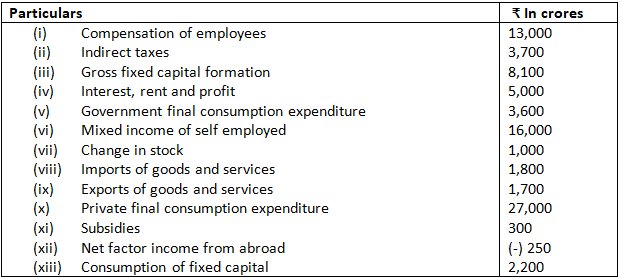
Solution –
- Income Method
NDPFC = COE + OS + MI
= 1300 + 5000 + 16000
= Rs.34000 crore
GDPMP = NDPFC + Dep. + NIT
= 34000 + 2200 + (3700 – 300)
= 34000 + 2200 + 3400
= Rs.39600 crore
- Expenditure Method
GDPMP = PFCE + GFCF + GDCF + Not Exp.
= PFCE + GFCF + (GD Fixed CF + change in stock) + (E – I)
= 27000 + 3600 + (8100 + 1000) + (1700 – 1800)
= 30600 + 9100 + (-100)
= 39700 – 100
= Rs.39600 crore
NNPFC = GDPMP – Dep. – NIT + NFIA
= 39600 – 2200 – (3700 – 300) + (-250)
= 39600 – 2200 – 3400 – 250
= Rs.33750 crore
45. Calculate GDP at MP by Income method and National Income by Expenditure method.
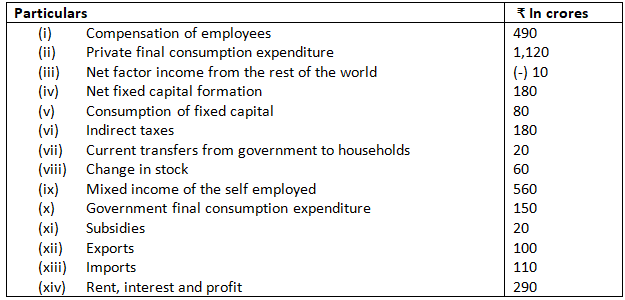
Solution –
- Income Method
NDPFC = COE + OS + MI
= 490 + 290 + 560
= Rs.1340 crore
GDPMP = NDPFC + Dep. + NIT
= 1340 + 80 + (180 -20)
= 1340 + 80 + 160
= Rs.1580 crore
- Expenditure Method
GDPMP = PFCE + GFCF + GDCF + Not Exp.
= PFCE + GFCF + (Net D Fixed CF + Dep. +D in stock) + (E – I)
= 1120 + 150 + (180 + 60 + 80) + (100 – 110)
= 1120 + 150 + 320 – 10
= Rs.1580 crore
NNPFC = GDPMP – Dep. – NIT + NFIA
= 1580 – 80 – ( 180 – 20) + (-10)
= 1500 – 160 – 10
= Rs.1330 crore
46. Calculate GDP at Factor cost by Income and Expenditure method.
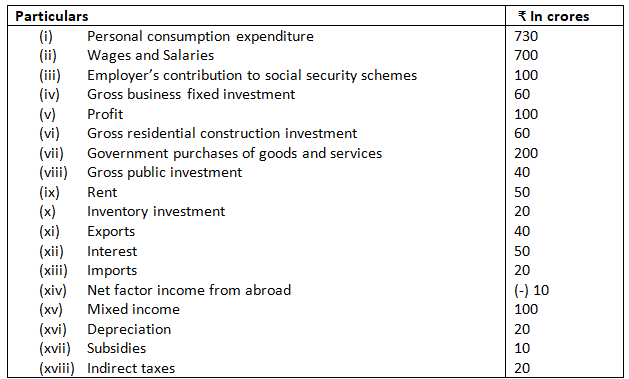
Solution –
- Income Method
NDPFC = COE + OS + MI
= (W/S + SSS) + (R + I + P) + MI
= (700 + 100) + (50 + 50 + 100) + 100
= Rs.1100 crore
GDPMP = NDPFC + Dep.
= 1100 + 20
= Rs.1120 crore
- Expenditure Method
GDPMP = PFCE + GFCF + GDCF + Not Exp.
= PFCE + GFCF + (GD Fixed CF + Dep. +D in stock) + (E – I)
= 730 + 200 + [60 + 60 + 40 + 200 + (40 – 20)]
= 930 + 180 + 20
= Rs.1130 crore
GDPFC = GDPMP –NIT
= GDPMP – (IT – Subsidies)
= 1130 – (20 -10)
= 1130 – 10
= Rs.1120 crore
47. Calculate National Income by Income and Output method.
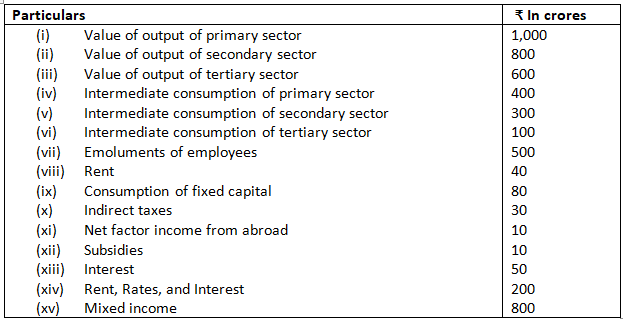
Solution –
- Income Method
NDPFC = COE + OS + MI
= E of E + R + R + I + MI
= 500 + 200 + 800
= Rs.1500 crore
NNPFC = NDPFC + NFIA
= 1500 + 10
= Rs.1510 crore
- Expenditure Method
GDPMP = Value of Output – I. consumption
= (Value of output of PS + SS + TS) – (IC of PS + SS + TS)
= (1000 + 800 + 600) – (400 + 300 + 100)
= 2400 – 800
= Rs.1600 crore
NNPFC = GDPMP – Dep. – NIT + NFIA
= 1600 – 80 – (30 – 10) + 10
= 1600 – 80 – 20 + 10
= Rs.1510 crore
48. Calculate National Income by Income method and Production method.
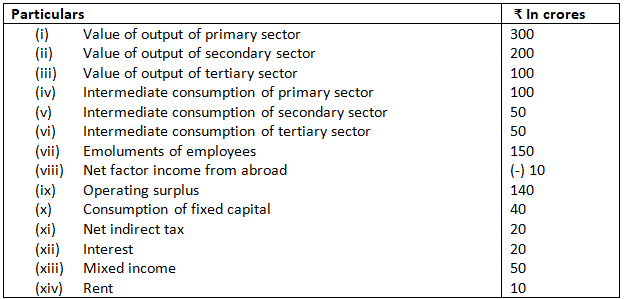
Solution –
- Income Method
NDPFC = COE + OS + MI
= E of E + R + R + I + MI
= 150 + 140 + 50
= Rs.340 crore
NNPFC = NDPFC + NFIA
= 340 + (-10)
= Rs.330 crore
- Expenditure Method
GDPMP = Value of Output – I. consumption
= (Value of output of PS + SS + TS) – (IC of PS + SS + TS)
= (300 + 20 + 100) – (100 + 50 + 50)
= 600 – 200
= 400
NNPFC = GDPMP – Dep. – NIT + NFIA
= 400 – 40 – 20 + (-10)
= Rs.330 crore
49. Calculate GDP at MP by value added method and income method.
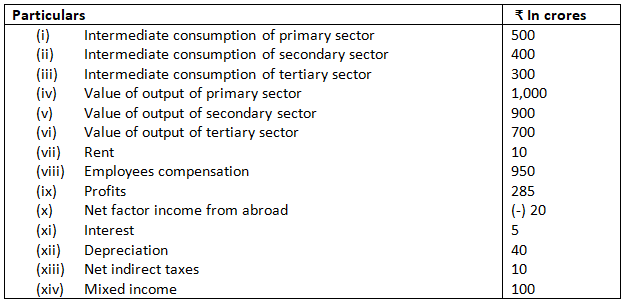
Solution –
- Value added method
GDPMP = Value of output – Int. Consumption
= (1000 + 900 + 700) – (500 + 400 + 300)
= 2600 – 1200
= Rs.1400 crore
- Income Method
NDPFC = COE + OS + MI
= COE + (R + I + P) + MI
= 950 + (10 + 5 + 285) + 100
= 950 + 300 + 100
= Rs.1350 crore
GDPMP = NDPFC + Dep. + NIT
= 1350 + 40 + 10
= Rs.1400 crore
50. Calculate (a) Gross domestic product at market price, and (b) Factor income from abroad from the following data:
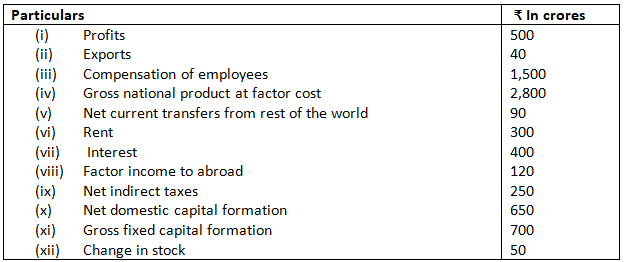
Solution –
Income Method
NDPFC = COE + OS + MI
= COE + ( R + I + P) + MI
= 1500 + (300 + 400 + 500) + 0
= 1500 + 1200
= Rs.2700 crore
GDPMP = NDPFC + Dep. + NIT
= 2700 + 100 + 250
= Rs.3050 crore
Depreciation = Gross capital Formation – Net capital formation
= (Gross fixed cap. Formation + case in stock) – Net capital formation
= (700 + 50) – 650
= Rs.100 crore
GNPFC = 2800
GNPFC = GDPMP + NFIA – NIT
2800 = 3050 + (factor income from Abroad – Factor income to abroad)
2800 = 3050 + (factor I from abroad – 120) – 250
2800 = 3050 + factor I from abroad – 120 – 250
2800 – 3050 + 120 + 250 = Factor I from Abroad
3170 – 3050 = FI from Abroad
Rs.120 = FI from Abroad
Factor income from abroad : Rs.120 crore
51. Find out Gross National Product at Market Price from the following data:
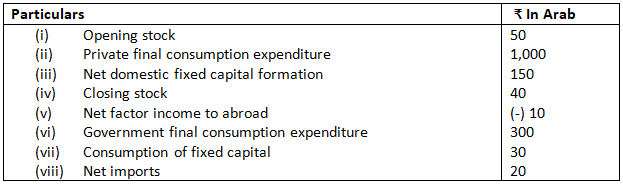
Solution –
Expenditure Method
GDPMP = PFCE + GFCE + GDCF + NE
= PFCE + GFCE + (net deposit fixed capital formation + Dep. + ( c long stock – opening stock) – Net import
= 1000 + 300 + (150 + 30 + (40 – 50) – 20
= 1300 + 180 + (-10) – 20
= 1300 + 180 – 10 – 20
= 1480 – 30
= Rs.1450 crore
GNPFC = GDPMP + NFIA
= GDPMP – Net factor to Abroad
= 1450 – (-10)
= 1450 + 10
= Rs.1450 crore
52. On the basis of the given data, estimate the value of Domestic Income:
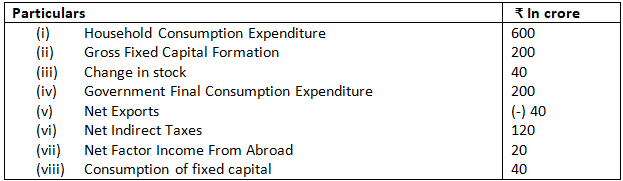
Solution –
Expenditure Method
GDPMP = PFCE + GFCE + GDCF + NE
= PFCE + GFCE + (Gross deposit fixed capital formation + change in stock + Net Export
= 600 + 200 + (200 + 40) + (-40)
= 800 + 240 – 40
= Rs.100 crore
NDPFC = GDPMP – Dep. – NIT
= 1000 – 40 – 120
= Rs.840 crore
53. From the following data relating to an economy, calculate national income by expenditure, income and value added method.
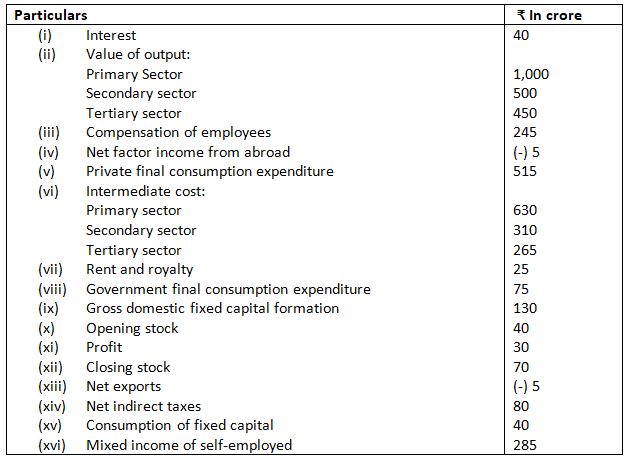
Solution –
- Expenditure Method
GDPMP = PFCE + GFCE + GDCF + NE
= PFCE + GFCE + (Gross deposit fixed capital formation + CS – OS) + N. E.
= 515 + 75 + (130 + (70 -40) + (-5)
= 590 + 130 + 30 – 5
= 590 + 155
= Rs.745 crore
NNPFC = GDPMP – Dep. + NFIA – NIT
= 745 – 40 + (-5) – 80
= 745 – 40 – 5 – 80
= Rs.620 crore
- Income Method
NDPFC = COE + OS + MI
= COE + ( R + I + P) + MI
= 245 + (25 + 40 + 30) + 285
= 245 + 95 + 285
= Rs.625 crore
NNPFC = NDPFC + NFIA
= 625 + (-5)
= Rs.620 crore
- Value added method
GDPMP = Value of output – IC
= (1000 + 500 + 450) – (630 + 310 + 265)
= 1950 – 1205
= Rs.745 crore
NNPFC = GDPMP – NIT – Dep. + NFIA
= 745 – 80 – 40 + (-5)
= Rs.620 crore
54. Estimate the value of Net National Product at Factor Cost (NNPFC), using the following information:
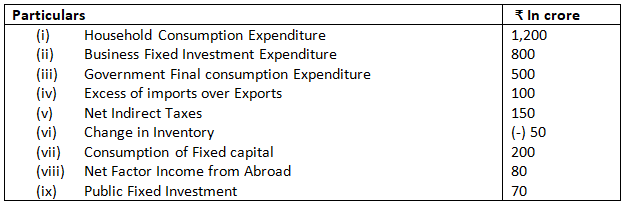
Solution –
- Expenditure Method
GDPMP = PFCE + GFCE + GDCF + NE
= PFCE + GFCE + (Busi. Fixed IE + Change in Inventor + Public Fixed Investment) – NI
= 1200 + 500 + (800 + (-50 + 70) – 100
= 1700 + 800 – 50 + 70 – 100
= 2500 -80
= Rs.2420 crore
NNPFC = GDPMP –Dep. – NIT + NFIA
= 2420 – 200 – 150 + 80
= 2420 – 350 + 80
= 2500 – 350
= Rs.2150 crore
55. Find out Net National Product at Market Price:
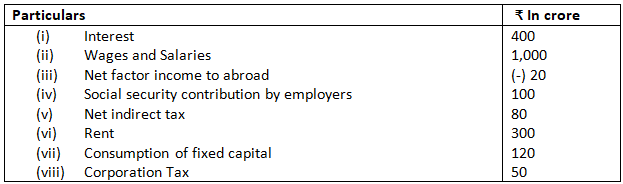
Solution –
- Income Method
NDPFC = COE + OS + MI
= (W/S + SSS) + ( RR + I + D + CF + UP) + MI
= (1000 + 100) + ( 300 + 400 + 50 + 20 + 60) + 0
= 1100 + 1010
= Rs.2010 crore
NNPFC = NDPFC + NFIA
= NDPFC – Net factor income to Abroad
= 2010 – (-20) + 80
= 2010 + 20 + 80
= Rs.2210 crore
56. Find out Gross National Product at Market Price:
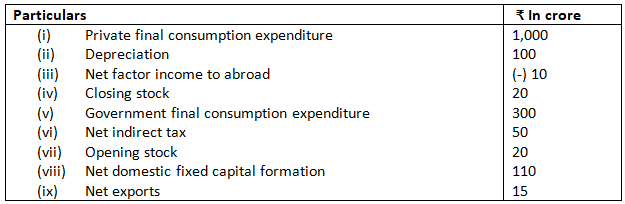
Solution –
- Expenditure Method
GDPMP = PFCE + GFCE + GDCF + NE
= PFCE + GFCE + (Net D fixed CF + (CS – OS) + Dep.) + NE
= 1000 + 300 + 110 + (20 – 20) + 100 + 15
= 1300 + 110 + 0 + 115
= Rs.1525 crore
GNPMP = GDPMP + NFIA
= GDPMP – Net factor Income to abroad
= 1525 – (-10)
= Rs.1535 crore
57. Calculate National Income.
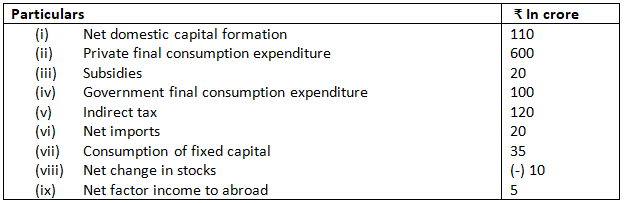
Solution –
GDPMP = PFCE + GFCE + GDCF + NE
= PFCE + GFCE + (Net D fixed CF + Dep.) – Net Import
= 600 + 100 + (110 + 35) – 20
= 700 + 145 – 20
= Rs.825 arab
NNPFC = GDPMP – Dep. – NIT + NFIA
= 825 – 35 – (IT – sub) – NFI to A
= 790 – (120 – 20) – 5
= 790 – 100 – 5
= Rs.685 Arab
58. On the basis of the data given below for an imaginary economy, estimate the value of Net Domestic Product at Factor Cost (NDPFC).
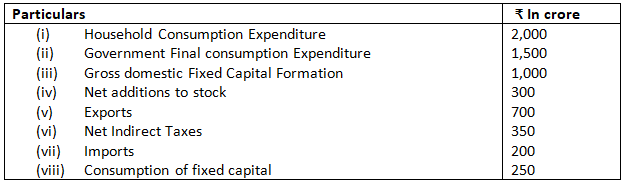
Solution –
- Expenditure Method
GDPMP = PFCE + GFCE + GDCF + NE
GDPMP = PFCE + GFCE + (Gross domestic fixed cap. Formation net addition to stock) + ( Export import)
= 2000 + 1500 + 1000 + 300 + (700 – 200)
= 3500 + 1300 + 500
= Rs.5300
NNPFC = GDPMP – Dep. – NIT + NFIA
= 5300 – 250 + 350
= 5300 – 100
= Rs.4700 crore
59. Calculate NNPMP.
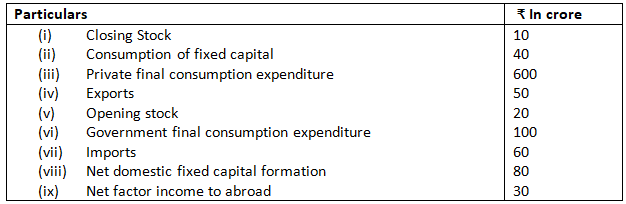
Solution –
- Expenditure Method
GDPMP = PFCE + GFCE + GDCF + NE
GDPMP = PFCE + GFCE + (Net Domestic fixed cap. Formation + closing stock – opening stock + (export – import)
= 600 + 100 + [80 + 40 + (10 – 20)] + (50 – 60)
= 700 + [80 + 40 – 10) + (-10)
= 700 + 110 – 10
= Rs.800 crore
NNPFC = GDPMP – Dep. + NFIA
= GDPMP – Dep. – Net FI to Abroad
= 800 – 40 – 30
= Rs.730 Arab
60. Calculate national income:
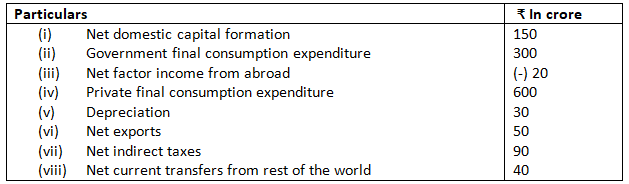
Solution –
- Expenditure Method
GDPMP = PFCE + GFCE + GDCF + NE
GDPMP = PFCE + GFCE + (Net Domestic cap. Fixed + Dep.) + NE
= 600 + 300 + (150 + 30) + 50
= Rs.1130 crore
NNPFC = GDPMP – Dep. – NIT + NFIA
= 1130 – 30 – 90 + (-20)
= 1130 – 120 – 20
= Rs.990 crore
61. Calculate national income:
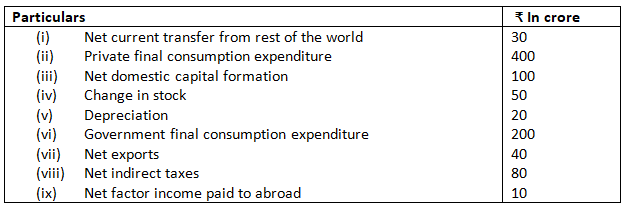
Solution –
- Expenditure Method
GDPMP = PFCE + GFCE + GDCF + NE
GDPMP = PFCE + GFCE + (Net Domestic cap. Fixed + Dep.) + NE
= 400 + 200 + (100 + 20) + 40
= Rs.760 crore
NNPFC = GDPMP – Dep. – NIT + NFIA
= 760 – 20 – 80 – NFI to Abroad
= 760 – 20 – 80 – 10
= 760 – 110
= 650 crore
62. From the following data relating to an economy, calculate (a) National income using Expenditure Method; (b) National income using income Method.
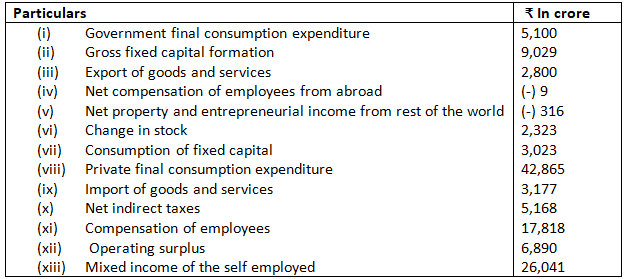
Solution –
- Income Method
NDPFC = COE + OS + MI
= 17818 + 6890 + 26041
= Rs.50,749 crore
NNPFC = GDPMP – Dep. – NIT + NFIA
= 50749 + (-9 – 316)
= 50749 – 325
= Rs.50424 crore
- Expenditure Method
GDPMP = PFCE + GFCE + GDCF + NE
GDPMP = PFCE + GFCE + (Net Domestic cap. Fixed + Dep.) + NE
= 42865 + 5100 + (9029 + 2323) + (2800 – 3177)
= 47965 + 11352 – 377
= Rs.58,940 crore
NNPFC = GDPMP – Dep. – NIT + NFIA
= 58940 – 3023 – 5 + (-9- 316)
= Rs.50,424 crore
63. From the following information, calculate GNPMP by income and expenditure methods.
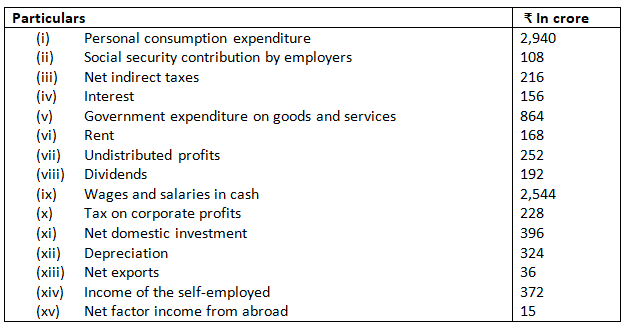
Solution –
- Income Method
NDPFC = COE + OS + MI
= (w/s + SSS) + [R + I + {D + CT + UP}] + MI
= (2544 + 108) + [168 + 156 + 192 + 228 + 252] + 372
= Rs.4025 crore
GDPMP = NDPFC + Dep. + NFIA + NIT
= 4025 + 324 + 15 + 216
= Rs.4575 crore
- Expenditure Method
GDPMP = PFCE + GFCE + GDCF + NE
= 2940 + 864 + (396 + 324) + 36
= Rs.4560 crore
GNPMP = GDPMP + NFIA
= 4560 + 15
= Rs.4575 crore
64. Calculate Gross National Product at Market Price.
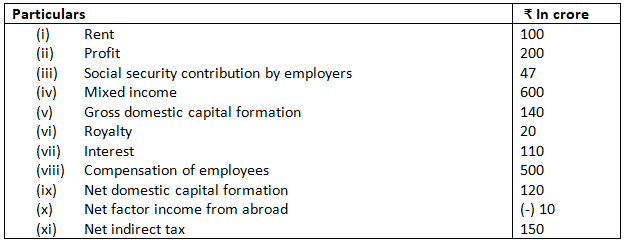
Solution –
- Income Method
NDPFC = COE + OS + MI
= COE + (R + R + I + P) + MI
= 500 + (100 + 20 + 110 + 200) + 600
= Rs.1530 crore
GDPMP = NDPFC + Dep. + NFIA + NIT
= 1530 + (Gross DCF – Net DCF) + (-10) + 150
= 1530 (140 – 120) – 10 + 150
= Rs.1690 crore
65. Calculate Net Domestic Product at Factor Cost:
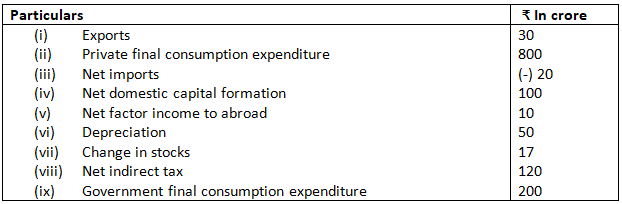
Solution –
- Expenditure Method
GDPMP = PFCE + GFCE + GDCF + NE
= 800 = 200 + (100 +50 ) – Net import
= 1000 + 150 – (-20)
= 1150 + 20
= Rs.1170 crore
NDPFC = GDPMP – Dep. – NIT
= 1170 – 50 – 120
= Rs.1000 crore
66. Calculate Net Domestic Product at Market Price:
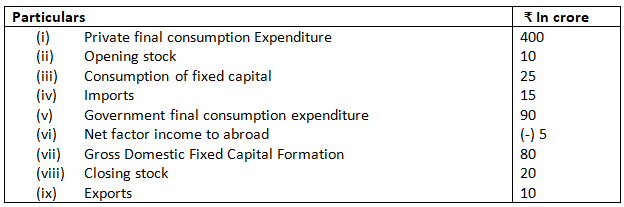
Solution –
- Expenditure Method
GDPMP = PFCE + GFCE + GDCF + NE
= PFCE + GFCE + [GD fixed CF + (CS – op)] + (E – I)
= 400 + 90 + [80 + 20 – 10] + (10 – 15)
= 490 + 90 – 5
= Rs.575 crore
NDPFC = GDPMP – Dep.
= 575 – 25
= Rs.550 crore
67. Calculate Net National Product at Market Price.
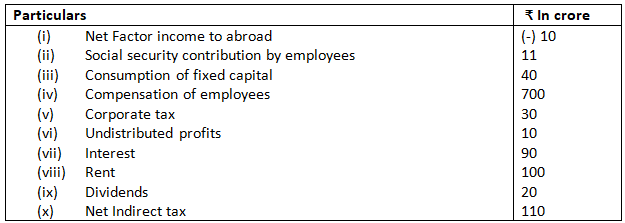
Solution –
- Income Method
NDPFC = COE + OS + MI
= COE + (R + I + UP + CT + D) + MI
= 700 + [100 + 90 + 10 + 30 + 20] + 0
= 700 + 200
= Rs.950 crore
NNPMP = NDPFC + NFIA + NIT
= NDPFC – Net FI to Abroad + NIT
= 950 – (-10) + 110
= 950 + 10 + 110
= Rs.1070 crore
68. From the following data, calculate net value added at factor cost.
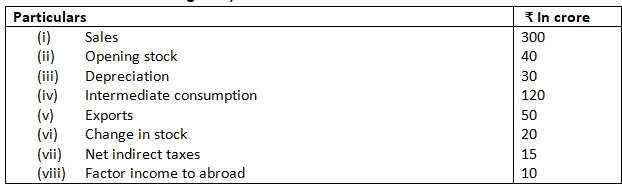
Solution –
GDPMP = Sale + (C. Stock – o Stock) – IC
= 300 + (20 – 400 – 120
= 300 – 20 – 120
= Rs.160 crore
NDPFC = GDPMP – Dep. – NIT
= 160 – 30 – 15
= Rs.115 crore
69. Calculate National Income.
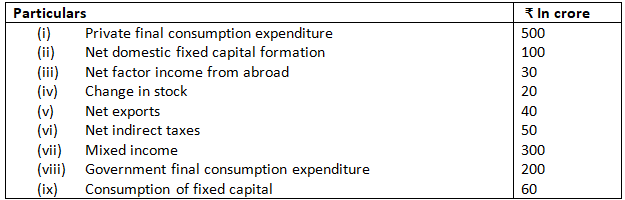
Solution –
GDPMP = PFCE + GFCE + Net D Fixed CF + Dep. + Change in Stock) + NE
= 500 + 200 + [100 + 60 + 20] + 40
= 700 + 180 + 40
= Rs.920 crore
NNPFC = GDPMP – Dep. – NIT + NFIA
= 920 – 60 – 50 + 30
= Rs.840 crore
70. Calculate net National product at Factor Cost:
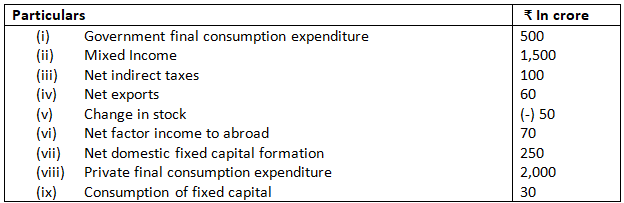
Solution –
GDPMP = PFCE + GFCE + Net D Fixed CF + Dep. + Change in Stock) + NE
= 2000 + 500 + (250 + 30 – 50) + 60
= 2500 + 230 + 60
= Rs.2790 crore
NNPFC = GDPMP – Dep. – NIT + NFIA
= 2790 – 30 – 1000 – Net FI to Abroad
= 2790 – 30 – 100 – 70
= Rs.2590 crore
71. Calculate gross value added added a factor cost.
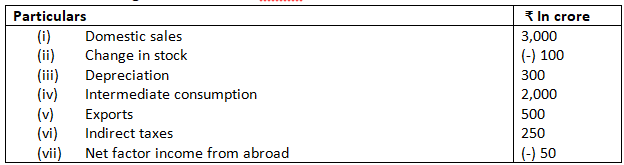
Solution –
GDPMP = Domestic sale + Exports + Change in stock – IC
= 3000 + 500 + (-100) – 2000
= 3500 – 100 – 2000
= Rs.1400 crore
GDPFC = GDPMP – NIT
= 1400 – (IT – Sub)
= 1400 – (250 – 0)
= Rs.1150 crore
72. From the following data, calculate Gross National product at Market Price:
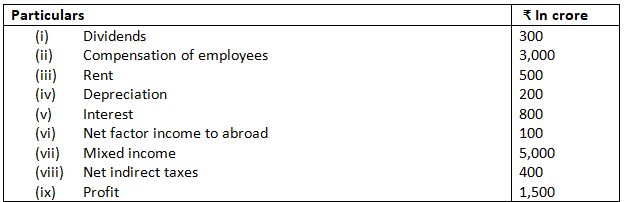
Solution –
NNPFC = 50000
GDPMP = NNPFC + Dep. – NFIA + NIT
= 50,000 + 700 – 500 + 1000
= Rs.51200 crore
GDPMP = PFCE + GFCE + GDCF + NE
51200 = PFCE + 12500 + 17000 + 2000
51200 = PFCE + 31500
51,200 – 31500 = PFCE
19700 crore = PFCE
PFCE = Rs.19700 crore
Income Method
NDPFC = NNPFC – NFIA
= 50,000 – 500
= Rs.49,500 crore
NDPFC = COE + OS + MI
49,500 = 20000 + OS + 13000
49,500 = 33000 + OS
49,500 – 33000 = OS
OS = Rs.16,500 crore
73. Calculate Net domestic product at Market price.
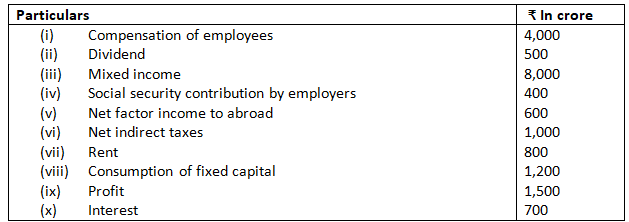
Solution –
NDPFC = COE + Rent + profit + Interest + Mixed income + NIT
= 4,000 + 800 + 1,500 + 700 + 8,000 + 1,000
= Rs.16,000 crores
74. Calculate Gross National Product at Factor Cost.
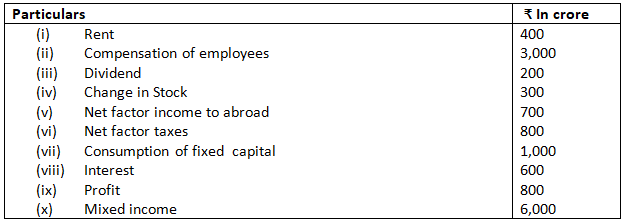
Solution –
GNPFC = COE + Rent + Interest + Profit + Mixed income + consumption of fixed capital – Net factor income to abroad
= 3,000 + 400 + 600 + 800 + 6,000 + 1000 – 700
= 11,800 – 700
= Rs.11,100 crores
75. Calculate Net domestic Product at Factor Cost:
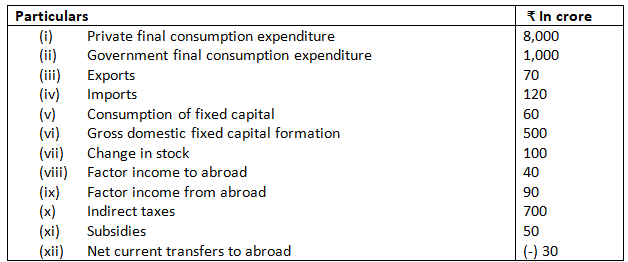
Solution –
NDPFC = PFCE + GFCE + GDFCF + change in stock + Net exports – consumption of fixed capital – NIT
= 8,000 + 1,000 + 500 + 100 + (70 – 120) – 60 – (700 – 50)
= 9,600 – 50 – 60 – 650
= 9,600 – 760
= Rs.8,840 crores
76. Estimate the missing values (?), if the value of Gross Domestic Product at factor cost (GDPFC) by Expenditure Method and Income Method is Rs.920 crore:
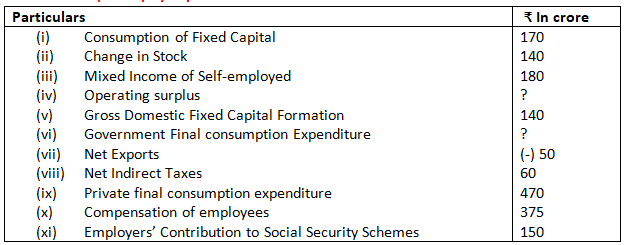
Solution –
77. Calculate Net Domestic Product at Factor Cost:
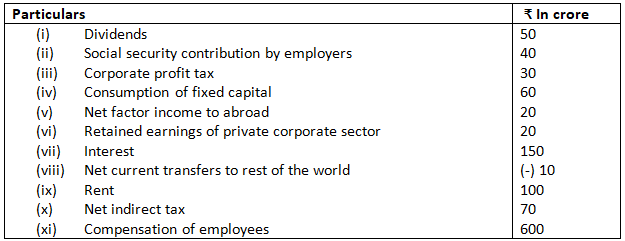
Solution –
NDPFC = COE + Rent + Interest + Retained earning of private corporate sector + Corporate profit tax + dividends
= 600 + 100 + 150 + 20 + 30 + 50
= Rs.950 crores
78. Given the following data, find the missing values of ‘Private Final Consumption Expenditure’ and ‘Operating Surplus’.
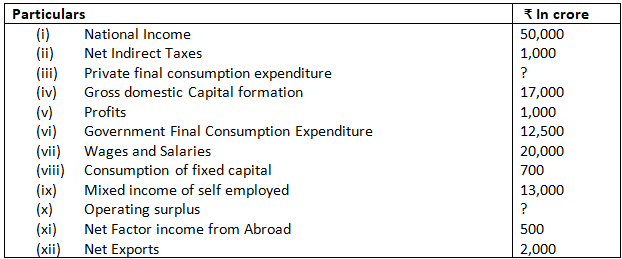
Solution –
NDPFC = NNPFC – NFIA
= 50,000 – 500
= Rs.49,500 crores
Calculation of Operating Surplus
NDPFC = COE + Operating Surplus + Mixed income
49,500 – 20,000 – 13,000 = Operating surplus
Operating surplus = Rs.16,500 crores
GDPMP = NNPFC – NFIA + Depreciation + NIT
= 50,000 – 500 + 700 + 1000
= Rs.51,200 crores
Calculation of PFCE
GDPMP = PFCE + GFCE + Net exports
51,200 – 12,500 – 17,000 – 2,000 = PFCE
51,200 – 31,500 = PFCE
PFCE = Rs.19,700 crores
79. Given the following data, find the missing values of ‘Gross domestic Capital formation’ and ‘Wages and salaries’.
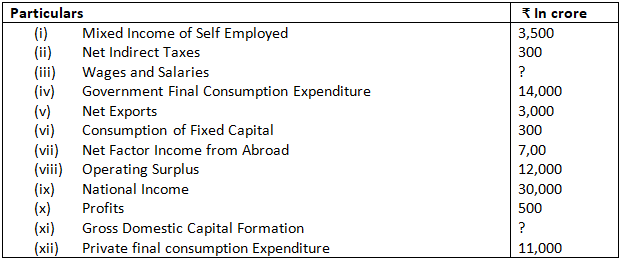
Solution –
GDPMP = NNPFC + Consumption of fixed capital + NIT – NFIA
= 30,000 + 300 + 300 – 700
= 30,000 – 700
= Rs.29,900 crores
NDPFC = NNPFC – NFIA
= 30,000 – 700
= Rs.29,300 crores
Calculation of Gross Domestic Capital formation
GDPMP = PFCE + GFCE + GDFCF + Net exports
29,900 – 11,000 – 14,000 – 3,000 = GDCF
29,900 – 28,000 = GDCF
GDCF = Rs.1,900 crores
Calculation of Wages and salaries
NDPFC = Wages and Salaries + Operating surplus + Mixed income
29,300 – 12,000 – 3,500 = Wages and salaries
29,300 – 15,500 = Wages and salaries
Wages and salaries = Rs.13,800 crores
80. Calculate value of “Interest” from the following data:
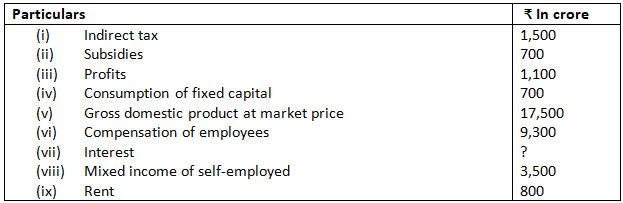
Solution –
NDPFC = GDPMP – Consumption of fixed capital – NIT
= 17,500 – 700 – (1,500 – 700)
= 16,800 – 800
= Rs.16,000 crores
Calculation of Interest
NDPFC = COE + Rent + Interest + Profit + Mixed income
16,000 – 9,300 – 800 – 1,100 – 3,500 = Interest
16,000 – 14,700 = Interest
Rs.1,300 crores = Interest
81. Given the following data, find the values of ‘Operating Surplus’ and ‘Net Exports’.
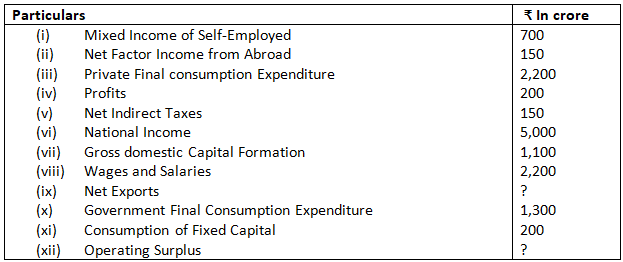
Solution –
NDPFC = NNPFC – NFIA
= 5,000 – 150
= Rs.4,850 crores
GDPMP = NNPFC + Consumption of Fixed capital + NIT – NFIA
= 5,000 + 200 + 150 – 150
= Rs.5,200 crores
Calculation of operating surplus
NDPFC = Wages and salaries + Operating surplus + Mixed Income
4850 – 2,200 – 700 = Operating surplus
Rs.1,950 crores = Operating surplus
Calculation of Net Export
GDPMP = PFCE + GFCE + GDCF + Net Exports
5,200 – 2,200 – 1,300 – 1,100 = Net Export
5,200 – 4,600 = Net Export
Rs.600 crores = Net Export
82. Calculate the value of “Mixed income of Self-Employed” from the following data:
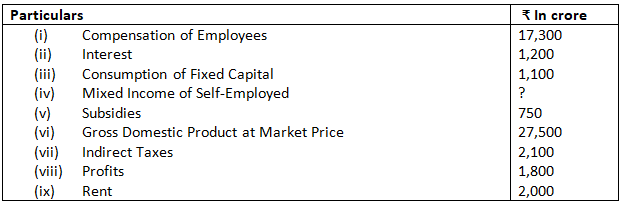
Solution –
NDPFC = GDPMP – consumption of fixed capital – NIT
= 27,500 – 1,100 – (2,100 – 750)
= 26,400 – 1350
= Rs.25,050 crores
Calculation of Mixed Income of self-employment
NDPFC = COE + Interest + Profit + Rent + Mixed income
25,050 – 17,300 – 1,200 – 1,800 – 2,000 = Mixed income
25,050 – 22,300 = Mixed income
Rs.2,750 crores = Mixed income
NCERT WEBSITE