Concept of Elasticity of Demand
Demand for a commodity is affected by a number of factors, such as a change in its own price, a change in the income of the consumer, a change in the prices of related goods, etc. Elasticity of demand refers to the percentage change in demand for a commodity with respect to the percentage change in any of the factors affecting demand for that commodity.
Elasticity of Demand = Percentage Change in Demand for X / Percentage change in a factor affecting the Demand for X
Out of various determinants of demand, there are three quantifiable determinants of demand (i) price of the given commodity (ii) price of related goods (iii) income of the consumer. So, we have three dimensions of elasticity of demand:
- Price elastic of demand – price elasticity of demand refers to the percentage change in demand for a commodity with respect to percentage change in the price of the given commodity.
- Cross elasticity of demand – Cross elasticity of demand refers to the percentage change in demand for a commodity with respect to percentage change in the price of a related good (substitute good or complementary good).
- Income elasticity of demand – Income elasticity of demand refers to the percentage change in demand for a commodity with respect to percentage change in the income of consumer.
Price Elasticity of Demand
Price Elasticity of Demand means the degree of responsiveness of demand for a commodity with reference to change in the price of such commodity. For example – If price elasticity of demand is (-) 2, it means, that one per cent fall in price leads to 2 per cent rise in demand or one per cent rise in price lead to 2 per cent fall in demand.
- For example – If prices of two commodities ‘X’ and ‘Y’ rise by 10% and their demands fall by 20% and 5% respectively, then commodity ‘x’ is said to be more elastic as compared to commodity ‘y’.
- Price is the most important determinant of demand. So, price elasticity of demand is sometimes shortened as ‘Elasticity of Demand’ or Demand Elasticity’ or simply ‘Elasticity’. Unless otherwise stated, whenever these words are used, they mean ‘Price Elasticity of Demand’.
Percentage Method for Measuring price Elasticity of Demand –
This method was introduced by Prof. Marshall. This method is also known as ‘Flux Method’ or proportionate Method’ or ‘Mathematical Method’. According to this method, elasticity is measured as the ratio of percentage change in the quantity demanded to percentage change in the price.
Elasticity of Demand (Ed) = Percentage change in Quantity demanded/ Percentage change in Price
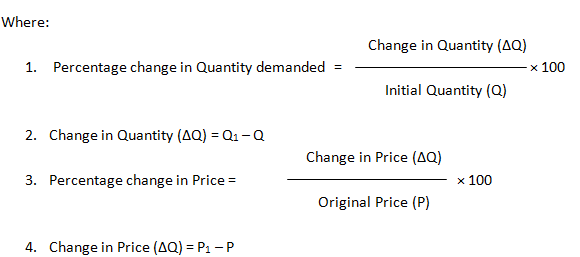
Proportionate Method – The percentage method can also be converted into the proportionate method. Putting the values of 1, 2, 3 and 4 in the formula of percentage method, we get:
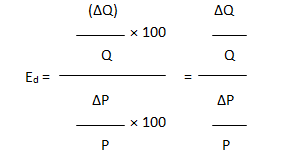
Price Elasticity of Demand (Ed) = ΔQ/ ΔP x P/Q
OR
Price Elasticity of demand (Ed) = 1/ Slope of Demand Curve x P/Q
(slope of demand curve* = ΔP/ ΔQ)
Where:
Q = Initial Quantity demanded
Q1 = New Quantity demanded
ΔQ = Change in the Quantity demanded
P = Initial Price
P1 = New Price
ΔP = Change in Price
Relationship Between Price Elasticity of Demand and total expenditure – The price elastic of demand for a good and the total expenditure made on the good are greatly related to each other. At times, it becomes important to determine the effect on the expenditure on a good due to change in price of the good.
- Elasticity is more than one (Ed > 1) – When demand is elastic, a fall in the price of a commodity results in increase in total expenditure on it. On the other hand, when price and total expenditure move in the opposite direction.

In Table 4.1, Ed > 1 because total expenditure rises with fall in price.
2. Elasticity is less than One (Ed < 1) – when demand is inelastic, a fall in the price of a commodity leads to fall in total expenditure on it. On the other hand, when price increase total expenditure also increases. It means, in case of less elastic demand, price and total expenditure move in the same direction.

In Table 4.2, Ed < 1 because total expenditure also fall in price.
3. Elasticity is equal to One (Ed = 1) – when demand is unitary elastic, a fall or rise in the price of the commodity does not change the total expenditure. It means, total expenditure will remain unchanged in case of unitary elastic demand.

In Table 4.2, Ed = 1 because total expenditure remains same even after fall in price.
Degrees or price Elasticitie’s of demand
When prices of different commodities change, the quantity demanded of each commodity reacts in a different manner. For example – demand of medicines or needle responds very less to a change in price as compared to AC or Smart TV. So, degree of responsiveness of quantity demanded to a change in price may differ and hence, elasticity of demand could also differ.
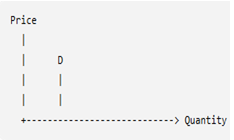
- Perfectly Elastic Demand – when there is an infinite demand at a particular price and demand becomes zero with a slight rise in the price, then demand for such a commodity is said to be perfectly elastic.
Fig.
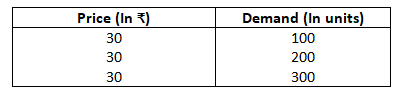
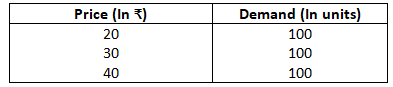
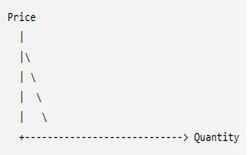
2. Perfectly Inelastic demand – When there is no change in demand with change in price, then demand for such a commodity is said to be perfectly inelastic.
3. Highly Elastic demand – When percentage change in the quantity demanded is more than percentage change in price, in demand for such a commodity is said to be highly elastic.

4. Less Elastic demand – When percentage change in the quantity demanded is less than percentage change in price, then demand for such a commodity is said to be less elastic or inelastic.

5. Unitary Elastic Demand – When percentage change in the quantity demanded is equal to percentage change in price, then demand for such a commodity is said to be unitary elastic.

Factors Affecting Price Elasticity of Demand – A change in price does not always lead to the same proportionate change in demand. For example – a small change in price of AC may affect its demand to a considerable extent, whereas, large change in price of salt may not affect its demand. So, elasticity of demand is different for different goods.
- Nature of Commodity – Elasticity of demand of a commodity is influenced by its nature. A commodity for a person may be a necessity, a comfort or a luxury.
- When a commodity is a necessity like food grains, vegetable, medicines, etc., its demand is generally inelastic as it is required for human survival and its demand does not fluctuate much with change in price.
- When a commodity is a comfort like fan, refrigerator, etc., its demand is generally elastic as consumer can postpone its consumption.
- When a commodity is a luxury like AC, Smart TV, etc., its demand is generally more elastic as compared to demand for comforts.
2. Availability of Substitutes – Demand for a commodity with a large number of substitutes will be more elastic. The reason in that even a small rise in it prices will induce the buyers to go for its substitutes. For example – a rise in the price of Pepsi encourages buyers to buy Coke an vice-versa. Thus, the availability of close substitutes makes the demand sensitive to change in the price. On the other hand, commodities with few or no substitutes, like wheat and salt, have less price elasticity of demand.
3. Income Level – Elasticity of demand for any commodity is generally less for higher income level groups in comparison to people with low incomes. It happens because rich people are not influence much by change in the price of goods. But, poor people are highly affected by increase or decrease in the price of goods. As a result, demand for lower income groups is highly elastic.
4. Level of Price – Level of price also affects the price elastic of demand. Costly goods like laptops, ACs, etc. have highly elastic demand as their demand is very sensitive to changes in their prices.
5. Postponement of Consumption – Commodities like biscuits, soft drinks, etc., whose demand is not urgent, have highly elastic demand as their consumption can be postponed in case of an increase in their prices.
Short Answer Type Questions
- What is meant by price elasticity of demand? Explain any 2 factors that affect it.
Answer: Price Elasticity of Demand (PED) – Price Elasticity of Demand (PED) refers to the degree of responsiveness of quantity demanded of a commodity due to a change in its price, other factors remaining constant.
Price Elasticity of Demand = % change in Quantity Demanded / % Change in Price
Factors affecting Price Elasticity of Demand (Any Two):
- Availability of Close Substitutes:– A commodity having close substitutes has more elastic demand because consumers can easily shift to another product if its price rises.
- Nature of the Commodity:– Demand for necessities such as food and medicines is generally inelastic, whereas demand for luxury goods is relatively elastic.
2. Discuss the percentage method for calculating price elasticity of demand.
Answer: The Percentage Method measures price elasticity of demand by comparing the percentage change in quantity demanded with the percentage change in price.
Price Elasticity of Demand = % change in Quantity Demanded / % Change in Price
Interpretation:
- If PED > 1, demand is elastic.
- If PED = 1, demand is unitary elastic.
- If PED < 1, demand is inelastic.
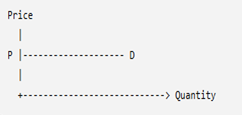
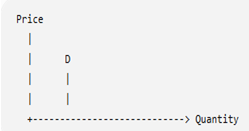
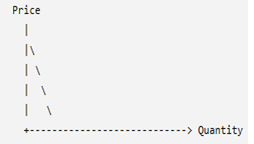
3. Draw three demand curves in which price elasticity of demand remains same at all points.
Answer: The following demand curves have the same elasticity at every point:
a. Perfectly Elastic Demand (PED = ∞)
b. Perfectly Inelastic Demand (PED = 0)
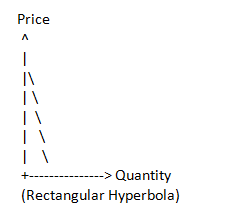
c. Unitary Elastic Demand (PED = 1)
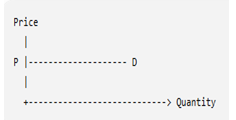
4. Distinguish between perfectly elastic demand and perfectly inelastic demand. Draw diagrams also.
Answer –

Perfectly Elastic Demand
Perfectly Inelastic Demand
5. Define unitary elastic demand and draw a demand curve for it. What is the significance of a unitary elastic demand curve?
Answer: Unitary Elastic Demand is a situation in which the percentage change in quantity demanded is exactly equal to the percentage change in price. Therefore, the value of price elasticity of demand is equal to one (PED = 1).
6. Mention any three factors that affect the price elasticity of demand for a commodity.
Answer: The following factors affect the price elasticity of demand:
- Availability of Close Substitutes: More substitutes make demand more elastic.
- Nature of the Commodity: Necessities have inelastic demand, while luxuries have elastic demand.
- Number of Uses of the Commodity: A commodity with many uses generally has more elastic demand.
7. How is the price elasticity of demand of a commodity affected by the number of its substitutes? Explain.
Answer: The availability of close substitutes has a direct effect on price elasticity of demand.
- If a commodity has many close substitutes, its demand is more elastic, as consumers can easily switch to another product.
- If there are no close substitutes, its demand becomes less elastic or inelastic, because consumers have limited alternatives.
8. How does the nature of a commodity influence its price elasticity of demand?
Answer: The nature of a commodity plays an important role in determining its price elasticity.
- Necessities such as food grains and medicines have inelastic demand, because they are essential for daily life.
- Luxury goods such as expensive cars and jewellery have elastic demand, because their purchase can be postponed or avoided.
9. When two demand curves intersect each other, which one is more elastic?
Answer: When two demand curves intersect, the flatter (less steep) demand curve is more elastic, while the steeper demand curve is less elastic. This is because a flatter curve shows a greater change in quantity demanded for a given change in price.
10. How is price elasticity of demand affected by: (i) Number of substitutes available for the food; (ii) Nature of the good?
Answer:
- Number of Substitutes: A larger number of close substitutes makes demand more elastic, whereas fewer substitutes make demand less elastic.
- Nature of the Good: Demand for necessities is generally inelastic, while demand for luxury goods is generally elastic.
11. Explain the influence of following on price elasticity of demand of a good; (i) Substitute goods; (ii) Own price of the good.
Answer:
(i) Substitute Goods: The greater the availability of close substitutes, the higher will be the price elasticity of demand, as consumers can switch to alternative goods.
(ii) Own Price of the Good: Generally, the higher the price of a commodity, the more elastic its demand tends to be, because consumers become more responsive to price changes.
12. What is the relationship between price elasticity of demand of a commodity and total expenditure on it? Explain.
Answer: The relationship between price elasticity of demand and total expenditure is as follows:
- Elastic Demand (PED > 1): Price and total expenditure move in opposite directions.
- Inelastic Demand (PED < 1): Price and total expenditure move in the same direction.
- Unitary Elastic Demand (PED = 1): Total expenditure remains unchanged when price changes.
Long Answer type Questions
- Explain the percentage method of determining elasticity of demand with the help of an example.
Answer: The Percentage Method (also known as the Proportionate Method) was given by Prof. Marshall. According to this method, Price Elasticity of Demand (Ed) is measured by comparing the percentage change in quantity demanded with the percentage change in price.
Ed =% Change in Quantity Demanded / % Change in Price
Or
Ed = ΔQ/Q x P/ΔP
Example:
Suppose the price of a commodity falls from ₹20 to ₹18 per unit. As a result, its quantity demanded increases from 100 units to 120 units.
- Percentage change in Quantity Demanded
= 20/100 x 100
= 20%
- Percentage change in Price
= 2/20 x 100
= 10%
Therefor,
Ed = 20%/10%
= 2
2. Explain, in brief, the following kinds of price elasticities of demand: (i) Highly elastic demand; (ii) Less Elastic Demand; (iii) Unitary elastic demand.
Answer: Price elasticity of demand measures the degree of responsiveness of quantity demanded to a change in the price of a commodity.
(i) Highly Elastic Demand – Demand is said to be highly elastic when a small change in price causes a more than proportionate change in quantity demanded.
Elasticity:
Ed > 1
Example:
Luxury goods, branded clothes, expensive cosmetics, etc.
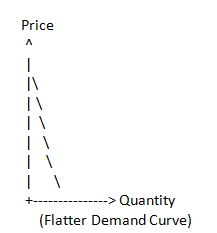
A small fall in price leads to a large increase in demand, and a small rise in price causes a large fall in demand.
(ii) Less Elastic Demand – Demand is less elastic (inelastic) when the percentage change in quantity demanded is less than the percentage change in price.
Elasticity:
Ed < 1
Example:
Salt, medicines, electricity, LPG, etc.
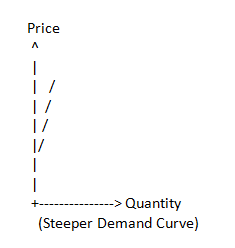
Consumers do not reduce or increase their demand significantly even when price changes because these goods are necessities.
(iii) Unitary Elastic Demand – Demand is unitary elastic when the percentage change in quantity demanded is exactly equal to the percentage change in price.
Elasticity:
3. Discuss various factors that affect price elasticity of demand.
Answer: Price elasticity of demand is influenced by several factors. These factors determine how much consumers respond to changes in the price of a commodity.
I. Availability of Substitutes
- If many close substitutes are available, demand becomes more elastic because consumers can easily switch to other products.
- If no close substitute is available, demand becomes less elastic.
Example: Tea and coffee are substitutes.
II. Nature of the Commodity
- Demand for necessities is generally inelastic because consumers cannot avoid buying them.
- Demand for luxury goods is generally elastic because consumers can postpone or avoid their purchase.
Example: Medicines are necessities, whereas expensive jewellery is a luxury.
III. Number of Uses – A commodity having many uses generally has elastic demand because consumers can increase or decrease its consumption according to changes in price.
Example: Electricity and milk have multiple uses.
IV. Possibility of Postponement
- If the purchase of a commodity can be postponed, demand becomes elastic.
- If it cannot be postponed, demand remains inelastic.
Example: Purchase of furniture can be postponed, but medicines cannot.
V. Proportion of Income Spent
- Goods on which consumers spend a large proportion of income usually have elastic demand.
- Goods involving only a small proportion of income generally have inelastic demand.
Example: Cars have elastic demand, whereas salt has inelastic demand.
VI. Time Period – Demand is generally less elastic in the short run because consumers need time to adjust their consumption habits. In the long run, demand becomes more elastic as consumers find alternatives.
VII. Habit-forming Goods – Demand for goods that create habits or addiction is usually inelastic, as consumers continue buying them despite changes in price.
Example: Cigarettes and tobacco.
VIII. Income Level of Consumers – Higher-income consumers are generally less affected by changes in price, so demand tends to be less elastic. Lower-income consumers respond more to price changes, making demand relatively more elastic.
Unsolved Practical’s
Calculation of Elasticity of Demand (When both price and quantity are given)
- The quantity demanded increases from 100 units to 200 units when the price decrease from RS.12 to 10.
Solution –
Elasticity of Demand = ΔQ / ΔP x P/Q
= 100/-2 x 12/100
Ed = -6
Working note:
Q = 100 units
Q1 = 200 units
ΔQ = Q1 – Q
= 100 units
P = Rs.12
P1 = Rs.10
ΔP = P1 – P
= – 2
2. As price of a commodity increase from Rs.4 per unit to Rs.5 per unit, demand falls from 20 units to 10 units. Find out the elasticity of demand.
Solution –
Given –
P = Rs.4
P1 = Rs.5
ΔP = P1 – P
= 5 – 4
= 1
So,
Ed = ΔQ/ ΔP x P/ Q
= -10/1 x 4/20
= – 2
3. The price and quantities demanded of a commodity are given below. On this basis, find out the price elasticity of demand.

Solution –
Given –
P = Rs.10 , Q = 20 units
P1 = Rs.20 Q1 = 15 units
ΔP = P1 – P
= 20 – 10
= 10
ΔQ = Q1 – Q
= 15 – 20
= – 5
So,
Ed = ΔQ/ ΔP x P/ Q
= -5/10 x 10/20
= – 0.25
4. Price of good falls from Rs.10 to Rs.8. As a result, its demand rises from 80 units to 100 units. What is the price elasticity of demand?
Solution –
Given –
P = Rs.10 , Q = 80 units
P1 = Rs.8 Q1 = 100 units
ΔP = P1 – P
= 8 – 10
= -2
ΔQ = Q1 – Q
= 100 – 80
= 20 units
So,
Ed = ΔQ/ ΔP x P/ Q
= 20/-2 x 10/80
= – 1.25
5. Demand increase by 10 units when the price decrease by Rs.2. As a result, demand increase to 100 units and price decrease to Rs.8. find out the price elasticity of demand.
Solution –
ΔQ = 10 units ΔP = -2
Q1 = 100 units P1 = Rs.8
Q = Q1 – ΔQ
= 90 units
P = P1 – ΔP
Ed = ΔQ/ ΔP x P/ Q
= 10/-2 x 10/90
= – 0.55
6. Following is the market demand schedule of commodity X. Calculate the coefficient of price elasticity of demand, when price increase from Rs.3 per unit to Rs.5 per unit.

Solution –
According to questions –
P = Rs.3 Q = 3,250 units
P1 = Rs.5 Q1 = 1,250 units
ΔP = P1 – P
= 5 – 3
= 2
ΔQ = Q1 – Q
= 1250 – 3250
= -2000 units
So,
Ed = ΔQ/ ΔP x P/ Q
= -2000/2 x 3/3250
= – 0.92
7. Suppose that originally, a product was being sold at Rs.10 per unit and the quantity demanded was 1,000 units. The product price changes to Rs.14 and, as a result, the quantity demanded changes to 500 units. Calculate the price elasticity of demand.
Solution –
Given –
P = Rs.10 Q = 1000 units
P1 = Rs.14 Q1 = 500 units
ΔP = P1 – P
= 14 – 10
= 4
ΔQ = Q1 – Q
= 500 – 1000
= -500 units
So,
Ed = ΔQ/ ΔP x P/ Q
= -500/4 x 10/1000
= – 1.25
8. A consumer purchased 10 units of a commodity when its price was Rs.5 per unit. He purchased 12 units of the commodity when its price fell to Rs.4 per unit. What is the price elasticity of demand for the commodity?
Solution –
Given –
P = Rs.5 Q = 10 units
P1 = Rs.4 Q1 = 12 units
ΔP = P1 – P
= 4 – 5
= -1
ΔQ = Q1 – Q
= 12 – 10
= 2 units
So,
Ed = ΔQ/ ΔP x P/ Q
= 2/-1 x 5/10
= – 1
9. Following are the demand schedules for commodities A and B. Which one of them has more elastic demand?

Solution –
Commodity A
Ed = ΔQ/ ΔP x P/ Q
= 10/-2 x 1/100
Ed of ‘A’ = -0.5
Commodity B
Ed = ΔQ/ ΔP x P/ Q
= 10/-2 x 20/100
Ed of ‘B’ = -1
Demand of commodity ‘B’ is more elastic.
10. Following is the demand schedule of commodity Y:

Calculate the elasticity of demand when: (i) Price rises from Rs.15 to Rs.20; (ii) When price falls from Rs.20 to Rs.15.
Solution –
Given – (i)
P = Rs.15
P1 = Rs.20
ΔP = Rs.5
Q = 100
Q1 = 40
ΔQ = -60 units
Ed = ΔQ/ ΔP x P/ Q
= 60/5 x 15/100
= -1.8
Given – (ii)
P = Rs.20
P1 = Rs.15
ΔP = -5
Q = 40
Q1 = 100
ΔQ = 60 units
Ed = ΔQ/ ΔP x P/ Q
= 60/-5 x 20/40
= -6
Calculation of Price of Quantity (When elasticity of demand is given)
11. The coefficient of price elasticity of demand for a commodity is 0.2. when price was Rs.10 per unit, the quantity demanded was 40 units. If the price falls to Rs.5 per unit, how much will be its quantity demanded?
Solution –
Given –
Ed = -0.2
P = Rs.10
Q = 40 units
P1 = Rs.5
To find: Q1
Ed = ΔQ/ ΔP x P/ Q
-0.2 = ΔQ /-5 x 10/40
0.2 x 0.2 = ΔQ
4 units = ΔQ
ΔQ = Q1 – Q
4 = Q1 – 40
44 unit = Q1
12. Market demand for a good at price of Rs.10 per unit is 100 units. When its price changes, its market demand falls to 50 units. Find out the new price, if the price elasticity of demand is (-) 2.
Solution –
Given –
Ed = -2
P = Rs.10
Q = 100 units
Q1 = 50 units
To find: P1
Ed = ΔQ/ ΔP x P/ Q
-2 = -50 / ΔP x 10/100
ΔP = 5/2
ΔP = 2.5
Now,
ΔP = P1 – P
2.5 = P1 – 10
Rs.12.5 = P1
13. A consumer buys 160 units of a good at a price of Rs.6 per unit. Price falls to Rs.6 per unit. How much quantity will the consumer buy at the new price, if price elasticity of demand is (-) 2?
Solution –
Given –
Ed = -2
P = Rs.8
Q = 160 units
P1 = Rs.6
To find: Q1
Ed = ΔQ/ ΔP x P/ Q
-2 = ΔQ /-2 x 8/160
2 x 40 = ΔQ
80 units = ΔQ
Now,
ΔQ = Q1 – Q
80 = Q1 – 160
240 units = Q1
14. A consumer buys 200 units of a good at a price of RS.5 per unit. With change in price, he buys only 100 units. If price elasticity is (-) 1, find out the changed pric.e
Solution –
Given –
Ed = -1
P = Rs.5
Q = 200 units
Q1 = 100 units
To find: P1
Ed = ΔQ/ ΔP x P/ Q
-1 = -100 / ΔP x 5/200
ΔP = 2.5
Now,
ΔP = P1 – P
2.5 = P1 – 5
Rs.7.5 = P1
15. Price of a commodity decrease from Rs.10 to Rs.5per unit. If the price elasticity of demand is 3 and the original quantity demanded is 40 units, calculate the new quantity demanded.
Solution –
Given –
Ed = -3
P = Rs.10
Q = 40 units
P1 = Rs.5
To find: Q1
Ed = ΔQ/ ΔP x P/ Q
-3 = ΔQ /-5 x 10/40
3 x 20 = ΔQ
60 units = ΔQ
Now,
ΔQ = Q1 – Q
60 = Q1 – 40
100 units = Q1
16. The elasticity of demand for salt is zero. If the demand is 2 kg at the price of Rs.5 per kg, calculate the demand , if the price rises to Rs.7.50 per kg.
Solution –
Given –
Ed = 0
P = Rs.5
Q = 2 kg
P1 = Rs.7.50
To find: Q1
Ed = ΔQ/ ΔP x P/ Q
0 = ΔQ /2.5 x 5/2
3 x 20 = ΔQ
0 units = ΔQ
Now,
ΔQ = Q1 – Q
0 = Q1 – 2
2 kg = Q1
17. Price elasticity of demand for a commodity falls by 5 units when price rises by Rs.1 per unit. Its price elasticity of demand is (-) 1.5. Calculate the price before change if it this price quantity demanded was 60 units.
Solution –
Given –
Ed = 1
P = Rs.2
Q = 50 units
Q1 = 145 units
To find: P1
Ed = ΔQ/ ΔP x P/ Q
1 = -5 / ΔP x 2/50
ΔP = 0.2
Now,
ΔP = P1 – P
0.2 = P1 – 2
Rs.2.2 = P1
18. The quantity demanded of a commodity falls by 5 units when price rises by Rs.1 per unit. Its price elasticity of demand is (-) 1.5. calculate the price before change if it this price quantity demanded was 60 units.
Solution –
Given –
Ed = -1.5
ΔP = Rs.1
ΔQ = -5 units
Q = 60 units
To find: P
Ed = ΔQ/ ΔP x P/ Q
-1.5 = -5.1 x P/60
1.5 x 12 = P
Rs.18 = P
19. When price of a commodity falls by Rs.1 per unit, its quantity demanded rises by 3 units. Its price elasticity of demand is (-) 2. Calculate its original quantity demanded if the price before the change was Rs.10 per unit.
Solution –
Given –
Ed = -2
ΔP = Rs.-1
ΔQ = 3 units
P = Rs.10
To find: Q
Ed = ΔQ/ ΔP x P/ Q
-2 = 3/-1 x 10/Q
Q = 15 units
Elasticity of Demand by Percentage Method
20. As a result of a 5 per cent fall in the price of a good, its demand rises by 12%. Find out the price elasticity of demand.
Solution –
Ed = Percentage change in Quantity Demanded / Percentage change in Price
= 12/5
= – 2.4
21. A 3% fall in the price of X leads to a 9% rise in its demand. A 5% rise in the price of leads to a 5% fall in its demand. Calculate the price elasticity of demand for X and Y. Which one is more elastic?
Solution –
Ed = Percentage change in Quantity Demanded / Percentage change in Price
Ed of X = -9/3
= – 3
Ed of Y = 5/5
= -1
Demand for good x is more elastic
22. A 5% fall in the price of X leads to a 10% rise in demand for X. A 2% rise in the price of Y leads to a 6% fall in demand for Y. Calculate elasticity of demand of X and Y.
Solution –
Ed = Percentage change in Quantity Demanded / Percentage change in Price
Ed of X = 10/5
= – 2
Ed of Y = 6/2
= -3
Demand for good Y is more elastic
23. As the price of a commodity falls from Rs.8 to Rs.6, its demand rises from 100 units to 125 units. Find out the price elasticity of demand by percentage method.
Solution –
Ed = Percentage change in Quantity Demanded / Percentage change in Price
Percentage change in Quantity Demanded = ΔQ/Q x 100
= 25/100 x 100
= 25%
Percentage change in Price = ΔP/P x 100
= -2/8 x 100
= -25%
Ed = 25/-25
= -1
24. At a price of Rs.20 per unit, the quantity demanded of a commodity is 300 units. If the price falls by 10% its quantity demanded rises by 60 units. Calculate its price elasticity.
Solution –
Ed = Percentage change in Quantity Demanded / Percentage change in Price
Percentage change in Quantity Demanded = ΔQ/Q x 100
= 60/300 x 100
= 20%
Ed = 20/-10
= -2
25. As a result of 10% rise in the price of a good, its demand falls from 100 units to 90 units. Find out the price elasticity of demand.
Solution –
Ed = Percentage change in Quantity Demanded / Percentage change in Price
Percentage change in Quantity Demanded = ΔQ/Q x 100
= -10/100 x 100
= -10%
Ed = -10/10
= -1
26. A household increases its demand for a commodity from 40 units to 50 units when its price falls by 10%. What is the price elasticity of demand for the commodity?
Solution –
Ed = Percentage change in Quantity Demanded / Percentage change in Price
Percentage change in Quantity Demanded = ΔQ/Q x 100
= 10/40 x 100
= 25%
Ed = 25/10
= -2.5
Calculate of Elasticity of Demand (When total expenditure is given)
27. As price of a commodity falls from Rs.7 per kg to Rs.5 per kg, the total expenditure on it increase from Rs.3,500 to Rs.6,250. Find out the elasticity of demand.
Solution –

ΔQ = Q1 – Q
= 1,250 – 500
= 750 units
ΔP = P1 – P
= 5 – 7
= -2
Ed = ΔQ/ ΔP x P/Q
= 750 /-2 x 7/500
= -5.25
28. A consumer spends Rs.80 on a commodity at a price of Rs.1 per unit and Rs.100 at a price of Rs.2 per unit. What is the price elasticity of demand?
Solution –

ΔQ = Q1 – Q
= 50 – 80
= -30 units
ΔP = P1 – P
= 2 – 1
= 1
Ed = ΔQ/ ΔP x P/Q
= -30 /1 x 1/80
= -0.375
29. Mr. Ram spent Rs.200 on a commodity and bought 20 units of it. When its price changed, he spent Rs.300 and bought 15 units. Find out the elasticity of demand.
Solution –

ΔQ = Q1 – Q
= 15 – 20
= -5 units
ΔP = P1 – P
= 20 – 10
= 10
Ed = ΔQ/ ΔP x P/Q
= -5 /10 x 10/20
= -0.25
30. On the basis of information given below, compare price elasticities of Goods A and B:

Solution – Good ‘A’

Ed = ΔQ/ ΔP x P/Q
= -2 /1 x 4/5
= -1.6
Good ‘B’

Ed = ΔQ/ ΔP x P/Q
= -4 /1 x 3/5
= -2.4
Good ‘B’ is more elastic.
Price Elasticity of Demand by Total Expenditure Method
31. Price of good falls from Rs.5 to Rs.4. As a result, its demand rises from 100 to 125 units. What can you say about price elasticity of demand by ‘total expenditure method?
Solution –

Total expenditure = same
Ed = 1
32. As price falls from Rs.5 to Rs.3 per kg, total expenditure on the commodity increase from Rs.300 to Rs.650. Find out elasticity of demand by total expenditure method.
Solution –

Ed ˃ 1
33. A consumer buys 50 units of a good at a price of Rs.10 per unit. When price falls to Rs.5 per unit be buys 100 units. Find out price elasticity of demand by the ‘Total Expenditure Method’.
Solution –

Ed = 1
34. Shaym spent Rs.500 on a commodity and bought 25 units of it. When its price changed, he spent Rs.600 and bought 20 units. Find out the elasticity of demand by total expenditure method.
Solution –

Ed ˂ 1
35. Price elasticity of demand of a good is (-) 1. The consumer buys 50 units of that good when price is Rs.2 per unit. How many units will the consumer buy if the price rises to Rs.4 per unit? Answer this question with the help of total expenditure method of determining price elasticity of demand.
Solution –

Ed = 1
Miscellaneous Practical’s
36. The price elasticity of demand of good X is double the price elasticity of demand of Good Y. A 10% rise in the price of good Y results in fall in its demand by 60 units. If original demand of commodity Y was 400. Calculate percentage rise in quantity demanded of good X when its price falls from Rs.10 to Rs.8 per unit.
Solution –
Good x
Price elasticity of x = Good Y/2 x Good Y
Δ% Price = 10%
P Q = 400 units
P1 Q1 = 340 units
% Δ in Price = 10%
ΔQ = 60 units
Price Elasticity of x = 2 x 1.5
Edx = 3
% Δ in Q. D = 9
% Δ in price = 9 – (20) %
P = 10
P1 = 8
ΔP = -2
= -2/10 x 100
= – 20%
Δ% Price = 10%
ΔQD = -(60)
37. A consumer buys a certain quantity of a good at a price of Rs.10 per unit. When price falls to Rs.8 per unit, she buys 40% more quantity. Calculate price elasticity of demand.
Solution –
Given –
P = 10
P1 = 8
Percentage change in quantity demanded = 40%
To find: Ed
Percentage change in price = ΔP/P x 100
= -2/10 x 100
= -20%
Ed = Percentage change in Quantity demanded / Percentage change in price
Ed = 40/-20
= -2
38. At a price of Rs.5 per pen, the demand is 40 pens. The elasticity of demand is 0.75 and increase in price is Rs.1. Calculate the change in quantity of pens demanded.
Solution –
P = Rs.5
Q = 40 pens
P1 = Rs.6
ΔP = Rs.1
Ed = 0.75
To find ΔQ
We know.
Ed = ΔQ/ ΔP x P/Q
0.75 = ΔQ/ 1 x 5/40
0.75 = ΔQ/8
ΔQ = 8 x 0.75
ΔQ = 6
39. The price elasticity of demand of commodity X is ½ of price elasticity of demand of commodity Y. when price of X falls by 40%, its demand rises by 20 units. Calculate price elasticity of demand of commodity X and Y, if original 100 units of X were demanded at price of Rs.5 per unit.
Solution –
Price elasticity of demand = 1/2 price elasticity of goods Y,
goods x
%Δ in price = -(40%)
ΔQD = 20 units
P = Rs.5 Q = 100 units
%Δ in price = (-40%)
Change in Q D = ΔQ/Q x 100
= 20/100 x 100
= 20%
Ed = 20%/-40%
= -0.5
Price elasticity of demand = 1/2 price elasticity of goods Y
-0.5 = 1/2 x P. of Y
-1 = Price el. Of Y
40. If ΔP/P = 0.2 and price elasticity is (-) 2, calculate the percentage fall in demand. Also calculate the original expenditure if new expenditure is rs.180 at price of Rs.6.
Solution –
ΔP/P = 0.2
Ed = -2
To find:
Percentage fall in demand
Original expenditure
We know,
Percentage change in price = ΔP/P x 100
= 0.2 x 100
= 20%
Ed = Percentage change in Quantity Demanded / Percentage change in Price
-2 = Percentage change in Quantity Demanded / 20
-40% = Percentage change in Quantity Demanded
41. The demand function of good ‘A’ is given as: QA = 40 – 5PA. Calculate its price elasticity when price rises from Rs.4 to Rs.6.
Solution –
Given-
QA = 40 – 5PA
P = Rs.4
P1 = Rs.6
To find: Ed
When price is Rs.4
QA = 40 – 5 x 4
= 40 – 20
= 20 units (Q)
When price is Rs.6
QA = 40 – 5 x 6
= 40 – 30
= 10 units (Q1)
Ed = ΔQ/ΔP x P/Q
= -10/2 x 4/20
= -1
42. The ratio of change in price (ΔP) to original price (P) is 0.4 and elasticity of demand is (-) 1.50, calculate the percentage change in demand.
Solution –
Given –
ΔP/P = 0.4
Ed = -1.50
To find:
Percentage change in demand
We know,
Ed = Percentage change in Quantity demanded/Percentage change in Price
Percentage change in Price = ΔP/P x 100
= 0.4 x 100
= 40%
Now,
-1.50 = % change in Demand / 40
% change in Demand = -60%
43. When the price of a good changes to Rs.11 per unit, the consumer’s demand falls from 11 units to 7 units. The price elasticity of demand is (-) 1. What was the price before change? Use expenditure approach of price elasticity of demand to answer the questions.
Solution –
Given-
Q1 = 11 units
P2 = Rs.11
Q2 = 7 units
Ed = -1
Total Expenditure = price x Quantity
Initial Expenditure (TE1) = Final Expenditure (TE2)
(TE2) = P2 x Q2
= 11 x 7
= Rs.77
(TE1) = P1 x Q1
77 = P1 x 11
P1 = 77/11
= 7
44. Commodities A and B have equal price elasticity of demand. The demand of A rise from 100 units to 150 units due to a 20 per cent fall in its price. Calculate the percentage fall in demand of B if its price rises by 8 per cent.
Solution –
Ed of A = Ed of B
Q of A = 100 units
Q1 of A = 150 units
Percentage fall in price of A = -20T
Percentage rise in price of B = 8%
To find:
Percentage fall in Demand of B
We know,
Percetnage change in price = ΔQ /Q x 100
= 50 /100 x 100
= 50%
Ed of A = Percentage change in quantity demand / Percentage change in price
= 50/-20
= -2.5
Ed of A = Ed of B = -2.5
Ed of B = Percentage change in quantity demand / Percentage change in price
-2.5 = Percentage change in quantity demand / 8
-20% = Percentage change in quantity demand
45. A consumer buys 17 units of a good at a price Rs.10 per unit. When price falls to Rs.8 per unit the consumer buys 23 units. Using the expenditure approach, what will you say about price elasticity of demand of the good?
Solution –
46. The price of commodity is Rs.10 per unit and its quantity demanded at this price is 500 units. If its quantity demanded rises by 75 units due to fall in price by 10 per cent, calculate its price elasticity of demand.
Solution –
Given –
P = Rs.10
Q = 500 units
ΔQ = 75 units
Percentage change in price = -10%
To find – Ed
We know,
Percentage change in Quantity Demanded = ΔQ /Q x 100
= 75/500 x 100
= 15%
Now,
Ed = Percentage change in Quantity Demanded / Percentage change in Price
= 15/-10
= -1.5
47. From the following data, calculate price elasticity of demand:

Solution –
Ed = ΔQ/ΔP x P/Q
= 50/0 x 9/100
= ꚙ
48. When price of a good is Rs.13 per unit, the consumer buys 11 units of that good. When price rises to Rs.15 per unit, the consumer continues to buy 11 units. Calculate price elasticity of demand.
Solution –
Given –
P = Rs.13
Q = 11 units
P1 = Rs.15
Q1 = 11 units
To find: Ed
Ed = ΔQ/ΔP x P/Q
= 0/2 x 13/11
= 0
49. The price elasticity of demand of commodity is -0.5. At a price of Rs.20 per unit, total expenditure on it is Rs.2,000. Its price is reduced by 10 per cent. Calculate its demand at the reduced rate.
Solution –
Given –
Ed = -0.5
P = Rs.20
TE = Rs.2,000
Percentage change in price = -10%
To find:
Demand at reduced price
Ed = Percentage change in Quantity Demand / Percentage change in Price
-0.5 = Percentage change in Quantity Demand / -10
5% = Percentage change in Quantity Demand
Now,
Percentage change in Quantity Demand = ΔQ / Q x 100
5 = ΔQ / 100 x 100
5 units = ΔQ
New demand = Q + ΔQ
= 100 + 5
= 105 units
50. A consumer buys 20 units of a good at a price of Rs.5 per unit. He incurs an expenditure of Rs.120, when he buys 24 units. Calculate price elasticity of demand using the percentage method. Comment upon the likely shape of demand curve based on this information.
Solution –
Given –
Q = 20 units
P = Rs.5
Q1 = 24 units,
TE = Rs.120
So,
P1 = 120/24
= Rs.5
To find: Ed by percentage method
We know,
Percentage change in Quantity Demand = ΔQ x 100
= 4/20 x 100
= 20%
Percentage change in price = ΔP/P x 100
= 0/5 x 100
= 0%
Ed = Percentage change in Quantity Demand / Percentage change in Price
= 20/0
= ꚙ
Demand curve will be horizontal straight line parallel to X- axis as demand is perfectly elastic.
51. The price of a commodity is Rs.20 per unit and total expenditure on it is Rs.1,000. When its price fails to Rs.18 per unit, total expenditure increases by 8 per cent. Calculate its price elasticity of demand by percentage method.
Solution –
Given –
P = Rs.20
TE = Rs.1,000
So, Q = TE / P = 50 units
P1 = Rs.18
ΔTE = 8%
i.e., 1,000 + 1,000 x 8/100
= Rs.1080
So, Q1 = TE1/P1
= 60 units
To find: Ed
Now,
Percentage change in Quantity Demanded = ΔQ / Q x 100
= 10/50 x 100
= 20%
Percentage change in price = ΔP / P x 100
= -2/20 x 100
= -10%
Ed = Percentage change in quantity demanded / Percentage change in price
= 20/-10
= -2
52. The price elasticity of demand of X is (-) 1.25. Its price falls from Rs.10 to Rs.8 per unit. Calculate percentage change in its demand.
Solution –
Given –
Ed = 1.25
P = Rs.10
P1 = Rs.8
To find:
Percentage change in demand
We know,
Ed = Percentage change in quantity demanded / Percentage change in price
-1.25 = Percentage change in quantity demanded / -20
25% = P Percentage change in quantity demanded
53. The price elasticity of demand for a good is – 0.4. If its price increases by 5 percent, by what percentage will its demand fall? Calculate.
Solution –
Given –
Ed = 0.4
Percentage change in price = 5%
To find:
Percentage change in Quantity Demand
Ed = Percentage change in quantity demanded / Percentage change in price
-0.4 = Percentage change in quantity demanded / 5
-2% = Percentage change in quantity demanded
54. The demand for good rises by 20 per cent as a result of fall in its price. Its price elasticity of demand is (-) 0.8. Calculate the percentage fall in price.
Solution –
Given –
Percentage change in Quantity demand = 20%
Ed = -0.8
To find:
Percentage fall in price = 5%
-0.8 = 20 / Percentage change in price
= Percentage change in Price / -25%
55. A 5 per cent fall in the price of a good raises its demand from 300 units to 318 units. Calculate its price elasticity of demand.
Solution –
Given –
Percentage fall in Price = 5%
Q = 300 units
Q1 = 318 units
To find: Ed
Percentage change in Demand = ΔQ/Q X 100
= 18/300 X100
= 6%
Ed = Percentage change in quantity demanded / Percentage change in price
= 6/-5
= -1.2
56. Price of a good rises from Rs.7 per unit to Rs.9 per unit but its demand remains unchanged. Calculate price elasticity of demand of the good.
Solution –
Given –
P = Rs.7
P1 = Rs.9
ΔQ = 0
Now,
Ed = ΔQ/ ΔP x P/Q
= 0/2 x 7/Q
= 0
57. A consumer buys 10 units of a good at a price of Rs.9 per unit. At price of Rs.10 unit, he buys 9 units. What is price elasticity of demand? Use expenditure approach. Comment on the likely shape of demand curve on the basis of this measure of elasticity.
Solution –
58. Price of good rises of 25 per cent but there is no effect on demand of the good due to this price rise. Calculate price elasticity of demand.
Solution –
Given –
Percentage rise in Price = 25%
Percentage change in Demand = 0
So,
Ed = 0
59. A consumer spends Rs.2,000 on a good priced at Rs.8 per unit. When price rises by 25%, the consumer continues to spend the same amount on the good. Calculate price elasticity of demand by the Percentage Method.
Solution –
Given –
TE = Rs.2,000
P = Rs.8
i.e.,
Q = TE/P
= 2,000/8
= 250
Percentage rise in price = 25%
i.e.,
ΔP = 8 x 25/100
= 2
P1 = ΔP + P
= Rs.10
Consumers spends same amount-
i.e.,
Q1 = TE1/P1
= 2,000/10
= 200 units
Now,
Percentage change in Demand = ΔQ/Q x 100
= -50/250 x 100
= -20%
Ed = Percentage change in Quantity Demand / Percentage change in Price
= 20/-25
= -0.8
60. When price of a good falls from Rs.15 per unit to Rs.12 per unit, its demand rises by 25 percent. Calculate price elasticity of demand.
Solution –
Given –
P = Rs.15
P1 = Rs.12
Percentage rise in demand = 25%
To find: Ed
Now,
Ed = Percentage change in Quantity Demand / Percentage change in Price
= 25/-20
= -1.25
61. Price elasticity of demand of a good is (-) 1. Calculate the percentage change in price that will raise the demand from 20 units to 30 units.
Solution –
Given –
Ed = -1
Q = 20 units
Q1 = 30 units
To find: percentage change in price
We Now,
Ed = Percentage change in Quantity Demand / Percentage change in Price
-1 = 50 / Percentage change in price
Percentage change in Price = 50%
62. Price elasticity of demand of two goods A and B is (-) 3 and (-) 4 respectively. Which of the two goods has higher elasticity and why?
Solution –
Good B higher elasticity as with 1% change in price, demand changes by 4% as compared good A in which with 1% change in price, there is 3% change in demand.
63. The quantity demanded of a good is 1,500 units at the price of Rs.10 per unit. Its price elasticity of demand is (-) 1.5. Calculate its quantity demanded, when its price falls to Rs.8 per unit.
Solution –
Given –
Q = 1500
P = Rs.10
Ed = -1.5
P1 = Rs.8
To find: Q1
We know,
Ed = ΔQ/ΔP x P/Q
-1.5 = ΔQ/-2 x 10/1500
450 units = ΔQ
Now, ΔQ = Q1 – Q
450 = Q1 – 1500
Q1 = 1950 units
64. The price elasticity of demand of a good is (-) 0.5. At a price of Rs.20 per unit its demand is 300 units. At what price will its demand increase by 10 percnet?
Solution –
Given –
Ed = -0.5
P = Rs.20
Q = 300 units
Percentage change in demand = 10%
To find : P1
We know,
Ed = percentage change in Quantity Demand / Percentage change in Price
percentage change in Price = 10/-0.5
= -20%
percentage change in Price = ΔP/P x 100
-20 = ΔP/20 x 100
-400/100 = ΔP
-4 = ΔP
Now,
ΔP = P1 – P
P1 = -4 + 20
= Rs.16
65. A consumer spends Rs.1,000 on a good priced at Rs.8 per unit. When price rises by Rs.25 per cent, the consumer continues to spend Rs.1,000 on the good. Calculate price elasticity of demand by percentage method.
Solution –
Given –
TE = Rs.1,000
P = Rs.8
Q = TE/P
= 1000/8
= 125 units
Percentage rise in price = 25%
i.e.,
ΔP/P x 100 = 25
ΔP = 2
i.e.,
P1 = ΔP + P
= 2 + 8
= Rs.10
TE1 = Rs.1,000
Q1 = TE1/P1
= 1,000/10
= 100 units
Now,
Percentage change in Quantity demanded = ΔQ/Q x 100
= -25/125 x 100
= -20%
Ed = Percentage change in Quantity Demand / Percentage change in Price
= 20/-25
= -0.8
66. A consumer spends Rs.1,000 on good priced at Rs.10 per unit. When its price falls by 20 per cent, the consumer spends Rs.800 on the good, Calculate the price elasticity of demand by the Percentage method.
Solution –
Given –
TE = Rs.1,000
P = Rs.10
i.e.,
Q = TE/P
= 1000/10
= 100 units
Percentage change in price = -20%
i.e.,
ΔP/10 x 100 = -20
ΔP = -2
i.e.,
ΔP = P1 – P
-2 + 10 = P1
Rs.8 = P1
TE1 = Rs.800
Q1 = TE1/P1
= 800/8
= 100
Now,
Ed = Percentage change in Quantity Demand / Percentage change in Price
= 0/-20
= 0
67. Price elasticity of demand of good X is – 2 and of good Y is – 3. Which of the two goods is more price elastic and why?
Solution –
Good Y is more price elastic because 1% change in price will lead to higher change in demand as compared to good X.
68. What will be the effect of 10 per cent rise in price of a good on its demand if price elasticity of demand is (a) Zero, (b) – 1, (c) – 2.
Solution –
- Zero: there will be zero or no change in demand
- -1: this is a situation of unitary elastic demand. So a 10% rise in price will lead to 10% fall in demand.
- -2: In this situation, with a 10% rise in price, there will be 20% fall in demand.
69. Price elasticity of demand for the two goods X and Y are zero and (-) 1 respectively. Which of the two is more elastic and why?
Solution –
Good Y is more elastic because 1% change in price will lead to 1% change in demand unlike good X, which has no effect V with change in price on demand.
70. The demand curve for the commodity is given as Dx = 10 + 2P. If slope of the demand curve is (-2), calculate price elasticity of demand for the commodity when the price of the commodity is Rs.5 per unit.
Solution –
Ed = 1/Slop of demand curve x P/Q
Dx = 10 + 2P (Given P = Rs.5)
= 10 + 2 x 5
= 20
Ed = 1/-2 x 5/20
= -0.125
71. The demand curve of a commodity is expressed as Dx = 20 – 2P. If slope of the demand curve is given to be (-2), calculate price elasticity of demand for the commodity when demand is 10 units.
Solution –
Ed = 1/Slop of demand curve x P/Q
Dx = 20 + 2P (Given Dx = Rs10units)
P = Rs.5
Ed = 1/-2 x 5/20
= -0.25
72. Price of a commodity falls from Rs.40 to Rs.30 per unit. Quantity demanded initially was 60 units. By how much the quantity will rise if elasticity of demand is established to be unitary?
Solution –
Given –
P = Rs.40
P1 = Rs.30
Q = 60 units
Ed = -1
To find: Q1
Ed = ΔQ/ΔP x P/Q
-1 = ΔQ/-10 x 40/60
10 x 60/40 = ΔQ
15 units = ΔQ
Now,
ΔQ = Q1 – Q
15 = Q1 – 60
75 units = Q1
73. When price of a commodity X falls by 10 per cent, its demand rises from 150 units to 180 units. Calculate its price elasticity of demand. How much should be the percentage fall in its price so that its demand rises from 150 to 210 units.?
Solution –
Percentage fall in price = 10%
Q = 150 units
Q1 = 180 units
To find : Ed
Percentage fall in price when Q is 150 units and Q1 is 210 units
Now,
Ed = Percentage change in Quantity Demand / Percentage change in Price
= 20/ -10
= -2
Percentage fall in price when:
Q = 150 units
Q1 = 210 units
Ed = Percentage change in Quantity Demand / Percentage change in Price
2 = 40 / Percentage change in Price
Percentage change in Price = 20%
74. When the price of a good rises from Rs.10 per unit to Rs.12 per unit, its quantity demanded falls by 20 per cent. Calculate its price elasticity of demand. How much would be the percentage change in its quantity demanded, if the price rises from Rs.10 per unit to Rs.13 per unit?
Solution –
Given –
P = Rs.10
P1 = Rs.12
Percentage change in Quantity Demanded = -20%
Ed = Percentage change in Quantity Demand / Percentage change in Price
= -20/20
= -1
Percentage change in Quantity Demanded when
P = Rs.10
P1 = Rs.13
Percentage change in Quantity Demanded = -20%
Ed = Percentage change in Quantity Demand / Percentage change in Price
-1 = Percentage change in Quantity Demand / 30
-30% = Percentage change in Quantity Demand
75. When the price of commodity A falls from Rs.10 to Rs.5 per unit, its quantity demanded doubles. Calculate its elasticity of demand. At what price will its quantity demanded fall by 50 per cent?
Solution –
Given:
P = Rs.10
P1 = Rs.5
Percentage change in Quantity Demanded = 100%
Ed = Percentage change in Quantity Demand / Percentage change in Price
= 100/50
= -2
Price at which Quantity Demanded falls by 50%
Ed = Percentage change in Quantity Demand / Percentage change in Price
-2 = -50 / Percentage change in Price
Percentage change in Price = 25%
Percentage change in Price = ΔP/P x 100
= ΔP/10 x 100
2.5 = ΔP
New Price (P1):
ΔP = P1 – P
2.5 + 10 = P1
12.5 = P1
76. Due to 10 per cent fall in the price of X, its demand rises from 100 units to 120 units. How much percentage will its demand fall due to 10 per cent rise in its price?
Solution –
Given:
Percentage change in Price = -10%
Q = 100 units
Q1 = 120 units
To finds: Fall in demand due to rise in price by 10%
Ed = percentage change in Quantity Demanded / Percentage change in Price
= 20/-10
= -2
Calculation of fall in demand
Ed = Percentage change in Quantity Demanded / Percentage change in Price
-2 = Percentage change in Quantity Demanded / 10
-20% = Percentage change in Quantity Demanded