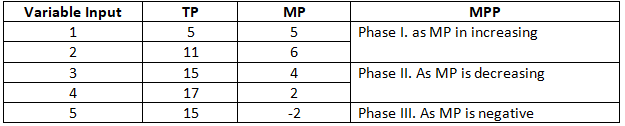
Introduction
We are aware that both consumers and producers are needed for the smooth functioning of an economy. In the previous three chapters, we focused our attention on the behavior of consumers. Now, we will pay attention towards the producers. A producer makes use of various inputs (known as Factors of Production) for the production of goods and services. Production is an important economic activity as it enhances the utility of the product by changing it in the form needed by the consumers. For example – leather is of less use in its raw form until it is transformed into some desirable product like shoes, bags, jackets, etc. The term production, in economics, covers a much wider range of activities, than in its everyday use.
Production Function
There exists some relationship between inputs and output of a firm. In Economics, such a relationship is known as production function. Production function is an expression of the technological relation between physical inputs and output of a good.
Example of Production function – Suppose a firm manufactures chairs with the help of two inputs, say labor (L) and capital (K). Then, production function can be written as: OChairs = f (L, K)
More about Production Function
- The production function specifies either the maximum output that can be produced with the given inputs or the minimum quantity of inputs needed to produce a given level of output.
- Production function establishes a relation between inputs and output, which is technical in nature.
Production function is not economical in nature as we do not consider the value of inputs and output.
- Production function is always defined with respect to a given technology. If there is an improvement in the technique of production, then increased output can be obtained with the same physical inputs.
Short Run And Long Run
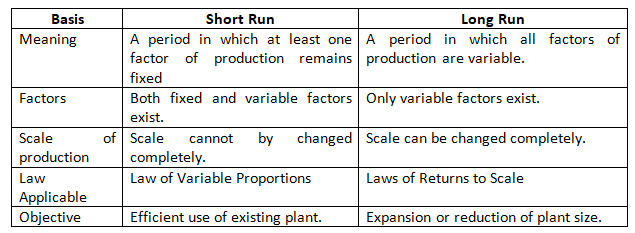
Short Run – Short run refers to a period in which output can be changed only variable factors. In the short run, fixed inputs like plant, machinery, building, etc., cannot be changed. It means, production can be raised by increasing variable factors, but till the extent of capacity of fixed factors. For example – If a producer wants to increase output in the short run, then this objective can be achieved by using more raw materials and increasing the number of workers in the existing factory building plant and equipment.
Long Run – Long run refers to a period which output can be changed by changing all factors of production. Long run is a period, that is long enough for the firm to adjust all its inputs according to change in the conditions. In the long run, firm can change its factory size, switch to new techniques of production, purchase new machinery, etc.
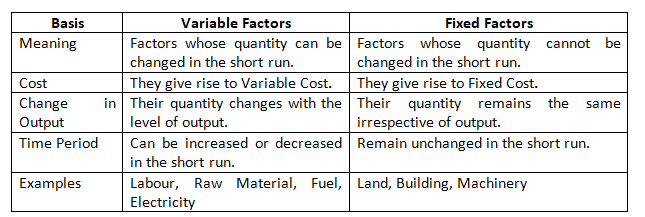
Variable Factors And Fixed Factors – Production is the result of combined efforts of the factors of production. These factors are broadly classified as: (i) Variable Factors; (ii) Fixed Factors.
- Variable Factors – Variable Factors refer to those factors, which can be changed in the short run. For example – raw material, casual labor, power, fuel, etc. Variable factors vary directly with the level of output. As output increases, requirement for variable factors also rises and vice-versa. It must be noted that variable factors are not required in case of zero output.
- Fixed Factors – Fixed factors refers to those factors, which conn not be changed in the short run. For example – plant and machinery, building, land, etc. The quantity of fixed factors remain same in the short run irrespective of level of output, i.e. they do not change, whether the level of output rises, falls or becomes zero.
Types of production function – The distinction between fixed and variable factors helps us to study the two types of production function:
- Short Run Production Function (variable Proportion type) – Short run production function refers to a situation when output is increased by changing only one input while keeping other inputs unchanged. As there is change in variable input only, the ratio between different inputs tends to change at different levels of output. This relationship is explained by ‘Law of Variable Proportions’ (discussed in Section 5.6).
- Long Run production Function (constant Proportion Type) – Long run production function refers to a situation when output is increased by increasing all the inputs simultaneously and in the same proportion. As all inputs are variable in the long run, the ratio between different inputs tends to remain the same at different levels of output.
Concept of Product
Product or output refers to the volume of goods produced by a firm or an industry during a specified period of time. The concept of product can be looked at from three different angles:
- Total Product (TP)
- Average Product (AP)
- Marginal Product (MP)
- Total Product (TP) – total product refers to total quantity of goods produced by s firm during a given period of time with given number of inputs. For example – It 10 labours produce 60 kg of rice, then the total product is 60 kg. in the short run, a firm can expand TP by increasing only the variable factors. However, in the long run, TP can be raised by increasing both fixed and variable factors.
- Average Product (AP) – Average product refers to output per unit of variable input. For example – if total product (TP) is 60 kg of rice, produced by 10 labours (variable input), then average product will be 60 ÷ 10 = 6 kg.
AP is obtained by dividing TP by units of variable factor.
Average Product (AP) = total Product (TP) / Units of variable factor (n)
- Marginal Product (MP) – Marginal Product refers to addition to total product, when one more unit of variable factor is employed. It measures extra output extra unit of input holding all other inputs fixed.
MPn = TPn – TPn-1
Where
MPn = Marginal product of nth unit of variable factor;
TPn = Total product of n units of variable factor;
TPn-1 = Total Product of (n – 1) units of variable factor;
n = number of units of variable factor.
Short Answer Type Questions
- What is meant by variable factor and fixed factor? Give two example of each.
Answer:
Fixed factor – A fixed factor is a factor of production whose quantity remains unchanged in the short run, regardless of the level of output.
Examples:
- Land
- Factory Building
variable factor – A variable factor is a factor of production whose quantity can be changed in the short run according to the level of output.
Examples:
- Labour
- Raw Material
2. Define the following terms: (i) total product; (ii) Average product; (iii) Marginal product.
Answer –
(i) Total Product (TP) – Total Product is the total quantity of output produced by employing a given amount of a variable factor along with fixed factors.
(ii) Average Product (AP) – Average Product is the output produced per unit of the variable factor.
AP = TP ÷ Units of Variable Factor
(iii) Marginal Product (MP) – Marginal Product is the additional output produced by employing one more unit of the variable factor.
MP = Change in TP ÷ Change in Variable Factor
3. What is meant by returns to a factor? State the law of diminishing returns to a factor.
Answer:
Returns to a factor- Returns to a factor refer to the change in total output when only one variable factor is increased while all other factors remain constant.
The Law of Diminishing Returns to a Factor states that when more and more units of a variable factor are employed with fixed factors remaining unchanged, the marginal product of the variable factor eventually begins to decline.
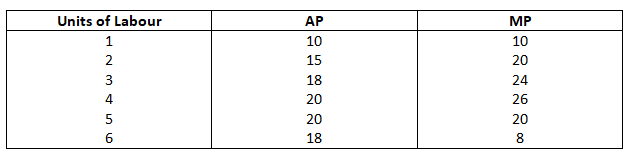
4. State the relation between Average Product (AP) and Marginal Product (MP), using a schedule or diagram.
Answer: The relationship between AP and MP is as follows:
- When MP is greater than AP, AP rises.
- When MP is equal to AP, AP is at its maximum.
- When MP is less than AP, AP falls.
Schedule
5. What is meant by returns to a factor? What leads to increasing returns to a factor? Explain.
Answer:
Returns to a factor refer to the change in total output resulting from an increase in one variable factor while other factors remain fixed.
Increasing returns to a factor occur when each additional unit of the variable factor adds more output than the previous unit, i.e., Marginal Product increases.
Reasons for increasing returns to a factor:
- Better utilisation of fixed factors.
- Division of labour and specialisation.
- Improvement in efficiency of workers.
6. What is meant by diminishing returns to a factor? Why does it occur?
Answer: Diminishing returns to a factor refer to the stage where the Marginal Product (MP) of the variable factor starts decreasing while the Total Product (TP) continues to increase at a diminishing rate.
Reasons:
- Fixed factors become insufficient in comparison to the variable factor.
- Optimum combination of fixed and variable factors gets disturbed.
7. In which phase a rational producer will operate in the short run?
Answer: A rational producer will always operate in the Second Phase (Stage of Diminishing Returns) because:
- Total Product is increasing.
- Marginal Product is positive.
- Resources are used efficiently and production is economical.
8. What does the Law of Variable Proportions show? State the behaviour of total product according to this law.
Answer: The Law of Variable Proportions shows the effect on output when only one factor of production is increased while other factors remain constant.
Behaviour of Total Product (TP):
- TP increases at an increasing rate.
- TP increases at a decreasing rate.
- TP starts declining.
9. What does the Law of Variable Proportions show? State the behaviour of marginal product according to this law.
Answer: The law explains how output changes when one variable factor is increased while fixed factors remain unchanged.
Behaviour of Marginal Product (MP):
- MP increases in the first stage.
- MP decreases but remains positive in the second stage.
- MP becomes negative in the third stage.
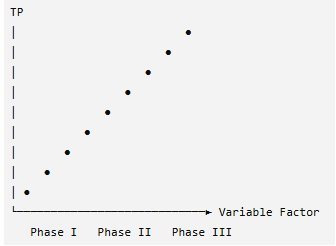
10. State the phase in the behaviour of total Product as per the Law of Variable Proportions. Use diagram.
Answer:
Phases of Total Product (TP):
- Phase I: TP increases at an increasing rate.
- Phase II: TP increases at a diminishing rate.
- Phase III: TP starts declining.
Simple Diagram
11. Giving reasons, explain the ‘Law of Variable Proportions’.
Answer: The Law of Variable Proportions states that when more units of a variable factor are employed with fixed factors remaining constant, output passes through three stages.
Reasons:
- Initially, better utilisation of fixed factors increases productivity.
- After a point, fixed factors become inadequate, causing diminishing returns.
- Excessive use of the variable factor results in negative returns.
12. Discuss the concepts of short Run Production Function and long Run Production Function.
Answer:
Short Run Production Function – In the short run, at least one factor is fixed and only variable factors can be changed.
Long Run Production Function – In the long run, all factors of production are variable, and the producer can change the scale of production.
13. What type of production function is this in which only one input is increased and others are kept constant? State the behaviour of total product in this production function.
Answer: It is called the Short Run Production Function or Production Function under the Law of Variable Proportions.
Behaviour of Total Product:
- Initially, TP increases at an increasing rate.
- Then, TP increases at a diminishing rate.
- Finally, TP starts declining.
14. Define production function. State the behaviour of marginal product when only input is increased and other input are held constant.
Answer: A production function shows the relationship between inputs used in production and the output produced.
Behaviour of Marginal Product (MP):
- MP first increases.
- Then MP decreases but remains positive.
- Finally, MP becomes negative.
15. What is meant by ‘negative returns to a factor? Discuss any two reasons behind negative returns to a factor.
Answer: Negative returns to a factor refer to the stage where adding more units of the variable factor causes Total Product to decrease and Marginal Product becomes negative.
Reasons:
- Excessive use of the variable factor with limited fixed factors.
- Overcrowding and inefficient use of resources reduce productivity.
Long Answer Type Questions
- Explain the Law of Variable Proportions with the help of total and marginal physical product curves.
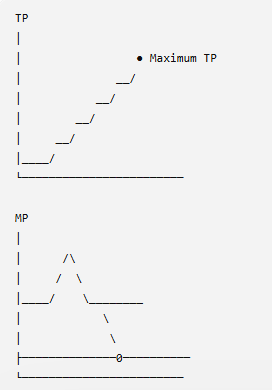
Answer – The Law of Variable Proportions states that when more and more units of a variable factor are employed with a fixed factor, the Total Product (TP) first increases at an increasing rate, then at a diminishing rate, and finally starts decreasing. Accordingly, the Marginal Product (MP) first rises, then falls, becomes zero and finally becomes negative.
Phases of the Law
Phase I – Increasing Returns to a Factor
- Total Product increases at an increasing rate.
- Marginal Product rises continuously.
- Better utilisation of fixed factors and division of labour increase efficiency.
Phase II – Diminishing Returns to a Factor
- Total Product continues to increase but at a decreasing rate.
- Marginal Product starts falling but remains positive.
- This is the rational stage of production, where the producer operates.
Phase III – Negative Returns to a Factor
- Total Product starts decreasing.
- Marginal Product becomes negative.
- Excess labour creates overcrowding and inefficiency.
2. Explain the likely behavior of Total Product and Marginal Product when for increasing production only one input is increased while all other inputs are kept constant.
Answer – When only one factor of production is increased while all other factors remain fixed, the behavior of Total Product (TP) and Marginal Product (MP) follows the Law of Variable Proportions.
Behavior of Total Product (TP)
Phase I
- TP increases at an increasing rate.
- Each additional unit of the variable factor contributes more output than the previous unit.
Phase II
- TP continues to increase but at a diminishing rate.
- Output increases, but each additional unit contributes less than before.
Phase III
- TP starts declining.
- Addition of more units of the variable factor reduces total output.
Behavior of Marginal Product (MP)
Phase I
- MP increases due to efficient utilisation of fixed factors.
Phase II
- MP declines but remains positive.
- Every additional unit adds less output than the previous one.
Phase III
- MP becomes zero and then negative.
- Additional units reduce total production.
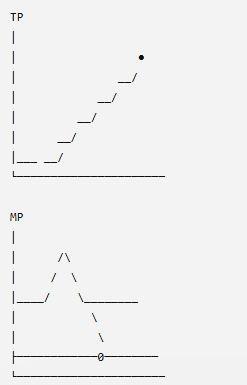
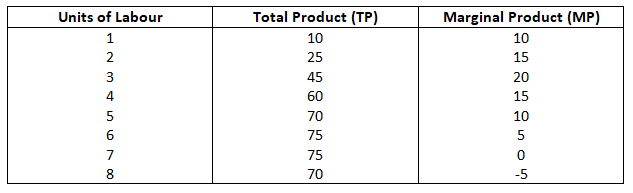
3. Explain the law of diminishing returns with the help of a hypothetical schedule and diagram.
Answer – The Law of Diminishing Returns states that when additional units of a variable factor are employed with fixed factors remaining unchanged, the Marginal Product of the variable factor eventually begins to decline.
Hypothetical Schedule
Explanation
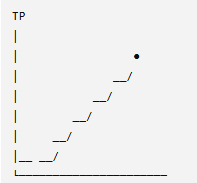
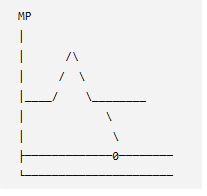
- Initially, TP increases rapidly and MP rises.
- After a certain point, MP starts falling due to the law of diminishing returns.
- TP continues to rise but at a slower rate.
- When MP becomes zero, TP reaches its maximum.
- When MP becomes negative, TP begins to decline.
4. Explain reasons for (i) Increasing returns to a factor; (ii) Diminishing returns to a factor.
Answer
(i) Reasons for Increasing Returns to a Factor
- Better Utilisation of Fixed Factors – Initially, fixed factors are underutilised. As more units of the variable factor are employed, these fixed resources are used more efficiently.
- Division of Labour and Specialisation – More workers allow work to be divided into specialised tasks, increasing productivity.
- Greater Efficiency – Workers gain experience and coordination improves, leading to higher output.
(ii) Reasons for Diminishing Returns to a Factor
- Limited Fixed Factors – Land, machinery and buildings remain fixed, so additional workers have fewer resources to work with.
- Overcrowding of Fixed Resources – Too many workers using the same machinery or land reduces efficiency.
- Declining Marginal Productivity – Successive units of the variable factor contribute less additional output than earlier units.
- 5. Discuss the relationship between: (i) MP and TP; (ii) AP and MP.
Answer –
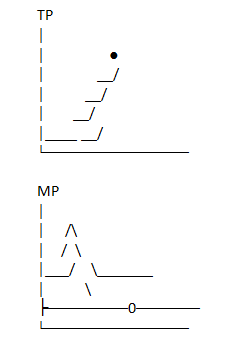
(i) Relationship between Marginal Product (MP) and Total Product (TP) – Marginal Product is the addition made to Total Product by employing one more unit of the variable factor.
(i) Relationship between Marginal Product (MP) and Total Product (TP) – Marginal Product is the addition made to Total Product by employing one more unit of the variable factor.
- When MP is increasing, TP increases at an increasing rate.
- When MP is positive but decreasing, TP increases at a decreasing rate.
- When MP becomes zero, TP reaches its maximum.
- When MP becomes negative, TP starts declining.
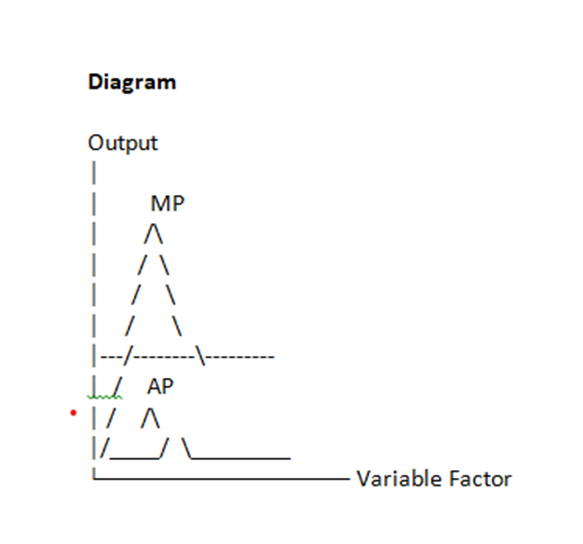
(ii) Relationship between Average Product (AP) and Marginal Product (MP) – Average Product is the output per unit of the variable factor, while Marginal Product is the additional output from one extra unit.
Relationship
- When MP > AP, AP rises.
- When MP = AP, AP is at its maximum.
- When MP < AP, AP falls.
6. Distinguish between (i) Variable factors and fixed factors; (ii) short run and long run.
Answer – (i) Variable factor and factors
(ii) short run and long run
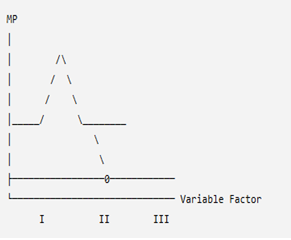
7. What are the different phases in the Law of Variable Proportions in terms of marginal product? Give reason behind each phase. Use diagram.
Answer – According to the Law of Variable Proportions, when more units of a variable factor are employed with fixed factors, Marginal Product (MP) passes through three phases.
Phase I – Increasing Marginal Product
Behaviour of MP
- MP increases continuously.
Reasons
- Better utilisation of fixed factors.
- Division of labour and specialisation.
- Improved efficiency of workers.
Phase II – Diminishing Marginal Product
Behaviour of MP
- MP starts falling but remains positive.
Reasons
- Fixed factors become relatively scarce.
- Additional workers have less machinery and land available.
- Efficiency begins to decline.
Phase III – Negative Marginal Product
Behaviour of MP
- MP becomes zero and then negative.
Reasons
- Overcrowding of fixed resources.
- Excess labour interferes with one another’s work.
- Total output starts declining.
8. Explain the changes that take place in total product & marginal product under diminishing returns to a factor.
Answer – Under Diminishing Returns to a Factor, additional units of the variable factor produce progressively smaller additions to total output while fixed factors remain unchanged.
Changes in Total Product (TP)
- TP continues to increase.
- However, it increases at a decreasing rate.
- Eventually, TP reaches its maximum.
- After that, TP starts declining.
Changes in Marginal Product (MP)
- MP starts falling after reaching its maximum.
- MP remains positive for some time.
- MP becomes zero when TP is maximum.
- MP becomes negative when TP starts falling.
9. State, with the help of a marginal product schedule, the different phase of the Law of Variable Proportions.
Answer –
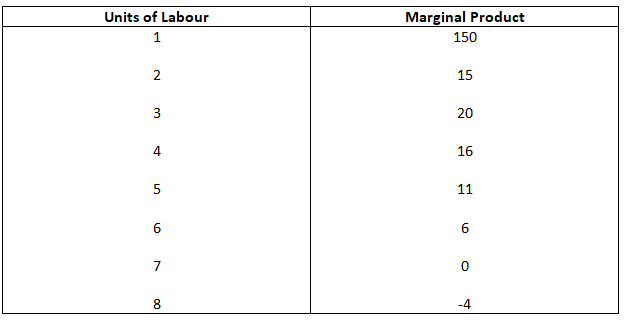
The Law of Variable Proportions can be explained with the following schedule.
Marginal Product Schedule
Explanation
Phase I – Increasing Returns
- MP increases from 10 to 20.
- Due to better utilisation of fixed factors and division of labour.
Phase II – Diminishing Returns
- MP falls from 16 to 6, but remains positive.
- Additional workers contribute less output.
Phase III – Negative Returns
- MP becomes zero and then negative.
- Excess labour causes inefficiency and TP starts falling.
10. Explain the Law of variable proportions with the help of a numerical example.
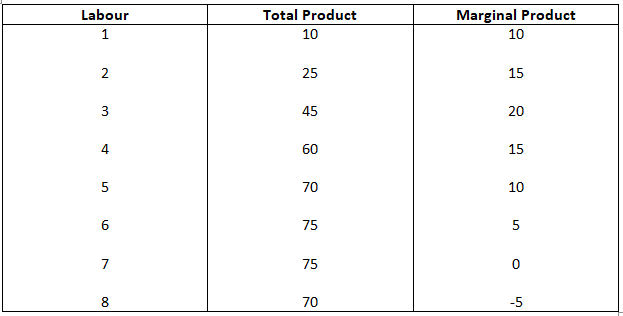
Answer – The Law of Variable Proportions states that when additional units of a variable factor are employed while other factors remain fixed, output first increases at an increasing rate, then at a decreasing rate and finally begins to decline.
Numerical Example
Explanation
Phase I
- TP increases rapidly.
- MP rises from 10 to 20.
Phase II
- TP continues to increase but at a decreasing rate.
- MP declines from 15 to 5, remaining positive.
Phase III
- TP starts falling.
- MP becomes zero and then negative.
11. What is meant by “diminishing returns to a factor”? Discuss any two reasons for the operations of diminishing returns to a factor.
Answer – Diminishing Returns to a Factor refers to the situation in which the Marginal Product of a variable factor starts declining after a certain level of employment while other factors remain fixed. It is a short-run phenomenon because some factors of production cannot be changed.
Reasons for Diminishing Returns
1. Limited Fixed Factors – In the short run, land, machinery and buildings remain fixed. As more workers are employed, the available fixed resources become insufficient. Consequently, each additional worker contributes less to total output.
2. Overcrowding of Fixed Resources – When too many workers use the same machinery or land, they interfere with each other’s work. This reduces efficiency and lowers the marginal product of additional workers.
Unsolved Practical’s
Practical’s on TP, AP and MP
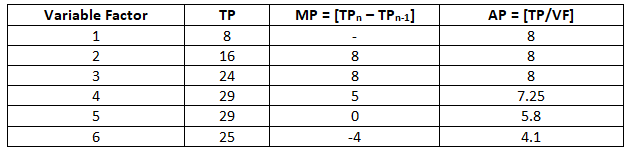
- Calculate Average Product (AP) and Marginal Product (MP):

Solution –
2. Calculate Average Product (AP) and Marginal Product (MP):

Solution –
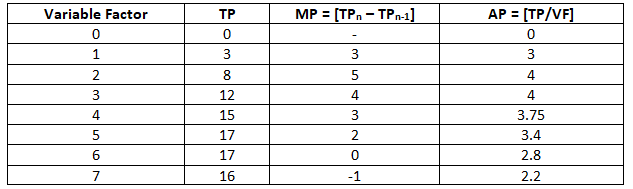
3. Calculate TP and AP:

Solution –
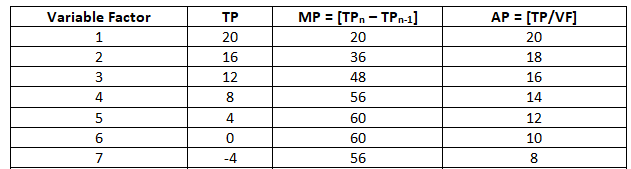
4. Calculate TP and AP from the following data:

Solution –
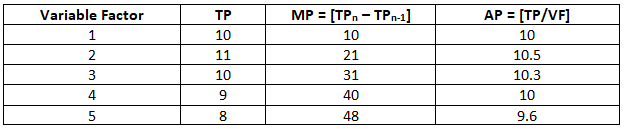
5. Calculate the values of TP and AP:

Solution –
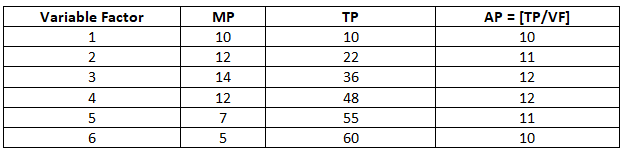
6. Compute TP and MP:

Solution –
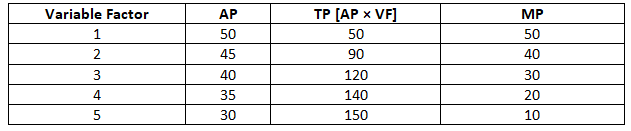
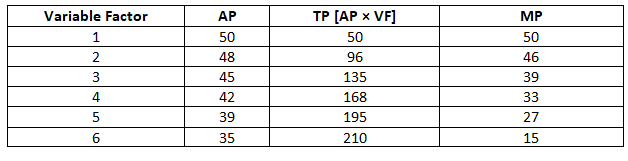
7. Calculate TP and MP:

Solution –
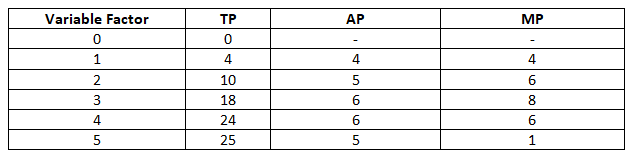
8. Find out the missing values from the following table:

Solution –
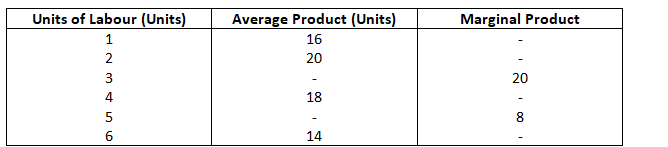
9. Complete the following table:
Solution –
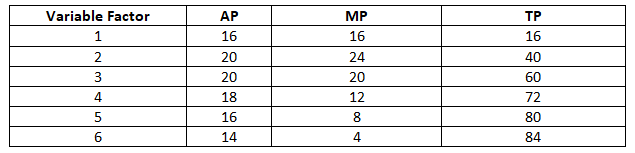
10. Complete the following schedule:

Solution –

Practicals on Law of Variable Proportions
11. Calculate MP of the variable factor and identify the various phases of change in total product, from the following schedule:

Solution –
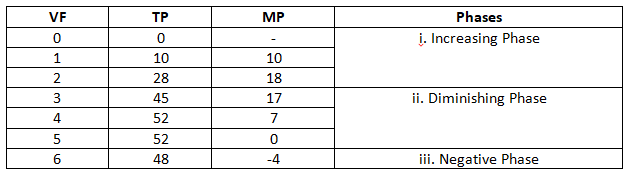
12. Identify the three phases of the Law of Variable Proportions from the following schedule:

Solution –

13. From the following table, find out the phase during which there are increasing returns to a factor. Give reasons for your answer.

Solution –
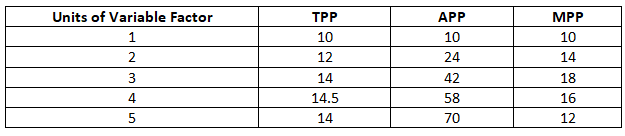
14. Identify the three phases of the law of variable proportions. Give reasons.
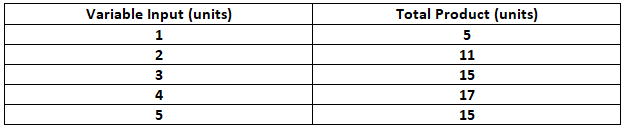
Solution –