microeconomics notes class 11 chapter 1
class 11 micro economics chapter 1 introduction notes
microeconomics notes class 11 pdf
class 11 microeconomics chapter 1 sandeep garg notes
sandeep garg microeconomics class 11 solutions pdf
What is Economy?
You must have observed many activities happening around you in your daily life. For instance, you may have seen factories, mines, shops, offices, flyovers, railways, etc. All these institution and organizations may collectively be called an economy. Such units enable people to earn and income and, at the same time, help to produce goods and services that people require for use. An economy is a system which provides people, the means to work and earn a living. It is an organization that provides living to the people. This task makes use of the available resources to produce the goods and services that people want. For example, Indian economy consists of all sources of production in agriculture, industry, transport and communication, banking, etc.
Vital Processes of an Economy
Economy is a system which provides living to the people. For this objective to be fulfilled, it is necessary that every economy should undertake three economic activities:
- Production
- Consumption
- Investment or Capital Formation.
These economic activities are known as the essentials or the vital processes of an economy.
SCARCITY
Scarcity refers to the limitation of supply in relation to demand for a commodity. It refers to situation, when wanted exceed the available resources. As a result, goods are not readily available and society does not any enough resource to satisfy all wants of its people. Scarcity is universal, i.e. every individual, organization and economy faces scarcity of resources. Scarcity of resources calls for economizing of resources. Economizing of resources refers to making optimum use of the available resources.
ECONOMIC PROBLEM
Economic Problem is a problem of choice involving the satisfaction of unlimited wants out of limited resources having alternative uses.
Reasons for Economic Problem
- Scarcity of Resources – Resources (i.e. land, labor, capital, etc.) are limited in relation to their demand and the economy cannot produce all the people want. It is the basic reasons for the existence of economic problems in all economies.
- Unlimited Human Wants – Human wants are never-ending, i.e. they can never be fully satisfied. As soon as one want is satisfied, another new want emerges. The wants of the people are unlimited and keep on multiplying & cannot be satisfied due to limited resources. Human wants also differ in priorities, i.e. all wants are not of equal intensity.
- Alternate Uses – Resources are not only scarce, but they can also be put to various uses. It makes choice among resources more important. For example, petrol is used not only in vehicles, but also for running machines, generators, etc. As a result, economy has to make choice between the alternative uses of the given resources.
Meaning of Economics – Economics is a social science which studies the way a society choose to use its limited resources which have alternate uses, to produce goods and serives and to distribute them among different group of people.
Positive Economics and Normative Economics
Positive Economics (or Science) – Positive economics studies the facts of life, i.e., it deals with ‘things as they are’. Positive Economics deals with what are the economic problems and how are they actually solved. For example, India is an overpopulated country or prices are constantly rising.
Positive Economics is neutral between ends – Positive economics remain strictly neutral with respect to ultimate ends. It avoids economic value judgments. For example a positive economic theory might describe that manufacturing and sale of cigarettes is injurious to health, but it does not provide any instruction or judgment on what policy output to be followed to avoid cigarettes in an economy.
“According to Robbins, economics is not concerned with moral or ethical questions and economists should analyse things as they are and have no right to give judgment.”
Do not confuse statement of Positive Economics as statement of truth – Positive economics statements should not be confused with statement of truth. They may be true of false. For example, If Para’s says that India is large than China in terms of land area, while Utkarsh says that China is larger than India in terms of land area, then India in terms of land area, then both are positive statement. However, Paras is wrong and Utkarsh is righ.
- Normative Economics (or Science) – Normative economics tell us ‘what ought to be’. Normative Economics deals with what ought to be or how the economic problems should be solved. For example, India should not be an overpopulated country or prices should not rise. Normative economic discusses what are desirable tings and should be realized and what are undesirable things and should be avoided. It gives decisions regarding value judgments.
Microeconomic and Macroeconomics
- Microeconomics – Adam Smith is considered to be the founder of the field of microeconomics. The term ‘micro’ has been derived from Greek word ‘mikros’ which means ‘small’.Microeconomics deals with analysis of behavior and economic actions of small and individual units of the economy, like a particular consumer, a firm or a small group of individual units. The concept of microeconomics is very important as it supplies the foundation for most of our understanding of the functioning of an economy. For example – Individual income, individual output, price of commodity, etc. its main tools are Demand and Supply.
- Macroeconomics – The term ‘macro’ has been derived from the Greek work ‘macros’ which means ‘large’. So, macroeconomics deals with the overall performance of the economy. It is concerned with the study of problems of the economy like inflation, unemployment, poverty, etc. Macroeconomics is that part of economics theory which studies that behavior of aggregates of the economy as a whole. For example – National income, aggregate output, aggregate consumption, etc. Its main tools are Aggregate Demand and Aggregate Supply.
Difference between Microeconomics and Macroeconomics
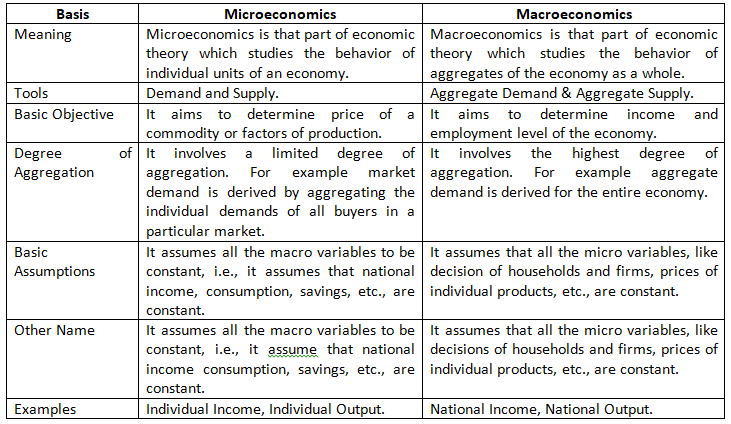
Central Problems of an Economy
Production, distribution and disposition of goods and services are the basic economic activities of life. In the course of these activities, every society has to face a scarcity of resources. Because of this scarcity, every society has to decide how to allocate scare resources. It leads to following central problems, that are faced by every economy:
- What to produce
- How to produce
- For whom to produce
These problems are called central problem because these are the most basic problems of an economy and all other problems revolve around them.
- What to produce – This problem involves section of goods and services to be produced and the quantity to be produced of each selected commodity. Every economy has limited resources and thus, cannot produce all the goods. More of one good or service usually means less of others. For Example – Production of more sugar is possible only by reducing the production of other goods. Production of more war goods is possible only by reducing the production of civil goods. So, on the basis of the importance of various goods, an economy has to decide which goods should be produced and in what quantities. This is a problem of allocation of resources among different goods.
The problem of ‘What to produce’ has two aspects:
- What possible commodities to produce – An economy has to decide, which consumer goods (rice, wheat, clothes, etc.) and which of the capital goods (machinery, equipment’s, etc.) are to be produced. In the same way, economy has to make a choice between civil goods (bread, butter, etc.) and war goods (guns, tanks, etc.).
- How much to produce – After deciding the goods to be produced, economy has to decide the quantity of each commodity, that is selected. It means, it involves a decision regarding the quantity to be produced, of consumer and capital goods, civil and war good and so on.
2. How to Produce – This problem refers to the selection of techniques to be used for the production of goods and services. A good can be produced using different techniques of production. By ‘technique’, we mean which particular combination of inputs to be used. Generally, techniques are classified as: labor intensive techniques (LIT) and Capital intensive techniques (CIT).
- In Labour intensive technique, more labour and less capital (in the form of machines, etc.) is used.
- In capital intensive technique, there is more capital and less labour utilization.
3. For Whom to Produce – This problem relates to the distribution of produced goods and services among the individuals within the economy, i.e. selection of the category of people who will ultimately consume the goods, i.e. whether to produce goods for more poor and less rich or more rich and less poor.
The problem can be categorized under two main heads:
- Personal Distribution – It means how the national income of an economy is distributed among different groups of people.
- Functional Distribution – It involves deciding the share of different factors of production in the total national product of the country.
Opportunity cost – As resources are scare, society is always forced to make choices. To produce more of one good, a certain amount of other goods has to be sacrificed. The true cost of using economic resources in any given project is the loss of the alternative output which they might have produced. Hence, Opportunity Cost is the cost of next best alternative foregone. For example – suppose you are working in a bank at a salary of Rs.70,000 per month. Further suppose, you receive two more job offers:
- To work as an executive at Rs.60,000 per month; or
- To become a journalist at Rs.65,000 per month.
In the given case, the opportunity cost of working in the bank is the cost of next best alternative foregone, i.e. Rs.65,000. The amount of other goods and services, that must be sacrificed to obtain more of any one good, is called the opportunity cost of that good.
Production Possibility Frontier (PPF)
Production Possibility Frontier (PPF) refers to the graphical representation of possible combinations of two goods that can be produced with given resource and technology. Alternately, PPF is the locus of various possible combinations of two goods that can be produced with given resources and technology.
Synonyms of PPF
PPF is also known by the following names:
- Production possibility Curve (PPC)
- Production possibility Boundary
- Transformation Curve
- Transformation Boundary
- Transformation Frontier
Assumptions for PPF
Production possibility frontier is based on the following assumption:
- The amount of resources in an economy is fixed, but these resources can be transferred from one use to another;
- With the help of given resources, only two goods can be produced;
- The resources are fully and efficiently utilized;
- Resources are not equally efficient in production of all products. So, when resources are transferred from production of one good to another, the productivity decreases;
- The level of technology is assumed to be constant.
The concept of PPF can be better understood with the help of following imaginary (hypothetical schedule and diagram:
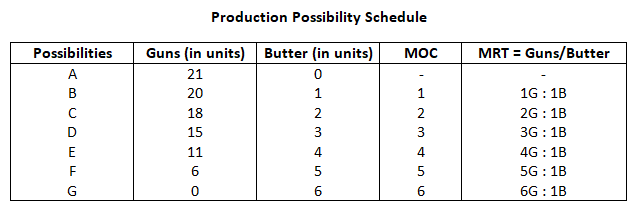
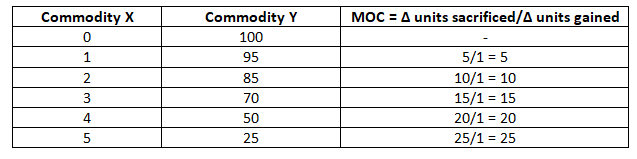
Marginal Opportunity Cost (MOC) – MOC refer to the number of a commodity sacrificed to gain one additional unit of another commodity. In case of PPF, MOC is always increasing, i.e. more and more unites of a commodity have to be sacrificed to gain an additional unit of another commodity.
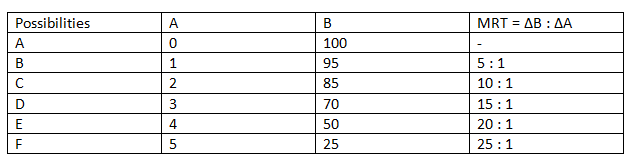
Marginal Rate of Transformation (MRT) – MRT is the ratio of number of units of a commodity sacrificed to gain an additional unit to another commodity.
MRT = Δ Units Sacrificed/ Δ Units Gained .
In the given example of guns and butter, MRT = Δ Guns / Δ Butter
MRT measures the slope of Production Possibility Frontier.
Characteristics or Properties of PPF
The two basic characteristics or features or properties of PPF are:
- PPF slopes Downwards – PPF shows all the maximum possible combinations of two goods, which can be produced with the available resource and technology. In such a case, more of one good can be produced only by taking resources away from the production of another good.
- PPF is Concave Shaped – PPF is concave shaped because of the increasing marginal rate of transformation (MRT), i.e. more and more units of one commodity are sacrificed to gain an additional unit of another commodity.
Whether Economy will always operate on PPF?
In must be remembered that PPF does not show the point at which the economy will actually operate. It only shows the maximum available possibilities, which an economy can produce.
The exact point of operation depends on how well the resources of the economy are used.
- Economy will operate on PPF only when resources are fully and efficiently utilized.
- Economy will operate at any point inside PPF if resources are not fully and efficiently utilized.
- Economy cannot operate at any point outside PPF as it is unattainable with the available productive capacity.
It means:
- Economy can either operate on PPF or inside PPF, known as ‘Attainable Combinations’.
- However, economy cannot operate outside PPF, known as ‘Unattainable Combinations’.
Attainable and Unattainable Combinations
Attainable Combinations – It refers to those combination at which economy can operate. There can be two attainable options:
- Optimum utilization of resources – If the resources are used in the best possible manner, then economy will operate at any point (like, A, B, C or D) on PPF.
2. Inefficient utilization of resources – However, the actual production can fall short of its capabilities. It there is wastage or inefficient utilization of resources, then economy will operate at any point inside the PPF (like E).
Unattainable Combinations: With the given amount of available resources, it is impossible for the economy to produce any combination more than the given possible combination, i.e. an economy can never operate at any point outside the PPF.
PPF and MRT – We can measure MRT on the PPF. For example, MRT between the possibilities D and E is equal to DH/HE and between E and F, it is equal to EI/IF and so on. We know, PPF is concave shaped curve. The slope of PPF is a measure of the MRT. Since the slope of a concave curve increase as we move downwards along the curve, the MRT also rises as we move downwards along the curve.
Can PPF be a straight line? – PPF can be a straight line if we assume that MRT is constant, i.e. the same amount of a commodity is sacrificed to gain an additional unit of another commodity. It is possible only when we assume that all the resources are equally efficient in the production of all goods.
Can PPF be Convex to the Origin? – PPF can be convex to the origin if MRT is decreasing, i.e. less and less units of a commodity are sacrificed to gain an additional unit of another commodity.
PPF and Opportunity Cost – The opportunity cost of a product is the alternative that must be given up to produce that product. PPF illustrates the concept of opportunity cost. The opportunity cost of producing more butter is fewer guns. As we mover from ‘E’ to ‘F’ the production of butter rises from 4 units to 5 units, but the number of guns decreases from 11 units to 6 units, i.e. opportunity cost of the 5th unit of butter is sacrifice of 5 units of guns.
PPF as Transformation Curve – Slope of PPF indicates the ease or difficulty in transforming one good into another.
Change in PPF – PPF is based on the assumption, that resources of an economy are fixed. However, in this changing world, the productive capacity of an economy is constantly changings due to increase or decrease in resources. Such changes in resource lead to change in PPF.
- Shift in PPF – The PPF can shift either towards right or towards left, when there is a change in resources or technology with respect to both the goods.
- Rightward Shift in PPF – when there is “Advancement or Upgradation of Technology” or/and “Growth of Resources” in respect to both the goods, then PPF will shift to the right. For example, if there is an increase in resource for the production of butter and guns, we can produce more of both the goods. In such case, existing PPF (PP) will shift to the right, represented by P1P1.
- Leftward Shift in PPF – PPF will shift towards left, when there is a technological degradation and /or decrease in resources with respect to both the goods. For example, destruction of resources in an earthquake will reduce the productive capacity and as a result, PPF will shift to the left from PP to P1P1.
2. Rotation of PPF – It happens when there is a change in productive capacity (resources or technology) with respect to only one good. The rotation can be either for the commodity on the X-axis or for commodity on the Y-axis.
- Rotation for Commodity on the X-axis – When there is a technological improvement or an increase in resources for the production of the commodity on the X-axis (say, butter), then PPF will rotate from AB to AC.
- Rotation for commodity on the Y-axis – A technological improvement or an increase in resources for production of commodity on Y-axis (say, guns), will rotate the PPF from AB to CB. However, in case of degradation in technology or a decrease in resources for production of guns, PPF will rotate to the left from AB to DB.
Short Answer type Questions
- Why does an economic problem arise? Explain.
Answer: An economic problem arises because human wants are unlimited, while resources are limited and have alternative uses. Since all wants cannot be satisfied with the available resources, every economy has to make choices regarding the use of resources. This creates the problem of scarcity, which is called the economic problem.
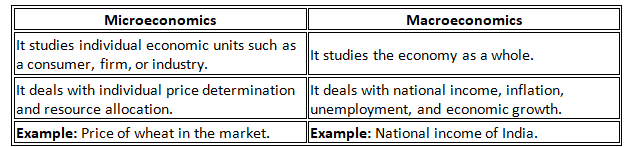
2. Differentiate between Microeconomics and Macroeconomics, with suitable examples.
3. What are the three central problems of an economy? Why do they arise?
Answer:
The three central problems of an economy are:
- What to produce and in what quantity?
- How to produce?
- For whom to produce?
These problems arise because resources are scarce and have alternative uses, whereas human wants are unlimited.
4. What is meant by the problem of allocation of resources?
Answer: The problem of allocation of resources refers to the efficient distribution of scarce resources among different uses. An economy has to decide what goods and services should be produced and in what quantity so that available resources are used in the best possible manner.
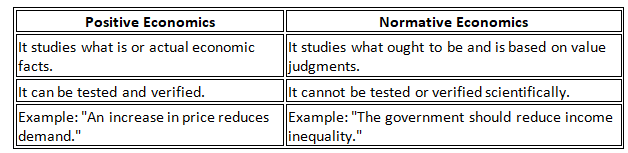
5. Distinguish between positive economics and normative economics. Give an example of each.
Answer –
6. Explain the central problem of ‘how to produce’.
Answer – The problem of ‘How to Produce’refers to the choice of thetechnique of production. An economy has to decide whether goods should be produced by using labour-intensive techniques (more labour, less capital) or capital-intensive techniques (more capital, less labour). The choice depends on the availability and cost of resources.
7. Explain ‘what to produce’ with the help of an example.
Answer: The problem of ‘What to Produce’ means deciding which goods and services should be produced and in what quantities. Since resources are limited, all goods cannot be produced.
Example: If resources are limited, an economy may decide to produce more food grains and fewer luxury cars to meet the basic needs of the people.
8. Explain the central problem of “for whom to produce”.
Answer: The problem of ‘For Whom to Produce’ means deciding who will get the goods and services produced. It depends on the income and purchasing power of people. Those who have higher income can buy more goods and services.
9. What is opportunity cost? Explain with the help of a numerical example.
Answer: Opportunity Cost is the value of the next best alternative sacrificed when a choice is made.
Example: A student has ₹500. He can buy either a book or a pair of shoes. If he buys the book, the opportunity cost is the pair of shoes that he gives up.
10. Discuss meaning of production possibility curve through a schedule and diagram.
Answer: A Production Possibility Curve (PPC) shows the maximum possible combinations of two goods that an economy can produce with its given resources and technology, when all resources are fully and efficiently utilised.
Production Possibility Schedule
| Combination | Wheat (Units) | Cloth (Units) |
| A | 0 | 50 |
| B | 10 | 45 |
| C | 20 | 35 |
| D | 30 | 20 |
| E | 40 | 0 |
11. Why do central problems arise? Explain
Answer: Central problems arise because resources are limited and have alternative uses, whereas human wants are unlimited. Therefore, every economy has to make choices regarding the production and distribution of goods and services.
12. Explain why a production possibilities curve is concave.
Answer: A Production Possibility Curve is concave to the origin because of the law of increasing opportunity cost. As more units of one good are produced, resources have to be transferred from the production of another good. Since resources are not equally efficient in all uses, the opportunity cost increases, making the PPC concave.
13. Draw a production possibility curve and show the following situations: (1) Fuller utilization of resources: (2) Economic growth; (3) Decrease in resources; (4) Under utilization of resources.
Answer:
- (i) Fuller Utilisation of Resources: When the economy moves from a point inside the PPC to a point on the PPC, it shows full and efficient utilisation of resources.
- (ii) Economic Growth: Economic growth shifts the PPC outward (to the right) due to an increase in resources or improvement in technology.
- (iii) Decrease in Resources: A reduction in resources shifts the PPC inward (to the left).
- (iv) Under Utilisation of Resources: Any point inside the PPC represents unemployment or inefficient use of resources.
14. What does a production possibility curve affected unemployment the economy? Explain.
Answer: A point inside the Production Possibility Curve indicates unemployment or underutilisation of resources. It means that the economy is not using all its available resources efficiently and can increase production without increasing the quantity of resources.
15. How is production possibility curve affected by unemployment in the economy? Explain.
Answer: Unemployment does not change the shape or position of the PPC. It only means that the economy operates at a point inside the PPC instead of on the curve. When unemployed resources are fully utilised, production increases and the economy moves from an inside point to a point on the PPC.
16. What is meant by marginal opportunity cost? Why is marginal opportunity cost increasing in case of PPF?
Answer: Marginal Opportunity Cost (MOC) – is the amount of one good that has to be sacrificed to produce one additional unit of another good.
Why does MOC increase?
- Resources are not equally efficient in producing all goods.
- As more units of one good are produced, resources less suitable for its production are used.
- Therefore, a larger quantity of the other good has to be sacrificed, causing MOC to increase.
17. Give the various reasons for shift in production possibility curve.
Answer: The PPC shifts due to the following reasons:
- Increase or decrease in the quantity of resources.
- Improvement or decline in technology.
- Change in the quality or productivity of resources.
- Natural calamities such as floods, earthquakes, etc.
18. What is ‘Marginal Rate of Transformation? Explain with the help of an example.
Answer: Marginal Rate of Transformation (MRT) – is the rate at which one good must be sacrificed to produce one more unit of another good.
Example: If increasing the production of wheat from 10 units to 11 units reduces the production of rice from 20 units to 18 units,
Then: MRT = 2 units of rice.
19. Define Production Possibilities Curve Explain why it is downward sloping from left to right.
Answer: A Production Possibility Curve (PPC) shows the maximum possible combinations of two goods that an economy can produce with given resources and technology.
It slopes downward from left to right because:
- Resources are limited.
- To produce more of one good, some quantity of the other good must be sacrificed.
- Hence, there is a trade-off between the two goods.
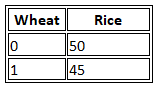
20. Explain the meaning of opportunity cost with the help of production possibility schedule.
Answer: Opportunity Cost is the value of the next best alternative sacrificed when a choice is made.
Example:
21. State any three assumptions on which a ‘Production Possibilities Curve’ is based.
Answer: The PPC is based on the following assumptions:
- Resources are fixed in quantity.
- Technology remains constant.
- Resources are fully and efficiently employed.
22. State the meaning and properties of production possibilities frontier.
Answer: The Production Possibility Frontier (PPF) is the boundary showing the maximum possible output combinations of two goods with available resources and technology.
Properties:
- It slopes downward from left to right.
- It is concave to the origin due to increasing marginal opportunity cost.
- Points on the curve indicate full and efficient utilisation of resources.
23. What will be the effect on PPC of Bihar if better job opportunities are created in Bihar?
Answer: If better job opportunities are created in Bihar:
- Employment will increase.
- Productive resources will be better utilised.
- Production capacity will increase.
24. Using a diagram, explain what will happen to the PPC of Bihar if the river Kosi causes widespread floods?
Answer: Widespread floods caused by the Kosi River will destroy land, crops, and infrastructure.
As a result:
- Productive resources will decrease.
- Production capacity will fall.
25. Explain the behavior of ‘marginal rate of transformation’ along a production possibility curve.
Answer: The Marginal Rate of Transformation (MRT) increases as we move downward along the PPC because:
- Resources are not equally efficient for producing all goods.
- More and more units of one good must be sacrificed to produce additional units of the other good.
26. What will likely be the impact of large scale inflow of foreign capital in India on Production Possibility curve.
Answer: Large-scale inflow of foreign capital increases the availability of capital, technology, and productive resources. This raises the productive capacity of the economy. Therefore, the Production Possibility Curve (PPC) shifts outward (rightward), indicating economic growth.
27. Explain the concept of marginal opportunity cost using a numerical example.
Answer: Marginal Opportunity Cost (MOC) – is the amount of one good sacrificed to produce one additional unit of another good.
Example:
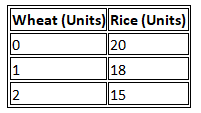
When wheat production increases from 0 to 1 unit, rice decreases from 20 to 18 units.
MOC = 2 units of rice.
When wheat increases from 1 to 2 units, rice decreases from 18 to 15 units.
MOC = 3 units of rice.
28. In what circumstances may the production possibility frontier shift away from the origin? Explain.
Answer: The Production Possibility Frontier (PPF) shifts away from the origin (outward) when the economy’s production capacity increases due to:
- Increase in the quantity of resources.
- Improvement in technology.
- Increase in the efficiency or quality of resources.
- Higher investment and capital formation.
29. Comment upon the shape of production possibility curve, if the marginal rate of transformation is constant.
Answer: If the Marginal Rate of Transformation (MRT) is constant, the Production Possibility Curve becomes a straight downward-sloping line. This is because the same quantity of one good is sacrificed to produce each additional unit of the other good.
30. Discuss briefly the concept of normative economics, with suitable example.
Answer: Normative Economics deals with what ought to be. It is based on value judgments and opinions about economic policies.
Example:
“The government should reduce taxes to improve the standard of living of the people.”
Unsolved Practical’s
- An unemployed person, Ramesh is looking out for a job. Ramesh received 2 job offers: on for Rs.20,000 from ICICI Bank and other offer of Rs.15,000 from HDFC Bank. What is the opportunity cost for Ramesh if he accepts the offer of ICICI bank?
Ans. Opportunity cost will be offer of Rs.15,000. As this is the next best alternative.
2. Calculate the marginal opportunity cost (MOC) of commodity X for the given combinations:

Ans.
3. A country produces two goods: A and B. Its production possibilities are shown in the following table. Calculate the values of MRT. Construct a PPF, with the help of given possibilities and discuss the shape of PPF.

Ans.
4. Giving reason, comment on the shape of Production Possibilities curve based on the following schedule:

Ans.
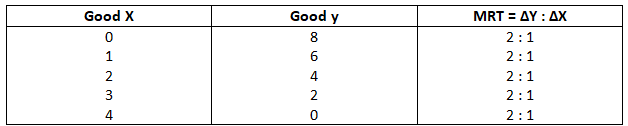
PPC will be downward sloping straight line as MRT is constant.
5. Giving reason, comment on the shape of the Production Possibilities curve based on the following schedule:

Ans.
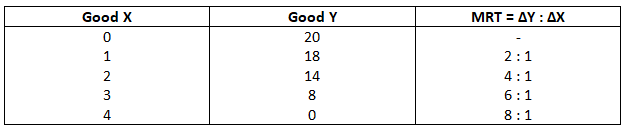
PPC will be downward sloping concave curve as MRT is increasing.
6. Giving reason, comment on the shape of Production Possibilities Curve based on the following table:

Ans.

PPC will be downward sloping straight line as MRT is constant.
sandeep garg microeconomics class 11 2026
sandeep garg microeconomics class 11 chapter 1
NCERT