Meaning of Analysis of Financial Statement – The process of critical evaluation of the financial information contained in the financial statement in order to understand and make decisions regarding the operations of the firm is called ‘Financial Statement Analysis’.
Significance of Financial Analysis – Financial analysis is the process of identifying the financial strengths and weaknesses of the firm by properly establishing relationships between the various items of the balance sheet and the profit and loss account.
Objectives of Financial Analysis – Analysis of financial statements reveals important facts concerning managerial performance and the efficiency of the firm. The analysis is undertaken to serve the following purposes (objectives):
- To assess the current profitability and operational efficiency of the firm as a whole as well as its different departments so as to judge the financial health of the firm.
- To ascertain the relative importance of different components of the financial position of the firm.
- To judge the ability of the firm to repay its debt and assessing the short-term as well as the long-term liquidity position of the firm.
Tools of Financial Analysis – The most commonly used techniques of financial analysis are as follows:
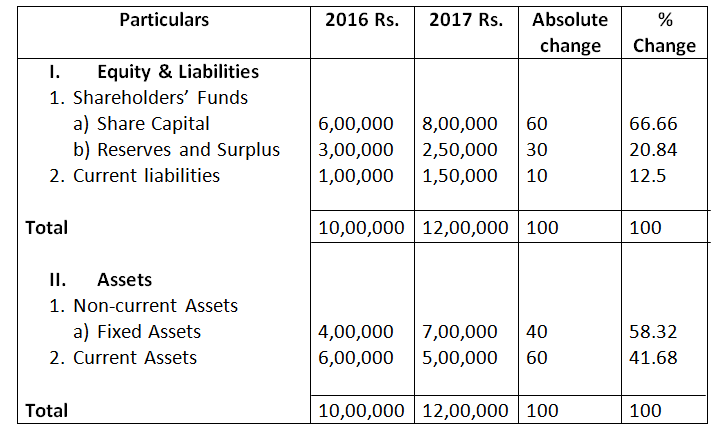
- Comparative Statements: These are the statement showing the profitability and financial position of a firm for different periods of time in a comparative form to give an idea about the position of two or more periods. It usually applies to the two important financial statements, namely, Balance Sheet and Income Statement prepared in a comparative form.
- Common size statement: These are the statements which indicate the relationship of different items of a financial statement with some common item by expressing each item as a percentage of the common item. The percentage thus calculated can be easily compared with the results corresponding percentages of the previous year or of some other firms, as the numbers are brought to common base.
- Trend Analysis: It is a technique of studying the operational results and financial position over a series of years. Using the previous years’ data of a business enterprise, trend analysis can be done to observe the percentage changes over time in the selected data.
- Ratio Analysis: It describes the significant relationship which exists between various items of a balance sheet and a profit and loss account of a firm. As a technique of financial analysis, accounting ratios measure the comparative significance of the individual items of the income and position statements.
- Cash Flow Analysis: It refers to the analysis of actual movement of cash into and out of an oraganisation. The flow of cash into the business is called as cash inflow or positive cash flow and the flow of cash out of the firm is called as cash outflow or a negative cash flow.
Limitations of Financial Analysis – Though financial analysis is quite helpful in determining financial strengths arid weaknesses of a firm, it is based on the information available in financial statements. As such, the financial analysis also suffers from various limitations of financial statements. Hence, the analyst must be conscious of the impact of price level changes, window dressing of financial statement, changes in accounting policies of a firm, accounting concepts and conventions, personal judgement, etc. Some other limitations of financial analysis are:
- Financial analysis does not consider price level changes.
- Financial analysis may be misleading without the knowledge of the changes in accounting procedure followed by a firm.
- Financial analysis is just a study of interim reports.
- Monetary information alone is considered in financial analysis while non-monetary aspects are ignored.
- The financial statements are prepared on the basis of on-going concept, as such, it does not reflect the current position.
A. Short Answer Questions
1. List the techniques of Financial Statement Analysis.
Ans. The various techniques used for financial statement analysis are:
1. Comparative Statements
2. Common Size Statements
3. Trend Analysis
4. Ratio Analysis
5. Cash Flow Analysis
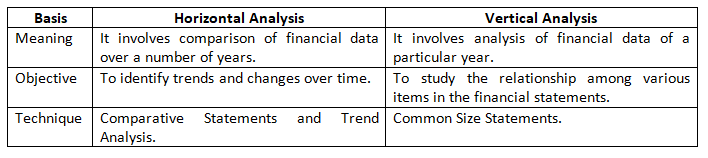
2. Distinguish between Vertical and Horizontal Analysis of financial data.
Ans.
3. Explain the meaning of Analysis and Interpretation.
Ans. Analysis of financial statements is the process of critical evaluation of the financial information contained in the financial statements in order to understand and make decisions regarding the operations of the firm. Interpretation means explaining the meaning and significance of the data so analysed.
4. Bring out the importance of Financial Analysis.
Ans. Financial analysis is useful in:
1. Assessing the earning capacity or profitability.
2. Assessing the managerial efficiency.
3. Assessing the short-term and long-term solvency.
4. Measuring the comparative position in relation to other firms.
5. Helping in forecasting and preparing plans.
5. What are Comparative Financial Statements?
Ans. Comparative Financial Statements are those statements in which figures for two or more periods are placed side by side to facilitate comparison. These statements indicate both the absolute change and percentage change in various items.
6. What do you mean by Common Size Statements?
Ans. Common Size Statements are those statements in which figures reported are converted into percentages to some common base.
- In the Income Statement, sales revenue is taken as 100%.
- In the Balance Sheet, total assets or total liabilities are taken as 100%.
B. Long Answer Questions
1. Describe the different techniques of financial analysis and explain the limitations of financial analysis.
Ans. Techniques of Financial Analysis –m The most commonly used techniques of financial analysis are:
(i) Comparative Statements – These are the statements showing the profitability and financial position of a firm for different periods in a comparative form to give an idea about the position of two or more periods.
(ii) Common Size Statements – These statements indicate the relationship of different items with a common item expressed as percentage of the common item.
(iii) Trend Analysis – It is a technique of studying the operational results and financial position over a series of years. One year is taken as the base year and its figures are taken as 100.
(iv) Ratio Analysis – Ratio analysis describes the significant relationship which exists between various items of a balance sheet and a statement of profit and loss.
(v) Cash Flow Analysis – Cash flow analysis shows the inflows and outflows of cash and cashequivalents from various business activities.
Limitations of Financial Analysis
1. Financial statements are based on historical data.
2. They do not consider price level changes.
3. They ignore qualitative aspects.
4. They are affected by changes in accounting policies.
5. The results are based on the reliability of accounting data.
6. Personal judgement of the analyst may affect conclusions.
2. Explain the usefulness of trend percentages in interpretation of financial performance of a company.
Ans. Trend analysis is a useful technique for studying the financial performance of a business over a number of years. Usefulness of Trend Percentages
1. They help in studying the direction of changes.
2. They indicate the rate of growth or decline.
3. They facilitate comparison over different years.
4. They help in forecasting future trends.
5. They assist management in planning and decision-making.
6. They help in evaluating the overall financial performance of the enterprise.
Thus, trend percentages provide a better understanding of the financial progress of a company.
3. What is the importance of comparative statements? Illustrate your answer with particular reference to comparative income statement.
Ans. Importance of Comparative Statements
1. They make comparison of financial data possible.
2. They indicate the trend of financial performance.
3. They reveal strengths and weaknesses of the business.
4. They help in planning and decision-making.
5. They help management in evaluating operational efficiency.
Comparative Income Statement – A Comparative Income Statement presents the figures of revenue and expensesof two or more accounting periods.
It shows:
- Increase or decrease in sales.
- Increase or decrease in various expenses.
- Increase or decrease in gross profit.
- Increase or decrease in net profit.
Thus, it helps in analysing the profitability of the business.
4. What do you understand by analysis and interpretation of financial statements? Discuss their importance.
Ans. Meaning – Analysis of financial statements is the process of critical evaluation of the financial information contained in the financial statements in order to understand and make decisions regarding the operations of the firm.Interpretation refers to explaining the meaning and significance of the analyseddata.
Importance
1. Helps in assessing profitability.
2. Helps in assessing managerial efficiency.
3. Helps in assessing solvency.
4. Helps in forecasting and planning.
5. Helps investors in making investment decisions.
6. Helps creditors in judging creditworthiness.
7. Helps management in taking business decisions.
Thus, analysis and interpretation are important tools for evaluating the financial performance and financial position of an enterprise.
5. Explain how common size statements are prepared giving an example.
Ans. A Common Size Statement is one in which the items appearing in the financial statement are shown as percentages of a common base.
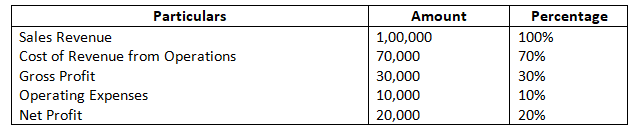
Preparation of Common Size Income Statement – In a Common Size Income Statement, sales revenue is taken as 100 and all other items are expressed as percentages of sales revenue.
Example
Preparation of Common Size Balance Sheet – In a Common Size Balance Sheet, total assets or total liabilities are taken as100 and each item is expressed as a percentage thereof.
Advantages
1. Facilitates comparison.
2. Helps in understanding the composition of financial statements.
3. Useful in inter-firm and intra-firm comparison.
These statements are particularly useful in assessing the relative significance of different components of financial statements.
Numerical Questions
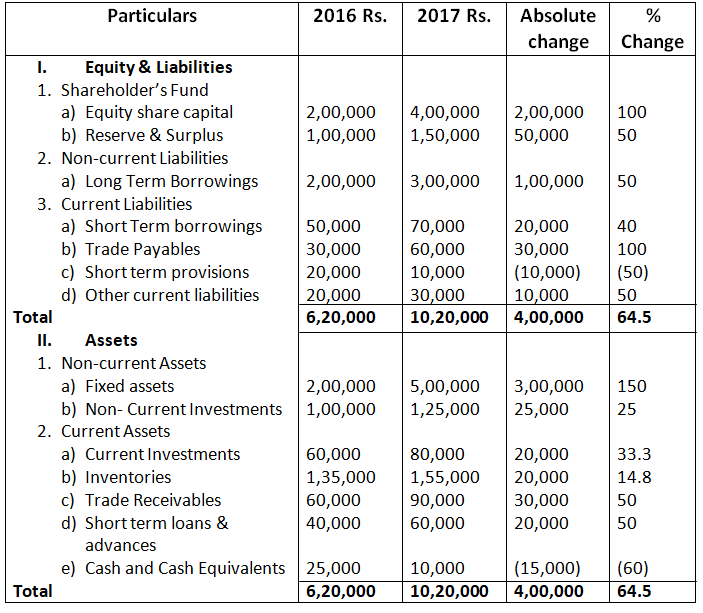
- Following are the balance sheet of Alpha Ltd. As at March 31, 2016 and 2017. You are required to prepare comparative Balance sheet.
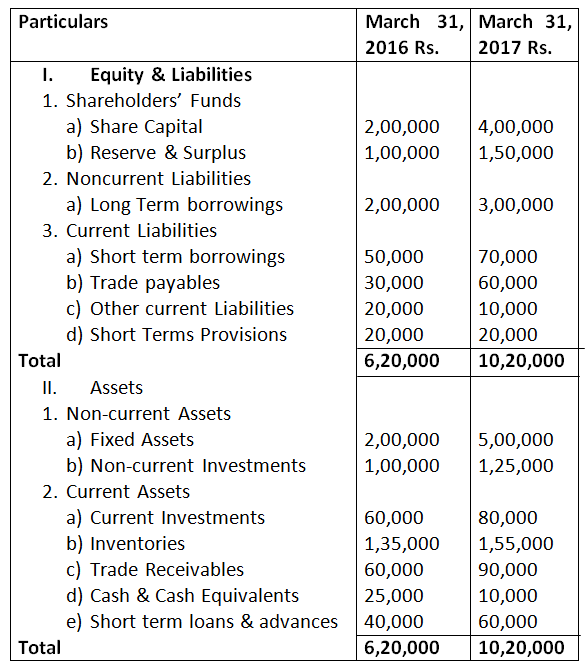
Solution –
Comparative Balance Sheet as on March 31, 2016 – 17
3. Following are the Balance Sheets of Beta Ltd., as at March 31, 2016 and 2017.
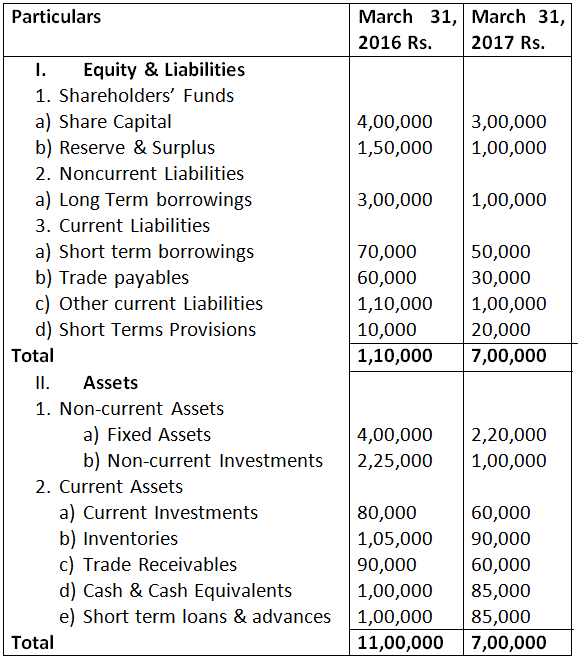
Prepare a Comparative Balance Sheet.
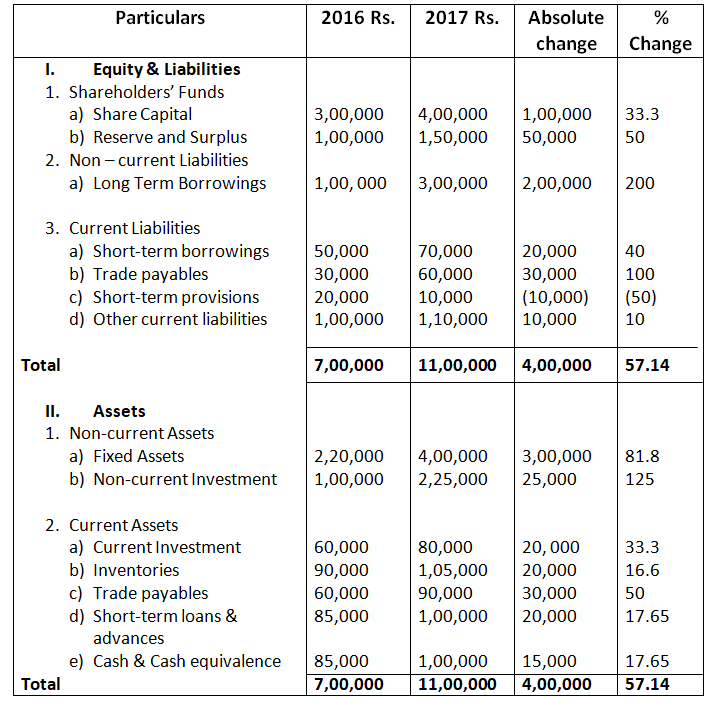
Solution –
Comparative Balance Sheet
As at 31st March 2016 – 17
3. Prepare Comparative Statement of Profit and loss from the following information.
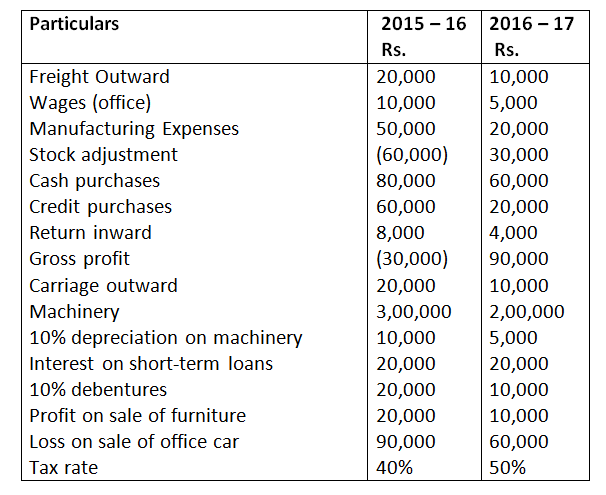
Solution –
Comparative Income Statement
As at 31st March 2016 – 17
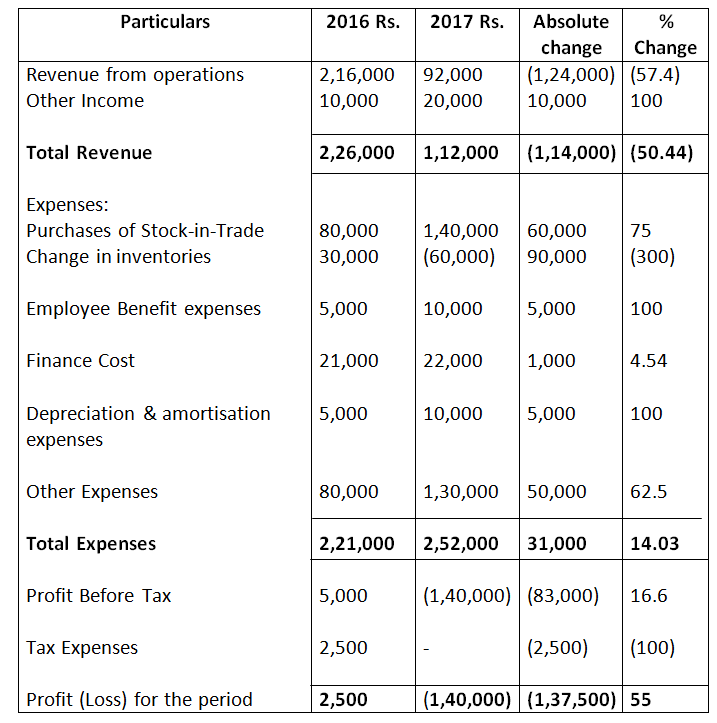
Working Notes:
Calculation of Net Sales
Net Sales = cost of Good sold + Gross Profit – Sales Return
Net Sales (2016) = 80,000 + 30,000 +90,000 – 4,000
= 2, 16,000
Net Sales (2017) = 1,40,000+ 50,000 – 60,000 – 30,000 – 80,000
= 92,000
Calculation of Finance Cost
Finance Cost = Interest on short term loans + Interest on 10% Debentures
Finance Cost (2016) = 20,000 + 1,000
= 21,000
Finance Cost (2017) = 20,000 + 2,000
= 22,000
Calculation of Other Expenses
Other Expenses = Freight outward + Carriage Outward + Loss on sale of office car
Other Expenses (2016) = 10,000 +10,000 + 60,000
= 80,000
Other Expenses (2017) = 20,000 + 20,000 + 90,000
= 1,30,000
4. Prepare Comparative Statement of Profit and loss from the following information:
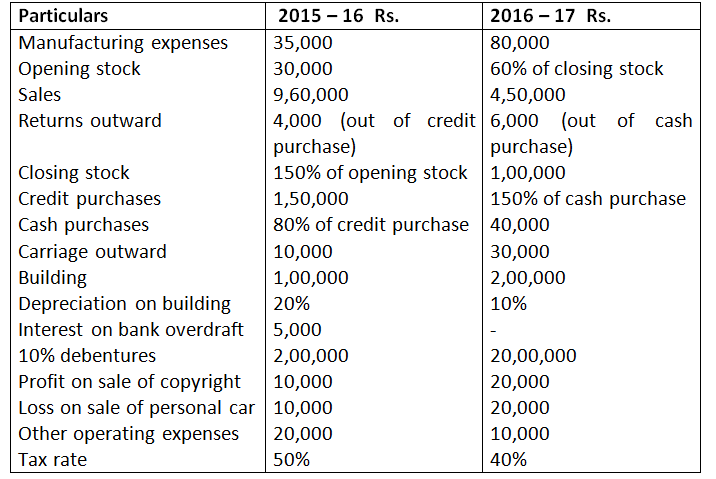
Solution –
Comparative Income Statement
As at 31st March 2016 – 17
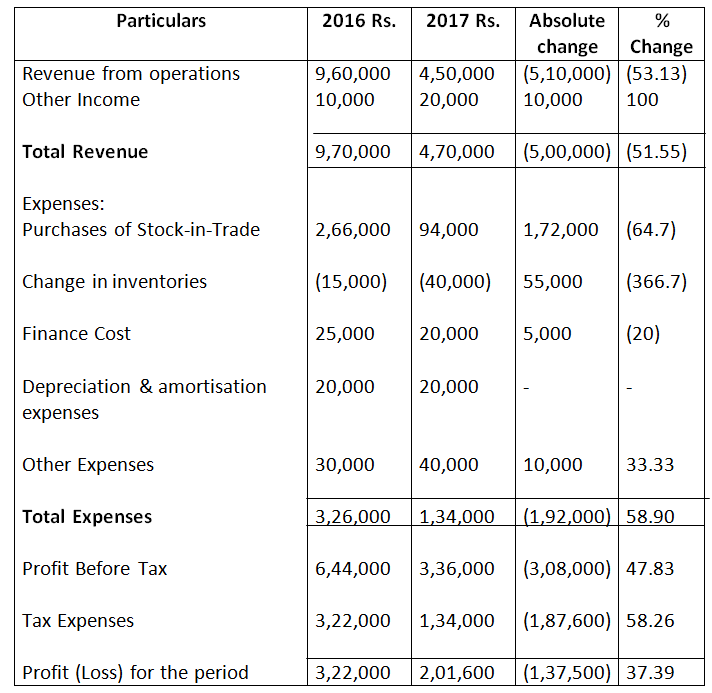
Working Notes:
Calculation of Net Purchases
Net Purchases = Cash Purchases + Credit Purchases – Purchase Return
Net Sales (2016) = 1,20,000 + 1,50,000 – 4,000
= 2,66,000
Net Sales (2017) = 40,000 + 60,000 – 6,000
= 94,000
Calculation of Inventory Changes
Year 2016 = 30,000 – 45,000
= (15,000)
Year 2017 = 60,000 – 1,00,000
= (40,000)
Calculation of Finance cost
Finance Cost = Interest on Bank OD + Interest on Debentures
Finance cost (2016) = 5,000 + 20,000
= 25,000
Finance Cost (2017) = 30,000 + 10,000
= 40,000
Calculation of Other Expenses
Other Expenses = Freight Outward + Carriage Outward
Other Expenses (2016) = 10,000 + 20,000
= 30,000
Other Expenses (2017) = 30,000 + 10,000
40,000
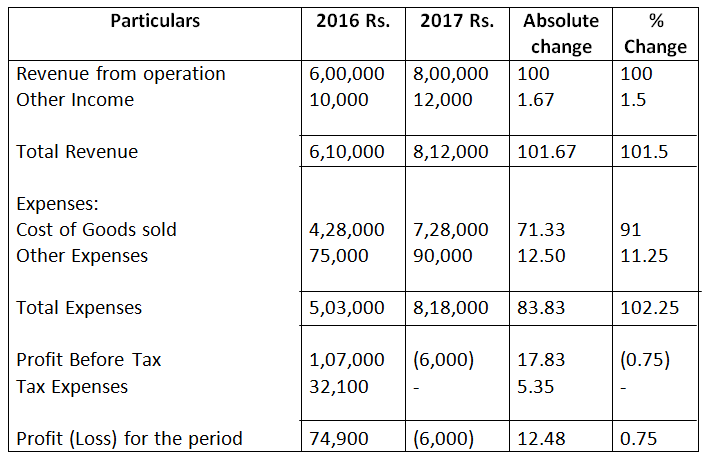
5. Prepare a Common size statement of profit and loss of Shefali Ltd., with the help of following information:
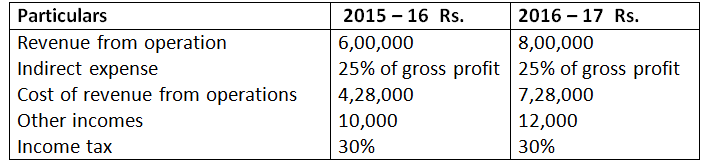
Solution –
Comparative Income Statement
As at 31st March 2016 – 17
Working Notes:
Calculation of Other Expenses
Other Expenses = Indirect Expenses x % Gross Profit
Year 2016 = 6,00,000 x 50% x 25%
= 75,000
Year 2017 = 8,00,000 x 45 % x 25%
= 90,000
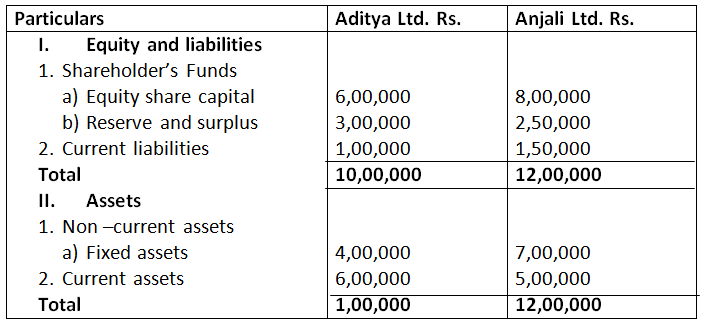
6. Prepare a Common Size balance Sheet from the following balance sheet of Aditya Ltd., and Anjali Ltd:
Solution –
Common Size Balance Sheet