reconstitution of a partnership firm-admission of a partner ncert
reconstitution of partnership firm admission of a partner class 12
admission of a partner class 12 ncert pdf
Modes of Reconstitution of a Partnership Firm – Reconstitution of a partnership firm usually takes place in any of the following ways:
- Admission of a new partner: A new partner may be admitted when the firm needs additional capital or managerial help. According to the provisions of Partnership Act 1932 unless it is otherwise provided in the partnership deed a new partner can be admitted only when the existing partners unanimously agree for it.
- Change in the profit sharing ratio among the existing partners: Sometimes the partnership of a firm may decide to change their existing profit sharing ratio. This may happen an account of a change in the existing partner’s role in the firm.
- Retirement of an existing partner: It means withdrawal by a partner from the business of the firm which may be due to his bad health, old age or change in business interests. In fact a partner can retire any time if the partnership is at will.
- Death of a partner: Partnership may also stand reconstituted on death of a partner, if the remaining partners decide to continue the business of the firm as usual.
Admission of a New Partner – According to the Partnership Act 1932, a new partner can be admitted into the firm only with the consent of all the existing partners unless otherwise agreed upon. With the admission of a new partner, the partnership firm is reconstituted and a new agreement is entered into to carry on the business of the firm.
A new admitted partner acquires two main rights in the firm-
- Right to share the assets of the partnership firm; and
- Right to share the profits of the partnership firm.
Following are the other important points which require attention at the time of admission of a new partner:
- New profit sharing ratio;
- Sacrificing ratio;
- Valuation and adjustment of goodwill;
- Revaluation of assets and Reassessment of liabilities;
- Distribution of accumulated profits (reserves); and
- Adjustment of partners’ capitals.
- New Profit Sharing Ratio – When new partner is admitted he acquires his share in profits from the old partners. In other words, on the admission of a new partner, the old partners sacrifice a share of their profit in favour of the new partner. But, what will be the share of new partner and how he will acquire it from the existing partners is decided mutually among the old partners and the new partner.
- Sacrificing Ratio – The ratio in which the old partners agree to sacrifice their share of profit in favour of the incoming partner is called sacrificing ratio. The sacrificing by a partner is equal to:
Old Share of Profit – New share of Profit
Goodwill – Goodwill is also one of the special aspects of partnership accounts which requires adjustment (also valuation if not specified) at the time of reconstitution of a firm viz., a change in the profit sharing ratio, the admission of a partner or the retirement or death of a partner.
A well – established business develops an advantage of good name, reputation and wide business connections. This helps the business to earn more profits as compared to a newly set up business. In accounting, the monetary value of such advantage is known as “goodwill”.
Need for valuation of Goodwill – Normally, the need for valuation of goodwill arises at the time of sale of a business. But, in the context of a partnership firm it may also arise in the following circumstances:
- Change in the profit sharing ratio amongst the existing partners;
- Admission of a new partner;
- Retirement of a partner;
- Death of a partner; and
- Dissolution of a firm involving sale of business as a going concern.
- Amalgamation of partnership firms.
Methods of Valuation of Goodwill – Since goodwill is an intangible asset it is very difficult to accurately calculate its value. Various methods have been advocated for the valuation of goodwill of a partnership firm. Goodwill calculated by one method may differ from the goodwill calculated by another method. Hence, the method by which goodwill is to be calculated, may be specifically decided between the existing partners and the incoming partner.
The important methods of valuation of goodwill are as follows:
- Average Profits Method – The goodwill, therefore, should be calculated by multiplying the past average profits by the number of years during which the anticipated profits are expected to accrue. For example – if the past average profits of a business works out at Rs.20,000 and it is expected that such profits are likely to continue for another three years, the value of goodwill will be Rs.60,000 (Rs.20,000 x 3).
- Super Profits Method – The steps involved under the method are:
- Calculate the average profit,
- Calculate the normal profit on the capital employed on the basis of the normal rate of return.
- Calculate the super profits by deducting normal profit from the average profits, and
- Calculate goodwill by multiplying the super profits by the given number of year’s purchase.
III. Capitalisation Method –
Capitalisation of Average Profits: Under this method, the value of goodwill is ascertained by deducting the actual capital employed (net assets) in the normal rate of return. This involves the following steps:
- Ascertain the average profits based on the past few years’ performance.
- Capitalize the average profits on the basis of the normal rate of return to ascertain the capitalised value of average profits as follows:
Average profits x 100/Normal rate of return
- Ascertain the actual capital employed (net assets) by deducting outside liabilities from the total assets (excluding goodwill).
Capital employed = Total assets (excluding goodwill) – Outside Liabilities
- Compute the value of goodwill by deducting net assets from the capitalised value of average profits, i.e. (ii) – (iii).
b. Capitalisation of Super profits: Goodwill can also be ascertained by capitalising the super profit directly. Under this method there is no need to work out the capitalised value of average profits. It involves the following steps.
- Calculate capital employed of the firm, which is equal to total assets minus outside liabilities.
- Calculate normal profits on capital employed.
- Calculate average profit for past years, as specified.
- Calculate super profits by the required rate of return multiplier, that is,
Goodwill = Super profits x 100 Normal rate of Return
Hidden Goodwill – Sometimes the value of goodwill is not given at the time of admission of a new partner. In such a situation it has to be inferred from the arrangement of the capital and profit sharing ratio.
Adjustment for Accumulated Profit and Losses – Sometimes a firm may have accumulated profits not yet transferred to capital accounts of the partners. These are usually in the firm of general reserve, reserve fund and /or Profit and Loss Account balance. The new partner is not entitled to have any share in such accumulated profits. These are distributed among the partners by transferring it to their capital accounts in old profit sharing ratio.
Revaluation of Assets and Reassessment of Liabilities – At the time of admission of a new partner, it is always desirable to ascertain partner the assets of the firm are shown in books at their current values. In case the assets are overstated or understated, these are revalued.
Adjustment of Capitals – Sometimes, at the time of admission, the partners agree that their capitals should also be adjusted so as to proportionate to their profit sharing ratio. In such a situation, if the capital of the new partner is given, the same can be used as a base for calculating the new capitals of the old partners.
Change in profit sharing ratio among the existing partners – Sometimes, the partners of a firm decide to change their existing profit sharing ratio without any admission or retirement of a partner. This results in a gain of additional share in future profits of the firm for some partners while a loss of a part thereof for other partners.
Questions for Practice
Short Answer Questions
1. Identify various matters that need adjustments at the time of admission of a new partner.
Ans. At the time of admission of a new partner, adjustments are required for:
- New Profit Sharing Ratio
- Sacrificing Ratio
- Goodwill
- Revaluation of Assets and Reassessment of Liabilities
- Reserves and Accumulated Profits/Losses
- Adjustment of Capital
2. Why is it necessary to ascertain new profit sharing ratio even for old partners when a new partner is admitted?
Ans. When a new partner is admitted, he acquires a certain share in the future profits of the firm from the existing partners. As a result, the old partners’ shares change. Therefore, it becomes necessary to ascertain the new profit sharing ratio.
3. What is sacrificing ratio? Why is it calculated?
Ans. Sacrificing Ratio is the ratio in which the old partners agree to sacrifice their share of profits in favour of the incoming partner.
It is calculated to determine the amount of compensation to be given to the sacrificing partners for the sacrifice made by them.
4. On what occasions is sacrificing ratio used?
Ans. Sacrificing ratio is used:
- At the time of admission of a new partner.
- For distributing the premium for goodwill brought by the new partner among the old partners.
5. If some goodwill already exists in the books and the new partner brings in his share of goodwill in cash, how will you deal with existing amount of goodwill?
Ans. As per Accounting Standard 26, goodwill already appearing in the books should be written off among the old partners in their old profit sharing ratio before the admission of the new partner.
6. Why is there need for the revaluation of assets and liabilities on the admission of a partner?
Ans. Assets and liabilities are revalued so that they may appear in the books at their current values.
The profit or loss arising from revaluation belongs to the old partners and should be credited or debited to their capital accounts in the old profit sharing .
Long Answer questions
1. Do you advise that assets and liabilities must be revalued at the time of admission of a partner? If so, why? Also describe how is this treated in the books of account?
Ans. Yes, it is desirable to revalue assets and reassess liabilities at the time of admission of a partner because the values at which the assets and liabilities appear in the books may not represent their current market values. Revaluation ensures that the new partner is neither benefited nor adversely affected by any profit or loss arising from the revaluation.
The increase or decrease in the value of assets and liabilities is recorded in the “Revaluation Account”. The profit or loss on revaluation is transferred to the capital accounts of the old partners in their old profit-sharing ratio.
2. What is goodwill? What factors affect goodwill?
Ans. Goodwill is the value of the reputation of a firm in respect of the profits expected in future over and above the normal profits.
The following factors affect goodwill:
1. Nature of business.
2. Location of business.
3. Efficiency of management.
4. Market situation.
5. Special advantages enjoyed by the firm.
6. Quality of products and services.
7. Earning capacity of the business.
3. Explain various methods of valuation of goodwill.
Ans. The various methods of valuation of goodwill are:
(i) Average Profit Method – Under this method, goodwill is calculated on the basis of the average profits earned during a specified period.
Goodwill = Average Profit × Number of Years’ Purchase
(ii) Super Profit Method – Super profit is the excess of average profit over normal profit.
Super Profit = Average Profit – Normal Profit
Goodwill = Super Profit × Number of Years’ Purchase
(iii) Capitalisation Method – Under this method, goodwill is determined by capitalising the average profits or super profits.
Capitalisation of Average Profit Method
Goodwill = Capitalised Value of Business – Net Assets
Capitalisation of Super Profit Method
Goodwill = Super Profit × 100 / Normal Rate of Return
4. If it is agreed that the capital of all the partners should be proportionate to the new profit sharing ratio, how will you work out the new capital of each partner? Give examples and state how necessary adjustments will be made.
Ans. When the capitals of partners are to be adjusted in the new profit-sharing ratio, the capital of one partner whose capital is in proportion to his share is taken as the base.
The total capital of the reconstituted firm is determined and the capital of each partner is calculated on the basis of the new profit-sharing ratio.
After comparing the actual capital with the required capital:
- A partner having excess capital withdraws the excess amount.
- A partner having deficient capital brings in the required amount.
Thus, the capitals of all partners become proportionate to the new profit-sharing ratio.
5. Explain how will you deal with goodwill when new partner is not in a position to bring his share of goodwill in cash.
Ans. When the new partner is unable to bring his share of goodwill in cash, the adjustment for goodwill is made through the capital accounts of the partners.
The new partner’s capital account is debited with his share of goodwill and the sacrificing partners’ capital accounts are credited in their sacrificing ratio.
Thus, the sacrificing partners are compensated for the sacrifice made by them.
6. Explain various methods for the treatment of goodwill on the admission of a new partner.
Ans. The treatment of goodwill depends upon the circumstances.
(i) When the new partner brings premium for goodwill in cash – The amount of premium brought by the new partner is credited to the sacrificing partners in their sacrificing ratio.
(ii) When the new partner brings only a part of premium in cash – The amount brought is distributed among the sacrificing partners in their sacrificing ratio.
(iii) When the new partner is unable to bring premium in cash – The adjustment is made through the capital accounts of the partners.
(iv) When goodwill already appears in the books – The existing goodwill appearing in the books is written off among the old partners in their old profit-sharing ratio before the admission of the new partner.
7. How will you deal with the accumulated profits and losses and reserves on the admission of a new partner?
Ans. Accumulated profits, reserves and accumulated losses belong to the old partners because they have arisen before the admission of the new partner.
Therefore, they should be transferred to the old partners’ capital accounts in their old profit-sharing ratio.
Accumulated Profits and Reserves
- General Reserve
- Credit Balance of Profit and Loss Account
- Workmen Compensation Reserve (to the extent not required)
These are credited to the old partners’ capital accounts.
Accumulated Losses and Fictitious Assets
- Debit Balance of Profit and Loss Account
- Advertisement Suspense Account
- Miscellaneous Expenditure
These are debited to the old partners’ capital accounts in their old profit-sharing ratio.
8. At what figures the value of assets and liabilities appear in the books of the firm after revaluation has been done? Show with the help of an imaginary balance sheet.
Ans. After revaluation, assets and liabilities are shown in the Balance Sheet at their revised values.
Imaginary Balance Sheet after Revaluation
Balance Sheet of the Firm
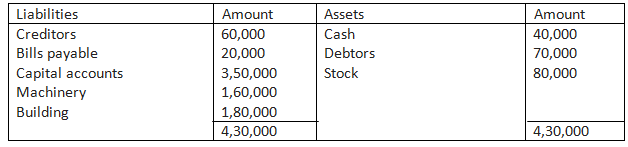
Thus, after revaluation, all assets and liabilities appear in the books at their revised values and the profit or loss arising on revaluation is transferred to the old partners’ capital accounts in their old profit-sharing ratio.
class 12 accounts chapter 4 admission of a partner solutions ncert
admission of a partner class 12 solutions pdf
Numerical Questions
- A and B were partners in a firm sharing profits and losses in the ratio of 3:2. They admit C into the partnership with 1/6 share in the profits. Calculate the new profit sharing ratio?
Solution-
Old profit sharing ratio of A and B = 3:2
C admitted for 1/6th share
Remaining share would be shared by A and B their profit sharing ratio i.e. 3:2
A’s new share = 5/6 x 3/5
= 15/30
B’s new share = 5/6 x 2/5
= 10/30
New profit sharing ratio of A, B and C
= 15/30 : 10/30 : 1/6 x 5/5
= 15/30 : 10/30 : 5/30
= 3:2:1
2. A, B, C were partners in a firm sharing profits in 3:2:1 ratio. They admitted D for 10% profits. Calculate the new profit sharing ratio?
Solution-
Old profit sharing ratio of A, B and C = 3:2:1
D admitted for 10% profits = 10/100
= 1/10
Remaining share = 1- 1/10
= 9/10
Remaining share would be shared by A, B and C in their sharing ratio i.e. 3:2:1
A’ new share = 9/10 x 3/6
= 27/60
B’ new share = 9/10 x 2/6
= 18/60
C’ new share = 9/10 x 1/6
= 9/60
New profit sharing ratio of A, B, C and D after making base equal
= 27/60 : 18/60 : 9/60 : 1/10 x 6/6
= 27/60 : 18/60 : 9/10 : 6/60
= 9 : 6 : 3 : 2
3. X and Y are partners sharing profits in 5:3 ratio admitted Z for 1/10 share which he acquired equally from A. Calculate new profit sharing ratio?
Solution-
Old profit sharing ratio of X and Y = 5 : 3
Z admitted for 1/10th share which he acquired equally from X and Y
Z acquired from X = 1/10 x 1/2
= 1/20
Z acquired from Y = 1/10 x ½
= 1/20
X’s new share = 5/8 – 1/20
= 25 – 2/40
= 23 / 40
Y’s new share = 3/8 – 1/20
= 15 – 2 / 40
= 13/40
New profit sharing ratio of X, Y and Z after making base equal
= 23/40 : 13/40 : 1/10 x 4/4
= 23 : 13 : 4
4. A, B and C are partners sharing profits in 2:2:1 ratio admitted D for 1/8 share which he acquired entirely form A. Calculate new profit sharing ratio?
Solution –
Old profit sharing ratio of A, B and C = 2:2:1
D admitted for 1/8th share which he acquired entirely form A
A’ new share = 2/5 – 1/8
= 16 – 5 / 40
= 11/40
B’ new share = 2/5 – 0/1
= 2 – 0/5
= 2/5
C’ new share = 1/5 – 0/1
= 1 – 0 / 5
= 1/5
New profit sharing ratio of A, B, C and D after making base equal
= 11/40 : 2/5 x 8/8 : 1/5 x 8/8 : 1/8 x 5/5
= 11 /40 : 16/40 : 8/40 :5/40
= 11 : 16 : 8 : 5
5. P and Q are partners sharing profits in 2:1 ratio. They admitted R into partnership giving him 1/5 share which he acquired from P and Q in 1:2 ratio. Calculate new profit sharing ratio?
Solution –
Old profit sharing ratio of P and Q is = 2:1
R admitted for 1/5th share which he acquired from P and Q = 1:2
P sacrificed to R = 1/5 x 1/3
= 1/15
Q sacrificed to R = 1/5 x 2/3
= 2/15
P’s new share = 2/3 – 1/15
= 20 – 2 /30
= 18/30
Q’s new share = 1/3 – 2 /15
= 10 – 4 /30
= 6/30
New profit sharing ratio of P, Q and R after making base equal
= 18 / 30 : 6 / 30 : 1/5 x 6/6
= 18 / 30 : 6 / 30 : 6 / 30
= 3: 1: 1
6. A, B and C are partners sharing profits in 3:2:2 ratio. They admitted D as a new partner for 1/5 share which he acquired form A, B and C in 2:2:1 ratio respectively. Calculate new profit sharing ratio?
Solution –
Old profit sharing ratio of A, B and C is 3 : 2 : 2
D is admitted for 1/5 share which he acquired from A, B and C in 2:2:1
A Sacrifices = 1/5 x 2/5
= 2/ 25
B sacrifices = 1/5 x 2/5
= 2/25
C Sacrifices = 1/ 5 x 1/5
= 1/25
A’s new share = 3/7 – 2/25
= 75 – 14 / 7 x 25
= 61 / 7 x 25
B’s new share = 2/7 – 2/25
= 50 – 14 / 7 x 25
= 36 / 7 x 25
C’s new share = 2/7 – 1/25
= 50 – 7 / 7 x 25
= 43 / 7 x 25
New profit sharing ratio of A, B, C and D is
= 61 / 7 x 25 : 36 / 7 x 25 : 43 / 7 x 25 : 1/5 x 35 /7×5
= 61 : 36 : 43 : 35
7. A and B were partners in a firm sharing profits in 3:2 ratio. They admitted C for 3/7 share which he took 2/7 from A and 1/7 from B. Calculate new profit sharing ratio?
Solution –
Old Profit sharing Ratio of A and B in 3:2
C admitted for 3/7th share which he took 2/7 from A and 1/7 from B.
A’s new share = 3/5 – 2/7
= 21 – 10 / 35
= 11 / 35
B’s new share = 2/5 – 1/7
= 14 – 5 /35
= 9 / 35
New profit sharing ratio of A, B and C is
= 11/35 : 9/35 : 3/7 x 5/5
= 11 : 9 : 15
8. A, B and C were partners in a firm sharing profits in 3:3:2 ratio. They admitted D as a new partner for 4/7 profit. D acquired his share 2/7 from A. 1/7 from B and 1/7 from C. Calculate new profit sharing ratio?
Solution –
Old profit sharing ratio of A, B and C is 3:2:2
D admitted for 4/7the share which he acquired from A 2/7, B 1/7 and C 1/7
A’s new share = 3/8 – 2/7
= 21 – 16 / 56
= 5 / 56
B’s new share = 3/8 – 1/7
= 21 – 8 / 56
= 13 / 56
C’s new share = 2/8 – 1/7
= 14 – 8 / 56
= 6 / 56
New profit sharing ratio of A, B, C and D after making base equal
= 5 / 56 : 13 / 56 : 6 / 56 : 4/7x 8/8
= 5 : 13 : 6 : 32
9. Radha and Rukmani are partners in a firm sharing profits in 3:2 ratio. They admitted Gopi as a new partner. Radha surrendered 1/3 of her share in favoure of Gopi and Rukmani surrendered ¼ of her share in favour of Gopi. Calculate new profit sharing ratio?
Solution –
Old profit sharing Ratio of Radha and Rukmani = 3:2
Gopi admitted at a new partner
Radha Surrendered = 3 /5 x 1/3
= 3 / 15
Rukmani Surrendered = 2 / 5 x ¼
= 2 /20
Radha’s new share = 3 /5 – 3 / 15
= 9 – 3 / 15
= 6 / 15
Rukmani new share = 2 / 5 – 2 /20
= 8 – 2 / 20
= 6 / 20
New profit sharing ratio of Radha, Rukmani and Gopi is
Gopi share = 3 / 15 + 2 /20
= 12 +6 / 60
= 18 / 60
= 6 / 15 x 4 / 4 : 6 / 20 x 3/3 : 18 / 60
= 24 : 18 : 18
= 4 : 3 : 3
10. Singh, Gupta and Khan are partners in a firm sharing profits in 3:2:3 ratio. They admitted Jain as a new partner. Singh surrendered 1/3 of his share in favoure of Jain: Gupta surrendered 1/4 of his share in favoure of Jain and Khan surrendered 1/5 in favoure of Jain. Calculate new profit sharing ratio?
Solution –
Old profit sharing ratio of singh Gupta & Khan in 3:2:3 ratio
Jain admitted as a new Partners
Singh Surrendered = 3/ 8 x 1/3
= 3 /24
Gupta Surrendered = 2 / 8 x 1/ 4
= 2 / 32
Khan Surrendered = 3 / 8 x 1 /5
= 3 / 40
Singh’s new share = 3 / 8 – 3 / 24
= 9 – 3 / 24
= 6 / 24
Gupta new share = 2/8 – 2/32
= 16 – 4 / 64
= 12 / 64
Khan’s new share = 3 / 8 – 3 /40
= 15 – 3 / 40
= 12 / 40
New profit sharing ratio of singh, Gupta, khan and Jain
Jain share = 3/ 24 + 2 / 32 + 3 /40
= 60 + 30 + 36 / 480
= 126 / 480
New profit sharing ratio of singh, Gupta, khan and Jain is
= 6 / 24 x 20 /20 : 12 / 64 x 7.5 /7.5 : 12 / 40 x 12 /12 : 126 / 480
= 120/480 : 90 /480 : 144/480 : 126/ 480
= 20 : 15 : 24 : 21
11. Sandeep and Navdeep are partners in a firm sharing profits in 5:3 ratio. They admit C into the firm and the new profit sharing ratio was agreed at 4:2:1. Calculate the sacrificing ratio?
Solution –
Calculation of Sacrificing ratio of Sandeep and Navdeep
Old Ratio of Sandeep and Navdeep is 5:3
C is admitted
New profit sharing ratio of Sandeep, Navdeep and = 4 : 2: 1
Sandeep Sacrifices = 5 / 8 – 4 / 7
= 35 – 32 / 56
= 3 / 56 (Sacrifice)
Navdeep sacrifices = 3 / 8 – 2 / 7
= 21 – 16 / 56
= 5 / 56 (Sacrifice)
Sacrificing Ratio of Sandeep and Navdeep is 3:5
12. Rao and Swami are partners in a firm sharing profits and losses in 3:2 ratio. They admit Ravi as a new partner for 1/8 share in the profits. The new profit sharing ratio between Rao and Swami is 4:3. Calculate new profit sharing ratio and sacrificing ratio?
Solution –
Old profit sharing ratio of Rao and Swami = 3:2
Ravi is admitted for 1/8th share
Remaining share = 1 – 1/8
= 7 / 8
Remaining share would be distributed by Rao and Swami = 4:3
Rao’s new share = 7/ 8 x 4 / 7
= 28 / 56
Swami new share = 7 / 8 x 3/ 7
= 21 / 56
New profit sharing ratio after making base equal
= 28 / 56 : 21 / 56 : 1 / 8 x 7 / 7
= 28 : 21 : 7
= 4 : 3: 1
Calculation of Sacrificing Ratio of Rao & Swami
Old Rati = 3:2
New Ratio = 4:3:1
Rao = 3/5 – 4/8
= 24 – 20 /40
= 4 / 40
Swami = 2/5 – 3/8
= 16 – 15 / 40
= 1/40
Sacrificing Ratio of Rao & Swami = 4:1
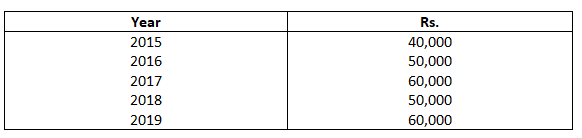
13. Compute the value of goodwill on the basis of four years’ purchases of the average profits based on the last five years? The profits for the last five years were as follows:
Solution –
Calculation of Goodwill of the firm
Average profit of cost
5 years = 40,000 + 50,000 + 60,000 + 50,000 + 60,000 / 5
= 2, 60,000 / 5
= Rs.52,000
Goodwill of the firm = Average profit of Cost x 4 years of purchase 5 years
= 52,000 x 4
= Rs.2,08,000
14. Frim’s Captial in a business is Rs.2,00,000. The normal rate of return on firm’s capital is 15%. During the year 2015 the firm earned a profit of Rs.48,000. Calculate goodwill on the basis of 3 years purchase of super profit?
Solution –
Calculation of Goodwill of the firm
Normal Profit = Capital Employed x Normal Rate of Return
= 2,00,000 x 15%
= 30,000
Super profit = Average profit – Normal profit
= 48,000 – 30,000
= 18,000
= 54,000
15. The books of Ram and Bharat showed that the firm’s capital on 31.12.2016 was Rs.5,00,000 and the profits for the last 5 years: 2015 Rs.40,000; 2014 Rs.50,000; 2013 Rs.55,000; 2012 Rs.70,000 and 2011 Rs.85,000. Calculate the value of goodwill on the basis of 3 years purchase of the average super profit of the last 5 years assuming that the normal rate of return is 10%?
Solution –
Average profit of cost 5 years = 40000 + 50000 + 55000 + 70000 + 85000 / 5
= 3,00,000 / 5
= 60,000
Normal profit = Capital Employed x normal Rate of Return
= 5,00,000 x 10%
= 50,000
Super profit = Average profit – Normal profit
= 60,000 – 50,000
= 10,000
Goodwill = super profit x 3 years purchase
= 10,000 x 3
= Rs.30,000
16. Rajan and Rajani are partners in a firm. Their capitals were Rajan Rs.3,00,000; Rajani Rs.2,00,000. During the year 2015 the firm earned a profit of Rs.1,50,000. Calculate the value of goodwill of the firm by capitalisation method assuming that the normal rate of return is 20%?
Solution –
Capital Employed = Rajan’s Capital + Rajani’s Capital
= 3,00,000 + 2,00,000
= 5,00,000
Capitalised valued of Ave. profit = Ave. profit/normal rate of return
= 1,50,000 x 100 / 20
= 7,50,000
Goodwill of the Frim = Capitalised value – Capital Emp. of Ave. profit
= 7,50,000 – 5,00,000
= 2,50,000
17. A business has earned average profits of Rs.1,00,000 during the last few years. Find out the value of goodwill by capitalisation method, given that the assets of the business are Rs.10,00,000 and its external liabilities are Rs.1,80,000. The normal rate of return is 10%?
Solution –
Calculation of Goodwill of the firm
Capital Employed = Assets – External liabilities
= 10,00,000 – 1,80,000
= 8,20,000
Capitalised valued of Ave. profit = Ave. profit / Normal rate of return
= 1,00,000 x 100 / 10
= 10,00,000
Goodwill of the Frim = Capitalised value of – Capital Employed Ave. profit
= 10,00,000 – 8,20,000
= 1,80,000
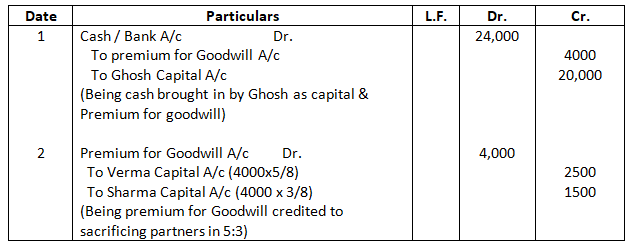
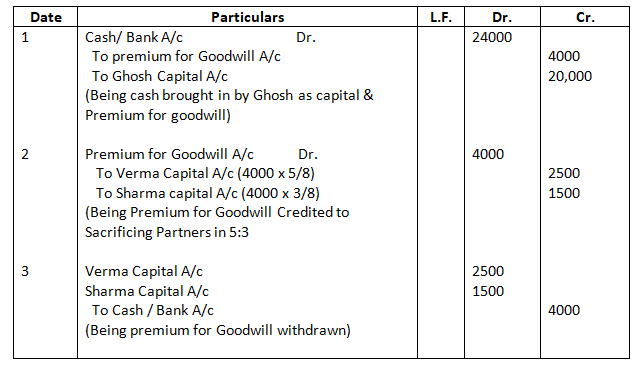
18. Verma and Sharma are partners in a firm sharing profits and losses in the ratio of 5:3. They admitted Ghosh as a new partner for 1/5 share of profits. Ghosh is to bring in Rs.20,000 as capital and Rs.4,000 as his share of goodwill premium. Give the necessary journal entries:
- When the amount of goodwill is retained in the business.
- When the amount of goodwill is fully withdrawn.
- When 50% of the amount of goodwill is fully withdrawn.
- When goodwill is paid privately.
Solution –
Case – a)
Journal
Case – b)
Journal
Case – c)
Journal
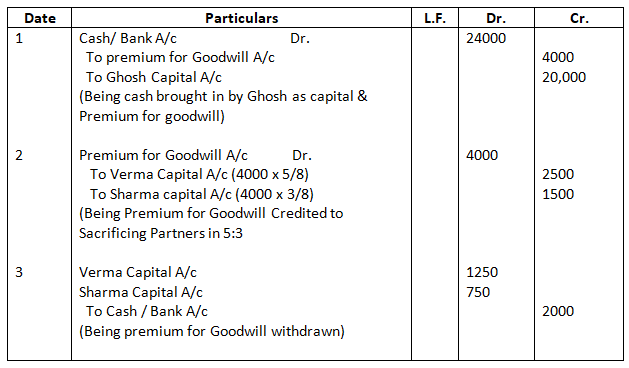
Case – d)
When goodwill is paid privately, no entry is passed in the books of the accounts.
19. A and B are partners in a firm sharing profits and losses in the ratio of 3:2. They decide to admit C into partnership with 1/4 share in profits. C will bring in Rs.30,000 for capital and the requisite amount of goodwill premium in cash. The goodwill of the firm is valued at Rs.20,000. The new profit sharing ratio is 2:1:1. A and B withdraw their share of goodwill. Give necessary journal entries?
Solution –
Journal
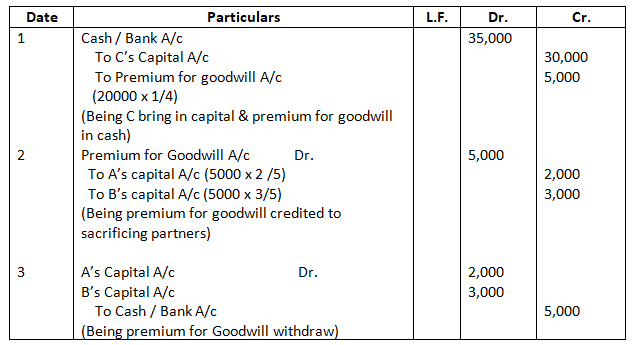
Calculation of Sacrificing Ratio of the Partners.
Old Ratio = 3:2
New Ratio = 2:1:1
A = 3/5 – 2/4
= 12 – 10 / 20
= 2/20
B = 2/5 – 1/4
= 8 – 5 /20
= 3/20
Sacrificing Ratio of A & B is = 2:3
20. Arti and Bharti are partners in a firm sharing profits in 3:2 ratio. They admitted Sarthi for 1/4 share in the profits of the firm. Sarthi brings Rs.50,000 for his capital and Rs.10,000 for his 1/4 share of goodwill. Goodwill already appears in the books of Arti and Bharti at Rs.5,000. The new profit sharing ratio between Arti, Bharti and Sarthi will be 2:1:1. Record the necessary journal entries in the books of the new firm?
Solution –
Journal
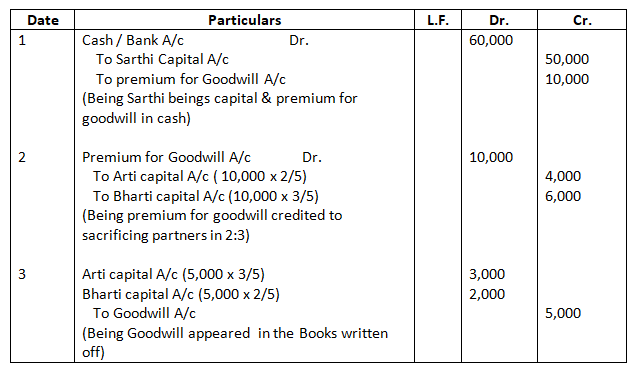
Calculation of Sacrificing Ratio of the Partners
Old Ratio = 3:2
New Ratio = 2:1:1
Arti = 3/5 – 2/4
= 12 – 10 / 20
= 2 / 20
Bharti = 2/5 – 1/4
= 8 – 5 /20
= 3 / 20
Sacrificing Ratio of A & B is 2:3
21. X and Y are partners in a firm sharing profits and losses in 4:3 ratio. They admitted Z for 1/8 share. Z brought Rs.20,000 for his capital and Rs.7,000 for his 1/8 share of goodwill. Goodwill already appears in the books at Rs.40,000. Show necessary journal entries in the books of X, Y and Z?
Solution –
Journal
22. Aditya and Balan are partners sharing profits and losses in 3:2 ratio. They admitted Christopher for 1/4 share in the profits. The new profit sharing ratio agreed was 2:1:1. Christopher brought Rs.50,000 for his capital. His share of goodwill was agreed to at Rs.15,000. Christopher could bring only Rs.10,000 out of his share of goodwill. Record necessary journal entries in the books of the firm?
Solution –
Journal
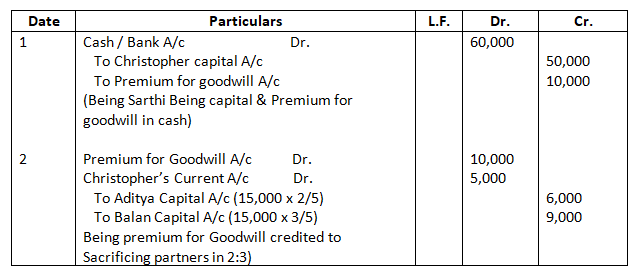
Calculation of Sacrificing Ratio of the Partners
Old Ratio = 3:2
New Ratio = 2:1:1
Aditya = 3/5 – 2/4
= 12 – 10 / 20
= 2/ 20
Balan = 2/5 – 1/4
= 8 – 5/20
= 3/20
23. Amar and Samar were partners in a firm sharing profits and losses in 3:1 ratio. They admitted Kanwar for 1/4 share of profits. Kanwar could not bring his share of goodwill premium in cash. The Goodwill of the firm was valued at Rs.80,000 on Kanwar’s admission. Record necessary journal entry for goodwill on Kanwar’s admission.
Solution –
Journal
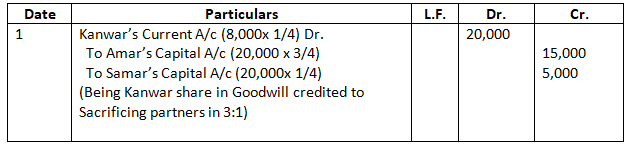
24. Mohan Lal and Sohan Lal were partners in a firm sharing profits and losses in 3:2 ratio. They admitted Ram Lal for 1/4 share on 1.1.2013. It was agreed that goodwill of the firm will be valued at 3 years purchase of the average profits of last 4 years which were Rs.50,000 for 2013, Rs.60,000 for 2014, Rs.90,000 for 2015 and Rs.70,000 for 2016. Ram Lal did not bring his share of goodwill premium in cash. Record the necessary journal entries in the books of the firm on Ram Lal’s admission when:
- Goodwill already appears in the books at Rs.2,02,500.
- Goodwill appears in the books at Rs.2,500.
- Goodwill appears in the books at Rs.2,05,000.
Solution –
Journal
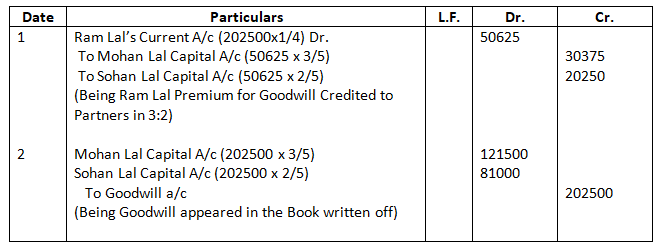
Calculation of Goodwill of the firm
Average profit of cost 4 Years = 50,000 + 60,000 + 90,000 + 70,000/4
= 270000/4
= Rs.67500
Goodwill of the firm = Aver. Profit of cost 4 years x 3 years Purchase
= 67500 x 3
= 202500
Ram Lal’s share in Goodwill = 202500 x 1/4
= Rs.50625
25. Rajesh and mukesh are equal partners in a firm. They admit Hari into partnership and the new profit sharing ratio between Rajesh, Mukesh and Hari is 4:3:2. On Hari’s admission goodwill of the firm is valued at Rs.36,000. Hari is unable to bring his share of goodwill premium in cash. Rajesh, Mukesh and Hari decided not to show goodwill in their balance sheet. Record necessary and Hari decided not to show goodwill in their balance sheet. Record necessary journal entries for the treatment of goodwill on Hari’s admission.
Solution –
Journal

Calculation of Sacrificing Ratio of the partners
Old Ratio = 1:1
New Ratio = 4:3:2
Rajesh = 1.2 – 4/9
= 9 – 8 / 18
= 1/ 18
Mukesh = ½ – 3/9
= 9 – 6 / 18
= 3/18
Sacrificing Ratio of Rajesh & Mukesh is 1:3
26. Amar and Akbar are equal partners in a firm. They admitted Anthony as a new partner and the new profit sharing ratio is 4:3:2. Anthony could not bring this share of goodwill rS.45,000 in cash. It is decided to do adjustment of goodwill without opening goodwill account. Pass the necessary journal entry for the treatment of goodwill?
Solution –
Journal
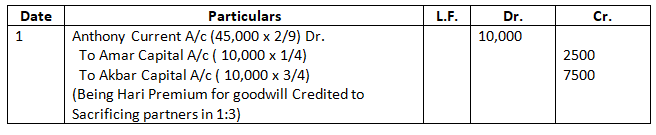
Calculation of Sacrificing Ratio of the Partners
Old Ratio = 1:1
New Ratio = 4:3:2
Amar = 1/2 – 4/9
= 9 – 8 / 18
= 1/ 18
Akbar = 1/ 2 – 3/9
= 9 – 6 /18
= 3/18
Sacrificing Ratio of Amar & Akbar is 1:3
27. Given below is the Balance Sheet of A and B, who are carrying on partnership business on 31.12.2016. A and B share profits and losses in the ratio of 2:1.
Balance Sheet of A and B as at March 31, 2016
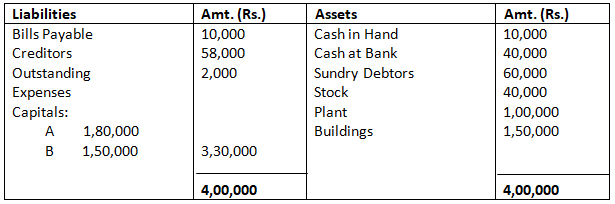
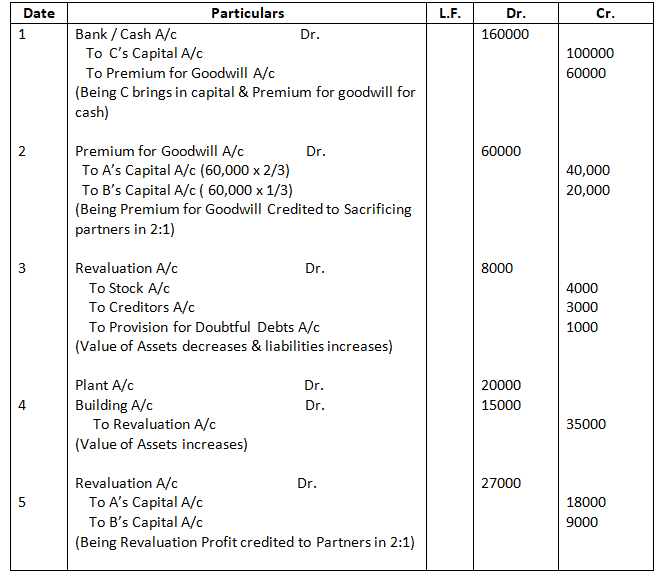
C is admitted as a partner on the date of the balance sheet on the following terms:
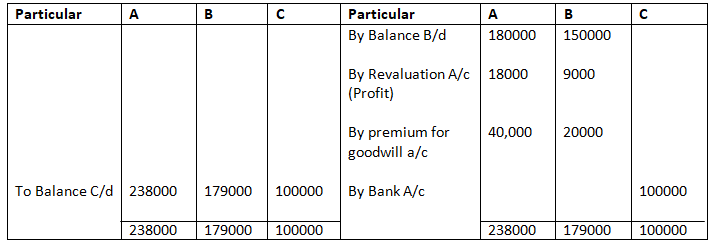
- C will bring in Rs.1,00,000 as his capital and Rs.60,000 as his share of goodwill for 1/4 share in the profits.
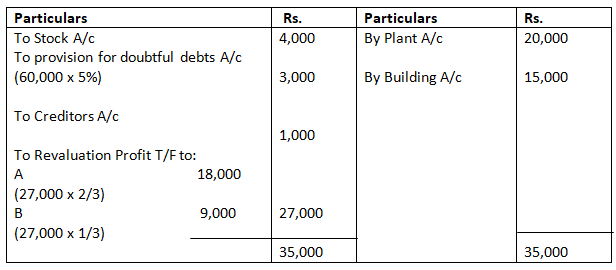
- Plant is to be appreciated to Rs.1,20,000 and the value of buildings is to be appreciated by 10%.
- Stock is found over valued by Rs.4,000.
- A provision for bad and doubtful debts is to be created at 5% of debtors.
- Creditors were unrecorded to the extent of Rs.1,000.
Pass the necessary journal entries, prepare the revaluation account and partners’ capital accounts, and show the Balance Sheet after the admission of C.
Solution –
Journal
Dr. Revaluation A/c Cr.
Dr. Partner’s Capital A/c Cr.
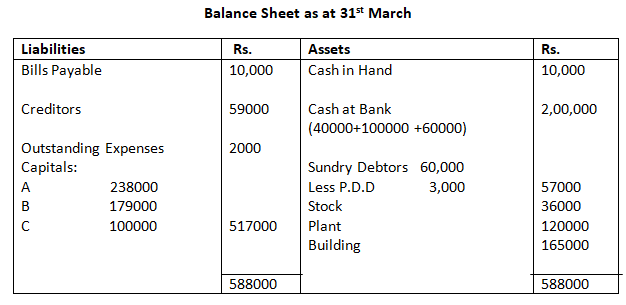
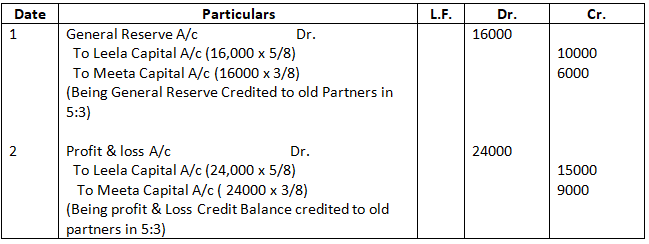
28. Leela and Meeta were partners in a firm sharing profits and losses in the ratio of 5:3. In April 2017 they admitted Om as a new partner. On the date of Om’s admission the balance sheet of Leela and Meeta showed a balance of Rs.16,000 in general reserve and Rs.24,000 (Cr) in Profit and Loss Account. Record necessary journal entries for the treatment of these items on Om’s admission. The new profit sharing ratio between Leela. Meeta and Om was 5:3:2.
Solution –
Journal
29. Amit and Viney are partners in a firm sharing profits and losses in 3:1 ratio. On 1.1.2017 they admitted Ranjan as a partner. On Ranjan’s admission the profit and loss account of Amit and Viney showed a debt balance of Rs.40,000. Record necessary journal entry for the treatment of the same.
Solution –
Journal

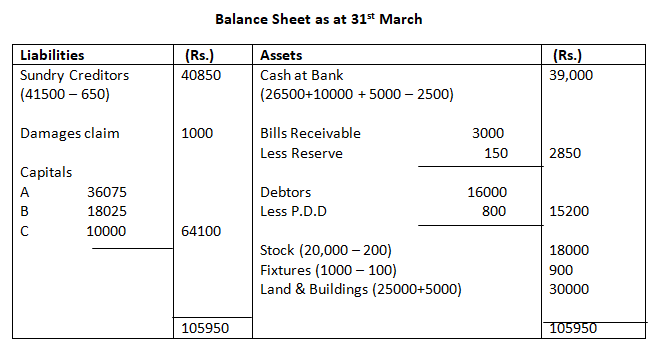
30. A and B share profits in the proportions of 3/4 and 1/4. Their Balance Sheet on March 31, 2016 was as follows:
Balance Sheet of A and B as at March 31, 2016
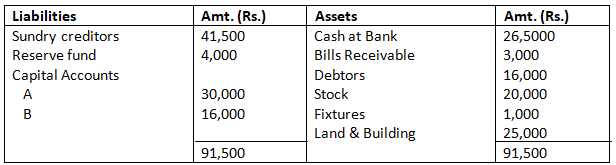
On April 1. 2017, C were admitted into partnership on the following terms:
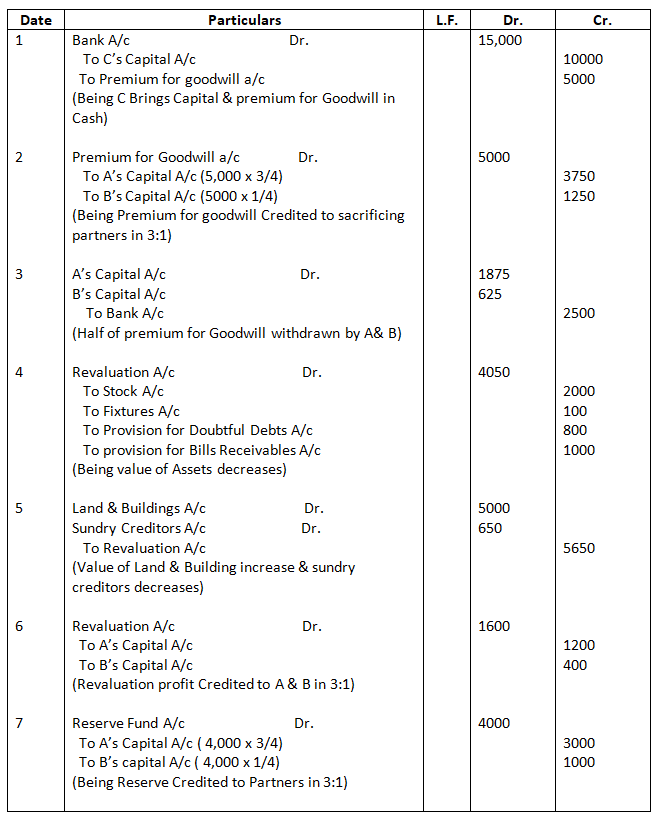
- That C pays Rs.10,000 as his capital.
- That C pays Rs.5, 000 for goodwill. Half of this sum is to be withdrawn by A and B.
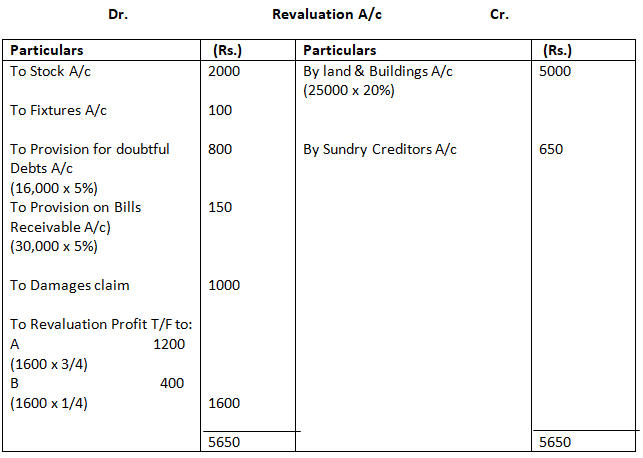
- That stock and fixtures be reduced by 10% and a 5% provision for doubtful debts be created on Sundry Debtors and Bills Receivable.
- That the value of Land and buildings be appreciated by 20%
- There being a claim against the firm for damages, a liability to the extent of Rs.1,000 should be created.
- An item of Rs.650 included in sundry creditors is not likely to be claimed and hence should be written back.
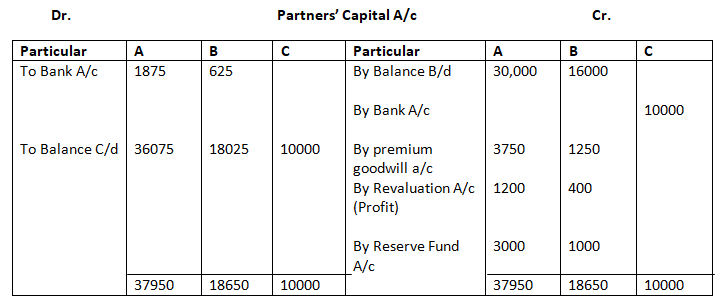
Record the above transactions (journal entries) in the books of the firm assuming that the profit sharing ratio between A and B has not changed. Prepare the new Balance Sheet on the admission of C.
Solution –
Journal
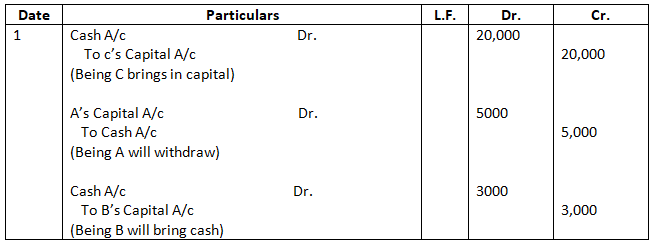
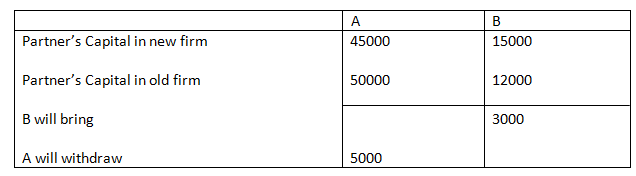
31. A and B are partners sharing profits and losses in the ratio of 3:1. On 1st April, 2017 they admitted C as a new partner for 1/4 share in the profits of the firm. C brings Rs.20,000 as for his 1/4 share in the profit of the firm. The capitals of A and B after all adjustments in respect of goodwill, revaluation of assets and liabilities, etc. has been worked out at Rs.50,000 for A and Rs.12,000 for B. It is agreed that partners’ capitals will be according to new profit sharing ratio. Calculate the new capitals of A and B and pass the necessary journal entries assuming that A and B brought in or withdrew the necessary cash as the case may be for making their capitals in proportion to their profit sharing ratio?
Solution –
Journal
Calculation on of New Profit Sharing Ratio of A & B in 3:1
Old Ratio of A & B = 3:1
C admitted for 1/4th share
Remaining share = 1- 1/4
= 3/4
A’s new share = 3/4 x 3/4
= 9 / 16
B’s New share = 3/4 x 1/4
= 3/16
New profit sharing ratio after making base equal
= 9/16 : 3/16 : 1/4 x 4/4
= 9: 3: 4
Calculation of Partner’s capital in New firm
Total capital in new firm = C’s Capital x Reciprocal of his share
= 20000 x 4
= Rs.80,000
A’s Capital in new firm = 80,000 x 9/16
= 45000
B’s Capital in new firm = 80,000 x 3/16
= 15000
C’s capital in new firm = 80,000 x 4/16
= 20,000
32. Pinky, Qumar and Roopa partners in a firm sharing profits and losses in the ratio of 3:2:1. S is admitted as a new partner for 1/4 share in the profits of the firm, which he gets 1/8 from Pinky, and 1/16 each from Qmar and Roopa. The total capital of the new firm after Seema’s admission will be Rs.2,40,000. Seema is required to bring in cash equal to 1/4 of the total capital of the new firm. The capitals of the old partners also have to be adjusted in proportion of their profit sharing ratio. The capitals of Pinky, Qmar and Roopa after all adjustments in respect of goodwill and revaluation of assets and liabilities have been made are Pinky Rs.80,000, Qmar Rs.30,000 and Roopa Rs.20,000. Calculate the capitals of all the partners and record the necessary journal entries for doing adjustments in respect of capitals according to the agreement between the partners?
Solution –
Journal
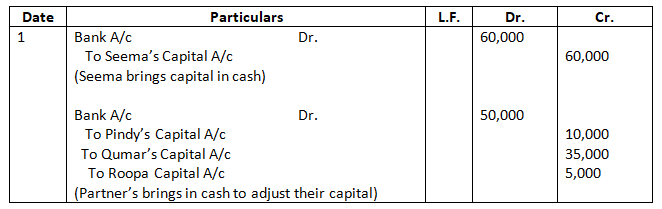
Calculation of New profit sharing ratio of partners
Old Ratio of Pinky, Qumar & Roopa is 3:2:1
S admitted for 1/4th share which he gets 1/8 from pinky and 1/16th each from Qumar and Roopa
Pinky’s New share = 3/6 – 1/8
= 12 – 3/24
= 9/24
Qumar’s New share = 2/6 – 1/16
= 16 – 3/48
= 13 / 48
Roopa’s New share = 1/6 – 1/16
= 8 – 3/48
= 5/48
New Profit sharing ratio after making base equal
= 9/24 x 2/2 : 13/48 : 5/48 : 1/4 x 12/12
= 10 : 13 : 5 : 12
Calculation of Partner’s Capital in new firm
Total Capital in New Firm = Rs.240000
Pinky capital in new firm = 24,0000 x 18/48
= 90,000
Qumar Capital in new firm = 240000 x 13/ 48
= 65000
Roopa Capital in new firm = 240000 x 5/48
= 25000
S Capital in new firm = 240000 x 12 / 48
= 60,000

33. The following was the Balance Sheet of Arun, Bablu and Chetan sharing profits and losses in the ratio of 6/14 : 5/14 : 3/14 respectively.
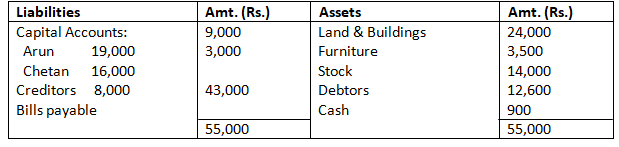
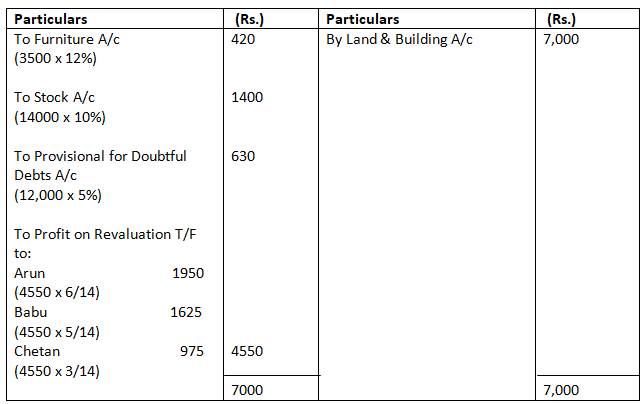
The agreed to take Deepak into partnership and give him a share of 1/8 on the following terms: a) that Deepak should bring in Rs.4,200 as goodwill and Rs.7,000 as his Capital; (b) that furniture be depreciated by 12%; (c) that stock be depreciated by 10% (d) that a Reserve of 5% be created for doubtful debts; (e) that the value of land and buildings having appreciated be brought upto Rs.31,000; (f) that after making the adjustments the capital accounts of the old partners (who continue to share in the same proportion as before) be adjusted on the basis of the proportion of Deepak’s Capital to his share in the business, i.e., actual cash to be paid off to , or brought in by the old partners as the case may be.
Prepare Cash Account, Profit and Loss Adjustment Account (Revaluation Account) and the Opening Balance Sheet of the new frim.
Solution –
Dr. Revaluation A/c Cr.
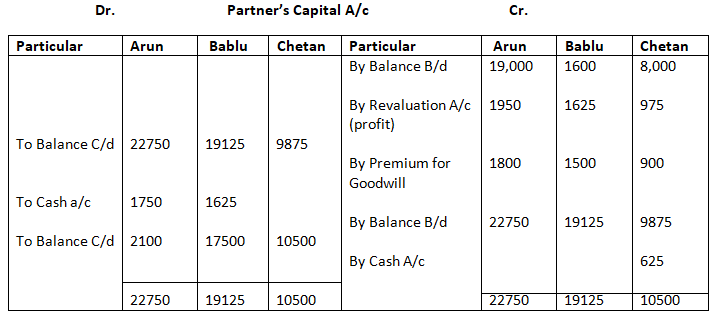
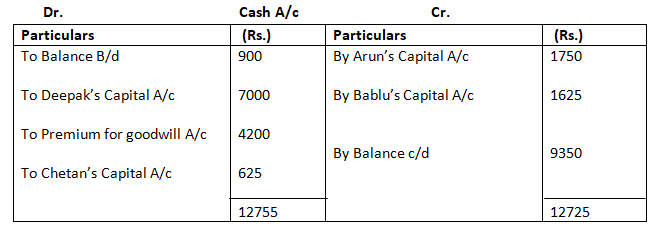
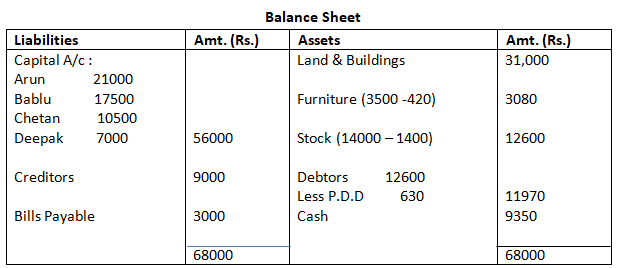
Calculation of Partner’s Capital In New Firm
Total Capital in new firm = Deepak’s Capital x Reciprocal of his share
= 7000 x 8
= 56,000
Arun’s share in new firm = 56000 x 6/16
= 21,000
Bablu’s share in new firm = 56000 x 5/16
= 17500
Chetan’s Share in new firm = 56000 x 3/16
= 10,500
Calculation of Partner’s New Profit sharing Ratio
Old Ratio of Arun Bablu & Chetan = 6 : 5: 3
Deepak admitted for = 1/8 share
Remaining share = 1 – 1/8
= 7/8
Arun’s new share = 7/8 x 6/14
= 42 / 112
Bablu’s New share = 7/8 x 5/14
= 35 / 112
Chetan’s New share = 7 / 8 x 3/14
= 21 / 112
New profit sharing Ratio of Arun, Bablu chetan & Deepak
= 42/112 : 35/112 : 21/112 : 1/8 x 14/14
= 6 : 5 : 3 : 2
Calculation of partner’s share in Goodwill of the firm
Deepak Premium for goodwill = Rs.4200
It would be shared by old partners in their profit sharing ratio 6 : 5 : 3
Arun’s share = 4200 x 6/14
= 1800
Bablu’s share = 4200 x 5/14
= 1500
Chetan’s share = 4200 x 3/14
= 900
Journal
Premium for Goodwill A/c Dr. 4200
To Arun capital a/c 1800
To Bablu capital A/c 1500
To chetan capital A/c 900
34. Azad and Babli are partners in a firm sharing profits and losses in the ratio of 2:1. Chintan is admitted into the firm with 1/4 share in profits. Chintan will bring in Rs.30,000 as his capital and the Azad and Babli are to be adjusted in the profit sharing ratio. The Balance sheet of Azad and Babli as on March 31, 2016 (before Chintan’s admission) was as follows:
Balance Sheet of A and B as on 31.03.2016
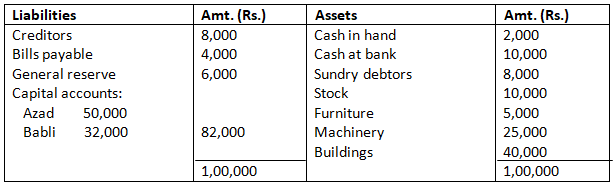
It was agreed that:
- Chintan will bring in Rs.12,000 as his share of goodwill premium.
- Buildings were valued at Rs.45,000 and Machinery at Rs.23,000.
- A provision for doubtful debts is to be created @ 6% on debtors.
- The capital accounts of Azad and Babli are to be adjusted by opening current accounts.
Record necessary journal entries, show necessary ledger accounts and prepare the Balance Sheet after admission.
Solution –
Balance Sheet of A and B as on 31.03.2016
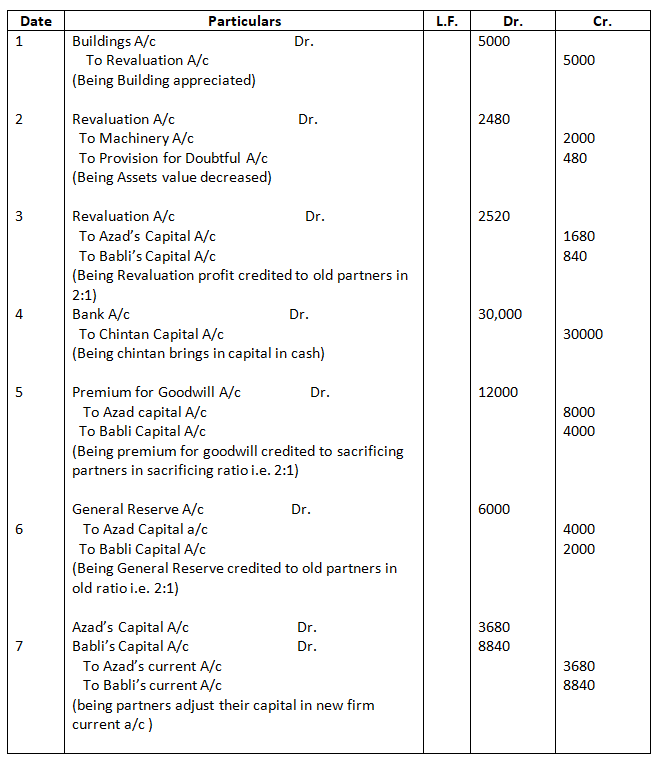
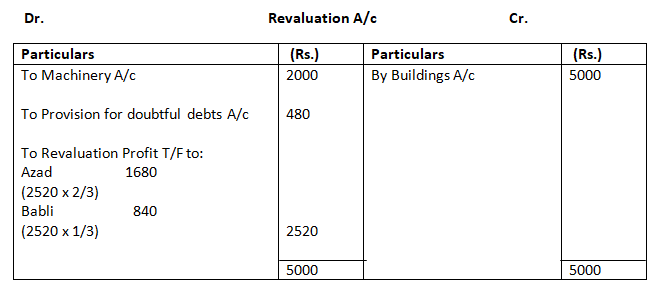
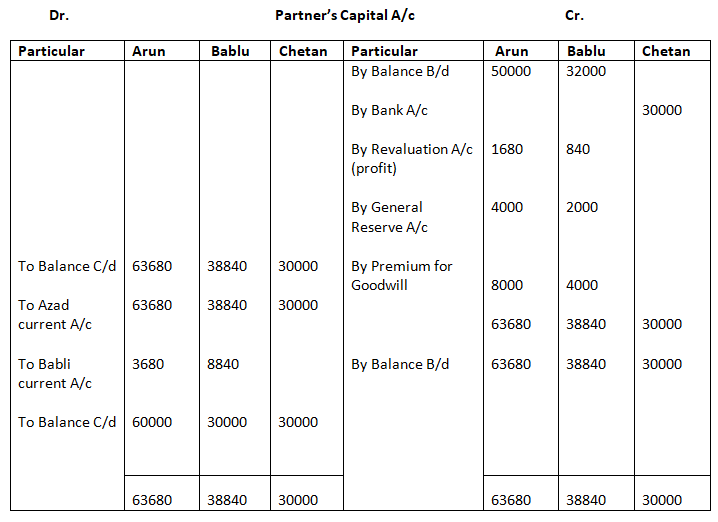
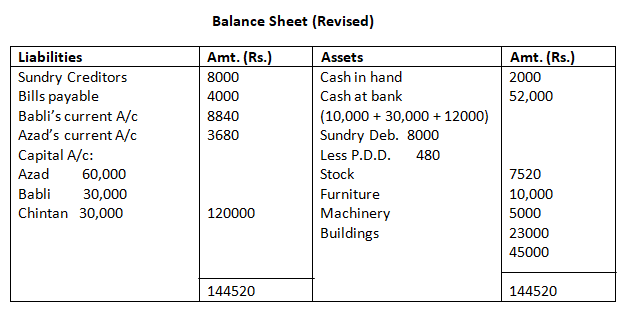
Calculation of new profit sharing ratio of partners
Old ratio of Azad, Babli = 2:1
Chintan admitted for 1/4th share
Remaining share = 1 – 1/4
= 3/4
Azad’s new share = 3/4 x 2/3
= 6/12
Babli’s new share = 3/4 x 1/3
= 3/12
New profit sharing ratio of Azad, Babli and chintan is
= 6/12 : 3/12 : 1/4 x 3/3
= 2:1:1
Calculation of Partner’s Capital in New Firm
Total Capital of the new firm = Chintan’s Capital x Reciprocal of his share
= 30,000 x 4
= 1,20,000
Azad capital in new firm = 120000 x 2/4
= 60,000
Babli capital in new firm = 120000 x 1/4
= 60,000
Chintan capital in new firm = 120000 x 1/4
= 30,000
Calculation of partner’s share in goodwill of the firm
Chintan premium for Goodwill is = 12000
Azad and Babli will share it in their sacrificing ratio i.e. 2:1
Azad’s share = 12000 x 2/3
= 8000
Babli’s share = 12000 x 1/3
= 4000
Journal
Premium for Goodwill A/c Dr. 12000
To Azad capital A/c 8000
To Babli Capital A/c 4000
=
35. Ashish and Dutta were partners in a firm sharing profits in 3:2 ratio. On Jan. 01, 2015 they admitted Vimal for 1/5 share in the profits. The Balance Sheet of Ashish and Dutta as on March 31, 2016 was as follows:
Balance Sheet of A and B as on 1.03.2016
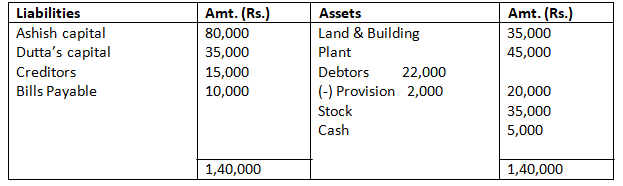
It was agreed that:
- The value of Land and Building be increased by Rs.15,000.
- The value of plant be increased by 10,000.
- Goodwill of the firm be valued at Rs.20,000.
- Vimal to bring in capital to the extent of 1/5th of the total capital of the new firm.
Record the necessary journal entries and prepare the Balance Sheet of the firm after Vimal’s admission.
Solution –
Journal
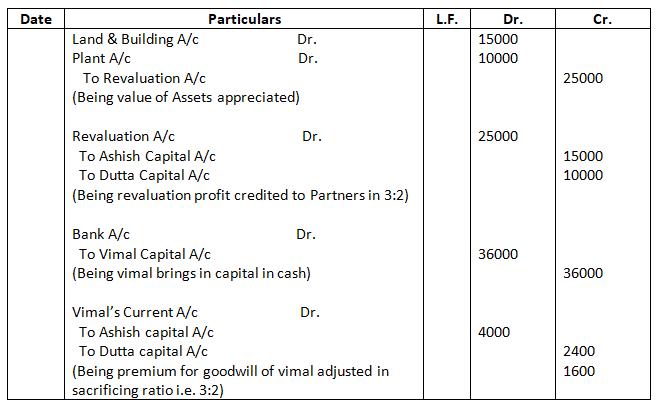
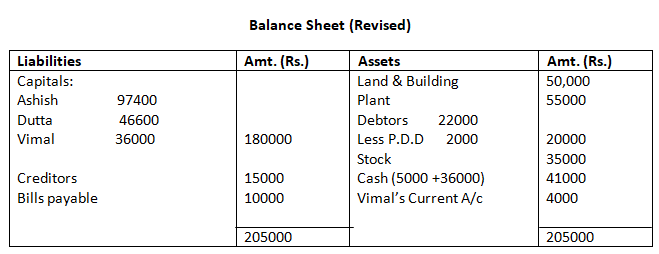
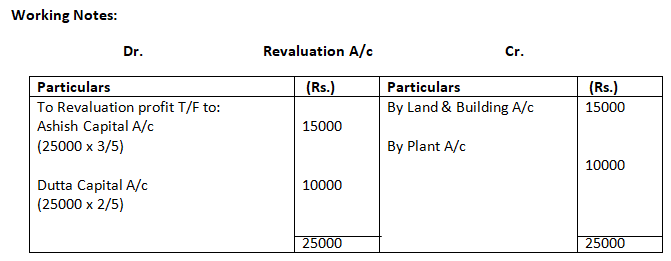
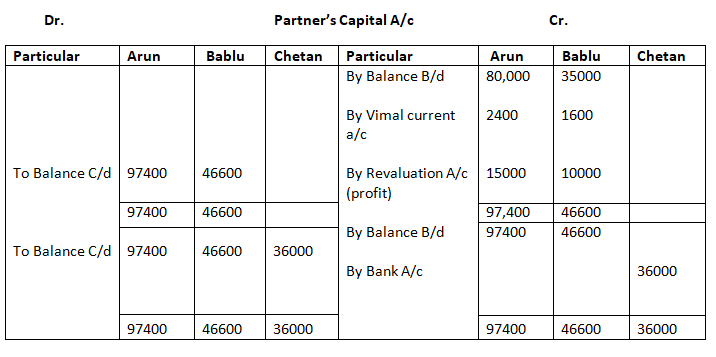
Calculation of Partner’s share in Goodwill of the firm
Goodwill of the firm = Rs.20,000
Viaml share = 20,000 x 1/5
= 4,000
Ashish share = 4000 x 3/5
= 2400
Dutta share = 4000 x 2/5
= 1600
Journal
Vimal’s Current A/c Dr. 4000
To Ashish capital A/c 2400
To Dutta Capital A/c 1600
Calculation of Vimal Capital in new firm
Total Capital in new firm = Adjusted capital of the x reciprocal of combined share
= (97400 + 46600) x (1 – 1/5)
= 144000 x 5/4
= 180000
Vimal Capital in new firm = 180000 x 1/5
= 36000
ACCOUNTING FOR PARTNERSHIP FIRM
NCERT