Meaning of Supply
Supply refers to the quantity of a commodity that a firm is willing and able to offer for sale at a given price during a given period of time.
The definition of supply highlights 4 essential elements:
- Quantity of a commodity
- Price of the commodity
- Willingness to sell
- Period of time
Stock – Stock refers to the total quantity of a particular commodity that is available with the firm at a particular point of time. On the other hand, supply is that part of stock which a producer is willing to bring into the market for sale. Stock can never be less than the supply. For example – If a seller has 50 tonnes of sugar in his godown and he is willing to sell 30 tones @ Rs.37 per kg, then supply is 30 tones and stock is 50 tonnes.
Determinants of Supply (Individual Supply)
- Price of the given commodity – The most important factor determining the supply of a commodity is its price. As a general rule, price of a commodity and its supply are directly related. It means, as price increases, the quantity supplied of the given commodity also rises and vice-versa.
- Price of Other Goods – As resources have alternative uses, the quantity supplied of a commodity depends not only on its price but also on the prices of other commodities.
- Prices of the Factors of Production or Inputs – Prices of the factors of production or inputs (like labour, capital, raw material, etc.) used in the process of production constitute the cost of production of the commodity.
- State of Technology – Technological changes influence the supply of a commodity. Advanced and improved technology reduces the cost of production, which raises the profit margin. It induced the seller to increase the supply.
- Government Policy (Taxes and Subsidies) – An increase in taxes raises the cost of production and, thus, reduces the supply, due to a lower profit margin. On the other hand, tax concessions and subsidies increase the supply as they make it more profitable for the firms to supply goods.
Determinants of Market Supply
- Number of Firms in the market – When the number of firms in the industry increases, market supply also increases due to a large number of producers producing that commodity. However, market supply will decrease, if some of the firms start leaving the industry due to losses.
- Future Expectation regarding price – If sellers expect a rise in price in near future, then current market supply will decrease in order to raise the supply in future at higher prices. However, if the sellers fear that the prices will fall in the future, then they will increase the present supply to avoid losses in future.
- Means of Transportation and communication – Proper infrastructural development, like improvement in the means of transportation and communication, help in maintaining an adequate supply of the commodity.
Supply Function
Supply functions shows the functional relationship between the quantity supplied for a particular commodity and the factors influencing it. It can be either with respect to one producer (individual supply function) or to all the producers in the market (market supply function).
Individual Supply Function – individual supply function refers to the functional relationship between supply and factors affecting the supply of a commodity.
It is expressed as: = Sx = f (Px, Po, Pf, St, T, G)
Market Supply Function – Market supply function refers to the functional relationship between market supply and factors affecting the market supply of a commodity.
Supply Schedule
Supply schedule is a tabular statement showing various quantities of a commodity being supplied at various levels of price, during a given period of time.
Like demand schedule, supply schedule is also of two types:
- Individual supply schedule
- Market supply schedule.
- Individual Supply Schedule – Individual supply schedule refers to a tabular statement showing various quantities of commodity that a producer is willing to sell at various levels of price, during a given period of time.
- Market Supply Schedule – Market supply schedule refers to a tabular statement showing various quantities of a commodity that all the producers are willing to sell at various levels of price, during a given period of time.
Supply Curve
Supply Curve refers to a graphical representation of the supply schedule. It is the locus of all the points showing various quantities of a commodity that a producer is willing to sell at various levels of price, during a given period of time, assuming no change in other factors.
- It shows the direct relationship between price and quantity supplied, keeping other factors constant.
- It can be drawn for any commodity by plotting each combination of the supply schedule on a graph.
- Like supply schedules, supply curves can also be drawn both for individual producer and for all the producers in the market. So, the supply curve is of two types:
- Individual Supply curve – Individual Supply curve refers to a graphical representation of individual supply schedules.
- Market Supply Curve – Market supply curve refers to a graphical representation of market supply schedule. It is obtained by horizontal summation of individual supply curves.
Market Supply Curve is Flatter – The market supply curve is flatter than all individual supply curves. This happens because with a change in price, the proportionate change in market supply is greater than the proportionate change in individual supplies.
Slope of Supply Curve – As stated before, the slope of a curve is defined as the change in the variable on the Y-axis divided by the change in the variable on the X-axis. So, the slope of the supply curve equals the Change in Price divided by the Change in quantity.
Slope of Supply Curve = Change in price (ΔP) / Change in quantity (ΔQ)
Law of Supply
Economists have studied the behaviour of sellers, just as they have studied the behaviour of buyers. As a result of their observation, they have arrived at the law of supply. Law of supply states the direct relationship between price and quantity supplied, keeping other factors constant (ceteris paribus).
Assumption of Law of Supply – While stating the law of supply, the phrase ‘keeping other factors constant of ceteris paribus’ are used. This phrase is used to cover the following assumption on which the law is based:
- Price of other goods is constant;
- There is no change in the state of technology;
- Prices of factors of production remain the same;
- There is no change in the taxation policy;
- Goals of the producer remain the same.
Reasons for Law of Supply – Let us now try to understand why the supply of a commodity expands as the price rises. The main reasons for operation of law of supply are:
- Profit Movie – The basic aim of producers, while supplying a commodity, is to secure maximum profits. When the price of a commodity increases, without any change in costs, it raises their profits. So, producers increase the supply of the commodity by increasing the production.
- Change in Number of Firms – A rise in price induces the prospective producers to enter into the market to produce the given commodity so as to earn higher profits. Increase in number of firms raises the market supply.
- Change in Stock – When the price of a good increases, the sellers are ready to supply more goods from their stocks. However, at a relatively lower price, the producers do not release large quantities from their stocks.
Exceptions to Law of Supply – As a general rule, the supply curve slopes upwards, showing that the quantity supplied rises with a rise in price. However, in certain cases, positive relationship between supply and price may not hold true.
- Future Expectations – If sellers expect a fall in price in the future, then the law of supply may not hold true. In this situation, the sellers will be willing to sell more, even at a lower price.
- Agricultural Goods – The law of supply does not apply to agricultural goods as their production depends on climatic conditions. If, due to unforeseen changes in weather, the production of agricultural products is low, then their supply cannot be increased even at higher prices.
- Perishable Goods – In the case of perishable goods, like vegetables, fruits, etc., sellers will be ready to sell more even if the prices are falling. It happens because sellers cannot hold such goods for long.
Movement Along The supply curve (Change in Quantity Supplied)
When the quantity supplied of a commodity changes due to a change in its own price, keeping other factors constant, it is known as ‘change in quantity supplied’. It is graphically expressed as a movement along the same supply curve.
- Upward Movement – when the price rises to OP1, quantity supplied also rises to OQ1 (known as expansion in supply), leading to an upward movement from A to B along the same supply curve SS.
- Downward Movement – On the other hand, fall in price from OP to OP2, leads to decrease in quantity supplied from OQ to OQ2 (known as contraction in supply), resulting in a downward movement from A to C along the same supply curve SS.
Expansion in Supply – Expansion in Supply refers to a rise in the quantity supplied due to an increase in the price of the commodity, other factors remaining constant.
- It leads to an upward movement along the same supply curve.
- It is also known as ‘Extension in Supply’ or ‘Increase in Quantity Supplied’.
Contraction in Supply – Contraction in supply refers to a fall in the quantity supplied due to a decrease in the price of the commodity, other factors remaining constant.
- It leads to a downward movement along the same supply curve.
- It is also known as ‘Decrease in Quantity Supplied’.
Shift In Supply Curve (Change in Supply)
Supply curve is drawn to show the relationship between price and quantity supplied of a commodity, assuming all other factors are constant. However, other factors are bound to change sooner or later. A change in one of ‘other factors’ shifts the supply curve. Supply is OQ at the price of OP. Chang in other factors leads to a rightward or leftward shift in the supply curve:
- Rightward Shift – When supply rises from OQ to OQ1 (known as an increase in supply) at the same price of OP, It leads to a rightward shift in the supply curve from SS to S1S1.
- Leftward Shift – On the other hand, fall in supply from OQ to OQ2 (known as decrease in supply) at the same price of OP, leads to a leftward shift in supply curve from SS to S2S2.
Increase in Supply – Increase in supply refers to a rise in the supply of a commodity caused due to any factor other than the own price of the commodity.
Decrease in Supply – Decrease in supply refers to a fall in the supply of a commodity caused due to any factor other than the own price of the commodity.
Effect on Supply Curve (due to change in other factors)
Change in Prices of other Goods – The quantity supplied of the given commodity depends not only on its price but also on the prices of other goods. ‘Increase’ and ‘Decrease’ in price of other goods shift the original supply curve of a given commodity.
- Increase in Price of other goods – When prices of other goods rise, then production of such other goods becomes more profitable in comparision to the given commodity. As a result, supply falls from OQ to OQ1 at the same price OP. it leads to a leftward shift in the supply curve from SS to S1S1.
- Decrease in Price of other goods – Fall in prices of other goods makes production of the given commodity more profitable and it increases its supply from OQ to OQ1 at the same price OP. It leads to a rightward shift in the supply curve from SS to S1S1.
Change in Price of Factors of Production – Price of the factors of production forms a major part of the cost of producing a commodity. With a change (increase or decrease) in the amount payable to factor inputs, the supply curve of the commodity also changes.
- Increase in Price of Factors of Production – A rise in the price of factors of production increase the cost of production and reduces the profit margin. As a result, supply falls from OQ to OQ1 at the same price OP. It leads to a leftward shift in the supply curve from SS to S1S1.
- Decrease in Price of Factors of Production – When the price of factors of production falls, the cost of production falls and the profit margin rises. It increase the supply from OQ to OQ1 at the same price OP. It leads to a rightwards shift in the supply curve from SS to S1S1.
Change in the Stage of Technology – Technological changes affect the cost of production, which directly influences the supply of the commodity. Supply increase with technological advancement, whereas, any degradation of technology reduces the supply.
- Upgradation of Technology – Advanced and improved technology reduces the cost of production and raises the profit margin. Supply rises from OQ to OQ1 at the same price OP. It leads to a rightward shift in the supply curve from SS to S1S1.
- Degradation of Technology – Technology degradation or complex and outdated technology leads to a rise in the cost of production and a fall in profit margin. It decreases the supply from OQ to OQ1 at the same price OP. As a result, supply curve shifts towards left from SS to S1S1.
Change in Taxation Policy – Taxes (like Goods and Services Tax or GST) directly affect the cost of producing a commodity. With a change (increase or decrease) in taxes, supply curve of the given commodity changes.
- Increase in Taxes – Rise in taxes increases the cost of production and reduces the profit margin. As a result, supply falls from OQ to OQ1 at the same price OP. It leads to a leftward shift in the supply curve form SS to S1S1.
- Decrease in Taxes – When taxes fall, the cost of production falls and the profit margin rises. It increases the supply from OQ to OQ1 at the same price OP. It leads to a rightward shift in the supply curve from SS to S1S1.
Price Elasticity of Supply
This concept is parallel to the concept of price elasticity of demand. It points out the reaction of the sellers to a particular change in the price of commodity. It explains the quantitative changes in supply of a commodity, due to a given change in the price of the commodity. Price elasticity of supply refers to the degree of responsiveness of supply of a commodity with reference to change in the price of such commodity. For example – if price elasticity of supply is 2, it means that one per cent fall in price leads to 2 per cent fall in supply or one percent rise in price leads to 2 per cent rise in supply.
Percentage Method for measuring Price Elasticity of Supply –
Like elasticity of demand, the most common method for measuring price elasticity of supply (Es) is percentage method. This method is also known as ‘proportionate Method’. According to this method, elasticity is measured as the ratio of percentage change in the quantity supplied to percentage change in the price.
Price Elasticity of Supply (ES) = Percentage change in Quantity Supplied / Percentage change in Price
Kinds of Elasticities of Supply
Different commodity respond differently to a given change in price. Depending upon the degree of responsiveness of the quantity supplied to the price change, there are five kinds of price elasticities of supply.
- Perfectly Elastic Supply – When there is an infinite supply at a particular price and the supply becomes zero with a slight fall in price, then the supply of such a commodity is said to be perfectly elastic.

2. Perfectly Inelastic Supply – When the supply does not change with change in price, then supply for such a commodity is said to be perfectly inelastic.

3. Highly Elastic Supply – When the percentage change in quantity supplied is more than the percentage change in price, then supply for such a commodity is said to be highly elastic.

4. Less Elastic Supply – When the percentage change in quantity supplied is less than the percentage change in price, then supply for such a commodity is said to be less elastic. In such a case, Es < 1 and the supply curve has an intercept on the X-axis.

5. Unitary Elastic Supply – When the percentage change in quantity supplied is equal to the percentage change in price, then supply for such a commodity is said to be unitary elastic.

Time Period And Supply
- Market period (very short period) – Market period refers to a very short period in which the supply cannot be changed in response to the change in demand.
- Short period – short period refers to a period in which output (supply) can be changed by changing only variable factors.
- Long Period – Long period refers to a period in which output (supply) can be changed by changing all factors of production.
Short Answer Type Questions
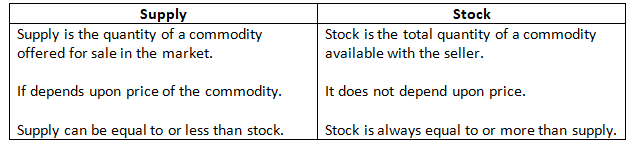
- Define supply. Distinguish between supply and stock.
Answer – Supply: Supply refers to the quantity of a commodity that a seller is willing and able to sell at different prices during a given period of time.
2. How is the supply of a commodity affected by changes in the prices of other commodities?
Answer – Supply of a commodity is affected by the prices of related goods:
- Substitute Goods: If the price of another good increases, producers may shift resources towards its production, causing a fall in the supply of the given commodity.
- Complementary Goods: If the price of a complementary good increases, the demand and supply of the related commodity may also increase.
3. Explain any four determinants of the market supply of a commodity.
Answer – The main determinants of market supply are:
- Price of the Commodity: Higher price increases supply and lower price decreases supply.
- Prices of Related Goods: Change in prices of substitute and complementary goods affects the supply of a commodity.
- Technology: Improvement in technology reduces cost and increases supply.
- Input Prices: Increase in input prices raises cost of production and reduces supply.
4. Explain any two determinants of supply of a commodity.
Answer –
- Price of the Commodity: Supply of a commodity increases with a rise in its price because producers get higher profits.
- Cost of Production: If the cost of inputs increases, production becomes expensive and supply decreases. A fall in cost increases supply.
5. Define market supply of a good. Give three causes of a rightward shift of supply curve.
Answer – Market Supply: Market supply refers to the total quantity of a commodity supplied by all the sellers in the market at different prices during a given period.
Causes of rightward shift of supply curve:
- Fall in prices of inputs.
- Improvement in technology.
- Increase in number of sellers in the market.
- What is meant by supply function? Show its algebraic expression.
6. What is meant by supply function? Show its algebraic expression.
Answer – Supply Function: Supply function shows the functional relationship between quantity supplied of a commodity and its various determinants.
Algebraic Expression:
Qs = f(P, Pr, C,T,G,N)
Where,
Qs = Quantity supplied
P = Price of the commodity
Pr = Price of related goods
C = Cost of inputs
T = Technology
G = Government policy
N = Number of sellers
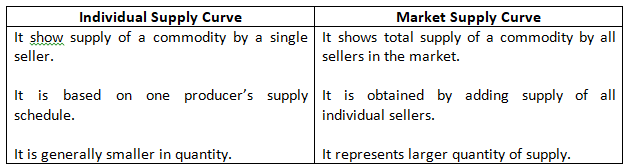
7. Distinguish between individual supply curve and market supply curve.
Answer –
8. Explain the law of supply with the help of a supply schedule and supply curve.
Answer – Law of Supply: Other things remaining constant, quantity supplied of a commodity increases with an increase in its price and decreases with a fall in its price.
Supply Schedule:
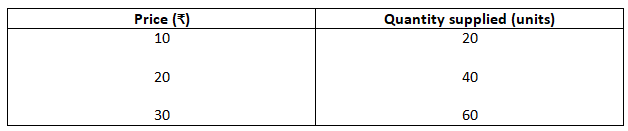
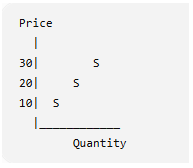
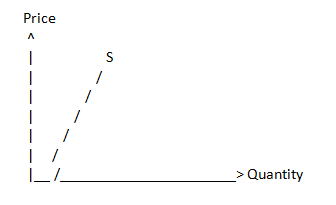
The supply curve slopes upward from left to right, showing a positive relationship between price and quantity supplied.
9. Distinguish between ‘change in supply’ and ‘change in quantity supplied’ of a commodity. (Use diagrams)
Answer –
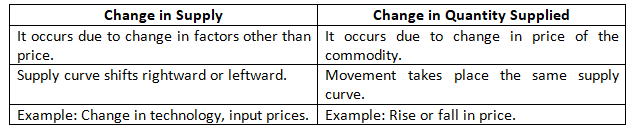
Change in Supply: Supply curve shifts from S to S₁.
Change in Quantity Supplied: Movement from one point to another on the same supply curve.
10. What is meant by ‘change in supply’? State three factors that can cause a ‘change in supply’.
Answer – Change in Supply: Change in supply refers to an increase or decrease in supply due to changes in factors other than the price of the commodity.
Factors causing change in supply:
- Change in prices of inputs.
- Change in technology.
- Change in number of sellers in the market.
11. Explain the effect of the following on the supply of a commodity: (a) Fall in the prices of factor inputs; (b) Rise in the prices of other commodities.
Answer –
(a) Fall in the prices of factor inputs: When the prices of factor inputs fall, the cost of production decreases. As a result, producers can supply more at the same price. Supply curve shifts to the right.
(b) Rise in the prices of other commodities: When the prices of other commodities increase, producers may shift resources towards their production. Hence, supply of the given commodity may decrease.
12. Explain the meaning of ‘increase in supply’ and ‘increase in quantity supplied’ with the help of a schedule.
Answer – Increase in Supply: It refers to a rise in supply due to factors other than the price of the commodity. It causes a rightward shift of the supply curve.
Increase in Quantity Supplied: It refers to a rise in quantity supplied due to an increase in the price of the commodity. It is shown by movement along the same supply curve.
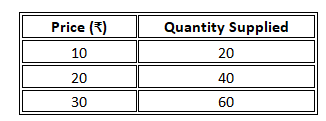
13. Distinguish between the increase in quantity supplied (expansion of supply) and an increase in supply. Use diagrams.
Answer –

14. Discuss the various points of difference between contraction and decrease in supply.
Answer –

15. State any three causes of a rightward shift of the supply curve.
Answer –
Three causes of rightward shift of supply curve are:
- Fall in prices of factor inputs.
- Improvement in technology.
- Increase in number of sellers.
16. State three causes of increase in supply.
Causes of increase in supply are:
- Decrease in cost of production.
- Improvement in production technology.
- Increase in prices of substitute goods.
17. Define ‘Market supply’. What is the effect on the supply of a good when the Government imposes a tax on the production of that good? Explain.
Answer:
Market Supply refers to the total quantity of a commodity that all the producers are willing and able to supply in the market at different prices during a given period of time.
Effect of Tax on Supply: When the Government imposes a tax on the production of a good, the cost of production increases. As a result, producers earn lower profits and are willing to supply a smaller quantity of the commodity at the same price.
18. Explain the effect of technical progress on the supply of a good.
Answer: Technical progress means the use of improved technology and better production methods. It increases the efficiency of production and reduces the cost per unit. As a result, producers can supply more quantity of the commodity at the same price.
19. Explain the effect of rise in the input prices on the supply of a good.
Answer: Inputs are the factors of production such as raw materials, labour and machinery. When the prices of inputs increase, the cost of production also rises. This reduces the profit of producers, so they are willing to supply less quantity of the commodity at the same price.
20. What is a supply schedule? What is the effect on the supply of a good when Government gives a subsidy on the production of that good? Explain.
Answer: A Supply Schedule is a table showing the different quantities of a commodity that a producer is willing to supply at different prices during a given period of time.
Effect of Subsidy on Supply: A subsidy is financial assistance given by the Government to producers. It reduces the cost of production and increases the profit of producers. As a result, producers supply more quantity of the commodity at the same price.
21. Explain the effect of the following on supply of a good: (i) Changes in prices of inputs; (ii) Technological advancement.
Answer:
(i) Changes in prices of inputs – Input prices and supply are inversely related. If the prices of inputs (raw materials, wages, etc.) increase, the cost of production rises and supply decreases. Conversely, if input prices fall, the cost of production decreases and supply increases.
(ii) Technological advancement – Improvement in technology increases production efficiency and reduces the cost of production. As a result, the supply of the good increases.
22. Briefly discuss the percentage method for measuring price elasticity of supply.
Answer: According to the percentage method, price elasticity of supply is measured by the percentage change in quantity supplied divided by the percentage change in price.
Es = % Change in Quantity Supplied / % Change in Price
If Es > 1 , supply is elastic; if Es < 1, supply is in elastic; and if Es = 1, supply is unitary elastic.
23. Distinguish between ‘Supply’ and ‘Quantity Supplied’.
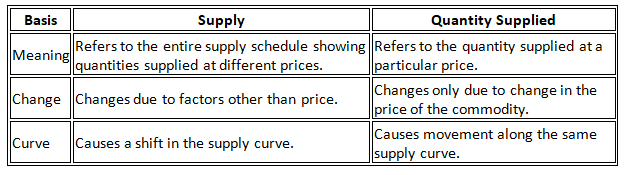
24. How does subsidy influence the supply of a good by a firm? Explain.
Answer: A subsidy reduces the cost of production. As a result, producers are encouraged to produce more. Therefore, the supply of the good increases, and the supply curve shifts to the right.
25. Explain how the following influences supply of a good: (i) Taxes on production; (ii) Changes in prices of other goods.
Answer:
(i) Taxes on production – Taxes increase the cost of production. As a result, producers supply less of the commodity. Hence, the supply decreases and the supply curve shifts to the left.
(ii) Changes in prices of other goods – If the price of another good rises, producers may shift their resources to produce that more profitable good. Consequently, the supply of the present good decreases. If the price of the other good falls, the supply of the present good increases.
26. Draw supply curves showing price elasticity of supply equal to: (i) Zero; (ii) one; and infinity throughout.
Answer –
(i) Perfectly Inelastic Supply (Es = 0)
- Supply remains fixed irrespective of changes in price.
- The supply curve is a vertical straight line parallel to the Y-axis.
(ii) Unitary Elastic Supply (Es = 1)
- Percentage change in quantity supplied is equal to the percentage change in price.
- The supply curve is a straight line passing through the origin.
(iii) Perfectly Elastic Supply (Es = ∞)
- Producers are willing to supply any quantity at a particular price.
- The supply curve is a horizontal straight line parallel to the X-axis.
27. Explain the concept of price elasticity of supply. When is the value of price elasticity of supply equal to one?
Answer – Price elasticity of supply refers to the degree of responsiveness of quantity supplied to a change in the price of the commodity.
Es = % Change in Quantity Supplied / % Change in Price
Price elasticity of supply is equal to one (Es = 1) when the percentage change in quantity supplied is exactly equal to the percentage change in price. It is known as Unitary Elastic Supply.
28. Define market supply. Explain the factor ‘input prices’ that can cause a change in supply.
Answer –
Market Supply: Market supply is the total quantity of a commodity supplied by all the firms in the market at a given price during a given period of time.
Effect of Input Prices: Input prices and supply are inversely related. When the prices of inputs increase, the cost of production rises, reducing supply. When input prices fall, the cost of production decreases, leading to an increase in supply.
29. Explain any four factors that affect the supply of a good.
Answer –
Any four factors affecting supply are:
- Prices of Inputs: Higher input prices increase the cost of production and reduce supply, whereas lower input prices increase supply.
- Technology: Improvement in technology reduces production cost and increases supply.
- Taxes and Subsidies: Taxes reduce supply by increasing production cost, whereas subsidies increase supply by reducing production cost.
- Prices of Other Goods: If the price of another good rises, producers may shift resources towards its production, reducing the supply of the present good.
Long Answer Type Questions
- Explain the concept of supply schedule & Supply curve with the help of a hypothetical schedule and diagram.
Answer – Supply refers to the quantity of a commodity that a producer is willing and able to sell at different prices during a given period of time.
Supply Schedule – A Supply Schedule is a tabular statement showing different quantities of a commodity supplied at different prices.
Hypothetical Supply Schedule
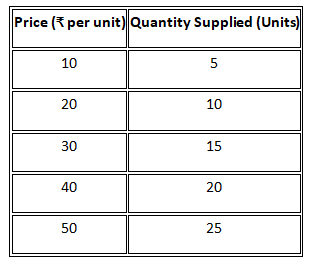
The schedule shows that as the price increases, the quantity supplied also increases.
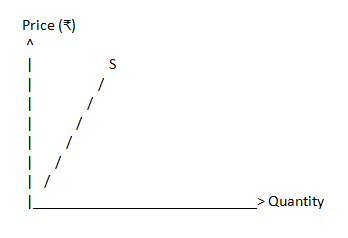
Supply Curve – A Supply Curve is the graphical representation of the supply schedule. It shows the relationship between price and quantity supplied.
2. Stat and explain law of supply with the help of a hypothetical schedule and diagram.
Answer:
Law of Supply – The Law of Supply states that other things remaining the same (ceteris paribus), the quantity supplied of a commodity increases with an increase in its price and decreases with a decrease in its price.
Assumption – The law operates under the assumption that other factors such as technology, input prices, taxes, and government policy remain constant.
Hypothetical Supply Schedule
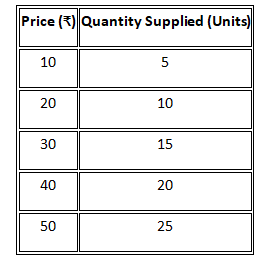
The table shows that as price rises from ₹10 to ₹50, quantity supplied increases from 5 units to 25 units.
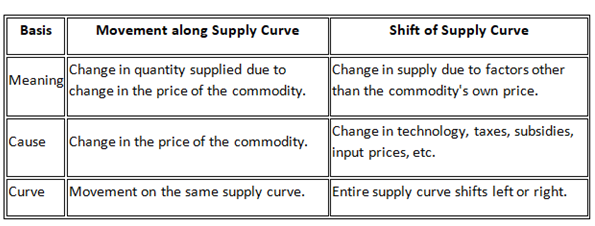
3. Explain the difference between “Shift of Supply Curve” and “Movement along Supply Curve”. State one factor responsible for each. Use diagrams.
Answer –
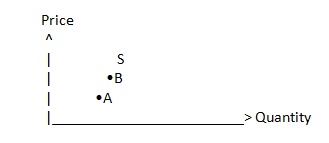
Movement along Supply Curve
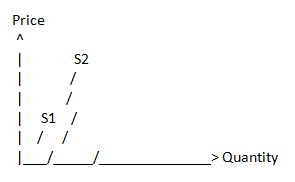
Shift of Supply Curve
One factor responsible
- Movement along Supply Curve: Change in the price of the commodity.
- Shift of Supply Curve: Technological improvement (or change in input prices, taxes, subsidies, etc.).
4. Define price elasticity of supply. Explain the percentage method for measuring price elasticity of supply.
Answer –
Price Elasticity of Supply – Price elasticity of supply measures the degree of responsiveness of quantity supplied to a change in the price of a commodity.
Percentage Method – According to the percentage method,
Es = % Change in Quantity Supplied / % Change in Price
Where,
- Es = Price Elasticity of Supply
Interpretation
- Es = 1 → Unitary Elastic Supply
- Es > 1 → Elastic Supply
- Es < 1 → Inelastic Supply
- Es = 0 → Perfectly Inelastic Supply
- Es = ∞ → Perfectly Elastic Supply
5. Explain any three factors causing a shift in the supply curve of a commodity.
Answer: A shift in the supply curve occurs due to changes in factors other than the price of the commodity.
(i) Prices of Inputs – If input prices (such as raw materials, wages, etc.) increase, the cost of production rises and supply decreases. If input prices fall, supply increases.
(ii) Technological Advancement – Improved technology increases production efficiency and reduces the cost of production. As a result, the supply of the commodity increases and the supply curve shifts to the right.
(iii) Taxes and Subsidies – Higher taxes increase the cost of production, reducing supply. On the other hand, subsidies reduce production cost and increase supply.
6. Discuss in brief the various kinds of price elasticity of supply.
Answer: Price Elasticity of Supply (Es)- Price Elasticity of Supply measures the degree of responsiveness of quantity supplied to a change in the price of a commodity.
The various kinds of price elasticity of supply are:
(i) Perfectly Inelastic Supply (Es = 0)
- Quantity supplied does not change even when the price changes.
- The supply curve is a vertical straight line.
(ii) Relatively Inelastic Supply (Es < 1)
- Percentage change in quantity supplied is less than the percentage change in price.
- Supply responds only slightly to changes in price.
(iii) Unitary Elastic Supply (Es = 1)
- Percentage change in quantity supplied is exactly equal to the percentage change in price.
- The supply curve is a straight line passing through the origin.
(iv) Relatively Elastic Supply (Es > 1)
- Percentage change in quantity supplied is greater than the percentage change in price.
- Supply responds more than proportionately to changes in price.
(v) Perfectly Elastic Supply (Es = ∞)
- Producers are willing to supply any quantity at a given price.
- The supply curve is a horizontal straight line.
7. Explain any three factors that determine the supply of a commodity.
Answer: The supply of a commodity is influenced by several factors. Three important factors are:’
(i) Prices of Inputs – Input prices directly affect the cost of production. A rise in input prices increases production cost and reduces supply. A fall in input prices lowers the cost of production and increases supply.
(ii) Technology – Improvement in technology increases productivity and reduces the cost of production. Therefore, producers are able to supply more output at the same price.
(iii) Taxes and Subsidies – Taxes increase the cost of production and reduce supply. On the other hand, subsidies lower production cost and encourage producers to supply more.
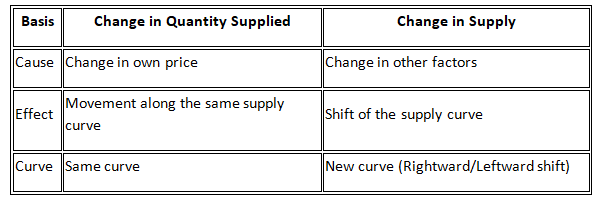
8. What is meant by change in supply and change in quantity supplied?
Answer: Although both terms are related to supply, they have different meanings.
Change in Quantity Supplied – It refers to an increase or decrease in the quantity supplied due to a change in the price of the commodity, while other factors remain constant. It is represented by a movement along the same supply curve.
Change in Supply – It refers to an increase or decrease in supply due to changes in factors other than the price of the commodity, such as technology, input prices, taxes or subsidies. It is represented by a shift of the supply curve.
9. Explain the effect of the following on market supply of a good: (i) Increase in input prices; (ii) Reduction in per unit tax.
Answer:
(i) Increase in Input Prices – An increase in input prices raises the cost of production. As production becomes more expensive, firms reduce their output. Therefore, market supply decreases and the market supply curve shifts to the left.
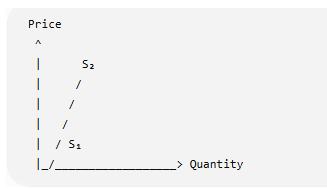
(ii) Reduction in Per Unit Tax – A reduction in per unit tax lowers the cost of production. Producers are encouraged to produce and sell more. Therefore, market supply increases and the market supply curve shifts to the right.
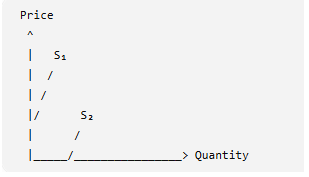
10. Examine the effect of: (a) Fall in the own price of good X, and (b) Rise in the tax rate on good X on the supply curve. Use diagrams.
Answer:
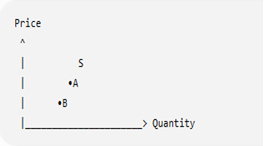
(a) Fall in the Own Price of Good X – A fall in the price of good X causes producers to supply a smaller quantity of the commodity. This results in a movement downward along the same supply curve (contraction in quantity supplied). The supply curve does not shift.
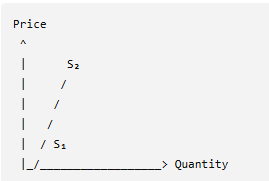
(b) Rise in the Tax Rate on Good X – An increase in the tax rate raises the cost of production. As a result, producers reduce the quantity supplied at every price.
Unsolved Practical’s
Practical’s on Supply Schedule and Supply Function
- There are 3 firms A, B and C is the market. Their individual supply schedules are given below. Prepare the market supply schedule.

Solution –

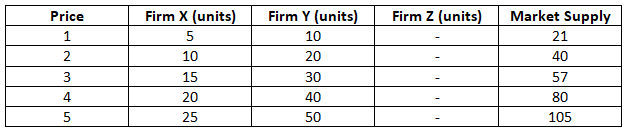
2. There are three firms X, Y and Z in the market. The supply schedule for the market and that for firms X and Y is given below. Prepare the supply schedule for firm Z.
Solution –
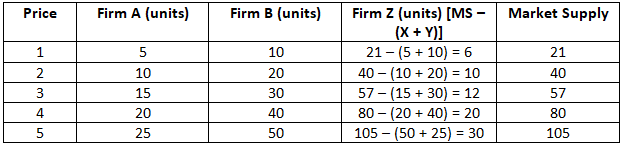
3. From the following supply function: Qs = -20 + 4p, answer the following questions: (i) Calculate supply at price of Rs.10; (ii) At what price, supply will be 0; (iii) Calculate price at which supply will be 60 units.
Solution –
Practical’s on Elasticity of Supply Calculation of Elasticity of Supply
4. Price of a commodity increase by Rs.4 per unit and due to this, its supply increases from 60 units to 90 units.
Solution –
Given –
ΔP = Rs.4
Q = 60 units
Q1 = 90 units
P = Rs.6
To find: ES
ES = ΔQ / ΔP X P/Q
= 30/4 X 6/60
= 0.75
5. When market price of a commodity is Rs.4 per unit, a seller is willing to sell 50 units of the commodity. As the price rises to Rs.5 per unit, he is willing to sell 60 units. Calculate the seller’s elasticity of supply.
Solution –
Given –
P = Rs.4
Q = 50 units
Q1 = 60 units
To find: ES
ES = ΔQ / ΔP X P/Q
= 10/1 X 4/50
= 0.8
6. Calculation the elasticity of supply, when price rises from Rs.2 per unit to 3 per unit and supply rises from 20 units to 30 units.
Solution –
Given –
P = Rs.2
Q = 20 units
Q1 = 30 units
P1 = Rs.3
To find: ES
ES = ΔQ / ΔP X P/Q
= 10/1 X 2/20
= 1
Calculation of Elasticity of Supply by Percentage Method
7. As a result of 20% rise in the price of a commodity, its supply increases by 30%. Calculate the elasticity of supply.
Solution –
Given –
Percentage change in price = 20%
Percentage change in supply = 30%
To find ES
ES = Percentage change in supply / Percentage change price
= 30 / 20
= 1.5
8. When price of a commodity increases by 10%, its supply decreases from 80 units to 60 units. Calculate the elastic of supply.
Solution –
Given –
Percentage change in price = 10%
Q = 80 units
Q1 = 60 units
To find: ES
ES = Percentage change in supply / Percentage change in price
Percentage change in supply = ΔQ / Q x 100
= 20 / 80 x 100
= 25%
ES = 25/10
= 2.5
9. Quantity supplied of a commodity increases by 25% when its price rises from Rs.4 per unit to Rs.5 per unit. Calculate the elastic of supply.
Solution –
Given –
Percentage change in supply = 25%
P = Rs.4
P1 = Rs.5
To find: ES
ES = Percentage change in supply / Percentage change in price
Percentage change in Price = ΔP / P x 100
= 1/4 x 100
= 25%
ES = 25/25
= 1
10. The price of a commodity rises from Rs.10 per unit to Rs.15 per unit, as a result of which its supply increases by 30%. Calculate the elasticity of supply.
Solution –
Given –
P = Rs.10
P1 = Rs.15
Percentage change in Supply = 30%
To find: ES
ES = Percentage change in supply / Percentage change in Price
Percentage change in Price = ΔP /P x 100
= 5/10 x 100
= 50%
ES = 30/50
= 0.6
11. At a price of Rs.10 per unit, the quantity supplied of a commodity is 400 units. If its price rises to Rs.12 per unit and the quantity supplied rises by 10 per cent, calculate its price elasticity of supply.
Solution –
Given –
P = Rs.10
P1 = Rs.12
Q = 400 units
Percentage change in Supply = 10%
To find: ES
ES = Percentage change in supply / Percentage change in Price
Percentage change in Price = ΔP /P x 100
= 2/10 x 100
= 20%
ES = 10/20
= 0.5
12. At a price of Rs.6 per unit, the quantity supplied of a commodity is 200 units. If price rises by Rs.3 per unit, the quantity supplied rises by 20%. Calculate the price elasticity of supply.
Solution –
Given –
P = Rs.6
Q = 200
ΔP = Rs.3
Percentage change in supply = 20%
To find: ES
ES = Percentage change in supply / Percentage change in Price
Percentage change in Price = ΔP /P x 100
= 3/6 x 100
= 50%
ES = 20/50
= 0.4
13. At a price of Rs.10 per unit, the supply of a product is 500 units. When its price falls by 20 per cent, its supply is 350 units. Calculate its price elasticity of supply. Is its supply elastic?
Solution –
Given –
P = Rs.10
Q = 500 units
Q1 = 350 units
Percentage change in Price = 20%
To find: ES
ES = Percentage change in supply / Percentage change in Price
Percentage change in Price = ΔP /P x 100
= 150/500 x 100
= 30%
ES = 30/20
= 1.5
Yes supply is elastic as it is more than 1.
14. At a price of Rs.40 per unit, the quantity supplied of a commodity is 400 units. When its price falls by 10 per cent, its quantity supplied falls by 36 units. Calculate its elasticity of supply. Is its supply elastic?
Solution –
Given –
P = Rs.40
Q = 400 units
ΔQ = 36 units
Percentage change in Price = 10%
To find: ES
ES = Percentage change in supply / Percentage change in Price
Percentage change in Price = ΔP /P x 100
= 36/400 x 100
= 9%
ES = 9/10
= 0.9
No, supply is elastic as it is less than 1.
15. The price elasticity of supply of commodity X is 1/2 of price elasticity of supply of commodity Y. When price of X falls by 50%, its supply falls by 20 units. Calculate price elasticity of supply of commodity X and Y if 100 units of X were supplied at price of Rs.4 per unit.
Solution –
Given –
ES of X = 1/2 (ES of Y)
Percentage change in price of x = 50%
ΔQ of X = 20 units
Q of X = 100 units
P of X = Rs.4
To find: ES of X
ES of Y
ES = Percentage change in supply / Percentage change in Price
Percentage change in Price = ΔQ /Q x 100
= 20/100 x 100
= 20%
ES = 20/50
= 0.4
Now ,
2 ( ES of X) = ES of Y
2 x 0.4 = ES of Y
0.8 = ES of Y
Calculation of Price or Quantity
16. The coefficient of elasticity of supply of a commodity is 3. A seller supplies 20 units of units of this commodity at a price of Rs.8 per unit. How much quantity of this commodity will the seller supply when the price rises by Rs.2 per unit?
Solution –
Given –
ES = 3
Q = 20 units
P = Rs.8
ΔP = Rs.2
To find: Q1
ES = ΔQ / ΔP x P/Q
3 = ΔQ / 2 x 8 / 20
ΔQ = 15 units
Now,
ΔQ = Q1 – Q
15 = Q1 – 20
35 unit = Q1
17. The coefficient of elasticity of supply of commodity X is 2. What quantity of the commodity will a seller supply at a price of Rs.6 per unit, if he supplies 100 units at the price of Rs.5 per unit?
Solution –
Given –
ES = 2
P1 = Rs.6
Q = 100 units
P = Rs.5
To find: Q1
ES = ΔQ / ΔP x P/Q
2 = ΔQ / 1 x 5 / 100
ΔQ = 40 units
Now,
ΔQ = Q1 – Q
40 = Q1 – 100
140 unit = Q1
18. The coefficient of elasticity of supply of a commodity is 2. At Rs.4 per unit, supply is 100 units. How much quantity will be supplied, if the price decreases to Rs.2 per unit?
Solution –
ES = 2
P1 = Rs.4
Q = 100 units
P = Rs.2
To find: Q1
ES = ΔQ / ΔP x P/Q
2 = ΔQ / -2 x 4 / 100
ΔQ = -100 units
Now,
ΔQ = Q1 – Q
-100 = Q1 – 100
0 unit = Q1
19. Price elasticity of supply for a product is ‘Unity’. A firm supplies 25 units of this product at a price of Rs.5 per unit. If the price of a product rises to Rs.6 per unit, how much quantity of the product will be supplied by the firm?
Solution –
Given –
ES = Rs.5
Q = 25 units
P1 = Rs.6
To find: Q1
ES = ΔQ / ΔP x P/Q
2 = ΔQ / 1 x 25/ 125
ΔQ = 5 units
Now,
ΔQ = Q1 – Q
5 = Q1 – 25
30 unit = Q1
20. The elasticity of supply of a commodity is 3. An increase in its price from Rs.20 to Rs.21 per unit results in a rise in its quantity supplied by 150 units. Calculate the quantity supplied at the increased price.
Solution –
Given –
ES = 3
P = Rs.20
ΔQ = 150 units
P1 = Rs.21
To find: Q1
ES = ΔQ / ΔP x P/Q
3 =150 / 1 x 20/Q
Q = 1000 units
Now,
ΔQ = Q1 – Q
150 = Q1 – 1000
1150 unit = Q1
21. The coefficient of elasticity of supply of a commodity is 1. Its supply is 500 units at a price of Rs.10 per unit. What will the supply of this commodity by when its price falls to Rs.8 per unit?
Solution –
Given-
ES = 1
P = Rs.10
Q = 500 units
P1 = Rs.8
To find: Q1
ES = ΔQ / ΔP x P/Q
1 = ΔQ / -2 x 10/500
Q = -100 units
Now,
ΔQ = Q1 – Q
-100 = Q1 – 500
400 unit = Q1
22. The supply curve of commodity ‘A’ is a straight line parallel to Y-axis. If its supply is 20 units at the price of Rs.10 per unit, then what will be its supply when price rises by Rs.2 per unit?
Solution –
Given-
ES = 0
P = Rs.10
Q = 20 units
ΔP = Rs.2
To find: Q1
ES = ΔQ / ΔP x P/Q
1 = ΔQ / 2 x 10/20
ΔQ = 0
Now,
ΔQ = Q1 – Q
0 = Q1 – 20
20 unit = Q1
Supply of commodity A will remain fixed at 20 units as its supply is perfectly inelastic.
23. The price elasticity of supply of a good is 2. If the percentage change in its price is 5%, find the percentage change in its quantity supplied.
Solution –
Given –
ES = 2
Percentage change in price = 5%
To find: Percentage change in quantity supplied
ES = Percentage change in quantity supplied/Percentage change in price
2 x 5 = Percentage change in quantity supplied
10% = percentage change in quantity supplied
24. The price elasticity of supply of a commodity is 0.5. The percentage change in quantity supplied is 4%. What is the percentage change in price?
Solution –
Given –
ES = 0.5
Percentage change in quantity supplied = 5%
To find: Percentage change in price
ES = Percentage change in quantity supplied / Percentage change in price
Percentage change in price 4 / 0.5
Percentage change in price = 8%
25. The price elasticity of supply of commodity X is twice the price elasticity of supply of commodity Y. if price of X falls by 10% and that of Y falls by 20%, calculate percentage fall in supply of commodity X and Y, if commodity Y has unitary elastic supply.
Solution –
Given –
ES of X = 2 (ES of Y)
Percentage fall in price of X = 10%
Percentage fall in price of Y = 20%
ES of Y = 1
ES of Y = percentage change in supply of Y / Percentage change in price of Y
20% = Percentage fall in supply of Y
ES of X = percentage change in supply of X / Percentage change in price of X
2 x 10 = Percentage change in supply
20% = Percentage fall in supply of X
26. The price of Dairy Milk chocolate rises by 20% and that of Nestle Bar falls by 6%. As a result, supply of Dairy Milk rises from 20,000 to 30,000 units. Calculate the percentage fall in supply of Nestle Bar if both the chocolates have equal price elasticity of supply.
Solution –
Given –
Percentage change in price of Dairy Milk chocolate = 20%
Percentage change in price of Amul Bar = -6%
Q of Dairy Milk = 20,000
Q1 of Dairy Milk = 30,000
ES of Dairy Milk = ES of Amul Bar
To find: Percentage fall in supply in Amul
ES of Dairy Milk = Percentage change in supply of Dairy Milk / Percentage change in price of Dairy Milk
= 50 / 20
= 2.5
Now: ES of Dairy Milk = ES of Amul Bar
27. The price of a commodity rises by 20%, which leads to an increase in supply by 20 units. If price elasticity is 2, calculate the initial and final supply of the commodity.
Solution –
Given –
Percentage change in price = 20%
ΔQ = 20 units
ES = 2
To find: Q and Q1
ES = Percentage change in supply / Percentage change in price
2 = Percentage change in supply / 20
40% = Percentage change in supply
Also:
Percentage change in supply = ΔQ / Q x 100
40 = 20/Q x 100
Q = 20/40 x100
Q = 50 units
ΔQ = Q1 – Q
20 = Q1 – 50
70 units = Q1
28. If the ratio of change in quantity (ΔQ) to original quantity (Q) is 0.4 and elasticity of supply is 1.25, calculate the percentage change in price.
Solution –
Given –
ΔQ / Q = 0.4
ES = 1.25
To find: Percentage change in Price
ES = Percentage change in supply / Percentage change in price
1.25 = 40 / Percentage change in price
Percentage change in price = 32%
29. The price elasticity of supply of commodity Y is half the price elasticity of supply of commodity X. 16 per cent rise in the price X results in a 40 per cent rise in its supply. If the price of Y falls by 8 per cent, calculate the percentage fall in its supply.
Solution –
Given –
ES of Y = 1/2 (ES of X)
Percentage change in supply of X = 40%
Percentage change in price of X = 16%
Percentage change in Price of Y = -8%
To find: Percentage fall in supply of Y
ES of X = Percentage change in supply/ Percentage change in price
= 40 / 16
= 2.5
ES of Y = 1/2 (ES of X)
= 1/2 x 2.5
= 1.25
Now,
ES of Y = Percentage change in supply / Percentage change in price
1.25 = Percentage change in supply / -8
-10% = Percentage change in supply
i.e. Percentage fall in supply = 10%
Calculation of Price Elasticity so of Supply
30. A firm received Rs.2,000, when price of the commodity was Rs.40 per unit. The revenue increased to Rs.3,000 when price increased to Rs.50 per unit. Calculate the price elasticity of supply.
Solution –
Given –
TR = Rs.2,000
P = Rs.40
TR1 = Rs.3,000
P1 = Rs.50
To find: ES
TR = P X Q
2,000 / 40 = Q
50 units = Q
TR1 = P1 x Q1
3,000 / 50 = Q1
60 units = Q1
ES = ΔQ / ΔP X P / Q
= 10/10 x 40/50
= 0.8
31. The receipts of firm are Rs.6,000 when the price of a good is Rs.100 per unit. When price increases to Rs.120 per unit, the receipts increase to Rs.7,800. What is the price elasticity of supply?
Solution –
Given –
TR = Rs.6,000
P = Rs.100
TR1 = Rs.7,800
P1 = Rs.120
To find: ES
TR = P X Q
6,000 / 100 = Q
60 units = Q
TR1 = P1 x Q1
7,800 / 120 = Q1
65 units = Q1
Now,
ES = ΔQ / ΔP X P / Q
= 5/20 x 100/60
= 0.41
32. Total revenue is Rs.400 when the price of the commodity is Rs.2 per unit. When price rises to Rs.3 per unit, the quantity supplied is 300 units. Calculate the price elasticity of supply.
Solution –
Given –
TR = Rs.400
P = Rs.2
Q1 = 300 units
P1 = Rs.3
To find: ES
TR = P X Q
400 / 2 = Q
200 units = Q
Now,
ES = ΔQ / ΔP X P / Q
= 100/1 x 2/200
= 1
33. The total receipts of a firm get doubled due to a 20% rise in price of commodity X. If the original supply was 30 units at a price of 100, calculate price elasticity of supply. Also, calculate quantity at the increased price.
Solution –
Given –
Q = 30 units
P = Rs.100
2 TR = TR1
Percentage rise in price = 20%
To find: ES and Q1
TR = P X Q
= 100 x30
= Rs.3,000
TR1 = 2TR
= 2 x 3,000
= Rs.6,000
Now,
P1 = P + 20/100 P
= 100 + 20
= Rs.120
TR1 = P1 x Q1
6,000 / 120 = Q1
50 units = Q1
Now,
ES = ΔQ / ΔP X P/Q
= 20/20 X 100/30
= 3.33
Miscellaneous Pracitcal’s
34. The price of a commodity is Rs.10 per unit and the total revenue from it is Rs.1,000. Its price elasticity of supply is 0.8. Its price falls by 10 per cent. Calculate the total revenue at the reduced price.
Solution –
Given –
P = Rs.10
TR = Rs.1,000
Es= 0.8
Percentage rise in price = 10%
To find: TR1
TR = P X Q
1,000 / 10 = Q
100 units = Q
Es= Percentage change in supply / Percentage change in price
0.8 = Percentage change in supply / 10
8% = Percentage fall in supply
So,
Q1 = Q – 8/100 Q
= 100 – 8
= 92 units
P1 = P – 10/100 P
= Rs.9
TR1 = P1 × Q1
= 9 x 92
= Rs.828
35. When the price of a commodity rises by 10 percent, its supply rises by 40 units. Its elasticity of supply is 1. Calculate its supply at the original price.
Solution –
Given –
Percentage rise in price = 10%
ΔQ = 40 units
Es= 1
To find: Q
Es= Percentage change in supply / Percentage change in price
1 = Percentage change in supply / 10
10% = Percentage fall in supply
Also,
Percentage change in supply = ΔQ / Q x 100
10 = ΔQ/Q x 100
Q = 400 units
36. When the price of a commodity falls from Rs.10 per unit to Rs.9 per unit, total revenue from it falls from Rs.1,200 to Rs.918. calculate its elasticity of supply.
Solution –
Given –
P = Rs.10
P1 = Rs.9
TR = Rs.1,200
TR1 = Rs.918
To find: Es
TR = P x Q
1,200 / 10 = Q
120 units = Q
TR1 = P1 x Q1
918/9 = Q1
102 units = Q1
Now,
Es = ΔQ / ΔP x P / Q
= -18 / -1 x 10/120
= 1.5
37. A firm sells 1,000 units of a product a price of Rs.10 per unit. It price elasticity of supply is 3. How many units will the firm be able to sell if price falls to Rs.7.50 per unit?
Solution –
Given –
Q = 1,000 units
P = Rs.10
Es = 3
P1 = Rs.7.50
To find: Q1
Es = ΔQ / ΔP x P / Q
3 = ΔQ /-2.5 x 10 / 1000
-750 units = ΔQ
Now:
ΔQ = Q1 – Q
-750 + 1,000 = Q1
250 units = Q1
38. When the price of a commodity rises from Rs.10 to Rs.11 per unit, its quantity supplied increases by 100 units. Its price elasticity of supply is 2. Calculate the quantity supplied at the increased price.
Solution –
Given –
P = Rs.10
P1 = Rs.11
ΔQ = 100 units
Es = 2
To find: Q1
Es = ΔQ / ΔP x P / Q
2 = 100 /1 x 10 / Q
500 units = Q
Now:
ΔQ = Q1 – Q
100 + 500 = Q1j
600 units = Q1
39. A firm supplies 500 units of a good at a price of Rs.5 per unit. The price elasticity of supply of the good is 2. At what price will the firm supply 700 units?
Solution –
Given –
Q = 500 units
P= Rs.5
ES = 2
Q1 = 700 units
To find: P1
Es = ΔQ / ΔP x P / Q
2 = 200 / ΔP x 5 / 500
ΔP = Rs.1
Now:
ΔP = P1 – P
1 + 5 = P1
P1 = Rs.6
40. A producer supplies 200 units of a good at Rs.10 per unit. Price elasticity of supply is 2. How many will the producer supply at Rs.11?
Solution –
Given –
Q = 200 units
P = 10
ES = 2
P1 = Rs.11
To find: Q1
Es = ΔQ / ΔP x P / Q
2 = ΔQ / 1 x 10 / 200
ΔQ = 40 untis
Now:
ΔQ = Q1 – Q
40 + 200 = Q1
Q1 = 240 units
41. When the price of a good rises from Rs.20 per unit to Rs.30 per unit, the revenue of the firm producing this good rises from Rs.100 to Rs.300, Calculate the price elasticity of supply.
Solution –
Given –
P = Rs.20
P1 = Rs.30
TR = RS.100
TR1 = Rs.300
To find: ES
TR = P X Q
100/20 = Q
5 units = Q
TR1 = P1 X Q1
300/30 = Q1
10 units = Q1
ES = ΔQ/ΔP X P/Q
= 5/10 X 20/5
= 2
42. A firm’s revenue rises from Rs.400 to Rs.500 when the price of its product rises from Rs.20 per unit to Rs.25 per unit. Calculate the price elasticity of supply.
Solution –
Given –
TR = Rs.400
TR1 = Rs.500
P = Rs.20
P1 = Rs.25
To find: ES
TR = P X Q
400/20 = Q
20 units = Q
TR1 = P1 x Q1
500/25 = Q1
20 units = Q1
ES = ΔQ/ΔP X P/Q
= 0/5 X 20/20
= 0
43. The price elasticity of supply of a good is 0.8. Its price rises by 50 per cent. Calculate the percentage increases in its supply.
Solution –
ES = 0.8
Percentage rise in price = 50%
To find: Percentage increase in its supply
ES = Percentage change in supply / Percentage change in price
0.8 = Percentage change in supply / 10
40% = Percentage fall in supply
44. A frim supplies 10 units of a good at a price of Rs.5 per unit. Price elasticity of supply is 1.25. What quantity will the firm supply at a price of Rs.7 per unit?
Solution –
Given –
Q = 10 units
P = Rs.5
ES = 1.25
P1 = Rs.7
To find: Q1
ES = ΔQ/ΔP X P/Q
1.25 = ΔQ/2 x 5/10
ΔQ = 5 units
ΔQ = Q1 – Q
5 + 10 = Q1
15 units = Q1
45. The price elasticity of supply of a commodity is 2. A firm supplies 200 units of 8 per unit. At what price will it supply 250 units?
Solution –
Given –
ES = 2
Q = 200 units
P = 8
Q1 = 250 units
To find P1
ES = ΔQ/ΔP X P/Q
= 50/ΔP X 8/200
ΔP = Rs.1
Now,
ΔP = P1 – P
1 + 8 = P1
Rs.9 = P1
46. A 15 per cent rise in the price of a commodity raises its supply from 300 units to 345 units. Calculate its price elasticity of supply.
Solution –
Given –
Percentage change in price = 15%
Q = 300 units
Q1 = 345 units
To find: ES
Percentage change in supply = ΔQ / Q x 100
= 45/300 x 100
= 15%
ES = Percentage change in supply / Percentage change in price
= 15 / 15
= 1
47. Price elasticity of supply for a commodity is 5. When price of the commodity rises from Rs.9 per unit to Rs.10 per unit, supply rises by 25 units. Calculate the quantity supplied at Rs.9 per unit.
Solution –
Given –
ES = 5
P = Rs.9
P1 = Rs.10
ΔQ = 25 units
To find: Q
ES = ΔQ/ΔP X P/Q
5 = 25/1 x 9/Q
Q = 45 units
48. At a price of Rs.10 per unit, the supply of a good is 80 units. When its price rises to Rs.12 per unit, its supply rises by 20 per cent. Calculate price elasticity of supply.
Solution –
Given –
P = Rs.10
P1 = Rs.12
Q = 80 units
Percentage change in supply = 20%
To find: ES
Percentage change in supply = ΔP / P x 100
= 2 / 10 x 100
= 20%
ES = Percentage change in supply / Percentage change in price
= 20 / 20
= 1
49. 10 per cent increase in the price of a good raises its supply from 150 units to 180 units. Calculate its price elasticity of supply.
Solution –
Given –
Percentage change in price = 10%
Q = 150 units
Q1 = 180 units
To find ES
Percentage change in supply = ΔQ / Q x 100
= 30 / 150 x 100
= 20%
ES = Percentage change in supply / Percentage change in price
= 20 / 10
= 2
50. Supply of a good rises from 200 units to 240 units as a result of 20 percent rises in its price. Calculate its price elasticity of supply.
Solution –
Given –
Q = 200 units
Q1 = 240 units
Percentage change in price = 20%
To find: ES
Percentage change in supply = ΔQ / Q x 100
= 40 / 200 x100
= 20%
ES = Percentage change in supply / Percentage change in price
= 20 / 20
= 1
51. When the price of a commodity rises from Rs.5 to 6 per unit, total revenue increases from Rs.1,000 to Rs.1,200. Calculate its price elasticity of supply.
Solution –
Given –
P = Rs.5
P1 = Rs.6
TR = Rs.1000
TR1 = Rs.1,200
To find: ES
ES = ΔQ / ΔP X P/ Q
5 = 0 / 1 X 5 / 200
= 0
52. From the following data, calculate price elasticity of supply:

Solution –

ES = ΔQ / ΔP X P/ Q
5 = 25/2 x 8/125
= 0.8
53. A producer supplies 80 units of a good at a price of Rs.10 per unit. Price elasticity of supply is 4. How much will he supply at Rs.9 per unit?
Solution –
ES = ΔQ / ΔP X P/ Q
4 = ΔQ / -1 X 10/ 80
ΔQ = -32
ΔQ = Q1 – Q
-32 + 80 = Q1
Q1 = 48 units
54. When the price of a commodity falls from Rs.12 per unit to Rs.9 per unit, the producer supplies 75 per cent less output. Calculate price elasticity of supply.
Solution –
Given –
P = Rs.12
P1 = Rs.9
Percentage change in supply = -75%
To find: ES
Percentage change in price = ΔP / P x 100
= -3 / 12 x 100
= -25%
ES = Percentage change in supply / Percentage change in price
= – 75/ -25
= 3
55. When the price of a good falls from Rs.20 to Rs.10 per unit, the producer reduces supply from 100 units to 50 units. Calculate the price elasticity of supply.
Solution –
Given –
P = Rs.20
P1 = Rs.10
Q = 100 units
Q1 = 50 units
To find: ES
ES = ΔQ / ΔP X P/ Q
= -50 / -10 x 20 / 100
= 1