indian economy 1950 to 1990 notes
Indian economy sandeep garg notes pdf
chapter 3 indian economy 1950 to 1990
Central Problems of an Economy
The three major central problems of an economy are:
- What to Produce: It involves deciding the final combination of goods and services to be produced, i.e., it involves selection of goods and services and the quantity of each, that the economy should produce.
- How to Produce: It involves deciding the technique of production, i.e. whether selected goods should be produced with more labour and less capital (known as Labour Intensive Technique) or with more capital and less labour (known as Capital Intensive Technique).
- For whom to produce: It involves deciding the distribution of output among people, i.e., it involves selection of the category of people who will ultimately consume the goods.
Types of Economic Systems
Economic Systems are generally of 3 different types:
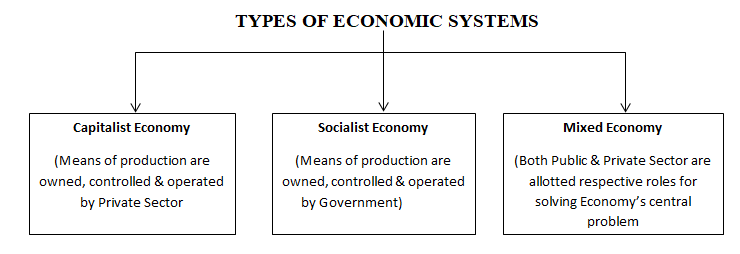
- Capitalist Economy: A capitalist economy is the one in which the means of production are owned, controlled and operated by the private sector. Production is done mainly to earn profits. So, the central problems are solved through the market forces of demand and supply.
- Socialist Economy: A socialist economy is the one in which the means of production are owned, controlled and operated by the government.
- Mixed Economy: A mixed economic system refers to a system in which the public sector and the private sector are allotted their respective roles for solving the central problems of the economy.
Economic Planning
After adopting the ‘Mixed Economic System’, the next important step for the Government was to revive the poor, backward and stagnant economy, inherited from the British rule.
- For the development of Indian economy, it was necessary for the Government to ‘plan’ for the economy, known as Economic Planning.
- Economic planning can be defined as making major economic decisions (what, how and for whom to produce) by the conscious decision of a determinate authority, on the basis of a comprehensive survey of the economy as a whole.
- The Industrial Policy Resolution of 1948 and the Directive Principles of the Indian Constitution assigned a leading role to the public sector. Private sector was also encouraged to participate in the plan’s efforts.
- The Planning Commission fixed the planning period at five years, which began the era of ‘five year plans’.
Goals of Five Year Plans
The five year plans have been concerned with the removal of economic backwardness of the country and making India a developed economy.
These basic Goals are:
Growth
Modernization
Self – reliance
Equity
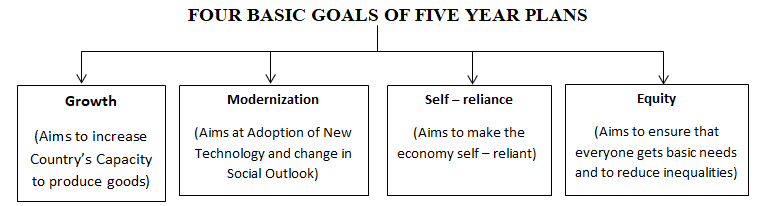
- Growth – The stagnation during the British rule forced the planners to make Economic Growth as the first and foremost objective of Indian plans.
(i) Growth refers to and increase in the country’s capacity to produce the output of goods and services within the country.
- Either a large stock of productive capital;
- Or a larger size of supporting like transport and banking;
- Or an increase in the efficiency of productive capital and services.
(ii) A good indicator of economic growth, in the language of economics, is steady increase in the Gross Domestic Product (GDP).
2. Modernization- Indian planners have always recognized the need for modernization of society to raise the standard of living of people. Modernization includes:
- Adoption of New Technology: Modernization aims to increase the production of goods and services through the use of new technology. For example – a farmer can increase the output on the farm by using new seed varieties instead of using the old ones.
- Change in social outlook: Modernization also requires a change in social outlook, such as gender empowerment or providing equal rights to women.
3. Self – reliance – The third major objective is to make to economy self-reliant.
To promote economic growth and modernization, the five year plans stressed on the use of won resources, in order to reduce our dependence on foreign countries.
- To reduce foreign dependence
- To avoid Foreign Interference
class 12 sandeep garg economics notes
Features (or problems) of Agriculture
Following were some of the main features (or Problems) of Indian agricultural sector between 1950 and 1990:
- Low Productivity:- Indian agricultural sector was known for its low productivity. Lack of knowledge was responsible for stagnation in this sector.
- Disguised Unemployment:- It refers to a state in which more people are engaged in work than are really needed. There were very high incidents of disguised unemployment in the sector during 1950 and 1990.
- High dependency on Rainfall:- Due to poor agricultural techniques, farmers depended largely on rainfall. There was minimum growth of this sector in the year that receives the least rainfall.
- Subsistence Farming:- It is the practice of growing crops only for one’s own use without any surplus for trade. There were also very high incidents of subsistence farming.
- Outdated Technology:- There were many obsolete technologies and harvesting machines. Harvesting was generally done manually and was very tedious.
class 12 economics chapter 2 indian economy 1950 to 1990 notes
class 12 indian economic development chapter 2 short notes
Policies for Growth of Agriculture
The measures undertaken to promote the growth in the agricultural sector can be broadly categorized as ‘Land Reforms’ and ‘Green Revolution’.
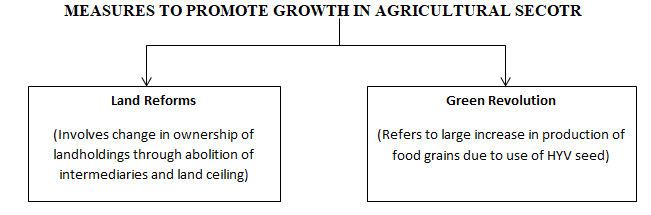
- Land Reforms – Land Reforms primarily refer to change in the ownership of landholdings. Land reform measures have been introduced by various underdeveloped and developed and developing countries, for attaining ad rational land distribution pattern and viable farming structure.
- Abolition of Intermediaries – Indian Government took various steps to abolish intermediaries and to make tillers, the owners of land. Aim behind ‘Lnad to the Tiller’ the idea behind this step was that step was that ownership of land would give incentives too the actual tillers to make improvements and to increase output. The abolition of intermediaries brought 200 lakh tenants into direct contact with the government. The ownership rights granted to tenants gave them the incentive to increase output and this contributed to growth in agriculture.
- Land Ceiling – Land Ceiling refers to fixing the specified limit of land, which could be owned by and individual. Beyond the specified limit, all lands belonging to particulars person would be taken over by the Government and will be allotted to the landless cultivators and small farmers. The purpose of land ceiling was to reduce the concentration of land ownership in a few hands.
2. Green Revolution – At the time of independence, about 75% of the country’s population depended on agriculture. India’s agriculture vitally depends on the monsoon and in case of shortage of monsoon, the farmers had to face lot of troubles. Green Revaluation refers to the large increase in production of food grains due to use of High Yielding Variety (HYV) or miracle seeds especially for wheat and rice.
HYV Seeds: Main Reason for Agricultural Revolution
- Theses seeds can be used in those places where there are adequate facilities for drainage and water supply.
- As compared to other ordinary seeds, these seeds need heavy doses of chemical fertilizers (4 to 10 times more fertilizers) to get the largest possible production.
- So, to derive benefit from HYV seeds, Indian farmers need to have:
i. Reliable irrigation facilities; and
ii. Financial resources (to purchase fertilizers and pesticides).
Indian Economy experienced the success of Green Revolution in 2 phases:
- In the first phase – (Mid 60s to Mid 70s), the use of HYV seeds was restricted to more affluent states (like Punjab, Andhra Pradesh, Tamil Nadu, etc.). Further, the use of HYV seeds primarily benefited the wheat growing regions only.
- In the second phase – (Mid 70s to Mid 80s), HYV technology spread to a larger number of states and benefited a wider variety of crops.
Important Effects of Green Revolution (or Merits of Green Revolution)
- Attaining Marketable Surplus – Green Revolution resulted in ‘Marketable Surplus’. Marketable or Marketed surplus refers to that part of agricultural produce which is sold in the market by the farmers after meeting their own consumption requirement.
- Buffer Stock of Food Grains – The green revolution enabled the government to procure sufficient amount of food grains to build a stock which could be used in times of food shortage.
- Benefit to low-income groups – As a large proportion of food grains were sold by farmers in the market, their prices declined relative to other items of consumption.
indian economy 1950 to 1990 class 12 sandeep garg
Risks involved Under Green Revolution (or Demerits of Green Revolution)
- Risk of Pest Attack – The HYV crops were more prone to attack by pests. So, there was a risk that small farmers who adopted this technology could lose everything in a pest attack.
- Risk of Increase in Income Inequalities – There was a risk that costly inputs (HYV seeds, fertilizers, etc.) required under green revolution will increase the disparities between small and big farmers since only the big farmers could afford the required inputs.
Debate over Subsidies to Agriculture
Subsidy, in the context of agriculture, means that the farmers get inputs at prices lower than the market prices. In other words, Subsidy is the financial assistance provided by the government to producers to fulfill their social welfare objectives.
Economists in Favour of Subsidies
- The government should continue with agricultural subsidies as farming in India continues to be a risky business.
- Majority of the farmers are very poor and they will not be able to afford the required inputs without the subsidies.
- Eliminating subsidies will increase the income inequality between rich and poor farmers and violate the ultimate goal of equity.
Economists Against the Subsidies
- Benefit to fertilizer industries and prosperous farmers – Subsidies do not benefit the poor and small farmers (target group) as benefits of substantial amount of subsidy go to fertilizer industries and prosperous farmers.
- Fiscal Burden – Economists argue that subsidies are a huge burden on government’s finances.
Some Important Observation
- Prices as Signals – Prices act as signals about the availability of goods. When a good becomes scarce, its price tends to rise and those who use this good are required to make efficient decisions about its use based on the price. For example – with the outspread of coronavirus, sanitizers, infrared thermometers, oximeters, masks, etc.
- Subsidies may also be beneficial for the economy and society – According to some economists, there are some positive points in favor of agricultural subsidies like;
By providing agricultural subsidies (for seeds, fertilizers, etc.), the government aims to make sure that everyone get the food they need.
3. Subsidies may lead to wasteful use of resources – According to some economists, there are some points against the agricultural subsidies, like:
- When electricity is provided at a subsidized rate or free, it will be used wastefully without any concern for its scarcity.
- When water is supplied free to the farmers, then they may cultivate water-intensive crops, even though the water resources in that region may be scarce.
Industrial Development
Developing countries (like India) can progress only if they have a good industrial sector. Industry provides employment, which is more stable than the employment in agriculture. Industrialization promotes modernization and overall prosperity. Due to this reason, five year plans stressed a lot on the industrial development.
Role of Public Sector in Industrial Development
- Shortage of Capital with Private Sector – Private entrepreneurs did not have the capital to undertake investment in industrial ventures, required for the development of Indian economy.
- Lack of Incentive for Private Sector – The Indian market was not big enough to encourage private industrialists to undertake major projects, even if they had capital to do so. Due to the limited size of the market, there was a low level of demand for industrial goods.
- Objective of Social Welfare – The objective of equity and social welfare of the Government could be achieved only through direct participation of the state in the process of industrialization.
Industrial Policy Resolution 1956
Industrial Policy is a comprehensive package of policy measures that covers various issues connected with different industrial enterprises of the country.
- Industrial Policy is essential for devising various procedures, principles, rules and regulations for controlling industrial enterprise of the country.
- After the Industrial Policy of 1948, the Indian economy had to face a series of economic and political changes, which necessitated the need for a fresh industrial policy for the country.
sandeep garg indian economics class 12 chapter 3 pdf
indian economy 1950 to 1990 class 12 notes handwritten
Classification of Industries
According to Industrial Policy Resolution 1956, the industries were reclassified into there categories, viz., Schedule A, Schedule B and Schedule C.
- Schedule A – This first category comprised industries which would be exclusively owned by the state.
- Schedule B – In this schedule, 12 industries were placed, which would be progressively state-owned. The state would take the initiative of setting up industries and private sector would supplement the state’s efforts.
- Schedule C – This schedule consisted of the remaining industries which were to be in the private sector.
Small- Scale Industry (SSI)
A small-scale industry is defined with reference to the maximum investment allowed on the assets of a unit. This limit has changed from rupees five lakh in 1950 to present limit of rupees one crore.
Important Points about Small-scale Industries
- Employment Generation – Small – scale industries are more labour intensive, i.e., they use more labour than the large – scale industries and, therefore, they generate more employment.
- Need for Protection from Big Firms – Small-scal industries cannot compete with big industrial firms. They can flourish only when they are protected from the large firms. To, various steps were taken by the government for their growth.
Protection form Imports through Tariffs and Quotas
Government made use of two ways to protect goods produced in India from imports:
- Tariffs – Tariffs refer to taxes levied on imported goods. The basic aim for imposing heavy duty on imported goods was to make them more expensive and discourage their use.
- Quotas – Quotas refer to non-tariff barriers imposed on the quantity of imports and exports. They fix the maximum limit on the imports of a commodity by a domestic producer.
Reason for Import Substitution
- The policy of protection (in the form of Import Substitution) is based on the notion that industries of developing countries, like India, are not in a position to compete against the goods produced by more developed economics. With protection, they will be able to compete in the due course of time.
- Restriction on imports was necessary as there was a risk of drain of foreign exchange reserves on the import of luxury goods.
Arguments against import substitution
- The policy of import substitution encourages the production of goods for domestic consumption only and prohibits sale to other countries. It can cause a loss of money due to the absence of would trade.
- Some domestically manufactured products can be more costly (due to scarcity of some resources) in the country, while at the same time, they can be imported at a cheaper rate from other countries. Moreover, due to the lack of competition, the inefficiency in the domestic industries might decrease.
- The economy can be less productive if it tries to manufacture everything domestically.
Short Answer Type Questions
- Why did India opt for mixed economy?
Answer: India adopted a Mixed Economy to achieve economic development along with social justice. In a mixed economy, both the Public Sector and the Private Sector work together. The public sector was given the responsibility of setting up basic and heavy industries, while the private sector was allowed to produce consumer goods and other services. This system was considered most suitable for India’s development.
2. State the importance of “Growth with equity” as the objective of Indian economic planning.
Answer: Growth with Equity means that the benefits of economic growth should reach all sections of society. Mere increase in national income is not enough unless the standard of living of the poor also improves. Therefore, this objective aims at reducing poverty, unemployment and inequalities of income and wealth and ensuring equal opportunities for all.
3. The objectives of growth, modernization and self-reliance may not improve the kind of life, until and unless the fourth objective of five year plans is achieved. Identify and the fourth objective.
Answer: The fourth objective of the Five Year Plans is Equity (Social Justice). Equity means reducing inequalities in income, wealth and opportunities. It ensures that the benefits of economic development are shared equally among all sections of society, especially the poor and weaker sections. Without equity, growth cannot improve the quality of life of the people.
4. Discuss briefly the rationale behind choosing ‘Modernisation’ as a planning objective for the India Economy.
Answer: Modernisation was adopted as a planning objective to increase the productivity and efficiency of the economy. It involves the use of new technology, modern methods of production and the development of a scientific outlook. It also aims at bringing social change, such as providing equal opportunities to women. Thus, modernisation helps in achieving faster economic development.
5. “Land reforms were more successful only in two states.” Why?
Answer: Land reforms were more successful in Kerala and West Bengal because these states implemented the land reform laws effectively. They abolished intermediaries (Zamindars), strictly enforced land ceiling laws and distributed surplus land among landless farmers. The strong commitment of the state governments made these reforms successful.
6. How did government ensure that the small farmers also benefit from the Green Revolution?
Answer: The government took several steps to ensure that small farmers also benefited from the Green Revolution. It provided subsidies on fertilizers, seeds and irrigation facilities. Institutional credit was made available through banks and cooperative societies. The government also ensured Minimum Support Price (MSP) and procurement of food grains to protect farmers’ income.
7. The protection of domestic industries through import substitution suffered from two drawbacks. Mention them.
Answer:
The policy of Import Substitution suffered from the following drawbacks:
- Lack of competition reduced the efficiency of domestic industries.
- Industries became dependent on government protection and failed to improve the quality of their products or reduce costs.
8. How was the licensing policy misused by some industrial houses?
Answer: Some large industrial houses obtained industrial licences not to start production but to prevent new firms from entering the market. This helped them reduce competition and maintain their monopoly. As a result, the objective of balanced industrial development could not be fully achieved.
9. Discuss briefly the role of small-scale industries in the growth Journey of India.
Answer: Small-scale industries played an important role in India’s economic development. They generated employment with low investment, promoted balanced regional development, encouraged the use of local resources and helped in increasing exports. They also supported the growth of rural and cottage industries.
10. Why there was a need for protection of small-scale industries? State the steps undertaken by the government for their growth.
Answer:
Small-scale industries needed protection because they could not compete with large industries due to limited capital and technology.
- Reserving the production of certain goods for small-scale industries.
- Providing financial assistance and concessional loans.
- Offering tax concessions and other incentives.
11. Discuss any two salient features of Indian industrial sector during the period of 1950-1990.
Answer:
The two main features of the Indian industrial sector during 1950–1990 were:
- Expansion of the Public Sector: The government established basic and heavy industries to promote industrial development.
- Industrial Licensing: Private industries were required to obtain a licencefrom the government before setting up or expanding their business.
12. “Green Revolution experienced the success in two phases.” Comment.
Answer: The Green Revolution experienced success in two phases. In the first phase (mid-1960s to mid-1970s), it was mainly successful in the production of wheat in states like Punjab, Haryana and Western Uttar Pradesh. In the second phase (mid-1970s onwards), the benefits of the Green Revolution spread to more crops like rice and to more states. As a result, agricultural production increased significantly.
13. Discuss any two merits and demerits of the Green Revolution in the agricultural sector in the Indian economy.
Answer:
Merits of Green Revolution:
- It increased the production of foodgrains, especially wheat and rice.
- It helped India to achieve self-sufficiency in food grains and reduced dependence on imports.
Demerits of Green Revolution:
- It increased regional inequalities as its benefits were mainly limited to certain states.
- It benefited mainly large farmers due to the high cost of modern inputs.
14. How were the industries classified according to the Industrial Policy Resolution 1956?
Answer:
According to the Industrial Policy Resolution (IPR), 1956, industries were classified into three categories:
- Schedule A: Industries exclusively owned by the State.
- Schedule B: Industries in which both the Public Sector and Private Sector could operate.
- Schedule C: Remaining industries which were left for the Private Sector, but were subject to government regulation.
15. Define the following terms: (a) Import Substitution; (b) Quota.
Answer:
- Import Substitution refers to a policy of replacing imports with domestic production. Under this policy, the government encouraged domestic industries to produce goods that were earlier imported from other countries.
- Quota refers to a limit imposed by the government on the quantity of a particular commodity that can be imported into the country during a specific period.
16. State the meaning of import substitution. Explain how import substitution can protect the domestic industires.
Answer: Import Substitution means replacing imported goods with goods produced within the country.
It protects domestic industries by:
- Imposing restrictions on imports through tariffs and quotas.
- Providing protection to domestic producers from foreign competition.
- Encouraging industries to increase production and become self-reliant.
17. Discuss briefly the rationale behind choosing ‘Self’reliance’ as an objective for the planning process of the Indian economy.
Answer: Self-reliance was chosen as an important objective of economic planning to reduce India’s dependence on foreign countries. It aimed at promoting domestic production and encouraging the use of local resources. Self-reliance was necessary to achieve economic independence and protect the Indian economy from external influences. It also helped in reducing dependence on imports.
18. ‘Land ceiling promotes equity’. Support the statement with valid explanation.
Answer: Land ceiling means fixing a maximum limit on the amount of land that an individual can own. It promotes equity by reducing inequalities in land ownership. The surplus land obtained from large landowners was distributed among landless farmers. This helped in providing equal opportunities and improving the economic condition of weaker sections.
19. “Green revolution transformed India from a subsistent food grain economy to a food surplus economy.” Justify the statement, giving reasons in support of your answer.
Answer: The Green Revolution brought a major change in Indian agriculture. The introduction of High Yielding Variety (HYV) seeds, fertilizers, irrigation facilities and modern technology increased the production of foodgrains. Due to the increase in agricultural output, India became self-sufficient in foodgrains and changed from a food-deficit economy to a food surplus economy.
20. Explain the need and types of land reforms implemented in the agriculture sector.
Answer:
Need of Land Reforms:
Land reforms were necessary to remove inequalities in land ownership, provide security to farmers and increase agricultural productivity.
Types of Land Reforms:
- Abolition of Intermediaries: It removed zamindars and other intermediaries between the government and farmers.
- Tenancy Reforms: These reforms provided security of tenure and protection to tenants.
- Land Ceiling: It fixed the maximum limit of land ownership and surplus land was distributed among landless farmers.
21. ‘Under the Industrial Policy Resolution (IPR) 1956 in India, the system of industrial licensing was introduced to promote regional equality’. Justify the given statement with valid arguments.
Answer: The system of industrial licensing was introduced under Industrial Policy Resolution (IPR), 1956 to ensure balanced regional development. The government issued licences to industries after considering the location of industries. This encouraged the establishment of industries in backward areas and helped in reducing regional inequalities. Thus, industrial licensing promoted equal distribution of industrial development across different regions.
22. Consider the concept of Agricultural Subsidies, which are financial aids provided by government to support farmers and agricultural production. As a policymaker, evaluate the virtues and virtues and analyze the vices of agricultural subsidies on the agricultural sector, the economy, and society as a whole.
Answer:
Agricultural subsidies are financial assistance provided by the government to support farmers and increase agricultural production.
Virtues of Agricultural Subsidies:
- They reduce the cost of agricultural inputs like fertilizers, seeds and irrigation.
- They encourage farmers to adopt modern agricultural techniques.
- They help in increasing foodgrain production.
Vices of Agricultural Subsidies:
- They increase the financial burden on the government.
- Excessive use of subsidies may lead to overuse of resources and reduce efficiency.
23. Elaborate the reasons owing to which the private sector was regulated under the Industrial Policy Resolution, 1956.
Answer:
The private sector was regulated under Industrial Policy Resolution (IPR), 1956 to ensure that industrial development took place according to national priorities.
The main reasons were:
- To prevent the concentration of economic power in a few hands.
- To promote balanced regional development.
- To ensure proper allocation of resources.
- To control private industries through industrial licensing.
24. As a researcher specializing in economic analysis, critically examine the concept of import substitution as an economic strategy in developing countries and thoroughly assess its potential three adverse effects on their economies.
Answer:
Import Substitution is a strategy in which a country encourages domestic production of goods that were earlier imported.
Although it helps in promoting domestic industries, it has some disadvantages:
- It reduces competition, which affects the efficiency of industries.
- Domestic industries may become dependent on government protection.
- It may result in the production of low-quality goods due to lack of competition.
25. “Direct and active participation of state was considered essential in Industrial development process in period 1950-1990.” Justify the given statement with valid explanation.
Answer:
During 1950–1990, the government played an active role in industrial development because private investment was not sufficient for rapid industrialisation.
The state:
- Established basic and heavy industries.
- Developed infrastructure and provided support to industries.
- Controlled private industries through industrial licensing.
Thus, public sector participation was considered necessary for achieving industrial growth and economic development.
26. “Even coin has two sides – debate over farm subsidies is one such classic example of the same.” Justify the given statement with two arguments each in favour of and against the continuation of the farm subsidies.
Answer:
Arguments in favour of farm subsidies:
- Subsidies reduce the cost of inputs like fertilizers and electricity for farmers.
- They encourage agricultural production and help in ensuring food security.
Arguments against farm subsidies:
- They increase the financial burden on the government.
- They may lead to inefficient use of resources and discourage farmers from becoming self-reliant.
Long Answer type questions
- “Subsidies put a huge burden on the government’s finances, but are necessary for poor and marginal farmers.” Comment.
Answer:
Subsidies are financial assistance provided by the government to reduce the cost of agricultural inputs like fertilizers, seeds and irrigation.
Although subsidies put a financial burden on the government, they are necessary because:
- They help poor and marginal farmers to use modern inputs.
- They increase agricultural productivity.
- They support farmers and ensure food security.
However, subsidies should be provided in a targeted manner to avoid unnecessary burden on government finances.
2. Discuss the risks involved under green revolution. Also state the steps taken by the Government to overcome these risks.
Answer:
The Green Revolution increased agricultural production but also created some risks:
Risks:
- It increased regional inequalities as benefits were limited to certain states.
- It mainly benefited large farmers due to high cost of inputs.
- Excessive use of fertilizers and irrigation affected soil quality.
Steps taken by Government:
- Expansion of Green Revolution to more areas and crops.
- Providing support to small farmers through subsidies and institutional credit.
- Promoting sustainable agricultural practices.
3. Critically appraise the development of agricultural between 1950 and 1990.
Answer:
The agricultural sector showed significant changes during 1950–1990.
Positive aspects:
- Introduction of land reforms improved the condition of farmers.
- Green Revolution increased foodgrain production and helped India achieve self-sufficiency.
Limitations:
- Agricultural growth remained uneven across regions.
- Benefits of Green Revolution were mainly enjoyed by large farmers.
- Dependence on traditional methods continued in many areas.
4. Briefly discuss the policy of industrial licensing.
Answer:
Industrial Licensing was a system under which private industries required permission from the government before setting up new industries or expanding existing ones.
The main objectives of this policy were:
- To regulate industrial development.
- To prevent concentration of economic power.
- To promote balanced regional development.
5. Briefly discuss the progress of Indian economy during the first seven plans in the agriculture, industrial and trade sector.
Answer:
During the first seven Five Year Plans (1951–1990), India made progress in different sectors:
Agriculture Sector:
- Land reforms were introduced.
- Green Revolution increased foodgrain production.
Industrial Sector:
- Development of basic and heavy industries took place.
- Public sector played an important role.
Trade Sector:
- The policy of Import Substitution was adopted to promote self-reliance and protect domestic industries.