Meaning
In the context of management of organization, directing refers to the process of instructing, guiding, counseling, motivating and leading people in the organization to achieve its objectives.
You can observe here that directing is not a mere issue of communication but encompasses many elements like supervision, motivation and leadership. It is one of the key managerial functions performed by every manger. Directing is a managerial process which takes place throughout the life of an organization.
The main characteristics of directing are discussed below:
- Directing initiates action: Directing is a key managerial function. A manager has to perform this function along with planning, organizing, staffing and controlling while discharging his duties in the organization. While other functions prepare a setting for action, directing initiates action in the organization.
- Directing takes place at every level of management: Every manager, from top executive to supervisor performs the functions of directing. The directing takes place wherever superior- subordinate relations exist.
- Directing is a continuous process: Directing is a continuous activity, it takes place throughout the life of the organization irrespective of people occupying managerial positions. We can observe that in organizations like Infosys, Tata, BHEL, HILL and the managers may change but the directing process continues because without directions the organizational activities can not continue further.
- Directing flows from top to bottom: Directing is first initiated at top level and flows to the bottom through, organizational hierarchy. It means that every manager can direct his immediate subordinate and take instructions from his immediate boss.
IMPORTANCE OF DIRECTING
- Initiates Action: Directing is a point form where the action starts, subordinates understand their jobs and so according to the instructions given. Whatever plans are made can be implemented only when the actual work starts, the direction becomes beneficial.
- Integrated Efforts: The superiors are able to guide, inspire and instruct the subordinates to work. Efforts of every employee towards fulfillment of goals are required. It is through this direction the efforts of every department can be related and integrated with others.
- Means of Motivation; A manager makes use of motivational techniques to improve the performance of subordinates by providing monetary and non-monetary incentives. Motivation is also helpful for the subordinate to give the best of their abilities which ultimately helps in growth.
- Provides stability and balance: Stability and balance in the organization become very important for long term survival. Effective leadership, communication, supervision and motivation provide stability and maintain balance in the different parts of the organization.
- Adopting Changes: Directing function helps in making changes in the internal and external environment. It is the role of the manager to communicate the possible changes very clearly to the subordinates like new technology, production techniques, management policies, etc.
- Efficient Utilization of Resources: Directing helps to utilize all the resources to the optimum level. Proper direction helps the employees, gives guidance and motivation in the right manner which reduces wastages and increased efficiency. This also helps in maximum possible utilization of resources of men, machines, material, methods and money.
PRINCIPLES OF DIRECTING
- Maximum individual contribution: This principle emphasis that directing techniques must help every individual in the organization to contribute to his maximum potential for achievement of organizational objectives. It should bring out untapped energies of employees for the efficiency of organization. For example, a good motivation plan with suitable monetary plan with non-monetary rewards can motivate an employee to contribute his maximum efforts for the organization as her or she may feel that their efforts will bring them suitable rewards.
- Harmony of objectives: Very often, we find that individual objectives of employees and the organizational objectives as understood are conflicting to each other. For example, an employee may expect attractive salary and monetary benefits to fulfill his personal needs. The organization may except employees to improve productivity to achieve expected profits. But, good directing should provide harmony by convincing that employee rewards and work efficiency are complimentary to each other.
- Unity of Command: This principle insists that a person in the organization should receive instructions from one superior only. If instructions are received only. If instructions are received from more than one, it creates confusion, conflict and disorder in the organization. Adherence to this principle ensures effective direction.
- Appropriateness of directions technique: According to this principle, appropriate motivational and leadership technique should be used while directing the people based on subordinate needs, capabilities, attitudes and other situational variables. For example, for some people money can act as powerful motivator while for other promotion may act as effective motivator.
- Managerial communication: Effective managerial communications across all the levels in the organization makes direction effective. Directing should convey clear instructions to create total understanding to subordinates. Through proper feedback, the managers should ensure that subordinate understands his instruction clearly.
ELEMENTS OF DIRECTION
The process of directing involves guiding. Coaching, instructing, motivating, leading the people in an organization to achieve organizational objectives. Consider the following examples (i) A supervisor explains a worker about operations to be carried b him on a lathe machine. (iii) A mining engineer explains about safety precautions to be followed while working in a coal mine. (iii) A managing Director declares share in the profits to the managers for their contribution to enhance profits of the company, and (iv) A manager inspires his/her employees by playing a lead role in performing a work.
Directing may broadly be grouped into four categories which are the elements of directing. These are:
- Supervision
- Motivation
- Leadership
- Communication
SUPERVISION
Supervision being an element of directing, every manager in the organization supervises his/her subordinates. In this sense, supervision can be understood as the process of guiding the efforts of employees and other resources to accomplish the desired objectives. It means overseeing what is being done by subordinates ad giving instructions to ensure optimum utilization of resources and achievement of work targets
Importance of Supervision
- Supervisor maintains day-to-day contact and maintains friendly relations with workers. A good supervisor acts as a guide. Friend and philosopher to her works.
- Supervisor acts as a link between workers and management. He conveys management ideas to the works problems to the management on the other. This role played by supervisor helps to avoid misunderstandings and conflicts between management and workers/employees.
- Supervisor plays a key role in maintaining group unity among workers placed under his control. he sorts out internal differences and maintains harmony among workers.
- Supervisor ensures performance of work according to the targets set. He takes responsibility for task achievement and motivates his workers effectively.
- Supervisor ensures performance of work according to the targets set. he takes responsibility for task achievement and motivates his workers effectively.
- Supervisor provides good on-the-job training to the workers and employees. A skilled and knowledgeable supervisor can build efficient team of workers.
- A good supervisor analyses the work performed and gives feedback the workers. He suggest ways and means of developing work skills.
MOTIVATION
Motivation: Motivation means incitement or inducement to act or move. In the context of an organization, it means the process of making subordinates to act in a desired manner to achieve certain organizational goals.
While discussing about motivation, we need to understand three inter related terms – motive, motivation and motivators.
Features of Motivation: The analysis of various definitions and viewpoints on motivation reveals the following features of motivation:
- Motivation is an internal feeling. The urge, drives, desires, aspirations, striving or needs of human being, which are internal, influence human behavior. For example, people may have the urge or desire for possessing a motorbike, comfortable house, reputation in the society. These urges are internal to an individual.
- Motivation Produces goal directed behavior. For example, the promotion in the job may be given to employee with the objective of improving his performance. If the employee is interested in promotion, it helps to produce a behavior to improve performance.
- Motivation can be either positive or negative. Positive motivation provides positives rewards like increase in pay, promotion, recognition etc., Negative motivation uses negative means like punishment, stopping increments, threatening etc. Which also may induce a person to act in the desired way.
- Motivation is a complex process as the individuals are heterogeneous in their expectations, perceptions and reactions. Any type of motivation may not have uniform effect on all the members.
Motivation process:
Motivation process is based on human needs. A simple model to explain motivation process is presented below.
The following example explains the process of satisfaction of human needs.
Ramu is very hungry since he did not have breakfast in the morning. By 1.00 P.M., he became restless and started walking on the road in search of a hotel for snacks or meals. After walking for 2 kms, he could find a hotel where roti and dal was available for 10. Since he had only 15 in his pocket, he paid 10 and had a satisfying meal. After taking a meal, he felt that he had regained energy. An unsatisfied need of an individual creates tension which stimulates his or her drives. These drives generate a search behavior to satisfy such need. If such need is satisfied, the individual is relieved of tension.
Importance of Motivation: In the example of Tata Steel you have seen how the direction, motivation and effective leadership has taken the company forward. Even communication systems in the company have encouraged employees to achieve targets.
- Motivation is considered importance because it helps to identify and satisfy the needs of human resources in the organization and ther by helps in improving their performance. It is the reason why every major organization develops various kinds of motivational programs and spends crores of rupees on these programmes. The importance of motivation can be pointed out by the following benefits:
- Motivation helps to improve performance levels of employees as well as the organization. Since proper motivation satisfies the needs of employees, they in turn devote all their energies for optimum performance in their work. A satisfied employee can always turnout expected performance. Good motivation in the organization helps to achieve higher levels of performance as motivated employees contribute their maximum efforts for organizational goals.
- Motivation helps to change negative or indifferent attitudes of employee to positive attitudes so as to achieve organizational goals. For example, a worker may have indifferent or negative attitude towards his work, if he is not rewarded are given and supervisor gives positive encouragement and praise for the good work done, the worker may slowly develop positive attitude towards the work.
- Motivation helps to reduce employee turnover and therby saves the cost of new recruitment and training. The main reason for high rate of employee turnover is lack of motivation. If managers identify motivational needs of employees and provide suitable incentives, employees may not think of leaving the organization. High rate of turnover compels management to go for new recruitment and training which involve additional investment of money, time and effort, motivation helps to save such costs. It also helps to retain talented people in the organization.
- Motivation helps to reduce absenteeism in the organization. Some importance reasons for absenteeism are-bed working conditions, inadequate rewards, lack or recognition, poor relations with supervisors and colleagues etc. through sound motivational system, all these deficiencies can be covered. If motivation is adequately provided, work becomes a source of pleasure and workers attend to the work regularly.
- Motivation helps managers to introduce changes smoothly without much resistance from people. Normally, for any changes introduced in the organization, there may be resistance for changes. If manger can convince employees that proposed changes will bring additional rewards to employees that proposed changes will bring additional rewards to employees, they may readily accept the change.
Maslow’s Need Hierarchy Theory of motivation: Since motivation is highly complex, many researchers have studied about motivation from several dimensions and developed some theories. These theories help to develop understanding about motivation phenomenon. Among these, Maslow’s Need Hierarchy Theory is considered fundamental to understanding of motivation. Let us examine it in detail.
Abraham Maslow, a well-know psychologist in a classic paper published in 1943, outlined the elements of an overall theory of motivation.
His theory was based on human needs. He felt that within every human being, there exists a hierarchy of five needs. These are:
- Basic physiological Needs: These needs are most basic in the hierarchy and corresponds to primary needs. Hunger, thirst, shelter, sleep and sex are some example of these needs. In the organizational context, basic salary, helps to satisfy these needs.
- Safety/Security Needs: These needs provide security and protection from physical and emotional harm. Examples: job security, stability of income, Pension plans etc.,
- Affiliation/Belonging Needs: These needs refer to affection, sense of belongingness, ecceptance and friendship.
- Esteem Needs; These include factors such as self-respect, autonomy status, recognition and attention.
- Self-Actualization Needs: it is the highest level of need in the hierarchy. It refers to the drive to become what one is capable of becoming. These needs include growth, self-fulfillment and achievement of goals.
Maslow’s theory is based on the following assumptions:
- People’s behavior is based on their needs. Satisfaction of such needs influences their behavior.
- People’s needs are in hierarchical order, starting from basic needs to other higher level needs.
- A satisfied need can no longer motivate a person; only next higher level need can motivate him.
- A person moves to the next higher of the hierarchy only when the lower need is satisfied.
Financial and Non-Financial Incentives
Incentive means all measures which are used to motivate people to improve performance. These incentives may be broadly classified as financial and non financial. Let us learn about these incentives in detail.
Financial Incentives: In the context of existing economic system, money has become a means to satisfy the physical needs of daily life and also of obtaining social position and power. Since, money has the purchasing power. It becomes a very important incentive for every individual,
Financial incentives refer to incentives which are in direct monetary from or measurable in monetary term and serve to motivate people for better performance. These incentives generally used in organizations are listed below:
- Pau and allowances: For every employee, salary is the basic monetary incentive. It includes basic pay, dearness allowance and other allowances, salary system consists of regular increments in the pay every year and enhancement of allowances from time-to-time. In some business organizations, pay hike and increments may be linked to performance.
- Productivity linked wage incentives: Several wage incentive plans aims at linking payment of wages to increase in productivity at individual or group level.
- Bonus: Bonus is an incentive offered over and above the wages/salary to the employees.
- Profits Sharing: Profit sharing is meant to provide a share to employees in the profits of the organization. This serves to motivation the employees to improve their performance and contribute to increase in profits.
- Co-partnership/ Stock option: Under these incentive schemes, employees are offered company shares at a set price which is lower than market price. Sometimes, management may allot shares in line of various incentives payable in cash. The allotment of shares creates a feeling of ownership to the employment and makes them to contribute for the growth of the organizations. In Infosys the scheme of stock option has been implemented as a part of managerial compensation.
- Non-financial Incentives: All the needs of individuals are not satisfied by money alone. Psychological, social and emotional factors also play important role in providing motivation. Non-financial incentives mainly focus on these needs. Sometimes, monetary aspect may be involved in non-financial incentives as well. However, the emphasis is to provide psychological satisfaction rather than money driven satisfaction. Some of the important non-financial incentives are discussed below:
- Status: In the organizational context, status means ranking of positions in the organizations. The authority, responsibility, rewards, recognition, perquisites, and prestige of job indicate the status given to a person holding a managerial position. Psychological, social and esteem needs of an individual are satisfied by status given to their job.
- Organizational Climate: Organizational climate indicates the characteristics which describe an organization and distinguish one organization from the other. These behavior of individuals in the organization. Some of these characteristics are-individual autonomy, reward orientation, consideration to employees, risk-tasking, etc., If managers take positive measures regarding these aspects, it helps to develop better organizational climate.
- Career Advancement Opportunity: Every individual wants to grow to the higher level in the organization. Managers should provide opportunity to employees to improve their skills and be promoted to the higher level jobs. Appropriate skills development programmes, and sound promotion policy will help employees to achieve promotions. Promotion works as a tonic and encourages employees to exhibit improved performance.
- Job Enrichment: Job enrichment is concerned with designing jobs that include greater variety of work content, require higher level of knowledge and skill; give workers more autonomy and responsibility; and provide the opportunity for personal growth and a meaningful work experience. If jobs are enriched and made interesting, the job itself becomes a source of motivation to the individual.
- Employee Recognition programmes: Most people have a need for evaluation of their work and due recognition. They feel that what they do should be recognized by others concerned. Recognition means acknowledgement with a show a appreciation. When such appreciation is given to the work performed by employees, they feel motivated to perform/ work at higher level.
LEADERSHIP
Whenever we hear the success stories of any organization. We are immediately reminded or their leaders. Can you imagine Microsoft without Bill Gates, Reliance Industries without Ambanis, Infosys without narayana Murthy, Tata without J.R.D. Tata or Wipro without Azin Premji. You would say it is not possible to achieve success without such great leaders. The leaders always play a key role for the success and excellence of any organization.
Features of Leadership
An examination of the above definition reveals the following important features of leadership:
- Leadership indicates ability of an individual to influence others.
- Leadership tries to bring change in the behavior of others.
- Leadership indicates interpersonal relation between leaders and followers.
- Leadership is exercised to achieve common goals of the organization.
- Leadership is a continuous process.
Importance of Leadership
The importance of leadership are as follows:
- Inspire Employees: The behaviour of individuals in influenced and a strong urge to improve their performance is created amongst the employees by effective leadership. Effective leadership inspires the employees to positively contribute their energies for the benefit of the organization. Good leadership leads to the achievement of goals effectively and efficiently.
- Psychological Support: Psychological support is provided by a leader. He maintains personal relations with the followers and satisfies their aspirations and personal needs. He also acts as a friend and provides confidance, support and encouragement to employees.
- Helps in implementing changes: Any change in the organization is introduced by the leaders. As changes are resisted by the employees, he persuades, clarifies, and inspires them to accept the changes. He takes employees into confidence and cooperates with them to implement the changes smoothly.
- Handles conflicts Effectively: Conflicts arising in an organization are arising in an organization are resolved by a leader. He explains the common goals of the members and integrates their efforts for the achievement of the organizational goals. Effective leadership plays a very important role in sharing the feelings of the employees and sorting out their disagreements by providing clarifications.
- Development of individuals: Overall growth and development of employees is achieved because of effective leadership. Training is provided to employees by leaders and their knowledge and skills are enhanced and update. A good leader also trains his followers for the
Leadership Style
There are many theories of leadership behavior and styles. Research studies have revealed certain traits and qualities which a leader might posses. However, these are not conclusive since many people may possess these qualities but may not be-leaders.
There are several bases for classifying leadership styles. The most popular classification of leadership styles is based on the use of authority. Depending on the use of authority, there are three basic of leadership:
- Autocratic
- Democratic
- Laissez-faire
I. Autocratic or Authoritarian leader
- An autocratic leader gives orders and expects his subordinates to obey those orders. If a manager is following this style, then communication is only one-way with the subordinate only acting according to the command give by the manager.
- This leader is dogmatic, I.e., does not change or wish to be contradicted. His following is based on the assumption that reward or punishment both can be given depending upon the result.
II. Democratic or participative leader
A democratic leader will develop action plans and makes decisions in consultation with his subordinates. He will encourage them to participate in decision-making. This kind of leadership style is more common now-a-days, since leaders also recognize that people perform best if they have set their own objectives. They also need to respect the other’s opinion and support subordinates to perform their duties and accomplish organizational objectives. They exercise more control by using forces within the group.
III. Laissez faire or Free-rein leader
Such a leader does not believe in the use of power unless it is absolutely essential. The followers are given a high degree of independence to formulate their own objectives and ways to achieve them. The group members work on their own tasks resolving issues themselves. The manager is there only to support them and supply them the required information to complete the task assigned. At the same time, the subordinate assumes responsibility for the work to be performed.
COMMUNICATION
Communication plays key role in the success of a manager. How much professional knowledge and intelligence a manager possesses becomes immaterial if he is not able to communicate effectively with his subordinates and create understanding in them. Directing abilities of a manager mainly depend upon his communication skills. That is why organization always emphasise of improving communication skills of managers as well employees.
The work communications has been derived from the latin word ‘communis’ which means ‘common’ which consequently implies common understanding. Communication is defined in different ways. Generally, it is understood as a process of exchange of ideas, views, facts, feelings, etc., between or among people to create common understanding.
Elements of Communication Process
Communication has been defined as a process. This process involves elements like source, encoding, media/channel, receiver, decoding, noise and feedback. The process is represented in the figure.
The elements involved in communication process are explained below:
- Sender: Sender means person who conveys his thoughts or ideas to the receiver. The sender represents source of communication.
- Message: It is the content of ideas, feelings, suggestions, order, etc., intended to be communicated.
- Encoding: It is the process of converting the message into communication symbols such as words, pictures, gestures etc.,
- Media: It is the path through which encoded message is transmitted to receiver. The channel may be in written form, face to face, phone call, internet etc.,
- Decoding : It is the process of converting encoded symbols of the sender
- Receiver: The person who receives communication of the sender.
- Feedback: It includes all those actions of receiver indicating that he has received and understood message of sender.
- Noise: Noise means some obstruction or hindrance to communication. This hindrance may be cause to sender, message or receiver.
Importance of Communication
Communication is one of the most central aspects of managerial activities. It has been estimated that a manager spends 90 percent of his time in communicating-reading, writing, listening, guiding, instructing, approving, reprimanding, etc. Effectiveness of a manager depends significantly on his ability to communicate effectively with his superiors, subordinates and external agencies such as bankers, suppliers, union and government.
An ex-president of American Management Association once observed that number one management problem today is communication. Bernard has called it the foundation of all group activities. communication serves as the lubricant fostering for the smooth operations of the management process. The importance of communication in management can be judged form the following:
- Acts as basis of coordination: Communication acts as basis of coordination. It provides coordination among departments. activities and persons in the organizational goals, the mode of their achievement and inter relationships between different individuals, etc.
- Helps in smooth working of an enterprise: Communication makes possible for the smooth and unrestricted working of the enterprise. All organizational interactions depend on communications. The job of a manager is to coordinate the human and physical elements of an organization into an efficient and active working unit the achieves common objectives. It is only communication which makes smooth working of an enterprise possible.
- Acts as basis of decision making: Communication provides needed information for decision making. In its absence, it may not be possible for the managers to take any meaningful decisions. Only on the basis of communication of relevant information one can take right decision.
- Increases managerial efficiency: Communication is essential for quick and effective performance of managerial functions. The management conveys the goals and targets, issues instructions, allocates jobs and responsibilities and looks after the performance of subordinates. communication is involved in all these aspects. Thus, communication lubricates the entire organization and keeps the organization at work with efficiency.
- Establishes effective leadership: Communication is the basis of leadership. Effective communication helps to influence subordinates. While influencing people, leader should possess good communication skills.
FORMAL AND INFORMAL COMMUNICATION
Formal Communication
Formal communication flows through official channels designed in the organization chart. This communication may take place between a superior and subordinate, a subordinate and superior or among same cadre employees or managers. The communications may be oral or written but generally recorded and filed in the office.
Formal communication may be further classified as- Vertical and Horizontal.
Vertical communication flows vertically, i.e., upwards or downwards through formal channels. Upward communications refer to flow of communication form subordinate to superior whereas downward communication indicates communication from a superior to subordinate.
Horizontal or lateral communication takes place between one division and another. For example, a production manger may contact marketing manager to discus about schedule or product delivery, product design, quality, etc.
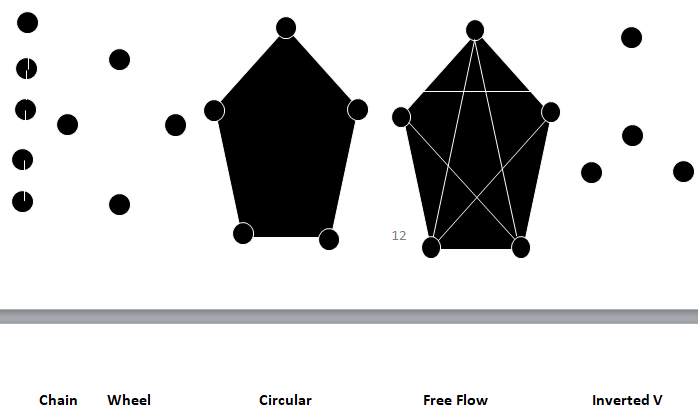
- Single Chain: This network exist between a supervisor and his subordinates. Since many levels exist in an organization structure, communication flows from every superior to his subordinate through single chain.
- Wheel: In wheel network, all subordinates under one superior communicate through him only as he acts as a hub of the wheel. The subordinates are not allowed to talk among themselves.
- Circular: In circular network, the communication moves in a circle. Each person can communicate with his adjoining two persons. In this network, communication flow is slow.
- Free flow: In this network, each person can communicate with other freely. The flow is communication is fast in this network.
- Inverted V: In this network, a subordinate is allowed to communicate with his immediate superior as well as his superiors superior. However, in later case, only prescribed communication takes place.
Informal Communication
Communication that takes place without following the formal lines of communication is said to be informal communication is said to be informal communication. Informal system of communication is generally referred to as the ‘grapevine’ because it spreads throughout the organization with its branches going out in all directions in utter disregard to the levels of authority.
The informal communication arises out of needs of employees to exchange their views, which cannot be done through formal channels. Workers chit chating in a canteen about the behavior of the superior, discussing about rumors that some employees are likely to be transferred are some example of informal communications.
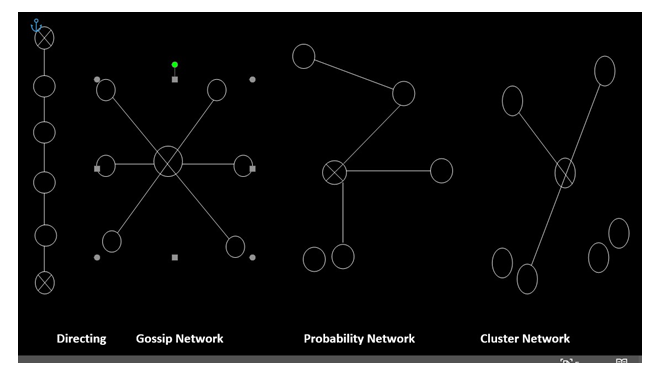
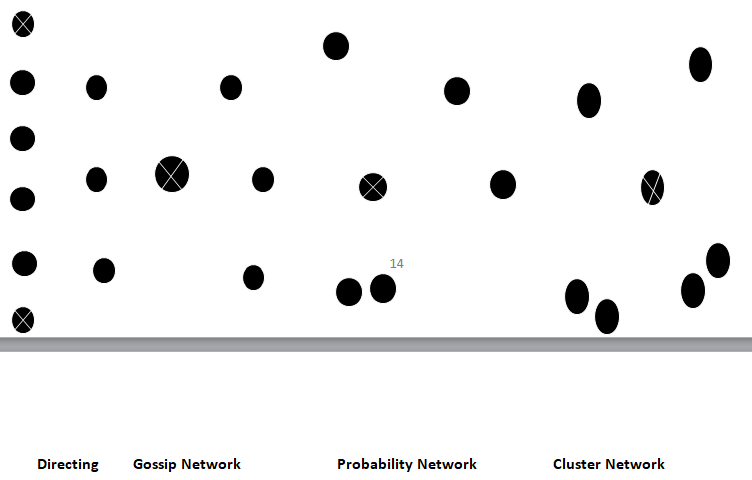
Grapevine Network
Grapevine communication may follow different types of network.
- Single strand network- In each person communication to the other in sequence.
- Gossip network- In each person communication with all on non-selective basis.
- Probability network- In the individual communication randomly with other individual
- Cluster- In the individual communicates with only those people whom he trusts. Of these four types of networks, cluster is the most popular in organizations.
Barriers to communication
It is generally observed that managers face several problems due to communication breakdowns or barriers. These barriers may prevent a communication or filter part of it or carry incorrect meaning due on which misunderstandings may be created. Therefore, it is import for a manager to identity such barriers and take measures to overcome them.
The barriers to communication in the organizations can be broadly grouped as: semantic barriers, psychological barriers, organizational barriers, and personal barriers. These are briefly discussed below:
- Semantic barriers: Semantics is the branch of linguistics dealing with the meaning of words and sentences. Semantic barriers are concerned with problems and obstructions in the process of encoding and decoding of message into words or impressions. Normally, such barriers result on account of use of wrong words, faulty transactions, different interpretations, etc. These are discussed below:
- Badly expressed message: Some times intended meaning may not be conveyed by a manager to his subordinates. These badly expressed messages may be an account of inadequate vocabulary, omission of needed words, etc.
- Symbols with different meanings: A word may have several meanings. Receiver has to perceive one such meaning for the work used by communicator. For example, consider these three sentences where the work ‘value’ is used:
- What is the value of this ring?
- I value our friendship
- What is the value of learning computer skills?
You will find that the ‘value’ gives different meaning in different meaning in different contexts. Wrong perception leads to communication problems.
C. Faulty transactions: Sometimes the communications originally drafted in one language (e.g., English) need to be translated to the language understandable to workers (e.g., Hindi). If the translator is not proficient with both the languages, mistakes may creep in causing different meanings to the communication.
D. Unclarified assumptions: Some communications may have certain assumptions which have certain assumptions which are subject to different interpretations. For example, a boss may instructs his subordinate, “Take care of out guest”. Boss may mea that subordinate should take care of transport, food, accommodation of the guest until he leaves the place. The subordinate may interpret that guest should be taken to hotel with care. Actually, the guest suffers due to these unclarified assumtions.
E. Technical jargon: It is usually found that specialist use technical jargon while explaining to persons who are not specialists in the concerned field. Therefore, they may not understand the actual meaning of many such words.
2. Psychological barriers: Emotional or psychological factors acts as barriers to communicators. For example, worried person cannot communicate properly and an angry receiver cannot understand the real meaning of message. The state of mind of both sender and receiver of communication reflects in the effective communication. Some of the psychological barriers are:
- Premature evaluation: Some times people evaluate the meaning of message before the sender completes his message. Such premature evaluation may be due to pre-conceived notions or prejudices against the communication.
- Lack of attention: The preoccupied mind of receiver and the resultant not-listening of message acts as a major psychological barrier. For instance, an employee explains about his problems to the boss who is pre-occupied with an important file before him. The boss does not grasp the message and the employee is disappointed.
- Loss by transmission and poor retention: When communication passes through various levels, successive transmission of the message results in loss of, or transmission of inaccurate information. This is more of in case of oral communication. Poor retention is another problem. Usually people cannot retain the information for a long time if they are inattentive or not interested.
- Distrust: Distrust between communicator and communicate acts as a barrier. If the parties do not believe each other, they message in its original sense.
3. Organizational barriers: The factors related to organization structure, authority may, sometimes, act as barriers to effective communication. Some of these barriers are:
- Organizational policy: If the organizational policy, explicit or implicit, is not supportive to free flow of communication, it may hamper effectiveness of communication. For example, in an organization with highly centralized pattern, people may not be encouraged to have free communication.
- Rules and regulations: Rigid rules and cumbersome procedures may be a hurdle to communication. Similarly, communications through prescribed channel may result in delays.
- Status: Status of superior may create psychological distance between him and his subordinates. A status conscious manger also may not allow his subordinates to express their feelings freely.
- Complexity in organization structure: In an organization where there are number of managerial levels, communication gets delayed and distorted as number of filtering points are more.
- Organizational facilities: If facilities for smooth, clear and timely communications are not provided communications may be hampered. Facilities like frequent meetings, suggestion box, complaint box, social and cultural gathering, transparency in operations, etc., will encourage free flow of communication. Lack of these facilities may create communication problems.
4. Personal barriers: The personal factors of both sender and receiver may both sender and receiver may exert influence on effective communication. Some of and subordinates are mentioned below:
- Fear of challenge to authority: If superior perceives that a particular communication may adversely affect his authority, he or she may withhold or suppress such communication.
- Lack or proper incentives: If there is no motivation or incentive for communication, subordinates may not take initiative to communicate. For example, if there is no reward or appreciation for a good suggestion, the subordinates may not be willing to offer useful suggestions.
Improving Communication Effectiveness
The barriers to effective communication exist in all organizations to a greater or lesser degree. Organizations keen on developing effective communication should adopt suitable measures to overcome he barriers and improve communication effectiveness. Some such measures are indicated below:
- Clarify the ideas before communication: The problem to be communicated to subordinates should be clear in all its perspective to the executive himself. The entire problem should be studied in depth, analyzed and stated in such a manner that is clearly conveyed to subordinates.
- Communicate according to the needs of receiver: The level of understanding of receiver should be crystal clear to the communicator. Manager should adjust his communication according to the education and understanding levels of subordinates.
- Consult other before communicating: Before actually communicating the message, it is better to involve others in developing a plan for communication. participation and involvement of subordinates may help to gain ready acceptance and willing cooperation of subordinates.
- Be aware of languages, tone and content of message: The contents of it message, tone, language used, manner in which the message is to be communicated are the important aspects of effective communication. The language used should be understandable to the receiver and should not offend the sentiments of listeners. The message should be stimulating to evoke response from the listeners.
- Convey things of help and value to listeners: While conveying message to others, it is better to know the interests and needs of the people with whom you are communicating. If the message relates directly or indirectly to such interests and needs it certainly evokes response from communicate.