Meaning of Financial Statements – Financial statement are the basic and formal annual reports through which the corporate management communication financial information to its owners and various other external parties which include-investors, tax authorities, government, employees, etc. These normally refer to (a) the balance sheet (position statement) as at the end of accounting period, and (b) the profit and loss account (income statement) of a company.
Nature of Financial Statements – The chronologically recorded facts about events expressed in monetary terms for a defined period of time are the basis for the preparation of periodical financial statements which reveal the financial position as on a date and the financial results obtained during a period. The American Institute of Certified Public Accountants states the nature of financial statements as, “the statements prepared for the purpose of presenting a periodical review of report on progress by the management and deal with the status of investment in the business and the result achieved during the period under review. They reflect a combination of recorded facts, accounting principles and personal judgements.”
The following points explain the nature of financial statements:
- Recorded facts: Financial statement are prepared on the basis of facts in the form of cost data recorded in accounting books.
- Accounting Conventions: Certain accounting conventions are followed while preparing financial statement.
- Postulates: Financial statement are prepared on certain basic assumptions (pre-requisites) know as postulates such as going concern postulate, money measurement postulate, realisation postulate, etc.
- Personal Judgments: Under more than one circumstance, facts and figures presented through financial statement are based on personal opinion, estimates and judgments.
Objectives of Financial Statements – Financial statements are the basic sources of information to the shareholders and other external parties for understanding the profitability and financial position of any concern. They provide information about the results of the concern during a specified period of time and status of the concern in terms of assets and liabilities, which provide the basis for taking decisions.
- To provide information about economic resources and obligations of a business
- To provide information about the earing capacity of the business
- To provide information about cash flows
- To judge effectiveness of management
- Information about activities of business affecting the society
- Disclosing accounting policies
Types of Financial Statements – The financial statements generally include two statement known as balance sheet and profit and loss account which are required for external reporting and also for internal needs of the management like planning, decision-making and control.
Balance Sheet – The purpose of balance sheet is to show its resources and obligations for acquiring its resources i.e., assets and liabilities.
Profit and Loss Account or Income Statement – The profit and loss account is the accounting report which summarises the revenues and expenses and ascertains the profit/loss for a specified accounting period.
Questions for Practice
Short Answer Questions
1. What is a Public Company?
Ans. A public company means a company which:
(i) is not a private company;
(ii) has a minimum paid-up capital as may be prescribed;
(iii) is a private company which is a subsidiary of a company which is not a private company.
2. What is a Private Limited Company?
Ans. A private company means a company which by its articles:
(i) restricts the right of members to transfer its shares;
(ii) limits the number of its members to 200 excluding present and past employees;
(iii) prohibits any invitation to the public to subscribe for any securities of the company.
3. Define Government Company.
Ans. A Government Company means any company in which not less than 51 per cent of the paid-up share capital is held by the Central Government, or by any State Government or Governments, or partly by the Central Government and partly by one or more State Governments.
4. What do you mean by a Listed Company?
Ans. A listed company is a company which has any of its securities listed on any recognised
stock exchange.
5. What are the uses of Securities Premium?
Ans. The amount of Securities Premium may be applied by the company:
1. Towards the issue of unissued shares to members as fully paid bonus shares.
2. In writing off the preliminary expenses of the company.
3. In writing off the expenses of, or the commission paid or discount allowed on, any issue of shares or debentures of the company.
4. In providing for the premium payable on redemption of redeemable preference shares or debentures of the company.
5. For the purchase of its own shares or other securities under Section 68.
6. What is Buy-back of Shares?
Ans. Buy-back of shares means the purchase by a company of its own shares from its existing shareholders in accordance with the provisions of the Companies Act.
7. Write a brief note on Minimum Subscription.
Ans. Minimum Subscription means the minimum amount which, in the opinion of the Board of Directors, must be raised by the issue of shares in order to provide for:
1. Purchase price of any property purchased or to be purchased.
2. Preliminary expenses payable by the company.
3. Repayment of money borrowed by the company.
4. Working capital requirements.
5. Any other expenditure necessary for the conduct of business operations.
Long Answer Question
- Explain the Nature of Financial Statements.
Ans. The financial statements are prepared to present the financial information of an enterprise in a concise and understandable form. The nature of financial statements can be explained as follows:
1. Recorded Facts: Financial statements are prepared on the basis of facts recorded in the books of accounts. The original cost or historical cost forms the basis of recording transactions.
2. Accounting Conventions: Financial statements are prepared in accordance with generally accepted accounting principles, concepts and conventions such as conservatism, consistency and disclosure.
3. Personal Judgements: Certain items in financial statements are based on estimates and personal judgements. For example, depreciation, provision for doubtful debts and valuation of inventories.
Thus, financial statements reflect a combination of recorded facts, accounting conventions and personal judgements.
2. Explain in detail the Significance of Financial Statements.
Ans. Financial statements are significant for the following reasons:
1. Source of Information: They provide information about the profitability and financial position of the business.
2. Basis for Decision Making: They help management in planning, controlling and decision-making.
3. Useful to Investors: Investors use financial statements to assess the earning capacity and financial soundness of the enterprise.
4. Useful to Creditors: Creditors analyse financial statements to determine the ability of the business to repay debts.
5. Useful to Government: Government authorities use financial statements for taxation and regulatory purposes.
6. Facilitates Comparison: Financial statements help in inter-firm and intra-firm comparisons.
3. Explain the Limitations of Financial Statements.
Ans. The limitations of financial statements are:
1. Based on Historical Cost: Financial statements are prepared on the basis of historical cost and ignore current market values.
2. Ignore Price Level Changes: Changes in the purchasing power of money are not considered.
3. Influence of Personal Judgements: Various estimates and judgements affect the accuracy of financial statements.
4. Ignore Qualitative Factors: Qualitative aspects such as management efficiency and employee relations are not reflected.
5. Influence of Accounting Policies: Different accounting policies may affect comparability.
6. Interim Reports: Financial statements represent the position only at a particular date.
4. Prepare the Format of Income Statement and Explain its Elements.
Ans. Income Statement (Statement of Profit and Loss)
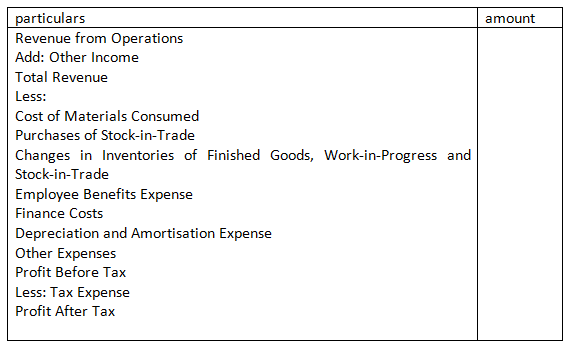
Elements of Income Statement
Revenue: Income earned from business operations and other activities.
Expenses: Cost incurred in earning revenue.
Profit: Excess of revenue over expenses.
Loss: Excess of expenses over revenue.
- Prepare the Format of Balance Sheet and Explain the Various Elements of Balance Sheet.
Ans. Balance Sheet
I. Equity and Liabilities
1. Shareholders’ Funds
Share Capital
Reserves and Surplus
2. Non-Current Liabilities
Long-Term Borrowings
Deferred Tax Liabilities
Other Long-Term Liabilities
Long-Term Provisions
3. Current Liabilities
Short-Term Borrowings
Trade Payables
Other Current Liabilities
Short-Term Provisions
II. Assets
1. Non-Current Assets
Property, Plant and Equipment
Non-Current Investments
Long-Term Loans and Advances
Other Non-Current Assets
2. Current Assets
Current Investments
Inventories
Trade Receivables
Cash and Cash Equivalents
Short-Term Loans and Advances
Other Current Assets
Elements of Balance Sheet
Assets: Economic resources owned by the business.
Liabilities: Obligations payable by the business.
Shareholders’ Funds: Owners’ claim against the assets of the business.
- Explain how Financial Statements are Useful to Various Parties Interested in the Affairs of an Undertaking.
Ans. 1. Owners:** To know profitability, financial position and growth prospects.
2. Management: For planning, decision-making and control.
3. Investors: To assess safety of investment and expected returns.
4. Creditors: To judge the solvency and liquidity position.
5. Employees: To know stability and future prospects of the enterprise.
6. Government and Regulatory Authorities: For taxation, regulation and policy formulation.
7. Researchers: For economic and financial analysis.
- “Financial Statements Reflect a Combination of Recorded Facts, Accounting Conventions and Personal Judgements.” Discuss.
Ans. Financial statements are prepared on the basis of:
Recorded Facts: All transactions are recorded in the books of accounts on the basis of documentary evidence.
Accounting Conventions: Financial statements follow accepted accounting principles and conventions such as consistency, conservatism and full disclosure.
Personal Judgements: Certain accounting estimates require personal judgement, such as depreciation, provision for doubtful debts and valuation of inventories.
Therefore, financial statements are a combination of recorded facts, accounting conventions and personal judgements.
- Explain the Process of Preparing Income Statement and Balance Sheet.
Ans. The process of preparing Income Statement and Balance Sheet involves the following
steps:
1. Recording business transactions in journals.
2. Posting journal entries into ledger accounts.
3. Preparing the Trial Balance.
4. Making necessary adjustments.
5. Preparing the Income Statement to ascertain profit or loss.
6. Preparing the Balance Sheet to ascertain the financial position of the business.
7. Preparing Notes to Accounts and other disclosures as required.
Numerical Questions
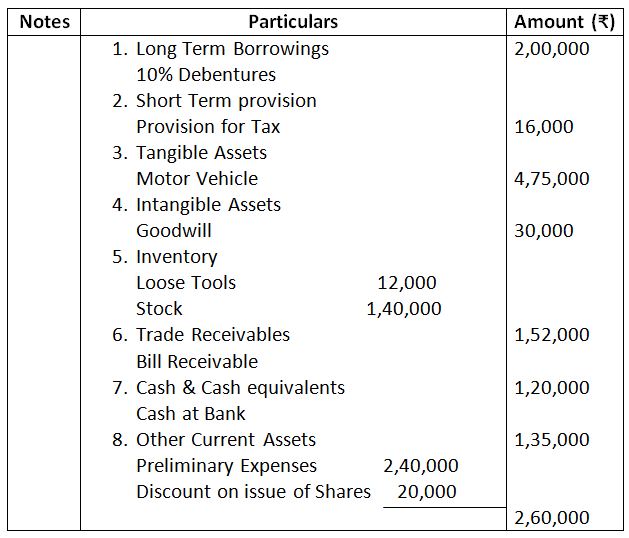
- Show the following items in the balance sheet as per the provision of the companies Act, 2013 in Schedule III.
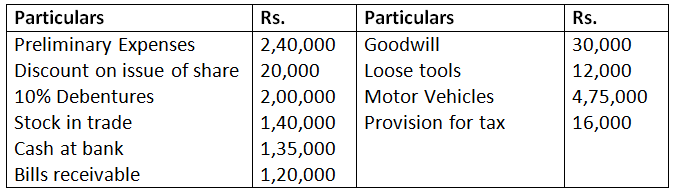
Solution –
Extract of Balance Sheet
As at 31st March 2013
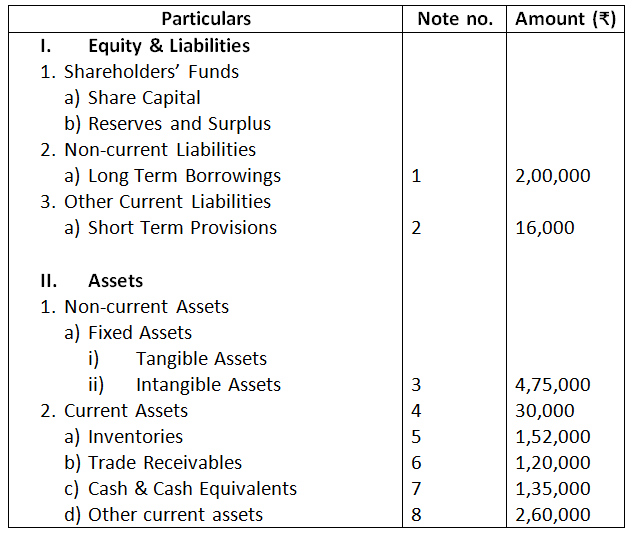
Note to Accounts
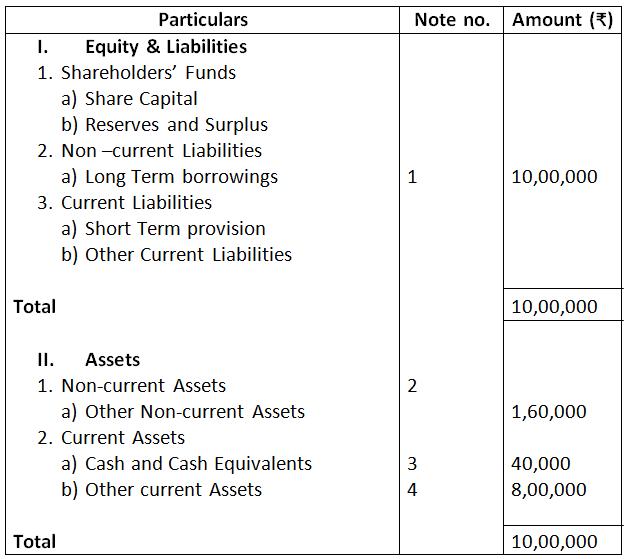
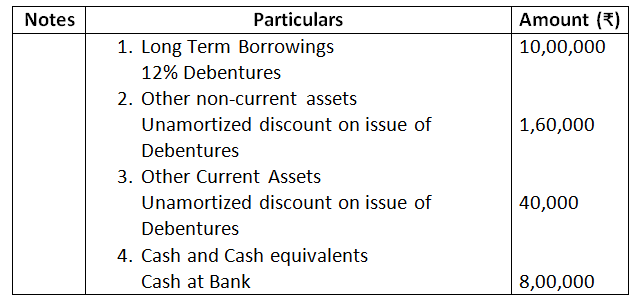
2. On April 1, 2017, Jumbo Ltd., issued 10,000; 12% debentures of Rs.100 each a discount of 20%, redeemable after 5 years. The company decided to write-off discount on issue of such debentures on March 31, 2018. Show the items in the balance sheet of the company immediately after the issue of these debentures.
Solution –
Extract of Balance Sheet
As at 01 April, 2017
Notes to Accounts
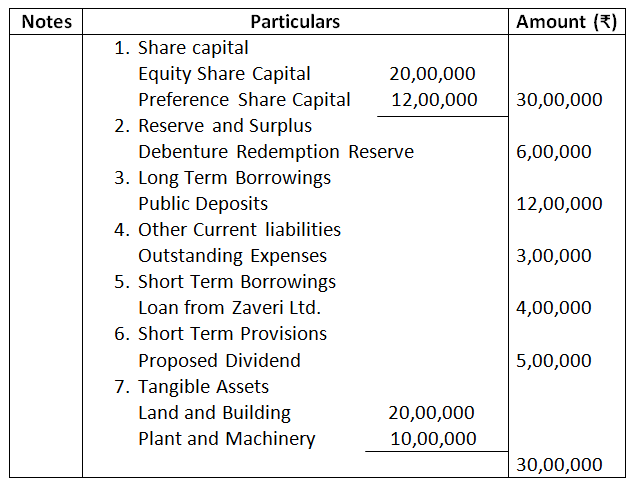
3. From the following information prepare the balance sheet of Gitanjali Ltd.
Inventories Rs.14, 00,000; Equity share Capital Rs.20, 00,000;
Plant and Machinery Rs.10,00,000; Preference Share Capital Rs.12,00,000; Debenture Redemption Reserve Rs.6,00,000; Outstanding Expenses Rs.3,00,000; Proposed Dividend Rs.5,00,000; Land and Building Rs.20,00,000; Current Investments Rs.8,00,000; Cash Equivalent Rs.10,00,000; short term loan from Zaveri Ltd. (A Subsidiary Company of Twilight Ltd.) Rs.4,00,000; Public Deposits Rs.12,00,000.
Solution –
Extract of Balance Sheet
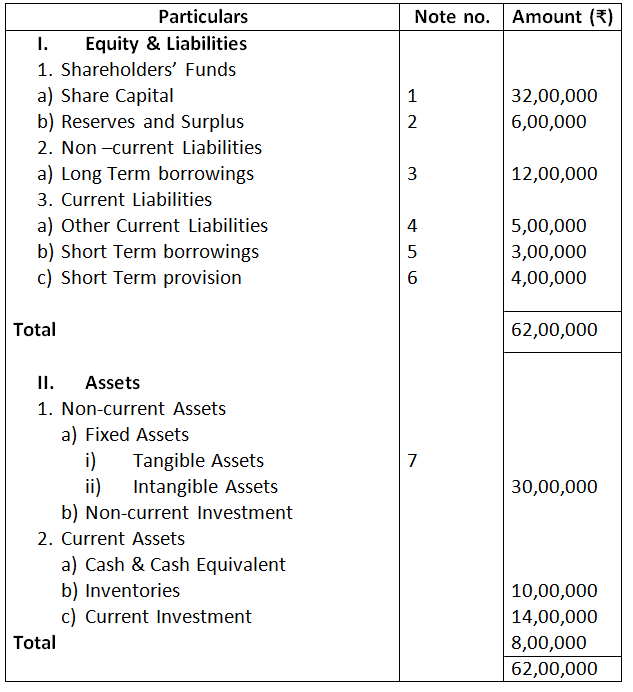
Notes to Accounts
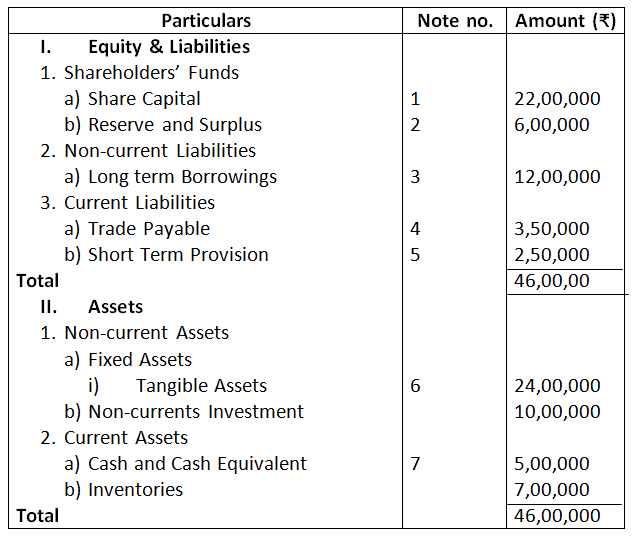
4. From the following information prepare the balance sheet of Jam Ltd.
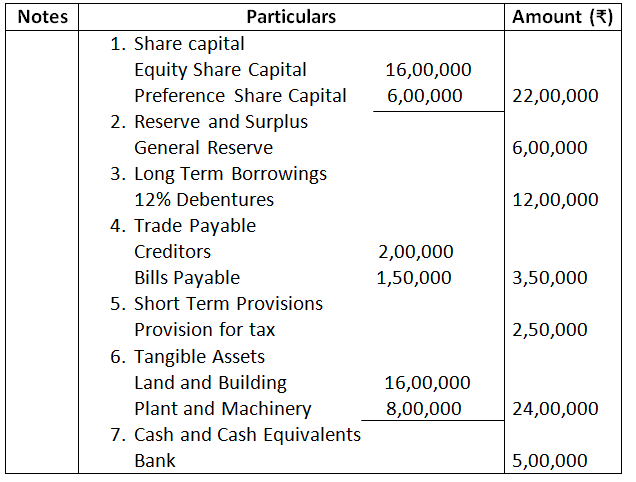
Inventories Rs.7,00,000; Equity Share Capital Rs.16,00,000; Plant and Machinery Rs.8,00,000; 8% Preference Share Capital Rs.6,00,000; General Reserves Rs.6,00,000; Bills payable Rs.1,50,000; Provision for taxation Rs.2,50,000; Land and Building Rs.16,00,000; Non-current Investments Rs.10,00,000; Cash at Bank Rs.5,00,000; Creditors Rs.2,00,000; 12% Debentures Rs.12,00,000.
Solution –
Balance Sheet as at 31st March, 2023
Note to Accounts
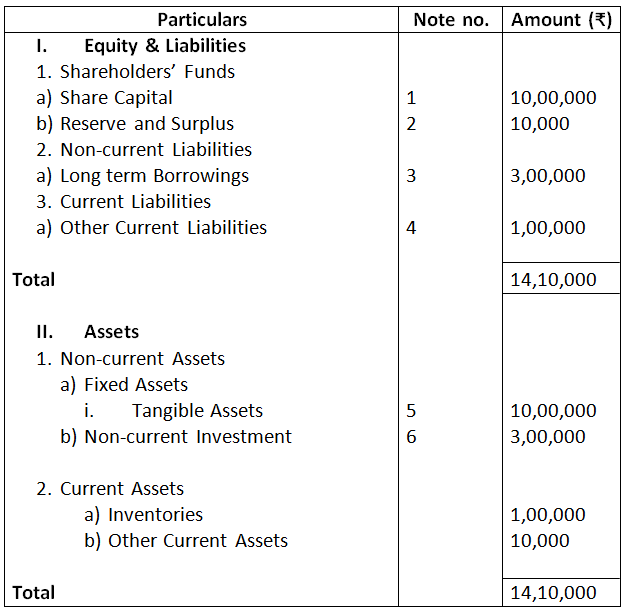
5. Prepare the balance sheet of Joyti Ltd., as at March 31, 2017 from the following information.
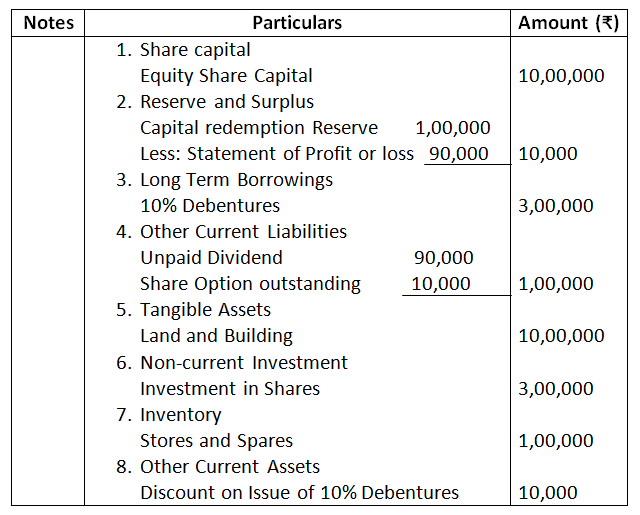
Building Rs. 10,00,000; Investments in the shares of Metro Tyers Ltd. Rs.3,00,000; Stores & Spares Rs.1,00,000; Statements of Profit and Loss (Dr.) Rs.90,000; 5,00,000; equity shares of Rs.20 each fully paid-up; Capital Redemption Reserve Rs.1,00,000; 10% Debentures Rs.3,00,000; Unpaid dividends Rs.90,000; Share options outstanding account Rs.10,000.
Solution –
Balance Sheet as at 31st March, 2017
Note to Accounts
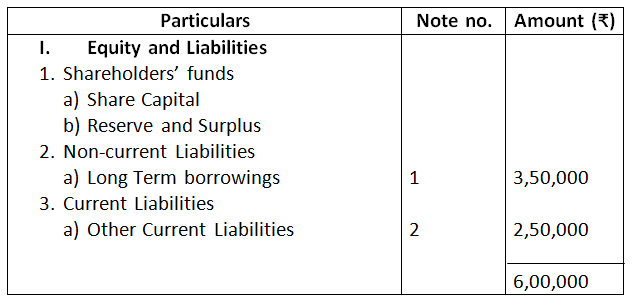
6. Brinda Ltd., has furnished the following information:
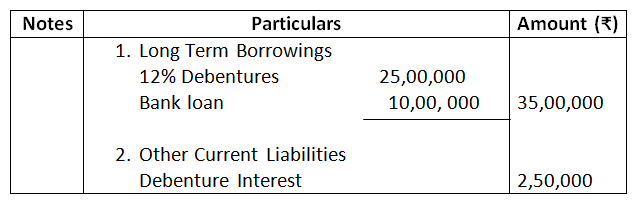
- 25,000; 10% debentures of Rs.100 each;
- Bank loan of Rs.10,00,000 repayable after 5 years;
- Interest on debentures is yet to be paid.
Show the above items in the balance sheet of the company as at March 31, 2017.
Solution –
Balance Sheet Extract
As at 31st March 2017
Note to Accounts
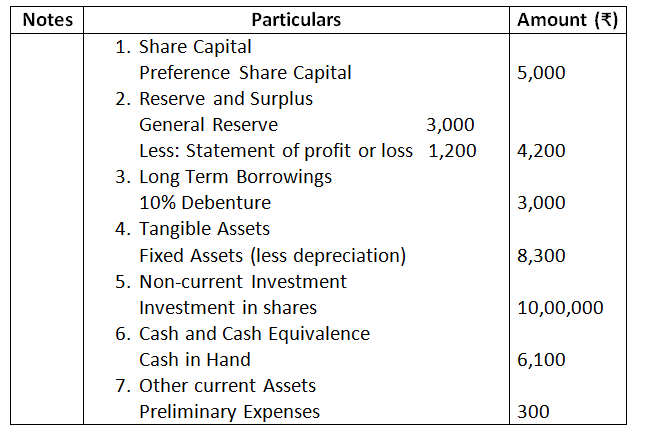
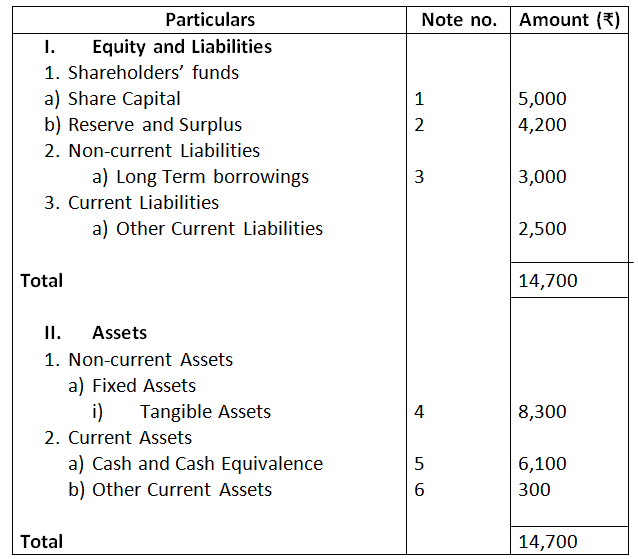
7. Prepare a balance sheet of Black Swan Ltd., as at March 31, 2017 from the following information:
Rs. General Reserve : 3,000
10% Debentures : 3,000
Balance in Statement of : 1,200
Profit and Loss Depreciation on fixed assets : 700
Gross Block : 9,000
Current Liabilities : 2,500
Preliminary Expenses : 300
6% Preference Share Capital : 5,000
Cash & Cash Equivalents : 6,100
Solution –
Balance Sheet as at 31st March, 2017
Note to Accounts