class 11 statistics for economics chapter 2 notes sandeep garg
Meaning, Scope and Importance of Statistics
meaning scope and importance of statistics class 11 notes
class 11 chapter 2 meaning, scope and importance of statistics notes
Meaning of Statistics
Statistics refers to aggregates of facts, affected to a market extent by multiplicity of causes, numerically expressed, enumerated or estimated according to reasonable standard of accuracy, collected in a systematic manner for predetermined purpose and placed in relation to each other. For example – data relating to aggregate percentage of 5 Toppers of XIth class of a school.
Characteristics
- Aggregates of Facts – Statistics are a number of facts. Single and isolated figures are not statistics as such figures cannot be compared and no conclusions can be drawn from them.
For example – a single figure like “50 cars in the parking lot” is not statistics. But saying “20 SUVs, 18 sedans, and 12 hatchbacks in the parking lot” is statistics because the data is classified and meaningful.
- Affected by multiplicity of causes – Numerical figures (data) are influenced by a variety of factors. It is not an easy job to study the effects of any one factors separately by ignoring other factors. For example – statistics of production of a crop, say rice is affected by the rainfall, fertilizer, seeds, method of cultivation, etc. It is not possible to study separately the effect of each of these forces on the production of rice.
- Statistics are numerically expressed – The statistical approach to a subject is numerical. So, any facts, to be called statistics, must be numerically or quantitatively expressed. For example – Isha is taller than Mollie and Ananya, will not be called statistics. However, if the same facts are expressed in numbers (like, Isha: 162 cm; Mollie: 157 cm; Ananya: 145 cm), we will call them statistics.
- Statistics should be collected with reasonable standard of accuracy – In statistics, data is collected with reasonable standard of accuracy. A high degree of accuracy, as observed in accountancy or mathematics, is not insisted upon in statistics, because mass of data is involved.
- Statistics are collected for a pre-determined purpose – The purpose of collecting statistical data must be decided in advance, otherwise usefulness of the data collected would be negligible.
Functions of Statistics
- To simplify complex facts – It is very difficult for an individual to understand and conclude from huge numerical data. Statistical methods try to present the great mass of complex data into simple and understandable form. For example – statistical techniques like mean, median, correlation, graphs, etc. make complex data intelligible and understandable in short period and in better way.
- To present facts in definite form – Quantitative facts can easily be believed and trusted in comparison to abstract and qualitative facts. Statistics summarizes the generalized facts and presents them in a definite form. For example – statement like annual rate of inflation in a country is 10%, is more convincing than statement like prices are rising.
- To make comparison of facts – Comparison is one of the main functions of statistics as the absolute figures convey a less concrete meaning. For example – per capita income of developing countries may not be of much use unless we know the per capita income of developed countries.
- To facilitate planning and policy formulation – Statistics help in analysis of causes of an economic problem and facilitates formulation of policies for solving them. On the basis of numerical data and their analysis, businessmen and administrators can plan future activities and shape their policies.
- To help in forecasting – As business in full of risks and uncertainties, correct forecasting is essential to reduce the uncertainties of business. Statistical tools (like interpolation, time series analysis, etc.) help in making projections for future.
class 11 statistics for economics chapter 2 meaning, scope and importance of statistics notes
Scope and Importance of Statistics In Different Fields
- Importance of Statistics in Economics – Statistics is an indispensable tool for a proper understanding of various economic problems. Most of the economic facts are capable of being expressed in numerical figures. Such economic facts are also known as Data. For example – output of agriculture, volume of exports, etc.
- Helps in understanding and solving an economic problem – statistical data and statistical methods play a vital role in understanding, analyzing and solving economic problems such as poverty, unemployment, increasing rate of inflation, disparities in income distribution and wealth, etc.
- Study of market structures – study of perfect competition, oligopoly, monopoly, etc. requires statistical comparison of market prices, cost and profits of individual firms. Statistics also facilitates inter-sectoral and inter-temporal comparison.
- Helps in establishing mathematical relation – Statistical methods can also be used to estimate mathematical relation and cause and effect relationship between various economic variables. For example – effect of change in price on quantities demanded of a commodity, shows the mathematical form of demand relationship between the two variables.
2. Importance of Statistics in Business – Statistics is important in the business due to following reasons:
- For Establishing a Business Unit – Before starting a business, it is necessary to know its feasibility, like best location, required investment, market size, availability of raw materials, government taxes, etc. This guides entrepreneurs in taking correct initial decisions.
- For Making Marketing Strategy – Statistics help in market research through various statistical techniques (like pilot survey), to study consumers’ habits, purchasing power, competitors, pricing, etc. this reveals the market potential before launching a product.
- For Estimating the demand of Product – After launching of the business, the next step is to estimate the present as well as the future demand of the product. Statistical methods are extremely helpful in preparing trend lines leading to reliable forecasting.
3. Importance of Statistics of the Government – The subject of statistics was initially used by the ancient rulers in assessment of their military and economic strength. Gradually, its scope was enlarged to tackle other problems relating to political activities of the economy. In the present scenario, Government collects the largest amount of statistics for various purposes.
- The role of government has increased and required much greater information and data to fulfill the welfare techniques in addition to the efficient of their administration.
- Popular statistical techniques such as time-series analysis, index number, forecasting and demand analysis are extensively used in formulating economic policies and determining whether the specified rate of growth is sustainable or not. For example – statistical investigations provide date about paying capacity of the people, which helps the government in deciding the rates of direct and indirect taxes.
Limitations of Statistics
- Statistics does not study qualitative phenomena – Statistics can be applied in studying only those problems which can be stated and expressed quantitatively.
- Qualitative characteristics such as honesty, poverty, welfare, beauty, health, etc. cannot directly be measured quantitively.
- As a result, qualitative characteristics are not suitable for statistical analysis.
2. Statistics does not deal with individuals – Statistics deals only with aggregates of facts and no importance is attached to individual items. For example – makes of one student of a class does not constitute statistics, but the average marks have statistical relevance.
3. Statistics can be Misused – Statistics can be misused by ignorant or wrongly motivated persons. Any person can misuse statistics and draw any type of conclusion he likes.
4. Statistical results are true only on average – Statistical results are true on an average as the results are affected by a large number of causes. In other words, statistical laws are not mean that every student of the class has secured 76 marks.
5. Statistical laws are not exact – As statistical laws are probabilistic in nature, inferences based on them are only approximate and not exact like inference based on mathematical or scientific laws.
Short Answer Type Questions
- Define statistics in plural sense. Point out its characteristics.
Answer: In plural sense, statistics refers to numerical facts and figures collected for a specific purpose.
Characteristics of Statistics:
- Statistics are expressed in numerical form.
- They are collected for a definite purpose.
- They are collected in a systematic manner.
- They should be comparable and related to each other.
2. Define statistics as a singular noun. Discuss various stages involved in it.
Answer: In singular sense, statistics refers to the science of collecting, organising, presenting, analysing and interpreting numerical data.
Stages involved in statistics are:
- Collection of data
- Organisation and classification of data
- Presentation of data
- Analysis of data
- Interpretation of results
3. Distinguish between ‘statistics in singular sense’ and ‘statistics in plural sense’.
Answer –
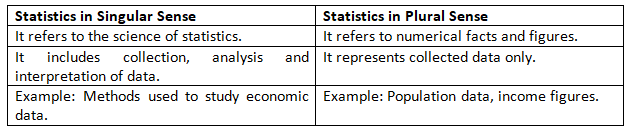
4. How is statistics important for studying economics?
Answer:
Statistics is important in economics because:
- It helps in understanding economic problems.
- It helps in analysing economic data.
- It assists in making economic policies and decisions.
- It helps in forecasting future economic trends.
5. Explain the limitation of statistics.
Answer:
The main limitations of statistics are:
- Statistics deals only with quantitative data and ignores qualitative aspects.
- Statistical results may be misused or misinterpreted.
- Statistics does not study individual cases; it studies groups.
- Statistics cannot provide complete solutions to economic problems.
6. Explain any three functions of statistics.
Answer:
The main functions of statistics are:
- Simplifies Complex Data: Statistics presents large and complicated data in a simple form.
- Helps in Comparison: It helps to compare different groups, situations or periods.
- Helps in Decision Making: Statistics provides useful information for making policies and decisions.
7. Discuss the importance of statistics in Business.
Answer:
Statistics plays an important role in business activities:
- It helps in business planning and decision-making.
- It helps in studying market demand and consumer behaviour.
- It helps in forecasting future sales and profits.
- It helps in controlling costs and improving efficiency.
8. Distinguish between ‘quantitative’ and ‘qualitative’ variable. Give two examples of both.
Answer –

9. Categorise the following into quantitative data and qualitative data: (i) Marks of students; (ii) Expenditure of family; (iii) Honesty of employees; (iv) Wages of workers; (v) Intelligence of students; (vi) Age of People.
Answer:
Quantitative Data:
- Marks of students
- Expenditure of family
- Wages of workers
- Age of people
Qualitative Data:
- Honesty of employees
- Intelligence of students
10. Discuss the concept of ‘Distrust of Statistics’.
Answer: Distrust of statistics means lack of confidence in statistical results. It arises because statistics can be misused, manipulated or wrongly interpreted. Therefore, statistics should be used carefully and with proper knowledge.
11. Briefly discuss the importance of statistics to the government.
Answer:
Statistics is important for the government because:
- It helps in making economic policies and plans.
- It provides information about population, employment, income and production.
- It helps the government in analysing the success of various programmes.
- It assists in proper allocation of resources.
NCERT
https://ncert.nic.in/textbook.php
class 11 statistics for economics chapter 2 notes