demand class 11 notes
demand notes class 11 pdf
class 11th microeconomics chapter 3 demand notes
class 11 microeconomics chapter 3 demand notes sandeep garg
Introduction
Demand is the quantity of a commodity that a consumer is willing and able to buy at, each possible price during a given period of time.
The definition of demand highlights four essential elements of demand:
- Quantity of the commodity
- Willingness to buy
- Price of the commodity
- Period of time
Demand for a commodity may be either with respect to an individual or to the entire market.
- Individual demand – Individual demand refers to the quantity of a commodity that a consumer is willing and able to buy, at each possible price during a given period of time.
- Market demand – Market demand refers to the quantity of a commodity that all consumers are willing and able to buy, at each possible price during a given period of time.
Determinants of Demand (Individual Demand)
- Price of the Given Commodity – It is the most important factor affecting demand for the given commodity. Generally, there exists an inverse relationship between price and quantity demanded. It means that as price increases, quantity demanded falls due to a decrease in the satisfaction level of consumers. For example – It price of given commodity (say, tea) increases, its quantity demanded will fall as satisfaction derived from tea will fall due to rise in its price.
- Price of Related Goods – Related goods are the goods in which change in price of one good (say, x) causes a change in the demand for other good (say, y). Demand for the given commodity is also affected by changes in prices of the related goods.
- Substitute Goods – Substitute goods are those goods which can be used in place of one another for the satisfaction of a particular want, like tea and coffee.
- Complementary Goods – Complementary goods are those goods which are used together to satisfy a particular want, like tea and sugar.
3. Income of the Consumer – Demand for a commodity is also affected by income of the consumer. However, the effect of change in income on demand depends on the nature of the commodity under consideration.
4. Tastes and Preferences – Tastes and preferences of the consumer directly influence the demand for a commodity. They include changes in fashion, customs, habit, etc.
5. Expectation of Change in the Price in Future – If the price of a certain commodity is expected to increase in the near future, then people will buy more of that commodity than what they normally buy.
Change in Quantity Demanded Vs Change in Demand
- Change in Quantity Demanded – Quantity demanded refers to a specific quantity to be purchased against the specific price of the commodity. Whenever demand for a given commodity changes due to a change in its own price, then such change in demand is known as “Quantity Demanded “. For example if demand for Pepsi changes due to change in its own price, then such change in demand for Pepsin is known as change in quantity demanded.
- Change in Demand – Whenever demand for the given commodity changes due to factors other than price, then such change in demand is known as “Change in Demand”. For Example – if demand for Pepsi change due to a change in the price of Coke or due to change in income or due to a change in taste, then such change in demand for Pepsi is known as change in demand.
Determinants of Market Demand
Market demand is influenced by all the factors affecting individual demand for a commodity. In additional, it is also affected by the following factors:
- Size and composition of population – Market demand for a commodity is affected by size of population in the country. An increase in population raises the market demand, while a decrease in population reduces the market demand.
- Season and Weather – The seasonal an weather conditions also affect the market demand for a commodity. For example – during demand for woolen clothes & jackets increases, whereas, market demand for raincoats and umbrellas increase during the rainy season.
- Distribution of Income – If income in the country is equitably distributed, them market demand for commodities will be higher. However, if income distribution is uneven, i.e. people are either very rich or very poor, then market demand will remain at a lower level.
Demand Function
Demand function shows the relationship between quantity demanded for a particular commodity and the factors influencing it. It can be either with respect to one consumer (individual demand function) or to all the consumers in the market (market demand function).
Individual Demand Function – Individual demand function refers to the function relationship between individual demand and the factors affecting individual demand.
It is expressed as: Dx = f (Px, Pr, Y, T, F)
Market Demand Function – Market demand function refers to the functional relationship between market demand and the factors affecting market demand.
As mentioned before market demand is affected by all factors affecting individual demand. In addition, it is also affected by size and composition of population, season and weather and distribution of income.
So, market demand function can be expressed as: Dx = f (Px, Pr, Y, T, F, Po, S, D)
Demand Schedule – Demand schedule is a tabular statement showing various quantities of a commodity being demanded at various levels of price, during a given period of time. It shows the relationship between price of the commodity and its quantity demanded.
A demand schedule can be determined both for individual buyers and for the entire market. So, demand schedule is of two types:
- Individual Demand Schedule
- Market demand schedule
Individual Demand Schedule – Individual demand schedule refers to a tabular statement showing various quantity of a commodity that a consumer is willing to buy at various levels of price, during a given period of time.
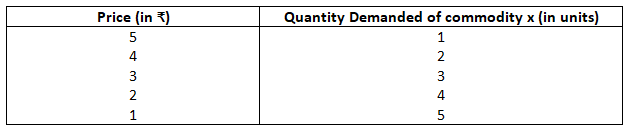
Market demand schedule – Market demand schedule refers to a tabular statement showing quantities of a commodity that all the consumer are willing to buy at various levels of price, during a given period of time.
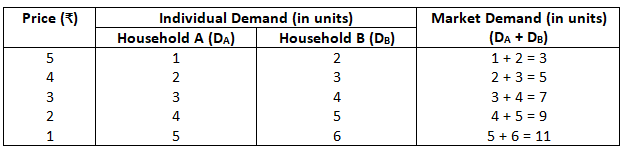
Demand curve – Demand curve is a graphical representation of demand schedule. It is the locus of all the points showing various quantities of a commodity that a consumer is willing to buy at various levels of price, during a given period of time, assuming no change in other factors.
- It shows the inverse relationship between the quantity demanded of a commodity and its price, keeping other factors constant.
- It can be drawn for any commodity by plotting each combination of demand schedules on a graph.
- Like demand schedules, demand curves can also be drawn both for individual buyers and for the entire market. So, the demand curve is of two types:
- Individual Demand curve
- Market Demand Curve
Individual Demand Curve – Individual demand curve refers to a graphical representation of individual demand schedule.
Market Demand Curve – Market demand curve refers to a graphical representation of market demand schedule.
Slope of Demand Curve – Slope of a curve is defined as the change in the variable on the Y-axis divided by the change in the variable on the X-axis. So, the slope of the Demand curve equals in Price divided by the Change in Quantity.

- Due to inverse relationship between price and demand, the demand curve slopes downwards. So, slope is Negative.
- Slope of the demand curve measure its flatness or steepness. So, it is based on the absolute change in price and quantity.
Law of Demand – In our daily life, it is normally observed that decrease in price of a commodity leads to increase in its demand. Such behaviour of consumer has been formulated as ‘Law of Demand’. Law of demand states the inverse relationship between price and quantity demanded, keeping other factors constant (ceteris paribus). This law is also known as ‘First Law of Purchase’.
Assumptions of Law of Demand – while stating the law of demand, we use the phrase ‘keeping other factor constant or ceteris paribus’. This phrase is used to cover the following assumption on which the law is based:
- Prices of substitute goods remain constant.
- Prices of complementary goods remain constant.
- Income of the consumer remains the same.
- There is no expectation of a change in price in the future.
- Tastes and preferences of the consumer remain the same.
Important Facts about Law of Demand
- Inverse Relationship – It states the inverse relationship between price and quantity demanded. It simply affirms that an increase in price will tend to reduce the quantity demanded and a fall in price will lead to an increase in the quantity demanded.
- Qualitative, not Quantitative – It makes a qualitative statement only, i.e. it indicates the direction of change in the amount demanded and does not indicate the magnitude of change.
- No proportional relationship – it does not establish any proportional relationship between a change in price and the resultant change in demand. If the price rises by 10%, the quantity demanded may fall by any proportion.
- One-Sided – Law of demand is one-sided as it only explains the effect of a change in price on the quantity demanded. It states nothing about the effect of change in quantity demanded on the price of the commodity.
Derivation of ‘Law of Demand’ – This inverse relationship between price and demand as given by Law of demand, can be derived by: (i) Marginal Utility = Price Condition, and (ii) Law of Equi-Marginal Utility. Let us discuss the two in detail:
i. Marginal Utility = Price (Single commodity Equilibrium Condition) – According to the single commodity equilibrium condition, the consumer purchase that much quantity of a good at which marginal utility (MU) is equal to price.
When MU is more than Price: – If Price of the good falls, MU becomes greater than price. This encourages the consumer to buy more. It shows that when the price of a good falls, its demand rises.
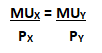
ii. Law of Equi-Marginal Utility – According to this law, a consumer will be at equilibrium when he spends his limited income in such a way that the ration of marginal utilities and their respective prices are equal and MU falls as consumption increase. In case of two goods (say, X and Y), equilibrium condition will be stated as:
Reasons of Law of Demand
- Law of Diminishing Marginal Utility – Law of diminishing marginal utility states that as we consume more and more units of a commodity, the utility derived from each successive unit goes on decreasing. So, demand for a commodity depends on its utility. If the consumer gets more satisfaction, he will pay more. As a result, consumers will not be prepared to pay the same price for additional units of the commodity. The consumer will buy more units of the commodity only when the price falls.
- Substitution Effects – Substitution effect refers to substituting one commodity in place of other when it becomes relatively cheaper. When the price of the given commodity falls, it becomes relatively cheaper as compared to its substitute (assuming no change in the price of substitute). As a result, demand for the given commodity rises. For example – If Price of given commodity (say, Pepsi falls, with no change in price of its substitute (say, Coke), then Pepsi will become relatively cheaper and will be substituted for coke, i.e. demand for Pepsi will rise.
- Income Effect – Income effect refers to effect on demand when real income of the consumer changes due to a change in the price of the given commodity. When the price of the given commodity falls, it increases the purchasing power (real income) of the consumer. As a result, he can purchase more of the given commodity with the same money income. For example – suppose Isha buys 4 chocolates @ Rs.10 each with her pocket money of Rs.40. If the price of chocolate falls to Rs.8 each, then with the same money income, Isha can buy 5 chocolate due to an increase in her real income.
- Additional customer – When the price of a commodity falls, many new consumer, who were not in a position to buy it earlier due to its high price, start purchasing it. In addition to new customers, old consumers of the commodity start demanded more due to its reduced price. For example – If price of ice-cream family pack falls from Rs.150 to Rs.100 per pack, then many consumers who were not in a position to afford the ice-cream earlier can now buy it with decrease in its price. Moreover, the old customers of ice-cream can now consume more. As a result, its total demand increases.
- Different Uses – Some commodities like mile, electricity, etc., have several uses, some of which are more important than the others. When the price of such a good (say, milk) increases, its uses get restricted to the most important purpose (say, drinking) and demand for less important uses (like cheese, butter, etc.) gets reduced. However, when the price of such a commodity decreases, the commodity is put to all its uses, whether important or not.
Exceptions to Law of Demand – As a general rule, demand curve slopes downwards, showing the inverse relationship between price and quantity demanded. However, in certain special circumstances, the reverses may occur, i.e. a rise in price may increase the demand. These circumstances are known as ‘Exceptions to the low of Demand’.
Some of the important Exceptions are:
- Geffen Goods – These are special kinds of inferior goods on which the consumer spends a large part of his income and their demand rises with an increase in price and demand falls with a decrease in price. For example – in our country, it is often seen that when the price of coarse cereals like jowar and bajra falls, the consumers have a tendency to spend less on them and shift over to superior cereals like wheat and rice. This phenomenon, popularly known as “Giffen’s Paradox’, was first observed by Sir Robert Giffen.
- Status Symbol Goods or Goods of Ostentation – the exception relates to certain prestige goods which are used as status symbols. For example – diamonds, gold antique paintings, etc. are bought due to the prestige they confer upon the possessor. Such goods are demanded only because their prices are very high. If their prices fall, they will no longer be considered as statues symbol goods and their demand will decrease.
- Fear of Shortage – If the consumers expect a shortage or scarcity of a particular commodity in the near future, then they will start buying more and more of that commodity in the current period even if their prices are rising. The consumers demand more due to fear of further rise in prices. For example – during emergencies like war, famines, etc., consumers demand goods even at higher prices due to fear of shortage and general insecurity.
- Ignorance – consumers may buy more of a commodity at a higher price when they are ignorant of the prevailing prices of the commodity in the market.
- Fashion related goods – Goods related to fashion do not follow the law of demand and their demand increase even with a price in their prices. For example – if any particular type of dress is in fashion, then demand for such does will increase even if its price is rising.
Movement Along the Demand Curve (change in quantity Demanded)
When quantity demanded of a commodity changes due to a change in its price, keeping other factors constant, it is known as change in quantity demanded. It is graphically expressed as a movement along the same demand curve. There can be either a downward movement (expansion in demand) or an upward movement (contraction in demand) along the same demand curve. Let us understand the movement along the demand curve
- Upward Movement – When price rises to OP2 quantity demanded falls to OQ2 (known as contraction in demand) leading to an upward movement from A to C along the same demand curve DD.
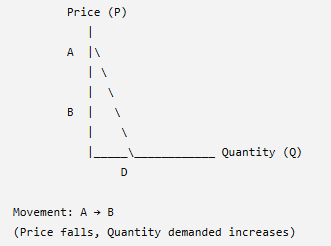
- Downward Movement – On the other hand, fall in price from OP to OP1 leads to an increase in quantity demanded from OQ to OQ1 (known as expansion in demand), resulting in a downward movement from A to B along the same demand curve DD.
Expansion in Demand – Expansion in demand refers to a rise in the quantity demanded due to a fall in the price of commodity, other factors remaining constant.
- It lease to a downward movement along the same demand curve.
- It is also known as ‘Extension in Demand’ or ‘Increase in Quantity Demanded’.
Contraction in Demand – Contraction in demand refers to a fall in the quantity demanded due to a rise in the price of commodity, other factors remaining constant.
- It leads to an upward movement along the same demand curve.
- It is also known as ‘Decrease in Quantity Demanded’.
Shift in Demand curve (Change in Demand) – Demand curve is drawn to show the relationship between price and quantity demanded of a commodity, assuming all other factors being constant. However, other factors are bound to change sooner or later. A change in one of ‘other factors’ shifts the demand curve. When the demand of a commodity change due to change in any factor other than the own price of the commodity, it is known as change in demand. It is expressed as a shift in the demand curve.
Various Reasons for Shift in Demand Curve
- Change in price of substitute goods;
- Change in price of complementary goods;
- Change in income of consumers;
- Change in tastes and preferences;
- Expectation of change in price in future;
- Change in distribution of income;
- Change in season and weather.
Increase in Demand – Increase in Demand refers to a rise in the demand of a commodity caused due to any factor other than the own price of the commodity. In this case, demand rises at the same price or demand remains same even at higher price.
Decrease in Demand – Decrease in Demand refers to a fall in the demand of a commodity caused due to any factor other than the own price of the commodity. In this case, demand falls at the same price or demand remains same even at lower price. It leads to a leftward shift in the demand curve.
Substitute Goods and Complementary Goods
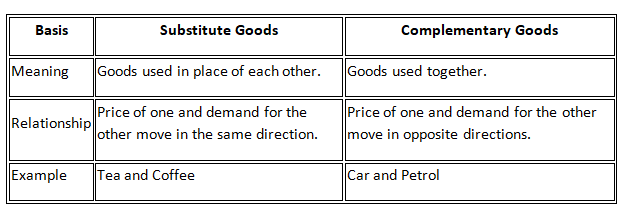
Substitute Goods – Substitute goods are those goods which can be used in place of one another for satisfaction of a particular want, like tea and coffee.
Demand for a given commodity varies directly with the price of a substitute good. For example if price of a substitute good (say, coffee) increases, then demand for given commodity (say, tea) will rise as tea will become relatively cheaper in comparison to coffee.
Complementary Goods – Complementary goods are those goods which are used together to satisfy a particular want. Demand for a given commodity varies inversely with the price of a complementary good. For example – If price of a complementary goods (say, sugar) increases, then demand for given commodity (say, tea) will fall as it will be relatively costlier to use both the goods together.
Cross Demand – Cross demand refers to the relationship between the demand of a given commodity and the price of related commodities, other things remaining the same. Cross demand indicates how much quantity of a given commodity will be demanded at different prices of a related commodity (substitute or complementary).
It can be expressed as: DX = f (Py)
Cross Demand can be either Positive or Negative
- Cross demand is positive in case of substitute goods as demand for the given commodity varies directly with the prices of substitute goods.
- Cross demand is negative in case of complementary goods as demand for the given commodity varies inversely with the price of complementary goods.
Cross Price Effect on Demand Curve
Cross Price Effect refers to effect on the demand for a given commodity due to a change in the price of a related commodity.
Change in Prices of Substitute Goods – A change (increase or decrease) in the price of substitute directly affects the demand for a given commodity.
- Increase in Price of Substitute Goods – When price of substitute goods (say, coffee) rises, demand for the given commodity (say, tea) also rises from OQ to OQ1 at its same price of OP. It leads to a rightward shift in the demand curve of the given commodity from DD to D1D1.
- Decrease in Price of Substitute Goods – With decrease in price of substitute goods (coffee), demand for the given commodity (tea) also decreases from OQ to OQ1 at the same price of OP. It shift the demand curve of the given commodity towards left from DD to D1D1.
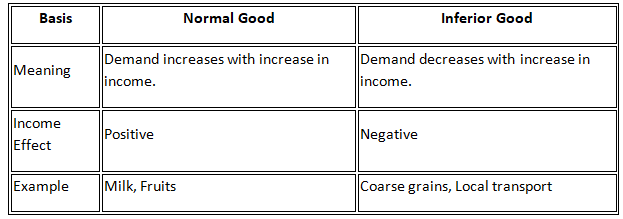
Normal Goods – Normal goods refer to those goods whose demand increases with an increase in income. For example – If the demand for TV increases with a rise in income, then TV will be called a normal good. Income effect is positive in case of normal goods.
Inferior Goods – Inferior goods refer to those goods whose demand decrease with an increase in income. It means, that there exists an inverse relationship between income and the demand for inferior goods. So, income effect is negative in case of inferior goods. It must be noted that inferior goods are generally purchased because they are essentials of life. For example – If the income of a consumer rises and he prefers to replace his black-and-white (B/W) TV with a coloured one, then demand for B/W TV will fall. In such case, B/W TV is an inferior good.
Effect on Demand Curve (with change in income) – A change in income causes a positive change in demand for normal goods, whereas, a negative change occurs in the case of inferior goods. So, the demand curve of a given commodity is affected by change in income in case of normal goods and inferior goods. It must be noted that there is no change in demand for the necessity goods with increase or decrease in income.
Change in income (Normal Goods) – A change (increase or decrease) in the income of consumer directly affects the demand for a given commodity.
- Increase in Income – As income rises, the demand for normal goods (say, TV) also rises from OQ to OQ1 at the same price of OP. It leads to a rightward shift in the demand curve of normal good from DD to D1D1.
- Decrease in Income – With fall in income, the demand for normal goods (TV) falls from OQ to OQ1 at the same price of OP. it shift the demand curve of normal good towards left from DD to D1D1.
Change in Income (Inferior Goods) – An increase or decrease in income affects the demand inversely, if the given commodity is an inferior good.
- Increase in Income – As income increases, the demand for inferior goods (say, black-and-white TV) falls from OQ to OQ1 at the same price of OP. It leads to a leftward shift in the demand curve of inferior good from DD to D1D1.
- Decrease in Income – As income decreases, the demand for inferior goods (say, black-and-white TV) rises from OQ to OQ1 at the same price of OP. It leads to a rightwards shift in the demand curve of inferior good from DD to D1D1.
class 11 microeconomics chapter 3 demand pdf sandeep garg
sandeep garg microeconomics class 11 2026-27
Kinds of Demand –
- Price Demand – price demand for refers to relationship between the price demand of a commodity, assuming other factors are constant. It can be shown as Dx = f (Px, Where Dx = Demand for the given commodity; f = functional relationship; Px = Price of the given commodity.
- Income Demand – Income demand refers to a relationship between the income of a consumer and the quantity demanded of a commodity, assuming other factor are constant. Symbolically. Dx = f(Y); Where: Dx = Demand for the given commodity; f = functional relationship, Y = Income of the consumer.
- Cross Demand – Cross demand refers to a relationship between the demand for a given commodity and the prices of related commodities, assuming other things remain the same.
- Joint Demand – When two or more goods are demanded simultaneously to satisfy a particular want, then such a demand is called joint demand. For example – demand for sugar, mile, and tea leaves is a joint demand, as they are demanded together to prepare tea.
- Composite Demand – When a commodity can be put to several uses, its demand is known is composite demand. For example – demand for electricity is a composite demand as it can be used for various purpose like lighting rooms, running the refrigerator, TV, AC, etc.
- Derived Demand – Demand for a commodity which depends on the demand for other goods, is known as derived. For example – demand fro labour producing cloth is a derived demand as it depends on the demand for cloth.
- Direct Demand – When a commodity satisfies the wants directly, its demand is termed as direct demand. For example – demand for clothes, books, food is a direct demand as these items satisfy the wants directly.
- Alternative Demand – Demand is known as alternative demand, when in can be satisfied by different alternatives. For example – there are a number of options (alternatives) to satisfy the demand for food like chapatti, rice, salad, fruits, burger, pizza, etc.
- Competitive Demand – When two goods are close substitutes of each other and increase in demand for one of them will decrease the demand for the other, then the demand for any one for them is known as competitive demand. For example – increase in demand for coffee might reduce the demand for tea. It happens because purchase of more of one commodity (say, coffee) leads to a lesser requirement for the other commodity (say, tea).
Short Answer Type Questions
- Explain three factors that can bring about an increase in the market demand for a commodity.
Answer:
The following factors can increase the market demand for a commodity:
- Increase in Consumers’ Income: Demand for a normal good increases when consumers’ income rises.
- Increase in the Price of Substitute Goods: If the price of a substitute rises, consumers shift to the given good, increasing its demand.
- Change in Taste and Preferences: Favourable changes in consumers’ tastes, fashion, or preferences increase demand.
2. Define market demand. State the law of demand and the assumption behind it.
Answer:
Market Demand: Market demand is the total quantity of a commodity demanded by all consumers in the market at different prices during a given period.
Law of Demand: Other things remaining the same, as the price of a commodity falls, its quantity demanded increases, and as the price rises, its quantity demanded decreases.
Assumption: The law assumes that other factors such as income, tastes, prices of related goods, and consumer expectations remain constant (ceteris paribus).
3. Explain the effect of increase in income of the consumer on demand for a good.
Answer:
- In the case of normal goods, an increase in consumers’ income increases demand.
- In the case of inferior goods, an increase in income decreases demand because consumers shift to better-quality goods.
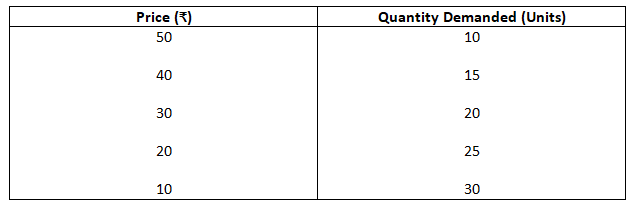
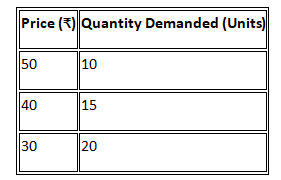
4. Explain the law of demand with the help of a demand schedule.
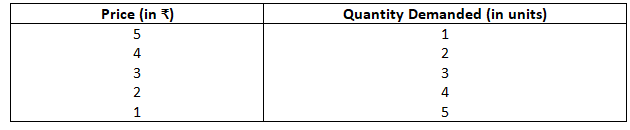
Answer: The law of demand states that when the price of a commodity falls, its quantity demanded increases, and vice versa, other things remaining constant.
Demand Schedule:
5. State any 3 factors that causes an ‘increase’ in demand of a commodity.
Answer:
Any three factors are:
- Increase in consumers’ income (for normal goods).
- Increase in the price of substitute goods.
- Favourable change in consumers’ tastes and preferences.
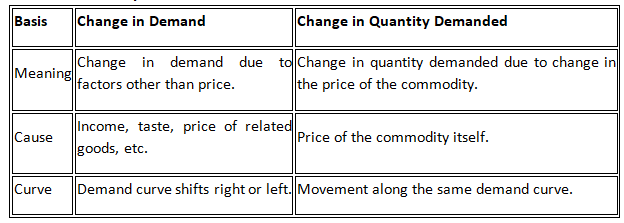
6. Distinguish between change in demand’ and ‘change in quantity demanded’ of a commodity.
7. Explain the inverse relationship between the price of a commodity and its demand.
Answer: According to the Law of Demand, there is an inverse relationship between the price of a commodity and its quantity demanded. When the price of a commodity falls, consumers buy more of it, and when the price rises, they buy less, other things remaining constant.
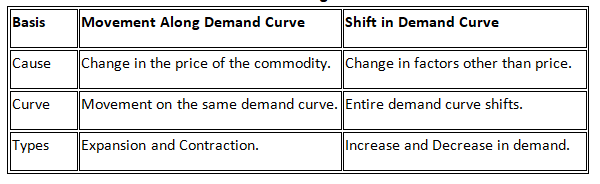
8. Differentiate between movement along demand curve and shift in demand curve.
9. What is meant by expansion in demand? Explain it with the help of a schedule and a diagram.
Answer: Expansion in demand refers to an increase in quantity demanded due to a fall in the price of the commodity, while other factors remain constant.
Demand Schedule
10. Define the following terms: (i) Increase in demand; (ii) Decrease in demand; (iii) contraction in demand.
Answer –
(i) Increase in Demand – Increase in demand refers to a rise in demand due to changes in factors other than the price of the commodity. It is shown by a rightward shift of the demand curve.
(ii) Decrease in Demand – Decrease in demand refers to a fall in demand due to changes in factors other than the price of the commodity. It is shown by a leftward shift of the demand curve.
(iii) Contraction in Demand – Contraction in demand refers to a decrease in quantity demanded due to a rise in the price of the commodity, other things remaining constant.
11. Distinguish between expansion in demand and increase in demand.
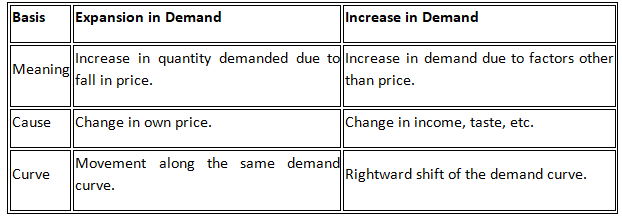
12. Distinguish between ‘decrease in demand’ and ‘decrease in quantity demanded’ of a commodity.
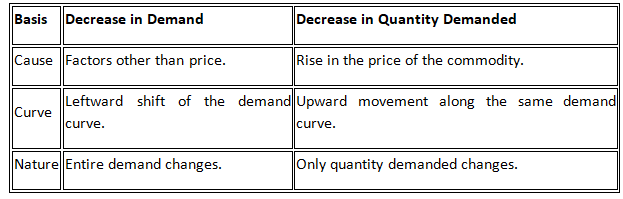
13. Which changes can cause a leftward shift in the demand curve? Also state the change, which causes downward movement along the demand curve?
Answer:
A leftward shift in the demand curve may be caused by:
- Decrease in consumers’ income (for normal goods).
- Unfavourable change in tastes and preferences.
- Fall in the price of substitute goods.
- Rise in the price of complementary goods.
14. How is the demand of a commodity affected by changes in the price of related goods? Explain with the help of diagrams.
Answer:
The demand for a commodity is affected by the prices of substitute and complementary goods.
- Substitute Goods: If the price of a substitute rises, demand for the given commodity increases. The demand curve shifts rightward.
- Complementary Goods: If the price of a complementary good rises, demand for the given commodity decreases. The demand curve shifts leftward.
Diagram:
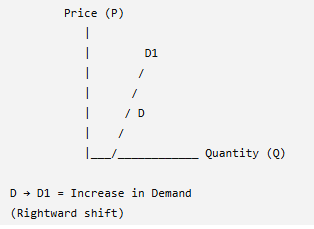
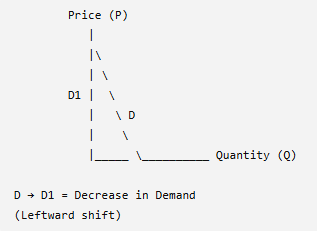
- Draw a rightward shift (D to D₁) for substitute goods.
- Draw a leftward shift (D to D₂) for complementary goods.
15. Explain the effect of a rise in the price of ‘related goods’ on the demand for a good X.
Answer:
The effect depends on the type of related good:
- If the related good is a substitute, a rise in its price increases the demand for good X, as consumers shift to X.
- If the related good is a complementary good, a rise in its price decreases the demand for good X, as both goods are consumed together.
16. Goods X and Y are substitutes. Explain the effect of fall in price of Y on demand for X.
Answer: Goods X and Y are substitute goods. If the price of Y falls, consumers will buy more of Y instead of X. As a result, the demand for X decreases. The demand curve for X shifts leftward.
17. Explain the meaning of normal goods and inferior goods.
Answer:
- Normal Goods: Goods whose demand increases when consumers’ income increases.
- Inferior Goods: Goods whose demand decreases when consumers’ income increases because consumers shift to better-quality goods.
18. Distinguish between a normal good and an inferior good. Give example in each case.
19. Distinguish between substitute goods and complementary goods, with examples.
20. What is ‘market’ demand? State four factors causing ‘increase’ in market demand.
Answer: Market demand is the total quantity of a commodity demanded by all consumers in the market at different prices during a given period.
Factors causing increase in market demand:
- Increase in consumers’ income.
- Rise in the price of substitute goods.
- Fall in the price of complementary goods.
- Favourable change in consumers’ tastes and preferences.
21. What happens to the demand of a good when consumer’s income change?
Answer:
- For normal goods, demand increases when income increases and decreases when income falls.
- For inferior goods, demand decreases when income increases and increases when income falls.
22. How does change in price of a substitute good affect the demand of the given good? Explain with the help of an example.
Answer: If the price of a substitute good increases, consumers shift to the given good. As a result, the demand for the given good increases.
Example: If the price of coffee increases, the demand for tea increases.
23. How does change in price of a complementary good affect the demand of the given good? Explain with the help of an example.
Answer: If the price of a complementary good increases, the demand for the given good decreases because both goods are used together.
Example: If the price of petrol rises, the demand for cars decreases.
24. Explain the effect of: (a) change in own price and (b) change in price of substitute on demand of a good.
Answer:
(a) Change in Own Price: A fall in the price of a commodity increases its quantity demanded, while a rise in price decreases it. This causes movement along the same demand curve.
(b) Change in Price of Substitute: If the price of a substitute rises, demand for the given good increases. If the price of a substitute falls, demand decreases. This causes a shift in the demand curve.
25. Distinguish between individuals’ demand and market demand. Name the factors affecting demand for a good by an individual.
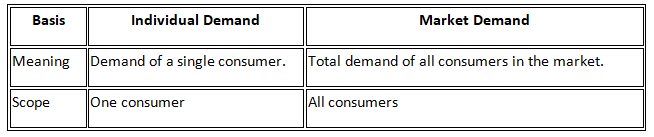
Factors affecting individual demand:
- Price of the commodity.
- Income of the consumer.
- Price of related goods.
- Tastes and preferences.
- Future expectations.
26. Show that there is an inverse relation between price of a commodity and its quantity demanded. Use Utility Analysis.
Answer: According to Utility Analysis, a consumer purchases a commodity up to the point where Marginal Utility (MU) = Price. As more units are consumed, MU falls due to the Law of Diminishing Marginal Utility. Therefore, consumers buy more only when the price falls. Hence, price and quantity demanded have an inverse relationship.
27. If the income of a consumer increases, discuss briefly its likely impact on the demand for an inferior good, Good X.
Answer: When the consumer’s income increases, the demand for inferior good X decreases because the consumer shifts to superior or better-quality goods. Thus, the demand curve for Good X shifts leftward.
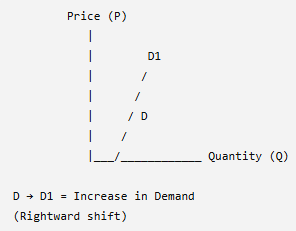
28. How would the demand for a commodity by affected by a change in “tastes and preference” of the consumers in favour of the commodity? Explain using a diagram.
Answer:
A favourable change in consumers’ tastes and preferences increases the demand for the commodity. As a result, the demand curve shifts rightwardfromD to D₁.
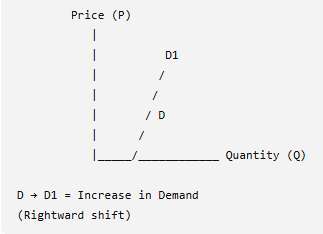
29. Explain the effect of the increase in the level of air pollution, on the market demand for “Air Purifires”. (Use diagram)
Answer: An increase in air pollution makes consumers more conscious about health. Therefore, the market demand for air purifiers increases, causing the demand curve to shift rightward.
Long Answer Type Questions
- Define demand. Explain any 4 factors that affect demand for a commodity.
Answer –
Demand – Demand refers to the quantity of a commodity that a consumer is willing and able to purchase at different prices during a given period of time. Demand is not only a desire for a commodity; it must be supported by purchasing power and willingness to buy.
Factors Affecting Demand for a Commodity
The demand for a commodity is affected by various factors. Some important factors are:
1. Price of the Commodity – The price of a commodity is the most important factor affecting its demand. Generally, demand decreases when price rises and increases when price falls, keeping other factors constant.
2. Income of the Consumer – Demand for a commodity changes with a change in consumer’s income. In case of normal goods, demand increases with an increase in income. However, in case of inferior goods, demand decreases when income increases.
3. Price of Related Goods – Demand for a commodity is also affected by the prices of related goods.
- Substitute goods: Increase in the price of one good increases the demand for its substitute.
- Complementary goods: Increase in the price of one good decreases the demand for its complement.
- 4. Tastes and Preferences of Consumers – Changes in tastes, habits, fashion and preferences of consumers affect demand. A favourable change in preference increases demand, while an unfavourable change decreases demand.
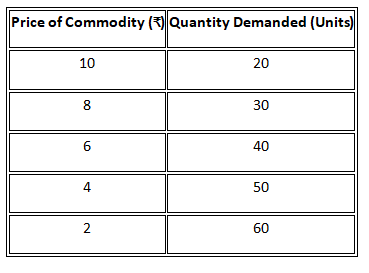
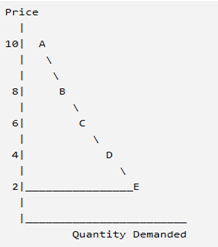
2. Explain the law of demand with the help of an imaginary schedule and diagram.
Answer –
Law of Demand – The law of demand states that other things remaining constant, quantity demanded of a commodity increases when its price falls and decreases when its price rises.
Assumptions of Law of Demand
The law of demand is based on the following assumptions:
- Income of the consumer remains constant.
- Tastes and preferences remain unchanged.
- Prices of related goods remain constant.
- No expectation of future price changes.
Demand Schedule
3. Explain the causes behind law of demand.
Answer – The main causes behind the law of demand are:
a. Law of Diminishing Marginal Utility – According to this law, as a consumer consumes more units of a commodity, the additional satisfaction from each additional unit decreases. Therefore, consumers purchase more only at a lower price.
b. Income Effect – When the price of a commodity falls, the purchasing power of consumers increases. They can buy more quantity with the same income. This is known as the income effect.
c. Substitution Effect – When the price of a commodity falls, it becomes cheaper compared to its substitutes. Consumers shift towards that commodity and demand increases.
d. New Consumers – A fall in price makes the commodity affordable for more consumers. As a result, the number of consumers increases, leading to an increase in demand.
e. Different Uses of a Commodity – Some commodities have multiple uses. When their price falls, consumers increase their consumption for various purposes.
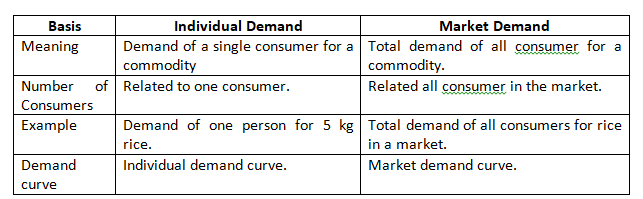
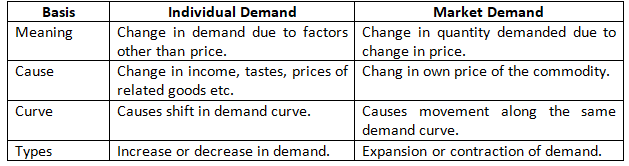
4. Distinguish between: (a) Individual demand and market demand; (b) ‘Change in demand’ and ‘change in quantity demanded’.
Answer –
a. Individual demand and market demand
b. ‘Change in demand’ and ‘change in quantity demanded’
5. Explain in brief, the various exceptions to law of demand.
Answer –
The law of demand does not apply in some special situations. These are called exceptions to the law of demand.
i. Giffen Goods – In case of inferior goods, sometimes demand increases even when price rises. Such goods are known as Giffen goods. Example: Certain staple food items consumed by low-income groups.
ii. Articles of Prestige – Some goods are purchased for showing status and prestige. A higher price may increase their demand. Example: Luxury cars, diamonds and expensive watches.
iii. Expectations Regarding Future Prices – If consumers expect prices to rise further in future, they may buy more even at the current high price.
iv. Ignorance of Consumers – Sometimes consumers consider high-priced goods to be of better quality and purchase more of them.
v. Emergency Situations – During war, famine or natural disasters, people may buy more goods even at higher prices due to fear of shortage.
vi. Habit-forming Goods – Demand for goods like cigarettes and other addictive products may not fall significantly even when their prices increase.
6. Explain the causes of a rightward shift in demand curve of a commodity of an individual consumer.
Answer –
Rightward Shift in Demand Curve – A rightward shift in the demand curve takes place when the demand for a commodity increases due to factors other than a change in its own price. It is also known as an increase in demand.
Causes of Rightward Shift in Demand Curve
Increase in Income of Consumer – When the income of a consumer increases, the demand for normal goods increases. As a result, the demand curve shifts towards the right.
Favourable Change in Tastes and Preferences – When consumers develop a liking or preference for a commodity, its demand increases, causing a rightward shift in the demand curve.
Rise in Price of Substitute Goods – If the price of a substitute good increases, consumers prefer the given commodity, leading to an increase in its demand.
Fall in Price of Complementary Goods – A fall in the price of complementary goods increases the demand for the related commodity.
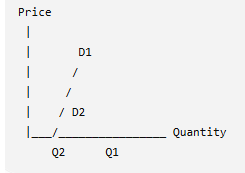
7. Explain with the help of diagrams, the effect of the following changes on the demand of a commodity. (i) fall in the price of substitute good; (ii) Fall in the income of its buyer.
Answer –
(i) Fall in the price of substitute good – Substitute goods are those goods which can be used in place of each other. When the price of a substitute good falls, consumers shift their demand towards that cheaper substitute. As a result, the demand for the given commodity decreases.
Example: If the price of coffee falls, consumers may buy more coffee and reduce the consumption of tea.
(ii) Fall in the income of its buyer – When the income of a consumer falls, the demand for normal goods decreases because consumers have less purchasing power.
Example: A fall in income reduces the demand for luxury goods.
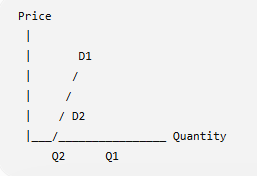
8. Distinguish between an inferior good and a normal good. Explain the effect of change in income on each giving suitable examples.
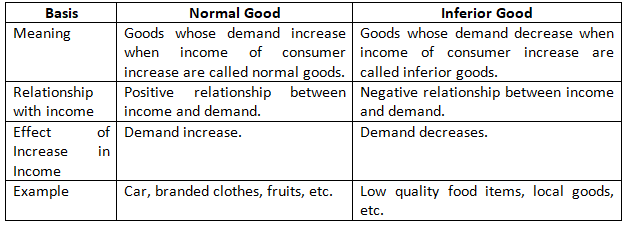
Effect of Change in Income
1. Normal Goods – When the income of consumers increases, they purchase more normal goods. Therefore, the demand curve shifts towards the right. Example: Increase in income increases the demand for branded clothes.
2. Inferior Goods – When the income of consumers increases, they reduce the consumption of inferior goods and shift towards better quality goods. Therefore, the demand curve shifts towards the left. Example: A person may reduce the consumption of low-quality food items after an increase in income.
9. Explain with the help of diagrams, the effect of the following changes on the demand of a commodity: (i) An unfavourable change in taste of the buyer for the commodity; (ii) A fall in the income of its buyer, if the commodity is inferior.
Answer –
(i) An unfavourable change in taste of the buyer for the commodity – Demand for a commodity depends upon the tastes and preferences of consumers. If consumers develop an unfavourable attitude towards a commodity, its demand decreases.
Example: If people lose interest in a particular brand, its demand decreases.
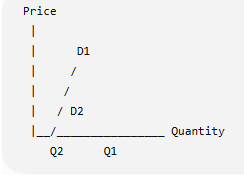
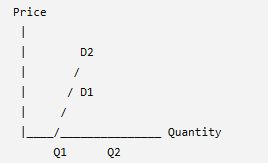
(ii) Fall in income of buyer, if the commodity is inferior – Inferior goods have an opposite relationship between income and demand. When the income of a consumer falls, demand for inferior goods increases because consumers shift towards cheaper goods.
Example: Demand for low-cost food items may increase when income falls.
10. Explain causes of leftward shift in demand curve of a commodity.
Answer –
Leftward Shift in Demand Curve – A leftward shift in the demand curve occurs when the demand for a commodity decreases due to factors other than its own price. It is known as a decrease in demand.
Causes of Leftward Shift in Demand Curve
1. Decrease in Income of Consumer – For normal goods, a decrease in income reduces the demand for the commodity.
Example: A fall in income reduces the demand for luxury goods.
2. Unfavourable Change in Tastes and Preferences – If consumers lose interest in a commodity, its demand decreases.
3. Fall in Price of Substitute Goods – When the price of substitute goods decreases, consumers prefer substitutes, causing a fall in demand for the given commodity.
Example: A fall in coffee prices may reduce the demand for tea.
4. Rise in Price of Complementary Goods – An increase in the price of complementary goods reduces the demand for the related commodity.
Example: A rise in petrol prices may reduce the demand for cars.
5. Decrease in Number of Buyers – A decrease in the number of consumers in the market leads to a fall in market demand.
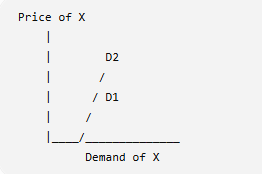
11. A consumer consumes good ‘X’. Explain the effects of fall in the price of related goods on the demand of ‘X’. Use diagrams showing demand for good ‘X’ on the x-axis and is price on y-axis.
Answer – The demand for a commodity is affected by the prices of related goods. Related goods are of two types:
- Substitute Goods
- Complementary Goods
(i) Effect of fall in price of Substitute Goods – Substitute goods are those goods which can be used in place of each other. When the price of a substitute good falls, consumers prefer to buy more of that cheaper substitute good. As a result, the demand for good X decreases.
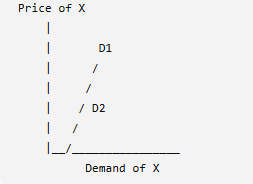
(ii) Effect of fall in price of Complementary Goods – Complementary goods are those goods which are used together. When the price of a complementary good falls, the demand for good X increases because both goods are consumed together.
12. Explain how do the following influence demand for a good: (i) Rise in income of the consumer. (ii) Fall in prices of the related goods.
(i) Rise in income of the consumer – Income of consumers is an important determinant of demand.
Normal Goods – In case of normal goods, a rise in income increases the demand for the commodity because consumers have higher purchasing power. Example: Increase in income increases the demand for cars, branded clothes and better quality goods.
Inferior Goods – In case of inferior goods, a rise in income reduces the demand because consumers shift towards better quality goods. Example: A rise in income may reduce the demand for low-quality food items.
(ii)Fall in prices of related goods – The effect of fall in prices of related goods depends on the type of related goods.
Substitute Goods – A fall in the price of substitute goods decreases the demand for the given commodity. Example: A fall in the price of coffee reduces the demand for tea.
Complementary Goods – A fall in the price of complementary goods increases the demand for the given commodity. Example: A fall in petrol prices increases the demand for cars.
13. Explain the relationship between: (i) Prices of other goods and demand for the given good: (ii) Income of the buyers and demand for a good.
Answer –
(i) Prices of other goods and demand for the given good – The relationship between prices of other goods and demand depends on whether the goods are substitutes or complements.
Substitute Goods – When the price of one substitute good increases, the demand for the other good increases.
Complementary Goods – When the price of one complementary good increases, the demand for the related good decreases.
(ii) Income of buyers and demand for a good – The relationship between income and demand depends on the nature of goods.
Normal Goods – There is a positive relationship between income and demand. When income increases, demand increases.
Inferior Goods – There is a negative relationship between income and demand. When income increases, demand decreases.
14. Explain the effect of the change in the prices of related goods on the demand for a given good.
Answer – The prices of related goods affect the demand for a commodity. Related goods may be substitutes or complementary goods.
1. Effect of Change in Price of Substitute Goods
- When the price of substitute goods increases, demand for the given good increases.
- When the price of substitute goods decreases, demand for the given good decreases.
Example: If the price of coffee rises, demand for tea increases.
2. Effect of Change in Price of Complementary Goods
- When the price of complementary goods increases, demand for the given good decreases.
- When the price of complementary goods decreases, demand for the given good increases.
Example: If petrol prices decrease, demand for cars increases.
demand class 11 unsolved practicals
Unsolved Practical’s
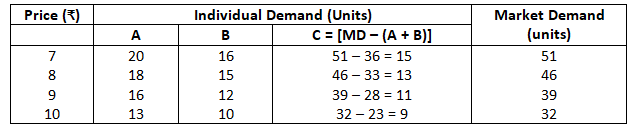
- From the following data regarding individual demand schedules of household A, B and market demand schedule, prepare the demand schedule of household C, assuming that there are only there households in the market.
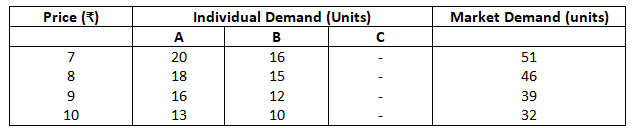
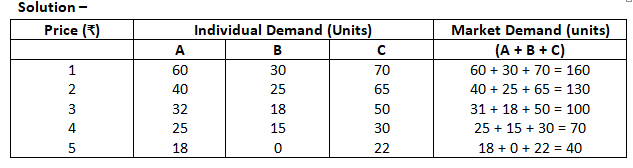
Solution –
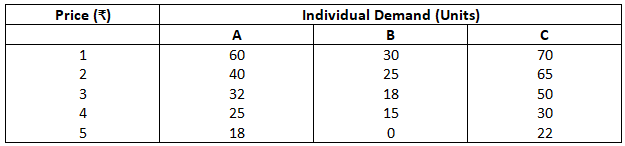
2. Suppose there are 3 consumers in a particular market: A, B and C. Their demand schedules are given in the following table. Prepare the market demand schedule.
3. On the basis of information given in the following table, prepare the demand schedules for three commodities:

Solution –

4. The demand function of a commodity x is given by Qx = 20 – 3Px. Find out the values of Px, when corresponding values of Qx are given as: 5, 8, 11 and 14.
Solution –
Given –
Qx = 20 – 30x
To find – Px When:
Qx = 5
5 = 20 – 3Px
3Px = 15
Px = 5
Qx = 8
8 = 20 – 3Px
3Px = 12
Px = 4
Qx = 11
11 = 20 – 3Px
3Px = 9
Px = 3
Qx = 14
14 = 20 = 3Px
3Px = 6
Px = 2
demand class 11 economics